There’s something living under the streets of New York City.
That’s the basic idea behind 1984’s C.H.U.D., a film that opens with an upper class woman and her little dog being dragged into the sewers by a creature the reaches out of a manhole. People are disappearing all over the city but the authorities obviously aren’t revealing everything that they know. Even after the wife of NYPD Captain Bosch (Christopher Curry) disappears, the city government doesn’t seem to be too eager to dig into what exactly is happening.
Instead, it falls to two activists. Photographer George Cooper (John Heard) specializes in taking picture of the homeless, especially the one who live underground in the New York subways. He’s like a well-groomed version of Larry Clark, I guess. Social activist A.J. “The Reverend” Shepherd (Daniel Stern) runs a homeless shelter and is convinced that something is preying on the most vulnerable citizens of New York. When the police won’t do their job, George and the Reverend step up!
So, what’s living in the sewers? Could it be that there actually are cannibalistic humanoid underground dwellers out there? Everyone in New York City has heard the legends but, much like stories of the alligators in the Chicago sewers, most people chose not to believe them. Or could the disappearance have something to do with the cannisters labeled Contamination Hazard Urban Disposal that are being left in the sewers by the Nuclear Regulatory Commission? Wilson (George Martin) of the NRC says that they would never purposefully mutate the people living underground but Wilson works for the government so who in their right mind is going to trust him?
C.H.U.D. is a horror film with a social conscience. It’s very much an 80s films because, while you have Shepherd running around and attacking everyone for not taking care of the most vulnerable members of society, the true villain is ultimately revealed to be the members of a regulatory agency. Instead of finding a safe way to get rid of their nuclear waste, they just found a sneaky way to abandon it all in New York and obviously, they assumed no one would care because …. well, it’s New York. Everyone in the country knows that New York City isn’t safe so who is going to notice a few underground monsters, right?
The idea behind C.H.U.D. has a lot of potential but the execution is a bit lackluster. For every good C.H.U.D. kill, there’s long passages where the story drags. Considering that Heard spent most of his career typecast as the type of authority figure who would dump nuclear waste under New York City, it’s actually kind of interesting to see him playing a sympathetic role here. Daniel Stern, on the other hand, is miscast and rather hyperactive as Shepherd. You really do want someone to tell him to calm down for a few minutes. Watching C.H.U.D., one gets the feeling that it’s a film with an identity crisis. Is it a horror film, an action flick, a work of social commentary, or a dark comedy? There’s no reason why it can’t be all four but C.H.U.D. just never really comes together. It ultimately feels more like a mix of several different films instead of being a film made with one clear and coherent vision.
In the end, Death Line remains the film to see about underground cannibals.
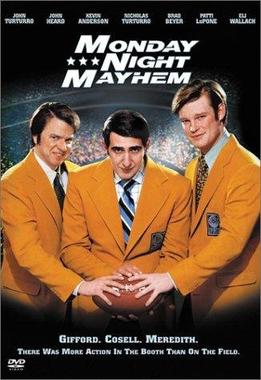
In the late 1960s, television coverage of football is dull and boring. The games are played during the day and the announcers have no personality. An executive at ABC named Roone Arledge (John Heard) changes all of that by convincing the NFL to start scheduling games for Monday night. Arledge launches Monday NightFootball, a broadcast that puts the viewers at home in the stadium. Arledge explains that he wants cameras everywhere. He wants the sidelines and the stands to be mic’d up. And he wants announcers who will make the game interesting. He picks an experienced radio announcer named Keith Jackson (Shuler Hensley), former Dallas quarterback Don Meredith (Brad Beyer), and finally an egocentric, loquacious, and opinionated sports reporter named Howard Cosell (John Turturro). The straight-laced Jackson only lasts a season and finds himself overshadowed by Meredith’s good ol’ boy charisma and Cosell’s eccentricities. Arledge brings in Frank Gifford (Kevin Anderson) as a replacement and changes both sports and television forever. Monday night football becomes huge but so do the egos of the men involved.
Based on a non-fiction book by Bill Carter, MondayNightMayhem is a look at the early days of Monday Night Football, with most of the attention being given to the mercurial Howard Cosell. As a work of history, it’s pretty shallow. There’s a lot of montages set to familiar 70s tunes and there’s plenty of familiar stock footage. Beyer and Anderson do adequate impersonations of Meredith and Gifford without really digging for much under the surface. MondayNightMayhem is dominated by John Turturro’s performance as Howard Cosell. Turturro doesn’t look like Cosell and he really doesn’t sound that much like Cosell but he does capture the mix of arrogance and bitterness that made Howard Cosell such a memorable and controversial announcer. In its breezy manner, the film hits all the well-know points of Cosell’s life and career, from defending Mohammad Ali to considering a run for the Senate to trying to reinvent himself as a variety show host to the controversy when he was though to have uttered a racial slur during one of the games. I wish the film had a bit more depth but John Turturro’s committed but bizarre performance keeps it watchable.
2013’s Assault on Wall Street tells the story of Jim Braxford (Dominic Purcell), a security guard who loses all of his money due to some bad investments that he had no control over and whose wife, Rosie (Erin Karpluk), kills herself rather than continue her expensive medical treatments. Jim snaps and, after listening to a bunch of angry people on MSNBC, he decides to take violent vengeance on Wall Street, targeting brokers and CEOs and ultimately launching an all-out assault on a firm owned by the cartoonishly evil Jeremy Stancroft (John Heard).
Full of anti-capitalist rhetoric and heavy-handed plot developments, Assault on Wall Street finds director Uwe Boll in a political mood. Because the film deals with economic anxiety to which everyone can relate, this film is slightly more effective than Boll’s usual films but that still doesn’t mean that it’s particularly good. It’s one of those films that takes forever to get where it’s going and the film also suffers due to Boll’s confounding decision to cast Dominic Purcell in the lead role. The blank-eyed, flat-voice Purcell gives such a spectacularly dull performance that one wonders if he was constructed out of charisma anti-matter. It doesn’t help that Purcell’s three best friends are played Edward Furlong, Michael Pare, and Keith David, all of whom come across like they would have been a better pick for the lead role.
The film ends with a spate of violence that I remember that I found to be a bit shocking when I first saw the film on cable in 2013. Of course, today, such violence has been normalized and is often celebrated on social media. I imagine that members of the creepy Luigi death cult would probably claim that Jim Braxford didn’t go far enough in his murder spree.
Two of my favorites, Eric Roberts and Lochlyn Munro, have supporting roles in this film. Munro is Jim’s broker, who makes the mistake of complaining about how he had to cancel his planned vacation to Barbados as a result of the economic meltdown. Roberts plays the lawyer who agrees to help Jim get justice but who ultimately proves to be no help at all. Both of them are memorable in their small roles, which once again leaves us to wonder why, with all the talent available, Uwe Boll apparently decided to make Dominic Purcell his muse. That was a bad investment.
Previous Eric Roberts Films That We Have Reviewed:
Directed by Martin Scorsese, 1985’s After Hours opens in an office. This isn’t the type of office that one might expect a Scorsese movie to open with. It’s not a wild, hedonistic playground like the office in The Wolf of Wall Street. Nor is it a place where an aging man with connections keeps his eye on the business for his friends back home, like Ace Rothstein’s office in Casino. Instead, it’s a boring and anonymous office, one that is full of boring and anonymous people. Scorsese’s camera moves around the office almost frantically, as if it’s as trapped as the people who work there.
Paul Hackett (Griffin Dunne) works in the office, at a job that bores him but presumably pays him enough to live in New York. Paul is not a typical Scorsese protagonist. He’s not a fast-talker or a fearsome fighter. He’s not an artist consumed by his own passion or an amoral figure eager to tell his own story. Instead, he’s just a guy who wears a tie to work and who spends his day doing data entry. He’s a New Yorker but he doesn’t seem to really know the city. (He certainly doesn’t know how much it costs to ride the subway.) He stays in his protected world, even though it doesn’t seem satisfy him. Paul Hackett is not Travis Bickle. Instead, Paul is one of the guys who would get into Travis’s cab and, after spending the drive listening to Travis talk about how a storm needs to wash away all of New York’s sin, swear that he will never again take another taxi in New York.
One day, after work, Paul has a chance meeting with a seemingly shy woman named Marcy (Rosanna Arquette). Marcy lives in SoHo, with an artist named Kiki (Linda Fiorentino) who sells plaster-of-Paris paperweights that are made to look like bagels. Marcy gives Paul her number and eventually, Paul ends up traveling to SoHo. He takes a taxi and, while the driver is not Travis Bickle, he’s still not amused when Paul’s last twenty dollar bill blows out the window of the cab.
Paul’s trip to SoHo doesn’t goes as he planned. Kiki is not impressed with him. Marcy tells him disturbing stories that may or may not be true while a search through the apartment (not cool, Paul!) leads Paul to suspect that Marcy might have disfiguring burn scars. Paul decides to end the date but he then discovers that he doesn’t have enough change on him to take the subway home. As Paul attempts to escape SoHo, he meets a collection of strange people and finds himself being hunted by a mob that is convinced that he’s a burglar. Teri Garr plays a sinister waitress with a beehive hairdo and an apartment that is full of mousetraps. Catherine O’Hara chases Paul in an ice cream truck. Cheech and Chong play two burglars who randomly show up through the film. John Heard plays a bartender who appears to be helpful but who also has his own connection to Marcy. Even Martin Scorsese appears, holding a spotlight while a bunch of punks attempt to forcibly give Paul a mohawk. The more that Paul attempts to escape SoHo, the more trapped he becomes.
Martin Scorsese directed After Hours at a time when he was still struggling to get his adaptation of The Last Temptation of Christ into production. If Paul feels trapped by SoHo, Scorsese felt trapped by Hollywood. After Hours is one of the most nightmarish comedies ever made. It’s easy to laugh at Paul desperately hiding in the shadows from Catherine O’Hara driving an ice cream truck but, at the same time, it’s impossible not to relate to Paul’s horror as he continually finds himself returning again and again to the same ominous locations. In many scenes, he resembles a man being hunted by torch-wielding villagers in an old Universal horror film, running through the shadows while villager after villager takes to the streets. Paul’s a stranger in a strange part of the city and he has absolutely no way to get home. I think everyone’s had that dream at least once.
Paul is not written to be a particularly deep character. He’s just a somewhat shallow office drone who wanted to get laid and now just wants to go home. Fortunately, he’s played by Griffin Dunne, who is likable enough that the viewer is willing to stick with Paul even after Paul makes some very questionable decisions and does a few things that make him a bit less than sympathetic. Dunne and John Heard keep the film grounded in reality, which allows Rosanne Arquette, Linda Fiorentino, Catherine O’Hara, and especially Teri Garr to totally play up the bizarre quirks of their character. Teri Garr especially does a good job in this film, revealing a rather frightening side of the type of quirky eccentric that she usually played.
Scorsese’s sense of humor has been evident in almost all of his films but he still doesn’t get enough credit for his ability to direct comedy. (One need only compare After Hours to one of Brian De Palma’s “comedies” to see just how adroitly Scorsese mixes laughs and horror.) After Hours is one of Scorsese’s more underrated films and it’s one that everyone should see. After Hours is a comedy of anxiety. I laughed while I watched it, even while my heart was racing.
Welcome to Retro Television Reviews, a feature where we review some of our favorite and least favorite shows of the past! On Mondays, I will be reviewing Miami Vice, which ran on NBC from 1984 to 1989. The entire show can be purchased on Prime!
This week, the Canadians are coming!
Episode 2.15 “One Way Ticket”
(Dir by Craig Bolotin, originally aired on January 24th, 1986)
This week’s episode of Miami Vice opens with one of the most unintentionally hilarious shots that I’ve ever seen. The action starts at a fancy wedding. The daughter of District Attorney Richard Langley (Jon DeVries) is getting married. The cream and the crop of Miami society has turned out. The camera pans over all of the formally dressed men and women until it finally comes to a stop on Sonny, wearing his white suit, a blue t-shirt, and no socks. He’s attending the wedding Tubbs, who at least bothered to put on a dress shirt.
Seriously, Sonny …. it’s wedding! Would it kill you to wear a tie or maybe put on socks to go to a wedding? And, I know I bring this up every week, but how can Sonny continually convince every bad guy in Miami that he’s a drug dealer named Sonny Burnett when he’s doing stuff like attending the wedding of the District Attorney’s daughter? Does he think that no one is going to notice that the drug dealer who always wears the same white suit looks and sounds exactly like the cop who is always wearing the same white suit?
That said, I guess it’s good that Sonny and Tubbs are the wedding because, during the reception, a coked-up assassin named Sagot (Lothaire Bluteau) pulls a gun and kills not only Langley but also two bridesmaids who happened to be standing close by. Sagot manages to escape from the reception but, that night, Zito and Switek track him down to Miami’s hottest French Canadian nightclub, Le Lieu, and arrest him on possession charges.
Sagot is working for a French Canadian drug lord named Faber (Jean-Pierre Matte) and, as with all of Faber’s men, his attorney is Laurence Thurmond (John Heard). Thurmond was a good friend of Langley’s and it’s obvious from the start that he’s not comfortable with the idea of defending the men who killed him. Thurmond and Crockett also have a long history together. Crockett blames Thurmond for getting a case dismissed against someone who shot one of Crockett’s partners, though it sounds like Thurmond was just doing his job and Crockett is actually to blame for not following proper procedure while making his arrest. (Seriously, due process may be a pain in the ass but Sonny has no excuse for not knowing what’s going to happen when he violates it.) Crockett continually demands to know how Thurmond can live with himself. Thurmond, who likes to fly a private plane in his spare time, says that it’s not easy. Then again, Thurmond can afford his own airplane and a wedding suit so, even if it is difficult to live with himself, at least he’s living well. (And again, Sonny may not like it but everyone has the right to an attorney. Again, if you’re sloppy enough to not read someone their rights or to search someone’s house without probable cause, that’s on you and not on the person who pointed it out.)
As much as Crockett would love to spend all of his time harassing Thurmond, he has a case to solve. He wants to get revenge for Langley’s death. He also wants to figure out who keeps sending him anonymous tips that are full of information that presumably only a defense attorney would know….
Lothaire Bluteau’s makes for a memorably unhinged villain and all of the evil French Canadians made for a nice change of pace from the show’s usual rogue’s gallery. That said, this episode was pretty much dominated by John Heard, playing the type of role that he played best. Heard’s morally conflicted attorney has a lot in common with the morally conflicted police detective that he later played on TheSopranos and Heard’s melancholy performance was a nice contrast to Don Johnson’s intensity. Full of twists and turns, this episode ended on a perfect note. In the end, Crockett may still not like Thurmond but he finally understands him.
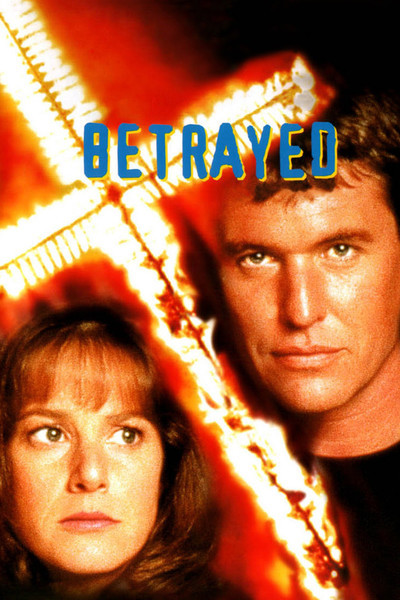
The 1988 film, Betrayed, starts out on a strong note but then quickly becomes annoying as Hell.
It opens with shots of a radio talk show host, an outspoken liberal named Sam Kraus (Richard Libertini). Kraus berates his callers. Kraus ridicules anyone who is to the left of Bernie Sanders. When a man with a rural-accent calls in and attacks Karus for being Jewish, Kraus calls the man an idiot. After he gets off the air, Kraus walks through a parking garage and stops in front of his car. Another car pulls up beside Kraus and suddenly, a masked man with a gun opens fire on Kraus, killing him. The gunman gets out of the car and spray paints, “ZOG” on Kraus’s car before then fleeing the garage.
(ZOG stands for Zionist Occupational Government. It’s a term used by the type of anti-Semitic dipshits who thinks that the Protocols of Elder Zion are real.)
From this shockingly brutal opening, we cut to panoramic shots of beautiful farmland and crops being harvested in the American midwest, the heartland. Gary Simmons (Tom Berenger) owns a farm. He’s a Vietnam vet who nearly received the medal of honor. He lives with his mother and he has two children. (He’s divorced and his ex-wife died as the result of a mysterious hit-and-run in California.) Almost everyone in his small hometown seems to worship Gary. They’re certainly curious about his new girlfriend, Katie Phillips (Debra Winger).
And really, they probably should be. Katie Phillips isn’t Katie Phillips at all. She’s actually an FBI agent named Cathy Weaver and she’s been sent undercover to investigate whether or not Gary was involved in the murder of Kraus. Cathy, who comes from a broken family and who we’re told has always been seeking some sort of deeper meaning in her life, is charmed by both Gary and his family. In fact, she falls in love with Gary. She tells her superior, Mike Carnes (John Heard), that there’s no way Gary is dangerous. Mike doesn’t believe her but, of course, Mike has a personal stake in this because he and Cathy used to be romantically involved.
(That’s right, everyone. Betrayed is so narratively lazy that it resorts to making Mike a scorned lover, even though the film’s plot would have worked just as well if he wasn’t.)
As I said, the first part of the movie works. Debra Wingers gives a strong performance and Tom Berenger is a charming roughneck. For the first half-hour or so, the film does a good job of showing why men like Gary and his friends are susceptible to conspiracy theories and why they feel that the entire world is stacked against them. You can understand why Cathy is so troubled by her assignment because Gary’s friends are hardly master criminals. For the most part, they’re farmers who feel like their entire way of life has been taken away from them.
Unfortunately, almost immediately after Mike refuses to allow her to end her investigation, Cathy returns to the farm and sleeps with Gary. Not only is this a plot development a disservice to everything that has previously been established about Cathy as a character but it also marks the point where the movie entirely falls apart. Immediately after sleeping with Cathy, Gary suddenly goes from being a complex but troubled character to being a cartoonish super villain. And listen — we’ve all been there. You meet a guy. He’s handsome. He says all the right things. He seems like he’s sensitive. He makes you feel safe. You let down your defenses for one night and the next morning, he’s yelling at you for wearing a short skirt in public. It happens. Of course, in Gary’s case, it means that he’s not only criticizing the way that Cathy dresses but he’s also taking her on a hunt where the prey is terrified person of color who Gary and his friends have kidnapped. It also means that Gary drags Cathy along on a bank robbery and then expects her to join him when he wants to assassinate a presidential candidate. Even after all that, Cathy remains conflicted about what to do with Gary. The problem is that it’s not like Gary’s a guy who needs sensitivity training or who spends too much time watching ESPN. Gary is a guy who is carting around weapons and talking about how he wants to kill “mud people.” That Cathy still has mixed emotions after all of that goes against everything that the film previously asked us to believe about her. Gary becomes too cartoonish to be plausible and, as a result, he drags down Cathy’s character as well.
Unfortunately, as the film’s narrative falls apart, so do the majority of the performances. While Debra Winger struggles to make her character’s motivations plausible, Tom Berenger is reduced to doing a lot of glaring. (Poor John Heard spends most of the movie shouting and bugging his eyes.) About the only actor who comes out Betrayed unscathed is John Mahoney, who plays Shorty. Shorty is one of Gary’s friends. He’s a friendly and personable guy who seems to sincerely care about everyone and who has a charmingly gentle smile. He’s also a total racist and the contrast between Shorty’s amiable nature and his hateful thoughts provide the latter half of Betrayed with its only powerful moments. Mahoney gets one big scene, where he talks to Cathy about how much he hates violence but, at the same time, he feels that the world has left him no other choice. Mahoney does a great job with his small role. It’s unfortunate that the rest of Betrayed couldn’t live up to his performance.
With this year’s Sundance Film Festival getting underway in Colorado, I’m going to be spending the next two weeks looking at some films that caused a stir at previous Sundances. Today, I’m taking a look at 2018’s The Tale.
The Tale is all about memory.
Jennifer Fox (Laura Dern) is, as her mother (Ellen Burstyn) often reminds her, nearly fifty years old and childless. She’s been engaged to the sensitive Martin (Common) for three years but she’s in no hurry to get married. As for children — well, she decided a long time ago that she didn’t want to have children. Jennifer is a documentarian and a teacher. She not only records real life but she also teaches others how to do the same thing. She makes films that, in the decades to come, will be used by future students of history who want to know what it was like to live in the late 20th and early 21st Century. And yet, it’s her own history that Jennifer has never come to terms with.
When her mother comes across a school essay that a 13 year-old Jennifer once wrote about her relationship with her riding instructor, Mrs. G (Elizabeth Debicki), and her running coach, Bill (Jason Ritter), Jennifer dismisses her concerns. As Jennifer explains it to Martin, her mother is just upset because Jennifer once had a boyfriend who was “older.” Of course, that older boyfriend was in his 40s. What’s obvious to everyone but Jennifer is that her coach took advantage of and raped her. Jennifer, however, refuses to accept that. She refers to the coach as being her “lover” and, more than a few times, she attempts to dismiss the whole topic by shrugging and saying, “It was the 70s.”
It’s not that Jennifer doesn’t realize the truth about what actually happened. Laura Dern gives a fiercely intelligent performance as Jennifer, one that slowly and deliberately peels away at the layers of defensive protection that Jennifer has spent the past 35 years developing. Jennifer knows what happened but she’s allowed her memory to cloud the reality of it, largely because that’s the only way that she could deal with the aftereffects of Bill’s sexual abuse. When Jennifer thinks back to the summer that she spent with Mrs. G and Bill, she first sees herself as she was when she was 15 years old, curious and headstrong. It’s only when Jennifer looks at a photograph that was taken that summer that she sees starts to see herself as she really was, an introverted and vulnerable 13 year-old (played by Isabelle Nelisse) who was groomed and abused by two predators.
As Jennifer investigates her past and finally begins to understand what really happened over the course of that summer, her memories begin to change. Hazily-remembered conversations take on new meaning and she begins to understand that terrible truth between the looks that were often exchanged between Bill and Mrs. G. At times, the older Jennifer finds herself interrogating her memories of Bill, Mrs. G, and even her younger self. She demands to know how they could have done what they did and their answers leave you wondering whether you’re hearing what they would really say or if your just hearing what Jennifer would hope they would say. When Jennifer talks to others who were around that summer, she’s shocked to learn that she wasn’t the only one who Bill abused and her insistence that she was Bill’s lover (as opposed to his victim) sounds more and more hollow. When Jennifer finally does track down some of her abusers, you wonder if their somewhat confused reactions are due to guilt or if it’s possible that there were so many victims that they don’t even remember what they did to Jenny Fox. And if they do remember, they seem to be either horrifically ignorant or curelly unconcerned about the consequences of their actions.
It’s a brave and powerful film, one that is made all the more disturbing by the fact that director and screenwriter Jennifer Fox is telling her own story. At least year’s Sundance Film Festival, it premiered to acclaim and controversy. There was also some surprise when, instead of securing a theatrical release, the film was instead sold to HBO. At the time, there was a lot of concern that the film’s power would somehow be diluted as a result of playing on television as opposed to a big screen. However, in hindsight, the small screen — with its unavoidable vulnerability — was the perfect place for this uncompromising and emotionally raw film.
The Tale is not an easy film to watch but it is an important one. It’s a film for anyone who has ever struggled to come to terms with the past. It’s both a reminder that you’re not alone and a warning to not ignore or laugh off your suspicions. It’s also a good example of the type of film that probably would never have been discovered if not for Sundance. There’s a lot of legitimate criticism that one can direct towards the Sundance Film Festival but occasionally, it does do what it’s supposed to do.
What is Sharknado Day? If you have to ask, you’ll never understand. Sharknado Day is the day that the latest chapter in The Asylum’s Sharknado franchise premieres on SyFy. That’s the day when people like me cause twitter to go over capacity tweeting about the film. That’s the day good people all across America try to count the number of celebrity cameos while also trying to keep track of all of the homages and references to past movies that are always waiting to be found in every Sharknado Film. Yesterday was the sixth Sharknado Day since 2013 and, if we’re to believe our friends at The Asylum, it was also the last Sharknado Day.
Is it true? Was The Last Sharknado: It’s About Time truly the final Sharknado? Perhaps. But somehow, I have a feeling that the flying sharks will return someday. Critics have always underestimated the production savvy of The Asylum and I wouldn’t be shocked if, after a year or two of nostalgia, we saw Sharknado 7: A New Beginning.
But if The Last Sharknado was truly the final Sharknado, then it can be said that the franchise truly went out on a high note.
The plot — well, usually, the conventional wisdom is that the plot of a Sharknado movie really doesn’t matter. Usually, it’s assumed that all a Sharknado film needs is a lot of shark mayhem and snarky humor. And that’s true, to an extent. And yet, I still found myself getting caught up in The Last Sharknado‘s storyline. It all deals with Fin (Ian Ziering), April (Tara Reid), the head of a robot version of April (again, Tara Reid), Nova (Cassandra Scerbo), and Skye (Vivica A. Fox) traveling through time, hopping from period to period. Fin and April’s goal is to stop the first Sharknado and to save the life of their son, Gil. Nova wants to save the life of her grandfather, even though that might change history to the extent that she would never become a great shark hunter. As for the robot head … well, she develops an agenda of her own, one that really has to be seen to be believed.
The film has a lot of time travel and, of course, the journey from period to period allows for several celebrity cameos. When Fin ends up in Arthurian Britain, Neil deGrasse Tyson pops up as Merlin. During the Revolutionary War, a somewhat sarcastic General Washington is played by Darrell Hammond. Dee Snider plays a sheriff in the old west. Tori Spelling and Dean McDermott show on the beach in the 60s. Touchingly, the film even finds a way to include the late John Heard in the action. (Heard played a key supporting role in the first Sharknado.) I’m a history nerd, so I enjoyed all of the time travel. I especially enjoyed the film’s portrayal of Benjamin Franklin as a rather bitchy eccentric, largely because it’s often forgotten that Franklin was, in real life, a bit of a bitchy eccentric.
(Add to that, how can you resist a film the features both dinosaurs and flying sharks?)
The film takes a surprisingly dark turn during the second hour, as Fin and Skye spend some time in a dystopian future and Nova tries to change history by saving her grandfather’s life. When Fin points out that doing so will change history and that, for Nova to become a great shark hunter, her grandfather has to die, Nova calls him out for being self-centered. To their credit, both Cassie Scerbo and Ian Ziering play the argument totally straight and both give heartfelt performances. Amid all of the comedy and the shark-related mayhem, the film develops a real heart.
That heart is at the center of The Last Sharknado. To a large extent, the sharks are superfluous. They’re carnivorous MacGuffins. Instead, the film is about celebrating not only the bonds between Fin, April, Nova, and all of their friends but also the bond that’s been developed between the characters and those of us who have watched them over the course of six films. Towards the end of the film, when Fin talks about what his friends and family mean to him, it’s clear that he’s also speaking for the filmmakers. Just as Fin thanks his friends for sticking with him, the filmmakers take the time to thank the audience for sticking with them. It was a heartfelt scene and it was the perfect way to end The Last Sharknado.
To those who do not celebrate Sharknado Day, it may seem strange to say that I got emotional while watching the final scene of The Last Sharknado on Sunday night. Then again, is it any stranger than the idea of a franchise about a bunch of sharks flying through the air, spinning around in a funnel, becoming a major pop cultural milestone?
It’s a strange world and we’re all the better for it.
(Lisa is currently in the process of cleaning out her DVR! This could take a while. She recorded the 2001 high school film O off of Cinemax on July 6th.)
Tell me if this sounds familiar.
O (Mekhi Phifer) is one of the only black students attending an exclusive high school in South Carolina. Despite a past that involves petty crime and drugs, O appears to have his life on the right track. As the captain of school’s basketball team, O is the most popular student at his school. Everyone looks up to him. Everyone wants to be him. He’s even dating Desi (Julia Stiles), the very white daughter of the school’s very white headmaster (John Heard). At a school assembly, Coach Duke Goulding (Martin Sheen) describes O as being like a son to him. When O is awarded the MVP trophy, he shares it with his teammate, Michael Cassio (Andrew Keegan).
Watching all of this with seething jealousy is Hugo Gaumont (Josh Hartnett). Hugo is a teammate of O’s. In fact, he even thought that he was O’s best friend. That was before O shared his award with Michael. Making Hugo even more jealous is that he happens to be the son of the coach. For every kind word that Duke has for O, he has a hundred petty criticisms for Hugo. Whereas O has overcome drug addiction and is proclaimed as a hero for doing so, Hugo is secretly doing steroids, trying to do anything to improve himself as a player and hopefully win everyone’s love.
So, Hugo decides to get revenge. Working with a nerdy outcast named Roger Calhoun (Elden Hansen), he manipulates O into thinking that Desi is cheating on him with Cassio. He also tricks Cassio into getting into a fight with Roger, leading to Cassio getting suspended from the team. To top it all off, Hugo gets O hooked on drugs, once again. Finding himself consumed by a violent rage that he thought he had under control, O starts to obsess on determining whether or not Desi has been faithful to him…
If that sounds familiar, that’s because O is basically Othello, transported to modern times and involving privileged teenagers. Even though the whole modernized Shakespeare thing has become a bit of a cliché, it actually works pretty well in O. Hugo’s obsessive jealousy of the “cool kids” feels right at home in a high school setting and director Tim Blake Nelson and writer Brad Kaaya do a fairly good job of transporting Shakespeare’s Elizabethan melodrama to the early aughts.
(Actually, O was filmed in 1999 but it sat on the shelf for two years. After a spate of school shootings, distributors were weary about releasing a film about high school students trying to destroy each other.)
Admittedly, O has its share of uneven moments. Martin Sheen, playing the type of role that always seems to bring out his worst instincts as an actor, goes so overboard as the coach that he threatens to sink almost every scene in which he appears and Rain Phoenix is miscast as Hugo’s girlfriend. Even Julia Stiles struggles a bit in the role of Desi. However, both Mekhi Phifer and Josh Hartnett are perfectly cast as O and Hugo. Phifer brings just the right amount of arrogant swagger to the role while Hartnett is a sociopathic marvel as Hugo. Tim Blake Nelson’s direction is occasionally overwrought, relying a bit too heavily on a groan-inducing metaphor about taking flight and claiming the spotlight. However, both Nelson and the film deserve some credit for not shying away from directly confronting and portraying the source material’s cultural and racial subtext.
O is hardly perfect but it is always watchable and, at its best, thought-provoking.
Yesterday, after it was announced that actor John Heard had been found dead in a Palo Alto hotel room, I lost track of how many people declared that Cutter’s Way, a 1981 film in which Heard co-starred with Jeff Bridges, was one of their favorite movies of all time. (That includes quite a few people who write for this very site.) In fact, people were so enthusiastic about Cutter’s Way that I quickly decided that this was a film that I needed to watch for myself. So, last night, after watching All About Eve on TCM and My Science Project with the Late Night Movie Gang, I curled up on the couch and I watched Cutter’s Way.
Technically, Cutter’s Way is a murder mystery but it’s actually a lot more. In the grand noir tradition, the mystery is less important than the milieu in which it occurs. Cutter’s Way takes place in Santa Barbara, California, which the film presents as being a microcosm of America. It’s place where the rich are extremely rich and the poor are pushed to the side and expected not to complain. The Santa Barbara of Cutter’s Way is controlled by new money and haunted by old sins. It’s a world that is perfectly captured, by director Ivan Passer and cinematographer Jordan Cronenweth, in the film’s haunting opening scene:
John Heard plays Alex Cutter. Years ago, Cutter served in Vietnam and returned with one less eye, one less arm, and one less leg. An angry alcoholic, the type who always looks like he’s in desperate need of a shower and a shave, Cutter exists on the fringes of society. Like many alcoholics, Cutter is a master manipulator. When he has to, he can turn on the charm. When the police are called after a drunken Cutter purposefully destroys his neighbor’s car, we suddenly see a totally different Alex Cutter. He’s polite and apologetic, explaining that he was merely swerving to avoid something in the road and, by the way, he served his country in Vietnam. As soon as the police leave, the real Cutter comes out. He gets his bottle and starts to rant about how much the world owes him. Watching the film, you find yourself understanding why some people might want to push this one-legged, one-armed, one-eyed veteran down a flight of stairs, that’s how obnoxious Alex Cutter can be.
And yet, there are people who love Alex Cutter. There’s his long-suffering wife, Mo (Lisa Eichhorn). Mo lives in squalor with Cutter, taking care of him and putting up with his bitterness. There’s the local bar owner, who could probably put his kids through college on Cutter’s bar tab. (He even drives Cutter home in the morning, after everyone else has deserted him.) And finally, there’s Richard Bone (Jeff Bridges).
Bone is Cutter’s best friend. Whereas Cutter is perpetually pissed off, Bone is almost always laid back. Whereas Cutter feels that everything is his business, Bone prefers to remain detached from the world. Mention is made of Bone being a graduate of the Ivy League but he spends most of his time giving tennis lessons and sleeping with wealthy women. Bone takes care of Cutter, though their friendship is occasionally hard to figure out. Why does Bone stick with Cutter despite all of Cutter’s abuse? Perhaps Bone feels guilty because he avoided being drafted while Cutter lost half of his limbs in Vietnam. Or maybe it’s because Bone is in love with Mo.
One night, when Bone is leaving a hotel, he sees a man in an alley. The man appears to be hiding something in a dumpster. Later, when the body of a woman is found in that same dumpster, Bone realizes that he probably saw the murderer. Even more so, Bone thinks that the man resembled J.J. Cord (Stephen Elliott), one of the richest men in Santa Barbara.
Bone, however, isn’t sure that Cord’s the murderer. Even more so, even if Cord was the murderer, Bone prefers to not get involved. However, Cutter is sure that Cord’s the killer. To Cutter, it makes perfect sense. If men like Cord were willing to send boys to Vietnam and then refuse to take care of them when they returned both physically and mentally maimed by the experience, then why wouldn’t they also think that they could get away with murdering some hitchhiker?
Soon, Cutter has met the dead girl’s sister, Valerie (Ann Dusenberry). Cutter says that his plan is to blackmail Cord. He badgers the reluctant Bone into working with him. It quickly becomes obvious, however, that Cutter is after more than money. He is obsessed with proving that this rich and powerful man is a murderer. And he’s not going to let anyone stand in his way. Not even a stuffed animal:
As I said, Cutter’s Way is about much more than just a murder. It’s a film about class differences, with even the otherwise slick Bone discovering how difficult it is to infiltrate Cord’s wealthy world. It’s a film about disillusionment, cynicism, and the fleeting promise of happiness. As angry as Cutter is, he still ultimately possesses the idealism that both Bone and Mo have lost. He still believes in right and wrong. While that angry idealism may make Cutter a pain in the ass, it’s also his redeeming feature. As the youngest of them, Valerie is still an optimist but she is also the least prepared to deal with the sordid reality of the world around her. Bone and Mo, meanwhile, both appear to have surrendered their belief that the world can be and should be a better place. Ultimately, Cutter’s Way is a film that forces you to consider what you would do if you were in the same situation. Cutter’s Way is not a great title, largely because it makes the film sound like a CW western, but it’s an appropriate one. The entire film is about Cutter’s way of viewing the world and whether or not Bone will follow Cutter or if he’ll continue to refuse to get involved.
(The novel that the film’s based on was called Cutter and Bone. According to Wikipedia, the title was changed because audiences thought the movie was a comedy about surgeons.)
I have to agree with those who have called Cutter’s Way a great film. Not only is it gorgeous to look at but it’s one of the best acted films that I’ve ever seen, from the stars all the way down to the most minor of roles. John Heard dominates the film, giving a performance of almost demonic energy but he’s perfectly matched by Jeff Bridges. Bridges, back in his incredibly handsome younger days, gives a subtle and powerful performance as a man struggling with his conscience. In the role of J.J. Cord, Stephen Elliott doesn’t get much screen time but he makes the most of it. When he first see him, he’s riding a white horse and rather haughtily looking down on the world around him. When he last see him, he delivers a line of such incredible arrogance that it literally left me stunned. Though, when compared to Bridges and Heard, their roles are underwritten, both Lisa Eichhorn and Ann Dusenberry more than hold their own, providing able and poignant support.
Cutter’s Way is a great film and one that everyone should watch if they haven’t.