Retro Television Review: Police Squad! 1.1 “A Substantial Gift (The Broken Promise)”


Welcome to Retro Television Reviews, a feature where we review some of our favorite and least favorite shows of the past!  On Thursdays, I will be reviewing Police Squad!, which aired on ABC in 1982.  The show can be found on Netflix!
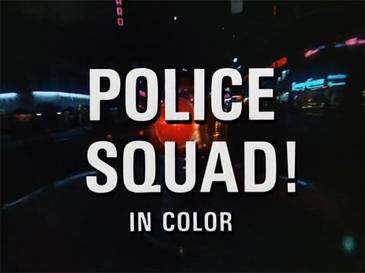
Today, we start a new show!  Produced, written, and directed by the comedy team of Jim Abrahams, David Zucker, and Jerry Zucker, Police Squad! was the group’s follow-up to Airplane!  It only aired for six episodes but it went on to inspire The Naked Gun films.  Netflix just added the show so I figured why not?  We could all use a few laughs on Thursday.

Episode 1.1 “A Substantial Gift (The Broken Promise)”

(Dir by Jim Abrahams, David Zucker, and Jerry Zucker, originally aired on March 4, 1982)

In debt to her orthodontist, credit union teller Sally Decker (Kathryn Leigh Scott) stages a robbery by shooting her boss, Mr. Johnson (Terry Wills), and customer Ralph Twice (Russell Shannon). She claims that Twice robbed the place and shot Johnson, and then she shot Twice. Sally probably would have gotten away with her scheme if not for the hard work of Lt. Frank Drebin (Leslie Nielsen).

Drebin, who also narrates in Nielsen’s trademark deadpan style, would rather be working the case of the naked models that someone in the city is dumping at local laundromats, but instead Drebin has been assigned to work the credit union robbery. (Drebin does still find time to pick up his laundry.) Drebin’s investigation takes him to the neighborhood “known as Little Italy,” and as Drebin and his boss, Ed Hocken (Alan North), drive to Mrs. Twice’s apartment, we spy the Colosseum in the background. (The apartment itself has a nice view of the Leaning Tower of Pisa.) After lab technician Ted Olson (Ed Williams) demonstrates the distance a bullet would travel by firing two through a stack of tapes of Barbara Walters interviews, Drebin realizes that Sally’s story doesn’t make sense. To be certain, Drebin recreates the crime from several different angles and ends up with a room full of dead bodies. Drebin also visits shoeshine boy/snitch Johnny (William Duell) and learns that Sally has a long criminal history. (After Drebin leaves, a member of the Episcopal clergy pays Johnny to explain life after death. Good luck, Anglican.)

Drebin confronts Sally and it leads to a shootout. Drebin ducks behind a bench. Two feet away, Sally ducks behind a trashcan. Sally fires her gun until she runs out of bullets. She throws the gun at Drebin. Drebin also runs out of bullets and throws his gun at Sally. Eventually, Ed Hocken arrives and arrests Sally.

Later, at the station, Drebin and Ed share a laugh over Sally’s fate and the episode ends with freeze frame! Or it would, except Ed and Drebin both struggle to hold their expressions through the end credits….

And so went the first episode of Police Squad! It’s a funny episode, one that works because of both the absurd humor (there’s an extended elevator gag in which Drebin and Ed have a deadpan conversation while the police station’s elevator door opens to reveal a ballroom and then a pool) and the way it perfectly captures the feel of the old cop shows. A few years ago, I watched every episode of the second Dragnet series on MeTV and I immediately recognized what Police Squad was satirizing with its narration and its rather simple murder case. As with most of the work of Jim Abrahams and the Zucker Brothers, it works because no one acknowledges the jokes. I should also note that there’s probably nothing more boring than trying to explain why a joke works or why it doesn’t.

Police Squad only ran for six episodes and was canceled because network executives felt that audiences were confused by the show’s style of humor. (The Naked Gun films were spun off from Police Squad and recycled many of the show’s same jokes. They were hits.) I read about the show while reading Surely You Can’t Be Serious: The True Story of Airplane! When I saw that all six episodes had been added to Netflix, I decided to make it our latest Retro Television Review.

For the next few weeks, join us every Thursday for Police Squad!
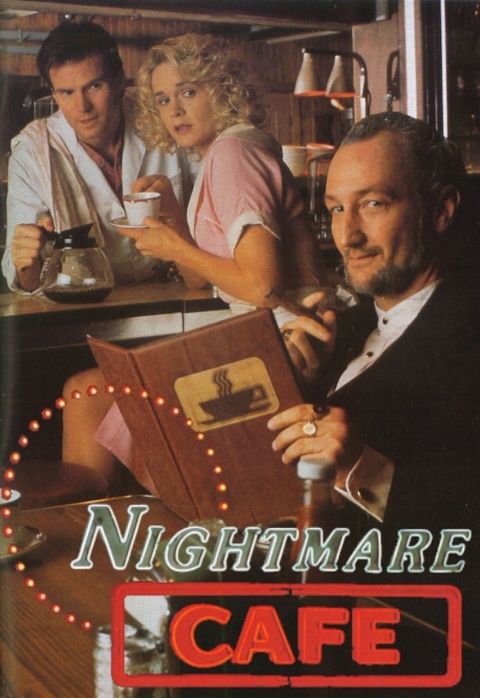
Late Night Retro Television Reviews: Nightmare Café 1.6 “Aliens Ate My Homework”


Welcome to Late Night Retro Television Reviews, a feature where we review some of our favorite and least favorite shows of the past!  On Mondays, I will be reviewing Nightmare Café, which ran on NBC from January to April of 1992.  The entire show is currently streaming on YouTube!

This week, Nightmare Café comes to an end!

Episode 1.6 “Aliens Ate My Homework”

(Dir by Wes Craven, originally aired on April 3rd, 1992)

When it came to the sixth episode of Nightmare Café, I don’t know if executive producer Wes Craven knew that it was going to be the final episode of the series when he decided to direct it.  It would be nice to think that Craven decided to say goodbye to the series by sitting in the director’s chair but the realities of network television make that doubtful.  It’s probably just a coincidence that the final episode of the series was directed by Wes Craven but it still feels appropriate.  Not only did Wes Craven create the series but he was directed the movie that made Robert Englund a big enough star that NBC was actually willing to make him the star and narrator of a prime time show.

(It’s interesting to consider that playing a viscous child murderer turned Robert Englund into a beloved pop culture legend but it says something about the natural friendliness that Englund projected that audiences still liked him even after he became most identified with playing the man of everyone’s nightmares.)

It’s a rather playful episode, one that eschews the drama and horror of the first five episodes for some rather broad comedy.  It’s also the episode that features the most narration from Blackie, as he both tells us what’s happening and also provides some commentary on the actions of the people in the story.  Robert Englund really seems to enjoy playing the character in this episode and it’s fun to watch him.

The episode focuses on tabloid reporter Harry Tambor (Bobby Slayton), who has been ordered by his new editor to hit the road and find an amazing story.  As ordered, Harry hits the road and, while driving through the country, he happens to pick up three little people (Jimmy Briscoe, Kevin Thompson, and Arturo Gil) who claim to be Romanian circus performers.  Harry’s new friends inform him that the town he is approaching has been the site of several mysteries disappearances.  It’s not humans disappearing, though.  It’s cows!

Since Bobby’s new editor just happens to be Blackie in disguise, it’s not a surprise that the town is not just home to a bunch of cows but also the Nightmare Café.  In fact, we learn that Harry is Frank’s favorite writer.  Fay thinks that you can’t believe anything that you read in the tabloids, which is a pretty judgmental attitude to have when you’re working in an extra-dimensional café that can randomly materialize anywhere.

Anyway, while stopping in the café for cup of coffee, Harry comes up with the brilliant idea to fake a UFO invasion.  He sends away for not only a fake flying saucer but also alien costumes that the Romanian circus performers agree to wear.  Harry fakes his UFO invasion but it causes a complete panic in the town and soon, Sheriff Filcher (Don S. Davis, best-known for playing Major Briggs on Twin Peaks) and the townspeople are looking to lynch the invaders.  Unfortunately, the Sheriff believes that the aliens are the folks working at the newly arrived Nightmare Café.  Who can blame him, really?  I mean, the place just showed up from out of nowhere!

As I said a few paragraphs ago, there’s nothing particularly serious about this episode of Nightmare Café.  Almost every plot development is played for laughs and there’s really not a subtle moment to be found in the entire episode.  We don’t really think of Wes Craven as being a comedic director, though all of his films displayed a certain subversive wit.  Craven does well-enough with the comedy in this show, though one gets the feeling that, if the episode had been any longer than 45 minutes, all of the running around and yelling would have gotten a bit exhausting to watch.  The comedy may be broad but everyone in the episodes — from Robert Englund to Don S. Davis — appears to be having fun and that goes a long way towards keeping things entertaining.

This episodes ends on a slightly different note than the other episodes of Nightmare Café.  Each character gets a title card, which explains what happened to them after the episode ended.  First, we learn about what has happened to the reporter, the circus performers, and the sheriff.  Then, the final title card informs us that Frank and Fay are still working at the Nightmare Cafe and they hope we’ll stop by if we’re in the area.  It’s a nice way to wrap up the series.

This was the final episode of Nightmare Café.  It was a fun show to watch and review.  Nightmare Café felt as if it was a bit before its time.  The show’s anthology format and it’s horror-themed stories would have made it a natural fit for the streaming era.  Unfortunately, it aired during the age of network television dominance and apparently, it never found an audience.  It’s a shame, because Jack Coleman, Lindsay Frost, and Robert Englund really did make for an intriguing team.

Next week, I’ll be reviewing something new in this time slot.  Who knows what it will be?  Certainly not me!  I have a few shows that I’m considering for Monday and Tuesday so we’ll see what happens.