Guilty Pleasure No. 78: Armageddon (dir by Michael Bay)


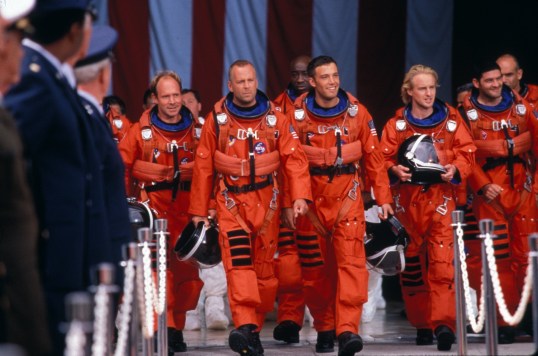
Remember that time that Bruce Willis and a team of oil drillers saved all of humanity from a giant asteroid that was apparently the size of Texas?

Sure, you do!  Everyone remembers Armageddon!

1998’s Armageddon is a film that doesn’t get a lot of respect but which everyone remembers.  There’s been a lot of movies made about giant asteroids on a collision path with the Earth.  Ever since scientists announced that a collision with a comet or an asteroid probably killed the dinosaurs, there’s been a somewhat irrational fear that the same thing could happen to us.  Back in 1978, Sean Connery and Karl Malden tried to stop a Meteor (and failed).  In 1998, the same year that Armageddon came out, Morgan Freeman, Robert Duvall, and Elijah Wood tried to stop an asteroid from causing a Deep Impact (and failed).  Adam McKay made an entire film about everyone saying, “Don’t Look Up,” in an attempt to promote increased panic about climate change (and failed).  (“I’m so scared!” Leonardo DiCaprio shouted and audiences responded, “Oh, calm down.”)  And yet, it’s Armageddon — ridiculed by critics, endlessly parodied by other movies — that people use as their go-to source for commenting on the prospect of a mass extinction event.  Mostly because, in Armageddon, humanity didn’t fail.  Bruce Willis showed that asteroid who was boss!

Why do we love Armageddon?  A lot of it has to do with the cast.  Not only do you have Bruce Willis battling an asteroid but you’ve also got Steve Buscemi, Owen Wilson, Ben Affleck, Will Patton, Michael Clarke Duncan, Peter Stormare, William Fichtner, and a host of others working with him.  You’ve got Billy Bob Thornton working ground control.  You’ve got Liv Tyler, somehow managing to give a decent performance even while Ben Affleck attacks her with animal crackers.  It’s not just the cast is full of familiar and likable actors.  It’s that the members of the cast know exactly what type of film that they’re appearing in and they all give exactly the right type of performance for that film.  They deliver their lines with conviction while not making the mistake of taking themselves too seriously.  Bruce Willis announces that his crew will destroy that asteroid in return for never having to pay taxes again and he announces with just the slightest hint of a smirk, knowing that the audience is going to cheer that moment.

But really, the real reason why Armageddon has survived that test of time is because it’s just so utterly shameless.  Director Michael Bay will never be accused of being a subtle director but Bay instinctively understood that Armageddon was not a film that demanded subtlety.  Armageddon is a film that demands that constantly moving camera and all of those carefully composed scenes that were clearly made so they could be included in the trailer.  It’s a film about big moments and big emotions.  Unlike something like Deep Impact, it doesn’t get bogged down in trying to be better than it actually is.  Unlike Don’t Look Now, it doesn’t degenerate into a bunch of histrionic speeches.  Armageddon exists to make the audience cheer and it succeeds.  It takes guts to include a slow motion scene of a bunch of kids celebrating in front of a faded Kennedy For President poster but Bay is exactly the type of director who can pull that off.  Michael Bay’s style is not right for a lot of films.  But it was perfect for Armageddon.

As I sit here typing this, there are some people panicking because there’s speculation that a meteor is going approach the Earth in the 2030s.  It’ll probably miss us but who knows?  But you know what?  I’m not worried at all.  I’ve seen Armageddon.  So, on this International Earth Day, let’s remember the courageous men who saved this planet back in 1998.
Previous Guilty Pleasures

  1. Half-Baked
  2. Save The Last Dance
  3. Every Rose Has Its Thorns
  4. The Jeremy Kyle Show
  5. Invasion USA
  6. The Golden Child
  7. Final Destination 2
  8. Paparazzi
  9. The Principal
  10. The Substitute
  11. Terror In The Family
  12. Pandorum
  13. Lambada
  14. Fear
  15. Cocktail
  16. Keep Off The Grass
  17. Girls, Girls, Girls
  18. Class
  19. Tart
  20. King Kong vs. Godzilla
  21. Hawk the Slayer
  22. Battle Beyond the Stars
  23. Meridian
  24. Walk of Shame
  25. From Justin To Kelly
  26. Project Greenlight
  27. Sex Decoy: Love Stings
  28. Swimfan
  29. On the Line
  30. Wolfen
  31. Hail Caesar!
  32. It’s So Cold In The D
  33. In the Mix
  34. Healed By Grace
  35. Valley of the Dolls
  36. The Legend of Billie Jean
  37. Death Wish
  38. Shipping Wars
  39. Ghost Whisperer
  40. Parking Wars
  41. The Dead Are After Me
  42. Harper’s Island
  43. The Resurrection of Gavin Stone
  44. Paranormal State
  45. Utopia
  46. Bar Rescue
  47. The Powers of Matthew Star
  48. Spiker
  49. Heavenly Bodies
  50. Maid in Manhattan
  51. Rage and Honor
  52. Saved By The Bell 3. 21 “No Hope With Dope”
  53. Happy Gilmore
  54. Solarbabies
  55. The Dawn of Correction
  56. Once You Understand
  57. The Voyeurs 
  58. Robot Jox
  59. Teen Wolf
  60. The Running Man
  61. Double Dragon
  62. Backtrack
  63. Julie and Jack
  64. Karate Warrior
  65. Invaders From Mars
  66. Cloverfield
  67. Aerobicide 
  68. Blood Harvest
  69. Shocking Dark
  70. Face The Truth
  71. Submerged
  72. The Canyons
  73. Days of Thunder
  74. Van Helsing
  75. The Night Comes for Us
  76. Code of Silence
  77. Captain Ron

October True Crime: Easy Prey (dir by Sandor Stern)


The 1986 film, Easy Prey, tells the story of Tina Marie Riscio (Shawnee Smith), a 16 year-old who was approached in a mall by man (Gerald McRaney) who claimed to be a photographer looking for models.  The man told the insecure Tina that he wanted to take her picture but that he needed her to come out to his car and sign a release.  At first, Tina was reluctant to follow the man out to his car but when he acted embarassed and apologized for making her feel uncomfortable, Tina decided to sign the release.  Later, she would say that the man reminded her of her father.

The man, however, was Christopher Wilder.  At the time that he approached Tina, Wilder was already a suspect in several murders and had been placed on the FBI’s Most Wanted List.  In many ways, Wilder did not seem to fit the typical profile of a serial killer.  Born in Australia, he was a naturalized American citizen who had started his own business and lived what seemed to be a glamorous lifestyle.  He was a millionaire.  He owned a Porsche.  He was a race car driver who competed in races across the country.  Even with his receding hairline, he was considered to be charming and handsome.  It was only under a close examination that cracks started to appear on his perfect surface.  He had a criminal record in Australia.  His girlfriends described him as being paranoid, insecure, and abusive.  His business partners said that, despite his apparent wealth, Wilder was always one step away from financial ruin.

Because Wilder was killed by the police while resisting arrest, it’s not known how many women he murdered over the course of his six-week crime spree in 1984.  It is believed that he definitely murdered eight but the actual number is thought to be much higher.  (He’s a suspect in the disappearance of actress Tammy Lynn Lepert, who appeared in Scarface as the woman who distracted Steven Bauer while the latter should have been keeping track on what was happening with Tony’s meeting with the Colombians.)  However, he did not kill Tina Marie Riscio.  Instead, after kidnapping and assaulting her, he drove across the country with her.  After using her to lure victims in both Indiana and New York, Wilder eventually drove Tina to Boston and bought her an airplane ticket home.  While Tina was flying back to Los Angeles, Wilder was heading for Canada.  (He would be shot and killed by police near the border, in New Hampshire.)

Easy Prey follows Wilder and Tina as they drive from location-to-location.  Along the way, Tina is shown to develop a case of Stockholm Syndrome.  As much as she hates Wilder, she still fails to take advantage of many chances to escape from him.  Unfortunately, the film’s script itself doesn’t provide much insight into how this happened, beyond the fact that Wilder reminded Tina of the father who earlier abandoned her.  The film does feature two strong performances, from Shawnee Smith and Gerald McRaney.  Smith gets a a powerful monologue, in which she talks about how easy it was for Wilder to take advantage of her insecurity.  Meanwhile, McRaney plays Wilder as being a pathetic man who is desperate to convince the world that he is actually a dynamic businessman and adventurer.  If he were alive today, there’s little doubt Christopher Wilder would be on twitter, siding into people’s DMs and posting a bunch of “alpha male” nonsense.  Wilder was a monster who still feels very familiar.

Film Review: Left Behind: World At War (dir by Craig R. Baxley)


With the 2005 film, Left Behind: World At War, the Left Behind series enter special guest star territory.  Kirk Cameron and Brad Johnson, while still present in the film, were largely pushed to the background and Louis Gossett, Jr. and Charles Martin Smith popped up as Nicolae Carpathia’s two main adversaries.

Gossett plays President Gerald Fitzhugh.  Smith plays Vice President John Mallory.  (Speaking as someone of Irish descent, it fills me with pride to think that America will someday be led by the presidential ticket of Fitzhugh and Mallory.)  Despite the fact that Carpathia (again played by Gordon Currie) spent the previous film talking about how, under his leadership, there would be no more borders, it appears that there still are borders.  However, Carpathia has a plan to take care of that.  Mallory has discovered the plan but, right after he tells Fitzhugh about it, they’re attacked by Carpathia’s goons.  The presidential limo is blown up and with it, John Mallory.  (Poor Charles Martin Smith.)  Fitzhugh manages to escape, thanks to the help of the Tribulation Force.

It turns out that Carpathia’s latest scheme is to steal the few remaining bibles in the world, lace them with anthrax, and then distribute them back to the believers.  Gossett gets to go full action hero as he tries to stop Carpathia and good for him.  As for the other members of the Tribulation Force, Buck (Kirk Cameron) marries Chloe Steele (Janaya Stephens) and Chloe’s father, Rayford (Brad Johnson), meets his former lover, Hatti Dunham (Chelsea Noble).  Hattie is now Carpathia’s lover and is pregnant with his child.  Some members of the Tribulation Force die over the course of the film.  Buck has a moment of anger at God, which is the best scene in the film because it at least acknowledges that one can believe and still be angry.  The majority of the film, however, is Lou Gossett, Jr. wandering around with a “How did I go from winning an Oscar to appearing in this?” look on his face.

Anyway, credit where credit is due.  World at War is the most action-packed of the Left Behind films and, while it’s still definitely an evangelical film, it’s considerably less preachy than either the first Left Behind film or Tribulation Force.  World at War is pure melodrama, with a lot of plotting and evil cackling and overdone action scenes.  If you don’t want to listen to the dialogue, you can focus on just how small the film’s version of the Oval Office is.  That’s what happens when you try to a globe-spanning epic on a low budget.  Sometimes, you have to settle for a small replica of the Oval Office instead of trying for the real thing.

That’s not to say that World At War is a particularly good film.  Brad Johnson gets even less to do than in the second film and Kirk Cameron is still Kirk Cameron.  Since he lost his job at the end of Tribulation Force, we’re no longer asked to believe that Kirk Cameron’s playing a respected journalist.  Instead, Buck is now just a self-righteous evangelist and, for obvious reasons, it’s easy to believe Kirk Cameron in that role but Kirk Cameron is one of those actors who is far more likable when he’s miscast than when he’s playing himself.  Much as with Tribulation Force, World At War can’t seem to decide just how powerful Carpathia actually is.  He’s got supernatural powers and is apparently actually immortal and yet, he is often easily deceived by the simplest of ruses and is incapable of killing anyone until their usefulness to the film’s narrative has expired.

Louis Gossett, Jr. was smart enough to play a character who dies at the end of World At War, therefore freeing him from having to appear in any more Left Behind movies.  It turned out to be a moot point, however.  This was the last Left Behind film until the recent unsuccessful attempt to reboot the franchise with Nicolas Cage as Rayford Steele.

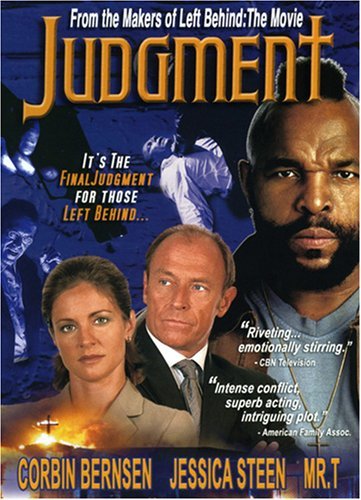
Film Review: Judgment (dir by Andre Van Heerden)


After three previous movies that all dealt with the growing power of Franco Macalousso (Nick Mancuso) and the revolution spearheaded by former journalist Helen Hannah (Leigh Lewis), the Apocalypse saga finally came to a close with the 2001 film, Judgment.

One of the more interesting things about the Apocalypse franchise is that each film was done in the style of a different genre.  Apocalypse was pretty much a straight-forward, faith-based film.  Revelation attempted to be an action film.  Tribulation was a horror film.  Meanwhile, Judgment is a courtroom drama, complete with a witnesses, objections, a corrupt judge, two former lovers turned legal adversaries, and a verdict.  Of course, the verdict itself is never in question.

Helen Hannah has finally been captured by O.N.E.  (That stands for One Nation Earth.)  Instead of just executing her like he does everyone else, Macalousso wants to put her on trial.  He wants to humiliate her while the entire world is watching.  He wants a show trial.  Mitch Kendrick (Corbin Bernsen), who father was a preacher who was executed after a previous show trial, is assigned to serve as Helen’s defense attorney,  Prosecuting the case is Victoria Thorne (Jessica Steen), who is Mitch’s former lover and one of the few people to know that Mitch has a fake mark of the beast on his hand.  Victoria believes that taking part in the trial will finally bring Mitch fully over to the side of Macalousso.

The trial has been carefully scripted out but, to everyone’s shock, Mitch refuses to follow the script.  Instead, he says that Helen cannot be punished because she has only been doing what her God told her to do so, therefore, God should be on trial instead of Helen.  Macalousso decides that he actually likes the idea of putting God on trial so he agrees to let Mitch do his thing.

Meanwhile, a revolutionary named  J.T. (Mr. T) is making plans to bust Helen out of prison but he finds himself frustrated by Helen’s aversion to violence.  J.T. just wants to break into the court and shoot everyone.  “There’s another way,” everyone keeps telling him….

Judgment is the best of the Apocalypse films, which may not be saying much when you consider how bad the other films are.  That said, Leigh Lewis had considerably improved as an actress by the time that she appeared in this film and Corbin Bernsen gives a good performance as a man torn between doing the right thing or doing what he has to do to keep himself safe.  Jessica Steen and Michael Copeman (as the Judge) bring a little bit more nuance than expected to their roles and Nick Mancuso is properly charismatic and smug as Franco Macalousso.  For a faith-based film, Judgment is not particularly preachy and I appreciated the fact that the film’s message was ultimately one of peaceful resistance.  Unfortunately, the film is also about 20 minutes too long.  It clocks in at 102 minutes and there are some parts of this film that seriously dragged.

As I’ve said about the previous Apocalypse films, Judgment actually works better as a political film than a religious tract.  The film presents Franco Macalousso as being the Beast but he could just as easily be seen as the ultimate symbol of collectivism.  When it’s announced that Helen is being prosecuted for the crime of “Hatred of the Human Race” and when witnesses in the court swear an oath to the “unity of all people,” it’s not a subtle moment but it’s a lot of fun for those viewers who tend to value personal freedom over the demands of the collective.

Judgment was the final Apocalypse film, though it doesn’t really bring the overall story to a close.  Tomorrow, we’ll bring our look at the apocalypse to a close with a look at the — God help us — Left Behind series.

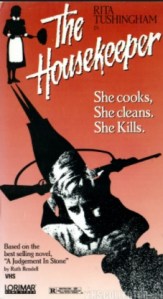
A Movie A Day #324: The Housekeeper (1987, directed by Ousama Rawi)


Eunice Parchman (Rita Tushingham) has always had a secret.  She is dyslexic.  When she was in school, the kids made fun of her for saying, “god” instead of “dog.”  When she grew up, her cruel father threatened to send her to a special school so that she could learn how to read.  Eunice suffocated him with a pillow and then moved to America, where she was hired as a housekeeper.  Eunice is a good housekeeper except she can not read any of the directions that her obnoxious employers leave for her.  When she befriends a religious fanatic (Jackie Burroughs) and accidentally overwaters her employer’s prized orchids in the same week, it can only lead to one thing, a shotgun rampage.

When I was growing up, The Housekeeper (also known as A Judgement In Stone) used to show up regularly on television.  As far as I know, it is the only horror film to have been inspired by dyslexia.  Eunice is so paranoid about people discovering that she can’t read that she is willing to murder to protect her secret.  It does not help that, in America, she works for the Coverdales, a family that is so obnoxious that they probably would give her a hard time about being dyslexic.  The film takes its time to get going but Rita Tushingham gives a good performance and all of her victims are so annoying that it won’t upset anyone when Eunice takes her revenge on them.  The best part of the film is the performance of Jackie Burroughs as an insane religious fanatic who brags about her sex life at a revival meeting.