1970’s The Revolutionary tells the story of a young man named A (Jon Voight).
When we first meet him, A is a college student who lives in the industrial town of Axton. A comes from a wealthy family but he chooses to live in a tiny and quite frankly repellent apartment. He has a girlfriend named Ann (Collin Wilcox). A and Ann don’t really seem to have much of a relationship. “We should make love,” A says in a flat tone of voice. Ann is willing to show her emotions while the self-serious A goes through life with everything under wraps. Ann and A are both members of a radical political group. The group spends a lot of time talking and discussing theory but they don’t really do much else.
A grows frustrated with the group. He gets a job at a factory, where he falls under the sway of a communist named Despard (Robert Duvall). Despard is a bit more active than A’s former comrades. Despard, for instance, is willing to call a general strike but, when that strike still fails, A, along with Despard and everyone else involved, goes underground. Suspended from the university, he soon finds himself being drafted into the Army. His father asks A if he wants to be drafted. A questions why only the poor should be drafted. His father looks at A as if he’s hopelessly naive and his father might be right.
A continues to wander around Axton in an idealistic daze, trying to get people to read the flyers that he spends his time passing out. Things change when A meets Leonard II (Seymour Cassel), a radical who recruits A into an apparent suicide mission….
The Revolutionary took me by surprise. On the one hand, it’s definitely very much a political film. The movie agrees with A’s politics. But, at the same time, the film is also willing to be critical of A and his self-righteous view of the world. One gets the feeling that A’s politics have less to do with sincere belief and more to do with his own need to be a part of something. Up until the film’s final few minute, A is something of a passive character, following orders until he’s finally forced to decide for himself what his next move is going to be. A’s father thinks he’s a fool. Despard views him as being an interloper. Even Leonard II seems to largely view A as being a pawn. A wanders through Axton, trying to find his place in the chaos of the times.
It’s not a perfect film, of course. The pace is way too slow. Referring to the lead character only as “A” is one of those 70s things that feels embarrassingly cutesy today. As was the case with many counterculture films of the early 70s, the film’s visuals often mistake graininess with authenticity. Seriously, this film features some of the ugliest production design that I’ve ever seen. But for every scene that doesn’t work or that plays out too slow, there’s one that’s surprisingly powerful, like when an army of heavily armored policemen break up a demonstration. The film itself is full of talented actors. Seymour Cassel is both charismatic and kind of frightening as the unstable Leonard II. Jon Voight and Robert Duvall are both totally convincing as the leftist revolutionary and his communist mentor. (In real life, of course, Voight and Duvall would become two of Hollywood’s most prominent Republicans.) In The Revolutionary, Duvall brings a certain working class machismo to the role of Despard and Voight does a good job of capturing both A’s intelligence and his growing detachment. A can be a frustrating and passive character but Voight holds the viewer’s interest.
The film works because it doesn’t try to turn A into some sort of hero. In the end, A is just a confused soul trying to figure out what his place is in a rapidly changing world. Thanks to the performance of Voight, Duvall, and Cassel, it’s a far more effective film than it perhaps has any right to be.
“I’m a politician. Which means that I am a cheat and a liar, and when I’m not kissing babies, I’m stealing their lollipops.” — Dr. Jeffrey Pelt, National Security Advisor
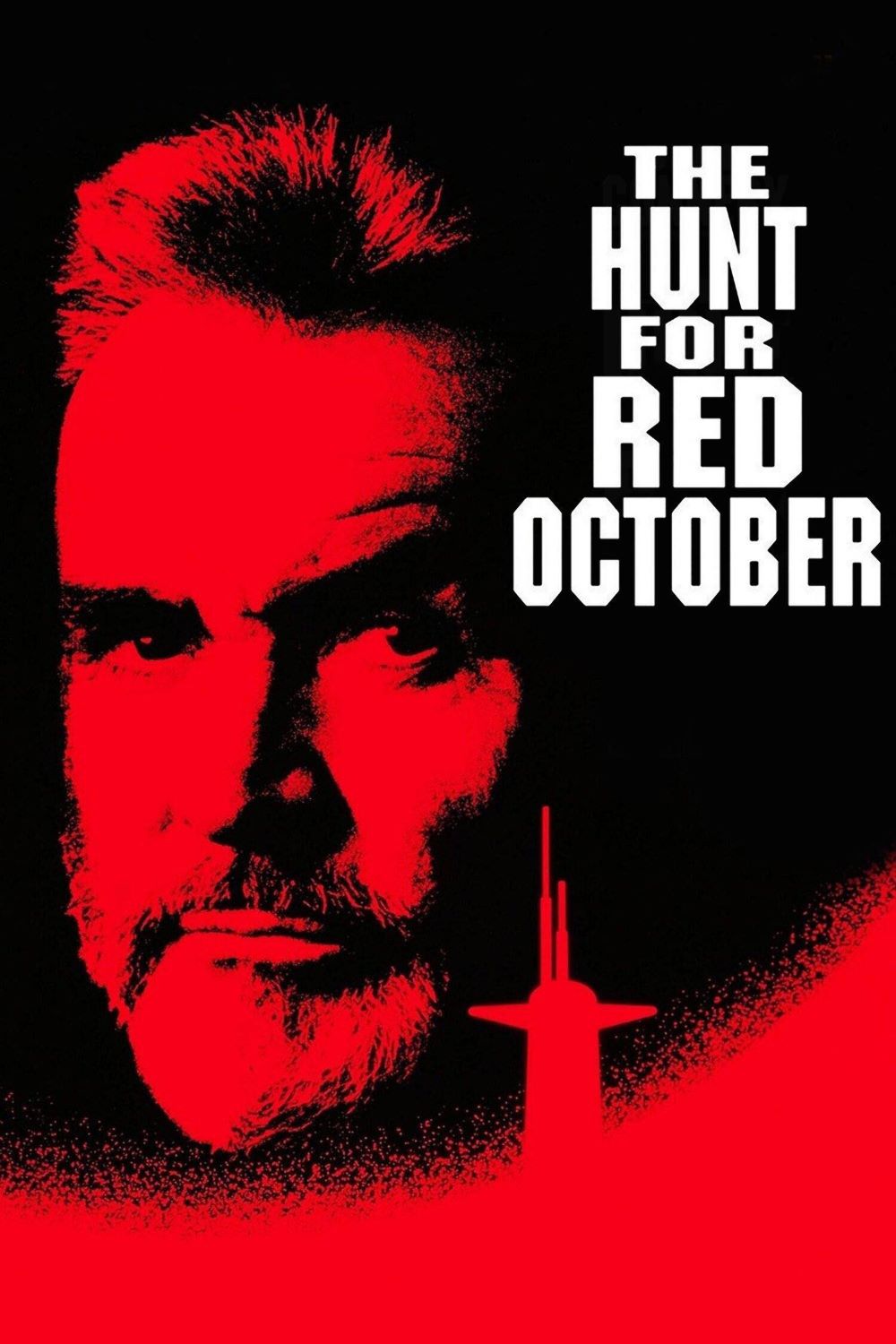
The Hunt for Red October glides into the tail end of Cold War cinema like a stealthy sub cutting through midnight swells, packing a smart mix of spy intrigue and nail-biting underwater showdowns that keep you locked in from the opening credits. Directed by John McTiernan, fresh from helming Die Hard, this 1990 adaptation of Tom Clancy’s doorstopper novel smartly distills pages of naval geekery into a taut, propulsive thriller where Soviet skipper Marko Ramius—Sean Connery in full brooding mode—pilots the formidable Red October, a behemoth sub with a hush-mode propulsion system that ghosts past detection like a shadow in fog.
McTiernan shines in wrangling the script from Clancy’s tech-heavy tome, slicing through the babble to propel the story with crisp momentum and unrelenting suspense, turning potential info-dumps into pulse-quickening beats that hook casual viewers and sub nerds alike. The premise grabs fast: Ramius’s bold maneuvers ignite a transatlantic frenzy, with U.S. and Soviet forces locked in a paranoid standoff over what looks like an imminent crisis. That ’80s-era distrust simmers perfectly here, crammed into a runtime that pulses with fresh urgency decades later, amplified by those dim-lit sub corridors in steely teal tones that squeeze the air right out of the room.
Alec Baldwin embodies Jack Ryan as the reluctant brainiac from CIA desks, sweaty and green around the gills yet armed with instincts that cut through official noise like a periscope through chop. Pulled from family downtime—teddy bear in tow—he injects everyday stakes into the global chessboard, proving heroes don’t need camo or cockiness, just smarts and stubbornness. Connery’s Ramius dominates as a haunted vet with a personal chip on his shoulder, steering a tight-knit officer corps including Sam Neill’s devoted second-in-command, their quiet bonds hinting at deeper loyalties amid the red menace.
Standouts fill the roster seamlessly: James Earl Jones lends gravitas as the steady Admiral Greer backing Ryan’s wild cards; Scott Glenn commands the American hunter sub with laconic steel; Jeffrey Jones brings quirky spark to the sonar savant whose audio tricks flip the script on silence. The dialogue crackles with shorthand lingo and understated jabs, forging a crew dynamic that’s as pressurized as the hull plates, pulling you into hushed command post vibes without a whiff of cheesiness.
McTiernan elevates the genre by leaning on wits over blasts—thrilling pursuits deliver without dominating, letting mind games and split-second calls drive the dread, all while streamlining Clancy’s minutiae into seamless propulsion. Gadgetry gleams without overwhelming: the sub’s whisper-quiet tech sparks clever cat-and-mouse in hazard-filled depths, ramping uncertainty to fever pitch. Pacing builds masterfully from war-room skepticism—Ryan battling brass skepticism—to heart-in-throat ocean dashes, every frame taut as a bowstring. Practical models and effects ground the peril in gritty tangibility, no digital gloss, evoking Ice Station Zebra‘s frosty traps but streamlined into a relentless machine that dodges the older film’s drag. It’s a clinic in balancing spectacle and smarts, where tension coils from isolation’s cruel math: one ping too many, and it’s lights out.
On the eyes and ears front, the movie plunges into submersed nightmare fuel—consoles pulsing crimson in battle stations, scopes piercing mist-shrouded waves, silo bays looming like sleeping leviathans. McTiernan tempers his action flair for thinker-thrills; Basil Poledouris’s great orchestral score surges with iconic power through the chases—those brooding horns, choral swells, and rhythmic pulses echoing engine throbs have etched into legend, pounding your chest like incoming cavitation and elevating every dive. Audio wizardry seals the immersion: hull groans, ping echoes, bubble roars craft a metallic tomb where errors echo eternally. Flaws peek through—early scenes drag with setup chatter, foes skew broad-stroked—but the core hunt erases them, surging to a sharp, satisfying close that nods to Ryan’s budding legend without overplaying the hand.
’90s tentpole lovers and thaw-era history fans find a benchmark here, as the film plays the long con of trust amid torpedoes, fusing bombast with nuance that reboots chase in vain. It bottles superpower jitters spot-on—frantic commands clashing with strike debates—yet softens adversaries via Connery’s world-weary depth and Neill’s subtle conviction. Endless rewatches uncover gems: crew hints dropped early, sonar hacks foreshadowing real tech leaps. Baldwin’s grounded Ryan—chopper-barfing, suit-clashing, chaos-navigating—earns triumphs the hard way, contrasting Das Boot‘s bleak grind with upbeat ingenuity that feels won, not waved. Poledouris’s motifs linger post-credits, a symphonic anchor boosting replay pulls.
Endurance stems from mastering sub-horror’s essence: solitude sharpening choices, where flubs invite apocalypse. Ramius embodies defector realism—war-weary idealist mirroring history’s turncoats—while Clancy’s specs (sub classes, velocities) anchor without anchoring down. McTiernan sidesteps flags; zero flag-waving, pure operator craft in dodges and climactic finesse that blends brains with boom. Quirks delight—the premier’s bluster, aides’ cool calculus—padding a 134-minute gem that exhales you surfacing, amped. Expands on score’s role too: “Hymn to Red October” choral rise mirrors Ramius’s quiet rebellion, threading emotional undercurrents through mechanical mayhem, a Poledouris hallmark outlasting the film.
Bottom line, The Hunt for Red October captivates via cerebral kick—shadow games in fluid physics, intellect over muscle, audacious plays punking empire folly. Sparks post-view chin-strokes on allegiances and risks. Connery’s gravelly “One ping only, Vasily” endures as gold; storm-watch it, trade sofa for sonar station—raw thrill spiked with savvy. Sub saga staple? This silent stalker nails every target.
“Morality… is the last bastion of a coward.”— Colonel Ives
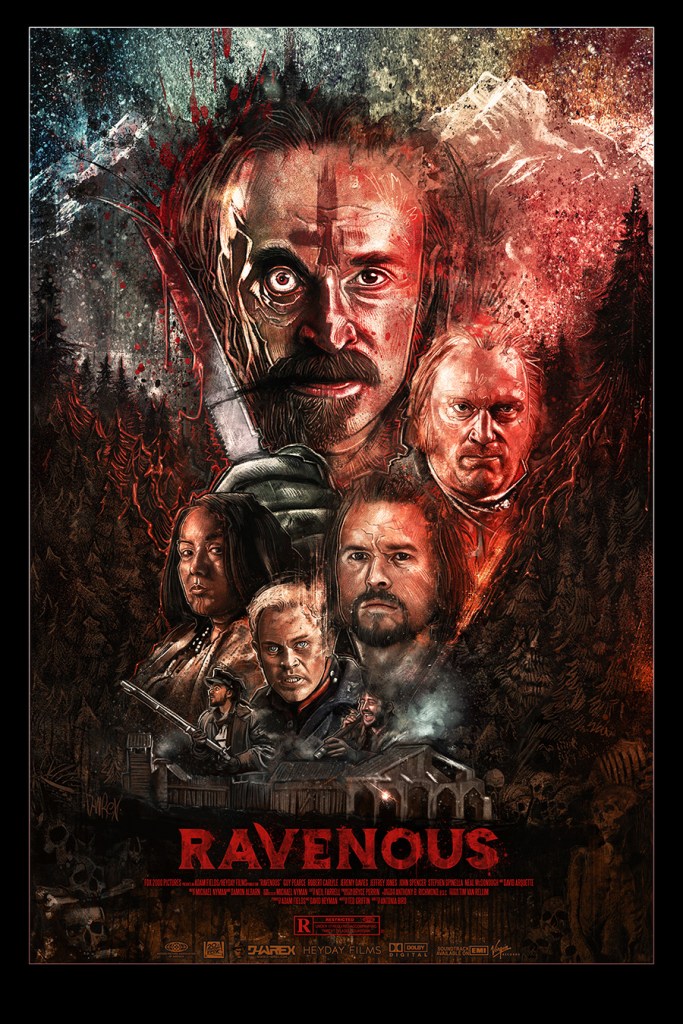
Ravenous remains one of the most fascinating and thematically daring horror films of the late 1990s—a layered meditation on hunger, morality, and the consuming appetite of empire disguised as a tale of survival. Set against the punishing winter backdrop of the Mexican-American War, the film centers on Lieutenant John Boyd, a soldier burdened by cowardice and guilt, sent to an isolated military outpost in the Sierra Nevadas. When a frostbitten stranger stumbles into camp with a horrifying tale of survival, the line between the living and the devoured—and between humanity and monstrosity—begins to blur.
At first glance, Ravenous is a dark horror film about cannibalism in a remote frontier fort. What distinguishes it is the way it transforms that premise into a meditation on civilization and consumption. The screenplay, written by Ted Griffin, draws inspiration from historical accounts such as the Donner Party and Alfred Packer—stories of pioneers who resorted to cannibalism to survive brutal winters. Griffin threads these historical horrors into a broader allegory about 19th-century American expansionism: a national hunger for land, power, and progress that consumes everything in its path, including its own humanity.
The mythological backbone of Ravenous lies in the inclusion of the wendigo, a spirit from Native American folklore. In Algonquin and Ojibwe tradition, the wendigo is born of greed and gluttony, a monstrous being that grows stronger and more grotesque with each act of consumption. The tale served as a warning against selfishness, warning that those who devour others—figuratively or literally—lose their humanity in return. Bird and Griffin seamlessly integrate this legend into the film’s themes, using the wendigo to mirror the psychological and cultural costs of empire. The story implies that the wendigo is not confined to mythic forests but lives in the blood of every nation that feeds on others to survive.
The fort where the story unfolds functions as both a stage and symbol: an outpost of civilization planted in the wilderness, claiming righteousness while sustained by exploitation. As starvation and moral decay take hold, the soldiers’ pretense of order crumbles. The isolated setting reflects the broader American project—civilization advancing through conquest yet losing its moral center in the process. The Native nations displaced and destroyed during expansion, reduced to resources or obstacles, become the unseen victims of this devouring drive. The film reframes cannibalism as a metaphor for Manifest Destiny itself—the act of consuming people, land, and spirit under the guise of progress.
That central metaphor gains power through the film’s performances. Guy Pearce delivers a subdued yet deeply expressive performance as Boyd, embodying the moral paralysis of a man trapped between guilt and survival. His silences, glances, and hesitations speak louder than any dialogue, conveying an internal conflict between virtue and instinct. Through him, the film explores how the will to endure can erode the boundaries of conscience.
Robert Carlyle, as Colonel Ives, stands in vivid contrast—charismatic, witty, and terrifyingly self-assured. He plays the role with the infectious energy of a man liberated by his own monstrosity, wearing sin as philosophy. For Ives, cannibalism is not horror but a revelation—a means to transcend weakness and embrace dominance. His eloquent justifications turn atrocity into ideology, echoing the rationalizations of expansionist politics. It is no coincidence that his confidence parallels Boyd’s doubt; the two men form mirror halves of a single corrupted ideal.
Director Antonia Bird’s touch elevates Ravenous from a historical thriller to a surreal moral fable. She handles violence and absurdity with equal precision, oscillating between grim horror and deadpan humor in a way that keeps viewers uneasy yet enthralled. Her direction never treats the horror as spectacle alone—every moment of gore carries weight, testing the limits of empathy and survival. Moments of unexpected humor punctuate the brutality, serving as a reminder that even atrocity can become ordinary when normalized by power.
While the fusion of dark comedy and horror lends the film its originality, it may also unsettle some viewers. The tonal shifts—helped by Michael Nyman and Damon Albarn’s strange, minimalist score—create an atmosphere that feels intentionally dissonant. This mix may challenge those expecting a traditional horror film, but it reinforces Bird’s vision of moral chaos. The unease generated by those shifts mirrors the absurdity of history itself: how horrors can coexist with banality, how laughter can accompany destruction.
The wendigo myth binds all these elements together. Bird portrays it less as a creature and more as a condition—one that spreads through ideology, greed, and the illusion of progress. The spirit of the wendigo thrives wherever ambition turns men into predators and justifies their violence as destiny. In this sense, every character becomes a reflection of national hunger, caught in a metaphorical cycle of consumption. The act of eating flesh becomes a stand-in for the broader devouring inherent in colonization: of land, of native culture, of moral identity.
By framing the frontier as an arena of both physical and spiritual starvation, Ravenous reimagines American history as a feast of self-destruction. It suggests that survival is often indistinguishable from conquest—both are rooted in the urge to consume. Even at its most surreal or ironic moments, the film refuses to let its viewers forget that the hunger at its center is not merely for sustenance but for dominion.
Though underappreciated upon release, Ravenous has since earned recognition as a rare film that wields gore and satire to expose deeper truths. Bird’s control of tone, Griffin’s allegorical writing, and the actors’ opposing energies fuse into something that transcends genre. The result is a story that both horrifies and compels, holding a cracked mirror to the myth of progress.
The wilderness of Ravenous is vast, beautiful, and pitiless—a perfect reflection of the American spirit it depicts. It is a land that promises renewal but demands devouring, a landscape haunted by the ghosts of all it has consumed. The film endures not simply as a parable of survival, but as a meditation on empire, appetite, and the fragile line separating civilization from savagery.
Both grotesque and profound, Ravenous gnaws not only at flesh but at the conscience, forcing us to confront what happens when hunger—whether for life, for power, or for victory—becomes the only morality left.
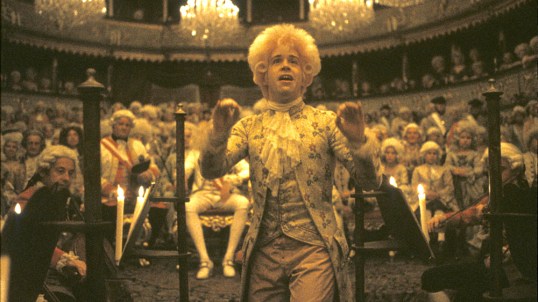
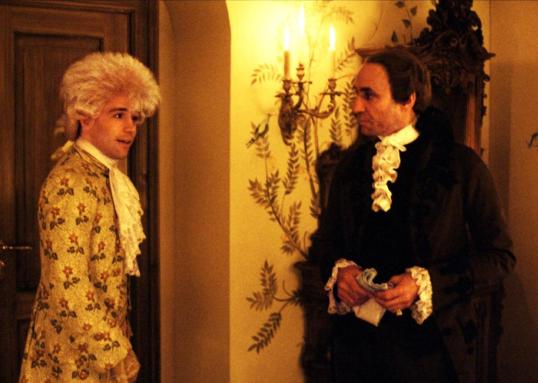
Today is Mozart’s birthday so, of course, today’s scene from the day comes from 1984’s Amadeus. In this scene, the Emperor (Jeffrey Jones) delivers his critique to Mozart (Tom Hulce) and anyone who has ever had to deal with an idiotic critic will be able to relate.
“There’s too many notes!”
What really makes this scene work, along with Hulce’s reaction, is Jones’s blandly cheerful manner. The Emperor really thinks he’s being helpful!
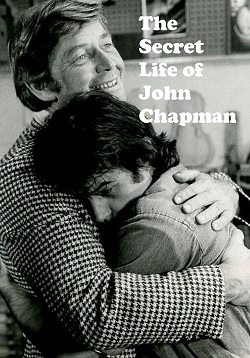
Welcome to Retro Television Reviews, a feature where we review some of our favorite and least favorite shows of the past! On Sundays, I will be reviewing the made-for-television movies that used to be a primetime mainstay. Today’s film is 1976’s The Secret Life of John Chapman! It can be viewed on Tubi.
John Chapman (Ralph Waite) is a mild-mannered college president and a recent widower. Everyone tends to assume that John grew up wealthy but John is actually the son of a bricklayer. As he puts it, his father literally helped to build the college of which John is now president. John has felt lost and directionless ever since the passing of his wife. When his rebellious son (Brad Davis) announces that he’s going to drop out of college and pursue a career as a laborer, John is at first outraged but soon, he’s wondering if perhaps his son has a point. Has John spent so much time cocooned in his college that he’s lost touch with the rest of the world?
John takes a sabbatical and pursues a career as a blue collar worker. He discovers that it’s not as easy as he assumed. Because John doesn’t want to reveal that he’s an academic, John doesn’t really have any references to offer up to potential employers. Because he’s nearly 50, John is continually told that he’s too old for most of the jobs that he applies for. When he goes into a bar and attempts to order a dry martini, he quickly realizes that he has no idea what it’s like to be blue collar.
John eventually does get a job, helping to lay water pipes. His boss is the gruff Gus Reed (Pat Hingle), who John eventually discovers is not quite as fearsome a figure as he originally appears. Once the pipe job is done, John gets a job in a diner and even pursues a tentative romance with a waitress (Susan Anspach) who, as she points out, comes from a totally different world than him. And yet, despite John’s efforts, his son remains unimpressed. According to his son, John is just slumming. He has the freedom to quit and return to the college whenever he wants.
Yikes! John’s son is a bit judgmental and it doesn’t help that he’s played by Brad Davis, who was never a particularly likable actor. (Davis later starred in Midnight Express, in which director Alan Parker used his lack of likability to good effect.) Yet, watching the film, you can’t help but feel that John’s son has a point. At times, it seems like John wants a lot of credit for spending a week working in the type of job that most people take because they don’t have any other option. Indeed, you could argue that John’s project is basically keeping someone who really needs the money from finding a job. It’s not like John gives up any of his money when he goes to work. It doesn’t help that John Chapman narrates his story and his voice-over often feels like a parody of liberal noblesse oblige.
Fortunately, Ralph Waite was a likable actor and he plays John Chapman as being well-intentioned if occasionally a bit condescending. The made-for-TV movie plays like a pilot and it’s easy to imagine a series in which John Chapman would have worked a different job every week. It’s a slight but pleasant-enough made-for-TV movie. Seen today, it works best as a time capsule, a portrait of a society still trying to find its identity in the wake of the turbulence of the 60s.
The 1984 film Amadeus is about a man who learns, after it’s a bit too late to really do anything about it, that he is thoroughly mediocre.
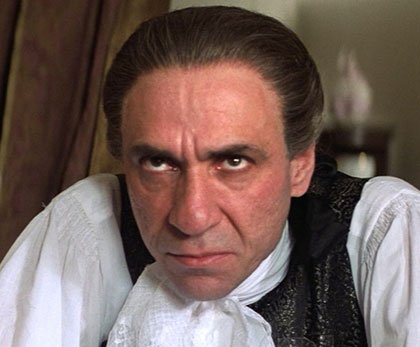
When we first meet Antonio Salieri (played by F. Murray Abraham), he’s an old man who has been confined to a mental asylum because he attempted to slit his own throat. What should drive Salieri — a respected, if not particularly beloved, composer in 18th Century Vienna — to attempt to take his own life? As he explains it to Father Vogler (Richard Frank), it’s the guilt of knowing that he’s responsible for death of the greatest composer of all time, Wolfgang Amadeus Mozart.
When Mozart (Tom Hulce) first showed up in Vienna, Salieri was already the court composer to the thoroughly vacuous Emperor Joseph II (Jeffrey Jones). At the time, Salieri believed himself to be a genius touched by God. As he recounts to Father Vogler, he prayed to God when he was a boy and he struck what he believed was an ironclad deal. God would make Salieri a great composer and Salieri would remain a faithful believer.
But then Mozart shows up and, from the minute that he first hears one of Mozart’s compositions, Salieri realizes that Mozart is the one who has been blessed with genius. Mozart is the one who is writing the music that will be remembered for the rest of time, long after Salieri and all of his other rival composers have been forgotten. Upon first hearing Mozart, Salieri suddenly realizes that he has been betrayed by God. He is a mediocre talent and he’s always been a mediocre talent.
The worst part of it is not just that Mozart’s a genius. It’s also that Mozart knows he’s a genius. He’s a bit of a brat as well, with a remarkably annoying laugh and vulgar manners that scandalize proper society. Despite the efforts of his rivals to dismiss his talent, Mozart is beloved by the common people. He’s an 18th century rock star and it seems as if no amount of scandal and petty jealousy can slow him down. Even worse, the emperor takes a interest in Mozart and commissions him — and not Salieri — to write an opera.
Rejecting a God that he feels has betrayed him, Salieri plots Mozart’s downfall….
Goddamn, this is a great movie. Seriously, everything about Amadeus works.
The ornate sets and the costumes not only wonderful to look at but they also actually tell us something about the characters who inhabit them. One look at the beautiful but cluttered home that Mozart shares with his wife, Constanze (Elisabeth Berridge), tells you almost everything you need to know about not only Mozart’s tastes (which are expensive) but also his talent (which is undisciplined but also limitless). The empty-headedness of Emperor Joseph is perfectly mirrored by the pretty but uninspired decor of his court while the grubby chaos of the mental asylum seems to have sprung straight from Salieri’s tortured soul. As visualized in Amadeus, there’s a cold beauty to Vienna, one that is fascinating but, at the same time, menacing. As for the costumes, Mozart’s powdered wig somehow seems to be brighter than everyone else’s and his colorful wardrobe demands your attention. Meanwhile, when a costumed and masked Salieri shows up at Mozart’s door, he’s like the Grim Reaper coming to collect a soul.
The witty script is full of sharp lines and director Milos Forman does a wonderful job of balancing comedy and drama. The scenes involving Joseph II are frequently hilarious and Jeffrey Jones does a great job of portraying Joseph as essentially being a very influential dunce. The scene where Joseph tells Mozart that he liked his latest composition but that “there are simply too many notes” is a classic and one to which any artist, whether they’re Mozart or not, will be able to relate. (“Just cut a few and it will be perfect.”)
The film is dominated by the performances of F. Murray Abraham and Tom Hulce. Hulce is wonderfully flamboyant in the early part of the film and, bravely, he doesn’t shy away from portraying Mozart as occasionally being a bit of a spoiled brat. It’s not just that Mozart can be annoying. It’s also that he’s often deliberately annoying. When we first see Mozart, it’s easy to understand why his very existence so grated on Salieri’s nerves and why Salieri considers him to be an “obscene child.” But as the film progresses, Hulce lets us in and we come to see that Mozart is actually a very vulnerable young man. When his disapproving father (Roy Dotrice) comes to visit, we suddenly understand both why Mozart is so driven to succeed but also why he is so instinctively self-destructive.
Meanwhile, F. Murray Abraham — well, what can I say about this performance? In the role of Salieri, Abraham gives one of the greatest film performances of all time. In many ways, Abraham has a tougher job than Hulce. If Hulce has to convince us that Mozart has been touched by genius despite the dumb things that he often does, Abraham has to make petty jealousy compelling. And somehow, Abraham manages to do just that. Whereas the role of Mozart allows Hucle to wear his emotions on the surface, Abraham has to play a character who keeps most of his thoughts and impulses hidden and the fact that we end up understanding Salieri (if never actually sympathizing with him) is a testament to F. Murray Abraham’s skill as an actor. Abraham won the Oscar for Best Actor for his work in Amadeus and it was more than deserved.
At the end of the film, Salieri declares himself to be the patron saint of mediocrities and, to a large extent, that’s what sets Amadeus apart from other biopics. Most people are mediocre. Most people are not going to end their life as a Mozart. They’re going to end their life as a Salieri or worse. This is one of the few films to be made about a runner-up. It’s interesting to note that, even though the film is more about Salieri than Mozart, it’s still called Amadeus. It’s not named Antonio or Salieri. Even in a film made about Salieri, Mozart is advertised as the main attraction.
(It should also be noted that many historians believe that Salieri and Mozart were actually fairly friendly acquaintances and that, beyond the normal rivalry that any two artists would feel, neither held any significant ill will towards the other. In other words, enjoy Amadeus as an outstanding piece of cinema but don’t necessarily mistake it for historical fact.)
Along with Abraham’s victory, Amadeus also won Best Picture of the year. Of the nominees, it certainly deserved it. (My pick for the best film of 1984 is Once Upon A Time In America with Amadeus as a close second.) It’s a great film and one that definitely deserves to be watched and rewatched.
The Soldier is really only remembered for one scene. The Soldier (Ken Wahl) is being chased, on skis, across the Austrian Alps by two KGB agents, who are also on skis. The Soldier is in Austria to track down a KGB agent named Dracha (Klaus Kinski, who only has a few minutes of screen time and who is rumored to have turned down a role in Raiders of the Lost Ark so he could appear in this movie). The Russians want the Soldier dead because they’re evil commies. While being chased, the Soldier goes over a ski slope and, while in the air, executes a perfect 360° turn while firing a machine gun at the men behind him. It’s pretty fucking cool.
The Soldier, who name is never revealed, works for the CIA. He leads a team of special agents. None of them get a name either, though one of them is played by the great Steve James. When a shipment of Plutonium is hijacked so that it can be used it to contaminate half of the world’s supply of oil, The Soldier is assigned to figure out who is behind it. Because terrorists are demanding that Israel withdraw from the West Bank, Mossad assigns an agent (Alberta Watson) to help out The Soldier. She gets a name, Susan Goodman. She sleeps with The Soldier because, she puts it, the world is about to end anyway.
The Soldier was obviously meant to be an American James Bond but Ken Wahl did not really have the screen charisma necessary to launch a franchise. He is convincing in the action scenes but when he has to deliver his lines, he is as stiff as a board. Fortunately, the majority of the movie is made up of action scenes. From the minute this briskly paced movie starts, people are either getting shot or blown up. Imagine a James Bond film where, instead of tricking the bad guys into explaining their plan, Bond just shot anyone who looked at him funny. That’s The Soldier, a film that is mindless but entertaining.
Ken Wahl may have been stiff and Klaus Kinski may have been wasted but there are still some interesting faces in the cast. Keep an eye out for William Prince as the President, Ron Harper as the director of the CIA, Zeljko Ivanek as a bombmaker, Jeffrey Jones as the assistant U.S. Secretary of Defense, and George Straight performing in a redneck bar. Best of all, one of the Soldier’s men is played by Steve James, who will be recognized by any Cannon Films aficionado.
Surprisingly, The Solider is not a Cannon film. It certainly feels like one.
From start to end, the 1994 film Ed Wood is a nearly perfect film.
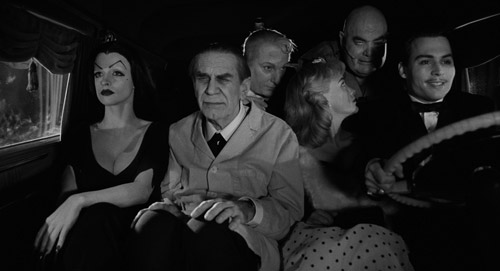
Consider the opening sequence. In glorious black-and-white, we are presented with a house sitting in the middle of a storm. As Howard Shore’s melodramatic and spooky score plays in the background, the camera zooms towards the house. A window flies open to reveal a coffin sitting in the middle of a dark room. A man dressed in a tuxedo (played to snarky and eccentric perfection by Jeffrey Jones) sits up in the coffin. Later, we learn that the man is an infamously inaccurate psychic named Criswell. Criswell greets us and says that we are interested in the unknown. “Can your heart handle the shocking facts of the true story of Edward D. Wood, Jr!?”
As streaks of lightning flash across the sky, the opening credits appear and disappear on the screen. The camera zooms by tombstones featuring the names of the cast. Cheap-looking flying saucers, dangling on string, fly through the night sky. The camera even goes underwater, revealing a giant octopus…
It’s a brilliant opening, especially if you’re already a fan of Ed Wood’s. If you’re familiar with Wood’sfilms, you know that Criswell’s appearance in the coffin is a reference to Orgy of the Dead and that his opening monologue was a tribute to his opening lines fromPlan 9 From Outer Space. If you’re already a fan of Ed Wood then you’ll immediately recognize the flying saucers. You’ll look at that octopus and you’ll say, “Bride of the Monster!”
And if you’re not an Ed Wood fan, fear not. The opening credits will pull you in, even if you don’t know the difference between Plan 9 and Plan 10. Between the music and the gorgeous black-and-white, Ed Wood is irresistible from the start.
Those opening credits also announce that we’re about to see an extremely stylized biopic. In the real world, Ed Wood was a screenwriter and director who spent most of his life on the fringes of Hollywood, occasionally working with reputable or, at the very least, well-known actors like Lyle Talbot and Bela Lugosi. He directed a few TV shows. He wrote several scripts and directed a handful of low-budget exploitation films. He also wrote a lot of paperbacks, some of which were semi-pornographic. Most famously, he was a cross-dresser, who served in the army in World War II and was wearing a bra under his uniform when he charged the beaches of Normandy. Apparently, the stories of his love for angora were not exaggerated. Sadly, Wood was also an alcoholic who drank himself to death at the age of 54.
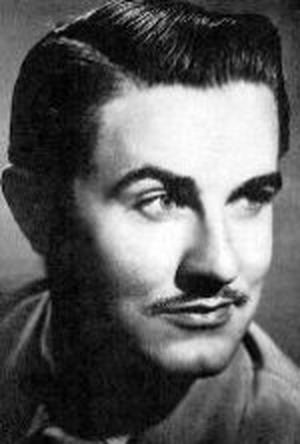
Every fan of Ed Wood has seen this picture of him, taken when he first arrived in Hollywood and looked like he had the potential to be a dashing leading man:
What people are less familiar with is how Ed looked after spending two decades on the fringes of the film business:
My point is that the true story of Ed Wood was not necessarily a happy one. However, one wouldn’t know that from watching the film based on his life. As directed by Tim Burton, Johnny Depp plays Ed Wood as being endlessly positive and enthusiastic. When it comes to determination, nothing can stop the film’s Ed Wood. It doesn’t matter what problems may arise during the shooting of any of his films, Wood finds a way to make it work.
A major star dies and leaves behind only a few minutes of usable footage? Just bring in a stand-in. The stand-in looks nothing like the star? Just hide the guy’s face.
Wrestler Tor Johnson (played by wrestler George “The Animal” Steele), accidentally walks into a wall while trying to squeeze through a door? Shrug it off by saying that it adds to the scene. Point out that the character that Tor is playing would probably run into that wall on a regular basis.
Your fake octopus doesn’t work? Just have the actors roll around in the water.
The establishment won’t take you seriously? Then work outside the establishment, with a cast and crew of fellow outcasts.
You’re struggling to raise money for your film? Ask the local Baptist church. Ask a rich poultry rancher. Promise a big star. Promise to include a nuclear explosion. Promise anything just to get the film made.
You’re struggling to maintain your artistic vision? Just go down to a nearby bar and wait for Orson Welles (Vincent D’Onofrio) to show up.
Personally, I’m of the opinion that Ed Wood is Tim Burton’s best film. It’s certainly one of the few Burton films that actually holds up after repeat viewings. Watching the film, it’s obvious that Wood and Burton shared a passionate love for the movies and that Burton related to Wood and his crew of misfits. It’s an unabashedly affectionate film, with none of the condescension that can sometimes be found in Burton’s other film. Burton celebrates not just the hopes and dreams of Ed Wood, Bela Lugosi, Tor Johnson and Criswell but also of all the other members of the Wood stock company, from Vampira (Lisa Marie) to Bunny Breckenridge (Bill Murray), all the way down to Paul Marco (Max Casella) and Loretta King (Juliet Landau). Though Ed Wood may center around the character of Wood and the actor who plays him, it’s a true ensemble piece. Landau won the Oscar but really, the entire cast is brilliant. Along with those already mentioned, Ed Wood features memorable performances from Sarah Jessica Parker and Patricia Arquette (one playing Wood’s girlfriend and the other playing his future wife), G. D. Spradlin (as a minister who ends up producing one of Wood’s films), and Mike Starr (playing a producer who is definitely not a minister).
For me, Ed Wood is defined by a moment very early on in the film. Wood watches some stock footage and talks about how he could make an entire movie out of it. It would start with aliens arriving and “upsetting the buffaloes.” The army is called in. Deep delivers the line with such enthusiasm and with so much positive energy that it’s impossible not get caught up in Wood’s vision. For a few seconds, you think to yourself, “Maybe that could be a good movie…” Of course, you know it wouldn’t be. But you want it to be because Ed wants it to be and Ed is just do damn likable.
As I said before, Ed Wood is a highly stylized film. It focuses on the good parts of the Ed Wood story, like his friendship with Bela Lugosi and his refusal to hide the fact that he’s a cross-dresser who loves angora. The bad parts of his story are left out and I’m glad that they were. Ed Wood is a film that celebrates dreamers and it gives Wood the happy ending that he deserved. The scenes of Plan 9 From Outer Space getting a raptorous reception may not have happened but can you prove that they didn’t?
I suppose now would be the time that most reviewers would reflect on the irony of one of the worst directors of all time being the subject of one of the best films ever made about the movies. However, I’ll save that angle for whenever I get a chance to review The Disaster Artist. Of course, I personally don’t think that Ed Wood was the worst director of all time. He made low-budget movies but he did what he could with what he had available. If anything, Ed Wood the film is quite correct to celebrate Ed Wood the director’s determination. Glen or Glenda has moments of audacious surrealism. Lugosi is surprisingly good in Bride of the Monster. As for Plan 9 From Outer Space, what other film has a plot as unapologetically bizarre as the plot of Plan 9? For a few thousand dollars, Wood made a sci-fi epic that it still watched today. Does that sound like something the worst director of all time could do?
Needless to say, Ed Wood is not a horror film but it’s definitely an October film. Much as how Christmas is the perfect time for It’s A Wonderful Life, Halloween is the perfect time for Ed Wood.
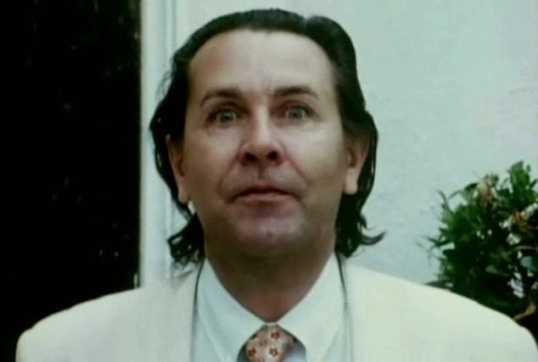
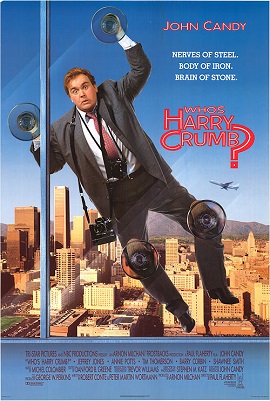
He is a private detective, the latest in a long line of gumshoes. While Harry’s father and his grandfather may have been great detectives, Harry is about as incompetent as can be. He is a self-styled master of disguise but not much else. He is employed at Crumb & Crumb Detective Agency, solely because of his family background. When the head of the agency, Eliot Draisen (Jeffrey Jones), engineers the kidnapping of a millionaire’s daughter, he gives the case to Harry because he knows Harry will never be able to solve it.
Who’s Harry Crumb?
He is John Candy, the much beloved and much missed comedic actor from Canada. As anyone who has ever seen an old episode of SCTV knows, John Candy could be one of the funniest men alive but Hollywood rarely knew what to do with him. Other than the movies that he made with John Hughes, Candy was always stuck in either supporting roles or in bad comedies. In Art Linson’s A Pound of Flesh, veteran film producer Linson writes that, because of Candy’s size, some Paramount executives wanted to cast him as Al Capone in The Untouchables. That is something that I would have enjoyed seeing. Instead, some actor named Robert De Niro got that role and Candy ended up making movies like Who’s Harry Crumb?
Who’s Harry Crumb? tries to be a mix of comedy and mystery but, due to a weak script and uncertain direction, it does not really succeed as either. John Candy delivers a few laughs because he was a naturally funny actor but, as a character, Harry Crumb is not that interesting. Instead, the film is stolen by Annie Potts, playing a duplicitous femme fatale. Potts and Candy previously came close to working together in the original Ghostbusters. (Candy pulled out of the role of Louis Tully so that he could play Tom Hanks’s brother in Splash. He was replaced by his SCTV co-star, Rick Moranis.) The rest of the cast seems bored and uninterested in what they are doing. Even Jeffrey Jones, usually so reliable in smarmy bad guy roles, seems bored.
John Candy died just 5 years after the release of Who’s Harry Crumb?, leaving behind two intriguing dream projects, one a biopic of Fatty Arbuckle and another an adaptation of A Confederacy of Dunces. Sadly, Hollywood never really figured out what to do with this talented comedian.
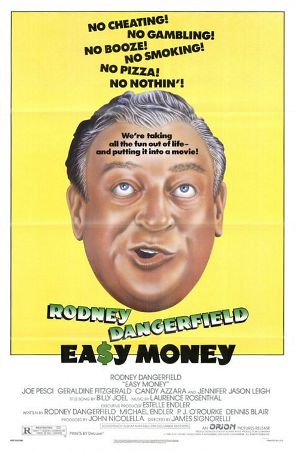
Rodney Dangerfield. He didn’t get no respect but he did smoke a lot of weed.
It’s true. Rodney first lit up in 1942 when he was a 21 year-old struggling nightclub comic. According to his widow, the moment meant so much to Rodney that, decades later, he could still remember the room number — 1411, at the Belvedere Hotel in New York City — where he and fellow comedians Bobby Byron and Joe E. Ross smoked that first joint. That was back when Rodney was performing under the name Jack Roy. (His was born Jacob Cohen.) Rodney’s first comedy career went so badly that he quit and spent the next twenty-two years as an aluminum siding salesman until he found the courage to return to the stage. However, whether he was selling or performing, Rodney never stopped smoking marijuana. When he was working on his autobiography, he wanted to call it My Lifelong Romance With Marijuana. His wife convinced him to go with a different title: It’s Not Easy Bein’ Me: A Lifetime of No Respect but Plenty of Sex and Drugs.
There’s plenty of drugs in Easy Money, which is a problem for baby photographer Monty Capuletti (Rodney, of course). Monty likes to gamble, drink, and smoke pot, much to the disapproval of his wealthy mother-in-law (Geraldine Fitzgerald). When she dies, she stipulates in her will that if Monty goes for a year without indulging in any of his vices, he and his family will receive 10 million dollars. Sounds easy, right? The only problem is that Monty really likes to eat, drink, gamble, and get high. His best friend (Joe Pesci) doesn’t think he can do it. His mother-in-law’s former assistant, Quincy Barlow (Jeffrey Jones), is determined to catch Monty slipping back into his old ways so that he can inherit the money. Monty’s determined, though, to win the money for his family, especially now that his daughter (Jennifer Jason Leigh) has married the bizarre Julio (Taylor Negron).
The episodic plot is really just an excuse for Rodney to be Rodney, spouting off one liners and making snobs like Quincy look foolish. Rodney and Joe Pesci were a surprisingly effective comedy team. The scene where they get stoned and try to drive home without damaging the huge wedding cake in the back of the van is a hundred times funnier than it has any right being. Even though it is hard to imagine her being, in any way, related to Rodney Dangerfield, Jennifer Jason Leigh is always a welcome presence. Like many comedies of that era, Easy Money is uneven, with as many jokes failing as succeeding but, for Rodney Dangerfield fans, it is a must see.

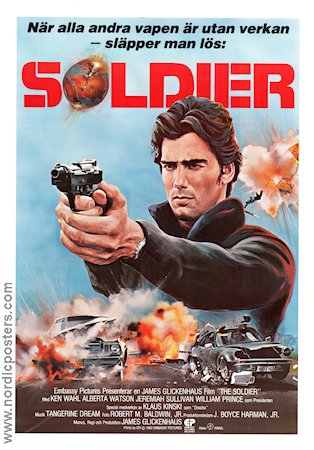 The Soldier is really only remembered for one scene. The Soldier (Ken Wahl) is being chased, on skis, across the Austrian Alps by two KGB agents, who are also on skis. The Soldier is in Austria to track down a KGB agent named Dracha (Klaus Kinski, who only has a few minutes of screen time and who is rumored to have turned down a role in Raiders of the Lost Ark so he could appear in this movie). The Russians want the Soldier dead because they’re evil commies. While being chased, the Soldier goes over a ski slope and, while in the air, executes a perfect 360° turn while firing a machine gun at the men behind him. It’s pretty fucking cool.

 Who’s Harry Crumb?
 Rodney Dangerfield. He didn’t get no respect but he did smoke a lot of weed.
 Through the Shattered Lens