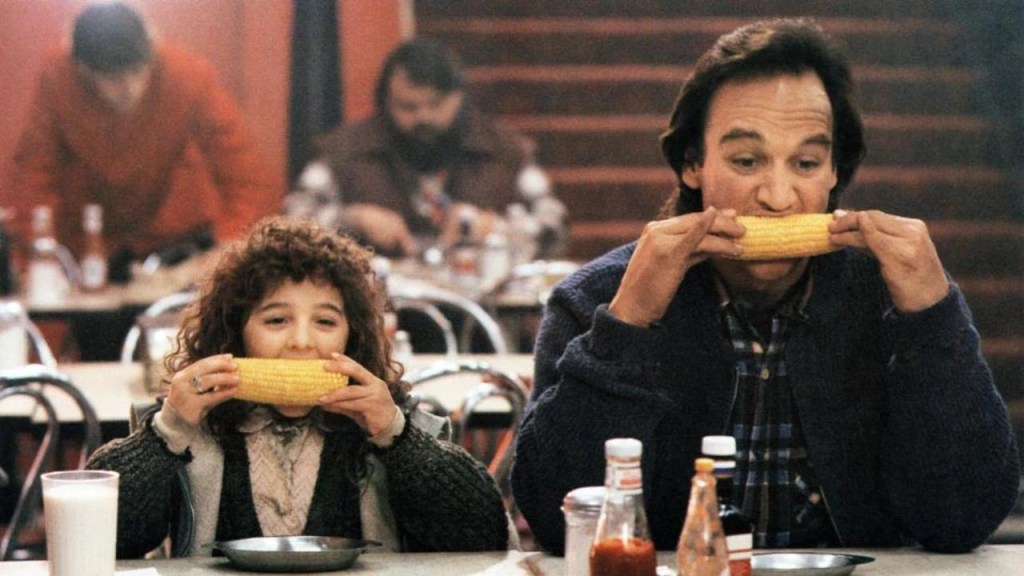
Brad reviews CURLY SUE (1991), starring James Belushi and Kelly Lynch!


Bill Dancer (James Belushi), a homeless drifter and small-time con artist, and his 9 year old companion Curly Sue (Alisan Porter), survive by running somewhat harmless scams against rich people. While traveling through Chicago they target Grey Ellison (Kelly Lynch), a rich, career-focused divorce attorney, tricking her into thinking that she ran over Bill with her Mercedes. Normally the pair are just after a free meal and maybe a little cash, but Bill doesn’t have the heart to take too much from Grey since she’s so darn pretty. Through a variety of circumstances, she actually does run over Bill the next day. This time she brings him and Curly Sue up to her fancy apartment so he can recover, despite the objections from her snobby boyfriend Walker (John Getz). As the three get to know each other, Grey forms an especially close connection with Curly Sue, and learns that Bill isn’t her actual dad, even though he’s raised her since she was a baby. Knowing that Grey can give Curly Sue a better life than he can, Bill thinks about leaving. But can he ever leave the girl he sees as a daughter? And can Grey discover a compassion for others and the maternal instinct that she’s been missing? 

As is often the case with movies I choose to write about, I had a sense of nostalgic warmth while watching CURLY SUE this morning for the first time in three decades. I saw CURLY SUE at the movie theater with my high school girlfriend in the fall of 1991. I remember enjoying the film and even buying it on VHS as a gift for my mom because I knew she would like it. In the years before she could record her Hallmark movies on her DVR, Mom watched that VHS tape many times. 

Quite different from his classic teen comedies, CURLY SUE, which is the final film directed by John Hughes, can only be described as unapologetically sentimental. Sure the movie is formulaic and pure syrup, but I still enjoy it anyway. This heartwarming fairy tale will make you believe that an unconventional, loving family can emerge from the most unexpected of circumstances. It will suggest that there are some things more important than any amount of money can buy. It will make you laugh out loud at times, and yes, it will even bring a tear to your eye as some of the more emotional scenes play out. CURLY SUE wants to manipulate its audience’s emotions, and it will happen if you just go with it. On the down side, if you catch this film in the wrong kind of mood, or if you’re feeling especially cynical, that magic will disappear and you probably won’t enjoy the movie at all. 

As for the performances, as a fan of James Belushi, I like him as the gruff but likable Bill. I also enjoy Kelly Lynch as the she evolves from a person married to her work to someone who starts to care deeply about the people around her. Probably the most important performance in the film comes from Alisan Porter as Curly Sue. If you don’t find her cute and adorable, then you’ll probably have a hard time watching the movie. I personally found her to be quite precious so that was not a problem for me. Once again, the movie version of early 90’s Chicago as our setting is something I enjoy as well. 

Overall, CURLY SUE is not in the same league as Hughes’ best work like PLANES, TRAINS AND AUTOMOBILES, and there will be many who downright dislike the schmaltzy nature of the film. However, if you’re in a nostalgic mood for an earnest, early ‘90s heart-tugger, this movie might just hit the spot.

Holiday Film Review: Jingle All The Way (dir by Brian Levant)


Whatever else one may want to say about it, 1996’s Jingle All The Way is a cute film.

It’s necessary to point that out because Jingle All The Way has a terrible reputation and, if we’re going to be honest, it deserves a lot of the criticism that it has gotten over the years.  In many ways, it epitomizes the way a Hollywood studio can take an interesting idea and then produce a film that seems to have no understanding of what made that idea so interesting in the first place.  Arnold Schwarzenegger plays Howard Langston, an overworked mattress store manager who waits until Christmas Eve to try to buy his son a Turbo Man action figure.  (In the film, they call it a “doll,” which is one of the film’s false moments.)  The only problem is that the Turbo Man action figure is the most popular gift of the year and everyone is looking for one.  What starts out at as a satire of commercialism ultimately becomes a celebration of the same thing as Howard ends up dressed up as Turbo Man and taking part in his town’s Christmas parade.   The film becomes a comedy without any sharp edges.

That said, it’s a cute film.  It’s not cute enough to really be good but it is cute enough that it won’t leave you filled with rage.  Arnold Schwarzenegger is in True Lies mode here, playing a seemingly boring and suburban guy who is secretly a badass.  (In True Lies, Schwarzenegger was secretly a spy who had killed man people, though all of them were bad.  In Jingle All The Way, he’s just a parent who has waited too long to go Christmas shopping.)  Schwarzenegger’s main strength as an action star — even beyond his physique — was that he always seemed to have a genuine sense of humor and he’s the best thing about Jingle All The Way.  This film finds him acting opposite actual comedic actors like Jim Belushi and Phil Hartman and holding his own.  (The film also features Sinbad as another dad trying to get the Turbo Man action figure but Sinbad comes across as being more of a stand-up comedian doing bits from his routine than an actual character.)  The film’s set pieces grow increasingly bizarre and surreal as Howard searches for his Turbo Man and the film actually becomes less effective the stranger that it gets.  A scene of Howard fighting a crowd in a toy store works far better than a later scene where Howard battles a bunch of men dressed as Santa Claus and his elves.  (It doesn’t help that, after an intelligent and well-edited opening thirty minutes, the film seems to lose all concept of comedic timing.)  But there’s a sincerity to Schwarzenegger’s performance that keeps you watching.

Of course, today, Jingle All The Way feels like a relic from a different age.  All the kids want a Turbo Man and you’re so busy at work that the stores are closed by the time you get home?  Fine.  Hop on Amazon at three in the morning and order one.  Christmas shopping is a lot easier nowadays.

It’s just not as much fun.

Brad reviews RETURN TO ME (2000), starring David Duchovny and Minnie Driver!


I’m a sucker for a good romance. Every year during tax season, I like to stream romantic films while I prepare my clients’ tax returns late into the evening. They make me feel good and help my mood as I work the necessary 80 to 90 hours every week leading up to April 15th. My list of favorites includes movies like HITCH (2005) with Will Smith, NOTTING HILL (1999) with Julia Roberts and Hugh Grant, and YOU’VE GOT MAIL (1998) with Tom Hanks and Meg Ryan. I also really enjoy the period romance movies based on the novels of Jane Austen, films like Ang Lee’s SENSE AND SENSIBILITY (1995) and the five-hour mini-series version of PRIDE AND PREJUDICE (1995) starring Colin Firth and Jennifer Ehle. There’s a decent chance that if you walk into my office at the end of one of these films you might even catch me wiping a tear from my eye as the obstacles finally clear, and we’re left with two people in love embarking on their specific “happily-ever-after” together. One such movie, that I don’t hear mentioned very often, but that I personally love, is the 2000 romantic film RETURN TO ME.

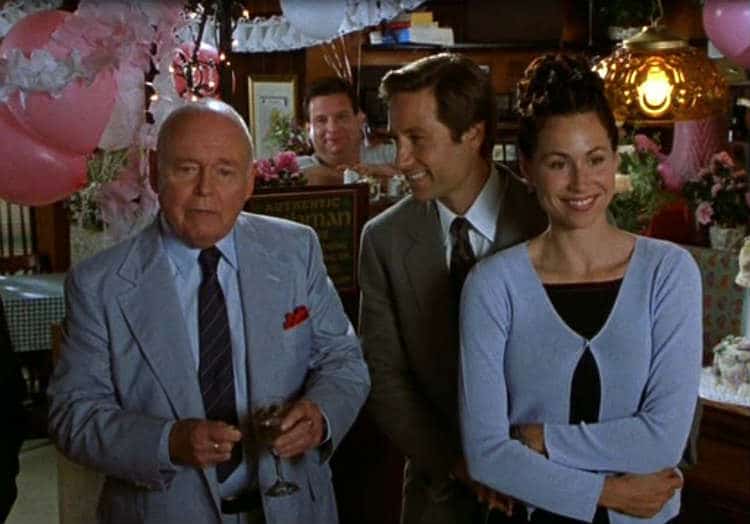
RETURN TO ME opens by introducing us to two families. First, we meet Bob Rueland (David Duchovny), a successful architect, and his wife Elizabeth (Joely Richardson), a kind-hearted zoologist, who are clearly very much in love. We follow the couple as they attend a fund-raising dinner that’s been organized to help expand the zoo’s gorilla habitat, a cause that’s very dear to Elizabeth’s heart, with Bob volunteering his own time and talents to design the new facility. The evening includes many sweet words and some quality slow dancing. Next, we meet Grace Briggs (Minnie Driver), who is very sick and in need of a heart transplant in the worst possible way. Her Catholic family and her friends, which includes her loving grandpa Marty O’Reilly (Carroll O’Connor) and her best friend Megan Dayton (Bonnie Hunt), are a wonderful support system, but without the new heart, she won’t be able to live much longer. On the same night that unspeakable tragedy strikes the Rueland’s on their way home from the fundraiser, Grace and her Grandpa’s prayers are answered when they get the call that a healthy heart is now available. A year later, Bob and Grace meet by chance at Marty’s business, O’Reilly’s Italian Restaurant. Bob has been a shell of the man he once was as he’s been unable to deal with his wife’s passing, while Grace has attempted to figure out life with her new heart. There’s just something about Grace though, so Bob asks her out and, after a series of sweet dates, it seems the two may be falling in love. But when Grace accidentally discovers that the heart that Bob is falling in love with was once beating inside the chest of his deceased wife Elizabeth, Grace doesn’t know how to tell him. Feeling guilty, as well as fearful of how Bob may respond to the shocking information, Grace decides she has no choice but to tell him. Will their blossoming love survive this unexpected and tragic revelation?

I love RETURN TO ME, and the main reason is that I love the characters, and especially the world that director Bonnie Hunt creates inside the film. The love story at the center is played well by Duchovny and Driver, but the greater love of family and friends is what sets this movie apart for me. In a way, Hunt creates a world that contains the kind of friends and family that we’d all love to have in real life. She does this by spending a lot of time with the entertaining supporting characters, showing them to be kind and decent people, the kind who make our lives valuable. As an example, O’Connor’s performance as the doting grandpa to Grace is wonderful, but we also get to see the interplay between Grace, Marty and their “family” at the restaurant, played by such great character actors as Robert Loggia, Eddie Jones, William Bronder and Marianne Muellerleile. Hunt herself is excellent in the role as Grace’s best friend Megan, but the time we spend with her blue-collar husband, played perfectly by James Belushi, and their kids are some of the best and funniest of the film. Based on the time and attention to these characters, as well as the time spent at “O’Reilly’s Italian Restaurant,” Hunt has created a scenario that feels like we’re watching real family and friends, in the best possible way. I never watch this film that I don’t want to go eat a big plate of spaghetti afterwards. The relationship between Bob and his best friend Charlie (David Alan Grier) isn’t quite as successful, but it has its moments as well.

RETURN TO ME is the kind of romantic film that we don’t get to see very often these days. A snarky, cynic would probably have a field day with this film, with its outrageous set-up, its old-fashioned values, and even older-fashioned characters. But that’s what I love about this film. As an example, this is the kind of movie where characters ask each other to pray, they do it, and the only purpose of it being shown is so we know how much these people care about each other. That feels very old-fashioned for 2025, but based on my own experiences in life, it’s something I can completely identify with.

Ultimately, RETURN TO ME is not a perfect film. Clocking in at almost 2 hours, there are definitely some scenes that could have been shortened or eliminated all-together. And it may seem like a criticism that I find the central love story of the film less appealing than the love shown by the main characters’ family and friends, but it’s really not. RETURN TO ME is a movie I return to every year because, at the end of the day, it’s an entertaining film that helps me appreciate the love of a family and the possibility that sometimes love is just meant to be.

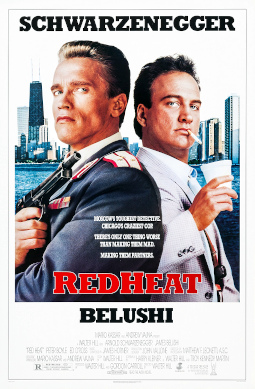
Red Heat (1988, directed by Walter Hill)


Ivan Danko (Arnold Schwarzenegger) is a Russian who lives in Moscow.  Art Ridzik (James Belushi) is an American who lives in Chicago.  They have two things in common.  They’re both cops and they both recently lost their partners while pursuing Russian drug lord Viktor Rostavali (Ed O’Ross).  When Danko comes to Chicago to bring the recently arrested Rostavali back to Moscow, Ridzik is assigned to be his handler.  When Rostavali escapes from custody, Ridzik and Danko team up to take him down.

Directed by Walter Hill, Red Heat may not be as well-remembered as some of Arnold Schwarzenegger’s other action films from the 80s but it’s still a good example of Schwarzenegger doing what Schwarzenegger did best.  Danko may not have been the quip machine that Schwarzenegger usually played but the movie gets a lot of comedic mileage out of his straight-to-the-point dialogue and the culture clash that Danko, a proud Soviet, experiences in Chicago.  It’s also an exciting action film, featuring a classic bus chase that perfectly complements Schwarzenegger’s bigger-than-life persona.

It gets a lot of mileage from the comedic chemistry of Arnold Schwarzenegger and James Belushi.  The always-talking Belushi provides a good comic foil to the steely Schwarzenegger.  Made in the waning years of the Cold War, Red Heat featured Belushi learning that the Russian cops didn’t worry about Miranda warnings and Schwarzenegger learning about “decadent” capitalism.  Belushi does a good job defending the honor of America.  Schwarzenegger, an anti-communist in real life, does an equally good job defending the Soviet Union.  Ultimately, they put aside their differences and show that even people on opposite sides can work together.

(We all know who won ultimately won the Cold War, though.)

Walter Hill specialized in buddy action movies.  Red Heat isn’t up to the level of 48 Hrs but it’s still an entertaining East-meets-West action film that packs a punch.

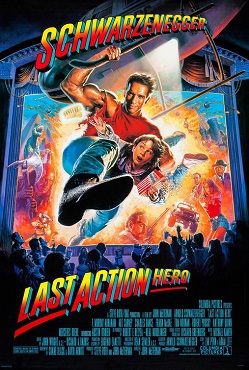
Guilty Pleasure No. 84: Last Action Hero (dir by John McTiernan)


Oh, Last Action Hero.

Ever since this film was first released in 1993, it’s usually held up as an example of a Hollywood fiasco.  The script was originally written to be a modest satire of action films.  The screenwriters wrote the character of Jack Slater, an movie action hero who comes into the real world, for Dolph Lundgren.  Instead, the film became an Arnold Schwarzenegger extravaganza and the studio ended up tossing a ton of money at it.  When the film was originally released, the reviews were mixed and the box office was considered to be disappointing.  (That it went up against the first Jurassic Park was definitely an underrated issue when it came to the box office.)  Ever since then, The Last Action Hero has had a reputation for being a bad film.

Well, I don’t care.  I like The Last Action Hero.  Yes, it’s a bit overproduced for a comedy.  (It breaks my own rule about how no comedy should run longer than two hours.)  Yes, it gets a bit sentimental with ten year-old Danny Madigan (Austin O’Brien) using a magic, golden ticket to enter the film world of his hero, Jack Slater.  If you want to argue that the film should have devoted more time to and gone a bit deeper into contrasting the film world with the real world, I won’t disagree with you.  But I will also say that Sylvester Stallone starring as The Terminator in Jack’s world was actually a pretty funny sight gag.  Danny knowing better than to trust a character played by F. Murray Abraham made me laugh.  Danny’s fantasy in which Arnold Schwarzenegger played Hamlet was made all the better by the fact that his teacher was played by Laurence Olivier’s wife, Joan Plowright.   Danny DeVito as Whiskers the Cartoon Cat makes me laugh as well, even if it is perhaps a bit too bizarre of a joke for this particular film.  (There’s nothing else about the Jack Slater films that would explain the presence of a cartoon cat.)

When you set aside the idea of the Last Action Hero being a symbol of Hollywood bloat and just watch it as a film, it emerges as an enjoyably goofy action movie, one that captures the joy of watching movies (because who hasn’t wanted to enter a movie’s world at some point in their life), and also one that features a rather charming performance from Arnold Schwarzenegger.  (Schwarzenegger, I should add, plays both himself and Jack Slater.  One of my favorite jokes is when the real Schwarzenegger is at a premiere and he mistakes the evil Ripper for Tom Noonan, the actor who played him in the previous Jack Slater film.)  Yeah, the golden ticket is a little bit hokey but who cares?  Underneath all of the special effects and action and money spent on star salaries, Last Action Hero is an action movie and comedy with a heart.  Danny meets his hero but also gets to become a hero himself.  And Jack Slater turns out to be everything you would hope your movie hero would be.  In the end, it’s obvious that a lot of the criticism of this film has more to do with the appeal of riding the bandwagon as opposed to what actually happens on screen.

Last Action Hero is a movie that I’ll happily defend.

Previous Guilty Pleasures

  1. Half-Baked
  2. Save The Last Dance
  3. Every Rose Has Its Thorns
  4. The Jeremy Kyle Show
  5. Invasion USA
  6. The Golden Child
  7. Final Destination 2
  8. Paparazzi
  9. The Principal
  10. The Substitute
  11. Terror In The Family
  12. Pandorum
  13. Lambada
  14. Fear
  15. Cocktail
  16. Keep Off The Grass
  17. Girls, Girls, Girls
  18. Class
  19. Tart
  20. King Kong vs. Godzilla
  21. Hawk the Slayer
  22. Battle Beyond the Stars
  23. Meridian
  24. Walk of Shame
  25. From Justin To Kelly
  26. Project Greenlight
  27. Sex Decoy: Love Stings
  28. Swimfan
  29. On the Line
  30. Wolfen
  31. Hail Caesar!
  32. It’s So Cold In The D
  33. In the Mix
  34. Healed By Grace
  35. Valley of the Dolls
  36. The Legend of Billie Jean
  37. Death Wish
  38. Shipping Wars
  39. Ghost Whisperer
  40. Parking Wars
  41. The Dead Are After Me
  42. Harper’s Island
  43. The Resurrection of Gavin Stone
  44. Paranormal State
  45. Utopia
  46. Bar Rescue
  47. The Powers of Matthew Star
  48. Spiker
  49. Heavenly Bodies
  50. Maid in Manhattan
  51. Rage and Honor
  52. Saved By The Bell 3. 21 “No Hope With Dope”
  53. Happy Gilmore
  54. Solarbabies
  55. The Dawn of Correction
  56. Once You Understand
  57. The Voyeurs 
  58. Robot Jox
  59. Teen Wolf
  60. The Running Man
  61. Double Dragon
  62. Backtrack
  63. Julie and Jack
  64. Karate Warrior
  65. Invaders From Mars
  66. Cloverfield
  67. Aerobicide 
  68. Blood Harvest
  69. Shocking Dark
  70. Face The Truth
  71. Submerged
  72. The Canyons
  73. Days of Thunder
  74. Van Helsing
  75. The Night Comes for Us
  76. Code of Silence
  77. Captain Ron
  78. Armageddon
  79. Kate’s Secret
  80. Point Break
  81. The Replacements
  82. The Shadow
  83. Meteor

Brad’s “Scene of the Day” is from RED HEAT (1988), starring Arnold Schwarzenegger and James Belushi!


I want to wish a happy 37th anniversary to RED HEAT, which premiered on June 17th of 1988. Directed by the legendary Walter Hill, one of the finest directors of the 70’s and 80’s, RED HEAT entertainingly combines Hill’s badass action scenes with the buddy cop shenanigans of Arnold Schwarzenegger and James Belushi. It’s a movie that I dearly love, and I’m glad to have an excuse to celebrate it today!

Enjoy this scene where the Russian cop played by Schwarzenegger, who’s just learned about the “Miranda rights” in the United States, proves he hasn’t quite grasped the concept yet! 

April Noir: Thief (dir by Michael Mann)


1981’s Thief tells the story of Frank (James Caan).

Frank is a professional diamond thief, one of the best in the business.  He’s so cool that he even has his own Tangerine Dream soundtrack.  After doing a stint in prison, Frank lives his life very carefully and with discipline.  He’s determined not to return to prison.  His mentor (played by Willie Nelson) is still behind bars and will probably die there.  In fact, Frank has even found himself thinking about abandoning his criminal lifestyle.  He’s got two front businesses, both of which are doing well.  (Frank’s used car lot looks like some sort of alien world.)  He’s fallen in love with a cashier named Jessie (Tuesday Weld) and it’s starting to seem like now would be a good time to settle down and become a family man.  The only problem is that Frank is working for Leo (Robert Prosky) and Leo has absolutely no intention of allowing Frank to walk away.  As Leo puts it, Frank belongs to him.  That’s not a smart thing to say to someone like Frank.

Frank’s an interesting character.  He’s the film’s hero, not because he’s a good guy but because he’s a smidgen better than most of the other bad guys.  He’s a professional, one who goes out of his way avoid unnecessary complications.  When we see him on the job, it’s impossible not to admire just how good he is at stealing stuff.  When he uses a blowtorch to break into a store or a safe, the screen is full of sparks and, for a few minutes, Frank looks like some sort of cosmic super hero brought to life.  We admire Frank but we discover early on that he’s willing to get violent.  He’s willing to pull a gun and threaten his way out of a situation.  Frank is loyal.  He visits his mentor in prison.  He takes care of his partner-in-crime, Barry (Jim Belushi, making his film debut).  He truly loves Jessie.  But, at heart, he’s a criminal who doesn’t hesitate to pull the trigger when he has to.  The question the film asks is whether one can just go straight, after years of breaking the law and living in the shadows.  Can Frank abandon the lifestyle, even for love?  Or is he destined to always be a thief?

Thief was Michael Mann’s feature film debut.  (The Jericho Mile was Mann’s directorial debut but it was made for television.)  Thief is full of the usual Mann themes and also Mann’s signature style, showing that Mann knew exactly what type of films he wanted to make from the start of his career.  The nights are full of shadows.  The days are deceptively calm.  The neon of Frank’s car lot glows like another dimension.  The final bloody shoot out takes place at night, in the type of suburban neighborhood in which most people would probably love to live.  And holding the film together is James Caan, giving a coolly centered performance as a man who has learned to hold back his emotions and who won’t be controlled by anyone.  Halfway through the film, Caan delivers a seven-minute monologue about life in prison and it’s an amazing moment, one in which Caan shows just how good of an actor he truly was.  Thief is an effective and stylish neo-noir, one that sticks with you as the end credits roll.


“Going All Kanye On You”: New Year’s Eve (dir by Garry Marshall)


“New Year’s Eve is the worst, people who don’t drink or party all year suddenly going all Kanye on you.”

That line was delivered by Ashton Kutcher in the 2011 film, New Year’s Eve.  Seven years ago, when the film was first released, I thought it was an awkward line, partially because Ashton Kutcher sounded like he was drowning in self-loathing when he said it and partially because the sudden reference to Kanye West felt like something that would be considered clever by 60-something screenwriter who had just spent a few hours scanning twitter to see “what the kids are into nowadays.”

(Of course, hearing the line in 2018 was an even stranger experience.  People who don’t drink or party all year suddenly going all Kanye on you?  So, they’re putting on red MAGA caps and spending New Year’s Eve tweeting about prison reform?  True, that’s the way a lot of people celebrated in my part of the world but I’m not sure how exactly that would play out in Times Square.)

In New Year’s Eve, Kutcher plays a character named Randy.  Randy is a comic book artist, which means that he’s snarky and cynical and doesn’t really see the point of celebrating anything.  Fortunately, he gets trapped in an elevator with Elise (Lea Michele) and, with her help, he comes to learn that New Year’s Eve is not the worst.  Instead, it’s the most important holiday ever created and, if you don’t think so, you’re worse than the devil.

Fortunately, Hillary Swank is present to make sure that we all get the point.  Swank plays Claire Morgan, who is in charge of making sure that the ball drops at exactly the right moment at Times Square and who gets a monologue where she explains that the purpose of the ball is to make you think about both the past and the future.  As she explains it, the world comes together one night a year, all so everyone can watch that ball drop.  Apparently, if the ball doesn’t drop, the new year doesn’t actually start and everyone is trapped in a timeless limbo, kind of like Iron Man at the end of Avengers: Infinity War.

Of course, there’s more going on in New Year’s Eve than just Randy taking Kanye’s name in vain and Claire refusing the accept that Times Square is not the center of the universe.  There’s also an old man (Robert De Niro) who wants to time his death so he passes right at the start of the new year.  Sarah Jessica Parker plays the mother of frustrated teenager Abigail Breslin and gets to make a “girls gone wild” joke.  (A Kanye reference and a girls gone wild joke in the same film?  It’s like a pop culture tsunami!)  Michelle Pfeiffer tries to accomplish all of her new year’s resolutions with the help of Zac Efron.  Halle Berry worries about her husband (Common) , who is serving overseas.  Josh Duhamel searches for a woman who once told him that his heart was more important than his business.  Seth Meyers and Jessica Biel compete with Til Schweiger and Sarah Paulson to see who can be the family of the first child born in the new year.  Jon Bon Jovi thinks about the woman that he nearly married and Katherine Heigl wonders if she’s ever going to have a career again.  In other words, New Year’s Eve is an ensemble piece, one in which a bunch of slumming Oscar winners and overachieving TV actors step into small roles.  It leads to some odd pairings.  De Niro, for instance, shares scenes with Alyssa Milano while Sofia Vergara and Ludacris are both relegated to playing sidekicks.  Michael Bloomberg, New York’s then-mayor and general threat to civil liberties everywhere, also shows up, playing himself with the type of smarminess that already has many people dreading the prospect of his 2020 presidential campaign.  This is one of those films where everyone has a familiar face but no one makes much of an impression.

New Year’s Eve was directed by the late Garry Marshall and it’s the second film in his so-called holiday trilogy, sitting right between Valentine’s Day and Mother’s Day.  By most accounts, Garry Marshall was a nice guy and popular in the industry, which perhaps explains why so many familiar faces were willing to sign up to appear in New Year’s Eve.  Though the film is ruthlessly mediocre, it’s actually the best of the holiday trilogy.  For all the schmaltz and forced sentiment, one gets the feeling that the film actually is sincere in its belief in the importance of that ball dropping in Times Square.

I remember that, when New Year’s Eve was first released, a lot of people joked that Marshall was going to make an ensemble romantic comedy about every single holiday, all with the hope that at least one of them would eventually become a television perennial in the style of It’s A Wonderful Life or The Ten Commandments.  Interestingly, that’s exactly what happened with New Year’s Eve.  Yesterday, E! aired New Year’s Eve three times, back-to-back!  For better or worse, this film is probably going to outlive us all, ensuring that, in the far future, viewers will spend New Year’s Eve asking themselves, “What’s a kanye?”

2017 In Review: Lisa Marie’s Final Post About Twin Peaks: The Return (for now)


“Nothing will die. The stream flows, the wind blows, the cloud fleets, the heart beats. Nothing will die.” — John Merrick’s Mother, quoting Tennyson, at the end of The Elephant Man (1980)

Was Twin Peaks: The Return a movie or a TV show?

As I sit here on January 9th, 2018, that’s a question that’s still on my mind.  There are many critics who insist that Twin Peaks: The Return should be viewed as being a 16-hour movie.  It’s a claim that I, myself, have made several times.  In order to support this argument, we point out that David Lynch and Mark Frost didn’t sit down and write 16 different scripts.  Instead, they wrote one 900-page script which they then filmed and subsequently divided into 16 different “chapters.”  It’s really not that much different from what Quentin Tarantino did with Kill Bill or what Peter Jackson did with both The Lord of the Rings and The Hobbit.  As well, Twin Peaks: The Return was such a monumental artistic achievement that calling it a TV show just seems somehow diminishing.

And yet, the fact of the matter is that Twin Peaks: The Return did air on television.  It aired in 16 different episodes, which were aired on a weekly basis.  To many, that fact alone makes Twin Peaks: The Return a television show.

It may all seem like a silly question to some readers.  However, for those of us who like to make best-of lists at the start of the new year, it is a legitimate issue.  Should I include Twin Peaks: The Return at the top of my list of the best 26 films of 2017 or should I rave about it in my list of good things I saw on television in 2017?

My solution is to do neither.  Twin Peaks: The Return was such a monumental achievement that it deserves a best-of entry of its very own.

(Of course, not everyone is going to agree.  For everyone who loved Twin Peaks: The Return, there was someone else who hated it with just as much of a passion.)

Months after the show ended, Twin Peaks: The Return continues to haunt many viewers.  As the Man From Another Place once told Agent Cooper, “She is full of secrets.”  When the show ended, many of the show’s mysteries were left unsolved.  Really, we shouldn’t have been surprised.  As a filmmaker, David Lynch has always been most interested in mysteries than solutions.  What happened to Audrey?  Why did Laura/Carrie scream?  At the end of the show, was Dale trapped in another world or another time?  Was BOB really destroyed?

Interestingly, David Lynch actually provided viewers with two endings.  The first ending, which occurred halfway through Part 17, was an ending that would have been perfect for a television show.  Dale Cooper, back to normal, defeated the bad guys and was reunited with all of his friends.  The second ending — also known as Part 18— was a much more Lynchian ending as two strangers took a road trip to nowhere.  Part 17 gave us hope for the future.  Part 18 ended with a dark reminder that the past cannot be changed, no matter how much we obsess over it.  For me, Part 18 was the most important chapter of Twin Peaks: The Return.  Part 8, of course, is the chapter that got and continues to get all the attention.  And Part 8 was probably one of the greatest stand-alone episodes in television history.  But, when considering the reoccurring themes of Twin Peaks: The Return and all of Lynch’s work, Part 18 was far more important.

What’s interesting is that, while the show ended on a dark note, Twin Peaks: The Return was often Lynch at his most optimistic.  For all the terrible things that happened, the show also featured a reoccurring theme of redemption.  Two of the original show’s most villainous characters — Dana Ashbrook’s Bobby Briggs and Richard Beymer’s Ben Horne — were reintroduced as two of the most sympathetic characters to be found in The Return.  Agent Cooper finally escaped from the Black Lodge and not only got a chance to redeem himself by destroying Bob but he also destroyed his evil Double.  He even got a chance to turn Dougie Jones into a good husband, father, and employee.

In the end, it would appear that Cooper’s only mistake was thinking that he could change the past.  He may have saved Laura but, in doing so, he just transformed her into Carrie, an unbalanced woman living in a house with a dead body on the couch.  As her final scream confirmed, he could save her life but he couldn’t erase her pain.  The past is the past but the future can always be better.

Of course, it wasn’t just the characters on the show who won redemption.  The cast of Twin Peaks: The Return was truly amazing and, by the time the show ended, my opinion of several performers had changed forever.  Who would ever have guessed that Jim Belushi would end up being one of my favorite characters?  Or that Michael Cera would turn Wally Brando into a minor cult hero?   Or that David Lynch would prove to be as good an actor as he is a director?  Or that Balthazar Getty would get a chane to redeem his less than impressive work in Lost Highway with a chilling performance as the newest face of Twin Peaks corruption?  Even the returnees from the original show — Dana Ashbrook, Wendy Robie, Sheryl Lee, Harry Goaz, Kimmy Robertson, Russ Tamblyn, Everett McGill, Peggy Lipton, Grace Zabriskie, James Marshall, Madchen Amick, and others — were given a chance to reveal new depths of character.  Veterans like Robert Forster, Ashley Judd, Laura Dern, Don Murray, Jennifer Jason Leigh, Naomi Watts and Tim Roth shared the stage with newcomers like Chrysta Bell and Eamon Farren and they all came together to create an unforgettable world.

You could even argue that Twin Peaks: The Return was a comeback of sorts for Kyle MacLachlan.  Hollywood has never seemed to really understand how to best use this appealing but quirky actor.  Twin Peaks: The Return provided him with a chance to show what he can do, giving him not just one but three characters to play.


Twin Peaks: The Return gave us one final chance to appreciate some talented people who are no longer with us.  Harry Dean Stanton was the face of old-fashioned decency.  Miguel Ferrer provided snarky commentary, letting the audience know that the show understood how strange it was.  Warren Frost returned briefly, still as reliable as ever as Doc Hayward.  And Catherine E. Coulson, who was so often Lynch’s muse, got to play the role one more time.

(Jack Nance, Don S. Davis, Frank Silva, and David Bowie all made appearances as well, a reminder that they may no longer be with us but they will never be gone.)

In the end, it seems appropriate to end this post with a picture of Ed and Norma, finally together.  The world of Twin Peaks: The Return was frequently a dark one but sometimes, love won.

Tomorrow, my look back at 2017 continues with my picks for my favorite songs of 2017.

Previous entries in the TSL’s Look Back at 2017:

  1. 2017 in Review: Top Ten Single Issues by Ryan C
  2. 2017 in Review: Top Ten Series by Ryan C
  3. 2017 In Review: Top Ten Collected Edition (Contemporary) by Ryan C
  4. 2017 In Review: Top Ten Collected Editions (Vintage) by Ryan C
  5. 2017 in Review: Top Ten Graphic Novels By Ryan C
  6. 25 Best, Worst, and Gems I saw in 2017 by Valerie Troutman
  7. My Top 15 Albums of 2017 by Necromoonyeti
  8. 2017 In Review: Lisa Marie’s Picks For the 16 Worst Films of 2017