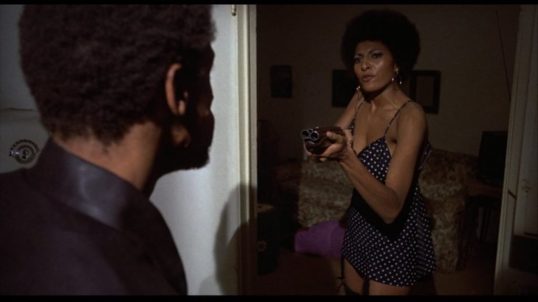
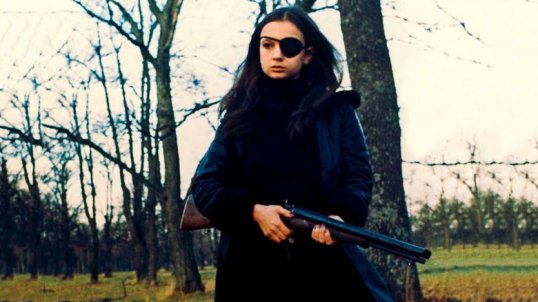
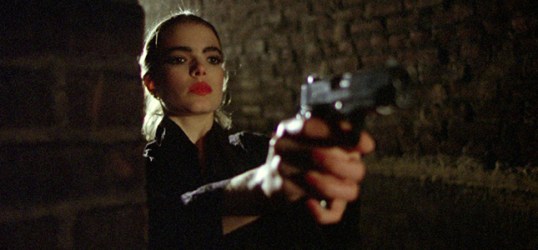
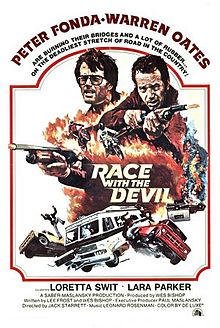
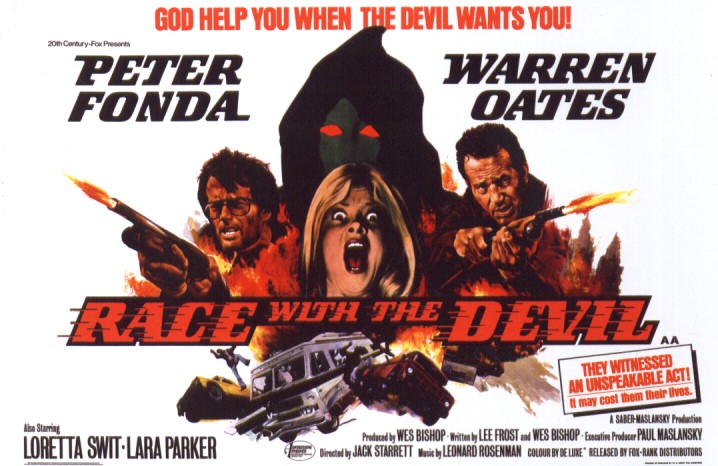
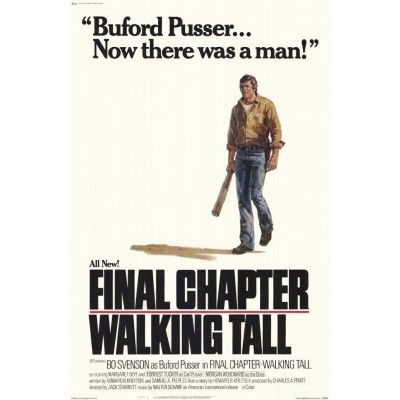
4 Shots From 4 Films is just what it says it is, 4 shots from 4 of our favorite films. As opposed to the reviews and recaps that we usually post, 4 Shots From 4 Films is all about letting the visuals do the talking.
For those who might question my decision to highlight four grindhouse films on International Women’s Day, I kindly refer them to my essay, Too Sordid To Ever Be Corrupted.
4 Shots From 4 Films
Coffy (1973, dir by Jack Hill)
Thriller, A Cruel Picture a.k.a. They Call Her One Eye (1973, dir by Bo Arne Vibenius)
Roger (Peter Fonda) and Frank (Warren Oates) are lifelong friends and business partners who, along with their wives Kelly (Lara Parker) and Alice (Loretts Swit), are planning on taking the “best damn vacation we ever had.” Traveling to Colorado in Frank’s RV, they decide to camp for a night next to a river. Not only do Frank and Roger witness what appears to be a human sacrifice but they also have to run for their lives when they are spotted. The local sheriff (R.G. Armstrong) tells them that they probably just saw a bunch of hippies killing an animal but Peter Fonda knows hippies and those were not hippies. Taking some blood-stained dirt so it can be analyzed by the authorities, Roger and Frank try to drive on but find themselves being pursued by Satanists.
A relentless and entertaining B-movie, Race With The Devil is a hybrid of Rosemary’s Baby, Smokey and the Bandit, and Easy Rider, with some Parallax View-style paranoia mixed in as well. Eventually, it seems as if everyone in rural Texas — from the sheriff to the gas station attendant to the residents of an RV park where our heroes try to spend the night — is a Satanist. (Even a wrecked school bus turns out to just be an excuse to get the RV to slow down so the Satanic rednecks can attack, leading to Warren Oates’s classic line, “I don’t believe in a school bus on Sunday.”)
A big part of the fun of Race With The Devil is getting to watch Peter Fonda and Warren Oates acting opposite each other. (A lot of drive-in patrons probably left Race With The Devil with a crush on the lovely Lara Parker as well.) Friends both on and off-screen (Oates previously co-starred in Fonda’s directorial debut, The Hired Hand), Fonda and Oates are a lot of fun to watch playing off of each other in Race With The Devil, with Warren Oates’s natural intensity providing a good contrast to Fonda’s laid back style.
It may not rank up there with the movies that he appeared in for Sam Peckinpah and Monte Hellman but Race With The Devil is still one of Warren Oates’s most entertaining films.
For the past week and a half, I have been on a major Warren Oates kick. The latest Oates film that I watched was Kid Blue, a quirky western comedy that features Warren in a small but key supporting role.
Bickford Warner (Dennis Hopper) is a long-haired and spaced-out train robber who, after one failed robbery too many, decides to go straight and live a conventional life. He settles in the town of Dime Box, Texas. He starts out sweeping the floor of a barber shop before getting a better job wringing the necks of chickens. Eventually, he ends up working at the Great American Ceramic Novelty Company, where he helps to make ashtrays for tourists.
He also meets Molly and Reese Ford (Lee Purcell and Warren Oates), a married couple who both end up taking an interest in Bickford. Reese, who ignores his beautiful wife, constantly praised Greek culture and insists that Bickford take a bath with him. Meanwhile, Molly and Bickford end up having an affair.
Bickford also meets the local preacher, Bob (Peter Boyle). Bob is enthusiastic about peyote and has built a primitive flying machine that he keeps in a field. The town’s fascist sheriff, Mean John (Ben Johnson), comes across Bob performing a river baptism and angrily admonishes him for using “white man’s water” to baptize an Indian.
Bickford attempts to live a straight life but is constantly hassled by Mean John, who suspects that Bickford might actually be Kid Blue. When Bickford’s former criminal partner (Janice Rule) shows up in town and Molly announces that she’s pregnant, Bickford has to decide whether or not to return to his old ways.
Kid Blue is one of a handful of counterculture westerns that were released in the early 70s. The film’s biggest problem is that, at the time he was playing “Kid” Blue, Dennis Hopper was 37 and looked several years older. It’s hard to buy him as a naïve naif when he looks older than everyone else in the cast. As for Warren Oates, his role was small but he did great work as usual. Gay characters were rarely presented sympathetically in the early 70s and counter-culture films were often the worst offenders. As written, Reese is a one-note (and one-joke) character but Warren played him with a lot of empathy and gave him a wounded dignity that was probably not present in the film’s script.
Kid Blue plays out at its own stoned pace, an uneven mix of quirky comedy and dippy philosophy. Still, the film is worth seeing for the only-in-the-70s cast and the curiosity factor of seeing Dennis Hopper in full counterculture mode, before he detoxed and became Hollywood’s favorite super villain.
For one last time, Buford Pusser is back! The 1977 film Walking Tall: Final Chapter ends the story that was begun in Walking Tall and continued in Walking Tall Part II.And it turns out that the final chapter is pretty much just like the previous two chapters. In fact, I’m tempted to just tell you go reread my review of Walking Tall Part II because that review works just as well for most of the Final Chapter.
Final Chapter starts with footage from the first Walking Tall, with Bo Svenson awkwardly inserted in place of Joe Don Baker. Once again, we watch as Elizabeth Hartman is shot in the back of the head and Svenson — in the role of Buford Pusser — is shot in the face. Oh my God, we think, how many times can the exact same thing happen to the exact same character!?
Oh wait — it turns out that Buford is just remembering the death of his wife. Buford is still haunted by that day and he’s still out for vengeance. For the next hour or so, we follow Buford as he and his deputies blow up moonshiners across Tennessee. After each arrest, an attorney shows up and yells at Buford for violating everyone’s civil rights. In response, Buford smirks until the attorney gets so mad that he decides to run for sheriff himself.
Buford doesn’t give his opponent much of a chance. As one of his deputies puts it, this guy is just a “bleeding heart liberal.” (But if he’s so liberal, what’s he doing in Tennessee? Off with you, sir — return to Vermont!) Instead of campaigning, Buford spends his time hunting down more moonshiners. When he discovers that one moonshiner is also an abusive father, he personally drives the man’s son down to the local orphanage. Oddly enough, Buford does not offer to adopt the kid himself.
Anyway, to the shock of everyone, Buford is not reelected. No longer sheriff, he struggles to find a full-time job and makes plans to run in the next election. One of the moonshiners shows up and taunts Buford until Buford is forced to beat him up in the middle of the street. The new sheriff show up and demands to know what happened. None of the townspeople are willing to snitch on Buford. Good for them!
After about an hour and a half of this, something interesting actually happens. A film producer drives up to the Pusser Farm and tells Buford that he wants to make a movie out of his life. “We’re going to tell the story exactly how it happened!” the producer assures him. In the next scene, Buford is advising the director of Walking Tall on how to properly film a car chase.
And you know what? These scenes of Buford watching his life story be filmed are actually rather charming. For the only time in the series, Bo Svenson actually appears to be having fun in these scenes. And, when Buford runs from a theater while watching the recreation of his wife’s murder, it’s actually a very effective moment.
Anyway, there’s not much running time left after all of that. We see Buford sign a contract to play himself in the sequel and, by this point, we all know what happened afterward. Buford was killed in a mysterious car accident. But fear not! The film opens with a heavenly choir and Svenson’s voice booming from the heavens so we all know that Buford Pusser is arresting moonshiners in Heaven.
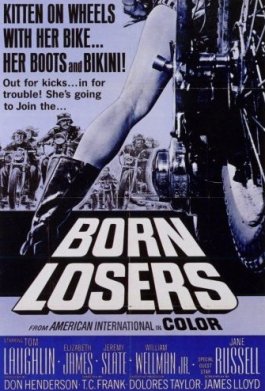
For the past few days, I’ve been in the process of reviewing 94 films about politics and politicians. With that in mind, you may be wondering why, after reviewing films like The Last Hurrah, Sunrise at Campobello, and Advise & Consent, I am now reviewing a 1967 biker film called The Born Losers.
It all comes down to Billy Jack. In the 70s, Tom Laughlin would write, direct, and star in two hit films — Billy Jack and The Trial of Billy Jack. In these films, Laughlin played the title character. Billy Jack was everything that you could hope for in a counter-culture hero. First off, as an American Indian, he was an authentic American as opposed to just another European intruder. He was a war hero, who had served as a Green Beret in Vietnam. He often carried a gun with him, which meant that he understood and supported the 2nd Amendment and good for him! Billy Jack was also a master of hapkido, which meant that he could kick ass in the most visually appealing way possible.
Even more importantly, Billy Jack called the Man out on his racism and his intolerance. Billy Jack was an environmental activist before anyone else. Billy Jack went on vision quests. Billy Jack was anti-war. Billy Jack was a pacifist. And, of course, Billy Jack ended up killing a lot of people but they were all bad guys.
By making and distributing Billy Jack himself, Laughlin became an independent film pioneer and made history. He also became a counter-culture hero and Billy Jack remains a cult figure even today. But what a lot of people don’t realize is that Billy Jack first appeared in Born Losers and that, in the little seen Billy Jack Goes To Washington, he eventually ended up serving in the U.S. Senate.
When you consider that Billy Jack would eventually be Sen. Jack, that means the Born Losers isn’t just a low-budget, violent biker film. Instead, it’s the exploitation version of Young Mr. Lincoln. It’s a chance to see what Billy Jack was doing before he became a statesman.
(And rest assured, the other three Billy Jack films will be reviewed before Shattered Politics ends.)
As we discover at the start of Born Losers, pre-politics Billy Jack was just an enigmatic veteran who lived in the mountains of California. When we first see Billy, he’s walking along a grassy hill. A deer safely runs by the camera. A rabbit pops its head out of a hole in the ground and looks relieved to see Billy. If I’m being a little bit snarky, it’s because I’ve seen all of the Billy Jack films and I know how often this exact scene is played out over the course of the franchise. But, in all fairness, it’s actually a fairly well-done and visually appealing scene and, as an actor, Laughlin had the presence to pull it off.
A far less pretty scene is occurring in the town of Big Rock, where teenagers are showing up to hang out on the beach and are being harassed by a group of bikers, the Born Losers of the title. The Born Losers are an odd collection of bikers, with half of them looking like extras from Sons of Anarchy and the other half looking like the type of hipsters that I always see whenever I go to a movie at the Alamo Drafthouse. Their leader (Jeremy Slate) is named Danny but the rest of the gang are known by their nicknames.
(For instance, there’s Crabs. Why is he called Crabs? “Because he’s got them!” Danny helpfully explains.)
After the Born Losers rape four girls, they launch a campaign of violence and intimidation to keep the girls from testifying in court. Billy comes to the aid of one of the girls, Vicky (Elizabeth James, who also wrote the script). I related to Vicky, largely because she does things like ride a motorcycle while wearing a white bikini, which is exactly the sort of thing that I would do if I lived in California.
Now, there’s a lot of negative things that I could say about Born Losers. It’s talky. With the exception of Laughlin and Slate, it’s obvious that the majority of the cast was made up of amateurs. The final half of the film drags as you wait for an ending that you have probably already predicted.
But you know what?
I actually like The Born Losers. Hidden underneath all of the exploitation trappings and heavy-handed moralizing, this is a very sincere film. Whatever they may have lacked in budget or subtlety, Laughlin’s films made up for in sincerity. And, as strange as it may be to say about a film that features four rapes and is padded out with a thoroughly gratuitous striptease, The Born Losers is not a misogynistic film. Both Laughlin the director and Billy Jack the character are on the side of the victims of the Born Losers and when the film calls out society for blaming the victims instead of the rapists, it does so with a fury that elevates the entire film above your typical 1967 biker film.
And, while I don’t know if I’d ever vote for Billy Jack, there’s nobody I’d rather have on my side.
Not to be confused with the 2010 action film, this Losers has been described as the best “bikers-in-Viet-Nam film ever.” It was directed by Jack Starrett and, like every other biker film from 1970, it stars William Smith.
This is another short trailer, in fact, I think — at just 30 seconds — it might be the shortest trailer I’ve ever featured in this series. Anyway, Chatterbox is a film about a woman whose vagina can talk and, apparently, sing. I have never seen this film though I have seen a few isolated clips. I hope if my vagina ever starts to speak, it 1) has a less annoying voice and 2) just displays a lot more wit and personality in general. Anyway, the talking vagina is not featured in this trailer. Anyway, you wouldn’t know any of that from watching the trailer, which I think is odd. I mean, if you’re going to make a film about a talking vagina, shouldn’t the vagina be allowed to speak for itself? Just saying…
Like all good things, this trailer comes to us from Italy.
5) Disco Fever (1978)
Wow! Disco, a concorde, dirt bike racing, braless dancers, and a boring 40 year-old rock star with a cocaine-flecked beard. Could this film be any more 70s? “Disco Fever — Everything is perfect…until the music stops!”
6) American Fever (1978)
Okay, I’m either in a disco mood or else I’m running a fever because I just have to end things with a second disco film. This is an Italian film. Does anyone out there own the American Fever soundtrack?