The TSL’s Daily Horror Grindhouse: Galaxy of Terror (dir by Bruce D. Clark)


galaxy_of_terror

Long before Event Horizon (but, perhaps more importantly, shortly after the original Alien), there was 1981’s Galaxy of Terror!

Produced by Roger Corman and featuring production design and second unit work from James Cameron, Galaxy of Terror tells the story of what happens when, in the future, the crew of the Quest are dispatched to a mysterious planet.  They’re on a rescue mission but what they don’t realize is that they’re heading into a trap!

The crew of the Quest is virtually a who’s who of cult actors.

The youngest member of the crew is Cos.  Cos is scared of everything and, from the minute you see him, you can tell that he’ll probably be the first to die.  Cos is played by Jack Blessing, who subsequently became a very in-demand voice over artist.  You may not recognize the name or the face but you’ve probably heard the voice.

Captain Trainor, who is still troubled by a disastrous mission in the past, is played by Grace Zabriskie, who is rumored to have inspired Bob Dylan’s “Like A Rolling Stone” and who subsequently became a regular member of David Lynch’s stock company.

The fearsome Quuhod is played by one of the patron saints of exploitation filmmaking, the one and only SID HAIG!  Quuhod doesn’t say much but Sid Haig doesn’t have to say much to make an impression.

Technical officer Dameia is played by Taaffe O’Connell.  She suffers through the film’s most infamous and distasteful scenes, in which she’s assaulted by a gigantic space worm.  That scene was apparently insisted upon by Roger Corman and it’s not easy to watch.  At the same time, since the film takes place on a planet that is ruled by pure evil, the scene somehow works.  It’s that scene that tells you that Galaxy of Terror is not going to be your typical B-movie.  That is the scene that says, “This movie is going to give you nightmares!”

Ranger is played by Robert Englund!  That’s right — the original Freddy Krueger himself.  It’s interesting to see Englund in this role because Ranger is actually one of the only likable characters in the film.  It’s strange to see the future Freddy Krueger being menaced by the same type of threats that he unleashed on Elm Street.  But Englund does a good job in the role.  In fact, he does so well that you wonder what would have happened in his career if he hadn’t been forever typecast as the man of your nightmares.

The arrogant and cocky Baelon is played by future director, Zalman King.  It says something about King’s acting career that Galaxy of Terror is not the strangest film that he ever appeared in.

Burned-out Commander Ilvar is played by Bernard Behrens, who is one of those character actors who has a very familiar face.  If you watch any movie from the 80s or 90s that features a weary homicide detective or an unsympathetic bureaucrat, it’s entirely possible that he was played by Bernard Behrens.

Kore, the ship’s cook, is played by Ray Waltson, who is another one of those very familiar character actors.  Over the course of his long career, Waltson appeared in everything from The Apartment to The Sting to Fast Times At Ridgemont High to a countless number of TV shows and TV movies.  Waltson was usually cast in comedic roles so it’s interesting to see him here, playing a role that is very much not comedic.

Alluma, an empath, is played by Erin Moran, who was best known for playing Ron Howard’s bratty sister on the somewhat terrible (but apparently popular and deathless) sitcom, Happy Days.  Moran’s explosive death scene is another reason why Galaxy of Terror has a cult following.

And finally, the “star” of the film is Edward Albert, who plays Cabren.  To return to my earlier comparison to Event Horizon, Edward Albert has the Laurence Fishburne role.

Anyway, our crew is sent on a rescue mission but, when they crash land on the planet Morganthus, they find themselves outside of a desolate pyramid.  They make the mistake of exploring the pyramid and end up being confronted by their greatest fears.  (They also eventually discover that one of their crewmates is a traitor.)  It’s pretty much a typical sci-fi slasher film but it makes an impression because, thematically, it’s just so dark.  The fears that attack the crew members are so ruthless and brutal that they will take even the most jaded of horror fans by surprise.  Galaxy of Terror is relentless and merciless in its effort to scare the audience.

What especially distinguishes Galaxy of Terror is that, despite the obviously low budget, the entire film feels sickeningly real.  A lot of credit for that has to go to James Cameron, who creates a lived-in future that actually feels a lot more plausible than anything to be found in Avatar.

So, if you have the chance, turn off the lights, watch the film in the dark, and prepare for a perfect Halloween nightmare!

6 Trailers From Planet Horror


For this week’s edition of Lisa Marie’s Favorite Grindhouse and Exploitation Film Trailers, we have 6 trailers from Planet Horror!

Planet of the Vampires (1965)

(From director Mario Bava)

Queen of Blood (1966)

Starship Invasions (1977)

Inseminoid (1981)

Galaxy of Terror (1981)

Breeders (1997)

What do you think, Halloween Visitors?

main-laser-beam-cloaking-device-could-save-planet-earth-from-being-annihilated-by-genocidal-aliens

Horror Film Review: Event Horizon (dir by Paul W. S. Anderson)


event_horizon_ver1

Event Horizon, a sci-fi/horror hybrid from 1997, is one of those films that starts out with a series of title cards:

“2015 First permanent colony established on moon.”

Wait … 2015?  How did I miss that?

” 2032 Commercial mining begins on Mars.”

Yay!  Only 16 more years to wait until we’re finally on Mars!

“2040 Deep space research vessel ‘Event Horizon’ launched to explore boundaries of Solar System. She disappears without trace beyond the eighth planet, Neptune. It is the worst space disaster on record.”

Wow, that sucks.  But things happen…

“2047 Now…”

Alright, let’s get this story going!

Seven years after it disappeared, the Event Horizon suddenly sends out a distress signal.  It turns out that it didn’t blow up like everyone assumed.  Instead, it’s still out in space.  The surly crew of the Lewis & Clark is called off of leave and sent on a rescue mission.  (And when I say surly, I do mean sur-ly!  Seriously, nobody on the Lewis & Clark is in a good mood … ever!)  Accompanying the crew is Dr. Weir (Sam Neill), the scientist who designed the Event Horizon.  Captain Miller (Laurence Fishburne) may not be happy about having Dr. Weir on his ship but, then again, Captain Miller always seems to be annoyed about something.

The Event Horizon appears to be deserted.  The walls are covered with blood.  The captain — at least it appears to be the captain — has been crucified and left on display.  Dr. Weir explains that the Event Horizon was designed to create an artificial black hole and it’s possible that the ship went into another dimension and that it may have brought something back with it.  Other crew members speculate that the Event Horizon may have accidentally been transported to Hell.  Either way, it’s not a good thing but, after the Lewis & Clark suffers some damage, the crew find themselves stranded on the Event Horizon.

Soon, the crew members are having hallucinations.  The ship’s doctor (Kathleen Quinlan) sees her son running through the ship.  Captain Miller sees the burning corpse of a friend that he had to abandon during a previous mission.  Another crewman appears to be possessed and attempts to commit suicide by opening up the airlock.  Dr. Weir has visions of his dead wife.  Things get darker and darker.  People die.  Eyes are ripped out of sockets.  A video of the original crew is found and it’s like something out of a painting by Hieronymus Bosch.  Miller wants to blow up the Event Horizon.  Dr. Weir replies, “We are home!”

Agck!

Seriously, Event Horizon is a curious film.  I’ve seen it a few times and I have to admit that it’s never quite as good as I remembered.  If you want to get really technical about it, Event Horizon is a poorly paced film that is overly derivative of the Alien franchise and it features perhaps the worst performance of Laurence Fishburne’s career.

(Yes, even worse than his performance in Contagion…)

But, at the same time, even if I’m always somewhat disappointed with the film, Event Horizon is also a movie that stays with you.  Whatever flaws the film may have, it is genuinely scary and disturbing.  Director Paul W.S. Anderson does a good job of turning that spaceship into the ultimate floating haunted house and, even more importantly, he keeps you off-balance.  This is one of the few horror films where literally anyone can die, regardless of whether they’re top-billed or have an Oscar nomination to their name.  Whatever the evil is that has possessed the Event Horizon, it is ruthlessly and sadistically efficient.

Plus, there’s that video.  If you’ve seen the movie, you know what I’m talking about.  Anderson has complained that the studio made him cut a lot of footage out of the video but what remains is disturbing enough.  Seriously, you’ll never want to hear another Latin phrase after watching Event Horizon.

Horror On The Lens: Plan 9 From Outer Space (dir by Edward D. Wood, Jr.)


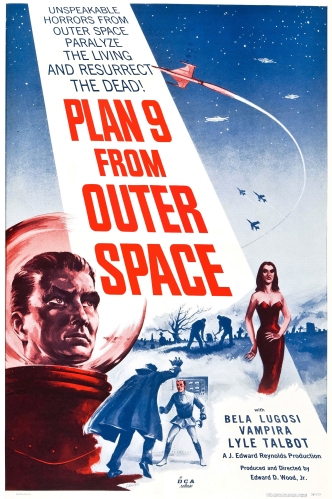
Plan_9_Alternative_posterWatching Ed Wood’s infamous Plan 9 From Outer Space is something of an October tradition here at the Shattered Lens!  And you know how much I love tradition!  (Add to that, I shared Bride of the Monster last night and I’m going to be reviewing at least two sci-fi horror films later today so it just seems appropriate to go ahead and share Plan 9 today!)

Incidentally, I know this film has a reputation for being the worst film ever made.  Personally, I don’t think that it deserves that reputation.  Is it bad?  By traditional standards of quality, I guess it can be argued that Plan 9 From Outer Space is a bad movie.  But it’s also a lot of fun and how can you not smile when you hear Criswell’s opening and closing statements?

Enjoy and be sure to read Gary’s review!

(And also be sure to read Jedadiah Leland’s tribute to Criswell!)

(On another note: Watch this as quickly as you can because, for the first time since we started Horror on the Lens, the films of Ed Wood are being yanked off of YouTube.  Copyright violations, they say.  Personally, I think that’s shameful.  First off, Ed Wood is no longer alive.  Wood had no children and his widow died in 2006, having never remarried.  Whatever money is being made off of his films is not going to support his family.  Wherever he is, I think Ed would be more concerned that people see his films than some faceless corporation make money off of them.)


Horror On TV: Tales From The Crypt 3.8 “Easel Kill” (dir by John Harrison)


For tonight’s excursion into televised horror, we have the 8th episode of the 3rd season of HBO’s Tales From The Crypt!

Easel Kill feels a bit like a remake of Color Me Blood Red.  Tim Roth plays a painter who appears to have lost his talent.  Apparently, he has recently stopped drinking and he’s just not that inspired when he’s sober.  (However, he’s just as angry as he’s always been.  He’s the type of neighbor who will push someone off of a fire escape if they’re playing their music too loud.)  Fortunately, once he starts painting with blood, people are suddenly interested in his paintings.

The only problem is getting the blood…

This episode originally aired on July 17th, 1991.

Enjoy!

The TSL’s Daily Horror Grindhouse: Scalps (dir by Fred Olen Ray)


The 1983 film Scalps answers the following question:

What happens when these grad students…

scalps-02

…dig up a sacred Native American burial ground and consider stealing some of the artifacts for themselves?

These grad students right here!

These grad students right here!

Well, they upset this lion…

scalps-1

…and this woman…

scalps-movie-1983-5

…and this guy, as well!

scalps

Needless to say, things don’t end well for anyone involved.

As for why those students were out digging for artifacts in the first place, the blame rests with Prof. Machen.  At first, Machen didn’t go with the students.  He had to take care of stuff back at the university.  When he finally did show up, it was a little bit too late.  Prof. Machen is played by an actor named Kirk Alyn, who was the first actor to play Superman back in the 1940s.

In the picture below, you can tell Prof. Machen is an explorer because of the pith helmet that he’s carrying:

vlcsnap-2014-07-26-09h28m09s26

Scalps is about 80 minutes long.  Most fans of low-budget horror will not be shocked to learn that Scalps is about 60 minutes of filler and 20 minutes of actual action.  Seriously, it takes forever for those grad students to actually reach the site of the dig and then, once they start digging, it seems to take even longer for anything to actually happen.  Occasionally, we get a quick flash forward of someone getting scalped or an insert of either the lion, the witch, or the warrior looking upset.

The grad students themselves are pretty much interchangeable.  As far as the men go, two of them have beards and another likes to drink beer.  As far as the women are concerned, two of them are blonde and one of them is slightly less blonde.  D.J. (Jo-Ann Robinson) is kind of a hippie and she has a bad feeling about everything.

(Stupid hippies!  Bleh!)

What’s odd is that, in the end, the film’s glacial pace actually works to its advantage.  Combined with an 80s synthesizer-of-doom score and some ragged but still effectively desolate shots of the desert, the slow pace actually gives Scalps something of a dream-like feel.  Like a filmed nightmare, the film is suffused with a feeling of impending doom.  Once the killings start, Scalps also makes good use of the slo-mo of doom.  Even the most rudimentary of scenes can be scary when they’re filmed in slow motion.

Scalps has been described as being one of the most censored films in cinematic history.  If you listen to Fred Olen Ray’s director’s commentary (more on that below), you’ll learn that it was largely censored due to the behavior of an unethical producer.  That said, it is a remarkably gory little film.  It may take a while for the blood to start flowing but once it starts, it doesn’t stop.  Admittedly, some of the gore effects worked better than others.  The arrow to the eye didn’t seem authentic.  The scalping, on the other hand, seemed far too authentic.  As for the decapitation …. well, I’d put that somewhere in the middle.

Scalps is something of a historical oddity, because it was one of the first films to be directed by the incredibly prolific Fred Olen Ray.  If you’re lucky enough to find the out-of-print Retromedia DVD, you can listen to a commentary track from Fred.  He’s remarkably honest about the film’s flaws and also discusses how he feels that the film’s producers ruined the film by adding random insert shots and flash forwards.  (“That’s not us doing that!” Fred says during one insert of the lion.)  Fred also points out that he made the mistake of actually shooting some of the night scenes at night.  It’s always interesting listening to a veteran director talk about his first film.  Since they have nothing to lose by openly discussing the mistakes that they made, their commentaries become a sort of a mini-film school.

Scalps is not a lost masterpiece but it is oddly watchable.  Somehow, it manages to be both silly and surprisingly effective at the same time.

210k4rq

Halloween Havoc!: THE FLY (20th Century Fox 1958)


gary loggins's avatarcracked rear viewer

fly1

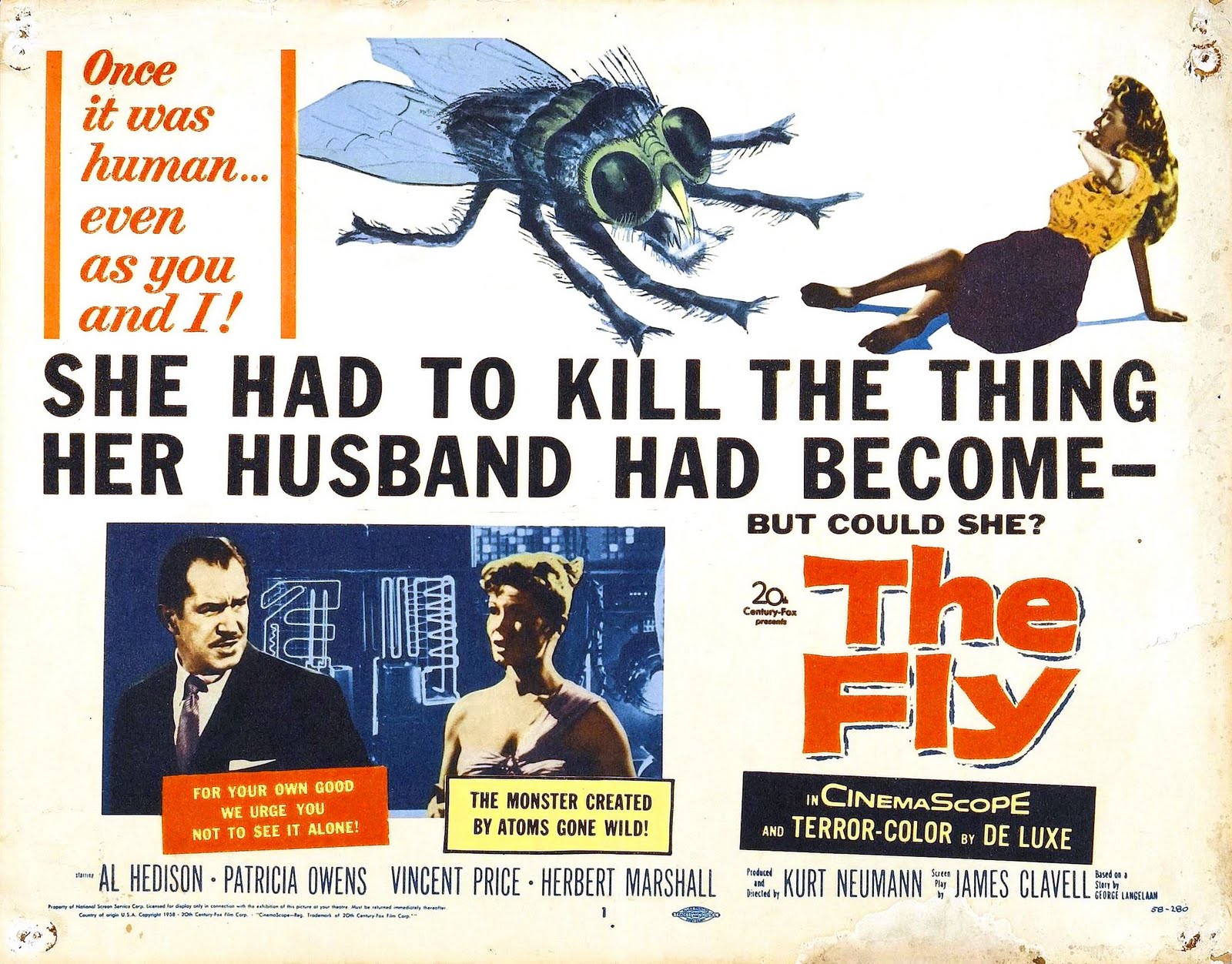
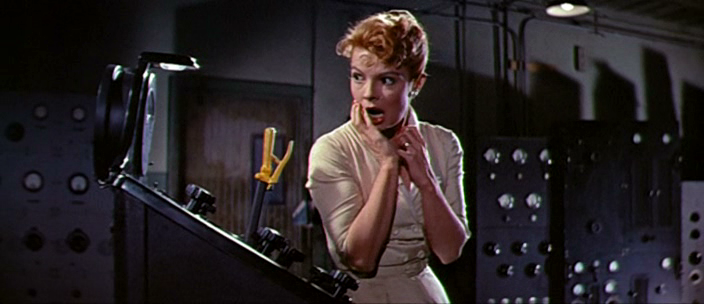
THE FLY is one of those films you’re probably familiar with if you’re a horror/sci-fi fan. I’ve seen it many times, but was under the impression it was a black & white movie (probably due to early viewings as a young’un, deprived of color TV). So when I rewatched it again in glorious Technicolor, I was pleasantly surprised. This tale of science gone wrong has held up well, and its iconic scene of The Fly’s unmasking still manages to jolt the viewer (even if you know it’s coming!).

fly2

The film’s framing device finds us witnessing Helene Delombre murdering her husband Andre by squishing his head and arm under a huge hydraulic press (and it’s a pretty gruesome demise), then calling her brother-in-law Francois to tell him. Francois is stunned, to say the least, and gets ahold of his friend Inspector Charas. They drive over to the Delombre Freres (the movie’s set in Montreal)…

View original post 827 more words

Horror Film Review: Son of Dracula (dir by Robert Siodmak)


son_of_dracula_movie_poster

Did you know that Count Dracula had a son?

Well, maybe he did or maybe he didn’t.  It all depends on how you interpret the 1943 film, Son of Dracula.  In Son of Dracula, Lon Chaney, Jr. plays a vampire named Count Alucard.  I get the feeling that it’s supposed to be a shocking moment when it’s pointed out that Alucard is Dracula spelled backwards but, since the movie is called Son of Dracula, I would think that most people would have already figured out the connection.

That said, when Alucard reveals that his true name is Dracula, he seems to be suggesting that he is the original Count Dracula.  And yet the name of the film is Son of Dracula.  At one point, two characters speculate that Alucard is a descendant of the original, just to be corrected by his bride.  “He is Dracula!” she announces.  Then again, she could just be bragging.  If you’re going to marry a Dracula, wouldn’t you rather marry the original than a descendant?

If he is the original Dracula, you do have to wonder why he’s still alive.  Since the film is a part of the Universal Dracula series, you have to wonder how he managed to survive being both staked by Van Helsing and having his body cremated by his daughter in Dracula’s Daughter.  You also can’t help but notice that Alucard doesn’t bear much of a resemblance to Bela Lugosi. nor does he have a European accent.  Instead, Alucard looks a lot like Lon Chaney, Jr.  Chaney does not make for the most convincing vampire.  As an actor, Chaney tended to project a certain “likable but dumb lug” quality that worked well for The Wolf Man and as Lenny in Of Mice and Men but it doesn’t quite work when he’s cast as a suave, Hungarian vampire.

Anyway, Son of Dracula finds Count Alucard in New Orleans at the turn of the century.  He has specifically moved to the Deep South so that he can be with Katherine Caldwell (Louise Allbritton), a young woman who is obsessed with the occult.  Katherine secretly marries Alucard.  When her former boyfriend, Frank (Robert Paige), finds out about the marriage he decides that the best way to handle way things would be to get drunk and shoot the count.  Unfortunately, since the Count is a vampire, the bullet passes through him and kills Katherine instead.

Or does it!?

Probably the most interesting thing about Son of Dracula is that it presents Alucard as being manipulated by a mortal.  Usually, Dracula is the one doing the manipulating but in Son of Dracula, it’s suggested that a clever mortal can manipulate the undead jut as easily.  GO KATHERINE!

Anyway, Son of Dracula is okay.  It has some steamy deep south atmosphere and it’s fun in a campy, Universal sort of way.  It has some historical significance because it was apparently the first film to actually feature a vampire transforming into a bat onscreen.  For the most part, though, it’s a film that will best be appreciated by Universal horror completists.

That said, I kind of like the fact that nobody in the film could figure out that Alucard is Dracula spelled backwards.  That was cute.

4 Shots From Horror History: House of Frankenstein, The Uninvited, House of Dracula, The Picture of Dorian Gray


This October, I’m going to be doing something a little bit different with my contribution to 4 Shots From 4 Films.  I’m going to be taking a little chronological tour of the history of horror cinema, moving from decade to decade.

Today, we continue our look at the 1940s.

4 Shots From 4 Films

House of Frankenstein (1944, dir by Erle C. Kenton)

House of Frankenstein (1944, dir by Erle C. Kenton)

The Uninvited (1944, dir by Lewis Allen)

The Uninvited (1944, dir by Lewis Allen)

House of Dracula (1945, dir by Erle C. Kenton)

House of Dracula (1945, dir by Erle C. Kenton)

The Picture of Dorian Gray (1945, dir by Albert Lewin)

The Picture of Dorian Gray (1945, dir by Albert Lewin)

Horror On the Lens: Bride of the Monster (dir by Ed Wood, Jr.)


Bride_of_the_Monster_(1956_movie_poster)

Today’s horror film on the lens is Edward D. Wood’s 1955 epic, Bride of the Monster.  The film itself doesn’t feature a bride but it does feature a monster, a giant octopus who guards the mansion of the mysterious Dr. Vornoff (Bela Lugosi).  Vornoff and his hulking henchman Lobo (Tor Johnson) have been kidnapping men and using nuclear power to try to create a race of super soldiers.  Or something like that.  The plot has a make-it-up-as-you-go-along feel to it.  That’s actually a huge part of the film’s appeal.

Bride of the Monster is regularly described as being one of the worst films ever made but I think that’s rather unfair.   Appearing in his last speaking role, Lugosi actually gives a pretty good performance, bringing a wounded dignity to the role of Vornoff.  If judged solely against other movies directed by Ed Wood, this is actually one of the best films ever made.

(For a longer review, click here!)