Horror on TV: Tales From The Crypt 3.7 “The Reluctant Vampire” (dir by Stephen Hopkins)


Since I’ve been reviewing so many Dracula films as of late, it seems only appropriate that tonight’s excursion into televised horror should be about a vampire as well!

The Reluctant Vampire was the 7th episode of the 3rd season of HBO’s Tales From The Crypt!  It stars Malcolm McDowell as a vampire who is a little bit too nice for his own good.  Seriously, you can’t go wrong with Malcolm McDowell as a vampire.

The Reluctant Vampire originally aired on July 10th, 1991.

Enjoy!

The TSL’s Daily Horror Grindhouse: Green Room (dir by Jeremy Saulnier)


greenroom5

Jeremy Saulnier’s Green Room is one of the best films of the year but I don’t know if I’m ever going to be able to bring myself to watch it a second time.

Why?

There’s two reasons:

Number one, Green Room is one of the most intense films that I’ve ever seen.  Much like Saulnier’s previous film, Blue Ruin, this is a violent movie that never makes violence look fun.  The violence here is all too real and the pain that the characters feel is all too real as well.  I watched a good deal of Green Room through my fingers, hiding my face behind my hands.  Seriously, I’ve seen some pretty gory movies.  (I’m an unapologetic fan of Italian horror, after all.)  But Green Room still left me shaken.  Occasionally, it even left me gasping for breath.  It’s just that intense.  It’s a film about four people battling for survival and I’m surprised (and a little proud) that I survived all the way to the end.

The other reason is that the film stars Anton Yelchin.  It was one of the final films that he made before his death and he gives such a likable and committed performance that it’s impossible for me to think about the film without getting a little emotional.  Far more than his supporting work in the Star Trek films, Green Room showcased what a good actor Anton Yelchin truly was.  It’s impossible for me to think about Green Room without mourning a talent taken from us far too soon.  And though it might be difficult to watch the film a second time, everyone should watch Green Room at least once.  If you ever wonder why some of us still get emotional when we talk about Anton Yelchin, it’s all there in the movie.

In Green Room, Yelchin plays Pat.  Pat is the bass player for a punk band called the Ain’t Rights.  The Ain’t Rights have been touring the northern part of the country.  It’s a low-budget tour, one that perfectly reflects that anti-corporate politics of the Ain’t Rights.  For them, the tour means crashing with friends, siphoning gasoline, and doing interviews with underground radio stations.  In fact, one interviewer — the rather dorky Tad (David W. Thompson) — arranges for them to do a show at an isolated bar in Oregon.  Tad tells them that the bar attracts a rough crowd but that they’ll be okay because his cousin Daniel (Blue Ruin‘s Macon Blair) works there.

The Ain’t Rights arrive and discover that the club appears to have a clientele that is exclusively made up of Neo-Nazi skinheads.  After some hesitation, the Ain’t Rights take the stage and, for a few brief moments, Saulnier shows them performing in slow motion and those of us in the film’s audience — even someone like me, who would probably otherwise never listen to a band like the Ain’t Rights — are briefly caught up in the joy and excitement of their performance.

Unfortunately, while the band is performing, the Nazis are busy murdering a woman in the green room.  And, after the band walks in on the aftermath of the murder, they soon find themselves marked for death as well.  The band is smart enough to lock themselves in the green room and to take one of the Nazis as a hostage.  However, they know that they can’t stay in that room forever.  At some point, they’re going to have to figure out how to escape from the bar…

Green Room is a harrowing and violent film, one that maintains an almost feverish intensity from start to end.  Making it all the more difficult to watch is that Saulnier keeps the horror rooted in reality.  The Neo-Nazis never turn into cardboard movie slashers.  Instead, they are a very real and disturbing threat.  (It’s interesting to note that occasionally, a Neo-Nazis will express some doubt about killing the band but none of them have the courage to actually refuse any of the orders that they receive.  We often hear that people need to respect authority.  Well, Green Room shows what happens when people blindly respect authority to the extent that they can no longer think for themselves.)  Though the film may be violent, it never celebrates that violence and when one character does get a chunk of arm chopped off, it’s literally one of the most painful images to ever be captured on film.  You like every member of the band so, when they get hurt, you feel their pain as well.  Though Yelchin may be the main character, the other members of the Ain’t Rights — played by Alia Shawkat, Joe Cole, and Callum Turner — all make a good impression as well.  You want them all to escape and dread the realization that not all of them will.

As for the owner of the club, his name is Darcy and he’s played by Patrick Stewart.  At first, it may sound like stunt casting.  Patrick Stewart as a Neo-Nazi?  But interestingly enough, Darcy doesn’t really seem to care about ideology.  Instead, you get the feeling that he realized that there was money to be made by catering to racists so that’s what he decided to do.  When he barks out orders and demands that the members of the band be killed, his main motivation seems to be pure greed.  If the band escapes and reports the murder, he’ll lose his club.  Stewart gives a chilling performance.  When he first appears, you do think, “Hey, it’s Patrick Stewart!”  But, within minutes, you forget who is playing him.  He becomes Darcy and you’re scared to death of him and his followers.

Green Room is an incredibly intense and scary film.  It also features perhaps the best performance of Anton Yelchin’s career.  Green Room stands as a testament to a talent taken too early.

(On a purely personal note: I’m glad that Green Room took place in Oregon.  Too often, movies tend to portray racism as being an exclusively Southern issue, one that somehow magically disappears once you head up north.  It often feels as if people spend so much time talking about racism in other states that they fail to actually look at what’s happening in their own backyard.  It’s easier to laugh at a state like Alabama than to ask why someone like Eric Garner died on the streets of New York City.  Racism is an American issue, and that includes the states both below and above the Mason-Dixon line.)

patrick-stewart

Halloween Havoc!: THE LIVING DEAD AT MANCHESTER MORGUE (Hallmark Releasing 1974)


gary loggins's avatarcracked rear viewer

manchester1

While doing some background research on actor Arthur Kennedy for my post about DESPERATE JOURNEY  back in June, I came across an IMDb entry for a movie titled THE LIVING DEAD AT MANCHESTER MORGUE. It’s description is as follows: “A cop chases two hippies suspected of a series of Manson-family like murders; unbeknownst to him, the real culprits are the living dead, brought to life with a thirst for human flesh by chemical pesticides being used by area farmers”. Sounded right up my alley, and a perfect candidate for this year’s ‘Halloween Havoc!’ horrorthon!

manchester2

Though the description isn’t 100% accurate, THE LIVING DEAD AT MANCHESTER MORGUE is a surprisingly good Italian-Spanish made chiller with elements of giallo movies, as our lead George is traveler who stumbles into murder. His motorcycle (a nice looking vintage Norton) is backed into by Edna on his way to Wyndhamere. She gives him a lift, and…

View original post 468 more words

Horror Film Review: Dracula’s Daughter (dir by Lambert Hillyer)


draculas_doughter_original_poster_1936

Did you know that Dracula had a daughter!?

Well, Bram Stoker might disagree but, according to Universal Studios, he did.  Her name was Countess Marya Zaleska and, as played by Gloria Holden, she is the title character in 1936’s Dracula’s Daughter!  Like her father, the Countess was also a vampire.  The film never gets into just how she became a vampire.  Was she born a vampire or, far more disturbingly, was she once a mortal who turned into a vampire by her own father?  The film doesn’t tell us but it does establish early on that she hates being one of the undead.  Unlike her father, she struggles with her urge to drink blood.  When she discovers that Dracula has been staked, she and her servant, Sandor (Irving Pichel), steal the body from the morgue and burn it.  The Countess thinks that this will cure her of her urges.

Sadly, it does no such thing.

So, what’s a reluctant, 20th century vampire to do?  Well, she can always go to a psychiatrist and hope that science can somehow break the curse.  She ends up as a patient of Dr. Jeffrey Garth (Otto Kruger).  By coincidence, Dr. Garth has another famous patient — Dr. Edward Von Helsing.  (That’s right, they changed the “van” to a “von” in Dracula’s Daughter.  Despite the name change, Edward van Sloan returns to play the veteran vampire hunter.)

Von Helsing in on trial, accused of murdering Dracula in the previous film.  Oddly enough, nobody mentions Renfield who, seeing as how we’re told Dracula’s Daughter starts exactly where Dracula left off, would have been found dead in the crypt as well.  Even stranger, no one steps forward to defend Von Helsing.  Dr. Seward, Mina, Johnathan Harker?  Forget about them.  Not a single one is to be found while Von Helsing is accused of murder.

Bastards.

Fortunately, Von Helsing has a defense!  Since Dracula was already dead and had been for 500 years, Von Helsing could not have killed him.  Helping him out with this defense is Dr. Garth…

Meanwhile, the Countess tries to resist the urge to attack every woman that she sees.  She pours her frustrations out into painting.  One night, Sandor brings the Countess a new model, a beautiful young woman named Lil (Nan Grey).  The Countess orders Lil to undress and then, after staring at her, gives into her urges and attacks…

If you’re thinking that there’s a subtext here, that’s because there is.  (In fact, Universal’s tagline for the film was, “Save the women of London from Dracula’s Daughter!”)  Perhaps even more so than in Dracula, Dracula’s Daughter uses vampirism as a metaphor for forbidden sex.  When the Countess stares at Lil and, later, when she prepares to bite the neck of Dr. Garth’s fiancée, she is embodying the hysterical fears of a puritanical society.  When she unsuccessfully seeks a cure for her vampirism, we’re reminded that, in the 1930s, psychiatry classified homosexuality as being a mental illness.  When the Countess struggles with her urge to drink blood, she is a stand-in for everyone who has struggled with their sexuality.

Gloria Holden plays the Countess as being as much a victim as a victimizer.  Whereas Bela Lugosi turned Dracula into the epitome of evil, Gloria Holden gives a performance that is full of ambiguity.  In fact, she at times seems to be so tortured by her vampiric state that, when she finally fully embraces the fact that she’s a vampire, you have to cheer a little.  At least she’s finally being honest with herself!  At least she’s no longer making apologies or allowing society to punish her for being who she is.  Was Countess Zaleska the first reluctant vampire in film history?  I’m not sure but Holden’s performance undoubtedly set the bar by which all other self-loathing vampires should be judged.

Dracula’s Daughter holds up surprisingly well.  It’s definitely one to look for during this Halloween season.

4 Shots From Horror History: Dr. Cyclops, The Wolf Man, Cat People, I Walked With A Zombie


This October, I’m going to be doing something a little bit different with my contribution to 4 Shots From 4 Films.  I’m going to be taking a little chronological tour of the history of horror cinema, moving from decade to decade.

Today, we take a look at the first few years of 1940s.

4 Shots From 4 Films

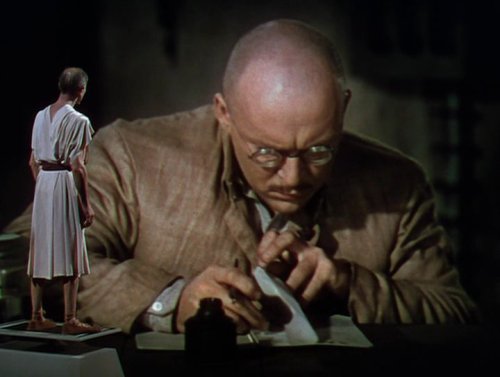
Dr. Cyclops (1940, dir by Ernest B. Schoedsack)

Dr. Cyclops (1940, dir by Ernest B. Schoedsack)

The Wolf Man (1941, dir by George Waggner)

The Wolf Man (1941, dir by George Waggner)

Cat People (1943, dir by Jacques Tourneur)

Cat People (1942, dir by Jacques Tourneur)

I Walked With A Zombie (1943, dir by Jacques Tourneur)

I Walked With A Zombie (1943, dir by Jacques Tourneur)

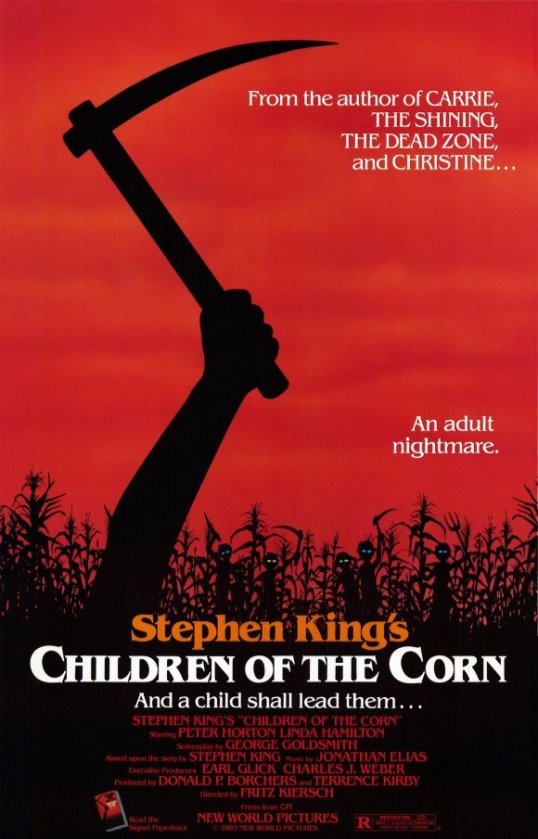
Horror on the Lens: Children of the Corn (dir by Fritz Kiersch)


ChildrenoftheCorn

Today’s horror on the lens is the 1984 film that TSL editor-in-chief Arleigh Sandoc has called the worst Stephen King adaptation of all time.  For the record, I tend to agree with that judgment but, for some reason, a lot of people seem to like Children of the Corn.

And I will admit — the kids are creepy.  Especially that little Isaac guy with the shrill voice.  Whenever Isaac starts screaming, “MALACHI!!!!,” — well, it’s like nails on a chalkboard, to be honest.

Anyway, in case you’d forgotten, this is the movie where all the little kids hang out in a cornfield and kill adults.  It attempts to say something about religion but I’m not sure what it’s trying to say.  It’s all kind of silly but, as I said, some people seem to like it.

(Personally, I prefer that old episode of South Park where they keep declaring shenanigans on the carnival, all the cows jump off a cliff, and the visiting yankee tourists end up getting devoured by rats in jail.)

In order to help you decide for yourself whether or not this is a decent film, here is Stephen King’s Children of the Corn!  Enjoy it while you can because you just know that YouTube is going to eventually yank it down for copyright reasons.

Horror on TV: Tales From the Crypt 3.2 “Carrion Death” (dir by Steven E. de Souza)


Tonight’s excursion into televised horror is a pretty good one.  Carrion Death, which originally aired on June 15th, 1991, was the second episode of the third season of HBO’s Tales From The Crypt.

Kyle MacLachlan plays a serial killer named Earl Raymond Digs.  After Earl escapes from custody, he finds himself stuck in the middle of the desert, handcuffed to a corpse.  As Earl walks through the desert, dragging a corpse alongside him, he discovers that he’s being watched…

Carrion Death is a gory, little story that has an enjoyably nasty little ending.  Kyle MacLachlan does a surprisingly good job as the dangerous but none too bright Earl.  And, of course, there’s the bird.  That bird does a great job…

Enjoy!

The TSL’s Daily Horror Grindhouse: Don’t Breathe (dir by Fede Alvarez)


stephen-lang-in-dont-breathe1

I’m currently on vacation but don’t worry!  I would never let a little thing like taking some time off get in the way of reviewing movies here on the Shattered Lens.  (Especially not when we’re in the middle of our annual Horrorthon!)

Before we left Dallas, Jeff and I finally saw Don’t Breathe.  It’s hard for me to explain why it took me so long to see Don’t Breathe.  Ever since I first saw the trailer this summer, I had been excited about eventually getting to watch it.  When the first few positive reviews started to come in, I got even more excited.  Everything I heard about Don’t Breathe made it sound like this was a film that was specifically made for enjoyment.

But then the film was actually released and it was just so damn popular.  It was number one at the box office.  It got great word of mouth.  People on twitter wouldn’t shut up about how scary it was and how much they loved it.  While I realize that this actually says a lot more about me than it does about the state of current American cinema, there was a part of me that started to think, “How good could it be if everyone else loves it?”  Traditionally, the best horror films have always struggled to find an audience.  Whenever the majority automatically embraces any work of art, that’s usually not a good sign.

And so, I put off seeing Don’t Breathe.  I decided to wait until it was a little less popular.  I didn’t want to have to watch this film surrounded by a bunch of people who didn’t know names like Argento, Fulci, and Rollin so I waited until the showings would be a little less packed.  Finally, last Tuesday, I saw Don’t Breathe.

Seriously — what was I thinking waiting so long?

Like almost all recent independent horror films, Don’t Breathe takes place in Detroit and the first few minutes of the film are dedicated to giving us a tour of a city in decline.  As we stare at the collapsing buildings, the potholed streets, and the desolate lots of overgrown weeds, we’re forced to consider whether any cinematic horrors could possibly match the horrors of real life.

Those establishing shots of Detroit are important for another reason.  They also provide all the motivation that our three protagonists need.  All we have to do is look at the landscape and we understand why they’re so desperate to find something better in life.  (And, of course, you can’t find something better unless you have the money to look…)  Rocky (Jane Levy), Alex (Dylan Minnette), and Money (Daniel Zovatto) make their living breaking into houses and selling what they steal.  Money is their leader.  Alex’s father owns a home security company, which gives Alex access to everyone’s security code.  (Of course, Alex’s main motivation is that he’s in love with Rocky.)  As for Rocky, she’s just trying to raise enough money so that she and her younger sister can escape to California.

Money is given a tip about a blind army veteran (Stephan Lang) who apparently has $30,000 stored in his home.  (He won the money in a court settlement after his daughter was killed by a rich girl who was driving drunk.)  The veteran is the last remaining resident of an otherwise deserted neighborhood.  He spends all of his time in his large but dilapidated house, apparently living with only a viscous guard dog.  Money figures that all they have to do is drug the dog and then they can break into the house and steal everything that they need.  Money assures the hesitant Alex that it’ll be easy because the man’s blind and he really doesn’t need the cash anyway.

Of course, it doesn’t quite work out like that.  The three of them get into the house pretty easily but getting out proves to be much more difficult.  And when the man wakes up and hears his house being broken into, he turns out to be far more formidable and much more dangerous than any of them thought.

About halfway through Don’t Breathe, there’s a big twist that I didn’t care much for.  As played by Stephen Lang, the blind man was already intimidating enough without turning him into a Saw-style super villain.  But, even with that in mind, Don’t Breathe works.  It’s a relentless and well-directed thrill ride, with the camera freely roaming through that deserted house and the cast all giving good and believable performances.

Ultimately, the film is dominated by Stephen Lang.  Lang is one of those good actors who never seems to get the roles that he deserves.  (He was in Avatar but, in that film, he was 1) saddled with a bad accent, 2) had to recite some of the most melodramatic dialogue ever written, and 3) was stuck playing a character who was so thinly drawn that it’s a stretch to say he was even one-dimensional.)  When you first see the man, your natural instinct is to feel sorry for him.  He’s blind, he’s got a tragic backstory, and now he’s got three people trying to rob him.  That’s why it’s such a shock when you first discover just how dangerous and evil he actually is.  Lang transforms the man into one of the most memorable monsters of this very monstrous year.

So, if you haven’t seen Don’t Breathe, go see it.  Don’t let the fact that its popular scare you off.

db

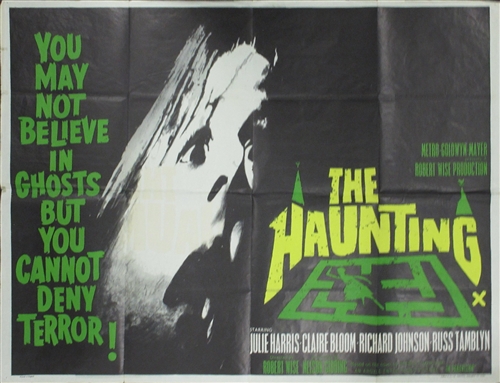
Halloween Havoc!: THE HAUNTING (MGM 1963)


gary loggins's avatarcracked rear viewer

“No one will come in the night… in the dark!”

haunting1

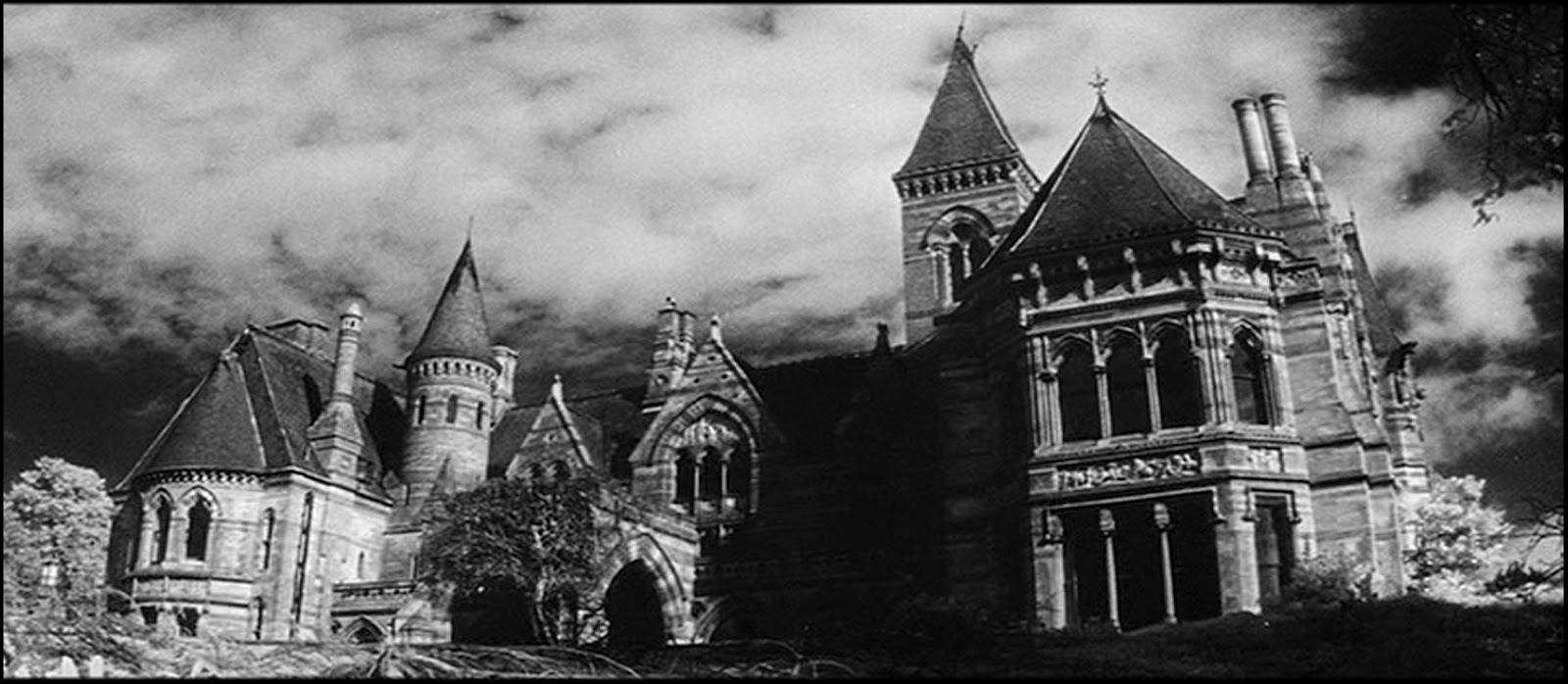
There’s nothing like a good haunted house movie, and 1963’s THE HAUNTING is one of the best ever. Producer/director Robert Wise cut his filmic teeth on Val Lewton shockers like THE BODY SNATCHER  and noirs such as BORN TO KILL  before graduating to mainstream movies like I WANT TO LIVE! and WEST SIDE STORY. In THE HAUNTING he returns to his dark roots to create a nightmarish vision of Shirley Jackson’s eerie novel The Haunting of Hill House.

haunting2

“Scandal, murder, insanity, suicide” have plagued Hill House for close to 100 years. The cursed Crain family were its original inhabitants, designed by eccentric Hugh Crain. The house is a darkly foreboding Gothic structure with oddly tilted angles both inside and out. Dr. John Markham, a paranormal investigator, visits proper Bostonian matron Mrs. Sanderson, the house’s current owner, asking to take a lease…

View original post 834 more words

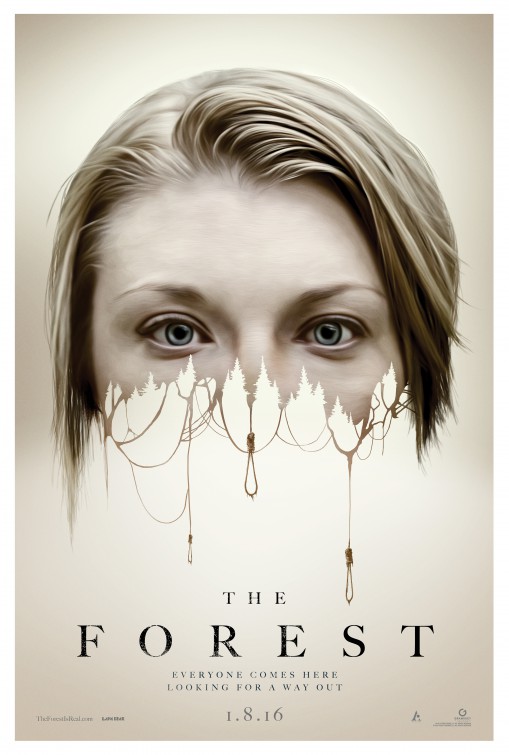
Horror Film Review: The Forest (dir by Jason Zada)


the_forest_poster

Why, as of late, have I been seeing so many movies about Aokigahara Forest?

Aokigarhara Forest is this location in Japan that’s right at the foot of Mt. Fiji and apparently, hundreds of people go there every year and commit suicide.  It happens so frequently that the location has been nicknamed “The Suicide Forest” and the problem has gotten so bad that the local authorities have even resorted to putting up signs that 1) ask people not to kill themselves and 2) reassure visitors that their problems will get better.

To me, that’s pretty depressing and not really something that should be glamorized or exploited.  I mean, this is an actual forest where real people — not fictional characters but real human beings — got to end their lives.  In fact, it’s been reported that local officials no longer publicly discuss the number of dead bodies that they find in the woods because they don’t want publicize Aokigahara’s reputation.

And yet, this year saw not one but two movies released about the Aokigahara Forest, both of which made a point of specifically saying that they were set in this very real location.  (Would I have been more comfortable with the films if they had been located in a fictional location where people go to commit suicide, even if that fictional location was obviously based on Aokigahara?  Probably.)  One was The Sea of Trees, a mawkish and sentimental mess from Gus Van Sant.  The other was The Forest.

Do you remember The Forest?  You might not because it came out in January and most of us were too busy trying to catch up on the Oscar nominees to waste much time with it.  Traditionally, the worst movies are released in January.  That’s especially true of horror movies.  I mean, let’s just be honest.  If a studio has a good horror movie, they’re going to release it in October and try to pick up on all the Halloween business.  When a studio has a bad horror movie, they’re going to dump it in January and hope that no one notices.

Anyway, The Forest came and went without a trace and now it’s making the rounds on HBO so you can watch it if you really want to.

The film stars Natalie Dormer as both Sara and her troubled sister, Jess.  Ever since their parents died in a mysterious car accident, Jess and Sara have had a strained relationship.  Jess witnessed their deaths but Sara did not.  By the film’s logic, this means that Jess starts dressing in black while Sara shakes her head in disapproval.  Anyway, Jess goes to Japan and disappears in the Aokigahara Forest.  Everyone tells Sara that Jess must be dead but Sara says that, since their twins, she can tell that her sister is still alive.

So, of course, Sara goes to Japan so that she can go search the forest for herself!  Now, since Sara is an American in Japan, we have to get at least one shot of her sitting in a taxi with all the lights of Tokyo reflected on the back windows.  Seriously, this shot appears in every single American movie made about Japan.

Sara goes to a bar and meets an American reporter.  His name is Aiden, he’s played by Taylor Kinney, and he’s not that interesting.  Aiden, Sara, and a guide (Yukiyoshi Ozawa) go into the woods and stuff happens.  I was tempted to say strange stuff happens but actually, none of it is that strange.  It’s pretty much exactly what you would expect to happen in a horror film set in the Suicide Forest.  By the time the mysterious schoolgirl showed up and started telling Sara not to trust anyone, I had pretty much lost interest.

I’m tempted to say that, at the very least, The Forest was atmospheric but … no.  I mean, there’s a lot of shots of shadowy trees and deserted tents and all of that but that’s all pretty much basic stuff.  That’s Horror 101.  I mean, even Grave Halloween, a 2013 SyFy film about the forest, managed to make the forest atmospheric.  So, no, I’m not having it.  There are too many good but underappreciated horror films out there for me to waste time making excuses for something like The Forest.

That’s The Forest.  It came out in January and, having watched it, I can see why.