Horror Film Review: Thirteen Ghosts (dir by Steve Beck)


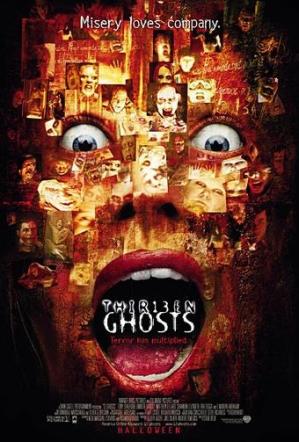
thir13en_ghosts_poster

Thirteen Ghosts!  

Oh my God, this 2001 haunted house movie scared the Hell out of my when I was way too young to know any better.  Seriously, it would come on HBO late at night and I would secretly watch it with the sound turned down and just the visuals would freak me out.

That lawyer getting chopped in half by the glass doors?  AGCK!

That ghost staring at Shannon Elizabeth?  AGCK!

That other ghost attacking Shannon Elizabeth?  AGCK!

All of the ghosts suddenly appearing and then just as quickly disappearing?  AGCK!

MATTHEW LILLARD!?  DOUBLE AGCK!

Seriously, I had nightmares about those ghosts!

For this month’s horrorthon, I decided to rewatch Thirteen Ghosts and … well, first of all, I was reminded by the DVD that apparently, the name of the film is not Thirteen Ghosts.  Instead, the proper name is Thir13een Ghosts, which is really kind of annoying because it’s not like that “13” even vaguely resembles a “T”.  I’m not even sure how exactly you would pronounce Thir13een.  Wasn’t one of the robots in the last Star Wars film named Thir13een?  Just looking at the title makes me think about that episode of South Park where Cartman went into the future and had a robot dog named K-10 (and a cat named Kit-9 and a bird named Kok-A-3!)

So, no offense meant to anyone who was involved in the naming of the film, but I’m going to keep calling it Thirteen Ghosts!

Anyway, I decided to rewatch Thirteen Ghosts because I remembered it as being the scariest film ever made and … wow, it really did not stand up to the test of time.  I mean, don’t get me wrong.  The ghosts were still kind of scary and I guess that Tony Shalhoub did the best that he could do with the material.  But the movie itself…oh my God.

Seeing as how I’m contractually obligated to come up with at least 500 words about Thirteen Ghosts, let’s talk about the plot, shall we?  Tony Shalhoub is Arthur.  Arthur’s a widower who has two children, Kathy (Shannon Elizabeth) and Bobby (Alec Roberts).  For some reason, Kathy is obsessed with sink fixtures.  Bobby, meanwhile, is your typical bratty kid.  Arthur is like way poor and about to lose his house.  Despite this, he continues to employ a housekeeper named Maggie (Rah Digga).  HEY, ARTHUR, THERE’S NO POINT IN HAVING A HOUSEKEEPER IF YOU CAN’T AFFORD YOUR FREAKING HOUSE!

Anyway…

Fortunately, Arthur is informed that his uncle, a legendary ghost hunter named Cyrus (F. Murray Abraham) has died and, as a result, Arthur has inherited his mansion!  YAY!  PROBLEM SOLVED!  Of course, the mansion is kind of weird.  The walls are covered with Latin phrases and it’s all glass.  “I do not do windows,” Maggie says.  Ha ha ha.

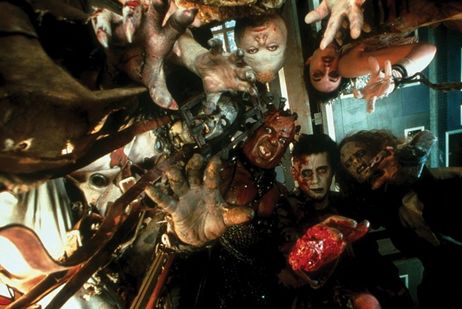
Well, it turns out that the entire house is full of murderous ghosts.  (Of course, you can’t see them unless you put on special glasses.)  We occasionally get glimpses of the ghosts and this is where Thirteen Ghosts actually triumphs.  The ghosts actually are really freaky looking and they’ve all got enjoyably weird backstories.  That’s a good thing.

What isn’t a good thing is that, in order for the ghosts to get free and wreck some havoc, everyone in the house is required to act like a total idiot.  Hence, we get Shannon Elizabeth staring at herself in a mirror for literally four minutes, just so one ghost can sneak up behind her.  We get Bobby and Maggie constantly running off.  We also get Embeth Davidtz as a “spirit liberator” and Matthew Lillard as a psychic.

Does Matthew Lillard give a good performance in Thirteen Ghosts?  It’s hard to say.  He definitely gives a performance that could only be given by Matthew Lillard.  There’s a few scenes where you do wish someone on set had told him to calm down but, on the whole, you can count me in the pro-Lillard camp.  It’s a silly film and it needs someone willing to give a silly performance.

There are a few parts of Thirteen Ghosts that have stood up well.  The ghosts, the production design, the scene with the lawyer.  But ultimately, the movie fails because you really don’t care about Arthur or his family or his housekeeper.  In these type of films, the main characters either have to be likable or they have to be so unlikable that you don’t mind seeing them get terrorized.  But bland just will not get the job done!

Since I love lists, here’s my ranking of the ghosts, from least to most frightening:

  1. The Withered Lover — I can’t talk too much about her without it counting as a spoiler but she’s the only ghosts that isn’t malicious and therefore, she’s not frightening.
  2. The Bound Woman — A hanging woman wearing a prom dress.  Who cares?
  3. The Torso — The torso is a legless torso that has to drag itself around by its hands.  The torso is kinda freaky but it’s hard to be scared of something that doesn’t have legs.
  4. The Pilgrimess — The Pilgrimess was accused of witchcraft in the 17th Century.  She’s kind of scary but she’s also still in the stocks so she’s not quite as threatening as she could be.
  5. The Great Child and
  6. the Dire Mother — AGCK!  The Dire Mother is a tiny woman who is always feeding her giant son, the Great Child!  Creepy!
  7. The Torn Prince — The Torn Prince always freaks me out.  Not only is he massively disfigured as the result of a car crash but he also carries a baseball bat.  AGCK!
  8. The First Born Son — The first born son is a kid who has an arrow sticking out his head.  He whispers that he wants to play.  AGCK!  Children are creepy.
  9. The Angry Princess — The Angry Princess is a total rip-off of the bathtub ghost from The Shining but she still scares the Hell out of me.  AGCK!
  10. The Hammer — AGCK!  He’s a former blacksmith, covered in spikes and featuring a hammer in place of his left hand.
  11. The Juggernaut — Oh my God, this guys is scary and evil-looking!  We’re told that he killed 9 people when he was alive and 31 people as a ghost.  DOUBLE AGCK!
  12. The Jackal — OH MY GOD!  The Jackal gave me nightmares when I was younger and he’s still the scariest of the ghosts!  He’s the one who has a cage on his head.  The scene where he attacks Shannon Elizabeth is pure nightmare fuel!  TRIPLE AGCK!

Anyway, the movie’s not as scary as I remembered but those ghosts are still Agck-worthy.
2001ghosts


Four Shots From Horror History: La Bruja, Cult of the Cobra, Dementia, The She Creature


This October, I’m going to be doing something a little bit different with my contribution to 4 Shots From 4 Films.  I’m going to be taking a little chronological tour of the history of horror cinema, moving from decade to decade.

Today, we continue to look at the 1950s.

Four Shots From Four Films

La Bruja (1954, dir by Chano Urueta)

La Bruja (1954, dir by Chano Urueta)

Cult of the Cobra (1955, dir by Francis D. Lyon)

Cult of the Cobra (1955, dir by Francis D. Lyon)

Dementia (1955, dir by John Parker)

Dementia (1955, dir by John Parker)

The She Creature (1956, dir by Edward L. Cahn)

The She Creature (1956, dir by Edward L. Cahn)

Horror On The Lens: Revenge of the Creature (dir by Jack Arnold)


For today’s horror on the lens, we present to you 1956’s Revenge of the Creature!

Revenge of the Creature was the first sequel to The Creature From The Black Lagoon.  It turns out that the Gil-Man didn’t actually die at the end of the last film.  Instead, he’s alive, he’s been captured, and he’s now being displayed in an aquarium.

Now, I’m going to be honest: Revenge of the Creature is not as a good as The Creature From The Black Lagoon.  But it’s still kind of fun in a silly 1950s monster movie sort of way.  And, if you keep your eyes open, you might spot a very young Clint Eastwood, playing a lab technician and sporting a truly impressive head of hair.

Enjoy!


Horror on TV: Tales From The Crypt 4.4 “Seance”


Tonight’s excursion into televised horror is the 4th episode of the 4th season of HBO’s Tales From The Crypt.

In Seance, two con artists (Cathy Moriarty and Ben Cross) make the mistake of trying to cheat a wealthy man played by John Vernon.  Things don’t go as planned and, as so often happens when things get complicated, it all leads to a fake séance that turns out to be not quite as fake as was originally believed.

Seance is a lot of fun.  Despite being in color, it’s shot in the style of an old school film noir and nobody played heartless with quite as much panache as John Vernon.

Seance was directed by Gary Fleder and originally aired on July 4th, 1992.

Enjoy!

The TSL’s Daily Horror Grindhouse: Demons (dir by Lamberto Bava)


demons

“What the Hell happened to Rosemary?”

— Tony The Pimp (Bobby Rhodes) in Demons (1985)

A lot of what you need to know about Demons, an Italian horror film from 1985, can be summed up by the fact that one of the leading characters is named Tony the Pimp.  Demons is a very self-aware film, one that is not only over-the-top and ludicrous but which is cheerfully aware that it’s over-the-top and ludicrous.  Considering that Demons is an apocalyptic film that ends with nearly the entire cast dead, Demons is a surprisingly good-natured horror film.

The film opens in Berlin.  There’s a mysterious man hanging out at a subway station.  He’s wearing a silver half-mask and, from what we can see of his face, he appears to be heavily scarred.  Interestingly enough, the man is played by Michele Soavi.  (Though Soavi is now best remembered as the director of Dellamorte Dellamore, he was an actor and assistant to Dario Argento when Demons was produced.)  The man doesn’t speak.  Instead, he hands out flyers to random people, inviting them to attend the premiere of a new horror film.

The man obviously does a very good because a truly diverse group of characters show up for the premiere.  There’s a wealthy blind man who comes with his assistant.  (The assistant is played by Dario Argento’s oldest daughter, Fiore.)  There’s an older couple who keep shushing everyone in the audience.  There’s Cheryl (Natasha Hovey), who ends up sitting next to the handsome George (Urbano Barberini, who would later co-star in Dario Argento’s Opera).  And, of course, there’s Tony the Pimp (Bobby Rhoades) who shows up wearing a white suit and with two prostitutes.

The film-within-the-film is a horror film that plays out like an homage to every Italian horror film released in the 1980s.  It deals with four teenagers who stumble across the grave of Nostradamus and end up transforming into blood-thirsty demons.  One of the teenagers is played by Michele Soavi, though it’s never clear whether the teenager and the man in the mask are supposed to be the same person.

As they watch the movie, something strange starts to happen in the audience.  One of the prostitutes scratched her face when she put on a prop mask.  When the same mask appears in the movie, the cut on her face starts to throb.  Soon, she is transformed into a … DEMON!

JUST LIKE IN THE MOVIE!

Needless to say, the arrival of a real-life demon leads to a panic in the theater but guess what?  The doors are locked!  There’s no way out!  When Tony the Pimp breaks into the projection booth, he discovers that there’s no projectionist and the movie cannot be stopped!  On top of that, getting scratched by a demon means that you transform into a demon yourself!

In other words — remember the debate about whether or not horror movies can turn their viewers into murderous monsters?  Well, Demons says that they definitely can…

Demons was directed by Lamberto Bava, son of the famous Mario Bava, and it remains one of the most popular Italian horror films of all time.  With a script that was co-written by Dario Argento (who also produced), Demons is a fun and exciting horror film that cheerfully dares you to take it too seriously.  Watching this energetic film, you can tell that Bava was having a lot of fun with the idea that the world could end as a result of watching just one horror movie.

Demons was a huge box office hit so, naturally, there were hundreds of unofficial sequels.  Though Michele Soavi’s The Church was a Demons film in every way but name, the only official sequel was Demons 2.  We’ll look at that film tomorrow.

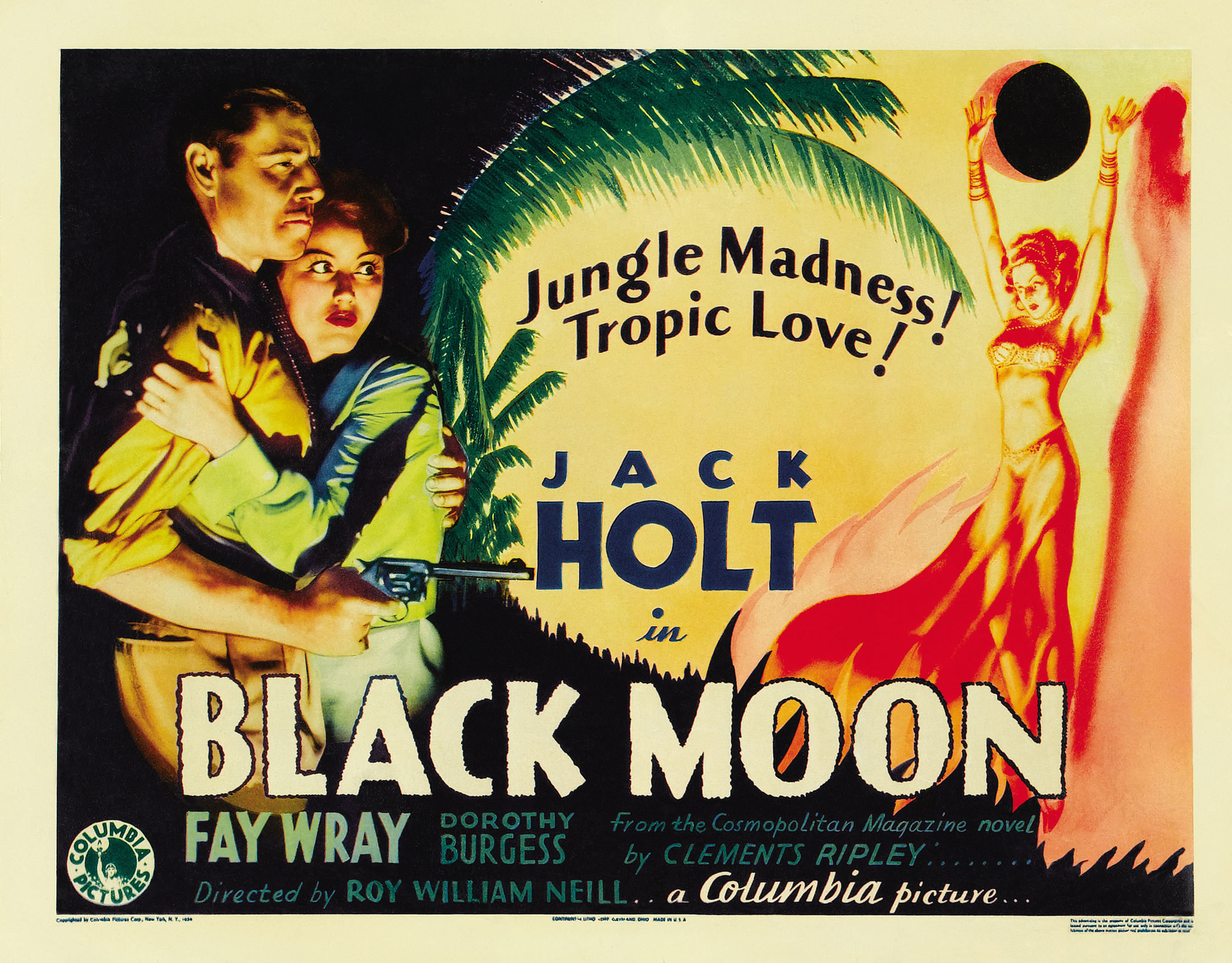
Halloween Havoc!: BLACK MOON (Columbia 1934)


gary loggins's avatarcracked rear viewer

moon1

I thought I’d seen, or at least heard of, all the horror films made during the 1930’s. I was wrong. BLACK MOON was new to me when I viewed it recently as part of TCM’S Summer Under the Stars salute to KING KONG’s  main squeeze, Fay Wray. It’s a voodoo tale also starring square-jawed Jack Holt and Pre-Code favorite Dorothy Burgess . The director is Roy William Neill, who would later work with genre giants Karloff (THE BLACK ROOM), Lugosi and Chaney (FRANKENSTEIN MEETS THE WOLF MAN), and helm eleven of the Universal Sherlock Holmes films with Basil Rathbone.

moon2

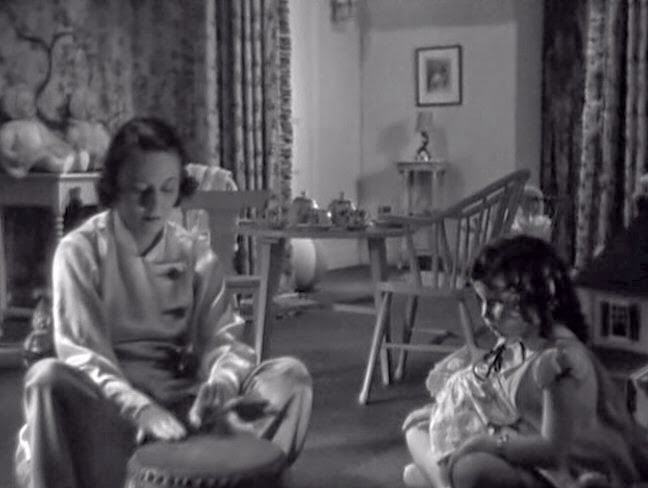
The film open with the pounding of jungle drums, and we see Nita Lane (Burgess) is the one pounding them in her luxurious home. Nita grew up on the Caribbean isle of San Christopher, where her parents were murdered during a native uprising. Hubby Stephen (Holt) is against Nita returning to the…

View original post 456 more words

Horror Film Review: The Invisible Man (dir by James Whale)


the-invisible-man

The 1933 Universal horror film, The Invisible Man, never seems to get as much attention as Frankenstein, Dracula, The Wolf Man, or The Mummy.  Perhaps it’s because the invisible man really isn’t a supernatural monster.  He’s just a scientist who has turned himself invisible and is now going mad as a result.  Or maybe it’s because there have been so many crappy films that have used invisibility as a plot point that the reputation of the original Invisible Man suffers by association.

For whatever reason, The Invisible Man never seems to get spoken about in the same breathless, gleeful manner as some of the other Universal monsters.  But I have to admit that, though I usually can’t stand movies about invisibility, I rather like The Invisible Man.

Based on a novel by H.G. Wells, The Invisible Man opens with a mysterious man (played by Claude Rains) arriving in a small English village.  He checks into a small inn and soon, everyone in the village is scared of him.  It’s not just his haughty attitude or his habit of ranting about his own superiority.  There’s also the fact that he is literally covered, from head to toe, in bandages.  He always wears gloves and dark glasses.  He insists that he’s doing important research and demands to be left alone.

The inn keeper (Forrester Harvey) and his histrionic wife (Una O’Connor) put up with the mysterious man until he falls behind on his rent.  However, once confronted, the mysterious man announces that he’s not going anywhere.  When the police and a mob of villagers arrives, the man starts to laugh like a maniac.  He unwraps the bandages around his head and…

THERE’S NOTHING UNDERNEATH!

Well, there is something there.  It’s just that the man is invisible so no one can see what’s underneath.  It turns out that the man is Dr. Jack Griffin, a chemist who has been missing for several days.  He’s created an invisibility serum but he can’t figure out how to reverse the effects.  Even worse, the serum is driving him insane.  Griffin’s fiancée, Flora (Gloria Stuart), and her father, Dr. Cranley (Henry Travers), are searching for Jack but Jack doesn’t particularly want to be found.  Jack is more interested in exploring how he might be able to use invisibility to conquer the world…

The Invisible Man is historically important because it was the film that brought Claude Rains to Hollywood.  Rains has previously made films in the UK but this was his first American film.  Think of how different film history would have turned out if The Invisible Man had, as originally planned, starred Boris Karloff.  Without Claude Rains coming to America, who would have played Louis in Casablanca?  Who would have played Sen. Paine in Mr. Smith Goes To Washington or Alex Sebastian in Notorious?  Of course, we don’t really see Claude Rains’s face until the very end of The Invisible Man.  Instead, we just hear his voice but what a voice Claude had!  He delivers his dialogue with just the right amount of malicious sarcasm.

I like The Invisible Man.  For modern audiences, it’s not particularly scary.  (Though I do find the idea of being unknowingly followed by an invisible person to be a little unnerving…)  However, unlike a lot of other old horror films, you can watch The Invisible Man and see why it would have been scary to an audience seeing it for the very first time.  In 1933, a time when film was still a relatively new medium and audiences had yet to become jaded by special effects, here was a man unwrapping his bandages to reveal that there was nothing underneath!  That had to have freaked people out!

The Invisible Man was directed by James Whale and the film features the same demented sense of humor that distinguished The Bride of Frankenstein.  The villagers are portrayed as being so hysterical that you can’t help but think that maybe Griffin has a point about being surrounded by fools.  By the time the local constable declares, “What’s all this then?,” you can’t help but start to sympathize with Jack Griffin.

There’s been a lot of  bad invisibility movies made but The Invisible Man is not one of them.  It may not be as well remembered as some of the other Universal horrors but it’s definitely one worth seeing.

4 Shots From Horror History: The Strange Door, The Black Castle, The Maze, House of Wax


This October, I’m going to be doing something a little bit different with my contribution to 4 Shots From 4 Films.  I’m going to be taking a little chronological tour of the history of horror cinema, moving from decade to decade.

Today, we look at the start of the 1950s.

4 Shots From 4 Films

The Strange Door (1951, dir by Joseph Pevney)

The Strange Door (1951, dir by Joseph Pevney)

The Black Castle (1952, dir by Nathan H. Juran)

The Black Castle (1952, dir by Nathan H. Juran)

The Maze (1953, dir by William Cameron Meznies)

The Maze (1953, dir by William Cameron Meznies)

House of Wax (1953, dir by Andre De Toth)

House of Wax (1953, dir by Andre De Toth)

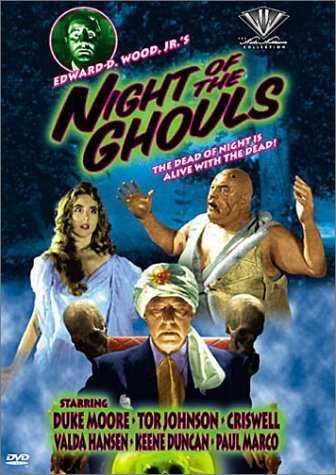
Horror on the Lens: Night of the Ghouls (dir by Edward D. Wood, Jr.)


GhoulsdvdToday’s movie is Ed Wood’s sequel to Bride of the Monsters.  In Night of the Ghouls, con man Dr. Alcula (Kenne Duncan) moves into Bela Lugosi’s old mansion and pretends to talk to the dead.  What Alcula doesn’t realize is that the house is actually haunted (by Tor Johnson’s Lobo, among others) and real ghosts don’t appreciate pretend ghosts.

What can you say about a film like of Night of the Ghouls?  It’s an Ed Wood film, with all that suggests.  However, how can you resist a film that starts with Criswell sitting up in his coffin and providing commentary?

The role of Dr. Alcula was originally written for Bela Lugosi.  After Lugosi’s death, veteran actor and longtime Wood friend Kenne Duncan got the role instead.  Also of note, Wood appears twice in this film.  Not only does his picture appear on a wanted poster in the police station but Wood also plays one of the female ghouls.

(See this one when you can because, as I mentioned yesterday, YouTube has been taking down almost all of the Ed Wood films that have been uploaded to the site.)

Horror On TV: Tales From The Crypt 3.10 “Mournin’ Mess” (dir by Manny Coto)


Tonight’s excursion into the world of televised horror is the 10th episode of the 3rd season of HBO’s Tales From The Crypt!

Steven Weber plays an alcoholic reporter who thinks that he has found the story of his career!  Someone is preying on the homeless and our reporter is determined to find out who and why.  (Not because he actually cares about the homeless, of course.  He just needs a big story to save his career.)  However, the reporter quickly discovers that 1) all charities are not charitable and 2) you should always be careful about biting off more than you can chew…

This well-acted episode was directed and written by Manny Coto and it originally aired on July 31st, 1991.

Enjoy!