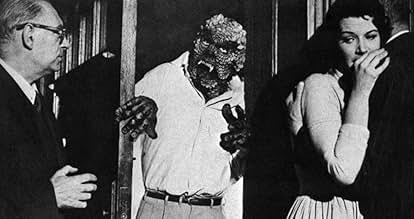
Tonight’s episode of One Step Beyond deals with a bellboy named Gerald Perkins (David Opatoshu). Gerald keeps telling everyone that there’s going to be an earthquake but no one’s willing to listen to him. Everyone knows that Gerald is a recovering alcoholic so they assume that he’s just drinking again. Needless to say, it’s far easier to fire someone than to listen to his insane ramblings, right?
Well, considering that this story takes place in San Francisco in 1906, perhaps they should have listened.
According to host John Newland, this is a true story. It originally aired on January 12th, 1960!
A group of friends gather and spend a night hanging out. Old resentments simmer to the surface. A murder is committed. A killer with a bag over his head emerges from the night. The friends try to figure out who amongst them could be a killer or if there’s something else going on. I know some people will automatically suspect the guy wearing the Slipknot t-shirt because the members of the band all wear masks and the killer wears a mask but that’s the same logic that led to the Satanic Panic of the 1980s. If he was wearing a Nickelback t-shirt, I would be with you.
This is a short horror film that feels like a bunch of real-life friends got together to play the fictional friends. The opening half is too talky and slow but the second half picks up and features a few clever touches. There aren’t many kills and they’re largely bloodless but I think director Jacob Osborn was going for something more than just another slasher. The movie is more about how the friends relate to each other than anything else. This is a low-budget, regional film that starts out way too slowly but I’m going to cut it some slack because the second half of the movie makes up for the weak first half. At a time when the term indie film gets applied to even big-budget productions with major stars, Murder In The Dark is a true independent film.
I’ve always felt that Barry Nelson’s performance as Ullman is one of the best parts of the early part of the film. Whereas Ullman was presented as being a stereotypical jerk in King’s novel, the film presents him as a blandly friendly bureaucrat who can talk about what happened with the previous caretaker and make it sound like the most normal thing in the world. The scene were he interviews Jack Torrance for the caretaker job is wonderfully ominous, even if it’s hard to describe why. I know that Stephen King disliked this scene because it made Jack look unbalanced from the start but, personally, I think it does a wonderful job of setting the mood.
Finally, Ullman’s office reminds me of Ben Horne’s office in Twin Peaks, right down to the somewhat campy name plate on his desk.
In 1960s, Lester Bullard lives alone in the mountains of Tennessee. Abused as a child and scorned as an adult, Bullard is the type of person that most people try to ignore. He’s angry, bitter, and not all that knowledgeable about the world outside of his own fevered imagination. Having been evicted from his home, he moves into an abandoned shack where he spends his time voyeuristically watching the teenagers who sneak off to the isolated mountains so that they can fool around in their cars without being harassed by the grown-ups. When Bullard stumbles across two dead bodies in a car, it doesn’t so much send him on a downward spiral as much as it just accelerates the only fate that can be waiting for someone like Lester Bullard. Bullard does some truly disturbing things but, as the narrator reminds us, he’s “a child of God, much like yourself perhaps.”
(No, definitely not like me! Though I do get the narrator’s point.)
First published in 1973, Child of God was Cormac McCarthy’s third novel. It tells a disturbing story and one that will leave readers unsettled. Inspired by the type of macabre tales that used to be told around campfires, it’s a novel of cold, gothic horror. McCarthy’s prose creates such an atmosphere of darkness that it’s difficult to read the novel in one sitting. You almost have to put the book down so you can step outside and take a deep breath after some of the more grotesque moments. Child of God is also a character study of a man living on the fringes of what most people would already consider to be the fringe of society. Just as the people living on the East and West Coasts have rejected the citizens of Appalachia, Appalachia has rejected Luster Bullard. The book links Bullard to the violent history of Appalachia, with the Bullard family having been involved in many of the feuds that helped to define the region. McCarthy’s matter-of-fact prose serves to make Bullard’s crimes all the more disturbing, with McCarthy refusing to give the reader the easy out of a traditional, guns-blazing ending. Bullard’s ultimate fate feels almost as random as his crimes, challenging the idea of any sort of karmic justice. In the end, Bullard is destined to become another barely-remembered regional legend, like Ed Gein or the Bloody Benders. By telling his story without a hint of melodramatic excess, McCarthy leaves the reader with no choice but to consider that the world is full of real Lester Bullards.
4 Or More Shots From 4 Or More Films is just what it says it is, 4 shots from 4 of our favorite films. As opposed to the reviews and recaps that we usually post, 4 Shots From 4 Films lets the visuals do the talking!
Today’s director is the one and only William Castle, who was as well-known for the gimmicks he used to promote his films as for the films themselves. It’s time for….
4 Shots From 4 William Castle Films
House on Haunted Hill (1959, dir by William Castle, DP: Carl E. Guthrie)
13 Ghosts (1960, dir by William Castle, DP: Joseph F. Biroc)
Strait-Jacket (1964, dir by William Castle, DP: Arthur E. Arling)
Shanks (1974, dir by William Castle, DP: Joseph H. Biroc)
The original The House on Haunted Hill is a classic and one that we make it a point to share every Halloween. And since October is now halfway over, now seems like the perfect time to do so!
For today’s horror song of the day, we have the main title track for 1980’s The Shining. Composed by Wendy Carlos and Rachel Elkind, this music perfectly capture the ominous grandeur of the Overlook Hotel and the snowy mountains that surround it.
It’s also a great song to play at the start of any road trip. Scare the Hell out of your friends. It’s fun!
This is not a Halloween song per se but it still feels appropriate for the season. Chloe sings that she’d rather go to Hell and have fun than go to Heaven and be bored. It sounds like someone just took a class on Paradise Lost.
“This is my job!”
I remember I saw a play in college where Hell was represented by lighting filters that were as red as my glorious hair. Unfortunately, someone screwed up and even the scenes that weren’t taking place in Hell were tinted red. Afterwards, I told the film’s cast, “You all were in Hell the entire time!” and they thought I was just referring to how much they disliked appearing in the play.
Twenty-five years ago, six employees were murdered at Phantom Fun-World, an amusement park owned by August Ambrose (played Ari Lehman, best known for having played the young Jason Voorhees in the first Friday the 13th). Now, the park is reopening and there’s already people competing to be the new Phantom Fun-World mascot. Unfortunately, none of them get the job because they’re all killed by a hulking figure wearing a mask. For whatever reason, this killer seems to have a real issue with mascots.
Yes, there is a killer stalking Phantom Fun-World and that’s not good news for Andi (Celeste Blandon), who has taken a job working nights at the park. Andi needs the money to take care of her teenage brother, Cole (Jace Carson) and the job will give her a chance to hang out with her best friend, Collins (Spooky Madison). (It will also give her a chance to spend time away from her toxic mother.) Unfortunately, the killer has plans of his own and soon, Andi’s co-workers are dying and Andi is fighting to both protect Cole and to survive the night.
Despite the brevity of this review, I actually enjoyed Phantom Fun-World quite a bit. There’s nothing particularly unique about the plot. It’s a standard slasher film and the fact that it points out more than once that it’s a standard slasher film doesn’t change that fact. (Indeed, the slasher genre has been so influenced by Scream that it’s now more surprising when a film doesn’t deliberately draw attention to or comment on its use of all of the genre’s cliches.) But the film makes good use of the theme park location and the killer is a frightening one, both because of his mask and the fact that he seems to truly relish his work. Someone like Jason Voorhees kills because it’s the only thing that he knows how to do. He doesn’t seem to take any pleasure out of it. The killer in Phantom Fun-World is having the time of his life and that’s make him all the more frightening. The murders are well-directed and surprisingly brutal. Again, this is one intimidating killer.
It helps that the cast is likable. There’s really no one in this movie who does a bad job. The viewer likes everyone and, as such, there’s some actual emotional stakes to all of the mayhem. Celeste Blandon does an especially good job as Andi, making her a worthy protagonist without making her so perfect that she becomes a less-than-credible character. One of the reasons that the movie works is because Andi truly does make the same mistakes that anyone in her situation would make and, as a result, it’s easy to empathize with her and her desire to protect Cole.
Don’t get me wrong. Phantom Fun-World is a low-budget slasher film and there’s not a whole lot going on here that you haven’t seen in other slasher films. That said, it’s a well-done film and an appropriate way to spend 90 minutes during the Halloween season.