Horror on TV: The Twilight Zone 5.26 “Living Doll”


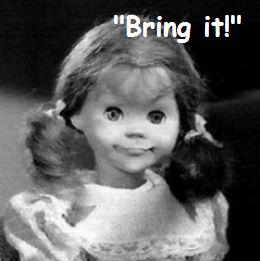
Talky Tina
Today’s televised horror is the Living Doll episode of The Twilight Zone. This memorably creepy episode takes a look at what happens when a suburban jerk of a father (played by Telly Savalas) gets into a fight with his daughter’s doll, Talky Tina (voiced by June Foray). Things do not end well for one of them.

Seriously, don’t mess with Talky Tina.

This episode was directed by Richard Sarafain, written by Charles Beaumont, and originally broadcast on November 1st, 1963.


Duke Tries A Halloween Marathon…Part One.


So, I think it may be fair to say that of most of the posters on this great site, I am probably the one who least enjoys the horror genre…or at least is never as excited about it as everyone else. It isn’t that I do not like horror films – there are quite a few I really love – but I just expect a lot from them. Probably – unfairly – more than I expect from other films. Why? Because I honestly think that when done right, horror films can be some of the most emotionally affecting films from any genre. But when done wrong – as I think far too many of them are – it just feels cheap and manipulative – and as someone who loves film, who loves how they can generate empathy and tell interesting stories, it always just feels like a slap to the face.

This love/hate relationship usually makes me hesitant to watch most horror films, which of course is an issue come October. This month is wall to wall horror from 12:01AM on the 1st – to midnight on Halloween. With this comes the pressure to watch a ton of horror films, and although in the past I have watched a few, I’ve never taken part in any sort of marathon that so many bloggers partake in this time of year…until now. This is part one – of what I hope will be a month long series – of quick reviews for horror films I watch this month. I hope to watch at least one a day.

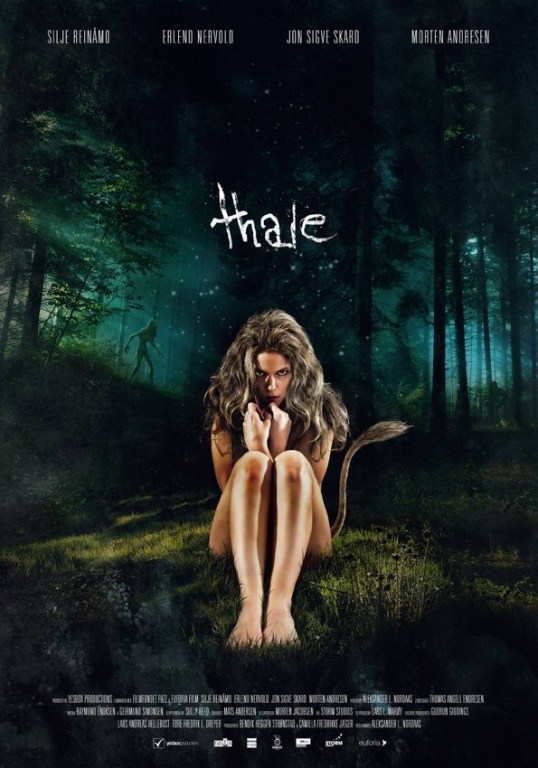
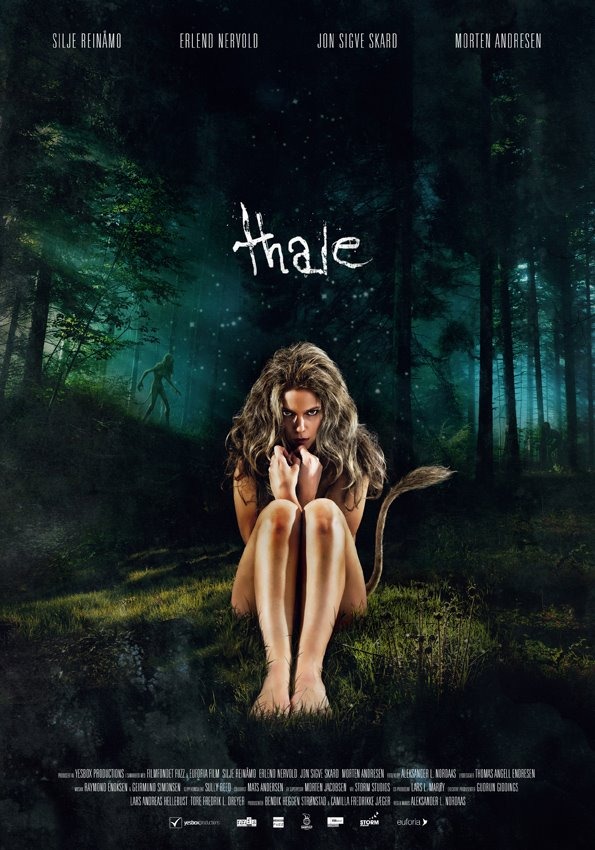
October 1st: ‘Thale’ (dir. Aleksander Nordaas)
tumblr_m490fyx40y1ruxqt3o1_1280

A very low budget Norwegian fantasy/horror film, with a lot of interesting ideas, that sadly doesn’t execute on enough of them to reach any level of greatness…which I think was possible.

‘Thale’ is about two friends, working in a crime scene cleaning service, who stumble upon a hidden basement at one of the locations they have been hired to clean. Within they find a lab of sorts, and a beautiful young woman who is unable to speak – and is most certainly more than she appears to be. The result is a rather unique horror film with fantasy elements; one that thrives on atmosphere for the first hour or so, building a genuine level of suspense and mystery. It is an intriguing story, one that is slow to build but never boring. There is certainly a lot under the surface.

The only real issue I had was that there is narration throughout that tries a bit too hard to add depth to the story, both narratively and thematically, without much success. Mainly because the exposition within would benefit more from a ‘show don’t tell’ approach – and also because the actual narrative comes off as so simple that many of the themes expressed through the narration have nothing to do with what we have actually been shown.

This isn’t too big of an issue really, and I can’t fault it for trying to give more meaning to the story, but had it executed on some of the ideas it alludes to under the surface than maybe this wouldn’t have been an issue at all – especially if it had been a half hour longer, and explored the fantasy element in more detail.

Still, the performances are very good and – given its very low budget – so are the effects and overall production. It certainly has its flaws, but it still warrants a recommendation.

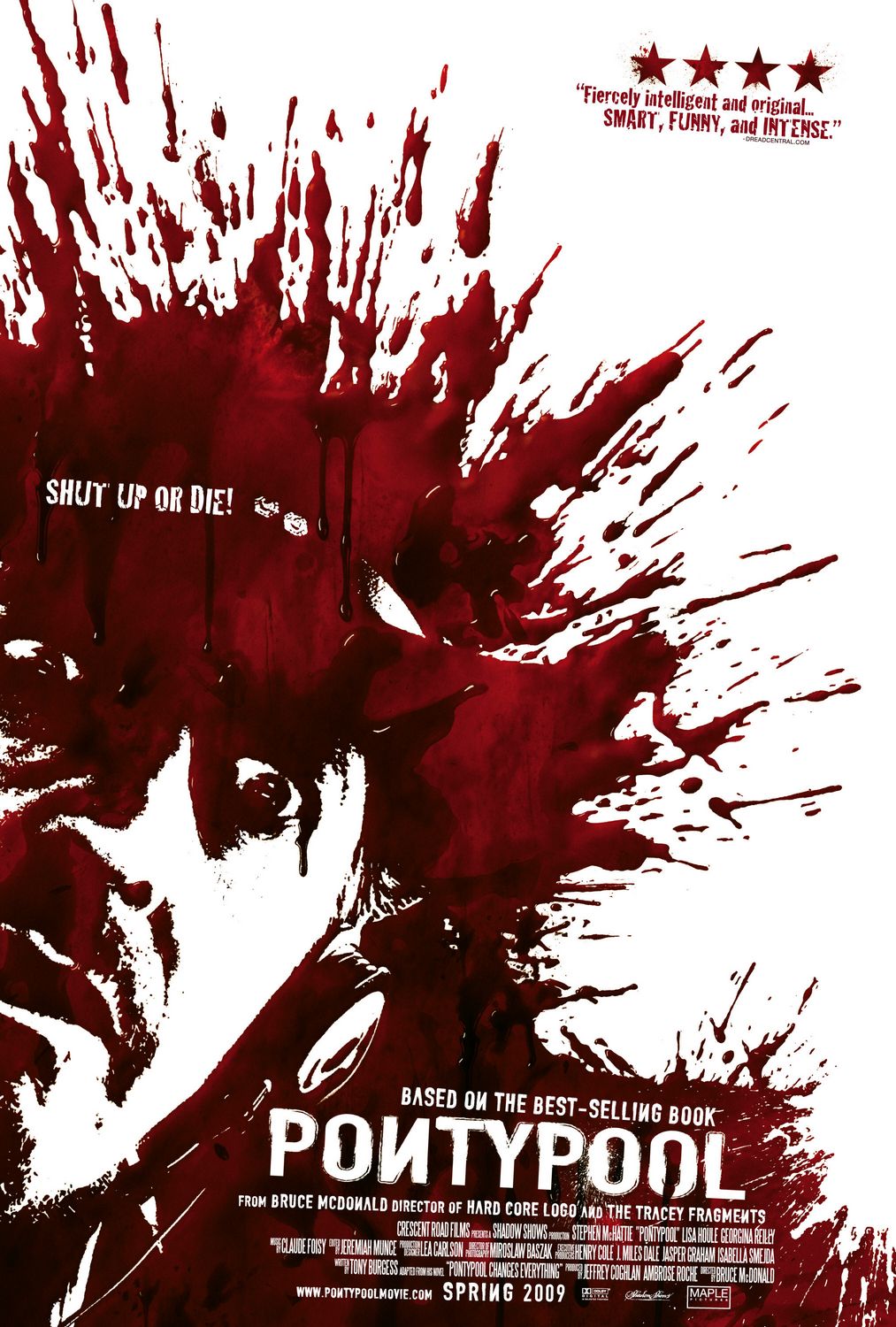
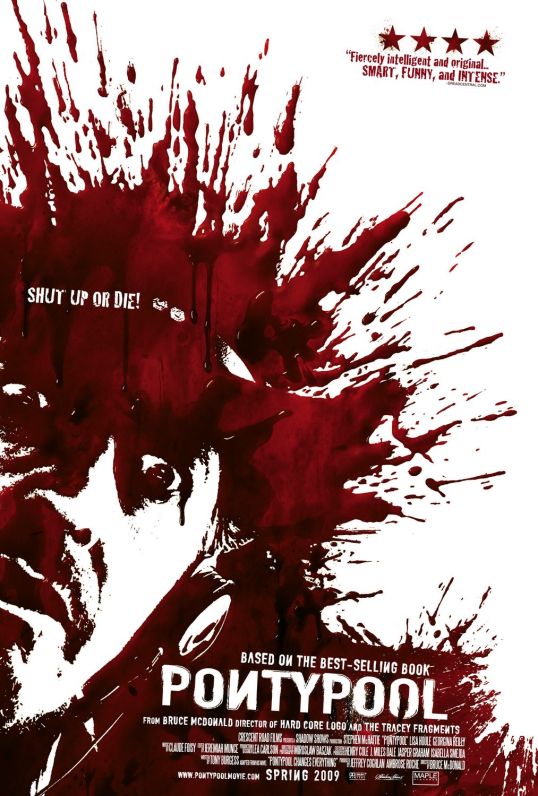
Oct. 2nd: ‘Pontypool’ (dir. Bruce McDonald)
pontypool_xlg

‘Pontypool’ is a mostly lean – though often convoluted – and creative horror film that builds slowly and contains just the right dash of humor. It is at times essentially ‘Welcome to Night Vale’ in film form.

It stars Stephen McHattie as an ex-shock jock who has reached a point in his career where he is stuck doing an early morning radio gig in a small Canadian town. He is quick to try to cause a stir, but his producer reminds him that the listeners just want to know the weather. As the morning slowly passes by the station begins to get weird reports of people, herds of people, swarming the streets. Whats seems to them to initially be a joke begins to turn into a life or death emergency situation where a virus is infecting the town, keeping the workers at the studio locked indoors, trying to figure out how it all started.

This isn’t the scariest horror film you will ever see, neither is it the most suspenseful – yet the development of the story, the unraveling mystery and the urgency of the performances make it an absorbing viewing experience. Things do start to get a little convoluted as we begin to better understand how the “virus” infecting people is being spread. The film seems to be making it up as it goes, and ironically it can’t seem to think of the rights words to explain what is actually happening.

But it does managed to create an interesting subtext on how language has been simplified and diminished by gossip, social websites and the media. It would also probably benefit from multiple viewings. But for now, I recommend you at least watch it once.

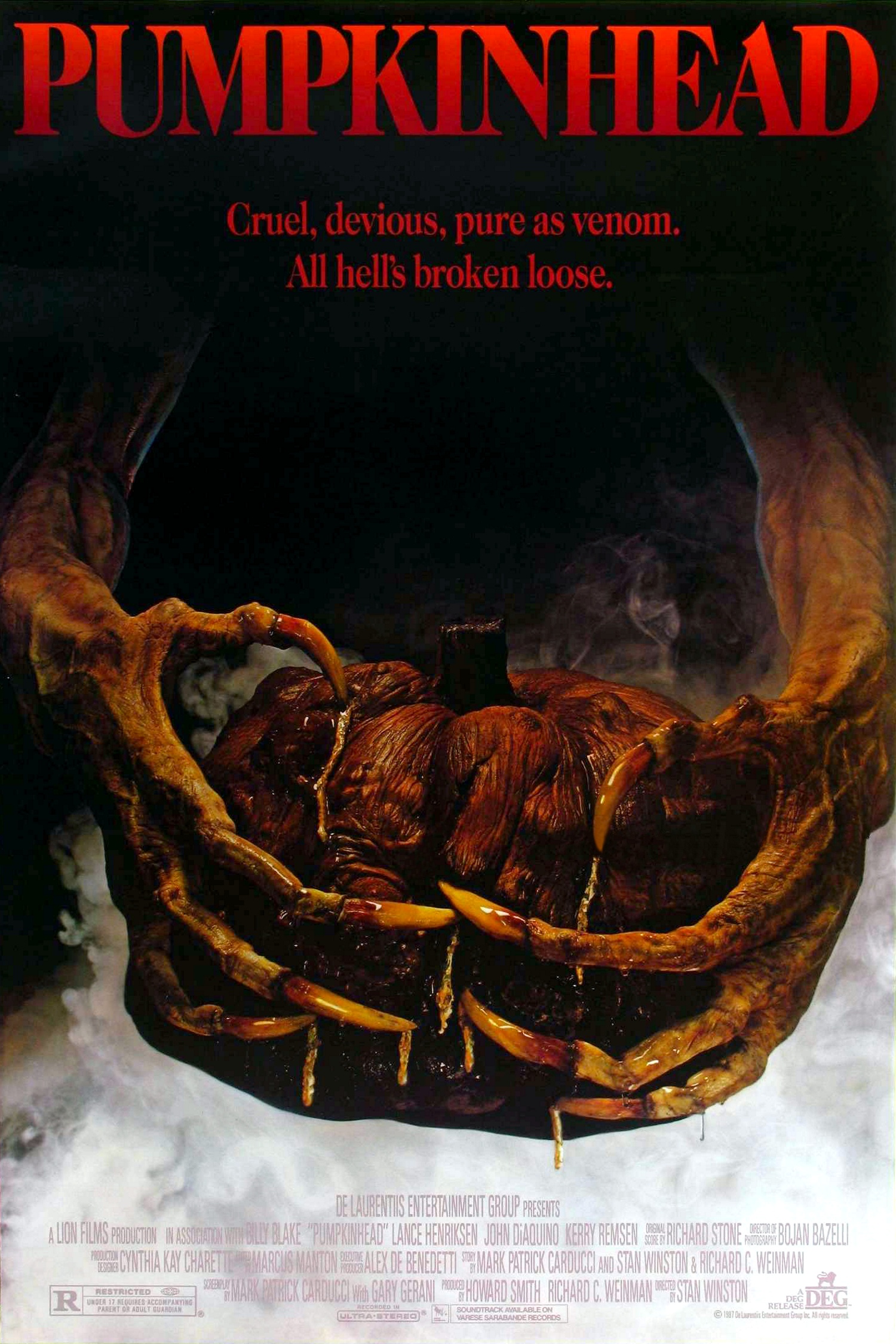
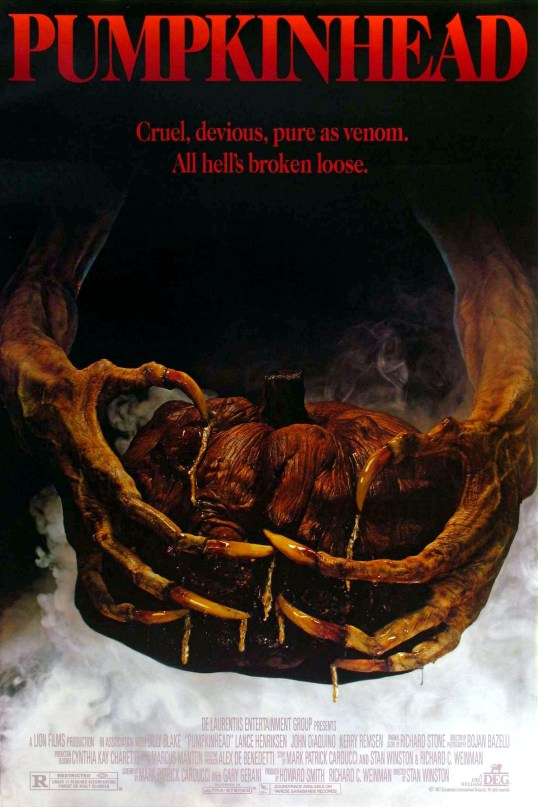
Oct. 3rd: ‘Pumpkinhead’ (dir. Stan Winston)
pumpkinhead-poster

‘Pumpkinhead’ is a creepy, cliche and cheesy as hell horror film about revenge, that manages to overcome all its faults with its brilliant creature design, a great central performance, and an emotional core that gives all the supernatural violence some resonance. The result isn’t a masterpiece – by any stretch – but it is a damn near perfect horror film for Halloween/October – especially with its eerie supernatural aesthetics.

The film stars Lance Henriksen as Ed Harley, a single father raising his son on a farm in the south. One day a group of teens (including a few blondes and a douchey “bad boy”) arrive in town. Their destination? A cabin in the woods…of course. On their way they encounter Harley at a local store he owns, which accidentally results in his son being killed by one of the teens in a dirt bike accident. The group heads for the cabin, fearing the repercussions, while Harley tracks down a creepy old lady who, according to local legend, can summon a demon-like creature to avenge the wrong doing done to a man.

From there we get a rather unoriginal creature feature – as the demon, called Pumpkinhead, hunts down the group of teens one by one. What kept this interesting, for me, was the structure of the events of the film and the development of Henriksen’s character. Henriksen is a great actor, and the bond that is built between him and his son, and the emotions he displays as he struggles with his son’s death and the revenge he seeks, manages to ground the film and gives it enough of an emotional relevancy to excuse the cheesiness of the supernatural horror elements – and some truly shitty dialogue.

On top of that are the great spooky horror aesthetics and atmosphere – moody lighting, fog…pumpkins – as well as the awesome design of the Pumpkinhead by special effects legend Stan Winston (‘Aliens’, ‘Terminator’) – who actually directed the film. It all adds up to an above average horror flick that I recommend everyone watch this October.
Horror Song of the Day: It Was Always You, Helen from Candyman (by Phillip Glass)


0801837000320

Latest Horror Song of the Day comes courtesy of one Phillip Glass who was tasked with composing the film score for the film adaptation of Clive Barker’s short story “The Forbidden”. The film would become Candyman.

“It Was Always You, Helen” becomes the film’s overarching theme throughout the film. Unlike other horror themes before it, the one created by Glass for Candyman highlighted the Southern Gothic backstory of the title character and the origins of the Candyman legend. It’s been called a minimalist score, yet it’s selling the film score short, especially this theme. While Glass has become famous for his work within the minimalist music movement he actually created a very symphonic score, albeit one which focused on subtlety over bombastic.

While listened on it’s own doesn’t evoke any sort of shivers up one’s arms and back, this theme will bring about such feeling of supernatural dread when paired with the film. It’s a shame that Phillip Glass doesn’t do more horror film scores because this theme and the score for the film shows that he has a knack for it.

Horror on the Lens: The Beach Girls and the Monster (dir by Jon Hall)


The Beach Girls and the Monster 02

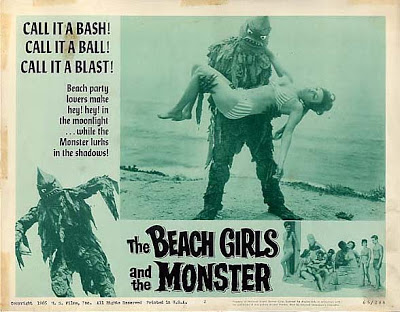
For today’s horror on the lens, we offer up 1965’s The Beach Girls and the Monster.  In this one, a monster that might be a mutated barracuda is hiding out on the beach and killing teenagers.  Can Dr. Otto Lindsay (played by the film’s director, Jon Hall) figure out how to defeat the monster?  Will Otto’s son Richard (Arnold Lessing) ever stop surfing long enough to get back to studying science?  Will Otto’s much younger wife Vicky (Sue Casey) seduce the troubled and crippled sculptor Mark (Walker Edmiston)?  And will it ever occur to anyone to just go to a different beach?

Complete with a ludicrous monster, a great soundtrack, tons of dancing, melodramatic acting, and a twist ending that will surprise no one, The Beach Girls and the Monster is low-budget favorite of mine.   It’s also, I think, a perfect movie to watch on the 3rd of October.

Enjoy!

Horror on TV: The Twilight Zone 2.3 “The Last Rites of Jeff Myrtlebank”


The_Last_Rites_of_Jeff_Myrtlebank

Today’s televised horror is an episode of The Twilight Zone called The Last Rites of Jeff Myrtlebank. It examines what happens when, in the middle of his funeral, Jeff Myrtlebank (played by James Best) suddenly sits up in his coffin and asks what’s going on. Jeff’s friends and family are now torn between being happy to have Jeff back and being worried as they try to figure out what exactly Jeff has come back as. I like this episode, largely because it’s a good example of country gothic and, in many ways, I’m a gothic country girl. Plus, it has a really great ending!


This episode was directed and written by Montgomery Pittman and originally aired on February 23rd, 1962.

Horror on The Lens: Robot Monster (dir by Phil Tucker)


Robot Monster

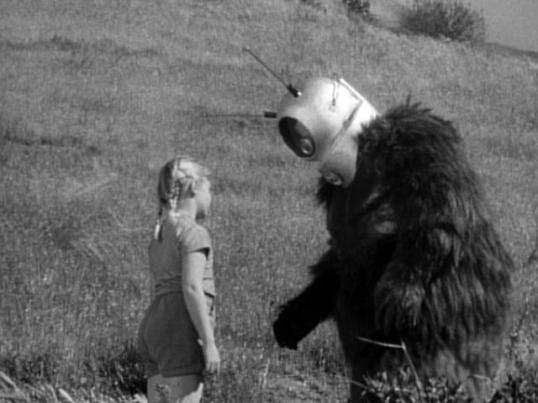
Today’s horror film is a true classic of its kind, the 1953 science fiction epic Robot Monster.

What happens with the Earth is attacked by aliens?  Well, first off, dinosaurs come back to life.  All of humanity is killed, except for one annoying family.  Finally, the fearsome Ro-Man is sent down to the planet to make sure that it’s ready for colonization.  (Or something like that.  To be honest, Ro-Man’s exact goal remains a bit vague.)

Why is Ro-Man so fearsome?  Well, he lives in a cave for one thing.  He also owns a bubble machine.  And finally, perhaps most horrifically, he’s a gorilla wearing a diver’s helmet.  However, Ro-Man is not just a one-dimensional bad guy.  No, he actually gets to have a monologue about halfway through the film in which he considers the existential issues inherent in being a gorilla wearing a diver’s helmet.

Can humanity defeat Ro-Man?  Will Ro-Man ever get his intergalactic supervisor to appreciate him?  And finally, why are the dinosaurs there?

All of those questions, and more, are cheerfully left unanswered but that’s a large part of this odd, zero-budget film’s considerable charm.  If you’ve never seen it before, you owe it to yourself to set aside an hour and two minutes in order to watch it.

You’ve never see anything like it before.

Enjoy!

Horror on TV: The Twilight Zone 2.7 “The Nick of Time”


TheTwilightZoneLogo

Along with starting each day of October with a horror film here at the Shattered Lens, we’re going to end each day with a horror-themed television show.

While I had previously caught a few episodes of the Twilight Zone during one of the annual holiday marathons on SyFy, I didn’t truly appreciate the show until I first exchanged e-mails with my friend in Australia, Mark. Among other things, Mark expressed a very eloquent appreciation for The Twilight Zone and that inspired me to watch quite a few episodes that have been uploaded to YouTube and Hulu. Along with being an essential piece of television history, the best episodes of the Twilight Zone remain watchable and entertaining 50 years after they were first broadcast.

Considering the esteemed place that the Twilight Zone continues to occupy in American culture, it seems appropriate to feature it during Horror Month here at the Shattered Lens.

We start things off with an episode that was originally broadcast on November 18th, 1960. The Nick of Time tells the story of what happens when two newlyweds stop off at a small town cafe and the superstitious husband (William Shatner) starts to play with a memorably creepy fortune telling machine. Now, I should warn you that, since this episode is not available on YouTube, I’m having to embed it from Hulu. That means that you’ll have to sit through a few commercials but it’s still a good episode.

Enjoy!

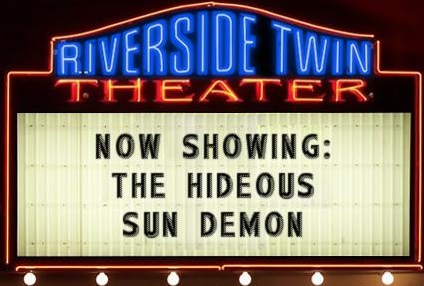
Horror On The Lens: The Hideous Sun Demon (dir by Robert Clarke and Tom Boutross)


Hideous Sun Demon

Hi there and welcome to October!  This is our favorite time of the year here at the Shattered Lens because October is horror month.  For the past three years, we have celebrated every October by reviewing and showing some of our favorite horror movies, shows, books, and music.  That’s a tradition that I’m looking forward to helping to continue this year.

So, let’s start things off with the 1959 cult classic The Hideous Sun Demon.  In The Hideous Sun Demon, a scientist named Gil (played by Robert Clarke, who also wrote and directed) is exposed to radiation.  Perhaps not surprisingly, this does not turn out well for Gil.  Now, whenever Gil is exposed to direct sunlight, he turns into a scaly and murderous monster.  Struggling to control his new monstrous side and slowly losing his grip on his own sanity, Gil retreats to a seaside town where he spends most of his time sitting in the dark.  He only emerges from his house at night and then only so he can go down to a bar and listen to the sultry Trudy sing a song.  However, the sun always rises…

The Hideous Sun Demon may not be a great film but it’s perfect for a little Halloween fun.  Robert Clarke is sympathetic in the lead role and, while the Sun Demon might just be a man in a rubber suit, that’s all just a part of the film’s charm.

So, let’s start October by pulling down the shades, blocking out the sun, and enjoying The Hideous Sun Demon!

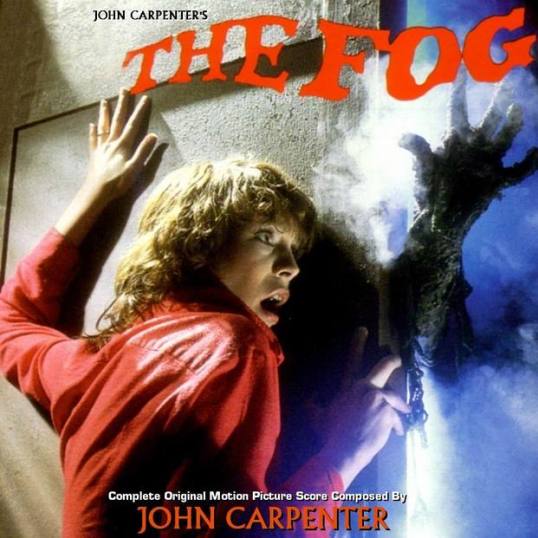
Horror Song of the Day: Theme from The Fog (by John Carpenter)


the-fog1

It’s that time of year again for the gang here at Through the Shattered Lens. October has become a sort of official month for the site with much of the posts and articles being related in some manner to all things horror (or close enough to it).

To start off 2014’s Horror Month here at Through the Shattered Lens I’ve chosen a wonderful and creepy piece of horror film music courtesy of the Master himself, John Carpenter.

It’s a great piece of atmospheric music that more than adds to the encroaching horror that is the film’s title. John Carpenter has done most of the soundtracks to his films and his use of electronic keyboards and synthesizers have become such a unique signature in all his films. The last couple years have seen a sort of revival for Carpenter’s type of electronic/synthesizer compositions. One recent film which made great use of this particular style was Jim Mickle’s Cold In July.

The theme to The Fog remains a favorite of horror fans and its influence on filmmakers today is a nice testament to well-earned classic status.

Film Review: A House Is Not A Home (dir by Christopher Ray)


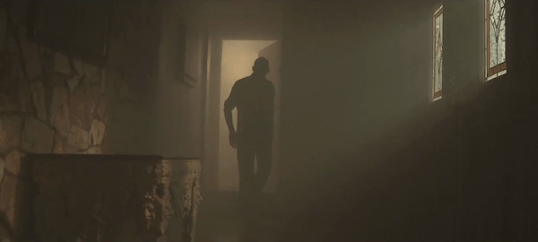
Gerald-Webb-Creepy-Stairs-A-House-is-Not-A-Home-Still

I was recently lucky enough to get a chance to see a perfectly creepy haunted house movie called A House Is Not A Home.  A House Is Not A Home is one of those films that I have wanted to see ever since I first heard about it last year.  I have to admit that, usually, whenever I find myself looking forward to a movie, I sometimes dread actually watching it.  There’s nothing worse than being disappointed by a film that fails to live up to your initial expectations.  That’s why I’m happy to report that A House Is Not A Home not only lived up to those expectations but exceeded them.

A House Is Not A Home begins with a close-up of a bloodied hand.  An obviously unstable man (played, with a truly unsettling intensity, by Richard Greico) calls 911 and tells the operator that “they’re all dead” and it’s all his fault.  He then hangs up and, after shouting, “Take me!”, disappears into a bright white light.  It’s an effective scene, largely because it’s played totally straight.  You look at Greico and you have no doubt that something terrible truly has just happened and that not only was he responsible but he’s going to also be responsible for a lot more before the film reaches its conclusion.  It’s the perfect way to open up a haunted house scene, one that hints at the promise that the film itself will soon fulfill.

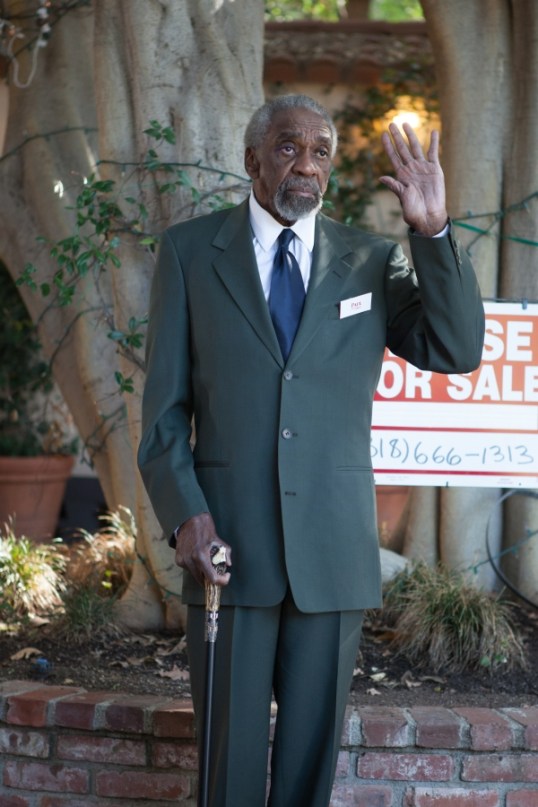
Sometime after the man had vanished, the house is up for sale.  Architect Ben (Gerald Webb) and his wife Linda (Diahnna Nicole Baker) are given a tour of the house by a real estate agent named Paul (Bill Cobbs).  When we first see Paul, he seems like a nice old man.  He’s friendly, he’s always smiling, and he comes across like he could probably sell snow in Canada.  But, it quickly becomes obvious that there’s something a little bit off about Paul.  By the time he finishes showing the house, you start to realize that his friendly smile seems to be more of a self-satisfied smirk.

Regardless, Ben and Linda buy the house and, along with their two teenagers, Ashley and Alex (Aurora Perrineau and Melvin Gregg), move in.  From the minute that they unpack, strange things start to happen.  Ashley is woken up in the middle of the night by mysterious laughter and, regardless of how many times she tries to move them, the same scary-looking dolls keep showing up on her dresser.  (Seriously, those dolls were creepy!)  Alex feels as if he’s being watched wherever he goes.  Linda, a recovering alcoholic, starts to drink again and her attempts to give piano lessons are made difficult by the fact that the piano occasionally attacks her students.  And Ben suddenly finds himself having nightmares and deliberately cutting himself so that the blood can hynotically drip down onto the kitchen table.

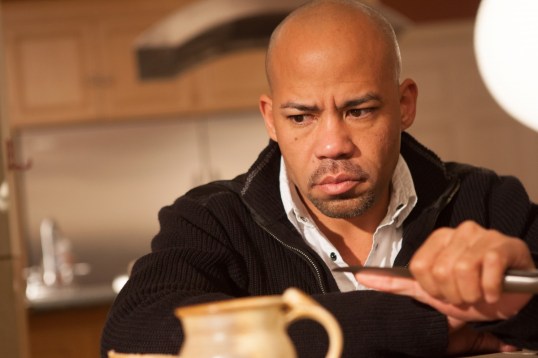
A-House-is-Not-a-Home-Still-Gerald-Webb-Ben-Williams

Even more frightening?  The man from the first scene in the film keeps popping up, standing in the corner and watching.

Yes, obviously the house is haunted and eventually, even Ben is forced to admit it.  The family is forced to call in a voodoo priest, who attempts to exorcise the house.  (The priest is played by Eddie Steeples, who may be best known for playing the comedic Crabman on My Name Is Earl but  who actually gives a nicely intense and creepy performance here.  Just check out his eyes!)  If you’re a fan of the horror genre, then you’ve probably seen a lot of haunted house exorcisms but, even if it might seem like a familiar development, the exorcism scenes in A House Is Not A Home are really well-done.  If nothing else, they’re distinguished by the fact that the exorcist isn’t the typical quirky medium or self-doubting Catholic priest that most movies offer up.  For once, we’re given an exorcism that’s interesting to watch…

But does the exorcism work?  Well — does an exorcism ever work in a haunted house film?  You’ll have to watch to find out.

A House Is Not A Home is an effectively creepy movie, one that uses its low-budget to its advantage. Director Christopher Ray allows the camera to creep through the house, snaking its way through empty passages while the soundtrack is full of the sounds of restless spirits.  The end result is a film that, as opposed to relying on predictable CGI for its scares, instead creates a palpable sense of doom and dread.

The film is well-acted by the entire cast, with Bill Cobbs especially giving a wonderfully sinister performance.  (I wish I could tell you about his final appearance in the movie without it acting as a spoiler but seriously, it’s a wonderfully acted scene.)  In the role of Ben is Gerald Webb, who will be a familiar face to anyone who regularly watches the SyFy Channel.  Webb (who also earned a bit of pop cultural immortality by serving as casting director for both Sharknados) has appeared in several beloved Asylum films as characters who inevitably always seem to end up getting killed.  It was nice, in A House Is Not A Home, to get to see Webb play a leading role and prove that he’s capable of a lot more than just a good death scene.  He gives an effective, sympathetic performance here.  In fact, the entire family does.  One reason that the film works as well as it does is because you believe that these four characters actually are a family.  You care about what happens to them and, as a result, the horror is all the more effective.

Finally, two final notes about A House Is Not A Home.  At its best, the film — with its emphasis on atmosphere and its scenes of the characters discovering that the house exists on its own plane of surreal logic — can compared favorably to the works of Italian horror director Lucio Fulci.  I don’t know if that was intentional or not.  But it’s definitely a good thing!

Secondly, and perhaps a little sadly, A House Is Not A Home is one of the few “serious” films that I’ve seen recently that featured an almost entirely African-American cast.  That’s really saying something when you consider that I literally watch hundreds of films a year.  At a time when mainstream filmmaking (and the horror genre in particular) still seems to be struggling to break free from racial stereotyping, A House Is Not A Home is definitely a step in the right direction.

A-House-is-Not-a-Home-Still-Bill-Cobbs-Paul