Beyond the Grave is an intriguingly enigmatic film about the end of the world.
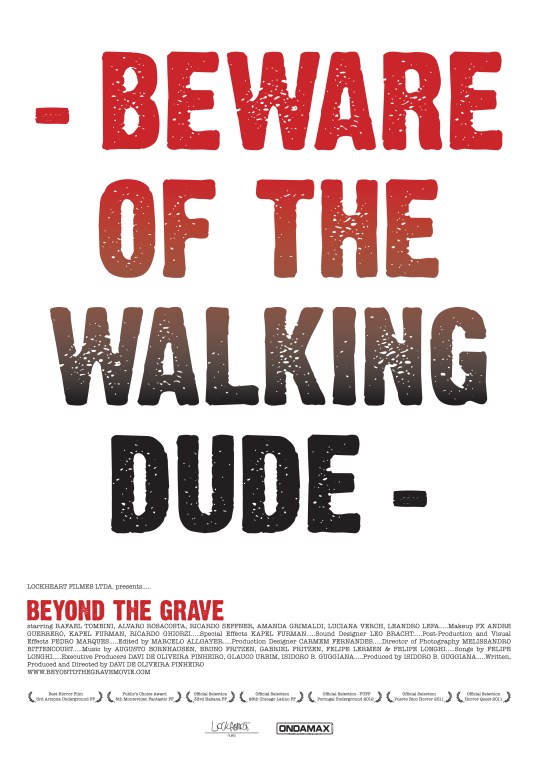
Why was the world ended? To the film’s credit, this is left intentionally vague. Some characters mention that the “Seven Gateways of Hell” have been opened. (Just the term “Seven Gateways of Hell” pays wonderful homage to Lucio Fulci’s horror classics, The Beyond and City of the Living Dead.) At one point, we spy some graffiti reading, “Beware the Walking Dude,” which, of course, brings to mind the apocalyptic fiction of Stephen King. Occasionally, small groups of “returners” are seen aimlessly wandering up and down empty highways. Are they zombies or are they something else? Occasionally, on the radio, a disembodied voice is heard over a car radio. “This is the end of the world,” the voice says, “If you are listening to this, it is already too late.”
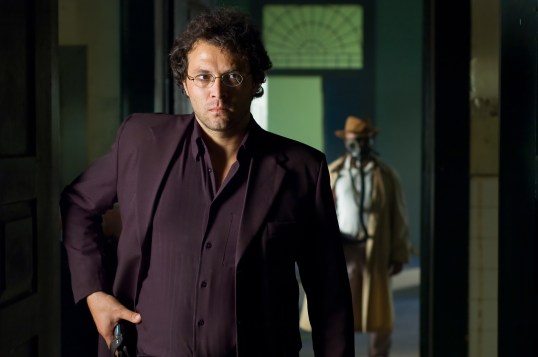
One thing that quickly becomes obvious is that there’s very few “normal” people left alive. One of these is a mysterious and enigmatic man known as the Officer (Rafael Tombini). The Officer, who carries both a sword and a gun that carries only one bullet, drives a police car over the deserted landscape and dispenses his own form of justice. Who he works for or if there’s any sort of controlling legal authority left in this world is another issue that the film leads intriguingly vague.
(I appreciated the fact that the film — much like Romero’s original Dead films and Cormac McCarthy’s The Road — only hinted at what had causes it’s world-changing cataclysm. When it comes to end of the world, there should never be any simple answers.)
The Officer is hunting a demonic force known as the Dark Rider and, as he explains, it’s a search that he began before the world even ended. (And, indeed, we saw in a brief flashback that the Dark Rider existed even when there was still civilization.) Throughout the film, the Dark Rider jumps from body to body, all the while uttering, “What is near me, shall become mine.”
Working with two teenagers, the Officer searches the Dark Rider, taking time to only briefly rest at a compound. When, about 42 minutes into the film, the Officer finally tracks the Rider down, something totally unexpected happens, something that forces the audience to reconsider everything that they had previously assumed about how the film was going to work. I’m not going to tell you what happens. That’s something you should discover for yourself.
Beyond the Grave is a visually stunning hybrid of a film. It’s a western, a zombie movie, a postapocalyptic action film, and a philosophical rumination of man’s place in the universe, all wrapped up in one! Director Davi de Oliveira Pinheiro gets the most out of the film’s bleak locations and Rafael Tombini gives an excellent lead performance as the enigmatic Officer. Beyond the Grave is an intriguing film, both for the questions it answers and for the ones that it leaves unanswered. It’s a film that any horror fan should see and will appreciate.
I had high hopes for Deliver Us From Evil, largely because it was directed by Scott Derrickson who, in 2012, gave us the wonderfully atmospheric and disturbing Sinister. Unfortunately, having now seen Deliver Us From Evil, I can only call it the anti-Sinister. Whereas Sinister took the viewers by surprise, Deliver Us From Evil is predictable. Whereas Sinister was full of genuinely disturbing moments, Deliver Us From Evil is full of jump scenes that are scary for a few seconds but then swiftly vanish from the memory. Whereas Sinister was fascinating for featuring a morally ambiguous hero, Deliver Us From Evil features a hero who is so mundanely heroic that you find yourself hoping that he’ll fail just as punishment for his smug hubris.
Perhaps the only way that Deliver Us From Evil tops Sinisteris that it features none other than the King of Television Snark, Joel McHale. As someone who loves both The Soup and Community, I’m always happy to see Joel but he’s oddly cast here, playing a muscle-bound, adrenaline junkie cop. It’s not that Joel does a bad job. In fact, he’s probably the most likable and compelling character in the entire film. It’s just that you can’t look at him on screen without asking, “Joel, why are you here!?”
Anyway, Deliver Us From Evil is pretty much your standard demonic possession/cop thriller hybrid. Mysterious murders are being committed. The murderers speak in a weird language and, it soon turns out, all of them are linked both to the discovery of ancient tomb in Iraq and to a painting company that was started by a group of returning veterans. It’s up to cops Ralph Sarchie (Eric Bana) and Parker (Joel McHale – why, Joel, why!?) to solve the crime. Helping them along the way is a former drug addict priest named Mendoza (Edgar Ramirez). If you’re guessing that the whole thing leads to a violent exorcism on a stormy night – well, you’re definitely on the right track.
Scott Derrickson does the best that he can with the material but he’s hampered by the fact that the film is based on a book that was written by the real-life Ralph Sarchie. Perhaps as a result, the film’s Ralph is such an upright and moral hero (though he does yell at his daughter in one unpleasant moment but even that is excused as simply being evidence of how personally Ralph takes his job) that he’s also not that interesting of a character. Eric Bana, who is actually a pretty good comedic actor, struggles to find some sort of depth to Ralph but ultimately, it’s just not there. And since 90% of horror is psychological, Deliver Us From Evil cannot recover from revolving around such a flat protagonist.
As a result, Derrickson has little option but to fill the film with standard horror movie scenes. The scenes, as themselves, work well enough but the story is so predictable that they don’t make much of an impact. The end result is a film that you’ve seen a hundred times before.
The only difference, of course, is that this version features Joel McHale dancing around with a knife.
“Just look at the flowers, Lizzie. Just look at the flowers.” — Carol Peletier
The Walking Dead tv series has always diverged from the comic book source to keep fans of the books guessing. Some fans of the comic books have complained about this since it would mean discarding certain subplots and characters that they love but were really non-essential to the overall story being told for the tv series version. Yet, the writers of the show, through the comic book’s creator Robert Kirkman, have mined the comic book source for material that remains important to the show’s narrative.
The latest episode, “The Grove”, takes a disturbing but very important subplot from the comics and manages to adapt it for the tv series in a way that made it one of the series’ best.
A cold opening that manages to be both quaint, idyllic and disturbing which sets the tone for the rest of the episode sees the return of the group led by Carol. It’s a group that could almost be seen as a makeshift family unit. There’s Carol the loving, yet stern mother who wants to make sure her daughters learn how to survive in this dangerous, new world while Tyreese remains te compassionate and protective father. Lizzie, Mika and Rick’s baby daughter Judith make up the children who must now adapt to this new world or perish.
First off, Judith remains the blank slate in the show. She’s the first baby born after the world went to hell and thus will have to grow up in it’s new environs and new set of morals and principles. The old civilization is gone and while people try to hold onto what made that civilization tick only those willing to adapt to this new world seem to survive. Now, Lizzie and Mika were already forming their own personalities and sets of morals when the zombie apocalypse hit. We see the two Samuels girl go in differing paths in how they cope with this new world.
While seeing these two girls’ inability to adapt to the world post-zombie apocalypse was a nice theme to explore the episode really focused on the group’s maternal unit. This latest episode was a culmination of the new Carol Peletier that season 4 unleashed on an unsuspecting audience.
This was a character that we saw as being the meek victim of spousal abuse even before the zombies arrived. Her emotional trauma would continue with the loss of her young daughter Sophia in season 2 and almost dying during break in prison security in season 3. Yet, by the time season 4 rolled around we see her become a hardened survivor who has turned the corner and decided she will not remain a victim anymore and make sure those people see as being helpless (the young children in the group) learn how to defend themselves from zombies and humans alike.
The titular grove the group stumbles upon early in the episode has an almost mystical quality to it. An idyllic locale in the middle of literal hell on earth. There’s untainted well water to be had, a pecan grove for food and even a solitary deer that seems to come by at the most opportune time for meat. Hell, the cabin even has a working gas stove (probably a propane tank fed one) and a secure enough fence of barbed wire to fend off the random zombies that may wander by. It’s almost paradise in comparison to the different place Carol, Tyreese and the girls have had to call shelter.
It is no wonder that both Tyreese and Carol entertain the idea of maybe staying at the grove and making a life for themselves with the girls instead of continuing onto the unknown potential haven that is Terminus. But one thing this show has been consistent about when it comes to it’s characters seeming to find peace and tranquility is that it will pull the rug from under them to reveal that things are not ideal and that it’s just a veneer over the ugliness and brutality this new world has turned into.
The rug gets pulled out gradually from beneath Carol’s feet as both Mika and Lizzie continue to fail in heeding her teachings about survival. Mike remains adamant about not ever wanting to hurt anyone alive (she makes some headway in killing off some zombies during the episode) which Carol sees as dangerously naive of the young girl. Lizzie on the other hand begins to reveal an even more dangerous quality which would turn tragic by episode’s end.
By this time many will have written and discussed the events involving Lizzie and Mika that would add another emotional stone on Carol’s back. It’s a sequence that’s as disturbing as anything this show has put on the air in the last four years. It’s not often that children get killed in tv shows (well except for Law and Order: SVU) and yet The Walking Dead manages to do it twice in one night and both times it’s not gratuitous or meant to be entertaining. both Mika and Lizzie’s death become a sort of crucible Carol must go through to find a sort of equilibrium between the nurturing mother she was before season 4 and the cold, pragmatic survivor she has become this season. She still remains conscious to the fact that hard decisions need to be made for the greater good and she makes it ones again when Lizzie murders her younger sister Mika. It’s a murder not done in spite or malice. Lizzie truly believes that Mika will return and remember not to attack her friends and family.
In the end, the grove ceases to be the ideal haven Carol and Tyreese saw it as in the beginning and realize it’s just another place to leave behind with bad memories. It’s become another haunted place for the next people to find and wonder what happened to the previous inhabitants and what caused them to leave behind three small graves in the flower and pecan grove.
Notes
Tonight’s episode was written by showrunner Scott M. Gimple and directed by Michael Satrazemis.
The cold opening sequence was a nice touch using The Ink Spot’s “Maybe” song that was also used in the Bethesda post-apocalyptic game, Fallout 3.
Mika definitely came off as being the more intelligent of the two sisters. Though as many would probably point out, just as Carol did, her inability to hurt other people who will want to hurt her will get her killed sooner or later.
Lizzie’s personality matches very closely that of the comic book Carol who began to see the zombies as more her friends than a danger. I’m sure Kirkman had a hand in helping Gimple round out the character of the elder Samuels girl.
I noticed that the pistol that Mika carried with her was a Smith & Wesson M&P 9 (full-size one even) just for the fact that I also own one so it was very recognizable.
The different subplots involving the scattered groups of prison survivors seem to be following an uneven timeline within this midseason narrative. The fire and smoke seen by Carol, Tyreese and the girls would mean that they’re at least a day behind Daryl and Beth.
Gimple must’ve been a fan of Steinbeck because tonight’s episode had a very Of Mice and Men feel to it right up to the sequence with Carol and Lizzie in the end.
Talking Dead Guests: Melissa McBride of The Walking Dead, Yvette Nicole Brown from Community and WWE’s CM Punk.
“Why hurt yourself when you can hurt other people.” — Joe
The Walking Dead has taken on a new narrative path since it’s return after this season’s mid-season break. One of the biggest complaints that some fans and critics have had about the show has been the lack of character development for many of the roles in the show. We’re not talking about people who show up for a scene or an episode or two. It’s for those who have become regulars through the show’s many season.
Well, it looks like from the show’s writers will be trying to rectify that flaw this second half of season 4.
Since the show’s return from it’s mid-season break it’s taken on an almost zealous attempt to show the audience more of who these people truly are. Each new episode in this second half has been more about exploring each surviving character’s backstory either through some sort of flashback (like we saw tonight with the cold opening showing Bob’s lonely existence before being found by Daryl and Glenn pre-prison attack) or some of the quieter moments of exposition between characters (last week’s episode between Daryl and Beth was a prime example of this). We’ve gotten to learn more about our favorite zombie apocalypse survivors. They’ve shown themselves to be more than what the previous seasons have made us to think of them.
Tonight’s episode continued to explore the growing relationship (whether romantic or platonic) between resident badass Daryl Dixon and bright-eyed optimist Beth Greene. We see him trying to teach the younger Greene girl how to become a better with the crossbow and be a better tracker. Throughout their section of tonight’s episoode we see Daryl become more protective of young Beth Greene. The false front he’s put up in the past to avoid getting closer to people has started to come down. In past season fans and writers have looked at Daryl Dixon as someone who probably would be better off being alone instead of trying to deal with a dysfunctional “family” unit of survivors. He’s the only one who seems to be ready-made for this zombie apocalypse.
Yet, as we’ve seen in the second half of this season being alone is something that he doesn’t want to ever return to. He may remain gruff and surly, but his need to be around those who care about him and people who he wants to belong with has made him a more well-rounded badass. The way the Daryl and Beth half of the episode ended it’s going to be interesting if his need to belong with a group will cause him to forget the humanity he has found while being with Rick’s group.
The theme of being alone continues, and actually began, with the Bob, Sasha and Maggie half of tonight’s episode which was aptly titled, “Alone”. Bob’s time being alone in the wilderness was the cold opening for tonight’s episode and revealed much about the enigmatic Bob. This was all done with Bob not speaking a line of dialogue in the first few minutes. He seemed able enough to survive on his own, but the moment Glenn and Daryl arrive and offers him sanctuary back in the prison he accepts with no questions asked.
It’s a theme that runs throughout tonight’s episode. Being alone may make it easier to survive. No one to worry about. Only have to keep one person alive. But for these survivors it’s the comfort of having others looking out for you which makes it all worth the headaches and drama that comes with being involved with other people. These lone wolf survivors may be great at surviving on their own, but they also want to be doing more than just survive. They want to live and being with others. It makes them feel more human and gives them a higher purpose than just trying to survive day to day.
Some fans may not be liking this more introspective turn of The Walking Dead this second half of the season. There’s still some gruesome scees to be had, but there’s also many more quiet scenes of just characters interacting with each other minus the violence and brutality inherent in a show about the zombie apocalypse.
Notes
Tonight’s episode was written by Curtis Gwinn and directed by Ernest Dickerson.
Some great genuinely scary moments in tonight’s episode: the fog sequence with the zombies involving Bob, Maggie and Sasha was shot and directed well by veteran director Ernest Dickerson (who has directed some of the best episodes in the series). Another was Daryl finding himself stuck in a room filling up with zombies and the only way out was going through them.
Tonight’s episode was the strongest of this season’s second half. We just didn’t get to learn about some of the things which motivates Bob, but also what made Sasha and Maggie such good survivors. Larry Gilliard, Jr. hasn’t been given enough chances to stretch his acting skills this season, but tonight he was allowed to do just that and he passed with flying colors.
Beth is really thirsting for some of Daryl and was really apparent in tonight’s episode. This should make Daryl/Carol shippers not very happy at all.
For Dead Rising fans tonight’s episode should bring a smile to their faces as we see Maggie become an expert in zombie killing just using a street sign pole and it’s very sharp squared steel sign.
The episode opened and ended with the song “Blackbird Song” by Lee DeWyze.
Jeff Kober returns as the leader of the small band of raiders we saw in the episode “Claimed”. His return may mean he’s the big baddie for this second half as the different groups make their way to Terminus.
Talking Dead Guests: Sonequa Martin-Green and Lauren Cohan, Sasha and Maggie of The Walking Dead.
The ratings numbers for the mid-season premiere of The Walking Dead was again shocking critics and fans both. Ratings for the show just stupefies critics of the show who can’t seem to get a handle on why this show has gone beyond popular and into pop icon status. By now we can honestly say that the show’s writing will never reach the status of other current popular shows like True Detective, Game of Thrones or that of Breaking Bad. Yet, the show continues to appeal to millions of fans not just in the US but worldwide.
The Walking Dead is basically a horror soap opera that’s airs on a basic cable network. But each and every week the show airs a new episode it beats everything put up against and more than holds its own with NBC’s Sunday Night Football. It’s a show that has had and continues to have issues with it’s writing and some of its characters, but for some reason the whole affair resonates with the millions who wait with anticipation for each new episode and news to appear.
Even detractors and strong critics of the show (some of who, vehemently hate the whole thing’s success and popularity) manage to still watch the show if just to poke fun and tear it down. It’s almost as if by doing so they can find that secret ingredient as to why the show remains so popular and successful.
Tonight’s episode focuses on the rest of the prison group who fled their sanctuary after the battle with the Governor’s forces. Last week it was more on the fleeing Rick, Carl and Michonne and their journey from the brink of despair to at least a semblance of hope and acceptance. We begin with the duo of Daryl and Beth who fled the prison on foot.
It’s an odd pairing that puts together one of the show’s most badass and pragmatic characters with one of it’s most hopeful (at least now with Hershel Dead). It’s a cold opening and section of the episode which includes diary readings by Beth of her renewed faith and need to continue to live after the group arrives at the prison. Once again we see the ghost of Hershel looming over all the survivors like a shade trying to give them hope to live for the next day despite the travails and horrors they’ve just left behind and still looking forward to.
The same goes for pretty much all the little groups who made it out of the prison. We see each and everyone of them not just fleeing for their lives, but also trying to get find a reason to continue on. With Tyreese and his group of Lizzie, Mika and Baby Judith it’s to continue on if just for the sake of keeping the girls alive. His road seems to be the toughest with three little girls to keep safe which makes his reaction to seeing Carol alive (at this time Rick hadn’t told Tyreese about Carol’s confession in regards to Karen’s death) was one of relief.
With Sasha, Bob and Maggie we see a trio dealing with the events they’ve just fled in their own ways. Sasha seems to be the most pragmatic with wanting to keep moving forward, scavenge for food and find a shelter. On the opposite end of the spectrum we see Maggie still dealing with the murder of her father (Hershel) and not knowing if her younger sister is still alive and, worst yet, if her husband (Glenn) made it out. It falls to Bob to find a middle ground between the two women’s agendas. Ironic considering that Bob, in the first half of the season, who was always unsure whether he truly belonged in the group and if his own personal demons meant he was a liability (yes and, to a degree, yes also). When they come across the prison bus that Maggie thought Glenn was in full of zombies and its passengers either turned or devoured one could almost see the light of hope fading from Maggie’s eyes. So, it was such a relief (again finding relief of any kind seems to be one of tonight’s theme) when Glenn wasn’t on the bus in one form or another.
Then there’s the final section of the episode where we find out that Glenn definitely survived the attack on the prison, but was left behind (due to the fact he left the bus to try and find Maggie during the battle) all alone in the ruins of their former sanctuary. He doesn’t know whether anyone else made it out and if his wife was amongst them. For a moment when back in their cell room he breaks down and seems to want to just shutdown and not deal with this new world anymore, but once again his time spent with Hershel brings him back from the brink.
Even new to the gang, Tara Chalmers, looks like she’ll fit in with Rick and his gang. She seems to survive when everyone else around her dies. Tara also harbors her own demons with the biggest being her participation in attacking the prison and getting pretty much everyone in her group killed. She’s troubled and hurting emotionally which makes her a perfect fit for Rick’s group.
Yet, the episode tonight all ended it’s three different sections with a sense of hope. The biggest being news that a new sanctuary might just be close enough for them to find shelter and safety once more. The biggest reveal of all in tonight’s episode is the arrival and introduction of three new characters whose impact on Rick’s people may just be as important and game-changing on the show as it was in the comics.
With the group slowly finding their bearings it looks like the apocalyptic battle that sent them all in different directions wasn’t the end. Things are definitely not over for Rick and his people. Will this new sanctuary hinted at in tonight’s episode become a new Woodbury or will it be something that Rick and his people can turn into something even better than the prison. The prison was sanctuary but was never an ideal place to restart whatever form of civilized society the survivors were hoping for. Maybe this new place they’re headed to will be that place.
Notes
Tonight’s episode was written by Matthew Negrete & Channing Powell and directed by Tricia Brock.
At least now the question of what happened to baby Judith has now been answered.
Lizzy looks like she’s turning out to be the very proper sociopath.
We get some resolution as to what happened to Tara’s sister, but only through Tara’s recollection of her being swamped by zombies after killing the Governor.
Some very fine work by Greg Nicotero’s wizards over at KNB EFX with the zombie kills and flesh-eating (I think these two things are part of why people continue to return to this show despite detractors and critics yelling to everyone and no one why it’s stupid to do so).
Ladies and gentlemen, let me introduce to you all Sgt. Abraham Ford, Rosita Espinosa and Eugene Powell played respectively by Michael Cudlitz, Christian Serratos and Josh McDermitt.
Talking Dead Guests: Alanna Masterson of The Walking Dead, Joe Kernen of CNBC Squawk Box and Jim Gaffigan
“I know we’ll never get things back to the way they used to be.” — Rick Grimes
We finally see the return of AMC’s very popular horror series, The Walking Dead, after a couple months on hiatus. Last we saw the series seemed to have done a sort of reboot of season 3’s season finale. A season finale that people thought would include not just the Governor’s assault on the prison, but the scattering of Rick’s group to the four winds. Season 3 didn’t end as expected and to say it was anti-climactic would’ve been a major understatement.
So, out goes Glen Mazzara as showrunner of the show and in comes Scott M. Gimple as head honcho for season 4. The change has been a nice change for the series which can’t seem to get on a consistent narrative track. Sure, it’s had major moments when it’s best thing on TV at that given moment, but it’s a far and few.
Gimple has done a much better job this season of letting the characters grow and let them dictate how the season unfolds. The zombies continue to remain the main threat (this season has shown them to be even more dangerous than in season’s past) but now interpersonal conflict adds a new level of complexities to keeping everyone safe and alive for one day more.
The first half of the season saw many new characters introduced (some given to more time to develop while others just cannon fodder) and some leave and some die. The biggest exits happening to be that of Hershel and the Governor himself. Both end up getting their ticket punched in the very assault on the prison that fans of the comic book have been wanting to see since the end of season 3. With that reboot of last season’s finale out of the way and with Rick and his group surviving out in the wilds in their own separate ways we now come to the start of the second half of The Walking Dead season 4.
Tonight’s return starts off pretty much moments after episode 8 with the prison now in flames and zombies pretty much roaming everywhere. We get Michonne returning to find something or someone. In the end, she ends up finding two zombies she turns into armless and jawless pets to help her blend in with the rest of the herd. She also manages to find Hershel’s reanimated head which she destroys and leaves behind but not before pausing for a moment to remember al that she has lost once more.
The episode jumps back and forth between Michonne’s time spent after fleeing the prison and those of Rick and Carl. The father and son duo are having a much tougher time. Rick is too injured from his fight with the Governor and their supplies of ammo and provisions are next to nothing. It doesn’t help that Carl’s resentment towards Rick has come to the surface after the disastrous events at the prison.
This episode was really about Michonne and Carl dealing with the events from the previous episode. Michonne has seen the group she has begun to see as a family scattered everywhere and a place that was becoming home destroyed. Worst yet would be seeing Hershel, who she was beginning to connect with, killed before her eyes. This causes her to revert back to how we first saw her in season 3. Alone once again and dragging along two zombie pets to keep her safe. Maybe being alone and away from any sort of emotional attachment would be best for her, but her own subconscious makes it finally known to her that this is not so.
She could sleepwalk through the rest of whats left of her life in this post-apocalyptic world or try and retain some of the humanity and connection with others that she was having within Rick’s group. Or she could just give up and end up becoming like the very thing that has destroyed the world. We see this in a sort of flashback dream sequence where we finally get some backstory on Michonne and her life before the fall of civiization. We now know where she got her original pair of zombie pets and why she had such a strong reaction to holding baby Judith back in the prison. This flashback Michonne was not the badass, katana-wielding survivor we’ve come to know the past two seasons, but one who seemed well-to-do with a nice family and a young son.
Like everyone else in this new world order she has lost just as much as everyone else, yet she seems to have found a way to adapt and prevail while others fail and die or succumb to their basest instincts. In the end, she chooses to get back what she had lost fleeing the prison and the zombie salughter she initiates in doing so seemed not just cathartic for her character but for the audience as well.
As for Carl, we see him attempting to deal with his current situation on his own. His resentment toward his father’s inability to protect him, Judith and everyone at the prison has begun to gnaw at him. He sees Rick as a failure not just as a father, but as a leader. His needling of Rick by mentioning Shane’s name and everyone who has died under his watch sounds like harsh truth being exposed, but also makes Carl come across like a rebelling teen trying to prove to his father that he is better than him. As we see throughout Carl’s segment, he can take care of himself, but he also has so many close-calls that his bravado makes him out to be like a teenager playing at being an adult when everyone knows he still has further to go.
Yet, as much as Carl might not be ready to cut off the parental strings, Rick understands that continuing to treat Carl like a regular kid who must be protected from the dangers of the world doesn’t belong in this new world. The Carl that Rick was searching for in the first two episodes of season 1 is no more. His son has become not just a veteran and capable survivor like him, but one who has left his childhood behind in order to be more helpful.
The Walking Dead will always be about the zombies and how this new world has danger for it’s survivors lurking in every home, building and shadows both zombies and humans. Yet, the show, especially this season, has tried to explore what this world has done to these survivors and how it’s either brought out the best, worst and everything in-between. We’ve seen characters fail to live up to the very ideals that allows one to keep a hold on their humanity while others succeed. Tonight we saw two survivors who have made a sort of peace with their situation and now moving forward to try and live one day more.
As the tagline for the second half of season 4 points out: “Don’t Look Back”.
Here’s to hoping that the show’s writer take that motto to heed and continue to look forward instead of looking back trying to fix what needed fixing. The show is now halfway through it’s fourth season and, for good or ill, it needs to move ahead with what it has established and let the audience decide whether they should continue to watch week in and week out.
Notes
Tonight’s episode was written and directed by The Walking Dead creator Robert Kirkman and series producer Greg Nicotero.
The cold opening for tonight’s episode was almost scene for scene out of the comic book with the exception of Hershel taking the place of Tyrese.
It was nice to see Aldis Hodge in the role of Michonne’s lover and father to her son. He was great in Leverage and nice to see him back on the small screen.
Michonne’s dream flashback gave us some answers as to her past, but it still doesn’t answer the one important question: where she got the katana and how did she got so proficient with it.
Still no word on baby Judith.
Talking Dead Guests: series producer and KNB FX head honcho Greg Nicotero and Michonne herself, Danai Gurira.
It’s just less than a month away until the second half of The Walking Dead season 4 begins.
This fourth season of AMC’s massively popular survival-horror series has had a sort of resurgent year. New showrunner Scott M. Gimple has done a good job in fixing some of the issues that popped up during previous showrunner Gen Mazzara’s tenure during the final stretch of season 3. While Gimple has done a good job the show still has some issues when it comes to stand-alone episodes as we saw with the two-parter that reintroduced the Governor.
The ultimate payoff of that two-parter led to the ending that should’ve been the season finale of season 3. The showdown and final attack on the prison was as exciting as how Kirkman wrote it for the comics. There were even scenes that seemed to have been lifted from the pages. With Rick and those who survived the prison assault now thrown to all points of the compass it brings up some interesting prospects of seeing the group trying to survive on the road not as a coherent veteran team, but in piecemeal.
With the Governor and most of his people dead the show will now have room to introduce some new characters. These characters should be familiar to fans of the comics and it will be interesting how Gimple and his stable of writers will be able to translate them from pages to the small screen.
The Walking Dead returns on AMC on February 9, 2014.
“We’re not too far gone. We get to come back.” — Rick Grimes
[some spoilers]
The Walking Dead had it’s mid-season finale over this past Sunday and like previous mid-season and season-ending finales of the past three season this one went for the gut-punch. Season 4 of the show has seen a major improvement in how the writers were finally treating some of the major characters on the show.
The first five episodes were pretty much using a plague situation within the prison community to explore the growth of some of the lead roles in the show. We saw how Rick tried to escape the burdens of leadership by attempting to just be a farmer and a good role-model for his son Carl. It didn’t necessarily work out the way he wanted it to. In the end, Rick finally realized that leadership was what the group needed from him and what he was really best suited for.
We saw a major character shift in one of the show’s less realized characters in the past meek Carol Pelletier. This season we see how she has grown into becoming just as much a cold, calculating survivor as The Governor, but still retaining some of the humanity the latter seems to have lost when the zombie apocalypse happened to the world. It was a surprise to see Carol in such a new light. A person who would do anything to protect the group with special attention to the young children — especially two young girls — who have survived this far into the zombie apocalypse.
Then we had Hershel finally get to have his time in the limelight. Episode 5 has been a near-unanimous choice as the strongest episode of the first half of the season and nothing about the mid-season finale changes that. That’s how good “Interment” really was in the overall scheme of this new season’s first half. We saw Hershel finally become the show’s moral center but one that didn’t have the rigidity of ideals that Dale had. Hershel kept his humanity but also knew that this new world meant having to put one’s life on the line and not just pay lip-service to one’s ideals. I know that Dale would’ve done the same, but we never truly saw him put it all out there. He was great with the speeches, but the writers could never have him act on them. With Hershel they were able to reset the show’s moral compass and write the role properly.
The last two episode saw the return of The Governor. It was a peculiar two-parter which focused only on the return of Season 3’s main villain. Scott M. Gimple and his crew of writers tried to dial back the cartoonish way the character had become a villain by the end of Season 3. They tried to put the character back on the road to redemption. They even gave him a new surrogate family with a young girl who looked eerily like his previous daughter pre-zombie. Yet, while the attempt was an interesting one the character arrived full-circle to the very Governor we first met in the early episodes of Season 3. He wasn’t as mustache-twirling evil that he had become by the end of last season, but that redemption road that episode 6 and 7 was all about ended up being a red herring.
Now, we come to the mid-season finally which literally reset’s the finale of season 3. It was a finale that was underwhelming at best. The war between Rick and the Governor never truly materialized. This was finally rectified with the arrival of the Governor and his new band of camp followers but this time he has a tank. It’s a scene straight out of the comics and it was one that readers and fans of the books have been waiting for years to happen.
“Too Far Gone” marks a turning point for the series in that we finally leave another fixed location but do so with some major characters never to return. It was an episode that started off like a sizzle reel of every complaint detractors have about the show. Dialogue that went nowhere and just seemed to spin the episode’s wheels to fill time. Yet, as the episode progressed the entirety of the first half’s story-arcs began to take shape.
Rick was willing to share the prison with his worst enemy. He wasn’t too far gone that he would put himself as innocent of doing some heinous things to survive. He might not like the Governor, but for the sake of both groups not killing each other he would swallow his pride and accept everyone. The prison has room for everyone and the didn’t need to interact. It’s a major character growth for Rick who always saw his group as the good guys in any conflict. But like any leader he was getting tired of the battles that hurt only the survivors. The real threat were still the zombies who were slowly gathering outside. Hershel’s reaction to finally seeing Rick realize that one didn’t have to sacrifice their humanity to survive in this new world was one of the most poignant scenes in the series to date.
What followed it moment’s later would become one of the most heart-wrenching scenes of the series and one fans of the books were dreading to see.
Hershel was the MVP of this season’s first half and it was only appropriate that he went out in such a memorable, albeit very gruesome manner. It’s not often we see someone decapitated on any tv show. What had been an episode that threatened to meander just the way the finale of season 3 ended up doing instead became a final 20-minutes of intense action that saw both groups fail to hold onto the prison and the survivors scattered to all points of the compass. In the comics, this particular story-arc saw Lori and Judith die just when readers thought they were about to be safe from the battle. With Lori already dead a full season ago the only question which remained during this mid-season finale was whether the writers would actually pull off the unthinkable and do the same to tv version of Judith.
Children have never been seen a sacred cows on this show, yet infants seemed to remain safe. The episode ends with the question of whether Judith is dead or alive hanging in the air. It’s to the visceral power that this show brings to the table that peope will wait the near to three months of hiatus before the show returns of the second half of season 4. The show will remain one that’s obsessed over by the general population while derided by a minority who have valid complaints about it.
“Too Far Gone” could almost be the motto of this show. Any sort of major change on how the show’s stories has been told might be too late to implement. The fans like the show for it’s violence, gore and the soap opera stories. It’s not perfect television, but it is television which seems to have grabbed, caught and held the attention of not just the American tv viewing public but the global tv viewing public. Maybe, it’s just time to just make the that decision each viewer has to make. Either stay on the ride and hold on until the rollercoaster ends or jump off now and forever hold their peace.
“And I ask for no redemption in this cold and barren place.” — Ben Nichols
[some spoilers]
Season 4 of The Walking Dead, from the very beginning, has been exploring the theme of whether those who have managed to survive this far into the zombie apocalypse could ever return to who they were in the past. Could they return from the brink of having to do some unthinkable acts in order to survive? It’s this running theme which has dominated this first half of the season, so far.
We’ve seen Rick trying to leave behind the “Ricktatorship” of Season 3, but only to find out that this new world won’t allow him to go back to the way he used to be. He has changed, and so has everyone, some of the better and some for the worst. We’ve seen several main characters of the show go through this very crucible and some have turned out much colder while others have seen their moral center strengthened.
The series has been hinting that the Governor was still out there and last week’s episode ended with a sudden reveal that he’s back and has now set his sight back on the prison. While quite an ominous moment considering the Governor’s past actions towards Rick and the prison group, tonight’s episode has put some ambiguity on what the Governor’s agenda in regards to the prison really is.
“Live Bait” is the title of the latest episode of The Walking Dead and it takes a risky move by concentrating on the Governor only. We don’t see Rick or anyone from the prison community. This episode was all about the Governor and what happened to him after his failed attack on the prison in the season 3 finale. We already know that he massacres pretty much every member of his attacking force with the exception of his two most loyal lieutenants in Martinez and Shumpert. We see during the episode’s cold opening the total breakdown of not just the Governor but also the full destruction of everything he had built with Woodbury both literally and symbolically.
Yet, we don’t see him continue his rampage against those who he sees as having been the architect of his downfall. We see that he has blamed no one else but himself for turning into something that Rick and his people always feared he was: a charismatic, but psychotic leader who would destroy anyone and everything if he can’t have it. Tonight’s Governor has come a long way from Season 3’s version. Tonight he’s become a wandering, disheveled loner who looks to have more in common with the very zombies he hates. He’s on automatic with the barest sense of survival in his mind. Yet, just when we think he has finally given up the image of someone in a second floor window of an apartment complex peaks his curiosity enough to want to live another day.
This begins the meat of this episode as we see the Governor encounter a family who has survived the past year of the zombie apocalypse on their own. A family of a cancer-stricken father, his two daughters and a granddaughter. A group that has managed to survive without having learned just exactly how to destroy zombies they encounter and the true nautre of the infection.
For some this latest episode was too much talking and exploring the state-of-mind of the Governor, but it was actually a very strong episode that shows not every week has to be action-packed. While the episode (written by series regular Nichole Beattie) wasn’t very subtle about having the granddaughter becoming a stand-in for the Governor’s daughter, Penny, it still doesn’t diminish the fact that we see a sort of reset on the Governor as a character. The almost cartoonishly villain that the character had become by the end of Season 3 looked to be getting a sort of rehab to something that retains some complexity. This is not crazy Governor tonight, but a damaged individual who doesn’t see redemption in the future for the sins he had done in the past.
By episode’s end we see him having built a sort of surrogate family from the two daughters and the granddaughter who took him in, but his attempt to try and escape his Woodbury past (going so far as to use a name he had seen during his aimless wanderings) goes for naught as we see his past literally come back to confront him from the bottom of a pit. Like I said, not the most subtle episode, but for the most part the ideas and themes explored stick the landing.
Now, time to see if the sudden change in the Governor in his road to redemption will continue with the next episode which, hopefully, will catch up to the reveal of him watching the prison in episode 5. Some may decry the loss of lunatic Governor, but I prefer my villains to be much more layered in their personalities and motivations. The Governor has come out of this latest episode a sympathetic villain, but who might still have that dark side just waiting in the shadows of his psyche for a chance to assert itself.
Notes
Tonight’s episode was written and directed by series regular Nichole Beattie and series newcomer Michael Uppendahl.
The barn spraypainted with the name Brian Heriot and instructions for this unseen individual on where to go was another reminder of how much the world of The Walking Dead has lost in terms of society and civilization.
The first episode of The Walking Dead where the original cast (those that still remain) don’t make any sort of appearance.
This episode also marks the very first flashback-only episode of the series.
The characters of Lilly and Tara look to be this show’s version of two characters from the comics and the novels. Lilly was one of the Governor’s loyal supporters in the comics while tv version of Tara was much closer to the novel version of the same name.
When the Governor gives the sisters his name as Brian it’s a little detail that fans who have read the novels know as the Governor’s real first name. Philip is actually the name of his brother whose identity and personality he takes.
The episode didn’t have much zombie and gore until the end and much props to KNB EFX for finding new ways to kill zombies. Best kill of the night being the use of a femur bone to rip off the head of zombie by pulling back it’s top jaw off violently like a pez dispenser.
Talking Dead Guests: Ike Barinholtz of The Mindy Project and David “The Governor” Morrissey.
“If you’re not ready to lose one, then you’ll lose them all.” — Dr. Caleb Subramanian
[some spoilers]
As this season’s of The Walking Dead gets closer and closer to it’s mid-season finale it’s time to take stock on what has happened, so far. There human-on-human conflict w hich dominated season 3 has now been replaced by a new and more insidious danger: disease outbreak. It’s a concept rarely explored in apocalyptic stories and barely even mentioned in zombie fiction. We’ve seen how the progression of the disease going through the population of the prison community has become an even bigger danger to everyone. Glenn said it best in episode 2. Zombies and raiders they can take on and succeed, but this disease is something that they can’t see until it’s too late. With the state of medical healthcare in the zombie apocalypse being horrendous at best and non-existent for the most part, this new wrinkle in this group’s survival since the world went to hell was a good move and start for new showrunner Scott M. Gimple.
We’ve seen characters we;ve grown to love in the first four episode grow in surprising and, at times, disturbing ways. Carol has become a hardened survivor who will do what it takes to protect the group from dangers both outside and inside the fences. We’ve seen Rick deal with trying to shed the mantle of leadership for the sake of his children, but quickly realizing (with some help from Carol) that it’s what he’s good at and something he needs to rediscover once again to help the group survive.
Even Carl has shown that he’s not just marching straight into sociopathy in this new world order. He’s realized what his father has sacrificed to try and bring him back from the brink of losing his humanity. So far, it has worked and we see more and more of his father in how he’s handling situations that in the past he would’ve used violence as a solution.
Tonight’s episode, “Internment”, we get to see the opposite image of what Carol has turned into by focusing on the group’s spiritual leader. Hershel Greene has taken over the spiritual and calming guidance that Dale used to provide. Where Dale seemed too entrenched in trying to live life as if the world still operated under the old rules and morality, Hershel has been more flexible. He doesn’t let his idealism get in the way of doing what’s necessary in the end. Yet, he still believes that saving everyone should still be a goal they as a community need to do. He’s willing to sacrifice his own well-being if it means keeping the sick from dying even if it means just providing that calming presence. He’s not just trying to save their lives but give their soul a semblance of hope that things will work out for the best in the end.
The episode played out like a calm before the storm. Some would say that it was unfolding like a throwaway episode that’s trying to give it’s viewers a breather before moving on to the next couple episodes with something more meaty and considerable. But like all slow burns this one exploded into action when we least expected it even though the writers dropped crumbs throughout that something big was about to happen.
Followers of the show won’t be disappointed when that slow-burning fuse finally leads to that gathering explosion. An explosion that once again saw the prison community become smaller and smaller with loses both to the disease that’s overtaken it and the zombies who have awoken inside the prison walls because of it. Showrunner and series writer Scott M. Gimple promised to make the zombies scary once again and in tonight’s episode we finally get the payoff the first four episodes have been working on achieving. Yes, they’re the faceless horde that has made killing them become more a chore than an act of survival, but the way the episode used them tonight made them scary once again. Their numbers will always be legion and this season has shown just how that still remains the scariest part of this show. Human enemies and even diseases are scary as well, but the zombies have once a gain returned as that patient, ever-encroaching symbol for the inevitability of death.
“Internment” has seen one of the more quieter members of the group who was becoming Dale 2.0, but tonight saw Hershel was just as much a badass survivor as Rick, Carl, Carol, Daryl and, his own daughter, Maggie. His faith in whatever plan God has in testing them might have taken a blow, but he still looks to his faith to get him and his friends and family through it all. He hasn’t let his physical handicap slow him and down. He’s even come through the crucible of tonight’s episode with his eyes much more open to the new realities of this new world, but still keeping his faith.
Time to see what the final reveal of tonight’s episode will now mean to the survival of what remains of the prison community.
Notes
Tonight’s episode was written and directed by Channing Powell and David Boyd respectively.
Interesting opening shot of Rick driving back to the prison with a very serious look on his face. Rick almost looked as if he’s steeling himself for the reaction on the news of what Carol did to Karen and David.
Looks like we now know that zombie flesh and blood is not toxic to animals. The two feral dogs feeding on the immobile zombie by the shoulder of the road was a nice detail.
Give Scott Wilson the first star for his incredible performance as Hershel tonight. He pretty much carried the episode from start to finish and there wasn’t a fake or boring section with him in it.
Great to see Rick finally see Carl as someone who is not just willing to provide help and protection for the group, but one who is more than capable of doing so. Carl looked more capable than Rick tonight.
Maggie has been pretty absent this season, but great to see her rush into the teeth of danger just like her father to try and save Glenn and the rest.
This is the second episode this week where half the cast doesn’t get any airtime which more than helps the episode’s pacing.
I still believe that Carol is protecting the real killer of Karen and David by confessing to Rick about it. My money is on scary-sister Lizzie who has taken on some very disturbing habits of treating zombies like pets and then using blood to make patterns on the floor with her shoe. The creepy-meter on this girl is reaching record levels.
Love the use of Ben Howard’s “Oats In The Water” during Hershel’s moment alone after taking down all the zombies in the cellblock and saving Glenn.



 Through the Shattered Lens