Here’s the official U.S. Trailer for Pride and Prejudice and Zombies! On the one hand, the trailer looks good. On the other hand, the film is being released in February and it’s rare that anything good is ever released in February.
Here’s the official U.S. Trailer for Pride and Prejudice and Zombies! On the one hand, the trailer looks good. On the other hand, the film is being released in February and it’s rare that anything good is ever released in February.

Remember how this morning’s movie — Robot Monster — featured dinosaurs?
Well so does tonight’s episode of The Twilight Zone! In The Odyssey of Flight 33, a commercial airline flight somehow flies straight into the past, where they see …. dinosaurs! Now, I’ll be honest here. These are not dinosaurs like the dinosaurs in Jurassic World. But I imagine for 1961, those dinosaurs were pretty impressive!
And this episode holds up as well. I especially love the ambiguous ending.
The Odyssey of Flight 33 originally aired on February 24th, 1961.
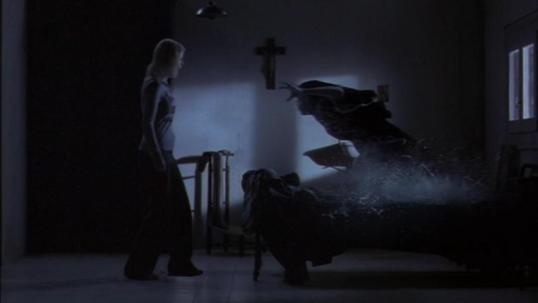
When talking about the 2005 Spanish horror film The Nun, it’s best to admit one thing from the start. This film has got an absolutely terrible ending.
It seems to be the unwritten rule of modern horror that every movie has to have a “shocking” twist that’s revealed during the film’s final 10 minutes. Occasionally, the twist is so well-done and memorable that it will actually redeem an otherwise forgettable film. Far too often, the twist turns out to be so predictable that most filmgoers will have guessed what it is within the first few minutes of the film. And then you’ve got a film like the Nun, where the twist will be so bad and so illogical that it’ll actually cause you to hate the entire film regardless of how effective it may have been before the twist was revealed.
I’ve debated with myself whether or not to just say “Spoilers be damned!” and reveal film’s twist in this review. Seriously, it literally comes from out of nowhere and it’s so ludicrous that I almost feel like I have a responsibility to warn you about what the film has up its sleeve. However, after a lot of thought, I’ve decided not to give the specifics of the twist. Instead, I’m just going to tell you that it’s there and it’s really, really stupid. It’ll probably make you hate the entire film. If you ever find yourself watching The Nun, maybe you should stop watching around the 90 minute mark, just so you don’t have to deal with “twist.”
Because, seriously, until that twist shows up, The Nun is actually a pretty well-done ghost story.
The movie tells the story of Sister Ursula, an insane nun who terrorizes six of her students until eventually, they end up fighting back and accidentally drowning her. They hide her body in a nearby pond and go on with their lives. However, 18 years later, the pond is drained and the former classmates start to die one by one.
Whenever it rains or a bathtub overflows or water drips from a leaky faucet, a murderous apparition of the Sister Ursula is formed from the drops of water. It may be because I was raised Catholic and I’ve actually experienced Catholic school firsthand but I thought that the apparition of Sister Ursula was one of the most effective cinematic ghosts that I’ve seen in a long time. Forming from clouds of mist and with a permanently enraged expression on her twisted face, Sister Ursula is a nightmare personified and, as long as she’s lurking about in the shadows, it doesn’t matter that the film itself doesn’t make much sense. Sister Ursula is scary and the scenes where she takes revenge on her former students are truly frightening.
But the film couldn’t be happy just being the type of simple (but effective) ghost story that would keep you awake at a slumber party. Instead, the film has to introduce that terrible “twist” during the final ten minutes and, as a result, the entire film collapses.
Sometimes, it’s better just to keep things simple.

The Exorcist is one of the greatest horror films of all time and a personal favorite of mine. But what about Exorcist II: The Heretic? Well, it would be a bit of an understatement to say that The Heretic has not quite received the amount of critical acclaim as the first film. Since it was first released in 1977, The Heretic has been widely considered to be one of the worst sequels of all time. It’s a film that is often cited as evidence as to why not all successful films need a follow-up.
Myself, I have sat through The Heretic twice. And yes, it is a pretty bad film but I have to admit that I enjoyed it each time that I saw it. It’s not a scary film at all. It’s not a successful horror film. But, as an unintentional comedy, it’s hilarious.
The Heretic opens four years after the end of The Exorcist. Father Merrin (Max von Sydow) is dead, having had a heart attack during the first film while performing an exorcism on Regan MacNeil (Linda Blair). In the years since, some in the Vatican have cast doubt on whether or not Merrin actually performed exorcisms. It turns out that, contrary to everything that we saw in the first film, Father Merrin was actually something of a rebel. His teachings are controversial. For instance, he was convinced that everyone has latent psychic powers and that the demon Pazuzu possesses those who have the potential to be the strongest psychics. Why? Because those people have the ability to lead humanity into a shared global consciousness and…
Well, it gets a little bit complicated. That’s one of the big differences between The Exorcist and Heretic. The Exorcist kept things relatively simple. The Heretic drags in a lot of metaphysical argle bargle.
The deceased Father Merrin has been brought up on charges of heresy. The Cardinal (Paul Henreid, many, many years after Casablanca), assigns Father Lamont (Richard Burton) to investigate the circumstances surrounding Father Merrin’s final exorcism.
The presence of Richard Burton is what elevates Heretic from merely being bad to being so bad that it’s good. As written, Father Lamont is supposed to be something of a naive idealist, someone who never met Father Merrin but who has been intrigued by his writings. Reportedly, several youthful actors turned down the role and eventually, production decided to make Lamont an older man and they ended up casting Richard Burton. Speaking in a shaky rasp and staring at the camera with bloodshot eyes, Burton appears to be at the height of his famous self-loathing in this film. Burton is so miscast as an idealistic priest that the film becomes fascinating to watch. Occasionally, the film tries to make us suspect that Lamont himself may be possessed but with Burton snarling his way through the role, how could anyone tell the difference?
Lamont tracks Regan down in New York. Regan doesn’t remember a thing about the exorcism and appears to be an overly happy teenage actress. (A good deal of the movie is devoted to her rehearsing a big dance number.) She is under the care of psychiatrist Gene Tuskin (Louise Fletcher). Tuskin has a device called the Synchronizer. When two people are hooked up to it, they can literally see into each other’s minds. They can share the same memories. They can … wait a minute. What the Hell? The Synchronizer essentially appears to be little more than a blinking light but it can actually allow you to enter into someone else’s mind? Doesn’t that seem like that should be a big deal?
Well, it’s not. Everyone pretty much just shrugs and accepts it…
Through the use of the Synchronizer, Reagan, Lamont, and Tuskin get to watch a lot of scenes from the first Exoricst. It also allows Father Lamont to have visions of Africa and another exorcism, this one involving a young boy named Kokumo.
This leads to one of my favorite parts of the film; Richard Burton wandering around a dusty African market and randomly telling people, “I am looking for Kokumo.” It turns out that Kukomo has grown up to be a doctor and he’s now played by James Earl Jones, who appears to be amused by his dialogue. Also showing up in the film’s Africa scenes is Ned Beatty. Beatty plays a pilot who flies Lamont to Kokumo’s village. “Have you come here before?” Beatty asks. “Once … on the wings of a demon,” Lamont replies.
Well, okay then…
The first Exorcist worked largely because William Friedkin directed it as if he was making a documentary. John Boorman takes the exact opposite approach here, trying to turn a cheap sequel into a metaphysical meditation on good, evil, and nature. It’s amazingly pretentious and it would actually be rather annoying if not for the fact that Burton doesn’t make the slightest bit of effort to come across as being in any way emotionally or intellectually invested in his over-the-top dialogue. When you combine Burton’s overwhelming cynicism with Linda Blair’s nearly insane perkiness, Louise Fletcher’s genial confusion, and James Earl Jones’s cheerful humor, the end result is something that simply has to be seen to be believed.
So, yes, The Heretic is as bad as you’ve heard. But that doesn’t mean you shouldn’t watch it.
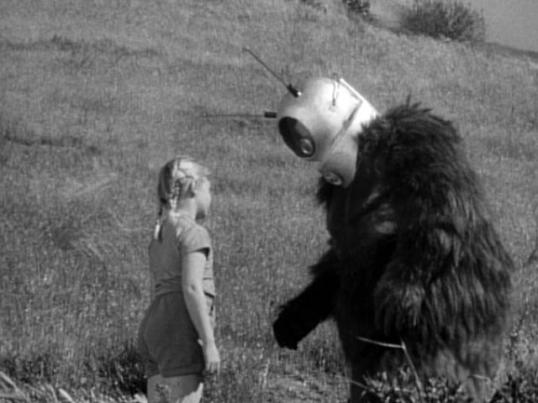
I realize I shared this last year as well, but hey, it’s Robot Monster! It’s a movie about what happens when Earth is invaded by a gorilla wearing a diving helmet. (For some reason, it also causes the dinosaurs to come back to life.) It’s one of the most compulsively watchable bad movies ever made so how could I be expected to resist the opportunity to share it again?
Seriously, it’s Robot Monster!
Tonight on Baywatch Nights…
A mythical wolf man from Eastern Europe is murdering runaways in Los Angeles. Can David Hasselhoff and Angie Harmon save the day?
Watch to find out!
And remember … “Don’t go out at night, or the zargtha will get you!”
(Zargtha originally aired on April 5th, 1997)
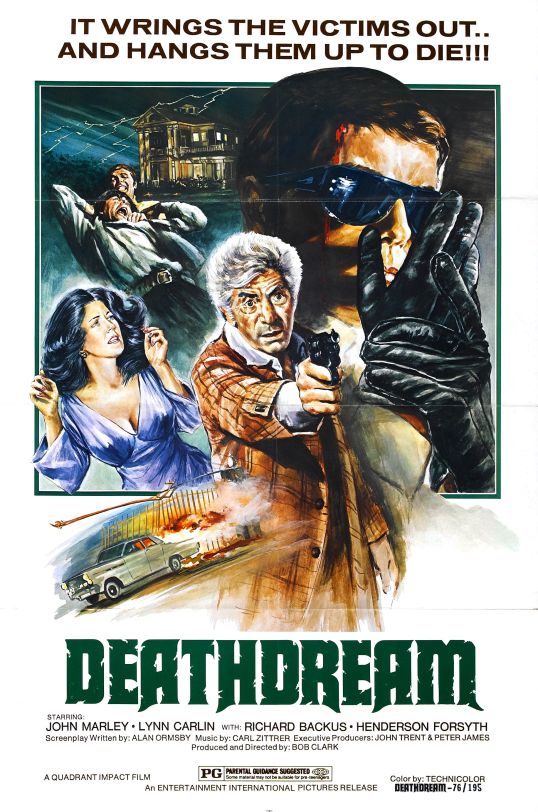
The 1974 film Deathdream opens with American soldier Andy Brooks (played by Richard Backus) on patrol in Vietnam. When he’s suddenly shot by an unseen sniper, he hears his mother’s voice calling out to him, telling him that he promised to come home. With the voice filling his head, Andy closes his eyes.
Sometime later, back in America, Andy’s family has been informed that Andy was killed in action. His father (John Marley, who you might recognize as the man who played Jack Woltz in The Godfather) and his younger sister (Anya Ormsby) have managed to accept the fact that Andy is dead but his mother (Lynn Carlin) remains in denial. Oddly enough, his mother is apparently proven to be correct in her doubts when Andy suddenly shows up at the front door.
The family (and, eventually, the entire community) welcomes Andy home but it quickly becomes apparent that Andy has returned as a far different person than when he left. Now pasty and emotionless, Andy spends most of his day sitting around listlessly. It’s only at night that Andy seems to have any energy and he spends those hours wandering around town and hanging out in the local cemetery.
It quickly becomes apparent to his father that Andy is no longer quite human. However, his devoted mother continues to insist that nothing is wrong with Andy and, once it becomes apparent just what exactly Andy is doing in order to survive, she becomes just as fanatical about protecting him as his father is about destroying him.
Not surprisingly, Deathdream is more than just a zombie film. When Andy suddenly shows up on his family’s doorstep, he’s more than just a decaying monster. He’s also a metaphor for the unease that viewers in the 70s would have felt about the state of American society. (Of course, in many ways, contemporary viewers share that same unease.) Andy goes off to war and it literally robs him of his humanity. I would also argue that, in its way, Deathdream serves as a satire of the type of complacent society that sends young people off to fight for their lives and then expects them to come back exactly the same as they were before they left. No matter how strange Andy’s behavior becomes, the people around him are willing to either ignore it or make excuses for it. Andy’s mother emerges as a stand-in for everyone who willfully refuses to acknowledge the human consequences of war.
Deathdream is one of those wonderful horror films that deserves to be better known than it is. Deathdream was an early credit for the legendary effects artist Tom Savini and, while the film itself is not especially gory, Savini’s work can definitely be seen in the scenes where Backus’s body slowly decays. Screenwriter Alan Ormsby and director Bob Clark (who later went on to direct the far different A Christmas Story) perfectly creates and maintains a deceptively low-key atmosphere of perpetual unease while the cast elevates the entire film. Backus makes for an all-too plausible ghoul and Marley is great as a man struggling to understand what his son has become. The film is totally stolen, however, by Lynn Carlin who is both poignant and frightening as Andy’s devoted mother.
If you haven’t discovered Deathdream yet, this Halloween is the perfect season to do so.
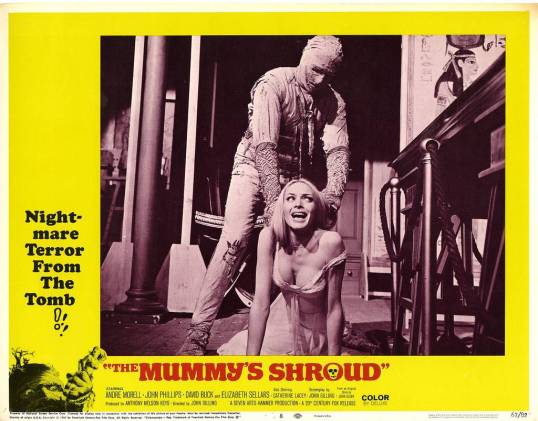
First released in 1967 and often dismissed as being one of the lesser horror films to come out of Hammer Studios, The Mummy’s Shroud is actually a pretty effective film. I watched it late last night, with lights out and the sound of rain pounding on the windows outside and I have to admit that, even if nothing about the film surprised me, it still had enough eerie moments that I found myself watching for sudden shadows and the sound of heavily wrapped feet.
For today’s horror on the lens, we present, for your viewing pleasure, a 1965 Italian thriller called The Embalmer. It’s also known as the Monster of Venice.
This film tells the story of a madman who lives in the catacombs in Venice, where he wanders around in a skull mask and embalms dead bodies. Why does he embalm dead bodies? Because he loves eternal beauty, of course!
Occasionally, he comes up to the surface and he wanders around Venice while wearing scuba gear. Nobody finds that to be strange but then again, that’s Venice for you.
(As I’m sure I’ve mentioned a few times in the past, I spent the summer after high school in Italy. I loved Venice!)
Anyway, as far as Venice-set thrillers are concerned, The Embalmer is no Don’t Look Now. But it still has a few atmospheric scenes and the whole thing is filmed on location and in beautiful black-and-white. It’s also fairly tame for an Italian horror film, so it might be good for those viewers who are looking for a thriller that doesn’t necessarily feature a lot of blood.

From the mid-60s to the early 80s, filmgoers could be sure of one thing. If a film was in any way successful in America or Europe, an Italian filmmaker would end up directing an unofficial sequel. These films usually had next to nothing to do with the original film, beyond having a similar title and occasionally duplicating a few plot points. (Since these films were always dubbed before being released in non-Italian markets, dialogue, character names, and even plot points were often arbitrarily changed to take advantage of whatever film was currently popular at the box office.) Occasionally, you’d have a film that managed to overcome its “unofficial sequel” status. For instance, Lucio Fulci’s Zombi 2 may have started out as a fake sequel to Dawn of the Dead but, thanks to Fulci’s skill as a director, the film transcended its origins and managed to establish its own identity.
Far more typical, however, was the case of Patrick Still Lives, a 1980 film that was sold as being a sequel to the Australian horror classic, Patrick. Though the film’s title suggests that it was meant to be a sequel, nobody involved in the production of Patrick had anything to do with Patrick Still Lives.
Patrick Still Lives follows the same basic plot as Patrick. A young man named Patrick (Gianni Dei) may be in a coma but he has psychic powers that he uses to kill various people. Again, Patrick falls in love with a woman, in this case a secretary named Lydia (Andrea Belfiore).
There are, of course, a few differences. Whereas Patrick opened with the title character murdering his mother and her lover, Patrick Still Lives opens with a hilariously awkward sequence in which Patrick gets struck in the head by something thrown from a passing car. Or, at least, that’s what I think happened. The way the scene is shot, it’s really hard to tell what exactly happens. At one point, Patrick is standing on the side of the road. Suddenly, he’s clutching his head and collapsing to the ground and we hear a car speeding away on the soundtrack. Patrick’s head is covered in ketchup, which I assume is meant to be blood.
Next thing we know, Patrick is in a coma and, with his eyes always open, he’s even duplicating the infamous stare that made the first film so memorable. Fortunately, Patrick’s father is a doctor who runs a spa. He keeps Patrick hidden in a locked room, where he’s wired to three other comatose people.
Eventually, five people show up at the spa. They’re looking to spend a relaxing weekend away from it all but Patrick is planning on killing them all…
There’s a few things that you notice immediately about Patrick Still Lives. First off, everyone’s naked, but, on the plus side, everyone has, at the least, an okay body and the men get naked too. The nudity is so gratuitous and so excessive that it actually becomes amusing. By the time the film’s male lead (who, it should be noted, had quite an impressive pornstache) was standing naked at a dresser and casually lighting a cigarette while ominous music played on the soundtrack, I simply could not stop laughing.
Secondly, you notice just how amazingly violent and bloody this film is. Whenever Patrick’s glowing eyes are superimposed over a scene, it means that someone is about to die in the most violent way possible. Dogs attack. A hook is driven into a face. An automatic car window is used as a tool for decapitation. The film’s most infamous scene features Mariangela Giordano being skewered, in close-up, by a fireplace poker.
That’s right — Patrick Still Lives is yet another Italian horror film that features Mariangela Giordano dying in the most unpleasant way possible. As such, along with Giallo in Venice and Burial Ground: The Nights of Terror, it forms an unofficial trilogy of films in which Mariangela Giordano is brutally murdered. Oddly enough, all three of these films were produced by Giordano’s then-boyfriend, Gabriele Crisanti. If my boyfriend ever produces a horror film, I better be one of the survivors and that’s all I’ll say about that.
The third thing that you notice about Patrick Still Lives is the dialogue. Now, I’m not sure if Patrick Still Lives ever got a “true” (and dubbed) release here in the States. I do know that my DVD features everyone speaking in Italian, with English subtitles. I have to admit that I’ve always resented that, in the U.S., so many Italian horror films are only available in a dubbed version. Often the dubbing is so terrible that it detracts from the film’s overall effectiveness and makes it impossible to fairly judge the performances. Well, with Patrick Still Lives, I got to see an Italian horror film in the original Italian and … well, the performances were just as bad in Italian as they probably would have been in badly dubbed English.
That said, I did enjoy reading the subtitles, largely because they were hilariously bad. It was almost as if someone had typed the film’s Italian dialogue into Google translator and transcribed the results. My favorite line? “The cause of death was fatality.”
Anyway, Patrick Still Lives is a pretty crappy film and I don’t recommend it unless you’re a diehard fan of Italian exploitation films. I do, however, recommend that you watch Zombi 2. That’s a really good film.
 Through the Shattered Lens