Horror On The Lens: Messiah of Evil (dir by Willard Huyck)


MOE Mariana HillWith only five days left until Halloween, I wanted to make sure that I continued an important tradition here at the Shattered Lens by sharing this film with our faithful and wonderful readers.  Messiah of Evil was first released in 1973 and, since it’s in the public domain, it has since been included in a countless number of bargain box sets from Mill Creek.

I can still remember the first time that I saw Messiah of Evil.  It was on a Monday night, many years ago.  I had recently picked up a 10-movie DVD box set called Tales of Terror and I was using the movies inside to try to deal with a bout of insomnia.  I had already watched The Hatchet Murders (a.k,a. Deep Red) and The House At The Edge of the Park and, at two in the morning, I was faced with a decision.  Should I try to sleep or should I watch one more movie?

Naturally, I chose to watch one more movie and the movie I chose was Messiah of Evil.  So, there I was at two in the morning, sitting at the edge of my bed in my underwear and watching an obscure horror movie while rain fell outside.

And, seriously — this movie totally FREAKED me out!

Messiah of Evil tells the story of Arletty (Marianna Hill), a neurotic woman who drives to an isolated California town in order to visit her father.  Her father is an artist who specializes in painting eerie pictures of large groups of black-clad people.  However, once she arrives at his home, Arletty discovers that her father has vanished and left behind a diary where he claims that a darkness has overtaken the town.

Meanwhile, a mysterious man named Thom (Michael Greer) is wandering about town with two groupies (played by Anita Ford and Joy Bang) and interviewing random townspeople.  One crazed man (Elisha Cook, Jr.) explains that “the dark stranger” is returning.  After meeting Arletty, they all end up moving into her father’s house.

But that’s not all.   There’s also an odd albino man who shows up driving truck and who eats mice….

Messiah of Evil is literally one of the strangest films that I’ve ever seen.  It’s shot in a dream-like fashion and the much of the film is left open to the viewer’s interpretation.  There are two classic scenes — one that takes place in a super market and one that takes place in a movie theater and the movie’s worth watching for these two scenes alone.

Messiah of Evil is a film that will be appreciated by all lovers of surrealism and intelligent horror and I’m happy to share it with you today.

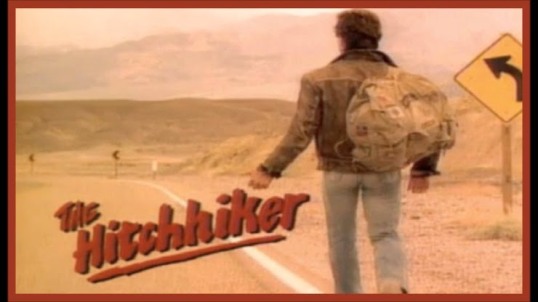
Horror On TV: The Hitchhiker 6.6 “Toxic Search” (dir by Jerry Ciccoritti)


Tonight’s episode of The Hitchhiker features two friends who get into a fight over whether or not its ethical to dump toxic waste near a small town.  Unfortunately, exposure to the toxic waste leads to madness.  This episode features a good performance from Zach Galligan as the polluter who learns the errors of his way.

This episode aired on October 26th, 1990.

Big Freakin’ Snake (2023, directed by Dustin Ferguson)


People are being killed in snake attacks across Los Angeles and the sheriff and a scientist are determined to discover why.  The Sheriff says that there hasn’t been a snake attack in over 40 years.  His father dealt with the last batch of attacks.  Now, it’s time for the new sheriff to pick up his father’s legacy and discover why people are dying from snake attack.

Could it be because of the big freakin’ snake!?

Nah, son, that snake’s not that big.

There actually is a big snake at the start of the movie, which slithers its way through Los Angeles and wraps itself around a building but most of the movie is just scenes of people screaming at normal sized snakes that don’t appear to actually be aggressive.  A lot of familiar B-horror folk show up to get bitten but the special effects budget only allowed for one actual snake attack to really be shown.  If you’ve ever wanted to watch Brinke Stevens fight a rubber snake in a bathtub, this film is for you.

Big Freakin’ Snake is short, only 40 minutes long, and it is obviously not meant to be taken seriously so I can’t criticize it too much.  But for a movie called Big Freakin’ Snake, it sure didn’t have many big snakes.

Retro Television Review: Jennifer Slept Here 1.4 “Boo”


Welcome to Retro Television Reviews, a feature where we review some of our favorite and least favorite shows of the past!  On Thursdays, I will be reviewing Jennifer Slept Here, which aired on NBC in 1983 and 1984.  The entire show is currently streaming on YouTube!

This week, Debbie Reynolds drops by!

Episode 1.4 “Boo”

(Dir by John Bowab, originally aired on November 11th, 1983)

This week’s episode of Jennifer Slept Here opens with Jennifer tormenting Joey while he tries to make a snack.  Whenever Joey tries to grab a bowl and a box of cereal, Jennifer materializes and says, “Boo!”  I guess when you’re a ghost, you have to find a way to pass the time.  Seriously, though, Joey acts like he’s about to have a heart attack every time that he sees Jennifer.  He should be used to her by now.

In other words — STOP BEING SUCH A WIMP, JOEY!

Joey is upset because he’s stuck at home while his parents take his little sister to a costume party but then Marc shows up with two twins (played by Jacqueline and Samantha Forrest).  The twins seem to like Joey and Marc but again, Joey can’t leave the house.  Jennifer suggests to Joey that he suggest that they just have a party at the house.  Joey follows Jennifer’s advice and it turns out that the twins really want to have a …. séance!

Joey is totally excited because he has his own ghost!  However, Jennifer informs him that she doesn’t want to perform like a trained seal so he’s going to have to figure out his own way to party with the twins.  Suddenly, the studio audience goes wild as Debbie Reynolds materializes in Joey’s bedroom.  It turns out that Debbie Reynolds is playing Jennifer’s mother, who is also a ghost.  Jennifer’s mom has spent 24 years searching for Jennifer.  Why?  Because she’s still upset over the fact that Jennifer didn’t thank her when she won a Golden Globe.  Jennifer’s mother has tracked down her daughter so that she can demand to be given credit for her daughter’s career!

(Really?  It’s just a Golden Globe.)

Jennifer and her mother argue over whether or not Jennifer has ever given her mother enough credit.  Jennifer’s mother eventually announces that she’s leaving and proceeds to walk through a wall.  Desperate for her mother to return, Jennifer asks Joey to perform a …. wait for it …. a séance!  Joey gets Jennifer to agree to help him to impress the twins in return for him trying to contact her mother.

At the séance, Marc says they should contact Jennifer’s mother but Joey is like, “Let’s contact her mother!”  As it storms outside, Jennifer does things like forcing everyone to keep their hands on table and causing candles to float around the living room.  It scares and impresses the twins and they suggest a trip to their place where they have a hot tub.  But Jennifer tells Joey that he can’t leave because the séance isn’t over.  Realizing that Jennifer is right, Joey says he can’t go to the hot tub because he has to clean up the house.

“Joey,” Marc announces, “I don’t know what’s wrong with but someday, it’s going to keep you out of the army.”

Okay, 80s TV show, way to be cringey there.

Anyway, Jennifer’s Mother does eventually appear and Joey gets to go hot tubbing with the twins while Jennifer and her mom work on their relationship in the living room.  And I have to say that, after a really silly 19-minute build-up, the final scene between Ann Jillian and Debbie Reynolds was actually very sweet and touching, perhaps more so than you would expect from a sitcom about a ghost and her dorky teenage roommate.

This episode did not get off to a great start but that final scene between Ann Jillian and Debbie Reynolds saved it.  The show definitely worked best when it focused more on Jennifer and less on the people who lived with her.

Horror Scenes That I Love: Donald Pleasence in Halloween 4


Donald Pleasence was born in the UK in 1919, the son of a railway station manager.  Pleasence briefly tried to follow in his father’s footsteps before, at the age of 20, realizing that he would much rather be a professional actor.  With his intense demeanor, Pleasence soon became an in-demand character actor and remained one for the rest of his life, only taking a break from acting when he served in World War II.  (A devout Methodist, Pleasence originally registered as a conscientious objector but changed his stance once the Blitz began.)   When he was taken prisoners by the Germans and sent to a POW camp, he organized plays among his fellow prisoners as a way to keep everyone’s spirits up as they waited for the war to end.

Pleasence’s experience as a POW led to him being cast in The Great Escape.  His ability to play villains led to him being cast as the original Blofeld in You Only Live Twice.  He appeared in classic horror films like Death Line and Wake In Fright.  In 1978, he was offered the role of Dr. Loomis in Halloween, after it had been turned down by both Christopher Lee and Peter Cushing.  Pleasence played Loomis with a righteous intensity that seemed to grow a bit more unhinged with each subsequent sequel.  Though he was, by his own admission, not a huge fan of the genre, Pleasence became a horror icon to a whole new generation of film goers.

1998’s Halloween 4 does not have a great reputation but it does have one of my favorite Loomis scenes.  In this scene, a hitchhiking Dr. Loomis is picked up by an old man (Carmen Filipi) who is on a mission of his own.  It’s hard not to regret that these two didn’t get their own spin-off.

October True Crime: Judgment Day: The John List Story (dir by Bobby Roth)


In 1971, a 46 year-old account named John List committed a shocking crime.

To the outside world, John List was a normal suburbanite.  He was perhaps a little bit strict but then again, it was 1971 and all of the traditional morals that John List had grown up with were being challenged in the streets and in the movies.  Neither he nor his family were particularly sociable but again, it was assumed that they just liked the privacy that was afford to them by the mansion in which they lived.  List was married to Helen.  They lived with their three teenage children and List’s 84 year-old mother.  John List was a hard worker, he taught Sunday School, and, again, he was seen as being perfectly normal.

On November 9th, 1971, John List methodically murdered his wife, his children, and his mother.  He left his mother in her upstairs apartment while the rest of his family was laid out, in sleeping bags, in the ballroom.  (Detectives later surmised that List stopped in the middle of his murder spree to have lunch and then attended his son’s soccer game before taking him home and killing him.)  List left behind several notes, explaining that he was in a bad financial situation and that he feared that his family was heading down an immoral path that would have condemned their souls to Hell if he hadn’t killed them first.  And then, John List vanished.

For the rest of the 70s and the 80s, John List was phantom.  Some speculated that he had committed suicide while others thought that he had changed his identity and had probably remarried.  In 1987, the classic thriller The Stepfather was released in theaters.  Inspired by List’s crimes, The Stepfather starred Terry O’Quinn as Jerry Blake, a real estate agent who was obsessed with creating the perfect family.  The Stepfather imagined its killer as a friendly but rigid man who snapped whenever his illusion of perfection was threatened.  It also imagine him as someone who moved from town to town, searching for a new family that wouldn’t let him down.

As for the real John List, it turned out that those who suspected him of having changed his identity were correct.  And, just as The Stepfather suggested, he had remarried and was actually now a real stepfather.  List remained free until his story was included in a 1989 episode of America’s Most Wanted.  A forensic scientist included a bust of what John List might have looked like in 1989 and a viewer realized that the bust looked a lot like an accountant named Bob Clark.  “Bob Clark” was arrested and eventually, he confessed that he was actually John List.  Despite his attorney’s attempt to argue that he was not guilty by reason of insanity, John List was eventually convicted of five counts of murder.  He spent the rest of this life in prison, dying of natural causes in 2008.

The 1993 film Judgement Day: The Story of John List tells the story of List’s crimes and his subsequent attempt to build a new life for himself.  John List is played by Robert Blake, which turns out to be a bit of a problem as Blake gives such a twitchy and obviously unstable performance that it’s hard to believe that he could have successfully gone into hiding for 18 years.  Carroll Baker and Beverly D’Angelo are not given much to do as, respectively, List’s mother and List’s first wife while David Caruso appears as the detective who is determined to catch List.  Though this film was made long before CSI: Miami, I still found myself expecting Caruso to say something quippy and put on his sunglasses.

Judgment Day doesn’t add much to the story of John List.  It certainly doesn’t offer up any new insight into what led to List becoming a murderer, beyond the fact that List himself was just kind of a jerk.  It’s pretty much a by-the-numbers production that’s only interesting today because of Blake’s subsequent legal problems.  (For the record, I’ve always felt Robert Blake was innocent.)  When it comes to John List films, stick with The Stepfather.

4 Shots From 4 Horror Films: Special George Romero Edition


4 Shots From 4 Films is just what it says it is, 4 shots from 4 of our favorite films. As opposed to the reviews and recaps that we usually post, 4 Shots From 4 Films is all about letting the visuals do the talking.

This October, I am going to be using our 4 Shots From 4 Films feature to pay tribute to some of my favorite horror directors, in alphabetical order!  That’s right, we’re going from Argento to Zombie in one month!

Today’s director is one of the most important names in the history of American horror cinema, George Romero!

4 Shots From 4 George Romero Films

Night of the Living Dead (1968, dir by George Romero)

Dawn of the Dead (1978, dir by George Romero, DP: Michael Gornick)

Day of the Dead (1985, dir by George Romero, DP: Michael Gornick)

Land of the Dead (2005, dir by George Romero, DP: Miroslaw Baszak)