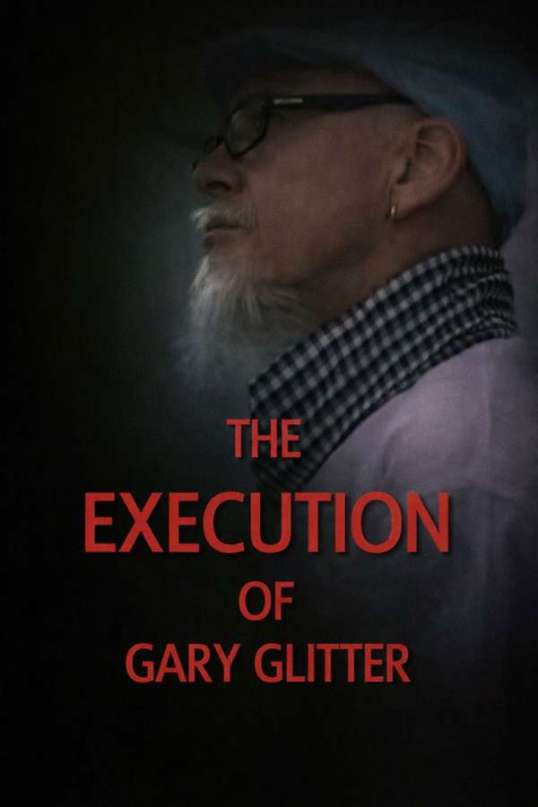
Made-For-TV-Movie Review: The Execution of Gary Glitter (dir by Rob Coldstream)


Made for British television, 2009’s The Execution of Gary Glitter opens with disgraced former rock star Gary Glitter (played by Scottish actor Hilton McRae) returning to the UK after serving a three-year prison sentence in Vietnam. When he was younger, Glitter was one of the most popular men in the UK, a rock star who was liked by both parents and — ahem — their children. His song “Rock and Roll Part 2,” with its chorus of “Hey!”, became a mainstay at sporting events. However, everything fell apart in the late ’90s when he was arrested and subsequently convicted of possessing child porn. After he was released from prison, Glitter went abroad and swore he would never return to Britain. In 2005, while living in Vietnam, he was convicted of having sex with underage girls. While he could have faced the firing squad as a result, he was instead given a three-year prison sentence. When he was released, he attempted to relocate to Hong Kong and Taiwan, only to be told that he was not welcome. Eventually, he had no choice but to return to the UK because every other country banned him from entering.

That’s all a matter of public record. The Execution of Gary Glitter imagines what would have happened if Glitter — or Paul Gadd, to use his real name — returned to a UK that had recently reinstated the death penalty. In this film, as soon as Gadd arrives in the UK, he’s placed under arrest. He’s been out of the country for so long that he totally missed the fact that Britain is once again hanging people. He’s also surprised to hear that he can be tried for crimes that were committed outside of British territory and that he can be executed if found guilty of the same crimes for which he was convicted in Vietnam.

The Execution of Gary Glitter is a mix of dramatic scenes and mockumentary-style interviews with people who were involved in Glitter’s criminal case. Though Gary Glitter is played by Hilton McRae, a few British journalists and politicians appear as themselves and talk about their feelings concerning the reinstatement of the death penalty. British MP Ann Widdecombe appears and makes the case for bringing back hanging. (Seventeen years after this special aired, Widdecombe would be brutally murdered in her own home, a victim of the political violence we’re always told isn’t actually occurring.) The film ends with a title card saying that, in 2009, polling showed that 53% of Britons supported bringing back capital punishment. It’s interesting how people always want the opposite of whatever it is they have. In America, the anti-death penalty movement is having a moment, but I can guarantee that, if capital punishment ever was outlawed here, you’d have people demanding that it be brought back within a month.

As for this film, it’s weird. Making a film like this about an actual person is weird. I honestly can’t tell you whether this film is for or against the death penalty. On the one hand, the scenes featuring the hangman and the gallows are rather cold and disturbing. The cold mercilessness of hanging is emphasized and with it, the idea that people who support the death penalty run the risk of becoming just as cold.  (Of course, considering what’s currently happening in Tennessee as a result of the botched lethal injection of Christa Pike, some viewers would today undoubtedly appreciate the cool precision of a hanging.) On the other hand, Gary Glitter is about as unsympathetic a character as you can imagine and, in the film, he’s portrayed as being someone who lacks the self-awareness to understand why people are even upset at him. He makes plenty of excuses but they all ring hollow. At one point, the film mentions that Europe is uniformly condemning and sanctioning the UK for bringing back the death penalty. That would probably be a big deal in the UK. In America, we really don’t care what Europe thinks. Annoying Brussels is our national pastime.

What the film definitely does get right is the carnival atmosphere that would accompany the execution of a celebrity. The film imagines people selling T-shirts outside of the prison, macabre remixes of Glitter’s song playing on the radio, and Glitter himself receiving letters from people who continue to be fans despite the crimes for which he’s been convicted. Hilton McRae does a good job in the lead role. He starts out as arrogant and cocky and then gradually, as the reality of his situation dawns on him, he grows more and more desperate.

As for the real-life Gary Glitter, he was not amused by this film and tried to keep it from airing. Six years after the film aired, he was arrested and convicted of several more sex crimes that came to light as a result of the inquest into Jimmy Savile’s crimes. He was sentenced to a 16-year prison term. Just this year, the still-incarcerated Glitter was charged in a new set of historic sex crimes. He has pled not guilty.
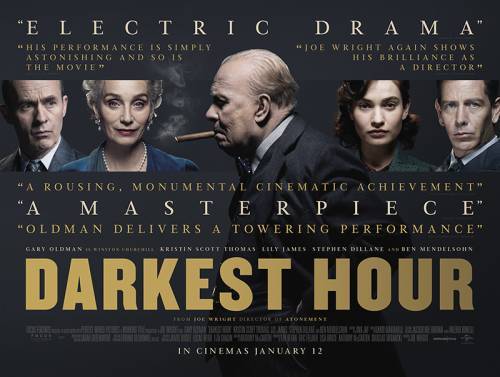
Lisa Reviews An Oscar Nominee: Darkest Hour (dir by Joe Wright)


The 2017 best picture nominee, Darkest Hour, opens with Europe at war.

While the United States remains officially neutral, the Nazi war machine marches across Europe.  After years of appeasement, the United Kingdom has finally declared war on Germany but the feeling in Parliament is that Prime Minister Neville Chamberlain (Ronald Pickup) is not strong enough to take on Hitler.  When the Opposition demands that Chamberlain resign, Chamberlain does so with the hope that he’ll be replaced by Lord Halifax (Stephen Dillane).  Like Chamberlain, Halifax continues to hold out hope for some sort of negotiated peace with the Germans.  However, Halifax declines, saying that it’s not yet his time.  Instead, Chamberlain’s successor is Winston Churchill (Gary Oldman), the only Conservative that the Opposition is willing to accept as Prime Minister.

(This is a bit of invention on the part of the filmmakers.  In reality, the Opposition did demand Chamberlain’s resignation but they did not stipulate that he could only be replaced by Churchill.)

No one is particularly enthusiastic about the idea of Winston Churchill becoming prime minister.  Chamberlain and Halifax both view him as being a war monger who is so determined to prove himself as a military strategist that he’ll sacrifice thousands of British lives just for his own glory.  The King (Ben Mendelsohn) worries that Churchill is an unreliable radical and he still resents Churchill for defending the marriage of Edward VIII and Wallis Simpson.  Churchill is regularly described as being a buffoon and an eccentric.  He’s quick-tempered and obsessive about things that many people would consider to be of no importance.  When we first see Churchill, he’s making his new assistant (played by Lily James) cry because he’s discovered that she single-spaced a memo as opposed to double-spacing it.  The only people who seem to like Winston are the member of his family and even his loyal wife (Kristin Scott Thomas) is frequently frustrated with him.

Churchill’s enemies are not impressed by his first actions as prime minister.  They listen in disgust as he lies about the prospects of victory in France.  They are shocked by his refusal to even consider a negotiated peace.  They are horrified by his ruthless pragmatism as he willing sacrifice a thousand British soldiers in order to save several thousand more at Dunkirk.  An aristocrat who has been rejected by his peers, Churchill is betrayed by those serving in his government but beloved by the people who ride the Underground and who are being asked to potentially sacrifice everything to defeat Hitler’s war machine.

As directed by Joe Wright, Darkest Hour plays out like a dream, with 1940s Britain recreated in hues of black and gray.  The film’s visual palette is so dark that, at times, Gary Oldman’s Winston Churchill appears to literally emerge out of the shadows, an almost mythical figure who symbolizes a society in transition.  In many ways, Churchill is an old-fashioned Edwardian who nostalgically remembers the glory days of the British Empire.  At the same time, Churchill is enough of a realist to see that the world is changing and, regardless of who wins the war, that it will never be the same.  Churchill is enough of an aristocrat to be unaware of what a backwards V-sign means but also enough of a commoner to laugh uproariously upon learning its meaning.

Churchill spends a good deal of the film bellowing and, at times, it’s easy to see why many initially dismissed him as being a buffoon.  Indeed, in Darkest Hour, Churchill frequently is a buffoon.  But he’s also a pragmatic leader who truly loves his country and its people.  Oldman has a lot of scenes where he’s loud but he also has other scenes in which he reveals Churchill to be a thoughtful man who loves his country and who is determined to win a war that many believe to be unwinnable.  When he’s reduced to calling the United States and has to pathetically beg President Roosevelt to honor a treaty, you feel for Churchill and you share his frustration as he tries to get the flaky FDR to understand the reality of what’s happening in Europe.  When Churchill explains why he’s willing to sacrifice a thousand in order to save 41,000 more, Oldman delivers his lines with a steely certainty.  As played by Oldman, Churchill knows what has to be done, even if no one else has any faith in him.

It’s a good film, even if it ultimately feels more like a showcase for one actor than a cohesive narrative.  The rest of the cast does a good job, especially Ronald Pickup as the haunted and dying Neville Chamberlain.  But ultimately, Darkest Hour is Gary Oldman’s show.  That’s appropriate.  Much as how Churchill dominated British politics, Gary Oldman has dominated British acting.  Not surprisingly, Gary Oldman won his first Oscar for playing Winston Churchill in Darkest Hour.  The film was also nominated for best picture but it lost to Shape of Water.


MacBeth Trailer Is Dark And Full Of Terrors


MacBeth1

Every year there’s always going to be that one filmmaker who takes on the challenge of putting their personal take on one of William Shakespeare’s classic dramas. It’s been going on since the advent of motion pictures and I don’t see it ending anytime soon.

This year it looks like we may have a winner with the latest adaptation of Shakespeare’s MacBeth. The film stars Michael Fassbender and Marion Cotillard as Lord and Lady MacBeth with Australian filmmaker Justin Kurzel in the director’s chair.

MacBeth has been getting such advance rave reviews due to it’s screening at this year’s Cannes Film Festival where it entered for competition for the Palme d’Or. The film itself just judging from the trailer below looks like a visual feast that one’s up the dark, gritty aesthetic of HBO’s Game of Thrones.

There’s still no announced release date for MacBeth for the North American market but with the critical buzz surrounding the film after Cannes it won’t be too long til it get one.