The Unnominated: Mean Streets (dir by Martin Scorsese)


Though the Academy of Motion Picture Arts and Sciences claim that the Oscars honor the best of the year, we all know that there are always worthy films and performances that end up getting overlooked.  Sometimes, it’s because the competition too fierce.  Sometimes, it’s because the film itself was too controversial.  Often, it’s just a case of a film’s quality not being fully recognized until years after its initial released.  This series of reviews takes a look at the films and performances that should have been nominated but were, for whatever reason, overlooked.  These are the Unnominated.

“Honorable men go with honorable men.” — Giovanni Cappa

1973’s Mean Streets is a story about Little Italy.  The neighborhood may only be a small part of the sprawling metropolis of New York but, as portrayed in this film, it’s a unique society of its very own, with its own laws and traditions.  It’s a place where the old ways uneasily mix with the new world.  The neighborhood is governed by old-fashioned mafiosos like Giovanni Cappa (Cesare Danova), who provide “protection” in return for payment.  The streets are full of men who are all looking to prove themselves, often in the most pointlessly violent way possible.  When a drunk (David Carradine) is shot in the back by a teenage assassin (Robert Carradine), no one bothers to call the police or even questions why the shooting happened.  Instead, they discuss how impressed they were with the drunk’s refusal to quickly go down.  When a soldier (Harry Northup) is given a party to welcome him home from Vietnam, no one is particularly shocked when the solider turns violent.  Violence is a part of everyday life.

Charlie Cappa (Harvey Keitel) is Giovanni’s nephew, a 27 year-old man who still lives at home with his mother and who still feels guilty for having “impure” thoughts.  Charlie prays in church and then goes to work as a collector for Giovanni.  Giovanni is grooming Charlie to take over a restaurant, not because Charlie is particularly talented at business but just because Charlie is family.  Giovanni warns Charlie not to get involved with Teresa (Amy Robinson) because Teresa has epilepsy and is viewed as being cursed.  And Giovanni particularly warns Charlie not to hang out with Teresa’s cousin, Johnny Boy (Robert De Niro).  Johnny Boy may be charismatic but everyone in the neighborhood knows that he’s out-of-control.  His idea of a good time is to blow up mailboxes and shoot out street lamps.  Charlie, who is so obsessed with sin and absolution that he regularly holds his hand over an open flame to experience the Hellfire that awaits the unrepentant sinner, finds himself falling in love with Teresa (though it’s debatable whether Charlie truly understands what love is) and trying to save Johnny Boy.

Charlie has other friends as well.  Tony (David Proval) runs the bar where everyone likes to hang out and he seems to be the most stable of the characters in Mean Streets.  He’s at peace with both the neighborhood and his place in it.  Meanwhile, Michael (Robert Romanus) is a loan shark who no one seems to have much respect for, though they’re still willing to spend the afternoon watching a Kung Fu movie with him.  Michael knows that his career is dependent on intimidation.  He can’t let anyone get away with not paying back their money, even if they are a friend.  Johnny Boy owes Michael a lot of money and he hasn’t paid back a single dollar.  Johnny Boy always has an excuse for why he can’t pay back Michael but it’s obvious that he just doesn’t want to.  Charlie realizes that it’s not safe for Johnny Boy in Little Italy but where else can he go?  Brooklyn?
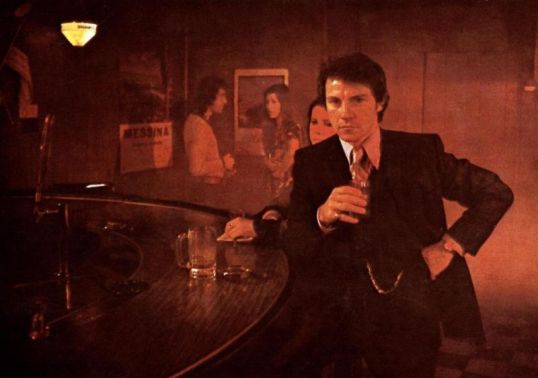
Mean Streets follows Charlie and his friends as they go about their daily lives, laughing, arguing, and often fighting.  All of the characters in Mean Streets enjoy a good brawl, despite the fact that none of them are as tough as their heroes.  A chaotic fight in a pool hall starts after someone takes offense to the word “mook,” despite the fact that no one can precisely define what a mook is.  The fights goes on for several minutes before the police show up to end it and accept a bribe.  After the cops leave, the fight starts up again.  What’s interesting is that the people fighting don’t really seem to be that angry with each other.  Fighting is simply a part of everyday life.  Everyone is aggressive.  To not fight is to be seen as being weak and no one is willing to risk that.

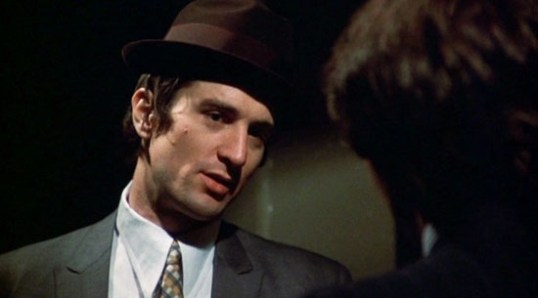
Mean Streets was Martin Scorsese’s third film (fourth, if you count the scenes he shot before being fired from The Honeymoon Killers) but it’s the first of his movies to feel like a real Scorsese film.  Scorsese’s first film, Who’s That Knocking On My Door?, has its moments and feels like a dry run for Mean Streets but it’s still obviously an expanded student film.  Boxcar Bertha was a film that Scorsese made for Roger Corman and it’s a film that could have just as easily been directed by Jonathan Demme or any of the other young directors who got their start with Corman.  But Mean Streets is clearly a Scorsese film, both thematically and cinematically.  Scorsese’s camera moves from scene to scene with an urgent confidence and the scene where Charlie first enters Tony’s bar immediately brings to mind the classic tracking shots from Goodfellas, Taxi Driver, and Casino.  One gets the feeling that Pete The Killer is lurking somewhere in the background.  The scenes between Keitel and De Niro are riveting.  Charlie attempts to keep his friend from further antagonizing Michael while Johnny Boy tells stories that are so long and complicated that he himself can’t keep up with all the details.  Charlie hold everything back while Johnny Boy always seems to be on the verge of exploding.  De Niro’s performance as Johnny Boy is one that has been duplicated but never quite matched by countless actors since then.  He’s the original self-destructive fool, funny, charismatic, and ultimately terrifying with his self-destructive energy.

Mean Streets was Scorsese’s first box office success and it was also the film that first brought him widespread critical acclaim.  However, in a year when the totally forgotten A Touch of Class was nominated for Best Picture, Mean Streets did not receive a single Oscar nomination, not even for De Niro’s performance.  Fortunately, by the time Mean Streets was released, De Niro had already started work on another film about the Mafia and Little Italy, The Godfather Part II.
Previous entries in The Unnominated:


  1. Auto Focus 
  2. Star 80
  3. Monty Python and The Holy Grail
  4. Johnny Got His Gun
  5. Saint Jack
  6. Office Space
  7. Play Misty For Me
  8. The Long Riders

Tom Horn (1980, directed by William Wiard)


Today would have been Steve McQueen’s 90th birthday.

Sadly, McQueen died in 1980 at the absurdly young age of 50.  In life, McQueen never got as much respect as he deserved as an actor but in death, he’s been rediscovered as not just an icon of cool but also as an underrated actor who, much like Clint Eastwood, could say a lot without uttering a word.  (Be sure to read Marshall Terrill’s biography of McQueen.)  When Steve McQueen (as played by Damian Lewis) showed up in Once Upon A Time In Hollywood, it seemed appropriate.  McQueen and Tarantino both seem made for each other, even if McQueen died long before Tarantino even wrote his first screenplay.

McQueen made two films shortly before he died, The Hunter and Tom Horn. Unfortunately, neither one of them was a hit with audiences or critics.  The Hunter, which was McQueen’s last film, is a forgettable movie that features McQueen as a bounty hunter who can’t drive.  Tom Horn, however, was an underrated western that features one of McQueen’s best performances.

In Tom Horn, McQueen plays the title character, a legendary frontier scout who is known for the role he played in the capture of Geronimo.  When the film opens, Tom Horn has seen better days.  With the frontier changing and the old west being replaced by the modern age, Horn has been reduced to being almost a vagrant, wandering from town to town in search of work.  When the film begins, Horn has found employment as a “stock detective.”  He’s employed by the local cattlemen to keep rustlers from stealing their stock.  Horn uses the same violent methods that he’s always used, gunning down rustlers and often doing so in public.  What Horn doesn’t realize is that times have changed and the methods that previously made him a legend are now making him a pariah.  When the cattlemen realize that the townspeople are turning against them because of Horn’s activities, they conspire to take out Horn themselves.

Tom Horn is based on a true story.  In 1903, Tom Horn was hung for shooting a 15 year-old boy.  While it is agreed that Horn killed many men over the course of his life, he was undoubtedly framed for the murder for which he was executed.  While sitting in his jail cell, waiting to be executed, Horn wrote the autobiography upon which this movie is based.  The movie makes the argument that Horn was executed because he was a reminder of what the West used to be like.  In order to prove that they were now ready to be members of civilized society, the cattleman had to sacrifice Horn in the most public way possible.

The film does a good job of capturing the final days of the old west and Steve McQueen does an even better job of playing a man who doesn’t realize that his time has come to a close.  Horn often seems to be the only man who doesn’t understand that the time of outlaws and the gunslingers is coming to a close and that leaves him defenseless when he’s put on trial.  Even after found guilty, Horn remains confident that he will somehow escape the hangman’s noose.  Tragically, it’s not until time is up that Horn truly comes to understand that the world has changed and civilization no longer has place for men like him.  The same people who used to depend on men like Tom Horn now just want to forget that he ever existed.  McQueen took a long break between making The Towering Inferno and Tom Horn and dropped out of the public eye.  The only film he made during that period was a barely released version of Enemy of the People.  When McQueen made Tom Horn, he was also a man out of time and he brings a sense of resignation and loss to the role that he might not have been capable of doing earlier in his career.

Sadly, it was while filming Tom Horn that McQueen first started to show symptoms of the cancer that would eventually kill him.  Tom Horn was released in 1980 and never got the attention that it deserved.  It’s a minor western classic and features Steve McQueen at his best.


Lisa Reviews An Oscar Winner: The Silence of the Lambs (dir by Jonathan Demme)


Oh, The Silence of the Lambs, I have such mixed feelings about you.

On the one hand, I’m a horror fan and Silence of the Lambs is a very important film in the history of horror.  Back in 1992, it was the first horror film to win the Academy Award for Best Picture!  It even made history by winning all of the big “five” awards — Picture, Director, Actor, Actress, and Adapted Screenplay!  It was the first film since One Flew Over The Cuckoo’s Nest and It Happened One Night to pull that off!

Beyond that, it’s one of the most influential films ever made.  Every erudite serial killer owes a debt to Anthony Hopkins’s performance as Hannibal Lecter.  Every competent but untested and unappreciated female FBI agent owes a debt to Jodie Foster’s performance as Clarice Starling.  Even though the whole criminal profiler craze probably owes more to Manhunter (a film to which Silence of the Lambs is a sequel, though that often seems to go unacknowledged) than to anything else, this Oscar winner still definitely played a part.  I mean, how many people watched Manhunter for the first time, specifically because Lecter mentioned the events in that earlier film in Silence of the Lambs?

Plus, this won an Oscar for Jonathan Demme, one of my favorite directors!  And while I’m sure Jodie Foster would have gone on to have a strong career regardless of whether she had played Clarice Starling or not, it’s generally acknowledged that Silence of the Lambs revitalized the career of Anthony Hopkins.  So for that, we should all be thankful.

And yet, it can be strange to watch Silence of the Lambs today.  All of the imitations (not to mention some ill-thought sequels and prequels) have lessened its bite.  I can only imagine how it must have freaked out audiences when it was first released but I have to admit that I was slightly disappointed the first time that I watched the film.  Looking back, I can see that disappointment was due to having been told that it were one of the scariest movies of all time but, because, I had seen a countless number of imitations, parodies, and homages, I felt as if I had already watched the film.  So, I wasn’t shocked when Lecter turned out to be ruthlessly manipulative and dangerously charismatic.  Nor was I shocked when he managed to escape and poor Charles Napier ended up strung up in that cage.  I’m sure that audiences in 1991 were freaked out, though.

Actually, as good as Foster and Hopkins and Scott Glenn are, I think the best performance in the film comes from Ted Levine, playing Buffalo Bill.  Seriously, Levine’s performance still freaks me out.  It’s the voice and the way he says, “Precious.”  Levine’s performance, I found to be a hundred times more frightening than Anthony Hopkins’s and I think it’s due to the fact that Hannibal Lecter was clearly an author’s invention while Levin’s Buffalo Bill came across like he might very will be hiding in an alley somewhere, waiting for one of your friends to walk by. (Interestingly enough, I had the same reaction when I first saw Manhunter.  Brian Cox did a good job as Lecter but he still came across as a bit cartoonish.  Meanwhile, Tom Noonan was absolutely terrifying.)  Levine has subsequently gone on to play a lot of nice guy roles.  He was a detective on Monk, for instance.  Good for him.  I’m glad to see he was able to escape being typecast.  Admittedly, I do kinda wonder how many serial killer roles he had to turn down immediately after the release of The Silence Of The Lambs.

Still, it’s a good film.  Time may have lessened it’s power but The Silence of the Lambs is still an effective and well-directed thriller.  It’s impossible not to cheer for Clarice.  It’s impossible not to smile at the fun that Anthony Hopkins seems to be having in the role of Lecter.  Jonathan Demme creates a world of shadows and darkness and still adds enough little quirks to keep things interesting.  (I especially liked Lecter watching a stand-up special in his cell.)  It’s the little details that makes the world of The Silence of the Lambs feel lived in, like Clarice’s nervous laugh as she gives a civilian instructions on what to do in case she accidentally gets trapped in a storage locker.  Even the film’s final one liner will make you smile, even though it’s the type of thing that every film seemed to feel the need to do nowadays.  It’s still a good movie, even if it no longer feels as fresh as it once may have.

A Movie A Day #153: Blue Collar (1978, directed by Paul Schrader)


Three Detroit auto workers (played by Harvey Keitel, Yaphet Kotto, and Richard Pryor) are fed up.
It’s not just that management is constantly overworking them and trying to cheat them out of their money.  That’s what management does, after all.  What really upsets them is that their union is not doing anything to help.  While the head of the union is getting rich off of their dues and spending time at the White House, Keitel is struggling to pay for his daughter’s braces, Kotto is in debt to a loan shark, and Pryor is lying to the IRS about the number of children that he has.  (When a social worker shows up unexpectedly, Pryor’s wife recruits neighborhood children to pretend to be their’s.)  Kotto, Pryor, and Keitel plot to rob the union but instead, they just discover evidence of the union’s ties to the mob.  The union bosses will do anything to keep that information from being revealed, from trying to turn the friends against one another to committing murder.

Blue Collar was the directorial debut of screenwriter Paul Schrader.  Schrader has said that the three main cast members did not get along during the filming, with Richard Pryor apparently bringing a gun to the set and announcing that there was no way he was going to do more than three takes of any scene.  The tension between the lead actors is visible in the film, with all three of them giving edgy and angry performances.  That anger is appropriate because Blue Collar is one of the few films to try to honestly tackle what it’s like to be a member of the “working class” in America.  While management is presented as being a bunch of clowns, Blue Collar reserves its greatest fury for the corrupt union bosses who claim to represent the workers but who, instead, are just exploiting them.  The characters in Blue Collar are pissed off because they know that nobody’s got their back.  To both management and the union, the workers are worth less than the cars that they spend all day putting together and the money that can be subtracted from all their already meager pay checks.

Since it’s a Paul Schrader film from 1978, the action in Blue Collar does come to a halt, 40 minutes in, for a cocaine-fueled orgy that feels out of place.  While Keitel and especially Kotto give believable performances, Pryor sometimes seems to be struggling to keep up.  Still, flaws and all, Blue Collar has a raw and authentic feel to it, something that few other movies about the working class have been able to capture.  Perhaps because it never sentimentalizes its characters or their situation, Blue Collar was not a box office success but it has stood the test of time better than many of the other films that were released that same year.  Sadly overlooked, Blue Collar is a classic American movie.


A Movie A Day #149: The All-American Boy (1973, directed by Charles Eastman)


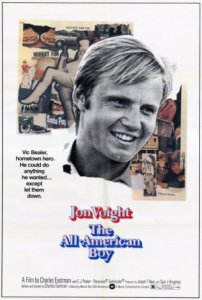
Vic “The Bomber” Bealer is an amateur boxer who appears to be poised to escape from life in his dreary hometown.  He is such a good fighter that he is on the verge of making the U.S. Olympic Team and he is so good-looking that everyone, from his teenage girlfriend (Anne Archer) to his gay manager (Ned Glass) to a woman he meets at a gas station, automatically falls in love with him.  However, after his girlfriend tells him that she is pregnant, Vic abandons both her and boxing.  When she leaves town to have an abortion, Vic starts boxing again but then he learns that she may not have actually had an abortion and Vic leaves for Los Angeles, to see both her and his son.

Sadly, there is something about boxing that has always brought out the pretentious side of some filmmakers and that is the case with The All-American Boy.  This episodic film (which claims to portray “The Manly Art In Six Rounds”) tries to present Vic as being an anti-hero but mostly, he just seems to be vacant loser.  Vic sulks through the entire film, despite not really having much to sulk about.  When one of his conquests asks him what he is thinking, Vic replies, “I ain’t thinkin'” and the movie provides no reason to doubt him on this point.  I was not surprised to learn that The All-American Boy was filmed in 1969 and was deemed unreleasable until the combined success of Midnight Cowboy and Deliverance made Voight into a star.  On the plus side, when he made the film, Jon Voight looked like he could actually step inside the ring and throw a few punches.  On the negative side, the boxing scenes go heavy on the slow motion which, when overused, just looks stupid.  Raging Bull, this film is not.

When it comes to The All-American Boy, Duke has the right idea:

A Movie A Day #33: Two-Minute Warning (1976, directed by Larry Peerce)


mpw-8771

For the longest time, I thought that Two-Minute Warning was a movie about a gang of art thieves who attempt to pull off a heist by hiring a sniper to shoot at empty seats at the Super Bowl.  As planned by a master criminal known as The Professor (Rossano Brazzi), the sniper will cause a riot and the police will be too busy trying to restore order to notice the robbery being committed at an art gallery that happens to be right next to the stadium.

I believed that because that was the version of Two-Minute Warning that would sometimes show up on television.  Whenever I saw the movie, I always through it was a strange plan, one that had too many obvious flaws for any halfway competent criminal mastermind to ignore them.  What if the sniper was captured before he got a chance to start shooting?  What if a riot didn’t break out?  The sniper spent the movie aiming at empty seats but, considering how many people were in the stadium, it was likely that he would accidentally shoot someone.  Were the paintings really worth the risk of a murder charge?

Even stranger was that Two-Minute Warning was not only a heist film but it was also a 1970s disaster film.  Spread out throughout the stadium were familiar character actors like Jack Klugman, John Cassevetes, David Janssen, Martin Balsam, Gena Rowlands, Walter Pidgeon, and Beau Bridges.  It seemed strange that, once the shots were fired and Brazzi’s men broke into the gallery, all of those familiar faces vanished.  When it comes to disaster movies, it is an ironclad rule that at least one B-list celebrity has to die.  It seemed strange that Two-Minute Warning, with all those characters, would feature a sniper shooting at only empty seats.  For that matter, why would there be empty seats at the Super Bowl?

That wasn’t the strangest thing about Two-Minute Warning, though.  The strangest thing was that Charlton Heston was in the film, playing a police captain.  In most of his scenes, he had dark hair.  But, in the scenes in which he talked about the art gallery, Heston’s hair was suddenly light brown.

Recently, I watched Two-Minute Warning on DVD and I was shocked to discover that the movie on the DVD had very little in common with the movie that I had seen on TV.  For instance, the television version started with the crooks discussing their plan to rob the gallery.  The DVD version opened with the sniper shooting at a couple in the park.  In the DVD version, there was no art heist.   The sniper had no motive and no personality.  He was just a random nut who opened fire on the Super Bowl.  And,  in the DVD version, he did not shoot at empty seats.  Several of the characters who survived in the version that I saw on TV did not survive in the version that I saw on DVD.

What happened?

The theatrical version of Two-Minute Warning was exactly what I saw on the DVD.  A nameless sniper opens fire and kills several people at the Super Bowl.  In 1978, when NBC purchased the television broadcast rights for Two-Minute Warning, they worried that it was too violent and too disturbing.  There was concern that, if the film was broadcast as it originally was, people would actually think there was a risk of some nut with a gun opening fire at a crowded event.  (In 1978, that was apparently considered to be implausible.)  So, 40 minutes of new footage was shot.  Charlton Heston even returned to film three new scenes, which explains his changing hair color.  The new version of Two-Minute Warning not only gave the sniper a motive (albeit one that did not make much sense) but it also took out all of the violent death scenes.

Having seen both versions of Two-Minute Warning, neither one is very good, though the theatrical version is at least more suspenseful than the television version.  (It turns out that it was better to give the sniper no motive than to saddle him with a completely implausible one.)  But, even in the theatrical version, the potential victims are too one-dimensional to really care about.  Ultimately, the most interesting thing about Two-Minute Warning is that, at one time, an art heist was considered more plausible than a mass shooting.

tmw

Shattered Politics #46: Used Cars (dir by Robert Zemeckis)


Used_Cars_film_poster

“Do you think we like being associated with the President of the United States?  I mean, we run an honest business here!” —

Jeff (Gerrit Graham) in Used Cars (1980)

As a film lover, I’ve sat through so many disappointing commentary tracks that, when I come across one that’s actually fun and informative, it causes me to like the film even more.  One of the best commentary tracks that I’ve ever heard was the one that Robert Zemeckis, Bob Gale, and Kurt Russell recorded for the DVD release of the 1980 comedy Used Cars.

The film — which was an early credit for both director Zemeckis and screenwriter Gale — tells the story of two rival used car lots.  The bad guy car lot is owned by Roy L. Fuchs (Jack Warden).  The good guy car lot is owned by Roy’s brother, Luke Fuchs (also played by Jack Warden).  The top salesman at the good guy car lot is Rudy Russo (Kurt Russell).  The film shows what happens when Luke dies and Rudy tries to prevent Roy from taking over the lot.

The commentary track is distinguished by just how much Zemeckis, Gale, and Russell seem to truly enjoy watching and talking about the film.  Kurt Russell, in particular, has an incredibly engaging laugh and his sense of fun is contagious.  However, for me, the most interesting part of the commentary track came when Bob Gale explicitly compared Rudy Russo and Luke’s daughter (played by Deborah Harmon) to Bill and Hillary Clinton and then even starts to do a surprisingly good imitation of Bill’s hoarse Arkansas accent.

What made it interesting was that the comparison was absolutely correct.

Politicians are salesmen.  Much as politicians will say anything to get your vote, the salesmen in Used Cars will say and do anything to get your money.  Politicians sell promises that are too good to be true.  Rudy Russo and Roy L. Fuchs do the same thing, claiming that their used cars are just as good and safe as a car that’s never been owned before.

In fact, one of the major plotlines in Used Cars is that Rudy is plotting to make the move from selling cars to buying votes.  There’s a vacancy in the state senate and Rudy is planning on running for the seat.  All he has to do is come up with the $10,000 necessary to buy the nomination from the local political machine. (I imagine it would be more expensive to buy a nomination today.)  Luke agrees to loan Rudy the money but, before he can, Luke goes on a test drive with a former race car driver.

The driver works for Luke’s evil brother, Roy.  Roy knows that Luke has a heart condition and he specifically sends over that driver to give Luke a fatal heart attack.  Just as Rudy is trying to sell a car to a costumer who is skeptical about whether or not he should pay an extra fifty dollar for something he doesn’t want (“$50.00 never killed anyone!” the customer insists), Luke staggers into the office and dies.

(The shocked customer agrees to pay the extra fifty dollars.  Ever the salesman, Luke grabs the fifty before he dies.)

With Luke dead and his estranged daughter nowhere to be seen, Roy is next-in-line to take over Luke’s car lot.  So, Rudy hides the body and tells everyone that Luke is down in Florida.  Both he and his fellow salesman, the hilariously superstitious Jeff (Gerrit Graham), conspire to make as much money as possible before anyone discovers the truth.

How do they do it?  Illegally, of course!

First off, they break into the broadcast of a football game and do an ad.  Then, they use strippers to attract customers.  And finally, Rudy comes up with his master plan, interrupting a televised address from the President of the United States.

“You can’t fuck with the President!” Jeff says.

“Hey, he fucks with us…” Rudy responds.

Seriously, I love Rudy.

In fact, I really liked Used Cars.  It’s a good combination of broad humor and clever satire and both Kurt Russell and Gerrit Graham give such likable performances that you can ignore the fact that they’re both playing total jerks.  (In fact, I would argue that one reason that we love Rudy is because he’s so honest about being so crooked.)  Not every scene worked perfectly.  The scene where Rudy and Jeff interrupt that football game goes on forever and, after a spokesmodel’s dress is ripped off, becomes so uncomfortable to watch that it actually takes the film a while to recover.  But then, after that, you get the interruption of the President’s speech.  You get Jeff freaking out over whether or not red cars or unlucky.  You get some fun driving school humor.  And, of course, you get a cute dog that can do tricks and helps to sell cars.  The film recovers and, ultimately, Used Cars is a celebration of small businesses everywhere.

And you know what?

I really hope Rudy did make it into the state senate.

We need more Rudy Russos in government.

And we really need more commentary tracks featuring Kurt Russell!

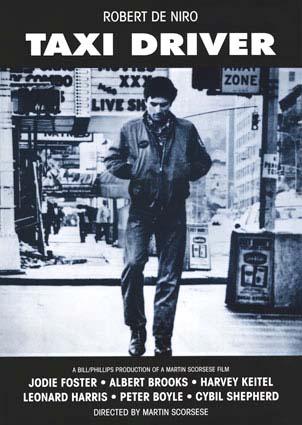
Shattered Politics #39: Taxi Driver (dir by Martin Scorsese)


Taxi_Driver_poster

We’ve never had a President named Charles.  We’ve had several Presidents named John and a quite a few named James.  We’ve even had three named George.  But we’ve never had a Charles.  We’ve come close.  Charles Evans Hughes nearly beat evil old Woodrow Wilson in 1916.  Charles Cotesworth Pinckney was nominated two times in a row by the Federalists but lost to Thomas Jefferson and James Madison respectively.  We’ve had three Vice Presidents names Charles — Fairbanks, Dawes, and Curtis — but never a President.

And, if we ever do elect a President named Charles, he’s probably go by either Charlie or Chuck.  The United States has always liked to think of itself as being a country that has no official royal family and, as a name, Charles probably sounds far to aristocratic for most voters.

That’s why I’m sure that, once U.S. Sen. Charles Palatine won the Democratic presidential nomination back in 1976, he probably insisted that people start calling him Chuck.  Of course, Sen. Palatine probably had no idea how lucky he was to win that nomination.  If not for a few secret service agents, Sen. Palatine could very well have fallen victim to a psychotic taxi driver named Travis Bickle.

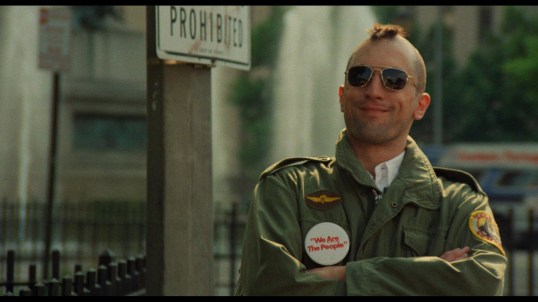
Sen. Palatine’s presidential campaign is a major subplot of Martin Scorsese’s 1976 masterpiece of paranoia, Taxi Driver.  As played by an actor named Leonard Harris, Sen. Palatine appears to be the epitome of a politician.  He may smile at the right moment but his eyes are always shifty.  Even his campaign slogan (“We Are The people!”) is vapid in an all too plausible way.  (How different is “We Are the People” from “We Are The People We’ve Been Waiting For?”)  For the most part, Palatine remains a remote figure, giving speeches and appearing in television commercials.  The only time that we get to know Palatine as a person is when he gets in a taxi being driven by Travis Bickle (Robert De Niro).

Travis recognizes him immediately and tells him that he tells everyone who gets in the cab that “they gotta vote for you.”  Palatine smirks a little as he asks Travis what he thinks the most important issue of the election is.  Travis goes on a bit about how someone needs to destroy all of the scum and filthy lowlifes who seem to populate Travis’s section of New York.  As Travis rambles, Palatine’s smile disappears and it becomes obvious that he’s realized that he is essentially being driven by a psycho.  Oh shit, Palatine is probably thinking, this guy is telling people that they gotta vote for me?  However, Palatine quickly regains his composure and assures Travis that the wisest people that he’s ever met have been taxi drivers.

Of course, what Palatine doesn’t realize is that Travis only knows about the campaign because he happens to be obsessed with a Palatine campaign worker named Betsy (Cybill Shepherd).  And Betsy even goes out with Travis a few times.  But then Travis, who spends the majority of the film showing how little skill he has when it comes to understanding and relating to other people, takes Betsy to an adult film.

With Betsy refusing to take his calls, Travis’s attention shifts to Iris (Jodie Foster), a teenage prostitute.  Obviously seeing himself as being a knight in shining armor, Travis tells Iris that she has to go back home to her parents.  As Travis talks, it becomes apparent that he’s simply repeating talking points that he’s heard on TV.  (If Taxi Driver was made today, Travis would be one of those people constantly sharing “inspirational” Facebook posts.)  Iris laughs at Travis and goes back to her pimp, Sport (Harvey Keitel).

And, of course, Travis goes even crazier than before.

38 years after it was first released, Taxi Driver remains a disturbing and powerful film.  However, what makes it effective is that, in many ways, it’s perhaps the darkest comedy ever made.  Throughout the entire film, Travis essentially tells everyone that he meets that he’s disturbed and potentially dangerous and, throughout the entire film, everyone seems to be determined to ignore all of the signs.

Critics always talks about the scene where Travis points a gun at his mirror and asks, “You talkin’ to me?”  And that’s a great scene.  It deserves to be famous, just as De Niro deserves all of the praise that he’s gotten for his iconic performance in Taxi Driver.

However, for me, there are two other scenes that are just as brilliant.  The first is where Travis attempts to get some advice from an older cabbie named Wizard (Peter Boyle).  Travis says he’s been having a lot bad thoughts.  Wizard shrugs and says that everyone has those.  What makes this scene particularly memorable are the lengths that Wizard goes to in order to avoid acknowledging that Travis is obviously disturbed.

And then, there’s the scene where Travis buys a gun from Easy Andy (Steven Prince).  Andy is such a salesman and is so nonchalant about all of his weaponry that, for a few brief minutes, Steven Prince actually manages to steal the spotlight from Robert De Niro.

Whenever one thinks about Taxi Driver, one automatically pictures Robert De Niro.  That’s why it’s all the more interesting that De Niro was not the first choice for Travis.  When Taxi Driver was in pre-production and a pre-Jaws Steven Spielberg (of all people) was thinking about directing it, Jeff Bridges as briefly attached to the role.  And while it’s always tempting to think about what a Spielberg/Bridges version of Taxi Driver would look like, I think we’re all right to be happy that the actual film was directed by Scorsese and starred De Niro.  They truly made Taxi Driver into one of the most memorable films ever made.

taxi-driver-mohawk

Lisa’s Homestate Reviews: Colorado and Over the Edge


From August of 1994 to July of 96, my family lived in Longmont, Colorado.  Whenever I think back to living in Colorado or the times that I’ve visited it since, there’s always two things that I remember.  First off, Colorado had the cleanest air that I’ve ever breathed and, for someone like me who grew up with severe asthma, that’s a big deal.  Secondly, Longmont had some great dance teachers.  I may have taken my first dance classes in Texas but I’ve always liked to think that Colorado is where I first truly fell in love with dancing.

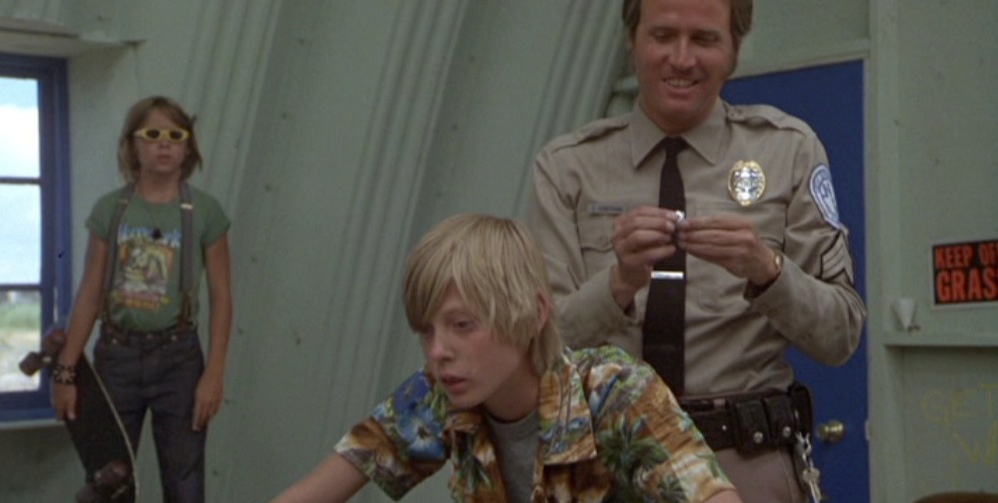
Fortuantely, my family and I lived in Longmont and not New Granada, the setting of the Colorado-shot 1979 film Over the Edge.  New Granada is a planned community, a collection of identical houses and sterile buildings that sit out in the middle of the desert.  The majority of town’s adult population views New Granada as less a home and more of a business opportunity.  When their children misbehave, they worry less about why and more about how that’s going to effect the effort to get a visiting businessman to invest in their town.  The streets of New Granada are patrolled by a fearsome cop with the very appropriate name of Doberman (Harry Northup).  Doberman may claim to be maintaining the peace but, as quickly becomes apparent, he’s just a bully with a uniform.

Is it any wonder then that the teenagers of New Granada are out-of-control?  Between living in a town where there is literally nothing to do other than skip school, smoke weed, and hang out at a dilapidated rec center and having to deal with parents who don’t really seem to want them around, the youth of New Granada are angry and Over the Edge suggests that they have every right to be.

When Mark (Vincent Spano) uses his BB gun to shoot a hole in Doberman’s windshield, Doberman reacts by blaming and harassing Carl (Michael Kramer) and his friend Richie (a very young Matt Dillon).  When Doberman demands that Richie tell him who shot the BB gun, Richie replies, “I only got one law.  Any kid who tells on another kid is a dead kid.”

Things escalate.  When a Texas businessman visits the town, the rec center is closed in an attempt to keep any of the kids from being seen.  Doberman arrests Claude (Tom Fergus) for possessing a gram of hash, which leads to Richie realizing that one of the kids has turned into a snitch.  Doberman’s obsession with finding out who shot the BB gun leads to the death of one of New Granada’s teens. Eventually, the adults of New Granada attend an emergency PTA meeting down at the high school, just to find themselves locked into the building by their children, the majority of whom proceed to riot and destroy the town outside.

Directed by Jonathan Kaplan and based on a true story, Over the Edge is one of the best youth-in-revolt films ever made.  Not only is it well-acted (with Matt Dillion in particular showing a lot of rebellious charisma as Richie) but it’s also unique in that it is totally on the side of the young people.  While Over the Edge does not necessarily endorse the violence that dominates the film’s finale, it also suggests that acting out was perhaps the only option left to the teenagers of New Granada.  That Over the Edge was made in the 70s is obvious as soon as you hear the soundtrack and see the clothes and hairstyles.  However, with its portrayal of both youthful alienation and out-of-control authority, it’s still very relevant today.

It’s a great film with an absolutely hear-breaking ending and it’s one that you should see if you haven’t yet.

The Face of Fascism In Over The Edge

The Face of Fascism In Over The Edge