Lisa Marie’s Take On Escape From New York (dir by John Carpenter)


I was a bit shocked to realize that I hadn’t reviewed Escape from New York for this site.  Leonard’s reviewed it.  Jeff’s reviewed it.  I’ve reviewed quite a few Italian films that were inspired by Escape from New York.  Last year, I devoted an entire day to how much I love Kurt Russell.  I’ve shared John Carpenter’s theme music, more than once.  I’ve reacted to Mamdani’s election by telling my friends that it’s time to escape from New York.  I’ve lost track of the number of times that I’ve told Leonard that it is “Time to leave the Bronx,” even though he doesn’t live in the Bronx.  (What do I know?  I live in Texas.)  But I’ve never actually reviewed Escape From New York.

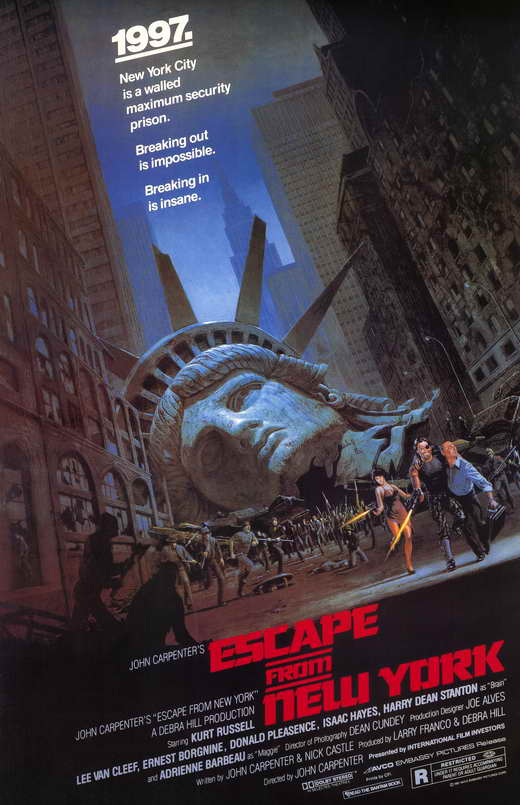
I love Escape from New York but I have to say that the film itself can’t live up the brilliant poster art.  The first time I watched Escape from New York, I was really disappointed that the Statue of Liberty’s head never appeared in the middle of a street in Manhattan.  If the film were made today, one imagines that the filmmakers would be able to do all sorts of things with the Statue of Liberty.  But Escape from New York was made in 1981, in the days before rampant CGI.  Escape from New York was made at a time when directors had to be somewhat clever and that definitely works to the film’s advantage.  The lack of big time special effects meant that Carpenter had to emphasize character and atmosphere.  Escape From New York might not feature the Statue of Liberty’s head but it does feature an amazing cast and a host of unforgettable characters.  When you manage to get Kurt Russell, Ernest Borgnine, Donald Pleasence, Harry Dean Stanton, Adrienne Barbeau, Lee Van Cleef, and Isaac Hayes all in the same film, there’s no way it isn’t going to be memorable.

We all know the plot.  Kurt Russell plays career criminal Snake Plissken.  (Everyone thought Snake was dead.)  When the President (Donald Pleasence) finds himself trapped on the prison island of Manhattan, Snake is the man who is sent to rescue him.  The fate of the world depends on rescuing the President.  If the President isn’t rescued, it could lead to nuclear war.  Snake doesn’t really care about the fate of the world.  He does care about the fate of himself, however.  He’s been injected with a poison that will kill him unless he receives the antidote in 24 hours.

(The doctor who gives Snake the poison is named Dr. Cronenberg.  Meanwhile, Frank Doubleday appears as a thug named Romero.  Lee Van Cleef’s police commissioner is named Hauk, as in Howard Hawks.  Tom Atkins plays Captain Rehme, as in producer Bob Rehme.  The film may be about the collapse and possible end of the world but John Carpenter’s having fun.  And, of course, so are we.)

The President has been captured by the Duke of New York (Isaac Hayes).  It doesn’t take Snake long to track down the Duke.  But rescuing the President and making it back to safety turns out to be far more difficult and violent than anyone was anticipating.  Snake gets some help, from characters like Cabbie (Ernest Borgnine), Brain (Harry Dean Stanton), and Maggie (Adrienne Barbeau).  Of course, that help is largely due to everyone’s self-interest.  The recurring theme is that no one really cares that much about whether or not the President or even Snake lives or dies.  Maggie loves Brain but, otherwise, there’s not much individual loyalty to be found in this film.  Instead, everyone just cares about getting the Hell out of New York.  In the end, even the President turns out to be a bit of a jerk.

(I do have to say that I absolutely love Donald Pleasence’s performance in Escape from New York.  The “You’re the Duke!  You’re the Duke!  A Number One!” scene?  That was Pleasence at his most brilliant.)

It’s a wonderfully acted and directed film, one that is often darkly humorous.  (While Kurt Russell delivers his lines with a endearing self-awareness, Carpenter has a lot of fun imagining the type of criminal society that would emerge on an isolated Manhattan.)  It’s also a film that understands the power of New York City.  Depending on who you ask, New York either represents the worst or the best of America.  That’s true today and, watching Escape from New York, it’s easy to guess that was probably true in 1981 as well.  There’s a power to the “New York” name and it’s why this film wouldn’t have worked if it had been called Escape From Houston or Escape From Spokane.  (One reason why Escape From LA failed was because the cartoonishness of Los Angeles couldn’t compete with the grit of New York.)  We all know the saying — “New York, New York: If you can make it there, you can make it anywhere.”  This film reminds us that it’s also true that if you can escape from there, you can escape from anywhere.  Escape from New York brilliantly captures the way that most of the rest of country view New York but, by limiting the action to Manhattan, it also presents a story that can be enjoyed by people in Brooklyn, the Bronx, Queens, and Staten Island.  I imagine the film is especially popular on Staten Island.

Escape From New York is a brilliant work of the pulp imagination.  It’s a film that will probably outlive the city.
Brad reviews THE LAST STAND (2013), starring Arnold Schwarzenegger!


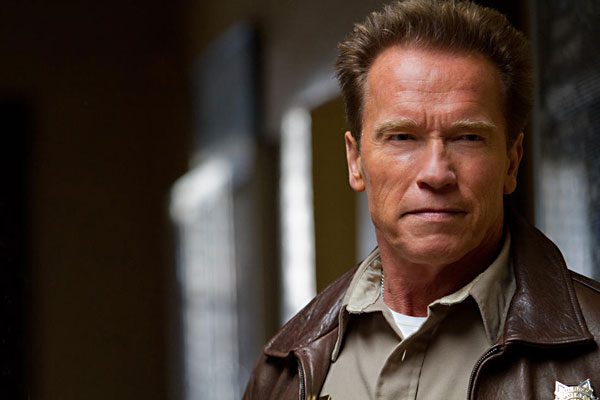
After eight years of serving as Governor of California, Arnold Schwarzenegger made his big comeback as an action movie star in director Kim Jee-woon’s THE LAST STAND (2013). Sure, he put in a little work on the first two EXPENDABLES movies, but those were really just glorified cameos. Here, Arnold was front and center for the film’s 107 minute running time. This was an exciting time for me, because like most action movie fans, I loved him and had truly missed seeing him consistently kicking butt and taking names on the big screen. I gladly made my way to the movie theater in January of 2013  for a large tub of ‘corn, a big Mr. Pibb, and the true return of an action megastar!!

In THE LAST STAND, Schwarzenegger plays Ray Owens, a former LAPD narcotics officer who chose to leave the big city and take a job as the sheriff of the quiet, southern border town of Sommerton, Arizona. It won’t be quiet for long after notorious drug kingpin Gabriel Cortez (Eduardo Noriega) makes a daring escape from FBI custody. Cortez immediately heads towards the border in a souped up Corvette where an advanced group of highly trained gunmen, led by Burrell (Peter Stormare), are waiting to help him cross. Cortez and his small army of mercenaries appear to be on a collision course with Sheriff Owens and his ragtag group of deputies, including Mike (Luis Guzman), Jerry (Zach Gilford), and Sarah (Jaimie Alexander). Knowing they’re outgunned and outmanned, Sheriff Owens asks for additional help from ex-military man and current drunk Frank Martinez (Rodrigo Santoro), as well as the crazy local gun nut Lewis Dinkum (Johnny Knoxville). Add to this mixture, FBI agent John Bannister (Forest Whitaker) and his team’s attempts to try to stop Cortez before he gets to Sommerton, and the stage is set for lots of action! 

I really liked THE LAST STAND when I saw it at the movie theater in 2013, and I really liked it again when I revisited the film this week. I made it a habit many years ago to not read reviews of a film before I go see it at the theater. I had found that reading potential negative comments could affect my viewing of a film, so I cut that out. As such, after totally enjoying myself with THE LAST STAND, I was surprised that the film wasn’t received very strongly by the audience or critical community, and I was even more surprised that it completely flopped at the box office, only bringing in a total of $12 million in the United States during its run. For me, the film delivered what I was looking for… Arnold Schwarzenegger kicking ass, spouting off some good one-liners, and outsmarting and outmuscling his much younger adversaries! No critic or keyboard warrior can take that away from me, as THE LAST STAND is an entertaining movie with a good cast. Heck, even the great Harry Dean Stanton pops in for a surprise cameo at the beginning of the action. 

I also appreciate the fact that THE LAST STAND is the American directorial debut of the great South Korean director Kim Jee-woon, who has directed some of my favorite South Korean films, including A BITTERSWEET LIFE (2005) and I SAW THE DEVIL (2010). His direction brings some Asian flair that results in stronger, more graphic violence, as well a penchant for jarring changes in tone between humorous character interplay and sometimes violent tragedy. In a movie designed primarily as a piece of entertainment, I appreciate those more over-the-top touches that lift it above the norm. 

Overall, I easily recommend THE LAST STAND to fans of Arnold Schwarzenegger and old-school action movies. It’s not a Schwarzenegger classic in the same way as movies like PREDATOR (1987), TERMINATOR 2 (1991), and TRUE LIES (1994), but it’s still a fun ride! 

Song of the Day: Everybody’s Talkin’, performed by Harry Dean Stanton, Johnny Depp, and Kris Kristofferson


This was filmed in 2016.  Not only do we have Harry Dean Stanton, Kris Kristofferson, and Johnny Depp but David Lynch puts in an appearance early on in the video as well.

Scenes I Love: Harry Dean Stanton in Paris, Texas


Today would have been the 99th birthday of the great character actor, Harry Dean Stanton.

My scene that I love for the day comes from Wim Wenders’s Paris, Texas.  This 1984 film gave Stanton a rare starring role as Travis, a man searching for Jane (Nastassja Kinski), the mother of his son.  In this scene, physically separated and hidden from Jane by a one-way mirror, Travis talks about their relationship and their son.

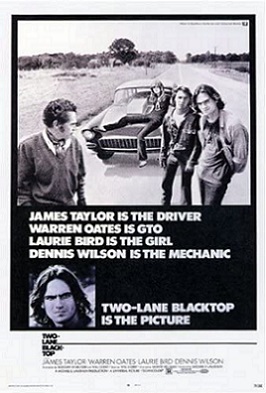
The Unnominated #18: Two-Lane Blacktop (dir by Monte Hellman)


Though the Academy of Motion Picture Arts and Sciences claim that the Oscars honor the best of the year, we all know that there are always worthy films and performances that end up getting overlooked.  Sometimes, it’s because the competition too fierce.  Sometimes, it’s because the film itself was too controversial.  Often, it’s just a case of a film’s quality not being fully recognized until years after its initial released.  This series of reviews takes a look at the films and performances that should have been nominated but were, for whatever reason, overlooked.  These are the Unnominated.

The 1971 road film, Two-Lane Blacktop, is a movie about four people whose real names are never revealed.  Indeed, their names are never as important as what they’re driving.

Named after his car, GTO (Warren Oates) is a talkative man who likes to brag on himself and who picks up hitchhikers so he can talk to them.  We don’t learn much about GTO’s background.  For someone who talks as much as he does, GTO doesn’t reveal much about who he is when he’s not driving.  It’s easy to imagine him as a salesman, traveling across the country and desperately trying to make his quota before the sun goes down.  With the way that he picks up hitchhikers and his need to convince everyone of his own skill and prowess behind the wheel, it’s easy to imagine that he’s probably recently divorced and still dealing with suddenly being on his own.  He seems to have something to prove, not only to everyone around him but especially to himself.  One gets the feeling that the life he had suddenly collapsed and he took to the road to escape it all but he still hasn’t reached the point where he can handle truly being alone.  For all of his talk, it doesn’t take long to notice that GTO isn’t quite as worldly as he claims he is.

A chance meeting leads to GTO getting into a cross-country race with The Driver (James Taylor) and the Mechanic (Dennis Wilson), two young men who are driving a 1955 Chevy and who make their money by engaging in street races.  (They’re also quick to steal a license plate when no one’s looking.)  The Driver and the Mechanic don’t talk a lot and, when they do, it’s in terse and somewhat awkward sentences.  (Both Taylor and Wilson were musicians who made their acting debut with this film.  Their natural stiffness and lack of emotion works well for their characters.)  The Driver and the Mechanic seem to communicate solely through driving.  They pick up The Girl (Laurie Bird) and both the Driver and the Mechanic seem to have feelings for her but it’s pretty obvious that their true love will always be for their car.

Two-Lane Blacktop is a road movie, a movie that really doesn’t have much of a plot (the cross-country race soon ceases to be a real race) but which does have some beautiful footage of America in 1971 and an outstanding performance from the great character actor, Warren Oates.  Easy Rider was advertised as being a film about a man who looked for America and couldn’t find it.  That’s actually a better description of Two-Lane Blacktop, a film about three uniquely American men who have embraced the car culture that is at the center of life in America but who are still, more or less, lost in their home country.  Oates, always talking and refusing to give up or even acknowledge the fact that he doesn’t really know much about how cars work, represents the so-called silent majority.  Wilson and Taylor are the next generation, their long-hair branding them as outsiders while their skill with a car and their desire win represents what we’re told is the best of the American competitive spirit.  What makes the film unsettling is the feeling that all three of them are using their cars as a way to avoid dealing with the reality of their lives.

Two-Lane Blacktop may sound a bit pretentious and it is.  The metaphors get a bit heavy-handed.  That said, as directed by Monte Hellman, it’s both a gorgeous travelogue and a valuable time capsule, a document of life in the late 60s and early 70s.  Hellman directed the film on the road.  When we see the Mechanic stealing a license plate so no one down south will know that he and the Driver are actually from California, it’s a powerful scene because it was actually filmed on location, in the South.  This isn’t a film that was shot on a backlot.  This is a film that was shot across America and it captures the country at a time when, much like today, no one was really sure what the future held for its politics or its culture.  It may be a film about three men who are obsessed with cars but it’s also a portrait of a country in an almost directionless state of turmoil.

Two-Lane Blacktop was promoted as being the next Easy Rider but it turned out to be a notorious box office failure.  James Taylor and Dennis Wilson never did another movie.  Warren Oates continued as a busy character actor while Laurie Bird died of an intentional drug overdose in 1979.  Director Monte Hellman’s directorial career continued but his days of being courted by the major studios were over.  However, as the years passed, audiences started to discover Two-Lane Blacktop and now, it’s considered to be a cult classic.

Given its failure at the box office, Two-Lane Blacktop was ignored by the Academy.  The Oscar for Best Picture went to another film that featured a memorable car chase, The French Connection.  While Two-Lane Blacktop may not have deserved to win Best Picture (not over nominees like The French Connection, The Last Picture Show, Fiddler on the Roof, and A Clockwork Orange), it certainly is far more memorable movie than the fifth film nominated that year, Nicholas and Alexandra.  If nothing else, Warren Oates deserved a nomination for his supporting performance.  The Academy may not have embraced Two-Lane Blacktop but, fortunately, film lovers eventually would.

Previous Entries In The Unnominated:

  1. Auto Focus 
  2. Star 80
  3. Monty Python and The Holy Grail
  4. Johnny Got His Gun
  5. Saint Jack
  6. Office Space
  7. Play Misty For Me
  8. The Long Riders
  9. Mean Streets
  10. The Long Goodbye
  11. The General
  12. Tombstone
  13. Heat
  14. Kansas City Bomber
  15. Touch of Evil
  16. The Mortal Storm
  17. Honky Tonk Man

Brad reviews COCKFIGHTER (1974), starring Warren Oates!


I read about the movie COCKFIGHTER many years ago, and I remember the review being very positive. I had never watched the film before, but with today being Warren Oates’ birthday and it being available on Amazon Prime, I decided I’d finally watch it. 

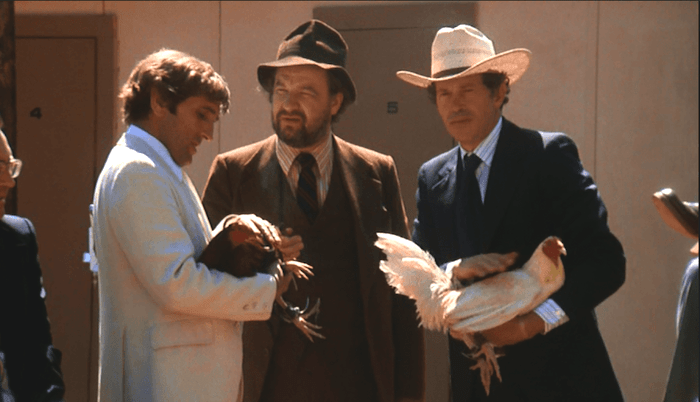
Directed by Monte Hellman and based on Charles Willeford’s 1962 novel, COCKFIGHTER introduces us to Frank Mansfield (Warren Oates), a man completely obsessed with the southern “sport” of cockfighting. As we meet him, he’s in the process of losing a bet and a cockfight with Jack Burke (Harry Dean Stanton). The loss isn’t just a setback, it costs him all of his cash, his truck, his trailer, and his current girlfriend Dody White (Laurie Bird). We also notice in these early scenes that Frank only communicates through sign language and writing notes. It seems that he’s been living under a self-imposed vow of silence. Two years earlier, on the eve of the big, season-ending cockfighting grand finale, Frank’s big-mouthed braggadocio caused him to lose his prized cock, and the prestigious “Cockfighter of the Year” medal in a meaningless hotel bet, also against Jack Burke. Frank vows not to speak again until he wins that medal. Coming up with cash in the only way he can by selling his family’s home, Frank buys a new cock named White Lightning from Ed Middleton, played here by the film’s writer Charles Willeford. Armed with new fowl and a new, capital rich partner named Omar Baradansky (Richard B. Shull), Frank will not let anything stop him, including the love of his life Mary Elizabeth (Patricia Pearcy) or an axe wielding competitor (Ed Begley, Jr.), from being named “Cockfighter of the Year” and finally regaining his voice and the respect he desires!

COCKFIGHTER definitely has some things going for it. First and foremost, Warren Oates is so good in the lead role as the obsessed man who puts success in cockfighting above anything else in his life, including every other person. He literally sells the family home out from under his alcoholic brother Randall (Troy Donahue) in order to fund his next cock purchase after he’s gone bust. This sets up quite the sight gag for such a gritty and realistic film as a large truck and trailer drives away the family home taking up the entire state highway. When his long time fiancé asks him to give up cockfighting, he just gets up, leaves her shirtless and heads back out on the circuit. He writes her a letter from the road and tells her he loves her, but he also makes it clear that life without cockfighting is a life that he’s unwilling to live. Oates’ Frank Mansfield is not the kind of person you’d ever want to depend on in life, but he’s also an uncompromising individual who is determined to live life wholly on his own terms, accepting of the successes and failures that come with it. I watched the film because it features Warren Oates, and after having done so, I can say that his performance is truly special. 

COCKFIGHTER is one of those movies that makes us feel like we’re watching real people, and that’s kind of fascinating even if they reside in a world that we don’t really want to live in. The primary credit for that has to go to director Monte Hellman and Oscar winning cinematographer Nestor Almendros (DAYS OF HEAVEN). The restraint that is shown in the storytelling, as well as the sweaty, ramshackle authenticity of the Georgia locations, brings the story to life. The supporting cast also does its part to create the world of COCKFIGHTER. Harry Dean Stanton as Jack Burke, Frank’s primary rival in the cockfighting game, is excellent as you might expect, and he seems a lot like a regular guy. I really like Richard B. Schull, who plays Frank’s outgoing and talkative partner Omar. His friendly and gregarious personality seems a little untrustworthy at first, but he turns out to be the most likable person in the film. And finally, I want to shoutout Charles Willeford. Not only did he write the source novel and screenplay for COCKFIGHTER, he also gives a solid performance as Ed Middleton, an old-timer in the game who treats Frank with honesty and decency when he’s hit rock bottom. 

With all the positive things I’ve said above, I have to address the graphic depiction of cockfighting in COCKFIGHTER. This was the 70’s, and the scenes shown here are real and were very difficult for me to watch. It’s not fun to see animals fight and kill each other, and this is coming from a person who loves fried chicken and is not particularly an animal lover. The scenes are presented as matter of fact and in service of the story, but that still doesn’t make them easy to watch. Director Monte Hellman has gone on record to express his personal disgust at even filming these scenes. While a movie made in the 1970’s probably couldn’t have been made without these sequences, I just wanted to make it clear that this film is probably unwatchable for a lot of people.

Overall, COCKFIGHTER is a relic of the 1970’s. It’s a gritty and realistic film, featuring a great central performance from Warren Oates. It’s also an ethically troubling film that features real animal on animal violence. Based on that I don’t necessarily recommend the film. Rather, I just want to share my own thoughts, and you can determine if you want to watch it or not. That’s what I’ve tried to do above. 

#MondayMuggers presents FAREWELL, MY LOVELY (1975) starring Robert Mitchum!


Every Monday night at 9:00 Central Time, my wife Sierra and I host a “Live Movie Tweet” event on X using the hashtag #MondayMuggers. We rotate movie picks each week, and our tastes are quite different. Tonight, Monday June 2nd, we are showing FAREWELL, MY LOVELY (1975) starring Robert Mitchum, Charlotte Rampling, John Ireland, Sylvia Miles, Anthony Zerbe, Harry Dean Stanton, Jack O’Halloran, Joe Spinell, and Sylvester Stallone.

FAREWELL, MY LOVELY finds Los Angeles private eye Philip Marlowe being hired by paroled convict Moose Malloy to find his girlfriend Velma, a former seedy nightclub dancer. All kinds of intrigue ensues as Robert Mitchum puts his droopy-eyed, world-weary spin on the famous detective!

So join us tonight for #MondayMuggers and watch FAREWELL, MY LOVELY! It’s on Amazon Prime. The trailer is included below:

Film Review: Kelly’s Heroes (dir by Brian G. Hutton)


1970’s Kelly’s Heroes takes place in France during the Second World War.  The American army is moving through the country, liberating it town-by-town.  Private Kelly (Clint Eastwood) is a former lieutenant who was busted down in rank after leading a disastrous raid on the wrong hill.  (It was the fault of the generals but Lt. Kelly was set up as a scapegoat.)  When Kelly learns that the Germans are hiding a huge amount of gold in an occupied town, he gathers together a team of weary soldiers, misfits all, and plans to go AWOL to steal the gold for themselves.

Kelly’s Heroes was one of the big budget studio films that Eastwood made after finding stardom in Europe with Sergio Leone’s Spaghetti westerns.  This is very much an ensemble film, in the vein of The Dirty Dozen.  Indeed, Eastwood’s co-star, Telly Savalas, was in The Dirty Dozen.  Here, Savalas plays Big Joe, the sergeant who isn’t sure that he wants to put his men in danger for gold that may or may not exist.  Don Rickles plays Crapshoot who is …. well, imagine Don Rickles in the middle of World War II and you have a pretty good idea of who Crapshoot is.  Stuart Margolin, Harry Dean Stanton, Perry Lopez, Gavin MacLeod shows up as soldiers.  Carroll O’Connor plays the bombastic general who mistakes Kelly’s attempts to go AWOL for a brilliant tactical maneuver,  Like all of the senior officers in this film, O’Connor’s general is a buffoon.  Kelly’s Heroes was made during the Vietnam War and, much like Patton (released the same year), it attempts to appeal to both the establishment and the counterculture by making the heroes soldiers but their bosses jerks.

And that brings us to Donald Sutherland, who plays a tank commander named Oddball.  You may not have know this but apparently, there were hippies in the 40s!  Actually, I don’t think that’s true but there’s really no other way to describe Oddball than as a Hollywood hippie.  He’s a blissed-out, spacey guy who thinks nothing of accidnetally driving his tank through a building.  The films ask us to believe that the long-haired and bearded Oddball is a World War II tank commander and Sutherland is such a likable presence that it’s temping to just go with it.  Oddball was obviously included to bring in “the kids” but he does generate some needed laughs.  This is a very long movie and the comedic moments are appreciated.

Kelly’s Heroes is two-and-a-half hours long and it definitely could have been shorter.  Director Brian Hutton allows some scenes to drag on for a bit too long and he sometimes struggles to balance the moments of comedy with the moments of violent drama (quite a few character dies) but he does get good performances from his ensemble.  Eastwood’s taciturn acting style is nicely matched with Savalas’s more expressive style and it’s hard not smile at Don Rickles, insulting everyone as if they were guests at Joe Gallo’s birthday party.  The film, at times, doesn’t seem to know if it wants to be a satire or a straight heist film but the cast keep things watchable.  Eastwood even gets to show a few hints of the dry sense of humor that always hid behind the perpetually bad mood that often seemed to hang over him in his early films.  Whatever flaws the film may have, it was a box office success.  One year after this release of Kelly’s Heroes, Eastwood would make history as Dirty Harry.

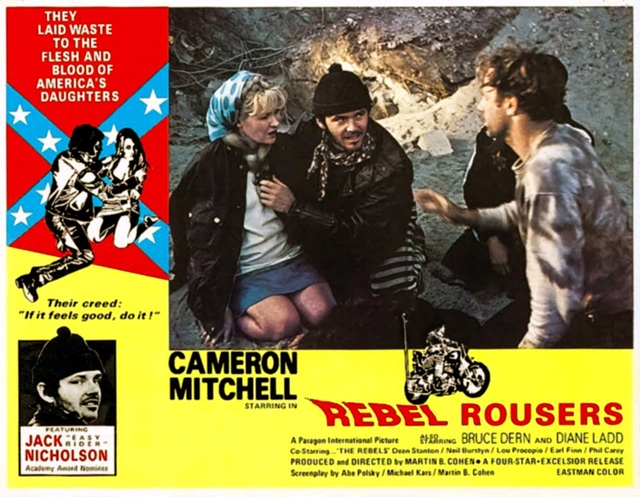
The TSL Grindhouse: Rebel Rousers (dir by Martin B. Cohen)


1970’s Rebel Rousers tell the story of what happens when Paul Collier (Cameron Mitchell) arrives in a small desert town, searching for his girlfriend, Karen (Diane Ladd).  Karen ran away when she discovered she was pregnant because she was scared that Paul would attempt to force her to get an abortion.  While Paul talks to Karen in a cheap motel, a motorcycle gang rides into town.  The members of the gang include Randolph (Harry Dean Stanton) and Bunny (Jack Nicholson), who wears striped prison pants and a stocking hat.  The leader of the gang is J.J. Weston (Bruce Dern), who went to high school with Paul.  They even played on the same football team but their lives have since followed differing paths.  (How exactly 30ish Bruce Dern and 50ish Cameron Mitchell could have been in the same high school class is not an issue that the film chooses to explore.)

Paul reunites with Karen and swears his love for her.  However, when Paul and Karen run into the motorcycle gang, Karen is kidnapped.  Bunny wants to force himself on Karen but J.J. wants to set her free.  J.J. challenges Bunny to a series of motorcycle games on the beach.  The winner decides what happens to Karen.  Meanwhile, Paul heads back to the town in search of help but discovers that almost everyone is too much of a coward to help him out.  Only Miguel (Robert Dix), the leader of a rival gang is willing to step up and save the community from the Rebels!

Rebel Rousers was filmed in 1967 but was considered to be so bad that it was put on a shelf and forgotten about until Jack Nicholson suddenly became a star in Easy RiderRebel Rousers was released on the drive-in circuit as a Jack Nicholson movie, even though Nicholson is barely in the film and he gives a pretty one-note performance as Bunny.  The movie’s star is Cameron Mitchell, who usually played villains and doesn’t seem to be too invested in this film.  (Mitchell has such a naturally sinister screen presence that I was actually worried about Paul finding Karen.  Bruce Dern and Diane Ladd are the sole members of the cast who really stand out, with Dern taking on the type of cool rebel role that was usually played by Peter Fonda while Ladd (pregnant at the time with Laura Dern) actually manages to bring some real emotional depth to her character. The movie itself was obviously made for next to nothing and it seems like it was shot in a hurry.  Everything feels like a first take or, even worse, like a rehearsal that was deemed “good enough.”  The competition between Bunny and J.J. ultimately feels mostly like filler than anything else.

Rebel Rousers is one of the more obscure entries in Jack Nicholson’s filmography.  If not for the success of Easy Rider, it never would have been released at all.  By the time Rebel Rousers did come out, Jack Nicholson was too busy establishing himself as one of the best leading men of the 70s to spend too much time looking back.  Today, watching this film can make it easier to understand why Nicholson was considering dropping out of Hollywood all together before he was cast in Easy Rider.  That said, the film today serves as a reminder that everyone started somewhere and sometimes, the somewhere is the second feature at the grindhouse.

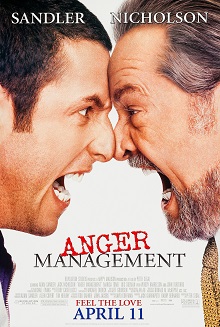
Anger Management (2003, directed by Peter Segal)


Dave (Adam Sandler), a timid man who has never gotten over being humiliated when he was a teenager, is sentenced to anger management after a slight argument on a plane is blown out of proportion by a taser-wielding shy marshal.  His therapist is Dr. Buddy Rydell (Jack Nicholson), whose techniques only seem to exacerbate Dave’s growing anger.  Among Dr. Rydell’s methods are giving Dave an unstable “anger buddy” named Chuck (John Turturro), ordering Dave to get revenge on the guy (John C. Reilly) who humiliated on his as a teenager, and also encouraging Dave to cheat on his girlfriend Linda (Maria Tomei) with a woman (Heather Graham) that they meet at bar.  Dave goes from timid to angry, Dr. Rydell starts dating Linda, and the whole thing is wrapped up with a totally implausible ending.

The idea of the star of Chinatown and Five Easy Pieces co-starring in an Adam Sandler comedy sounds like it should be exhibit #1 when it comes to talking about the decline of American cinema but I’ve always liked Anger Management.  Casting Jack Nicholson as the seemingly insane Dr. Rydell was an inspired choice and Nicholson gives a real performance in the film as opposed to just coasting on his already-established persona.  Anger Management came out a year after Adam Sandler’s first dramatic film, Punch-Drunk Love, and, even though Anger Management is a raunchy comedy from the start to finish, Sandler’s performance actually finds the reality in Dave’s situation.  Sandler plays Dave as being someone who is sincerely trying his best to get through his court-mandated anger management without losing control.  Nicholson and Sandler make for a surprisingly good team.

Of course, it’s an Adam Sandler comedy so it’s not for everyone.  The humor is often crude and the film’s final twist is so ridiculous that it can actually leave you feeling like you might need anger management.  But Anger Management does show how Jack Nicholson improves anything that he’s involved with and it also shows that Adam Sandler can act when he feels like it.  Anger Management also gave us the meme of Jack Nicholson nodding his approval, meaning the film and the performance will live forever.