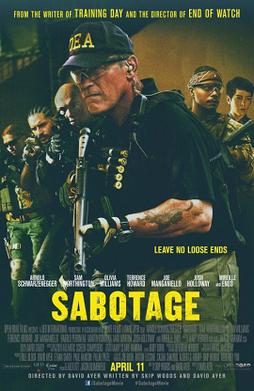
Atlanta Homicide detective Caroline Brentwood (Olivia Williams) and her partner, Darius Jackson (Harold Perrineau), are the primaries on the murder of a former DEA agent. Their investigation leads them to an elite special operations team led by “Breacher” Wharton (Arnold Schwarzenegger). Wharton and his crew were previously suspended for six months while the FBI investigates their last raid and why there was a $10 million dollar discrepancy between the amount of money the team reporter and the amount of money the FBI was expecting to be recovered. Someone is murdering the members of Breacher’s team one-by-one. Breacher and Brentwood investigate the murder and what happened to the money but they both discover that they can’t trust anyone.
Sabotage has got a cast that is full of talent and familiar faces, including Sam Worthington, Mireille Enos, Terrence Howard, Joe Manganiello, Martin Donavon, and Josh Holloway. It also has one truly great action scene, a violent chase down a busy Atlanta street that comes to sudden and very bloody conclusion. The film’s final scene takes Sabotage into western territory, with Schwarzenegger dominating the screen like a larger-than-life Sergio Leone hero. It’s just too bad that the rest of the movie isn’t as a good as its final shot or that one chase scene. Unfortunately, most of the film feels repetitive and half-baked, with way too much time being wasted on supporting characters who tend to blend together.
Arnold Schwarzenegger gives one of his better performances. When he made Sabotage, he was no longer a governor and he was also no longer an automatic box office draw and there’s a tired weariness to his performance. Unfortunately, the rest of the cast is either miscast (Olivia Williams) or stuck playing one-dimensional characters (everyone else). There’s enough good action sequences to keep Sabotage watchable and Schwarzenegger shows that he can actually be a very good actor but it’s also easy to see why this film didn’t reignite his his career.
Drug kingpin Frank White (Christopher Walken) has been released from prison and is again on the streets of New York City. Frank might say that he’s gone straight but, as soon as he’s free, he’s partying with his old crew (including Laurene Fishburne, Steve Buscemi, Giancarlo Esposito, and others). While Frank’s agent (Paul Calderon) goes to all of the other city’s gangsters and explains that they can either get out of Frank’s way or die, three detectives (Victor Argo, David Caruso, and Wesley Snipes) make plans to take Frank out by any means necessary. Meanwhile, Frank is donating money to politicians, building hospitals, and presenting himself as New York’s savior.
KingofNewYork is the epitome of a cult film. Directed by Abel Ferrara, the dark and violent King of New York was originally dismissed by critics and struggled to find an audience during its initial theatrical run. (It was lumped in with and overshadowed by other 1990 gangster films like Goodfellas and Godfather Part III.) But it was later rediscovered on both cable and home video and now it’s rightly considered to be a stone cold crime classic. Walken gives one of his best performances as Frank White and that’s not a surprise. The film was clearly made to give Walken a chance to show off what he could do with a lead role and Walken captures Frank’s charisma and humor without forgetting that he’s essentially a sociopath. Walken gives a performance that feels like James Cagney updated for the end of the 80s. What’s even more impressive is that all of the supporting characters are just as memorable as Walken’s Frank White. From Laurence Fishburne’s flamboyant killer to David Caruso’s hotheaded cop to Paul Calderon’s slippery agent to Janet Julian’s morally compromised attorney, everyone gives a strong performance. (I’m usually not a Caruso fan but he’s legitimately great here.) They come together to bring the film’s world to life. Everyone has their own reason for obsessing on Frank White and his return to power. I’ve always especially appreciated Victor Argo as the weary, veteran detective who finds himself trapped by Caruso and Wesley Snipes’s impulsive plan to take down Frank White. Frank White and the cops go to war and it’s sometimes hard to know whose side to be on.
Director Abel Ferrara has had a long and storied career, directing films about morally ambiguous people who are often pushed to extremes. Personally, I think KingofNewYork is his best film, a portrait of not just a criminal but also of a city that combines the best and the worst of human nature. The action is exciting, the cast is superb, and Frank’s justifications for his behavior sometimes make a surprising amount of sense. Thought there’s occasionally been speculation that it could happen, there’s never been a sequel to King of New York and it doesn’t need one. KingofNewYork is a film that tell you all that you need to know about Frank White and the city that he calls home.
Since Arnold Schwarzenneger left the California governor’s office and politics he’s gone back to doing what he was good at (or at least good at during the 80’s and 90’s). His first couple of films since getting back in front of the camera has been average at best (though I must say that Last Stand was pretty fun).
Now, we have him back in another film, but this time around one that’s a very hard, gritty R-rating that he hasn’t done since ever. He’s always had rated-R films, but they had a certain fun tone to them. With David Ayer’s Sabotage it looks like Schwarzenneger is trying to flex his hardcore bones. It’s definitely a surprise to hear him curse like a sailor during the red band trailer.
Sabotage is set for a March 28, 2014, release date.
After the success Kathryn Bigelow had with her award-winning film The Hurt Locker it was just part of the norm that people began to wonder what she would do to follow-up the film which gave her the Oscar for Best Director. There was talk of her making an action thriller about the Tri-Border Region in South America that many intelligence agencies consider a major haven for global organized crime and terrorist groups of all kinds. This particular idea bounced around for months then nothing came of it. Then news came about around late-Spring to early Summer 2011 that Bigelow and The Hurt Lockerwriter and collaborator Mark Boal came upon the idea that would be Bigelow’s follow-up.
The film that the two decided upon would be an action thriller detailing the global manhunt for Osama Bin Laden. Maybe it was just a coincidence, but this decision became even more important once news broke out on May 2, 2011 that the hunt for America’s Most Wanted criminal was finally over and that Operation Neptune Spear was a success with the death of Bin Laden.
Zero Dark Thirtyis the title of Bigelow’s film about the details and backstory which led up to this special operations mission on May 2, 2011. The first trailer for the film has been released by Sony and it’s short on details other than some voice overs over satellite imagery. I’m sure there’ll be more trailers that will open up what this film will truly be about leading up to it’s December release date (just in time for awards season).
It’s going to be interesting how Bigelow will do with this follow-up to The Hurt Locker. If her history is anything to go by then it shouldn’t disappoint even if some of her detractors will be chomping at the bit to see it fail and further see her Best Director Oscar win as a fluke done to keep the award from her ex-husband James Cameron.
Zero Dark Thirtyis scheduled for a December 19, 2012 release date…just two days from the end of the world.
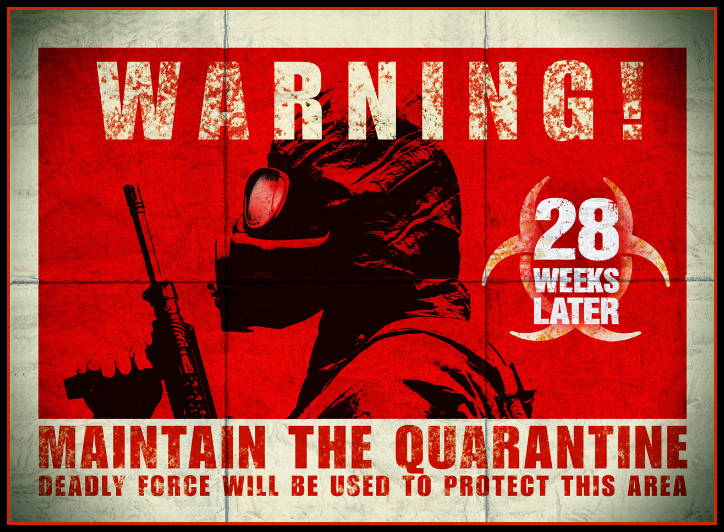
Danny Boyle and Alex Garland’s 28 Days Later was made in such a way that any sequel was almost destined to struggle in its shadow. Their film was not only one of the most influential horror films of the early 2000s, but also an exercise in experimental filmmaking and cinematic reinvention. It fused realism and terror through its digital photography, unconventional pacing, and minimalist score. Any follow-up would have to contend not just with its fresh twist on the zombie mythos (despite the infected not technically being zombies) but also its unique atmosphere, music, and stripped-down aesthetic. Against those odds, 28 Weeks Later manages to stand as an impressive and worthy successor—one that in some respects even surpasses the original.
Spanish director Juan Carlos Fresnadillo approaches the material with a clear reverence for Boyle and Garland’s vision while imprinting his own stylistic and emotional signature on the sequel. From the very first scene, Fresnadillo establishes a tone that blends despair and dread with human frailty. The film opens on a stunningly tense prologue in which Don (a gaunt and haunted Robert Carlyle) and Alice (Catherine McCormack) are living with several others in a rural cottage outside London during the first weeks of the Rage virus outbreak. In this sequence, Fresnadillo distills the central moral dilemma that runs through both films: whether to preserve one’s humanity through compassion or to surrender to pure survival instinct. When Don is forced to choose between rescuing his wife and saving himself, his decision—while horrifying to watch—feels horribly plausible. The following chase through open fields as he flees dozens of Rage-infected attackers captures the raw panic that made Boyle’s original so memorable, yet Fresnadillo shoots it with a sharper sense of chaos and movement. It sets the tone for a story that is both intimate in its human tragedy and apocalyptic in its reach.
Following this intense opening, the film transitions through an introductory credits montage that fills in the aftermath. Don’s escape was not the end of the story but the beginning of a grim reconstruction effort. The British Isles, we are told, were swiftly quarantined when it became clear the infection could not be contained. Twenty-eight weeks later, with the infected population presumed dead from starvation, a U.S.-led NATO force spearheads an ambitious effort to repopulate and rebuild. Led by General Stone (played with austere calm by Idris Elba), the military has converted London’s Isle of Dogs into a heavily fortified safe zone. This enclave represents both restoration and repression—a fragile bubble of civilization built atop the bones of horror.
Within this environment lives Don, now employed as a maintenance manager and struggling to suppress the guilt from his past. The arrival of his two children, Tammy (Imogen Poots) and Andy (Mackintosh Muggleton), who were abroad in Spain during the initial outbreak, reopens emotional wounds he had hoped were sealed. Their reunion, though heartfelt, carries an undercurrent of deception. Don’s explanation of their mother’s fate does not align with what the audience has already witnessed. This dishonesty propels the children into dangerous territory when they decide to sneak out of the Green Zone to retrieve personal belongings from their old cottage. While this act of recklessness fits with youthful impulses and emotional longing, it also feels like the film’s only contrived lapse in logic—an inevitable but frustrating horror trope that sets off the story’s next catastrophe.
What the children discover at the cottage reintroduces the virus in a shocking way. Without realizing it, they bring the Rage infection back into the supposedly secure refuge of London. As soon as containment is broken, the military response escalates with brutal efficiency. General Stone declares a “Code Red,” authorizing the use of extreme measures to eradicate the infected—including indiscriminate firebombing of civilian areas. These scenes echo not only classic apocalyptic tropes but also resonate as a grim reflection of post-9/11 militarism. Many viewers and critics interpreted this act of mass destruction as allegory for the United States’ War on Terror and the ethical corruption of occupation forces. Fresnadillo’s direction, while hinting at this reading, avoids heavy-handed political critique. His portrayal of military overreaction feels less ideological than tragic—a manifestation of fear, confusion, and the blunt-force nature of institutional power. The armed forces are not villains so much as desperate men trapped in an impossible moral quagmire. As in George A. Romero’s The Crazies, which 28 Weeks Later strongly recalls, the destructive consequences stem not from malice but from the futility of trying to maintain order amid chaos.
Where 28 Days Later focused on a small group of survivors and the intimate erosion of morality under crisis, 28 Weeks Later expands the scale dramatically. Fresnadillo transforms Boyle’s compact nightmare into a large-scale urban apocalypse. The sweeping aerial shots of a deserted London—bridges empty, streets silent—hammer home the desolation. When the city is engulfed in flames and gas clouds during the firebombing sequence, the imagery becomes both terrifying and grimly beautiful, a vision of civilization consuming itself. The sequel’s tone is darker and more nihilistic than Boyle’s film, which allowed a trace of optimism in its ending. Here, even innocence becomes a catalyst for doom: it is the children’s actions, driven by love and loss, that inadvertently reignite the infection and condemn the survivors to another wave of horror. This subversion of the “innocent child” trope underscores Fresnadillo’s bleak worldview—where sentiment and humanity, however noble, can still create destruction.
In several ways, 28 Weeks Later aligns more closely with Romero’s Living Dead films than with Boyle’s original. Though Boyle borrowed some of Romero’s thematic DNA, Fresnadillo fully embraces it. The infected may not be reanimated corpses, but the societal collapse, moral ambiguity, and recurring cycles of violence all trace back to Romero’s legacy. One of the sequel’s most striking qualities is its unflinching pessimism: even individuals acting out of love or duty become agents of devastation. The so-called survivors are reduced to primal instincts—running, hiding, killing—in a landscape where institutional power and human decency dissolve together. Fresnadillo makes the action kinetic without glamorizing it. His camera work, switching between chaotic handheld intensity and precise, panoramic destruction, keeps the viewer off balance, mirroring the unpredictability of the apocalypse itself.
The performances elevate the material beyond genre expectations. Robert Carlyle’s portrayal of Don is both gut-wrenching and terrifying. His character’s transformation—from remorseful father to infected embodiment of pure rage—serves as the film’s emotional and thematic anchor. Imogen Poots, in an early standout role, conveys resilience and vulnerability in equal measure, while Jeremy Renner delivers a strong supporting turn as Sergeant Doyle, the soldier torn between obedience and morality. Their performances, though sometimes confined within the film’s relentless pace, enrich its exploration of guilt, loyalty, and the futility of control.
Despite sacrificing some character depth for momentum, the film’s taut editing and grim atmosphere sustain tension throughout. Fresnadillo’s direction never loses sight of his central message: that humanity’s efforts to rebuild are perpetually haunted by its capacity for self-destruction. Even as the few surviving characters reach supposed safety, the final scenes undermine any hope of resolution. The closing image—infected sprinting through the streets of Paris—reminds viewers that, although the city itself appears intact and bustling in daylight, the Rage virus has now breached mainland Europe. This ending shifts the scale of threat from the quarantined British Isles to the broader continent, making containment and redemption feel like dangerous illusions.
As a sequel, 28 Weeks Later earns its place alongside 28 Days Later by honoring the original’s DNA while pushing its boundaries. It retains the visceral dread and societal commentary but broadens the lens to encompass collective failure rather than individual struggle. Fresnadillo’s approach feels colder and more apocalyptic, transforming the story into a study of fear’s infectious nature—social, political, and biological. While his film might not achieve the same creative purity as Boyle’s indie landmark, it succeeds in redefining the tone, expanding the mythology, and pushing the series toward a darker, more cinematic landscape.
In the end, 28 Weeks Later is both a continuation and an escalation—a relentless, despairing study of human fragility under crisis. Its pacing, performances, and imagery combine to create an experience that’s not only horrifying but profoundly unsettling in its realism. If 28 Days Later showed us the collapse of civilization, its sequel reveals the hopeless struggle to rebuild it. Few horror sequels accomplish that much, and fewer still end with such haunting inevitability.
Earlier tonight, I happened to catch, on Chiller, the 2011 film The Killing Jar.
Why Was I Watching It?
I was hoping that, at some point, the classic Siouxsie and the Banshees song would show up on the soundtrack. It didn’t.
What’s It About?
I’m trying to work up the strength necessary to go into it all but basically, there’s this diner down south and one night, right around closing time, a news story comes over the radio about a brutal murder that was committed at a nearby farm. There’s only a few people left in the diner — a depressed waitress (Tara from Buffy, a.k.a. Amber Benson), a tough trucker (Kevin Gage), a wimpy deputy (Lew Temple), a mysterious stranger (Harold Perrineau), two teenagers who don’t matter, and the Danny Trejo-look alike who apparently owns the place (Danny Trejo). Anyway, all these people are so upset to hear about the murders that they blame them on the first surly stranger who happens to step into the diner. Unfortunately, that stranger is played by Michael Madsen and he responds by shooting up the place (Danny Trejo’s head explodes in close-up) and holding the survivors hostage. Things get a little bit more complicated when Mr. Greene (Jake Busey) shows up and reveals that someone at the diner happens to be a contract killer known as Mr. Smith. Guess what? It’s not Michael Madsen.
After typing all that, I feel I have a responsibility to add that this all sounds a lot more interesting than it actually is.
What Works
Well, the big “twist” is kinda obvious and you probably figured out just from reading the previous paragraph. However, it’s still kinda fun, kinda being the word to remember. Benson and Gage both give pretty good performances and Busey seems to be having a lot of fun. Madsen, to be honest, seems to be on the verge of falling asleep in a few scenes but still, he can say more with an annoyed eye squint than most actors can with a 10-page monologue. However, the film really belongs to the always underappreciated Harold Perrineau and his combative, confrontational scene with Madsen is one of the few instances when the film really comes to life.
Danny Trejo’s head explodes with style.
What Doesn’t Work
Oh. My. God. Where to begin?
I can count the number of succesful “hostage” films on one hand and let’s just say that The Killing Jar is no Dog Day Afternoon. Taking place entirely in one location and with a small cast mouthing melodramatic dialogue, The Killing Jar unfolds like one of those really bad plays that an ex-boyfriend of mine used to write in high school. They always ended with everyone dead and always seemed to feature at least one evil redhead who ended up crying over the dead body of her ex-boyfriend.
Director Young does not help matters by confusing tension with meaningless pauses. There’s a lot of scenes of people glaring at each other but since nobody really comes across like a human being, the glares don’t mean anything.
HOWEVER, what really didn’t work about this film was the fact that the first 20 minutes of the film was taken up with Amber Benson asking people if they wanted a slice of “Pecan Pie,” that she claimed was “the best this side of the Mason-Dixon.” The problem here is that the film was clearly meant to be set in my part of the world. And in my part of the world, we pronounce it “PEH-cahn.” However, Benson repeatedly pronounced it “PEE-can.” Seriously, this annoyed me more than words can express. Listen up all you aspiring filmmakers — if you’re going to insist on setting your crappy films in my part of the world, at least try to get the pronunciation right. Speaking for myself, I don’t have the slightest idea what a PEE-can is supposed to be but it sounds kinda nasty. I’ll take a PEH-cahn over a PEE-can any day.
PEH-cahn Pie. Good Lord, people, it’s not that difficult.
 Atlanta Homicide detective Caroline Brentwood (Olivia Williams) and her partner, Darius Jackson (Harold Perrineau), are the primaries on the murder of a former DEA agent. Their investigation leads them to an elite special operations team led by “Breacher” Wharton (Arnold Schwarzenegger). Wharton and his crew were previously suspended for six months while the FBI investigates their last raid and why there was a $10 million dollar discrepancy between the amount of money the team reporter and the amount of money the FBI was expecting to be recovered. Someone is murdering the members of Breacher’s team one-by-one. Breacher and Brentwood investigate the murder and what happened to the money but they both discover that they can’t trust anyone.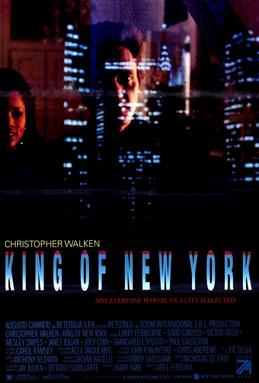


 Through the Shattered Lens