Since today is Friday the 13th, I decided to review a film called Scream….
No, not thatScream.
This Scream came out in 1981. It’s a slasher film but instead of featuring the usual collection of teenage victims, the victims in Scream are largely a collection of middle-aged tourists who are played a motely collection of former sitcom stars and western veterans. Even Ethan Wayne, the son of John Wayne, makes an appearance, playing a potential victim named Stan.
The film imagines what would happen if a bunch of tourists who were exploring the Rio Grande decided to spend the night in an apparently deserted ghost town. Speaking for myself, I would have never decided to sleep in a deserted town, especially one that isn’t even on a map. I mean, those places are called ghost towns for a reason. Even if they’re not haunted by ghosts, they are probably home to snakes, spiders, and all sorts of bugs. Considering that these people have camping gear with them, I’m not sure why they decided it would be smart to just sleep in an abandoned building. This is where the film’s use of adult victims really backfires. It’s easier to accept teenagers and 20-something doing something stupid. When it’s a bunch of people heading towards 40 and 50 (and even older in some cases), you can’t help but feel that they have no one but themselves to blame.
The murders begin on the first night. Needless to say, the survivors decide to find somewhere else to sleep but they discover that their rafts have been cut apart. They’re trapped in the town. Some of them leave to try to find a nearby ranch. Everyone else stays in the town and tries not to fall victim to the unseen killer.
And then Woody Strode shows up.
Oh, poor Woody Strode. Woody Strode was in his late 60 when he appeared in this film. In his youth, he was one of the first black men to play in the NFL. When he went into acting, he became a favorite of John Ford’s. In The Man Who Shot Liberty Valance, he was John Wayne’s best friend. In Sergeant Ruteledge, he had a rare lead role as man falsely accused of murdering a white woman. In Stanley Kubrick’s Spartacus, he was the gladiator whose defiant death sparked Spartacus’s rebellion. In Sergio Leone’s Once Upon A Time In The West, he was one of he gunmen waiting for Charles Bronson at the train station. Woody Strode had a long career and he broke a lot of barriers.
In Scream, Woody Strode plays Charlie, who claims that he’s spent forty years searching for the invisible killer who is currently terrorizing the tourists. It must be said that Strode gives the best performance in the film. He delivers his dialogue with a natural authority and, if you needed someone to defend you from an invisible killer with a scythe, Charlie is definitely who you would want to call. That said, Charlie wanders off for a good deal of the film. We never really find out where Charlie went off to. He returns eventually but not before the remaining survivors have managed to do several stupid things.
Scream is a pretty dull film, one that doesn’t even take advantage of its potentially atmospheric location. Watching it, one gets the feeling that everyone involved just made it up as they went along. It’s interesting to see a slasher film in which the victims are not a bunch of teenagers or camp counselors but otherwise, Scream is nothing to scream about.
In 1980’s Bronco Billy, Clint Eastwood plays Billy McCoy.
Billy is an aging cowboy, a trick-shooter who owns Bronco Billy’s Wild West, a traveling circus that has definitely seen better days. Bronco Billy and his friends travel the country, going from small town to small town and putting on a show. Billy is definitely the star and the highlight of each show is him shooting balloons and tossing a knife while his female assistant is strapped on a revolving disk. Unfortunately, Billy’s latest assistant flinches and gets a knife in her leg. Billy needs a new assistant and, wouldn’t you know it, Antoinette Lily (Sondra Locke) needs a job!
Antoinette is a runaway bride. She married John Arlington (Geoffrey Lewis), not because she loved him but because she needed to get married by the time she turned 30 or she would lose her inheritance. After the ceremony but before the wedding night, Antoinette fled. The police assume that John murdered her and promptly arrest him. John, suspecting that his wife is still alive, pleads insanity so that he can avoid the electric chair.
As Billy’s assistant, Antoinette challenges the way that Billy has always done the show, often to such an extent that you really have to wonder why she sticks around. Since this is a Clint Eastwood film, there a bar brawl where Billy rescues her from being assaulted by a couple of rednecks. Unfortunately, Antoinette’s arrival coincides with a string of accidents and other unfortunate incidents. The other members of the show start to suspect that Antoinette might be bad luck. Myself, I’m not superstitious and I don’t think that people can bring bad luck. I think people make their own luck. However, it’s hard to overlook the fact that Antoinette finds out that her husband is facing the death penalty due to her disappearance and her reaction is to basically shrug it off. Sondra Locke gives a rather flat performance was Antoinette, suggesting none of the quirkiness necessary to make her anything more than a very childish and very self-centered person. Antoinette is a role that demands the eccentricity of a young Sissy Spacek or Shelley Duvall or even Beverly D’Angelo, who did such a good job in Every Which Way But Loose. Sondra Locke gives a boring performance and it drags down the film.
That said, there is a lot to like about Bronco Billy. In many ways, this film feels like Clint Eastwood’s take on a Robert Altman film. The plot is episodic and casual and the best scenes are the ones the emphasize the members of the circus as being a family of misfits. (Indeed, one reason why Locke’s performance feels so jarringly wrong is because both she and Antoinette never seem to be interested in the other members of the show.) Billy may be their leader and their main attraction but every member of the show plays a role in keeping Billy’s Wild West alive. Scotman Crothers, Sam Bottoms, Bill McKinney, Dan Vadis, and Sierra Pecheur all give likable performances that bring the film’s world to life. The film becomes about more than just the aging Billy trying to find his place in a changing world. It’s a film about a group of people who have come together to form their own community and, by the end of the movie, it’s a community that you can’t help but love. In many ways, this film features both Eastwood the director and Eastwood the actor at his gentlest and most humanistic. Billy and his show bring the old west to a new America and, in the end, you’re happy they did.
In 1978’s Every Which Way But Loose, Clint Eastwood plays Philo Beddoe.
Philo’s an ordinary guy with beautiful hair and a way with throwing punches. He’s a truck driver. He enjoys a cold beer. He enjoys country music. He makes some extra money by taking part in bare-knuckle brawls. Everyone says that he could be the next Tank Murdock, a legendary fighter. Philo is just a simple, blue collar guy who lives in a small house, next door to his best friend Orville (Geoffrey Lewis) and Orville’s profanity-loving mother (Ruth Gordon). Philo also owns an orangutan named Clyde. He saved Clyde from being sent to live in a “desert zoo.”
(Actually, now that I think about it, most blue collar guys don’t own monkeys but whatever. Clyde’s cute and Eastwood’s Eastwood.)
When Philo meets a country singer named Lynn Halsey-Taylor (Sondra Locke), he is immediately smitten. When Lynn disappears and leaves Philo a cryptic note, Philo decides to go looking for her. Clyde, Orville, and Philo hit the road. Along the way, Orville meets and picks up a woman named Echo (Beverly D’Angelo). This is a road movie so, of course, Clyde, Orville, Philo, and Echo have their adventures on the way to Colorado. They end running afoul both a corrupt cop and a gang of buffoonish bikers. Philo enters a fight whenever they need money and one occasionally gets the feeling that Eastwood took this role to show off the fact that, for someone approaching 50, he still looked good without a shirt on. And good for him! Because, seriously, Clint does look good in this movie….
I have to admit that, for all of my attempts at sophistication, my roots are in the country and I’ve traveled down enough dirt roads that I find it hard to resist a good redneck story. And really, there aren’t many films that as proudly and unashamedly redneck than EveryWhich Way But Loose. It’s a film that has a laid back, take-it-as-it-comes vibe to it. Philo may be looking for Lynn but he seems to be okay with taking a few detour along the way. There’s no real sense of urgency to any part of the movie. Instead, EveryWhichWay But Loose was made for people who like a cold beer at the end of the day and who find Ruth Gordon to be hilarious when she curses. Myself, I don’t drink. That’s one part of the country lifestyle that passed me over. But I did enjoy seeing Ruth Gordon cuss out the Nazi biker gang.
Eastwood, Lewis, and D’Angelo have a likable chemistry and the monkey’s cute. Unfortunately, Sondra Locke isn’t particularly well-cast in the role of Lynn. (Considering that she was in a relationship with Eastwood, it’s amazing how little chemistry they have in this movie.) As I watched the film, it occurred to me that it probably would have worked better if Locke and D’Angelo had switched roles. Locke’s character is supposed to be a femme fatale type but she gives a boring performance and, as a result, the revelation that Philo has misjudged her doesn’t really carry any emotional weight.
That said, this film features some beautiful shots of the wilderness, a charming romance between Lewis and D’Angelo, and a shirtless Clint Eastwood beating folks up. That’s more than enough to please this secret country girl.
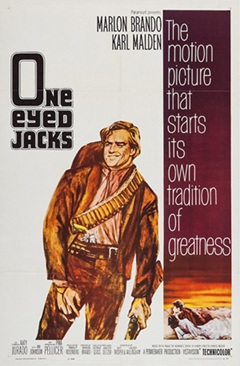
Rio (Marlon Brando), a young outlaw in the Old West, is betrayed by his partner and mentor Dad Longworth (Karl Malden) and ends up spending five years in a Mexican prison. When Rio escapes, he gets together a new gang and heads for Monterey, California. He wants to both get his revenge on Longworth and also rob the local bank. Things get complicated when Rio actually confronts Longworth and suddenly realizes that he can’t bring himself just to gun the man down in cold blood. Rio is not as ruthless of an outlaw as he thought he was.
However, Rio then meets and falls in love with Louisa (Pina Pellicer), Longworth’s stepdaughter Longworth is willing to do whatever he has to keep Rio away from Louisa and, when Rio starts to think about going straight in an effort to win Louisa’s love, his new gang turn out to be even less trustworthy than his old partners.
A teenage rebellion film disguised as a western (and it’s not a coincidence that the main bad guy is named Dad), One-Eyed Jacks was Marlon Brando’s only film as a director. The film was originally meant to be directed by Stanley Kubrick, who was working from a script written by a once-in-a-lifetime combination of Rod Serling and Sam Peckinpah. Kubrick and Brando worked together to develop the film, with Brando insisting on Karl Malden as Dad. (Kubrick wanted to cast Spencer Tracy.) Ultimately realizing that working on One-Eyed Jacks would mean essentially taking orders from his star, Kubrick stepped down from directing so he could focus on Lolita and Brando took over as director. The film finally went into production in 1958 and would not be released until 1961. Brando’s perfectionism was blamed for the film going massively overbudget and, when it was finally released, One-Eyed Jacks was the first of Brando’s films to lose money. The combined box office failures of One-Eyed Jacks and the remake of Mutiny on the Bounty left Brando in the cinematic wilderness for much of the 60s.
As for the film itself, One-Eyed Jacks takes what should have been a simple story and attempts to turn into an epic. Rio spends a good deal of time brooding and the film seems to brood right along with him. What starts out as a western becomes a forbidden love story as Rio and Louisa fall for each other. Dad Longworth may be an outlaw-turned-sheriff but Malden plays him more as a possessive father who can’t handle that his two stepchildren — Rio and Louisa — are both turning against him and his strict rules. Brando obviously viewed the film as being something bigger than a standard western. Sometimes, his direction works and he does manage to get the epic feel that he was going for. Other times, the film itself seems to be unsure what direction it wants to go in telling its story. This is method directing.
Ultimately, One-Eyed Jacks is an interesting experiment, one that doesn’t really work but which still features Charles Lang’s outstanding cinematography and one of Karl Malden’s best performances. As Brando’s only directorial effort, the film is a curiosity piece, one that will be best enjoyed by western fans who have the patience for something a little different. And, for what it’s worth, based on the film’s visual beauty and the performances that he gets from the cat, I think Brando could have developed into a fine director with a little more experience. However, it was not to be.
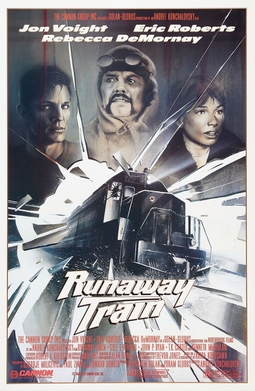
In 1985’s Runaway Train, Eric Roberts plays Buck McGeehy, a prisoner at Stonehaven Maximum Security Prison in Alaska.
Like the majority of the prisoners, Buck looks up to Manny (Jon Voight), a bank robber who has just been released from spending three years in solitary confinement. Manny is a tough guy who refuses to allow the prison system to beat him down. Warden Ranken (John P. Ryan) views Manny as being a threat to his authority and he’s especially angry that it was the courts that ordered that Manny finally be released from solitary. When Ranken tries to arrange for Manny to be assassinated at a prison boxing match, it’s Buck who saves Manny’s life. When Manny later manages to escape from the prison, Buck tags along.
Manny and Buck are a study in contrasts. Manny is as cold as the Alaskan landscape. He’s ruthless and doesn’t allow himself to get too close to anyone but, at the same time, he does live by a definite code. Buck is simple-minded, an earnest guy who talks too much and who probably wouldn’t have survived a day in prison if it wasn’t for his skill as a boxer. Buck and Manny manage to make their way across the frozen wilderness but, when they hop on a train, they soon find themselves trapped on the out-of-control locomotive, along with a railroad engineer named Sara (Rebecca De Mornay). The three of them have to find a way to either escape from or stop the train. At the same time, the obsessed Warden Ranken is determined to recapture Manny and, if that means flying a helicopter over the train so that Ranken can lower himself onto it, so be it.
Runway Train, which was based on a script by Akira Kurosawa, was one of the few Cannon films to find success with not just critics but also audiences and the industry. The Golden Globes nominated it for Best Film. The Academy didn’t go quite that far but they did nominate the film for Best Editing, along with also nominating Jon Voight for Best Actor and Eric Roberts for Best Supporting Actor. While Voight is a multiple-Oscar nominee (and one-time winner for Coming Home), Runaway Train is, so far, the only film for which Eric Roberts has been nominated. (He should have been nominated for Star 80 but his character in that film was a bit too realistically sleazy for the Academy to honor.) Roberts has described Runaway Train as being one of his favorite films and he even used the title for his autobiography. It was on this film that he met Danny Trejo, who not only trained Roberts for the boxing scenes but also helped Roberts kick his addiction to cocaine.
And Roberts has every reason to be proud. Runaway Train is a fast-moving, visually stunning thrill ride, a masterpiece of the pulp imagination. Yes, the symbolism of the runaway train is a bit obvious. Yes, the philosophical edge of the film’s dialogue can sometimes feel a bit out-of-place. Who cares? John Voight and Eric Roberts sell their characters with such skill that you don’t care that they’re both criminals who have done terrible things. From the minute we see that frozen jail and the prisoners tossing burning pieces of paper at the guards, we know why both Manny and Buck have to escape. John P. Ryan turns the warden into everyone’s worst nightmare of a small, pretty man with power, an authoritarian who uses the system to control the lives of others and who resents anyone who does not bow down before him. Even though her role is largely limited to reacting to what everyone else does around her, Rebecca de Mornay still turns Sara into a compelling character and never allows her to become merely a damsel in distress. Runaway Train is a heart-pounding action film and one that still holds up today.
Previous Eric Roberts Films That We Have Reviewed:
In this B-western, Johnny Mack Brown plays Chip Bennett, the foreman of the Flying U Ranch. The ranch is owned by J.G. Whitmore (Forrest Taylor) and his daughter (Doris Weston), who has just returned from college and who has eyes for Dusty (Bob Baker), a singing ranchhand.
Ed Duncan (Anthony Warde) and his gang are in the arms smuggling business. To make their business a success, they need access to the ranch, which sits on the shore of a lake. Knowing that Chip would never let them take over, Duncan tries to frame Chip for a bank robbery and murder. Chip responds by kidnapping two of Duncan’s men, leading to a final and explosive shootout.
Chip of the Flying U is a western that doesn’t seem to know what era it’s supposed to be taking place in. Chip, Duncan, and all of the other ranch hands dress like they’re in the late 1800s. Doris Weston dresses like she’s just stepped out of a 1930s photoshoot. Duncan is trying to smuggle hand grenades, which were invented in 1908 but not commonly used until World War I. The movie’s time period is all over the place but that was frequently the case with the B-westerns of the 30s. Shot on studio backlots and for a very low budget, these films were not concerned with historical accuracy. Instead, they were about shootouts and a few songs. Chip of the Flying U offers up both, along with Fuzzy Knight as the comedic sidekick who turns out to be very good with a rifle.
With lots of horse chases and bloodless shoot-outs and not too much romance, this movie may seem creaky by today’s standards but probably thrilled the kids who caught while spending an afternoon at the movies in 1939. Today, the appeal of movies like this is that the good guys are unquestionably good and the bad guys are unquestionably bad. They remind us of a simpler time that may have never existed but we all hope it did.
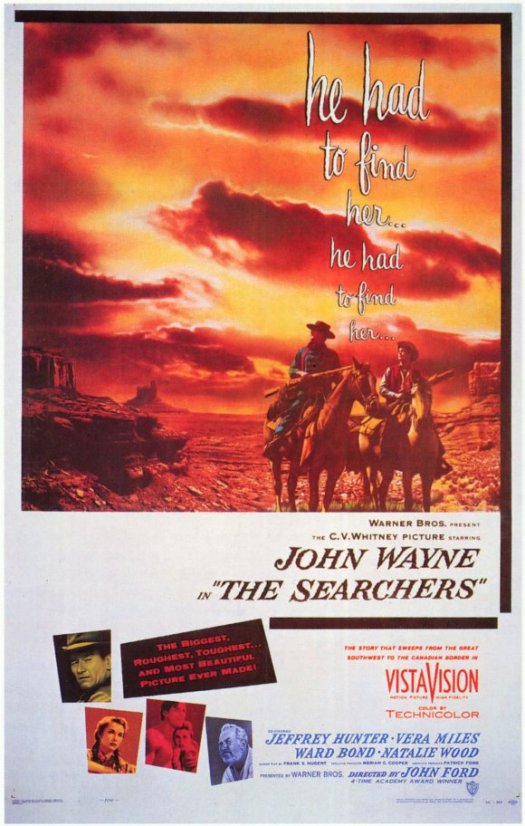
John Ford’s THE SEARCHERS is without question an American Film Classic. I’d even go as far as saying it’s my second all-time favorite film, directly behind CASABLANCA. Every shot is a Remington Old West masterpiece, every actor perfect in their role, large or small, and not a minute of footage is wasted. The film has also stirred up quite a bit of controversy over time for John Wayne’s portrayal of the main character Ethan Edwards.
The plot is structured like Joseph Campbell’s “Hero’s Journey”, but let’s get it out of the way right now: Ethan Edwards is no hero. He’s a mean, bitter, unreconstructed Confederate who’s been on the shady side of the law since war’s end. When he returns to his brother Aaron’s homestead, he makes no bones about his distaste for “half-breed” Martin Pawley (really an eighth Cherokee). His hatred of Native Americans even extends to their dead, as…
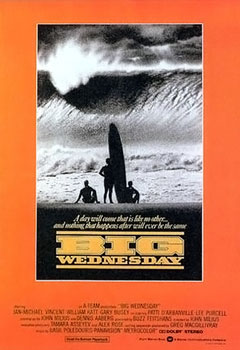
If there is a male bonding hall of fame, Big Wednesday has to be front and center.
This episodic movie follows three legendary surfers over twelve years of change and turmoil. Jack Barlowe (William Katt) is the straight arrow who keeps the peace. Leroy “The Masochist” Smith (Gary Busey) is the wild man. Matt Johnson (Jan-Michael Vincent) is the best surfer of them all but he resents both his fame and the expectation that he should be some sort of role model for the younger kids on the beach. From 1962 until 1974, the three of them learn about love and responsibility while dealing with cultural turmoil (including, of course, the Vietnam War) and waiting for that one legendary wave.
After writing the screenplays for Dirty Harry and Apocalypse Now and directing The Wind and The Lion and Dillinger, John Milius finally got to make his dream project. Big Wednesday was based on Milius’s own youth as a California surfer and he has said that all three of the main characters were based on different aspects of his own personality. Expectations for Big Wednesday were so high that Milius’s friends, George Lucas and Steven Spielberg, exchanged percentages points for Star Wars and Close Encounters of The Third Kind for a point of Big Wednesday. The deal turned out to be worth millions to Milius but nothing to Lucas and Spielberg because Big Wednesday was a notorious box office flop. Warner Bros. sold the film as a raunchy comedy, leaving audiences surprised to discover that Big Wednesday was actually, in Milius’s words, a “coming-of-age story with Arthurian overtones.”
I can understand why Big Wednesday may not be for everyone but it is one of my favorite movies. It is one of the ultimate guy films. Some of the dialogue and the narration may be overwrought but so are most guys, especially when they’re the same age as the surfers in Big Wednesday. We all like to imagine that we are heroes in some sort of epic adventure. The surfing footage is amazing but it is not necessary to be a surfer to relate to the film’s coming-of-age story or its celebration of the enduring bonds of friendship. Katt, Vincent, and Busey all give great performances. Considering their later careers, it is good that Big Wednesday is around to remind us of what Gary Busey and Jan-Michael Vincent were capable of at their best, before their promising careers were derailed by drugs and mental illness. Be sure to also keep an eye out for infamous 70s character actor Joe Spinell as an army psychiatrist, a pre-Nightmare on Elm Street Robert Englund, playing a fellow surfer and providing the film’s narration, and Barbara Hale, playing the patient mother of her real-life son, William Katt.
One final note: At a time when the shameful stereotype of the psycho Vietnam vet was becoming popular and unfairly tarnishing the reputation of real-life vets, Big Wednesday was unique for featuring a character who not only joins the Army but who appears to return as a better person as a result.
(You know how, when watching a classic movie or TV episode, you’ll spot someone in a small part and say, “Hey, I know that guy (or gal)? This new series will shine the spotlight on those unsung heroes of the Golden Age, the supporting actors we all know and love!)
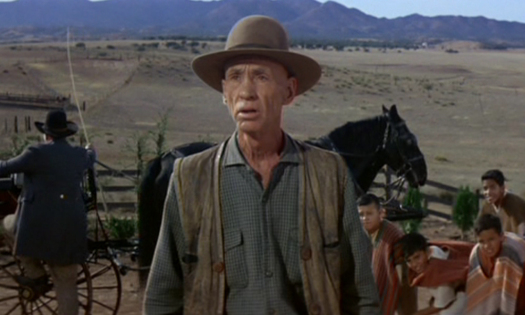
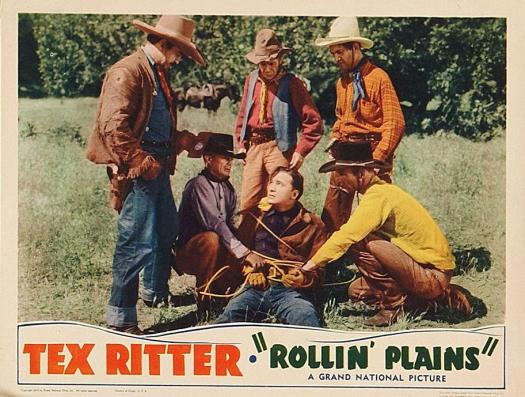
There’s no mistaking Hank Worden for anyone else in films. The tall, bald, lanky, soft spoken old codger with a face like a buzzard graced the screen with his presence in 170 features and numerous TV episodes, sometimes uncredited but always recognizable. He was a member in good standing of the John Ford/John Wayne Stock Company, worked with everyone from Howard Hawks and Clint Eastwood to Ma & Pa Kettle and Sonny & Cher, and even starred in a documentary about his life and career. Not bad for an old buzzard!
Hank (right) ties up Tex Ritter in 1938’s “Rollin’ Plains”
— Dale Cooper (Kyle MacLachlan) in Twin Peaks 2.22 “Beyond Life and Death”
“The Log Lady stole my truck!”
— Pete Martell (Jack Nance), same episode
“Some of your friends are here.”
— The Man From Another Place (Michael Anderson), same episode
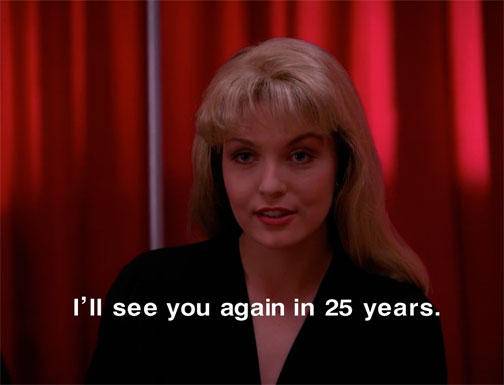
“I’ll see you again in 25 years.”
— Laura Palmer (Sheryl Lee), same episode
Here we are.
Starting exactly one month ago, we started our Twin Peaks recaps. I handled some, Leonard handled some, and Jeff handled some. Gary added a post on David Lynch’s first three short films. Val shared music videos that were either inspired by Lynch or directed by Lynch himself. Jeff devoted his Movie a Day posts to reviewing films that all had a Twin Peaks connection. As Leonard put it on twitter, projects are fun and I know we certainly had a lot of fun putting all of this together.
But, all good things must come to an end and, at least until the third season premieres on Showtime later this month, we have reached the end of Twin Peaks. Episode 30 brought the story to a temporary end. (The movie, Twin Peaks: Fire Walk With Me, was a prequel about the last days of Laura Palmer. It’s a haunting film and one that we’ll look at tomorrow but, at the same time, it doesn’t offer up any answers to any of the questions that the finale left hanging.)
A little history: Twin Peaks was a huge success during its first season but, during the second season, ratings plunged. According to the book, Reflections: An Oral History of Twin Peaks by Brad Dukes, neither David Lynch nor Mark Frost were as involved during the second season as they had been during the first. As compared to the genuinely unsettling first season, the second season struggled to find its voice. Was it a mystery? Was it a broad comedy? Was it a show about the paranormal or was it a soap opera? It was all of that and, for many people, that was too much. Today, of course, audiences are used to quirkiness. They’re used to shows that straddle several different genres. It’s no longer a revolutionary idea to be openly meta.
But in 1991, Twin Peaks was the show that ABC both didn’t know what to do with and, by the end, didn’t really want. It was regularly moved around the schedule and, often, weeks would pass without a new episode. Consider this: nearly two months passed between the airing of The Path to the Black Lodge and the final two episodes of the show. (Miss Twin Peaksand Beyond Life and Death were both aired on June 10th, 1991.)
For the final episode, David Lynch returned to direct and, though hardly anyone saw it when it originally aired, it’s an episode that left such an impression that — 25 years later — Showtime agree to bring the series back. The third season of Twin Peaks will premiere later this month but until then, let’s go ahead and recap Beyond Life and Death.
One last time, we open with Angelo Badalamenti’s beautiful theme music and those haunting shots of Twin Peaks.
We start at the sheriff’s station, with Lucy (Kimmy Robertson) and Andy (Harry Goaz) having a moment. Lucy talks about how scared she was when the lights went out and then says she found herself wondering what would happen if they were stuck in an elevator in the hospital and she went into labor. Andy replies that, if that happened, he would deliver the baby “in front of God and everyone.” Awwwww!
In Harry’s office, Cooper (Kyle MacLachlan) and Hawk (Michael Horse) stare at the cave drawing while Harry (Michael Ontkean) says that he has deputies in three counties looking for Windom Earle. Windom appears to have vanished. Cooper replies that the only hope they have of finding Windom and Annie is in the map.
“Fire walk with me,” Cooper says, softly, “Fire walk with me.”
Pete (Jack Nance) steps into the office and announces that the Log Lady stole his truck. I love the way that Jack Nance delivers the line, “The Log Lady stole my truck!” (Sadly, Nance was murdered just a few years after the end of Twin Peaks.) Pete says that, when last seen, the Log Lady was driving into Ghostwood Forest.
“Pete,” Cooper announces, “the Log Lady did not steal your truck. The Log Lady will be here in one minute.”
“12 rainbow trouts in the bed,” Pete says.
This triggers Harry’s memory. He announces that there is a circle of 12 sycamores in Ghostwood Forest. It’s called Glastonbury Grove. Hawk says that Glastonbury Grove is where he found the pages from Laura’s diary. Cooper suddenly says, “That’s the legendary burial place of King Arthur! Glastonbury!”
“King Arthur is buried in England,” Pete says, dismissively, “Last I heard anyway.”
Right on time, The Log Lady (Catherine E. Coulson) shows up at the office.
“Where’s my truck?” Pete demands.
“Pete, Windom Earle stole your truck,” Cooper says.
Pete looks very confused. Jack Nance really acted the Hell out of this scene. (Interestingly enough, Catherine Coulson was, in real life, Nance’s ex-wife.)
The Log Lady ignores Pete. She has a jar of oil that she hands to Cooper. The Log Lady says that her husband claimed that the oil was the opening to a gateway. Everyone agrees that it smells like scorched engine oil. Cooper has Hawk bring in Ronette Pulaski (Phoebe Augustine), who says that she smelled the oil the night that she was attacked and Laura Palmer was killed.
Out in the woods, a pickup truck comes to a stop in front of Glastonbury Grove. Inside the truck, Windom Earle (Kenneth Welsh) forces Annie (Heather Graham) to look at the 12 rainbow trout in back. Annie tells Windom that, if he’s going to kill her, to go ahead and get it over with. Windom says that there is plenty of time for that but, right now, he is enjoying the fear that he is feeling.
(After being portrayed in far too cartoonish a manner over the past few episodes, Windom is finally menacing again. For that matter, this is the first — and, as fate would have it, the only — episode where Heather Graham seems to be truly committed to her role as Annie. This episode directly challenges anyone who thinks that David Lynch is merely a visual artist who can’t direct actors.)
As Annie recites Psalm 141, Windom drags her through the woods. Windom shoves her into the the middle of the grove.
“I tell you, they have not died,” Windom recites, “Their hands clasp, yours and mine.”
Suddenly, in the middle of the woods, the red curtains appears. Windom leads the now zombified Annie through them.
At the Hurley House, Doc Hayward (Warren Frost) is looking over the heavily bandaged Mike (Gary Hershberger) and Nadine (Wendy Robie). Meanwhile, Ed (Everett McGill) is cheerfully talking to Norma (Peggy Lipton) by the fire place. (I like the fact that, with everything that’s going on, Ed and Norma are just happy to be together.) Just as Ed and Norma start to dance, Nadine suddenly gets her memory back and starts to shout about silent drape runners. Nadine demands that Ed make everyone go away.
At the Hayward house, Eileen (Mary Jo Deschanel) sits in her wheelchair and stares at Ben Horne (Richard Beymer). Donna (Lara Flynn Boyle) comes walking down the stairs, carrying a suitcase. Eileen begs Donna not to leave but Donna starts screaming about not knowing who her parents are. Ben steps forward and apologizes. He says he only wanted to do good. He wanted to be good. He says that it felt good to finally tell the truth.
Doc Hayward arrives home and is not happy to see Ben. Ben is begging for forgiveness when, suddenly, his own wife (Jan D’Arcy) comes walking through the front door. She demands to know what Ben is trying to do to their family.
Donna looks at Doc Hayward and starts to chant, “You’re my Daddy! You’re my Daddy!” Eileen looks away, which is a polite way of saying, “No, Ben’s your Daddy and you’ve got a half-sister that everyone likes more than you.”
Ben tries to apologize again and, after 29 episodes of never losing his temper, Doc Hayward finally snaps and punches Ben. Ben falls back and hits the back of his head on the fireplace! Oh my God! Is Ben dead!? Is Doc Hayward now evil!?
(I know the answer but I’m not going to tell you until the end of this review.)
At the Martell House, Andrew (Dan O’Herlihy) is all excited because he’s figured out that the key is the key to a safety deposit box. He steals the key from the pie plate and replaces it with a duplicate. However, Pete steps into the room just in time to see Andrew doing it.
In the woods, Cooper and Harry come across the abandoned truck. They walk into the forest but Cooper suddenly announces that he must go alone. Cooper takes Harry’s flashlight and walks through the forest. Eventually, he hears the hooting of an owl and comes across Glastonbury Grove. Cooper steps into the circle and the red curtains appear. As Harry watches from a distance, Cooper steps though the curtains.
(Though it may just be coincidence, the red curtains always make me think about the opening of Dario Argento’s Deep Red.)
Cooper finds himself in the red curtained hallways. He walks until he reaches the room from his dreams. As the lights stobe, the Man From Another Place (Michael Anderson) dances while a lounge singer (Jimmy Scott) sings about Sycamore Trees. The Man From Another Place eventually hopes into a velvet chair. It’s deeply unsettling to watch because we know that, behind one of those curtains, BOB is lurking.
In the forest, Andy finds Harry. They sit outside of Glastonbury Grove and wait for Cooper to return.
Morning comes. We get a few final shots of the countryside around Twin Peaks. The mountains. The bridge where, 29 episodes ago, Ronette Pulaski was discovered battered and nearly catatonic. The forest. The countryside was beautiful when we first saw it but, after spending 31 hours in the world of Twin Peaks, it is now impossible to look at that wilderness without wondering what secrets are being concealed beneath the tranquil surface.
Harry and Andy are still sitting outside of Glastonbury and there is something truly touching about the sight of these two friends loyally waiting for their third friend to return. Andy volunteers to go to diner to get them breakfast. Harry says, “Yes.” Andy lists off all of the usual Twin Peaks food. Coffee. Pancakes. Desert. “Yeah,” Harry replies. When Andy finally asks if Harry wants pie, Harry falls silent. How can anyone eat pie with Cooper missing?
Meanwhile, at the bank — OH MY GOD! YOU MEAN WE’RE NOT GOING TO THE BLACK LODGE TO FIND OUT WHAT’S GOING ON WITH COOPER YET!? — an old lady sleeps at the new accounts desk. (It’s a very Lynchian image, to be honest.)
Audrey Horne (Sherilyn Fenn) comes in and says hello the elderly bank president, Mr. Mibbler (Ed Wright). Mibbler is really happy to see Audrey, even after she explains that she is going to be chaining herself to the vault as a part of her environmental protest. For whatever reason, almost all of David Lynch’s film features at least one elderly character who moves slowly and is utterly clueless about the world around them. Mr. Mibbler is certainly a part of that tradition.
(Speaking for myself, I like the way that the scene in the bank is shot and acted but it still frustrates me that, during the 2nd season, Twin Peaks could never quite figure out what to do with Audrey. When Kyle MacLachlan vetoed any romance between Cooper and Audrey, it pretty much destroyed Audrey’s storyline. To make us believe that Cooper and Audrey could actually fall in love with other people, the writers kept Cooper and Audrey from interacting and, as a result, it often seemed that Audrey was trapped in another, rather less interesting show. While Cooper investigated the Black Lodge and Windom Earle, Audrey was stuck playing Civil War with her father and improbably falling in love with John Justice Wheeler. Even in the finale, Audrey mostly serves as a distraction from the show’s main storyline. The character deserved better.)
Andrew and Pete show up at the bank. Mibbler is shocked to see that Andrew is still alive but Andrew is more concerned with opening up that deposit box. It takes Mibbler a while to find the box but when he does, he promptly opens it. What’s inside the box? Well, there’s a note from Thomas that read, “Finally got you, Andrew. Love, Thomas.” And there’s a bomb, which promptly explodes.
Oh my God, is Audrey dead!? Well, the episode never reveals who died or survived in the bank. However, having looked through the recently published The Secret History of Twin Peaks, I know the answer and I will reveal it at the end of this review.
At the Double R, Major Briggs (Don S. Davis) and Betty (Charlotte Stewart) are sharing a booth and, as opposed to the way they were portrayed all through the first season, they appear to be very much (and very playfully) in love.
At the counter, Bobby (Dana Ashbrook) watches his parents making out and then turns to Shelly (Madchen Amick.) He asks her to marry him. Shelly mentions that she’s still married to Leo and then she and Bobby start going, “Arf! Arf! Arf!,” which is a strangely cheerful callback to the way that Bobby and Mike taunted James Hurley at the end of the pilot. Bobby says that Leo is up in the woods, having the time of his life. A jump cut quickly reminds us that Leo is actually up in the woods trying to keep a bunch of tarantulas from falling down on his head.
Suddenly, Dr. Jacoby (Russ Tamblyn) and Sarah Palmer (Grace Zabriskie) step into the diner. They walk right over to Maj. Briggs. Dr. Jacoby says that Sarah has a message for him, one that she felt was very important. Speaking in the distorted voice of Windom Earle, Sarah says, “I am in the Black Lodge with Dale Cooper. I’m waiting for you.”
And here is where the finale basically goes insane. Seen today, the final 20 minutes of this episode remain genuinely unsettling and often rather frightening. I can only imagine how audiences reacted in 1991. I did a little research (which is a fancy way of saying that I looked on Wikipedia) and, believe it or not, the top-rated television show in 1991 was 60 Minutes. Needless to say, the finale of Twin Peaks was about as far from 60 Minutes as you could get.
In the Black Lodge, Cooper still sits in the room with red curtains. The Man From Another Place tells him, “When you see me again, it won’t be me.” The Man From Another Place explains that the room with red curtain is a waiting room. (Purgatory, perhaps?)
“Some of your friends are here,” The Man From Another Place continues.
Laura Palmer (Sheryl Lee), dressed in black, walks in and sits down beside The Man From Another Place. “Hello Agent Cooper,” she says, speaking backwards. “I’ll see you again in 25 years. Meanwhile.” Laura vanishes.
(The 25 years explains why, way back in the third episode, Cooper appeared to be a much older man in his dream. It’s also interesting to note that, later this month, the 3rd season of Twin Peaks will air roughly 25 years after the 2nd season ended.)
Suddenly, the room service waiter (Hank Worden) appears with a cup of coffee. “Hallelujah,” he says. “Hallelujah,” the Man from Another Place agrees.
The waiter places on a table next to Cooper. Suddenly, the waiter is gone and the Giant (Carel Struycken) stands in his place. The Giant sits down next to The Man From Another Place.
“One and the same,” he says.
(Even though I know what’s going to happen, watching this scene still makes me nervous. The Giant, the Waiter, and The Man From Another Place are the only friends that Cooper has in the Black Lodge. Once the Giant leaves, who will be the next to come out?)
The Giant vanishes. The Man From Another Place rubs his hands together and gets a sinister little smile on his face. As he has done so many times since the series began, Cooper attempts to drink his coffee but discovers that it is now frozen solid. Suddenly, it’s not frozen and it pours out of the cup. Then, just as suddenly, it’s thick and only slowly dribbles out when Cooper tips the cup.
“Wow, BOB, wow,” the Man From Another Place says. He looks directly at the camera and says, his voice now much more rougher, “Fire walk with me.”
It’s an incredibly unsettling moment in an already unsettling episode. By this point, we all know what “Fire walk with me” means.
There’s an explosion. A woman (Laura or Annie?) screams. The lights start to strobe. Cooper walks out of the room and finds himself, once again, in the hallway. Having heard the scream and knowing what BOB did to Ronette, Laura, Maddy, and countless others, it is a coincidence that the only decoration in the hallway is a reproduction of the Venus de Milo, a beautiful woman who does not have the arms necessary to protect herself? As well, it is surely not a coincidence that the Black Lodge could just as easily pass for an “exclusive” section of One-Eyed Jack’s.
Cooper steps through another set of curtains and finds himself in a second room, one that looks just like the first room except that it’s deserted.
Cooper returns to the first room where The Man From Another Place snaps, “Wrong way!”
Cooper goes back to the second room. At first, it appears to be deserted but suddenly The Man From Another Place appears, laughing maniacally. “Another friend!” he says and suddenly, Maddy Ferguson (Sheryl Lee), dressed in black much like Laura, steps into the room. “Watch out for my cousin,” she says and then vanishes.
Cooper returns to the first room, which is now deserted.
Suddenly, the Man From Another Place appears beside him.
“Doppleganger,” the Man says.
Laura, her eyes white, suddenly stands in front of Cooper. “Meanwhile,” she says.
Suddenly, Laura screams and the lights start to strobe again. Still screaming, Laura charges at Cooper. Cooper runs from the room and suddenly, finds himself in the Black Lodge’s foyer. He realizes that, like all of Windom Earle’s victims, he has been stabbed in the stomach. Cooper staggers back into the hallway and, following a trail of bloody footprints, he returns to the second room.
In the room, he sees himself lying on the floor next to Caroline Earle (Brenda E. Mathers). Like Cooper, Caroline has been stabbed. Suddenly, Caroline sits up and … IT’S ANNIE! Cooper calls out her name but suddenly, the bodies disappear and the strobe lights start again.
Calling Annie’s name, Cooper returns to the first room. Annie is waiting for him. “Dale,” she says, “I saw the face of the man who killed me. It was my husband.”
“Annie,” Dale says.
“Who is Annie?”
Suddenly, Annie is a white-eyed Caroline and then she transforms into the still shrieking Laura. Laura turns into Windom Earle. As Cooper and Windom stare at each other, Annie materializes and then vanishes again. Windom says that he will set Annie free but only if Cooper gives up his soul.
“I will,” Cooper says and, for the first time, Cooper’s voice is now as distorted as all the other inhabitants of the Black Lodge.
Windom stabs Cooper in the stomach and suddenly, there’s another explosion. The strobe lights start again and Windom is screaming for help. Cooper, no longer wounded, sees that BOB (Frank Silva) has grabbed Windom. Windom screams and BOB snaps, “BE QUIET!”
(As scary as BOB is, it’s undeniably satisfying to see Windom Earle finally not in control.)
BOB tells Cooper to go. Windom, BOB explains, is wrong. “He can’t ask for your soul. I will take his!”
Windom screams as BOB literally rips his soul out of his head. Finally, Windom falls silent. As BOB continues to laugh, Cooper runs from the room. Suddenly, someone else comes running through the room and — OH NO! IT’S A DOPPELGANGER COOPER AND WOW, IS HE ACTING WEIRD!
Cooper walks through the hallway when suddenly, Leland Palmer (Ray Wise) steps out from behind a curtain. His hair is brown again but his eyes are now white. Leland smiles and says, “I did not kill anybody.”
Doppelganger Cooper appears and chases after the real Cooper. They run through the Black Lodge until Doppelganger Cooper manages to grab the real Cooper.
BOB appears and stares straight at the camera. AGCK!
Suddenly, at Glastonbury Grove, the curtains appear. Night has fallen again but Harry is still loyally sitting in the forest, waiting for Cooper’s return. When he sees the curtains, Harry runs into the circle of trees and finds the bodies of both Cooper and Annie.
Cut to the Great Northern. Cooper wakes up in bed, with Doc Hayward and Harry sitting beside him. Speaking in an oddly mechanical tone of voice, Cooper first says that he wasn’t sleeping and then asks, “How’s Annie?” Harry says that Annie is at the hospital and she’ll be okay.
“I need to brush my teeth,” Cooper says.
In the bathroom, Cooper squeezes an entire tube of toothpaste into the sink. He then rams his head into the mirror and, as the reflection of BOB stares back at him, he starts to laugh. “How’s Annie?” he mocking repeats. “How’s Annie?”
AGCK!
And, with that deeply unsettling turn of events, Twin Peaks came to a temporary end. This brilliantly directed episode ended with three cliffhangers. What happened to Ben? Who died at the bank? What happened to Dale Cooper?
I promised you answers to some of those question so, according to The Secret History of Twin Peaks, here they are:
Ben survived his injury.
At the bank, the bomb killed Mr. Dibbler, Andrew, and Pete. (Perhaps not coincidentally, both Dan O’Herlihy and Jack Nance died long before Showtime announced that it was reviving the show.) Audrey survived, largely because Pete shielded her with his body. Shaken by the violent death of both her brother and her husband, Catherine returned to Ben everything that he had signed over to her. Catherine became a recluse.
As for what happened to Dale — well, that’s question that we will hopefully get an answer to when Twin Peaks returns to Showtime on May 21st!
Well, that concludes our Twin Peaks recaps! Thank you everyone for reading and thank you, Jeff and Leonard, for going on this adventure with me!
Now, how about we all get some coffee and slice of cherry pie?


 If there is a male bonding hall of fame,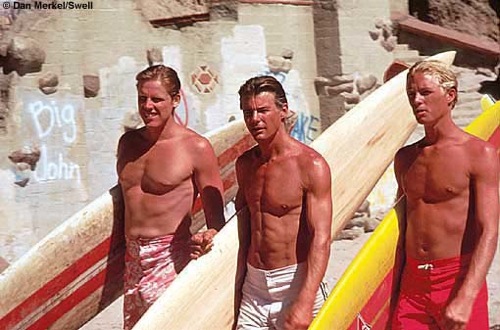


 Through the Shattered Lens