Happy Halloween to all of the readers and the visitors and the writers of The Shattered Lens!
Tag Archives: Halloween
October Music Series: Townes Van Zandt
Townes Van Zandt lived a troubled life, characterized by constant alcoholism, drug abuse, and failed relationships. He finally passed away of heart failure in a state of delirium tremens on January 1, 1997, at the age of 52, cryptically 44 years to the day after the death of perhaps his greatest influence, Hank Williams, under similar circumstances. As a song writer his music was inconsistent, but at his finest moments he tapped into his inner demons with an acute awareness that he was living more in dream than reality. He created his own folklore both in life and in song. The latter was quite deliberate, emerging sometimes from scratch and sometimes with attention to older legends. Narrated in the first person, always at night, bridging a gap between sleep and consciousness, he painted strikingly vivid images of personal confrontations with foul spirits and terrifying monsters physically imbued with emotional states which could never take on material form outside of a dream, or a song.
To call Spider Song a metaphor would do it a disservice. Of course it is about overcoming some inner demon, whatever that may be, and yes, through the battle against the spider we gain some insight into Van Zandt’s personal struggles, but that’s trivial. He’s not just beating that old dead horse again. The spider begins “in his dreams”, and at no point does it definitively leave them, yet the song is structured in such a way that Van Zandt’s dreams come to characterize more and more a real, physical monster encountered collectively by the narrator and the audience. What you get is a subtle transition from a nearly explicit metaphor (it’s in his dreams) to, by the end, momentary belief that a real, heroic, pitched battle against a giant spider is about to ensue. You don’t fully forget that the spider originated as a sort of representation of emotional states of fear, depression, or whatever you read into the first few stanzas of the song, but nevertheless here it stands, a menacing physical object. No, this song should not be regarded as a metaphor. Rather, our recognition of metaphor is employed to, over time, trick the senses into visualizing something supernatural.
Our Mother The Mountain is laden with hints at the supernatural from the outset: The woman’s esoteric claim to have come from her mother the mountain, her mysterious medallion, the refrain “singing tu-a-lu-ra-lai-o” with an emphasis on “lu-ra-lai”… “Lorelei”… The music feels like a dream, and the lyrics too, until the narrator stops observing the dream and tries to interact, reaching for her hand. The woman’s response is a manifest nightmare–a completely nonsensical appeal to pure foreboding terror captured in her physical actions. The narrator never sees her again, but he swears that it wasn’t just a dream, and as the listener you can’t help but believe him.
Spider Song
There is a spider in my dreams
Long and silent is his name
Cold as lightning is his smile
Final is his sting
His curse is deep as seven skies
Boys, I wouldn’t tell you lies
The legends say he never sleeps
and he’s never hungry long
He’s got us boys, I believe it’s true
But I’m fighting til he lays me down
Run his foul black body through
Cleave him all asunder
Think of your women, won’t you boys
Think of your mother growing old
Think about your darling son
Spit in the spider’s eye
Up at ease, against him ride
We’ll not take him by surprise
Give a scream down in your dreams
Let him know we’re coming
There is a spider in my dreams
Long and silent is his name
Cold as lightning is his smile
Final is his sting
Our Mother The Mountain
My lover comes to me with a rose on her bosom
The moon’s dancing purple all through her black hair
And her lady’s-in-waiting, she’ll stand ‘neath my window
And the sun will rise soon on the false and the fair
Singing tu-a-lu-ra-lai-o
She tells me she comes from My Mother The Mountain
And her skin fits her tightly, and her lips do not lie
She silently slips from her throat a medallion
Slowly she twirls it in front of my eyes
Singing tu-a-lu-ra-lai-o
I watch her, I love her, and I long for to touch her
The satin she’s wearing is shimmering blue
And outside my window her ladies are sleeping
My dogs are gone hunting; their howling is through
Singing tu-a-lu-ra-lai-o
So I reach for her hand, and her eyes turn to poison
And her hair turns to splinters, and her flesh turns to brine
She leaps ‘cross the room. She stands in the window
and screams that my first-born will surely be blind.
Singing tu-a-lu-ra-lai-o
Then she throws herself out to the black of the nightfall
She’s parted her lips, but she makes not a sound
I fly down the stairway and I run to the garden
No trace of my true love is there to be found
Singing tu-a-lu-ra-lai-o
So walk these hills lightly, and watch who you’re loving
By Mother The Mountain I swear that it’s true
And love not a woman with hair black as midnight
and a dress made of satin all shimmering blue
Singing tu-a-lu-ra-lai-o
My lover comes to me with a rose on her bosom
The moon’s dancing purple all through her black hair
And her lady’s-in-waiting, she’ll stand ‘neath my window
And the sun will rise soon on the false and the fair
Celebrate Halloween with Ms. 45!
Happy Halloween!
In honor of the holiday, here’s a Halloween-themed clip from one of the greatest films ever made — Ms. 45, the movie that proved that the Grindhouse is often more sincerely pro-woman than the mainstream.
(Big spoiler warning: This scene is actually the end of the film so if you’re the type of little toadsucker that’s always crying “You should have warned me boo hoo,” consider yourself warned.)
Song of the Day: Halloween Theme (by John Carpenter)
The penultimate choice for this week’s horror-themed “Song of the Day” feature brings one of the best theme songs ever composed and put on film. I am talking about the Main Title theme for John Carpenter’s classic horror film (also one of the best grindhouse films ever made) and one which launched a whole new horror subgenre with Halloween. This theme would become synonymous with the “slasher film” that when the many copies and imitators of the film came out in droves a year later they would try to replicate this keyboard synthesizer-based theme and fail miserably.
It’s actually a pretty simple theme. Carpenter composed the theme as a piano melody played in a 5/4 meter that even the most novice piano player could play with ease. This theme could be heard throughout the film whenever Michael Myers appears and/or in the vicinity. Some have even started calling it the Michael Myers theme and they wouldn’t be far off. It’s become the film’s leitmotif that Carpenter ends up relying on it to set the mood and tension in the film. Other kids of songs could be heard throughout the film but outside of the Blue Oyster Cult’s “Don’t Fear the Reaper” the rest of the score is forgettable until this theme kicks in.
This theme will be the final of the instrumental themes for the week. With one more day left in this special week-long horror-themed week for “Song of the Day” the last one will definitely usher in another awesome Halloween and help kick off the premiere of what will probably be the best thing to ever grace the tv screen past, present and future.
The Daily Grindhouse: Halloween (dir. by John Carpenter)
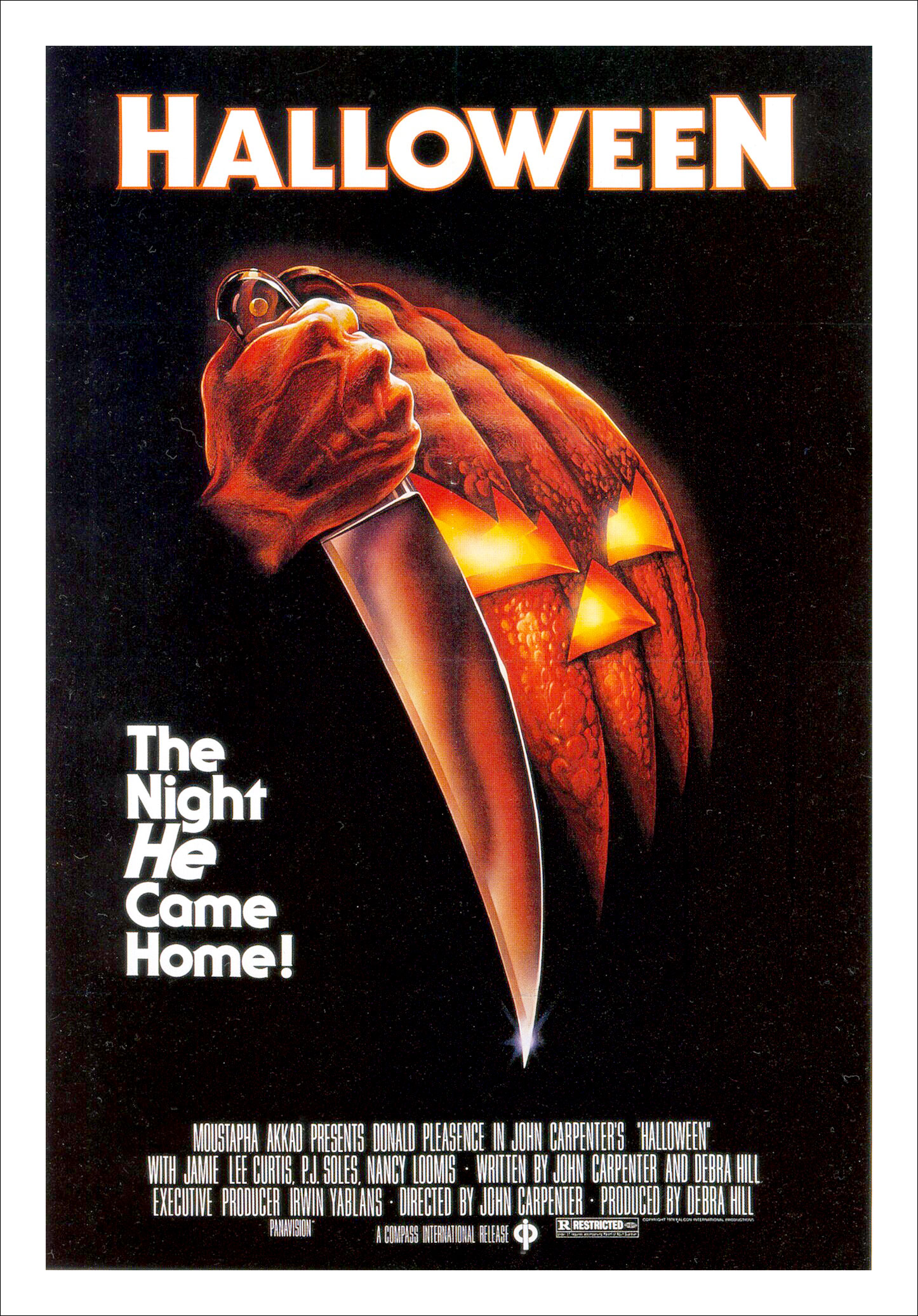
What better way to bring back a new daily grindhouse than the film which started the teen slasher genre. I speak of John Carpenter’s Halloween.
The film was truly a child of 1970’s independent filmmaking. With a budget of just $320,000 (even adjusting for inflation it’s still quite low) Carpenter made what’s considered one of horror’s defining films. Carpenter’s film was a smash hit when it was released in 1978. It played mostly in drive-in’s, grindhouse cinema houses before finally appearing in more mainstream venues. By then the film had become one of those must-see titles that many films both independent and mainstream try for but fail to do.
Some have commented that since Halloween was such a success in the box-office then it shouldn’t be considered grindhouse. I look at such thinking as quite narrow. Grindhouse was never synonymous with bad filmmaking. If one said the term meant cheap filmmaking then I would agree. Carpenter’s film has all the trappings of what makes a great grindhouse. It’s violent (though it really has less blood than what audience really remember) and uses sex as a storytelling tool (again the sex is quite chaste compared to later teen slashers).
While some film historians credit Hitchcock’s Psycho as the granddaddy of the slasher genre it wasn’t primogenitor of the teen slasher subgenre which has become an industry onto itself since Carpenter’s breakthrough hit. A hit that set many of the basic rules of teen slasher horror for decades to come. We get the nigh-unstoppable killer who seems more like a force of nature than human. The notion that teenage girls who have premarital sex will die horribly because of it while the chaste and virginal girl survives and inevitably stops the killer (until the subsequent sequel that is).
Halloween is grindhouse through and through. The fact that Carpenter’s obvious talent and skill as a director, editor, film composer and cinematographer shouldn’t DQ this film from being called grindhouse.

