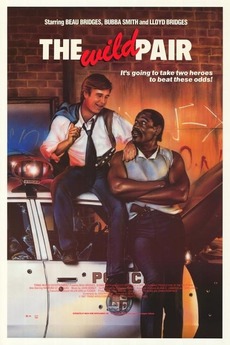
A police detective named Benny Avalon (Bubba Smith) and an FBI agent named Joe Jennings (Beau Bridges) are assigned to work together to take down a drug dealer named Ivory Jones (Raymond St. Jacques). Avalon and Jennings don’t immediately get along. Avalon is tough and streetwise while Joe is a good example of what used to be called a yuppie. When they discover that Ivory is connected to a white supremacist gang led by Col. Hester (Lloyd Bridges), Avalon and Jennings have to set aside their differences and work together.
TheWildPair starts out as a standard buddy cop film until things take a sudden serious turn and it instead becomes a violent and blood-soaked revenge thriller. It tries to mix comedy and action in the style of BeverlyHillsCop but it doesn’t work. BeverlyHillsCop understood that you could only take the violence so far without losing the laughs. TheWildPair has the bad guys killing several innocent (and likable) people and also murdering Avalon’s cat. Maybe Walter Hill could have pulled off what this film was going for. He certainly managed to do so with 48Hours. But this film was the directorial debut of Beau Bridges, a good actor who, as a director, was no Walter Hill. As for Bubba Smith, he was always more of a personality than an actor. That served him well in the PoliceAcademy films but here he’s actually supposed to be playing someone other than Bubba Smith and his limitations of an actor become especially glaring once the film turns serious. Lloyd Bridges also seems miscast as the villain but that may just be because I’ve watched Airplane! and Hot Shots too many times.
The pair may be wild but they’re also forgettable.
What’s an Insomnia File? You know how some times you just can’t get any sleep and, at about three in the morning, you’ll find yourself watching whatever you can find on cable or streaming? This feature is all about those insomnia-inspired discoveries!
If you were having trouble getting to sleep last night, you could have always hopped on Tubi and watched the 1976 “thriller,” Project Kill!
In Project Kill, Leslie Nielsen stars as John Trevor, an intelligence agent who has spent six years training a group of men who are regularly given injections of a super soldier serum. As the film begins, Trevor confesses to his second-in-command, Lassiter (Gary Lockwood), that he worries that the men are actually being used as assassins and that the serum is being used as a mind-control drug. Yikes!
When Trevor flees from his secret government base and heads to the Philippines, Lassiter is assigned to track him down and bring him back before he can reveal any government secrets. A crime boss named Alok Lee (Vic Diaz) wants to track down Trevor and learn his mind-control techniques. Trevor, meanwhile, would rather just spend all of his time in bed with Lee Su (Nancy Kwan). Unfortunately, because Trevor took a few doses of the serum himself, he soon finds himself losing control and becoming more and more violent. Lassiter comes to realize that he may not be able to bring back Trevor alive.
Sounds really exciting, doesn’t it?
Well, not quite. I mean, don’t get me wrong. There are plenty of fight scenes and there’s a car chase and the film ends with Trevor and Lassiter having a confrontation on a loading dock that’s about as exciting as a fight between two middle-aged, obviously out-of-shape men could be. Leslie Nielsen’s stunt double puts on a gray hairpiece and shows off some rudimentary karate moves. To give credit where credit is due, the end of the movie features nearly perfect use of slo mo of doom.
(What is slo mo of doom? It’s when the action starts moving in slow motion because someone is about to enter a world of pain. Slo Mo of doom works best when it involves a roundhouse kick and someone yelling, “Noooooooooooooooo!” Admittedly, that doesn’t happen in Project: Kill but still, the movie’s slo mo of doom works well.)
Unfortunately, in between the occasional action sequences, there are endless shots of people just wandering around. The film features so much padding that one almost gets the feeling that the film itself was made up on the spot and director William Girdler’s one direction was, “Keep walking until we get enough footage to push this out to 90 minutes.” As for the plot, I was never quite sure what John Trevor was trying to accomplish in the Philippines.
That said, I think most people are probably going to watch this movie specifically because it was one of the movies that Leslie Nielsen made before he became a beloved comedic icon. This film is from the era when Leslie Nielsen was a dramatic actor. The serious intentions don’t matter though. Nielsen essentially gives the same performance that he gave in The Naked Gun films and it’s impossible not to laugh with him, regardless of how many people he kills. Nielsen plays the role with a straight face, which, of course, was his comedic trademark. Even when he faces off against Lassiter, you expect him to say, “Good luck. We’re all counting on you.”
Project Kill is one of those films where the unintentional laughs save the film.
Welcome to Retro Television Reviews, a new feature where we review some of our favorite and least favorite shows of the past! On Fridays, I will be reviewing Half Nelson, which ran on NBC from March to May of 1985. Almost all nine of the show’s episodes can be found on YouTube!
The year was 1985 and actor/singer Joe Pesci was at an interesting place in his film career.
In 1980, Joe Pesci was nominated for Best Supporting Actor for his performance as Robert De Niro’s brother in Raging Bull. Raging Bull was Pesci’s second film and he earned critical acclaim for his performance as the second most angry member of the LaMotta family. In the years immediately following his first Oscar nomination, Pesci went on to play character roles in a handful of other films, including Dear Mr. Wonderful, Easy Money,Once Upon A Time In America, and Eureka. While no one could deny Pesci’s talent or his unique screen presence, it was also obvious that Hollywood wasn’t quite sure what to do with him. While Pesci was apparently high on everyone’s list when it came to playing gangsters with hair-trigger tempers, no one was willing to give Pesci a starring role.
Fortunately, television always has room for an Oscar nominee and, in 1985, Half Nelson came calling. Created by veteran television producers Glen A. Larson and Lou Shaw, Half Nelson was a detective show. Joe Pesci starred as Rocky Nelson, a tough New York cop who relocated to Los Angeles to pursue his acting career. While waiting for his big break, Rocky worked for Beverly Hills Security and lived in Dean Martin’s guest room. And when I say that Rocky was living in Dean Martin’s guest house, what I mean is that Dean Martin actually appeared on the show, playing himself.
NBC liked the idea enough to air the pilot film and then schedule the show as a mid-season replacement. Audiences were a bit less interested in the show and Half Nelson was canceled after only 8 weeks. Pesci went on to win an Oscar for Goodfellas and he never starred in another television show. Half Nelson would probably be forgotten if not for the fact that someone recently came across the opening credits on YouTube. When shared on Twitter, this video went viral as “the most 80s thing” ever created.
After I watched that video, I knew I simply had to review Half Nelson as soon as I finished up The Brady Bunch Hour. Fortunately, almost all of the episodes have been uploaded to YouTube so, for the next few weeks, I’ll be taking a look at HalfNelson, starring Joe Pesci!
Episodes 1 & 2 “The Pilot”
(Dir by Bruce Bilson, originally aired on March 24th, 1985)
Half Nelson begins in New York City, with NYPD’s finest, Detective Rocky Nelson (Joe Pesci), disguising himself as a waiter and sneaking into a mafia-owned restaurant. After punching out two guards, Rocky enters a backroom and discovers a group of guys with a lot of heroin. Rocky arrests them and becomes a hero. As Rocky explains in a voice-over, it’s the biggest drug bust in history. When Hollywood asks for the rights to the story, Rocky insists that he be allowed to audition for the lead role. Rocky quits the NYPD and heads out to Los Angeles. Rocky’s going to be a star!
And, at first, it seems like Rocky’s dream might actually come true. The film’s director (played by the veteran TV character actor, George Wyner) watches Rocky’s audition and announces that Rocky has the screen presence and talent of Al Pacino. Unfortunately, Rocky is also only 5’3. “You’re too short to play Rocky Nelson,” the director explains.
“But I am Rocky Nelson!” Rocky exclaims.
Despite the fact that Rocky’s telling the truth, it doesn’t matter. A tall British actor is cast in the film. As a dejected Rocky leaves the audition, he’s approached by a security guard who offers Rocky a job with Beverly Hills Patrol, a private security firm. Rocky’s skeptical until the security guard mentions that Rocky will get to live in Dean Martin’s guest house.
We jump forward six months. Rocky is now a trusted employee of Beverly Hills Patrol. When he’s not working as a bodyguard, he’s auditioning for roles. At the office, his boss is Chester (Fred Williamson) and the office manager is Annie O’Hara (Victoria Jackson). Chester is cool and all-business. Annie is flighty and has an obvious crush on Rocky. She also gives Rocky a pit bull named Hunk. Hunk is very loyal but also very quick to attack anyone who isn’t Rocky. I don’t know if a show could get away with a comic relief pit bull today but whatever. Hunk is a cute dog with a ferocious bark.
In just six months, Rocky has become surprisingly well-known in L.A. Some of that might be because he lives with Dean Martin. Martin appears in three scenes of the pilot and, to be honest, he definitely looks and sounds a bit worse for wear. Half Nelson was Dean’s final acting role. (He died ten years after the show was canceled.) But even though Dean was clearly not in the best shape when he appeared in the pilot, his natural charisma still shines through and there’s a lot of pleasure to be found in his scenes with Joe Pesci. For one thing, Pesci himself seems to be genuinely excited about acting opposite Martin.
Along with becoming friends with Dean Martin, Rocky has also befriended Parsons (George Kennedy), a Los Angeles police chief who is eager for Rocky to quit the Beverly Hills Patrol and to join the LAPD. Rocky turns down the offer, however. Rocky is done with police work. He’s going to be a star!
Of course, he’ll also find time to solve some crimes along the way.
For instance, in the pilot, Rocky investigates the death of his best friend and co-worker, Jerry (Nicholas Surovy). Parsons insists that all the evidence shows that Jerry murdered his girlfriend, Monika (Morgan Brittany), and then shot himself. However, Rocky doesn’t think Jerry would do something like that. When Jerry’s father (veteran screen actor Rory Calhoun) asks Rocky to find the people who killed his son, Rocky doesn’t have to be asked twice.
It turns out that Jerry and Monika were taking money from a tabloid magazine publisher (Terry Kiser). They had a video tape that would have been very embarrassing to some prominent Angelinos, including a businessman (Rod Taylor), a restauranter (Tony Curtis), a general (Mills Watson), an astronaut (Gary Lockwood), and a television executive (Bernie Kopell). Rocky assumes that the people on the tape ordered the murders but then he learns that, while the general did send two government agents to find the tape, he also made clear that no one was supposed to be killed. Instead, someone else who wanted the tapes committed the murders on his own.
Searching for the killer means that Rocky will have to assume many disguises and show off his acting skills. As an actor, he’s able to wander into the local movie studio and not only raid their wardrobe department but also borrow their cars. Over the course of the film, Rocky disguses himself as both a cowboy and a traffic cop. He also drives a Ferrari, a Cadillac, a jeep, a motorcycle, and KITT, the talking car from Knight Rider. (KITT, unfortunately, does not talk in Half Nelson.) On the one hand, the use of disguises is a little bit silly because Joe Pesci is always going to be Joe Pesci regardless of what costume he is wearing. The pilot’s silliest scene involves Rocky dressed up like a cop to confront two men who have been following him. Somehow, they fail to pick up on the fact that the 5’3 cop with the New York accent is the same 5’3 New Yorker who they’ve been tailing for the last few days. And yet, it’s one of those things that’s so ludicrous that you can’t help but think that the show was showing a bit of self-awareness and commenting on just how ludicrous most television shows tend to be.
Eventually, Rocky figures out that the killer is …. SPOILER ALERT …. Parsons! That’s right. The same police chief who kept offering Rocky a job with the LAPD turned out to be the murderer for whom Rocky was looking. What’s interesting is that, after realizing that Parsons is the killers, Rocky doesn’t arrest Parsons or attack him or do any of the other things that a typical TV detective might. And Parsons doesn’t try to flee or fight. Instead, the two men take a leisurely drive and talk about life, morality, and regret. Parsons talks about how he was once an honest cop but Los Angeles corrupted him. Rocky expresses some sympathy and says that he hates that he discovered that Parsons was the murderer. It’s a well-acted and surprisingly well-written scene. When Rocky asks Parsons about the murders, Parsons replies, “I had to empty my gun, just to drown out their screams.” (Yikes!) Parsons lets Rocky out of the car and tells him, “Don’t let them get to you, kid.” Parsons then drives the car over a cliff as Roberta and Chester (who have been tailing Parsons) run up to Rocky.
“Hard to believe that a man like that would kill himself!” Roberta says.
“That’s just the funeral,” Rocky replies as Parsons car explodes, “He died a long time ago.”
Wow, that’s dark! Fortunately, the mood is lightened during the show’s final scene, in which Rocky’s pit bull attacks boxer Larry Holmes.
The pilot for Half Nelson was nicely done. It set up the series and it gave us an introduction to the characters, which is exactly what a pilot is supposed to do. The cast showed off their chemistry and the final scene between Parsons and Rocky indicated that the show had the potential to be something more than just another mid-80s detective show. The pilot’s greatest strength, not surprisingly, was Joe Pesci. Pesci has played so many mobsters and crooked lawyers that it’s easy to forget what a likable actor he can be. The pilot featured Pesci at his most amiable and it also gave him a chance to show off his comedic timing. All-in-all, the pilot was a success and I could understand why NBC would have ordered more episodes after watching it.
But what about the series? Would the series live up to the promise of the pilot or would it just become another generic detective show? We’ll find out over the next 8 weeks!
This 1977 film is, for the most part, set in Alabama so I don’t know why it opens with a shot of a car driving down a country road while someone on the soundtrack sings about running moonshine down a “bad Georgia road.” Then again, I’ve been to both Alabama and California and it’s pretty obvious that, while the film may be set in the former, it was filmed in the latter. Those hills and mountains in the background definitely belong more to Hollywood than anywhere in the South.
As for the film itself, it’s about Molly Golden (Carol Lynley), a spoiled New York fashion designer who inherits an Alabama farm from an uncle that she barely knew. When Molly finds out that the land is worth $100,000, she promptly quits her job and moves to Alabama, accompanied by her friend and assistant, Larch (John Kerry and no, not that politician with the private plane). Molly is planning on selling the land and then heading back north with her money. Unfortunately, it turns out that her uncle died owing everyone in the county money so, as a result, his farm is worthless and Molly is now in debt.
What is Molly to do? Fortunately, her uncle’s two farmhands — Leroy (Gary Lockwood, who once co-starred in 2001: A Space Odyssey) and Arthur (Royal Dano) — are onhand to explain to her that her uncle was a moonshiner. Molly decides to become a moonshiner, too! Her plan is for Leroy and Arthur to do all the work and for her to make all the money.
While all of this is going on, Molly is also falling for Leroy. She doesn’t want to admit because she’s a sophisticated New Yorker while Leroy is a redneck slob. This leads to some conflict between the two of them, as she’s always talking down to Leroy and trying to deny that she’s totally in love with him. Eventually, in a deeply uncomfortable scene (all the more so because the films attempts to play it for laughs), Leroy literally forces himself on her and Molly realizes that she could be totally happy runnin’ moonshine with a barely literate hick.
I’m a Southern girl and, perhaps even more importantly, I’m enough a country girl that I usually enjoy a good moonshine and car chase film. And Bad Georgia Road gets off to a good start with an enjoyable chase scene, even if the road that the cars are roaring down is clearly located on the West Coast instead of the Deep South. But things go off the rails as soon as Molly and Larch show up in Alabama. What there is of a plot plays out at a painfully slow pace and there’s absolutely zero romantic chemistry between Gary Lockwood and Carol Lynley. On the plus side, Royal Dano is enjoyable eccentric as Arthur, an old-timer who may not be educated but who knows everything that needs to be known about both the Bible and moonshine.
Bad Georgia Road is the type of 70s film that was specifically made to play in Southern drive-ins, where audiences would undoubtedly appreciate the film’s portrait of a clueless Yankee getting outsmarted by a bunch of country folk. (For me and probably most other people, that’s actually the main appeal of the moonshine genre.) But even if you think that Molly is a totally smug and self-righteous New Yorker, she still deserves better than to get stuck with Leroy, a man who looks like he probably reeks of chicken feed and spilled beer. Especially if you’ve seen his personable performances in films like Model Shop and 2001, it’s hard not to feel bad for Gary Lockwood while watching this film. What did that bad Georgia road do to him?
Of splendour in the grass, of glory in the flower;
We will grieve not, rather find
Strength in what remains behind…
— “Ode: Intimations of Immortality from Recollections of Early Childhood” by William Wordsworth
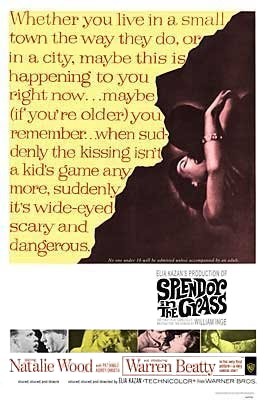
The 1962 film, Splendor in the Grass, takes place in Kansas shortly before the start of the Great Depression. Deanie (Natalie Wood) and Bud (Warren Beatty) are two teenagers in love but, as we learn, youthful love does not always translate into adult happiness.
Bud and Deanie are idealistic and in love but they’re from different social classes. Bud is the son of a boisterous oilman named Ace (Pat Hingle) and Ace acts much like you would expect a millionaire named Ace to behave. Bud’s parents are determined that he attend Yale and that he marry someone else from a wealthy family. They don’t want him to turn out like his older sister, Ginny (Barbara Loden), who drinks, smokes, and is rumored to have recently had an abortion. Meanwhile, Deanie is repeatedly told by her mother that she must always remain a “good girl” and not give in to the temptation to have premarital sex with either Bud or any other boy. If she does, she’ll be forever branded a bad girl and she’ll pretty much end up with a reputation like Ginny’s.
(Interestingly enough, Ace doesn’t have any problem with Bud finding himself a bad girl, nor does he have a problem with taking his son to a speakeasy later in the film. As far as society in concerned, being “good” and following the rules only applies to women.)
Needless to say, things don’t work out well for either Deanie or Bud. Bud is so frustrated that Deanie won’t have sex with him that he dumps her and then has the first of several breakdowns. When Deanie’s attempt to win Bud back by acting more like Ginny fails, she ends up going out with a classmate named Toots Tuttle (Gary Lockwood). Nothing good ever comes from going out on a date with someone named Toots Tuttle. That’s certainly the case here as Deanie and Bud both struggle with the demands of a hypocritical society that expects and encourages Bud to behave in a certain way but which also condemns Deanie for having desires of her own. And, of course, the entire time that Bud and Deanie’s drama is playing out, we’re aware that the clock is ticking and soon the stock market is going to crash and change everyone’s lives forever.
It’s kind of a depressing film, to be honest. I’ve always found it to be rather sad. When we first meet them, Deanie and Bud seem as if they’re perfect for each other but, throughout the entire film, the world seems to be conspiring to keep them apart. By the end of the film, they’ve both found a kind of happiness but we’re painfully aware that it’s not the happiness that either one was expecting while they were still in school. The film suggests that type of happiness might be impossible to attain and a part of growing up is realizing that there is no such thing as perfection. Instead, there’s just making the best of wherever you find yourself.
There’s a scene in this film where Natalie Wood nearly drowns and it always freaks me out, both because of my own fear of drowning and the fact that it foreshadows what would eventually happen to Natalie in 1982. (The fact that Natalie Wood and Robert Wagner’s yacht was called “Splendour” doesn’t help.) Natalie herself was also deeply scared of drowning and just filming the scene undoubtedly took a lot of courage on Natalie’s part. But then again, Natalie Wood’s entire performance is courageous. Natalie Wood gives an emotional and intense performance as Deanie, holding nothing back and it’s impossible not to get emotional while watching her. Making his film debut, Warren Beatty is a bit of a stiff as Bud, though he’s certainly handsome and you can tell why Deanie would have found him attractive. (In high school, you always assume that the boring, handsome guys actually have more depth than they let on.) By the end of the film, you understand that Deanie deserved better than Bud. Then again, Deanie deserved better than just about everything life had to offer her. But Deanie survived and endured and made the best of what she was given because, really, what else could she had done? What other choice did she have?
For her performance in Splendor in the Grass, Natalie Wood received her second Oscar nomination for Best Actress. She lost to Sophia Loren for Two Women and …. well, actually, Loren deserved the award. But so did Wood. 1961 would have been a great year for a tie.
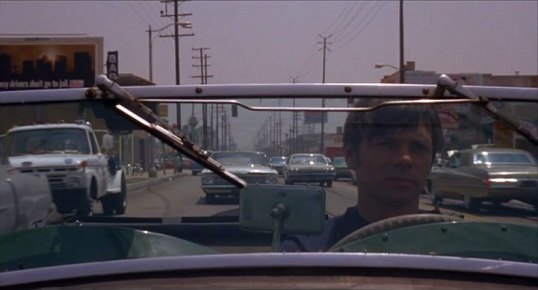
The 1969 film, Model Shop, plays out like a dream.
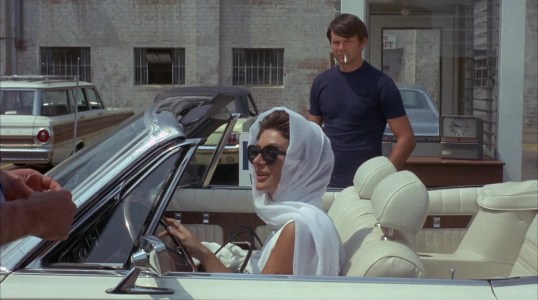
The film tells a simple enough story. In fact, it’s tempting to say that Model Shop is plotless though it actually isn’t. There’s a plot but, in many ways, the film is more about how the story is told than the story itself. Gary Lockwood plays George Matthews, a former architectural student who is currently living in Los Angeles with his girlfriend, Gloria (Alexandra Hay). Gloria is an actress while George …. well, George is just a drop out. Throughout the film, we get clues that George might have once cared about things (for instance, some of his friends are putting out an underground newspaper while another is into creating protest music). However, by the time we meet him, George seems to be rather detached from life. Of course, some of that may be due to the fact that, because he’s no longer in college, George is now eligible to be drafted and sent to Vietnam. (The film was made in 1969, after all.) In fact, George has just received his induction notice. He basically has a week left before joining the army. At one point, in a flat tone of voice, he says, “It feels like a death sentence.”
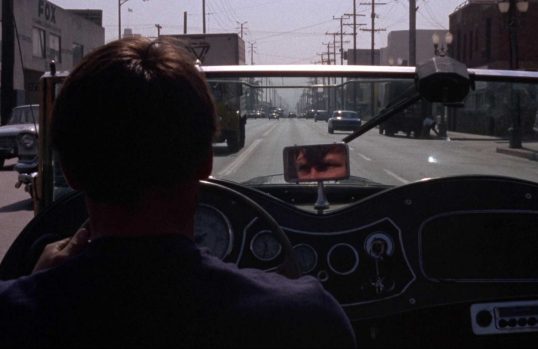
Getting drafted is not George’s only problem. He’s also about to lose his beloved car! George has a day to come up with a few hundred dollars so he can keep his beloved green roadster from being repossessed. (In George’s defense, it is a pretty nice car.) While Gloria goes off to shoot a soap commercial, George spends his day driving around Los Angeles and searching for money. George has a lot of friends but most of them are too busy making music and setting up love-ins in Griffith Park to help him out. George doesn’t want to call his mother for the money and when he tries to call his father, he gets a lecture about how his older brother served in Korea. No one is willing to make any sacrifices to help out George. That may have something to do with the fact that George is, at times, a tad whiny and a bit self-absorbed.
It’s while wandering around Los Angeles that George spots the beautiful Lola (Anouk Aimée). The glamorous but sad Lola works at a model shop, a sleazy establishment where men pay to take her picture. Lola has a tragic story of her own, one that finds her stranded in Los Angeles. It all leads to a brief romance that’s as bittersweet as ennui in May.
(Ennui in May is also the title of a musical that I’ve been writing, off-and-on, since 2012. Keep an eye out for more details!)
Model Shop was the first (and only) English-language film of French filmmaker Jacques Demy and one reason that the film seems so dream-like is because Demy wrote the dialogue-heavy script in French and then had it translated into English. As such, this is an extremely talky film in which no one ever seems to have a real conversation. (It should also be noted that what sounds beautiful and poetic in French can come across quite differently in the harsher tones of the English language.) George, Gloria, and Lola all speak in pedantic, declarative sentences. There’s none of the individual verbal quirks or changes in tone that would make it seem as if these were people having an actual conversation. As well, nobody ever talks over anyone else. No one ever attempts to interrupt anyone else’s train of thought. At times, it seems like the cast is performing under the influence of hypnosis and they’ve been told, “Do nothing while anyone else is speaking.” It creates a rather odd atmosphere.
Also adding to the film’s dream-like feel is Jacques Demy’s direction. The pacing feels just a little bit off. It’s not so far off as to harm the film. In fact, the fact that everything seems to be moving just a little bit slower than expected is actually one of the film’s biggest strengths. If nothing else, it reflects George’s own feelings of being on borrowed time. Beyond that, though, Demy often seems less like a director than an anthropologist. A good deal of the film is simply made up of shots of George driving around Los Angeles and one gets the feeling that Demy was more fascinated with capturing the unique style of America than with telling George’s story. Demy directs the film like an outsider looking in and, as a result, he often seems to focus on the details of daily life — like the television and the billboards and the red Coke signs hanging over every store window — that Americans takes for granted. At the start of the film, the camera lingers over an oil derrick, as if Demy is looking at this symbol of Americana and looking for clues to understand what makes America what it is. Much as Michelangelo Antonioni did when he made Zabriskie Point, Demy seems to be trying to use this film to solve the riddle of America and how Americans — even with the country embroiled in an unpopular war — could remain so youthful and optimistic about the future. Unlike Antonioni, Demy seems to be more bemused than angered by America’s contradictions. Anonioni ended Zabriskie Point by blowing up a luxury, mountain-side home. One gets the feeling that Demy would have found the same house to be rather charming.
Of course, the late 60s were a time when Hollywood studios felt that they were under attack, not just from television but from foreign films as well. With all the critics talking about European films were superior to studio films in every way and young filmgoers flocking to foreign films, it would only make sense that the studios would would bring filmmakers over from Europe. For the studios, it was a chance to try to convince people that they weren’t run by out-of-touch dinosaurs. For the filmmakers, it was a chance to try to capture and explain America on film. The end results were mixed, with many of the directors — like Fancois Traffuat and Michelangelo Antonioni — later testifying to the difficulty of trying to work with an American studio while having a European sensibility. This was also true of Demy, who never did another English-language film after Model Shop. Reportedly, Demy wanted to cast an unknown actor named Harrison Ford as George but Columbia Studios demanded that Demy use Gary Lockwood. (Lockwood, of course, is best known for not showing a hint of emotion, even while hurtling to his death, in 2001: A Space Odyssey.)
Model Shop is definitely a film of it’s time, which is why I enjoyed watching it. Yes, it’s pretentious and kind of silly. But, at the same time, Demy is so fascinated with the Los Angeles of the late 60s that it’s hard not to share his fascination. The film plays out like a dream of the past, like a time machine that puts you to sleep and then fills your head with images that you can see but you can’t quite reach. It’s a time capsule, perfect for history nerds like you and me.
Someday, if films like Back to the Future and Happy Death Day 2U are any guide, we’ll have time machines and we’ll be able to personally experience the past. Until then, we can watch films like Model Shop.
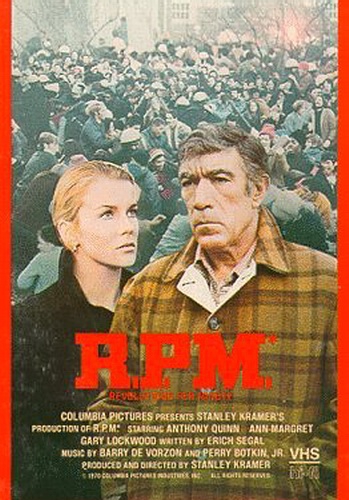
For my next return-to-college film, I ended up watching R.P.M. Like both Getting Straight and Zabriskie Point, R.P.M. was released in 1970 and deals with political unrest on campus.
Directed by Stanley Kramer (who also gave us such respectable and middlebrow liberal films asGuess Who’s Coming To Dinner and Judgment at Nuremberg),R.P.M. takes place at prestigious college. Students radicals led by Rossiter (Gary Lockwood) and Dempsey (Paul Winfield) have taken over a building on campus. When the university’s president goes to confront the students, one of them yells out, “Buzz off!” Well, you know how sensitive college presidents are. He quickly resigns his post and the students demand that he be replaced either by Che Guevara, Eldridge Cleaver, or Paco Perez.
Unfortunately, Guevara is dead and Cleaver is in Algeria. Fortunately, left-wing sociology professor Paco Perez (Anthony Quinn) is available and he just happens to teach on campus! Perez is named interim president of the college. Now, Perez has to bring peace to the campus, despite the fact that the protestors now see him as a sell-out because he accepted the position. Perez also has to deal with nonstop snarky comments from his girlfriend, a grad student named Rhoda (played by Ann-Margaret).
Especially when compared to Getting Straight and Zabriskie Point, R.P.M. is something of a forgotten film. I haven’t found many reviews online and the majority of them mostly seem to focus on the fact that the film is dated and that director Stanley Kramer’s portrayal of the student protestors is incredibly negative. And, in many ways, those criticisms are perfectly valid. And yet, with all that in mind, I still loved R.P.M. Of the three 1970 campus protest films that I watched last weekend, R.P.M. was my personal favorite.
Why do I so love R.P.M?
Well, let’s check out some of the dialogue.
When Paco first comes to see the protestors, one girl literally sings, “Look what the revolution dragged in!”
Later, another demonstrator is heard to philosophically ask, “Why is the good ass never radical and the radical ass never good?” (And that’s certainly a question that was asked by everyone who drove by Occupy Dallas back in 2011.)
About the college administration, one girl announces, “They’ve got empty scrotes!”
When Paco tells Dempsey that the college is finally going to hire a black admissions offer, Dempsey replies, “How black? Is this cat an oreo cookie? Is he related to my uncle Tom?”
When Paco asks how long it will take for the protestors to peacefully leave the building, one of them loudly announces, “It would take to the 12th of never!” Of course, everyone applauds.
And that’s not counting all of the times that random protestors say, “Right on!”
But even better than listening to the protestors is listening to Paco and Rhoda discuss their relationship.
When Rhoda tells Paco that she knows the real him because she sees him without his pajamas, Paco replies, “That’s not reality. That’s flab.” With a world-weary sigh, Rhoda replies, “Flab is reality.”
When Paco complains about Rhoda’s cooking, she sensibly tells him, “Next semester, hump a home economics major.” Paco replies, “I did. The food is great but the talk is lousy.”
After being taunted by a student, Paco asks Rhoda, “Did you tell the kids I was a lousy lay?” Rhoda laughs and replies, “I may have thought it but I never said it!”
Finally, in one heart-warming scene, Paco informs Rhoda that, “The whole campus calls you Paco’s Pillow.”
Seriously, how can you not love a movie with dialogue this overwritten and over-the-top? It’s obvious the Kramer and screenwriter Erich Segal were desperate to sound hip and contemporary and, as a result, nobody speaks like a normal person. Instead, listening to R.P.M. is a bit like listening to a party to which every 60s stereotype has been invited.
And yet, it’s not just the dated dialogue that causes me to love R.P.M. As opposed to the histrionic Getting Straight and the artistically detached Zabriskie Point, R.P.M. is an attempt to seriously deal with the issue of student protest. For every three moments that ring false, there’s one that works and that’s a lot more than most films about campus unrest can say. Anthony Quinn gives a good performance as a man who doesn’t realize quite how complacent he has become. He and Gary Lockwood have a wonderfully tense scene together where they sincerely and intelligent debate their different worldviews. It’s the best scene in the film and one that is so well-done that it excuses any previous missteps.
R.P.M. occasionally shows up on TCM. Keep an eye out for it.
 A police detective named Benny Avalon (Bubba Smith) and an FBI agent named Joe Jennings (Beau Bridges) are assigned to work together to take down a drug dealer named Ivory Jones (Raymond St. Jacques). Avalon and Jennings don’t immediately get along. Avalon is tough and streetwise while Joe is a good example of what used to be called a yuppie. When they discover that Ivory is connected to a white supremacist gang led by Col. Hester (Lloyd Bridges), Avalon and Jennings have to set aside their differences and work together.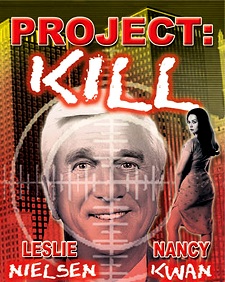





 Through the Shattered Lens