2025 may soon come to a close but have no fear. As Frank Stallone reminds us, we are far from over!
Enjoy!
2025 may soon come to a close but have no fear. As Frank Stallone reminds us, we are far from over!
Enjoy!
This holiday season, this message from Frank Stallone resonates even more than ever.
Enjoy!
Welcome to Retro Television Reviews, a feature where we review some of our favorite and least favorite shows of the past! On Mondays, I will be reviewing Miami Vice, which ran on NBC from 1984 to 1989. The entire show can be purchased on Prime!

This week, Gina’s in trouble again!
Episode 4.19 “Blood & Roses”
(Dir by George Mendeluk, originally aired on April 1st, 1988)
Frank Mosca (Stanley Tucci) is back!
In case you’ve forgotten, Mosca was the villain from the fourth season premiere, Contempt of Court. That episode ended with Mosca getting away with everything. This episode finds him killing a rival drug lord (Michael Wincott) and trying to kill Crockett. Because Mosca knows who Crockett and Tubbs are, it falls on Gina to go undercover. This becomes yet another episode where Gina starts to fall for the bad guy and ends up having sex with the target of a Vice investigation. As often happens with these type of episodes, Gina ends up shooting Mosca to keep him from shooting Sonny. Mosca’s body plummets down an air shaft and it’s hard not to notice that Stanley Tucci has suddenly become a mannequin with painted hair.
Stanley Tucci gave a magnetic performance as the charismatic but evil Frank Mosca. Watching Tucci, it’s easy to see why the show brought him but Mosca was such a memorable character that it’s shame that he was given a standard Miami Vice death scene. Mosca deserved to go out with a bit more style. Saundra Santiago gave a good performance as Gina but it’s hard not to notice that every time she’s at the center of an episode, it’s pretty much the same basic plot. As a character, Gina deserved better than to constantly be used as a sex toy by every bad guy she went undercover to investigate.
Watching this episode, I found myself wondering if the show’s writers remembered that Crockett was supposed to be married. Between his jealousy over Gina getting close to Mosco and a scene where he and Gina shared a brief but intense kiss, it was hard not to notice that Crockett didn’t seem to be thinking about his wife. Perhaps this episode was originally meant to air earlier in the season, before Crockett’s somewhat improbable wedding. Who knows? It’s been a while since anyone asked Crockett about Caitlin. Maybe they got a quickie divorce offscreen.
This episode was typical of season 4. It was well-made but everything just felt a bit too familiar. to be effective.
As our song of the day shows, Sylvester isn’t the only Stallone with talent! I don’t care how many jokes people make about Frank, this song always makes me dance.
Though the Academy of Motion Picture Arts and Sciences claim that the Oscars honor the best of the year, we all know that there are always worthy films and performances that end up getting overlooked. Sometimes, it’s because the competition too fierce. Sometimes, it’s because the film itself was too controversial. Often, it’s just a case of a film’s quality not being fully recognized until years after its initial released. This series of reviews takes a look at the films and performances that should have been nominated but were, for whatever reason, overlooked. These are the Unnominated.
I have come around on Tombstone.
The first time I watched this 1993 film, I was a bit confused as to why so many of my friends (especially my male friends) worshipped the film. To me, it was a bit too messy for its own good, an overlong film that told a familiar story and which featured so many characters that it was difficult for me to keep track of them all. Perhaps because everyone I knew loved the film so much, I felt the need to play contrarian and pick out every flaw I could find.
And I still think those flaws are there. The film had a troubled production, with original director Kevin Jarre falling behind in shooting and getting replaced by George Pan Cosmatos, a director who didn’t have any real interest in the material and whose all-business approach rubbed many members of the cast the wrong way. Kurt Russell took over production of the film, directing the actors and reportedly paring down the sprawling script to emphasize the relationship between Russell’s Wyatt Earp and Val Kilmer’s Doc Holliday. On the one hand, this led to a lot of characters who really didn’t seem to have much to do in the finished film. Jason Priestley’s bookish deputy comes to mind. On the other hand, Russell was right.
The film’s heart really is found in the friendship between Wyatt and Doc. It doesn’t matter that, in real life, Wyatt Earp was hardly as upstanding as portrayed by Kurt Russell. It also doesn’t matter that the real-life Doc Holliday was perhaps not as poetic as portrayed by Val Kilmer. Today, if you ask someone to picture Wyatt Earp, they’re probably going to picture Kurt Russell with a mustache, a cowboy hat, and a rifle. And if you ask them to picture Doc Holliday, they’re going to picture Val Kilmer, sweating due to tuberculosis but still managing to enjoy life. Did Doc Holliday every say, “I’ll be your huckleberry,” before gunning someone down? He might as well have. That’s how he’s remembered in the popular imagination. And it’s due to the performances of Russell and Kilmer that I’ve come around to eventually liking this big and flawed western. With each subsequent viewing, I’ve come to appreciate how Russell and Kilmer managed to create fully realized characters while still remaining true to the Western genre. If Wyatt Earp initially fought for the law, Doc Holliday fought for friendship. Kilmer is not only believable as a confident gunslinger who has no fear of walking into a dangerous situation. He’s also believable as someone who puts his personal loyalty above all else. He’s the type of friend that everyone would want to have.
That said, I do have to mention that there are a lot of talented people in the cast, many of whom are no longer with us but who will live forever as a result their appearance here. When Powers Boothe delivered the line, “Well …. bye,” he had no way of knowing that he would eventually become a meme. Boothe is no longer with us, I’m sad to say. But he’ll live forever as long as people need a pithy way to respond to someone announcing that they’re leaving social media forever. Charlton Heston appears briefly as a rancher and he links this 90s western with the westerns of the past. Robert Mitchum provides the narration and it just feels right. The large ensemble cast can be difficult to keep track of and even a little distracting but there’s no way I can’t appreciate a film that manages to bring together not just Russell, Kilmer, Boothe, Heston, and Mitchum but also Sam Elliott, Bill Paxton, Michael Biehn, Michael Rooker, Billy Bob Thornton, Frank Stallone, Terry O’Quinn, and even Billy Zane! The female roles are a bit underwritten. Dana Delaney is miscast but Joanna Pacula feels exactly right as Doc Holliday’s lover.
But ultimately, this film really does belong to Val Kilmer. When I heard the sad news that he had passed away last night, I thought of two films. I thought of Top Gun and then I thought of Tombstone. Iceman probably wouldn’t have had much use for Doc Holliday. And Doc Holliday would have resented Iceman’s attitude. But Val Kilmer — that brilliant actor who was so underappreciated until he fell ill — brought both of them to brilliant life. In the documentary Val, Kilmer attends a showing of Tombstone and you can say he much he loves the sound of audience cheering whenever Doc Holliday showed up onscreen.
Tombstone was a flawed film and 1993 was a strong year. But it’s a shame that Val Kilmer was never once nominated for an Oscar. Tombstone may not have been a Best Picture contender but, in a year when Tommy Lee Jones won the Oscar for Best Supporting Actor for his role in the similarly flawed The Fugitive, it seems a shame that Kilmer’s Doc Holliday was overlooked.
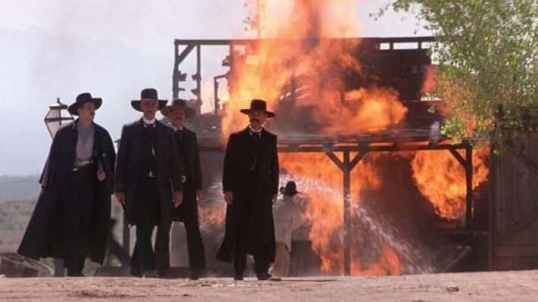
Tombstone (1993, dir by George Pan Cosmatos (and Kurt Russell), DP: William Fraker)
Previous entries in The Unnominated:
Now streaming on Netflix, Sly is a documentary about the life and career of Sylvester Stallone.
The documentary opens with Stallone watching as all of his belongings in his Hollywood mansion are packed in boxes so they can be shipped to his new home in New York. As I listened to Stallone talk about how you sometimes have to return to your roots to discover who you truly are, it occurred to me that Stallone is one of those people who is never not playing a role. Even when he’s not Rocky Balboa or John Rambo or any of the other characters that he’s played in the movies (or, less frequently on television), he’s still playing Sylvester Stallone, the bigger-than-life movie star who has been an inescapable part of the American pop cultural landscape for longer than I’ve been alive. Watching Stallone talk about what it’s like to go, overnight, from being an unknown to being a celebrity, I never doubted his sincerity but I was always aware of how carefully chosen his words seemed to be. Sylvester Stallone lets the audience in but he’s still careful about how much he reveals about himself.
The same can be said of the documentary, which largely focuses on Rocky, Rambo, and The Expendables, with a little Lords of Flatbush, F.I.S.T., Paradise Alley, and Cop Land trivia tossed in as well. Stallone admits that he’s not proud of all of the films that he’s made, citing Stop! Or My Mom Will Shoot! as his biggest regret. (Arnold Schwarzenegger pops up to brag about how he was smart enough to turn down the script when it was originally sent to him.) That said, there’s not much attention given to Stallone’s films with Roger Corman or for the films that he did for Cannon. Sorry, there’s no Over The Top trivia. There are a few clips from Cobra and Rhinestone but not much more. If you’re looking for a documentary about the B-movies of Sylvester Stallone, this is not it. (Interestingly enough, even films like Demolition Man — which was one of Stallone’s better non-Rocky and non-Rambo films — are also glossed over.) Beyond talking his troubled relationship with his father, mentioning his love for daughters, and a moment where he gets noticeably emotional while talking about his late son, there’s not much information here about Stallone’s private life. And again, it’s not that Stallone owes anyone any of that information. At one point, Stallone says that he hasn’t had a moment of privacy since the release of Rocky and he’s probably right. He’s earned the right to keep some things private.
Also interviewed in the documentary are Frank Stallone, Quentin Tarantino, film critic Wesley Morris, director John Herzfeld, and Talia Shire. Frank comes across as a lot more genuine here than he did in his own documentary while Talia does the best job of understanding the appeal of Rocky.
This is a documentary that will probably best be appreciated by people who are already fans of Stallone. Stallone doesn’t attempt to win over his doubters but, having been a star for nearly 50 years, Stallone can definitely argue that his doesn’t owe his doubters any effort. Watching the documentary, it became clear to me that Stallone is one of those pop cultural figures who it is impossible not to love. Everything about him, from the rough Hell’s Kitchen childhood to his decision to write a movie for himself to his decision to move into the director’s chair, is pure Americana. There’s a reason why Rocky Balboa often appears with an American flag.
(That said, I still think that Stallone’s best performance was in First Blood and, in this documentary, Stallone gets genuinely emotional as he discusses when he discusses why he felt it was important for Rambo to survive the end of the film.)
He’s a survivor and he’s confident enough to admit that he got a bit arrogant after the success of Rocky. Stallone still has that confidence that borders on arrogance but he’s aging well and it’s hard not to feel that he’s earned the right to brag on himself. (It helps, of course, that he’s become a better actor as he’s aged.) Stallone may not totally open up but he still has his movie star charisma. When he talks, you listen. When he moves, you watch. We’ll miss him when he’s gone.
Meow! Sing it, Frankie!
Meow!
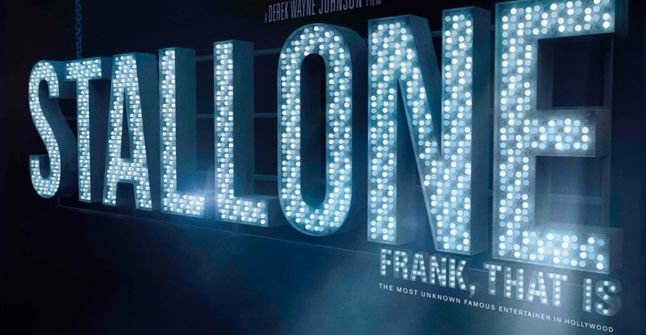
Frank Stallone is a great musician and a talented guy and you should really spend some money to see him perform.
That would seem to be the main message of the new documentary, Stallone: Frank That Is. This documentary, which profiles the brother of Sylvester Stallone, was produced by Frank himself so we perhaps shouldn’t be surprised that it’s full of people attesting to what a great entertainer Frank is. Billy Zane, Billy Dee Williams, Christopher McDonald, Joe Mantegna, Duff McKagen, Richie Sambora, and Frankie Avalon all pop up and assure the viewers that Frank is a talented musician. Arnold Schwarzenegger tells us that Frank deserves to be known as more than just Sylvester Stallone’s younger brother. Sylvester Stallone himself shows up, to tell stories about how he and Frank once lived in a condemned apartment building and how they smashed a hole in the wall so that their two apartments could become one big loft.
What’s interesting is that, despite the fact that the film often seems like it was largely made to provide Frank Stallone with some encouragement and an ego boost, it also convinces us that Frank does deserve to be known for being something more than Sylvester Stallone’s brother. There’s enough performance footage to show that Frank Stallone actually is a pretty decent singer. Though the film is honest about the quality of most of Frank’s filmwork, there’s still enough footage from the 1987 film Barfly to convince us that, when cast in the right role, Frank Stallone is capable of giving a memorable performance. When he’s interviewed on camera, Frank Stallone comes across as being likeable and a good raconteur. He’s someone who you might want to have dinner with, just so you can listen to his stories about being a struggling musician in New Jersey in the late 60s. (Be sure to ask him about the time that he and his band opened for Bruce Springsteen.) Frank is also honest about how much of his career his owes to his brother, even if he never comes across as if he’s really made peace with that fact.
In fact, Frank Stallone is actually pretty forthright when it comes to admitting that being permanently overshadowed by his older brother totally sucks. After spending several years struggling to make it as a musician, Frank wrote a song for Rocky. Sylvester admits that the main reason Frank was asked was because the budget was too tight to hire anyone who wasn’t a relative. Frank and his band appeared in Rocky, as well as the film’s sequels. He went on to record songs for several of Sylvester’s films, most famously for Staying Alive. And while working on Sylvester’s films made Frank known and even helped him achieve a brief stardom when one of his Saying Alive songs reached the top of the charts, Frank also knew that everyone assumed that he only got hired because he was Sylvester’s brother. When Frank would perform at clubs, he would be credited as being “Rocky’s brother, Frank Stallone.” Understandably, Frank was not happy about that. (Sylvester at one point says that Frank was bitter and that “Frank’s still bitter and that’s one reason why I love him, he’s consistent.”) The only people less happy about the situation than Frank were Frank’s bandmates who found themselves overshadowed by the guy who was best known for being overshadowed by his brother. Frank admits that he often struggled to deal with his odd claim to fame and, as a result, his alienated a lot of people around him.
For all of the celebrity testimonials and funny stories, there’s also wistful sadness that runs through this documentary. As positive and upbeat as Frank Stallone tries to present himself, there’s always a feeling that there’s a lot of regret right underneath the surface. Being Sylvester Stallone’s brother comes across as being both a blessing and a curse. On the one hand, it opened doors for Frank that probably would never have been opened, On the other hand, it also ensured that Frank is always going to struggle to get people to take him seriously as anything other than a famous sibling. (Even in this documentary, some of the most memorable moments come from Frank imitating Sylvester’s trademark deep voice.) Stallone: Frank, That Is does a good job of suggesting that Frank deserves to be known for more than just his family while also admitting that it probably won’t ever happen.
Yay! Brianne O’Neill (Lynda Carter) has a got a new job, working at a crisis hotline!
Boooo! The serial called known as the Barber is now obsessed with calling her!
The Barber is known as the Barber because he cuts his victims’s hair before killing them, which as far as I’m concerned, make him even worse than a normal serial killer. You have to wonder if he resents being known as the Barber as opposed to The Stylist.
Anyway, it’s up to Brianne to figure out why The Barber keeps calling her and to hopefully discover his identity. For whatever reason, no one else seems to be that concerned about it.
That’s the plot of Hotline, a 1982 made-for-TV movie that is today’s horror on the lens. It’s not a bad film, though it does inspire a certain amount of snarkiness while you’re watching it. For the most part, though, it’s well-acted and effectively directed. If you’ve got 95 minutes to kill, why not kill them with Lynda Carter, The Barber, and Frank Stallone?
 Through the Shattered Lens