Film Review: Hacksaw Ridge (dir by Mel Gibson)


hacksaw_ridge_poster

To be honest, Hacksaw Ridge is probably not the type of film that I would usually watch.  I’m not a huge fan of war movies and the trailer really didn’t inspire much enthusiasm within me.  However, ever since the film was released last Friday, it’s been the subject of some Oscar buzz and … well, you know me and the Oscars.  There’s no easier way to get me to take a chance on a movie than to tell me that it might be nominated for an Oscar.  I’m a completist, after all.  If they’re going to nominate 8 to 10 movies for best picture, you better believe I’m going to make sure that I’ve seen all of them.

So, after voting yesterday, I saw Hacksaw Ridge and all I can say is, “Wow!”  Hacksaw Ridge left me with tears in my eyes and feeling totally exhausted.  This is one of those films that kind of sneaks up on you.  I spent the first half of the film thinking to myself, “Okay, this is good and all but I still don’t see what the big deal is.”  And then suddenly, that second half started and soon, I was totally struggling to catch my breath.

I’ll just say this right now: Hacksaw Ridge is one of the most powerful anti-war films that I’ve ever seen.  It’s also an incredibly violent film, one that will leave non-veterans amazed at the number of ways that soldiers can be shot, stabbed, blown up, and set on fire.  But, despite all the visceral action that plays out across the screen, Hacksaw Ridge never glorifies combat.  It never glamorizes the destructive power of war.  We may be happy when we see a certain soldier somehow manage to survive but we never find ourselves cheering.  Instead, often times, we worry what awaits that soldier after the war.  The combat in Hacksaw Ridge is so brutal and so terrifying that you find yourself wondering not only how anyone could survive but also how anyone could ever go on with “normal” life after seeing the horrors of war.

Hacksaw Ridge tells the true story of Desmond Doss, a conscientious objector who served, as a combat medic, in the U.S. Army during World War II.  As a Seventh Day Adventist, Doss both refused to carry a rife and refused to train on the Sabbath.  Despite all the efforts of both his sergeant and his captain to convince Doss to leave the service, Doss stayed in the Army, served in combat despite refusing to carry a rifle, and became the first C.O. to be awarded the Medal of Honor.  In the film, Doss is played by Andrew Garfield, who is one of those extremely talented actors who has been miscast in several films.  Fortunately, he’s perfect for Hacksaw Ridge.  Though his rural accent occasionally slips, Garfield is convincing as both a relatively naive farmboy and a man of such strong convictions that he’s willing to risk being court martialed to uphold them.  If Hacksaw Ridge is about Doss proving himself to his fellow soldiers, it’s also a film about Andrew Garfield, who is still perhaps best known for being awkwardly cast as Spiderman, proving himself as a unique and interesting actor.

Garfield pretty much dominates the film but a few of the supporting performers do manage to make an impression.  Vince Vaughn is surprisingly effective as the tough and no-nonsense sergeant and Teresa Palmer is sympathetic as Doss’s wife.  Hugo Weaving plays Doss’s alcoholic father, a man who is still haunted by what he saw during the first world war and he does a great job.

I know that some people are going to be hesitant about Hacksaw Ridge because it was directed by Mel Gibson but you know what?   You may not expect Mel Gibson to direct one of the most searing anti-war films of the past decade but that’s exactly what he managed to do.  It’s an important film, one that reminds us that war is neither fun nor an adventure.  It’s a film that shows what our combat veterans had to deal with (and when we countless men lost their legs as the result of a Japanese rocket, it’s hard not to make the connection to the countless vets who have lost limbs in the Middle East) and, in its way, chastises a society that would abandon them after the war is over.  If Doss, working on his own, was willing to put his life at risk to save 75 wounded soldiers, how can we, as a society, justify not taking care of our wounded veterans?   Hacksaw Ridge is a film that works both as a tribute to our veterans and a reminder that the costs of war are all too real.

It’s a good and important film.  I recommend the Hell out of it.
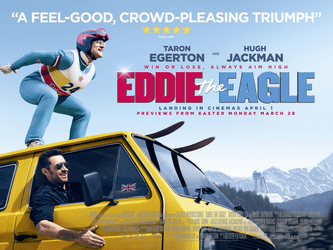
Film Review: Eddie the Eagle (dir by Dexter Fletcher)


eddie_the_eagle_poster

Hi, everyone!

So. I’m guessing, after what happened last night, some of our readers might need something to cheer them up.  If you’re a regular reader of this site, I’m going to imagine that you love movies.  And, in your moment of uncertainty or whatever, you might want to watch a movie.  And, of course, you’re asking yourself, “What does Lisa think I should watch?”

Well, I’ll be honest.  My cinematic tastes tend to be rather dark.  I like horror movies.  I like movies with sad endings.  I love brutal satire.  I love movies that attack their audience and that dare you to look away.  So, I might not be the best person to ask…

But you know what?

There actually is a movie that I can recommend to anyone who needs to be cheered up this week.  Eddie the Eagle, which came out way back in February, is exactly the type of movie that you would expect an arthouse snob like me to dismiss.  It’s a feel-good sports movie, one that is based on a true story but which also features a lot of composite characters and manufactured drama.  No, Eddie the Eagle is perhaps not the type of film that you would expect me to enjoy but, when I finally got around to watching it a few days ago, I absolutely loved it!

Eddie the Eagle tells the story of Eddie Edwards (Taron Egerton), a somewhat eccentric Englishman who dreams of competing in the Winter Olympics, despite the fact that he’s not all that athletically inclined.  When he’s turned down for a spot on the Olympic skiing team, Eddie decides to try to go to the Olympics as a ski jumper.  Working to Eddie’s advantage is the fact that there are no other English ski jumpers.  (We’re told that it’s been over 60 years since the UK even sent a ski jumper to the Olympics.)  In theory, Eddie should be able to qualify for the Olympic team just by showing up.  Working to Eddie’s disadvantage is the fact that the snooty British Olympic officials don’t want him to represent the UK in the Olympics.

Of course, there’s also the fact that Eddie has no experience as a ski jumper and only a few months to learn how to do it.  And, if Eddie makes any mistakes during one of his jumps, he could easily be severely injured or perhaps even die.

Most people would probably just give up and find something practical to do with their life but not Eddie!  Eddie has a dream and he’s going to achieve it, no matter what.  Fortunately, Eddie finds a coach.  Alcoholic Bronson Peary (Hugh Jackman) used to be a champion ski jumper but he’s spent the last few years drinking and being bitter.  At first, Bronson doesn’t want anything to do with Eddie but eventually, Eddie wins him over with his sincerity and his refusal to give up.  As Eddie explains to Bronson, he doesn’t care whether or not he wins a medal.  He just wants to compete…

And really, it shouldn’t work.  I should be complaining about how shamelessly manipulative this movie is.  I should be making fun of the fact that it features almost every sports film cliché imaginable.  But dammit, it’s such a sweet movie!  Director Dexter Fletcher does a great job filming Eddie’s jumps (often times from his point of view) and Taron Egerton is so charmingly odd in the role that you can’t help but cheer whenever Eddie manages to land without crippling himself.  Meanwhile, Hugh Jackman does a good job of grounding the movie in reality (which makes it all the more ironic that, unlike Egerton, Jackman is playing a fictional character).  Add to that, this film features a somewhat random Christopher Walken cameo!  Seriously, you’re sitting there and you’re thinking, “This is a good movie but I just wish Christopher Walken was here…” and then suddenly …. THERE’S CHRISTOPHER WALKEN!

Eddie the Eagle is a sweet and sincere burst of positivity.  It’s the perfect antidote to 2016!

Film Review: Volumes of Blood: Horror Stories (dir by Nathan Thomas Milliner, P.J. Starks, James Treakle, Sean Blevins, John William Holt, Jon Maynard, and Justin M. Seaman)


vob1

You may remember that, last year, I raved about an independent horror film called Volumes of Blood!  Did you take my advice and track it down?  DID YOU!?  It’s available on Amazon and, if you haven’t seen it yet, you’re running behind because the sequel has just been released.

Volumes of Blood: Horror Stories opens with the following warning:

vob

That warning pretty much tells you everything that you need to know.  Full of clever references and call backs to previous horror films, Volumes of Blood: Horror Stories was made by people who love horror and it will be best appreciated by other horror lovers.  Like the first film, it earns the title Volumes of Blood because the blood never stops flowing.

Like the first film, Volumes of Blood: Horror Stories is an anthology film, telling 8 different but inter-connected stories of gore and horror.  Things start off with a nicely done little slasher parody called Murder Death Killer.  Directed by Nathan Thomas Milliner, Murder Death Killer deals with three small-time crooks who make the mistake of visiting a junkyard that’s haunted by the vengeful spirit of Atticus Crow.  Murder Death Killer is nicely directed, with Milliner exploiting that junkyard for every ounce of ominous atmosphere that it has.  One of the crooks, Mr. Dawson, is played by Thomas Dunbar, an actor who gives off a welcome Sid Haig vibe.

Murder Death Killer is followed by Haters, which is directed by the film’s producer, P.J. Starks.  Haters deals with two horror fans who, after watching a remake of Murder Death Killer (one that we’re told stars Vin Diesel and Eric Roberts), make the mistake of pissing off the wrong usher.  Haters features many references to my favorite part of the first Volumes of Blood, a fictional movie called The Dewey Deathimal System.

The atmospheric and gory Trick or Treat (directed by Sean Blevins) picks up directly where the first Volumes of Blood ended, with the town of Owensboro, Kentucky coming to terms with the massacre at the local library and the first film’s mysterious murderer continuing to seek fresh victims.  You’ll never look at candy corn the same way again.

Trick or Treat leads directly to Killer House (directed by James Treakle).  A mysterious realtor (played by Christopher Bower) leads a couple on a tour through a mysterious house.  The realtor is quite insistent on visiting the cellar but the couple wants to see the upstairs first.  However, regardless of where the tour leads, each room triggers a different story.  The highlight of Killer House is the wonderfully creepy performance of Christopher Bower.

Feeding Time (directed by John William Holt) is a nicely done little film about an insurance salesman who is desperate to make a sell on the day before Thanksgiving.  The house that he visits doesn’t appear to be occupied by anyone other than a mysterious teenage girl (Shelby Taylor Mullins, giving a memorably off-key performance) who swear that there’s a monster in her closet.

In Blood Bath (directed by Jon Maynard), a man fears that his bathtub may have eaten both his wife and his best friend.  Is the bathtub truly possessed or is the man just suffering the side effects from having forgotten to take his medicine?  Blood Bath will keep you guessing.

Fear, For Sinners Here (directed by Nathan Thomas Milliner) was my personal favorite of all the stories in Volumes of Blood: Horror Stories.  On Christmas Eve, Carol (Jessica Schroeder) sits in her living room and she wraps presents while melancholy Christmas music plays on a record player.  Carol is wrapping toys for someone name “Joey.”  She’s sad, sometimes crying and sometimes growing angry.  I don’t want to spoil too much of this story, beyond saying that it’s superbly done.  It starts as a poignant look at holiday depression but then there’s a twist and then another.  Jessica Schroeder gives a great performance.

And finally, Death Day Party (directed by Justin M. Seaman) follows a seemingly sweet elderly couple as they celebrate a birthday in a definitely less than sweet way.  Full of rude humor, Death Day Party will appeal to those with an appreciation for the morbid and macabre.

Volumes of Blood: Horror Stories ends with a dedication to Wes Craven, Angus Scrimm, Gunnar Hansen, and Herschell Gordon Lewis.  It’s an appropriate dedication because Volumes of Blood: Horror Stories is a film made by people who love horror for viewers who love horror.  Mixing humor with gore, Volumes of Blood: Horror Stories is a fun celebration of the macabre.

vob2

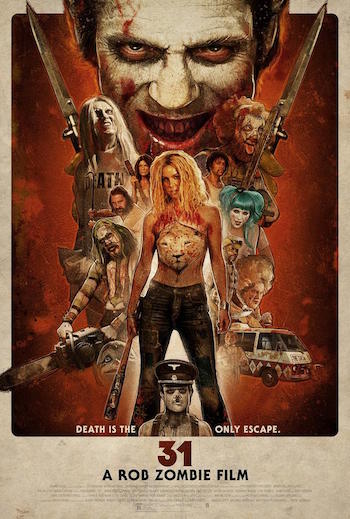
The TSL’s Daily Horror Grindhouse: 31 (dir by Rob Zombie)


31_film_poster

Are you scared of clowns?  Sure, you are.  All good people fear clowns.  However, if you somehow do not find clowns to be frightening, you may change your mind after seeing Rob Zombie’s latest film, 31.

Of course, that’s assuming that you actually see 31.  31 is not a film for everyone.  In fact, if you’re not a fan of Rob Zombie or his style of horror, you should probably stay miles away from 31.  Bloody, intense, violent, and occasionally rather nihilistic, 31 is perhaps the Rob Zombiest of all the films that Rob Zombie has ever made.

However, if you’re a fan of extreme horror, you’ll appreciate 31.  It may not always be easy to take but then again, that’s kind of the point.

The film takes place in the 70s, which means that it has a really kickass soundtrack.  A group of carnival workers are driving across the desert in a van when they are attacked and kidnapped.  They find themselves in a dark building, being lectured by three people who are dressed like 18th century French aristocrats.  The leader of the aristocrats (played by Malcolm McDowell) informs them that they are going to playing a game called 31.  For the next twelve hours, they will be locked away in a maze.  They will be hunted by five murderous clowns.

Yes, you read that right.  Not just one murderous clowns — FIVE!  (Even worse, a sixth bonus clown eventually joins the game.)

If they can survive for 12 hours, they win.  What do they win?  Other than freedom, the film is never particular clear on this point.  The motives of the aristocrats remain a mystery for the majority of the film.  Are they just sadists, are they perhaps devote fans of The Purge who were so disappointed with Election Year that they decided to recreate the second film on their own, or is there some bigger reason behind this game of 31?  The film leaves the question for us to answer.

The rest of the film is a collection of progressively more violent fights between the carnival workers and the clowns.  For the most part, the carnival workers are all likable and you don’t want to see any of them harmed.  The clowns, meanwhile, are just about the freakiest collection of killers that you’ve ever seen.  When one of them is cornered, he pathetically begs, “We’re all pawns!  We don’t want to do this!” but you never quite believe him.  The deadliest of the clowns is Doom-Head (Richard Brake) and his evil smirk will give you nightmares.

31 is an incredibly intense film and it’s definitely not for the faint of heart.  Everything from the acting to the set design to the costumes to David Daniel’s stark cinematography comes together to make 31 into a harrowing horror film.  If you can’t stand Zombie’s trademark mayhem, I would suggest avoiding 31.  However, if you’re a fan of Zombie’s films, you’ll find 31 to be perhaps the purest distillation of his artistic vision.

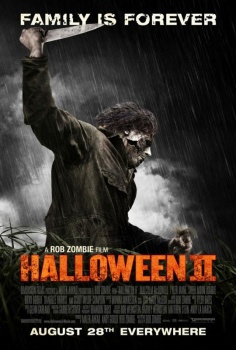
The TSL’s Daily Horror Grindhouse: Halloween II (dir by Rob Zombie)


halloween2009

The thing about praising Rob Zombie’s Halloween is that you’re then contractually obligated to talk about the 2009 sequel, Halloween II.  While I certainly don’t have any trouble defending the first film, Halloween II is about as big a mess as I’ve ever seen.

Much like the sequel to the original film, Halloween II opens with Laurie (Scout Taylor-Compton) being stalked in the hospital by her murderous older brother, Michael (Tyler Mane).  And the hospital scenes are actually pretty good.  Zombie makes good use of Nights in White Satin and the scenes of Michael chasing Laurie are genuinely suspenseful.

However, the film then jumps a year into the future and it’s all kind of annoying.  Halloween II follows three separate storylines, all of which converge at the rushed conclusion.

My favorite storyline dealt with Dr. Loomis (again played by the brilliant Malcolm McDowell).  Loomis has written a book about Michael and is now traveling the country, promoting himself as a true crime expert and dealing with people who think that he’s exploiting the whole tragedy for a quick buck.  McDowell is perfect in these scenes, playing Dr. Loomis as a pompous man who secretly knows that he’s a fraud.  “I was as much a victim as anyone,” he occasionally sputters.  Perhaps the highlight of the film comes when he’s interviewed by a rather sarcastic Chris Hardwick and finds himself being ridiculed by Weird Al Yankovic (playing himself).

The second storyline features Annie (Danielle Harris) and Laurie struggling to get on with their lives.  Laurie is now living with Annie and her father (Brad Dourif).  As opposed to the virginal Laurie of the first Halloween, this Laurie is pissed off and out of control.  On the one hand, I think Zombie deserves some credit for trying to deal with the PTSD that would obviously be the result of surviving being attacked by Michael Myers.  On the other hand, to say that Laurie is never not pissed off would be an understatement.  Scout Taylor-Compton does a good job playing her but, in Halloween II, a little Laurie Strode goes a long way.  You can only watch someone rage at the world for so long before it starts to get boring.

And the third storyline, not surprisingly, is Michael still trying to track down and kill his sister.  Michael continually sees visions of his dead mother (Sheri Moon Zombie), occasionally accompanied by a white horse, telling him, “It’s time.”  (Eventually, Laurie starts to see the same thing.)  Usually, if you come across someone online criticizing Halloween II, one of the first things that they’ll mention will be that white horse.  To be honest, the white horse didn’t both me.  I actually appreciated the surreal touch of Sheri Moon Zombie and a white horse appearing out of nowhere.  But still, as opposed to first film, Michael is just boring in this film.  The first film was memorable because it took the time to explore why Michael became who he became.  In Halloween II, Michael’s just another killer in a mask.  Leslie Vernon would have kicked his ass.

So, no, Halloween II does not really work.  The story is too messy and, with the exception of Dr. Loomis, none of the characters are particularly interesting.  I still stand by my claim that Rob Zombie is an underrated director but Halloween II is a definite misfire.

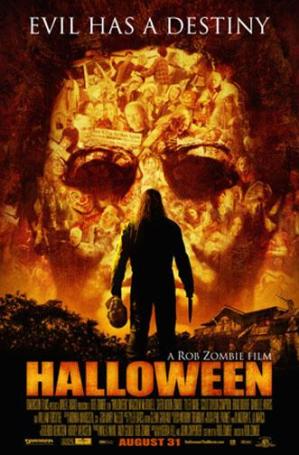
The Daily Horror Grindhouse: Halloween (dir by Rob Zombie)


halloween2007

Is Rob Zombie a good filmmaker?

That’s the question that every horror fan has to ask themselves at some point.  Needless to say, Zombie has a huge following and no one can doubt his love for the genre.  And yet, despite that, it seems that Zombie’s detractors will always be as outspoken as his fans.  His fans point out that Zombie makes movies that literally feel as if they’re filmed nightmares and that, as a committed horror fan, he’s willing to go further in his quest to shock you than most mainstream filmmakers.  His detractors, meanwhile, tend to see Zombie as an excessive filmmaker who often uses an abundance of style to cover for a weak narrative.

Personally, I’m somewhere in the middle when it comes to Zombie.  I think, as a storyteller, Rob Zombie does occasionally struggle to maintain a coherent narrative but, at the same time, I think his strengths as a director ultimately overcome his weaknesses.  As a visual filmmaker, he’s a lot stronger than he’s often given credit for and I don’t think anyone would criticize the way that he uses music in his films.  He may not be the strongest director of actors but he’s got a good eye for casting and he’s given work to some of our best character actors (Sid Haig, Malcolm McDowell, Brad Dourif, William Forsythe, and the late Karen Black, just to name a few).  If his films are extremely graphic and bloody … well, that’s the current state of horror.  If anything, I would argue that Zombie deserves credit for unapologetically embracing the mantle of being a 21st century grindhouse filmmaker.

That said, Rob Zombie’s films rarely seem to be as good on a second viewing as they were during the first.  He’s one of those directors who comes at you strong that, to a certain extent, his films almost beat you into submission.  During the first viewing of one of Zombie’s films, it’s not unusual to be overwhelmed by all the style and the music and the gore and the over-the-top characterizations.  Even if you don’t like the film itself, it definitely makes an impression on you.  It’s only on repeat viewing that you might start to notice that Zombie’s narratives are often rather clumsily slapped together.  Several times, Zombie’s visual style seems to dictate the story as opposed to the other way around.

That was certainly the case with his 2007 remake of Halloween.  While the film follows the same basic plot as John Carpenter’s original, it also spent a lot more time delving into the past of Michael Myers (Daeg Faerch as a child, Tyler Mane as an adult).  It was obvious that Zombie was far more interested in Michael than in any of his victims.  (Carpenter took the exact opposite approach, developing the characters of Annie, Laurie, and Linda and allowing Michael to remain a cipher.)  As a result, the first half of the film deals with Michael and his dysfunctional childhood while only the second half features Michael escaping and returning to Haddonfield.  Laurie, Annie, and Lynda are well-played by Scout Taylor-Compton, Danielle Harris, and Kristina Klebe but ultimately, they all remain rather generic.

The first time I saw Rob Zombie’s Halloween, I thought it was one of the most disturbing films that I had ever seen.  I should clarify that I mean that in a good way.  Zombie’s Michael was truly terrifying but, at the same time, Zombie portrayed him as a kid who never had a chance.  Whereas Carpenter’s Michael started the film as a fresh-faced little boy dressed up like a clown and holding a bloody knife, Zombie’s Michael is born into a world of chaos and darkness.  With his dysfunctional childhood, it was hard not to feel that Michael never had a chance.  Feeling abandoned by both his family and, eventually, his therapist, Michael retreated into a world of pure anger and hate.  Whereas John Carpenter’s Michael rarely seemed to be angry (instead he was just relentless), Zombie’s Michael is rage personified.

Unfortunately, Zombie’s Halloween spends so much time on Michael and his mother (Sheri Moon Zombie) and Dr. Loomis (Malcolm McDowell, perfectly cast) that it doesn’t leave much time for the night he came home.  Essentially, the entirety of Carpenter’s original film is crammed into the film’s second half and, on repeat viewings, you can’t ignore how incredibly rushed it all feels.  It’s obvious that Zombie’s heart was in the first half of the film.  In the second half, he’s just going through the slasher movie motions.

Rob Zombie’s Halloween is definitely a flawed film.  John Carpenter’s original remains the superior Halloween but, to be honest, I don’t think Rob Zombie would deny that.  Zombie set out not to replace Carpenter’s Halloween but to tell a different version of the same story.  When Zombie’s Halloween works, it really works.  Flawed as it may be, Halloween proves that Rob Zombie is a talented filmmaker, albeit one with room to grow.

As for Halloween II … well, we’ll talk about that later…

The TSL’s Daily Horror Grindhouse: The Night Before Halloween (dir by Sheldon Wilson)


nightbeforehalloween_hero_movie_0

‘Twas the night before Halloween

when all through the house

not a creature was stirring

except for a Bowman

whose name was Lisa Marie”

— Traditional Bowman Folk Song

And why was I stirring?

Well, first off, that’s what I tend to do.  However, on top of that, I was also stirring because I was watching SyFy’s latest original film, The Night Before Halloween.  I was excited because The Night Before Halloween was full of Degrassi actors!

For instance, Jahmil French played the nerdy but cool Dave Turner on Degrassi.  In The Night Before Halloween, he plays Kyle.  Kyle’s a teenager with a curse.  Basically, unless he can trick someone into killing another person, a supernatural creature will kill him on Halloween night.  It’s a bit like the It Follows curse, except that the curse isn’t passed on by sex.  Instead, it’s passed by fooling someone else into committing murder.  In other words, transmitting The Night Before Halloween curse is a lot less fun than transmitting the It Follows curse.

On Degrassi, Justin Kelly played Jake Martin, a handsome and lovable stoner.  In The Night Before Halloween, Justin Kelly plays Adam, who is handsome and lovable and probably likes to get high, even though we never see him do so in the film.  Adam, unfortunately, is friends with Kyle.  When Kyle tricks Adam in taking part in a prank that leads to the electrocution of Beth (Natalie Ganzhorn), Adam finds himself being pursued by the monster.  Can he and his girlfriend, Megan (Bailee Madison), survive?

On Degrassi, Alex Harrouch played Leo, the abusive boyfriend (and briefly, husband) of Alli.  In The Night Before Halloween, Harrouch plays a much more sympathetic character, Wyatt.  At first, Wyatt is likable and nerdy but then Kyle tricks him into helping to kill Beth.  Leo is the first of the friends to understand what has happened but, when he tried to inform his friends, they ignored his calls and texts.  So, as Leo puts it, he made some new friends, with names like Benny and Oxy.  Leo has had to do some terrible things to survive and he’s been left a haunted shell of his former self.

The final member of this group of friends is Lindsay.  Lindsay is played by Kiana Madeira, who does not have a Degrassi connection but still does a good job in her role.  Lindsay may start as a skeptic but soon, she’s willing to do almost anything to get rid of the curse.

Anyway, of all the It Follows-inspired films that showed up on SyFy this October, The Night Before Halloween was definitely the best.  It was well-acted and directed and the supernatural monster (which usually manifested itself as a swarm of flies) was creepy.  Best of all, the film fully embraced and explored the question of how far people would go to survive.  In The Night Before Halloween, the only way to escape the curse is to betray someone.  While you may not be surprised when the friends start to betray each other, you’ll still never guess just how far one of them is willing to go.  You may even find yourself considering just how far you would go to save your life.

The Night Before Halloween is a very well-done SyFy shocker.  Even if it didn’t have the Degrassi connection, it would still be one to track down.

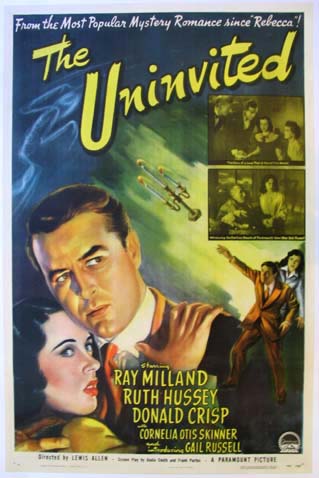
Horror Film Review: The Uninvited (dir by Lewis Allen)


the_uninvited_1944_film

If you want to see a really good haunted house movie, allow me to recommend that you track down the 1944 film, The Uninvited.  The Uninvited may not have been the first movie about a haunted house but it’s definitely one the best and one of the most influential.  None other than Guillermo Del Toro has regularly cited The Uninvited as an inspiration and, as I watched the film last night, I could definitely see where the film had influence Del Toro’s Crimson Peak.

The Uninvited tells the story of Rick Fitzgerland (Ray Milland) and his sister, Pamela (Ruth Hussey).  They’ve just purchased a long-empty seaside house and, incredibly, they were able to get it at an amazingly low cost!  The house’s owner, the frail Commander Beech (Donald Crisp, alternating between being menacing and sympathetic), was apparently desperate to get rid of it.

Far less happy about the selling of the house is Beech’s granddaughter, the mysterious Stella (Gail Russell).  As Stella explains it, she grew up in the house, her mother died in the house, and Stella is still attached to the house.  Beech has ordered Stella to stay away from the house but, with Rick falling in love with her, Stella is soon visiting on a regular basis.

Of course, Stella isn’t the only unexpected visitor that the Fitzgeralds get to know.  It quickly becomes obvious that there’s something strange about the house.  Rick and Pamela discover an artist’s studio that is always cold.  They both hear the sound of a woman crying.  Beech claims that it’s nothing to worry about.  Old house make weird noises, he informs them.  However, Rick and Pamela start to become convinced that the house is haunted.

Stella not only agrees that the house is haunted but she also informs them that she knows the identity of the ghost.  It’s Stella’s mother!  But if that’s true, why does the ghost constantly seem to be encouraging Stella to put her life at risk?  Why does Stella go into a trance and, much as her mother did 16 years earlier, attempt to jump over the side of a cliff?

Is Stella’s mother trying to manipulate her daughter into joining her in death?  Or is there something even more sinister happening?

Well-acted and perfectly paced, The Uninvited is an effectively creepy film, one that remains memorable even 72 years after it was initially released.  Visually, The Uninvited resembles a film noir and, if not for a brief scene towards the end of the film, viewers would be justified in wondering if the house really is haunted or if everyone in the film is just letting the isolation and the shadowy atmosphere get to them.  It’s that hint of ambiguity that elevates The Uninvited and makes it a truly thought-provoking haunted house story.


Horror Film Review: The Devil-Doll (dir by Tod Browning)


devil_dollposter

Paul Lavond (Lionel Barrymore) was just your ordinary Parisian bank owner until he was wrongly convicted of robbery and murder.  Sentenced to Devil’s Island and estranged from his beloved daughter, Lorraine (Maureen O’Sullivan), Paul spends 16 years plotting how to clear his name and progressively growing more bitter and angry.

He also befriends a scientist named Marcel (Henry B. Walthall).  Marcel has figured out the formula for shrinking people.  He’s convinced that shrunken people will eat less, use less fossil fuels, and take up a lot less space on the planet.  They’ll probably also be less likely to wage war on each other.  That’s right — the secret to world peace is shrinking the population.

However, Paul has other plans for that shrinking formula!  What better way to clear his name and seek revenge than by using a shrunken army of henchmen?

Uhmmm — okay, it sounds a little bit overcomplicated to me but who am I to doubt the wisdom of Lionel Barrymore?

(Yes, I know he’s Paul Lavond but, honestly, Lionel Barrymore is Lionel Barrymore regardless of who he’s playing.)

Anyway, Paul and Marcel escape from Devil’s Island but Marcel dies shortly afterward.  Paul, however, forms a partnership with Marcel’s widow, Maleta (Rafaela Ottiano).  Disguising himself as an elderly woman, Paul returns to Paris.  Not only does he use his disguise to watch over his daughter (who doesn’t realize that the kindly old woman is actually her father) but he also starts to develop quite a reputation for selling incredibly realistic dolls…

The Devil-Doll is an odd little mix of comedy and melodrama and, to be honest, it’s a bit too uneven to really work.  That said, the film is definitely worth watching just for the sight of Lionel Barrymore playing an elderly woman.  (Classic film lovers will immediately notice that, when in disguise, Lionel greatly resembles his sister, Ethel.)  This Christmas, when I’m watching It’s A Wonderful Life for the 100th time and Mr. Potter is cackling and plotting to put the Bailey Building and Loan out of business, I’ll have a hard time not thinking about The Devil-Doll.

The Devil-Doll was one of the final films to be directed by the legendary horror specialist, Tod Browning.  I’ve read that Browning’s later films suffered because Browning plunged into depression after the death of Lon Chaney, Sr. and he never quite recovered.  And, really, The Devil-Doll feels like a film that would have been perfect for Chaney’s unique talent.

But, that said, Lionel Barrymore appears to be having a lot of fun as Paul and his performance is the main reason to watch the film today.