Short Horror Film Review: Spirits of the Dead — Toby Dammit (dir by Federico Fellini)


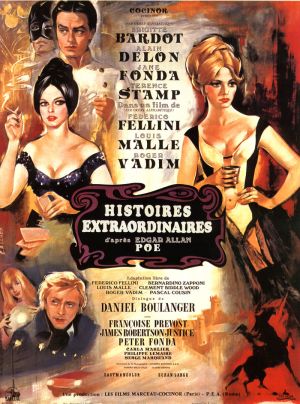
Directed by Federico Fellini, Toby Dammit was the third and final part of the 1968 anthology movie, Spirits of the Dead.

All three parts of Spirits of the Dead were based on a short story by Edgar Allan Poe.  Toby Dammit was based on Never Bet The Devil Your Head.  It seems appropriate that Fellini was the only director to rename his adaptation.  While Toby Dammit may be based on Poe’s story, it’s definitely Fellini’s film.

Terrence Stamp plays Toby Dammit, a former Shakespearean actor turned dissolute film star.  As is quickly established, Toby is an alcoholic.  As we watch him stumble through this film, alternatively bitter and flamboyant, we’re reminded of the stories of other British thespians who were legendary drinkers: Oliver Reed, Trevor Howard, David Hemmings, Peter O’Toole, and others.  With his Shakespearean background, it’s tempting to assume that Toby is meant to be a stand-in for Richard Burton but he actually bears a greater resemblance to Richard Harris.

(If you’re wondering how I came to be an expert on British alcoholics, might I recommend a short but informative book called Hellraisers: The Life and Inebriated Times of Richard Burton, Richard Harris, Peter O’Toole & Oliver Reed.  It was written by Robert Sellers and it makes for very interesting reading.  Especially the parts about Oliver Reed.)

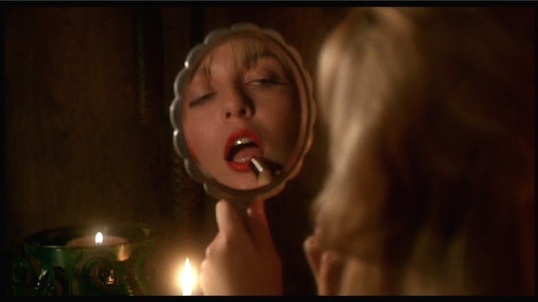
Toby has come to Rome, to work on a film.  He doesn’t seem to be quite sure what the film is about or what role he’ll be playing.  (Judging from what the people around him say, it appears to be a biblical epic and Toby will be playing Jesus.)  While Toby floats through the city in an alcoholic haze, sycophants and fans surround him.  While he sits in the back set of a limo, a fortune teller looks at his palm and gets a worried look on her face.  Toby doesn’t care.  He just wants to get the Ferrari that the film’s producers promised him.

The only thing that worries Toby is the little girl that he keeps seeing out of the corner of his eye.  She bounces a white ball and whenever Toby sees her, a truly evil smile cross her face.  Interestingly, Fellini always frames the girl so that, like Toby, we only seem to be seeing her out of the corner of our eye.  Is she real or is she a figment of Toby’s alcohol-addled brain?  And what are we to make of the fact that Toby’s normally noise-filled world goes silent whenever he sees the girl?
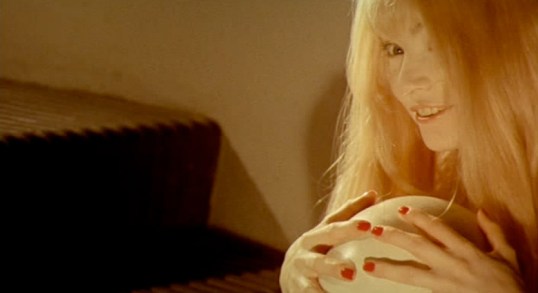
On a talk show, Toby is asked how he visualizes the devil.  He says that he doesn’t see the devil as being a demon with horns or an old man.  (Interestingly enough, that’s how Poe portrayed the Devil in the original short story.)  Instead, he sees the devil as being a little girl with a ball.

However, Toby can’t spend too much time worrying about the little girl.  He just got his Ferrari…

Toby Dammit is the only unqualified success among the three short films that make up Spirits of the Dead.  I think it helps that, unlike Roger Vadim and Louis Malle, Fellini updated Poe’s story to the 20th Century and set it in the international film world.  If Malle and Vadim both seemed detached from their segments, Fellini knew the world that he was depicting.  I imagine he certainly was acquainted with plenty of actors who were just like the brilliant but self-destructive Toby Dammit.

The images of frequently dream-like.  Everything is filmed slightly off-center, mirroring Toby’s hazy view of existence.  When he sits in his limo, the world outside looks like the ruins of some sort of apocalyptic hellscape.  When he is on a talk show or at an awards show, Toby still seems to be isolated from all of the adoring people around him.  The few times that he does talk to other people, he does so without looking at them.  In fact, the only person who seems to truly capture Toby’s attention is that little girl with the ball.

Speaking of which, it seems obvious that Toby Dammit was meant to be a bit of an homage to Fellini’s friend and fellow director, Mario Bava.  Not only is the film’s color scheme very Bavaesque but that little girl will look familiar to anyone who has ever seen Kill, Baby, Kill.

Valerio Valeri in Mario Bava’s Kill, Baby, Kill
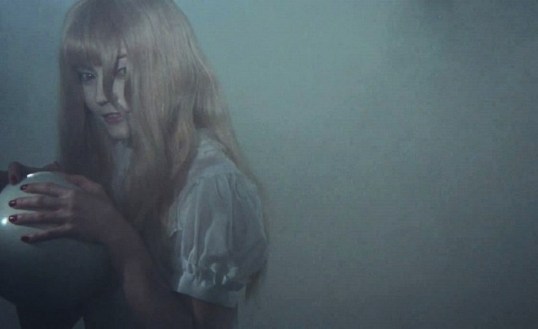
Marina Yaru in Federico Fellini’s Toby Dammit

Toby Dammit is definitely the best part of Spirits of the Dead.  It’s a true Italian horror classic.
Short Horror Film Review: Spirits of the Dead — William Wilson (dir by Louis Malle)


Directed by Louis Malle, William Wilson is the second part of the 1968 anthology film, Spirits of the Dead.  All three of the stories were adapted from the work of Edgar Allan Poe.

William Wilson is one of Poe’s best known and most highly regarded stories.  It’s also one that has been adapted into several films, perhaps most famously as the silent German film Student of Prague.  So, how did Louis Malle do when it came time to direct his own version?

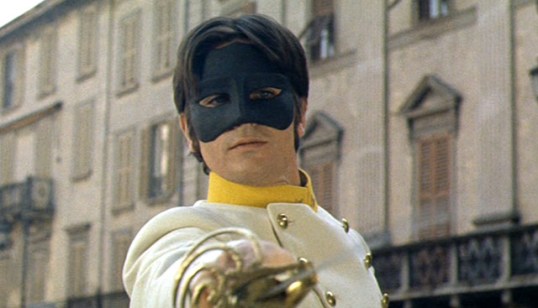
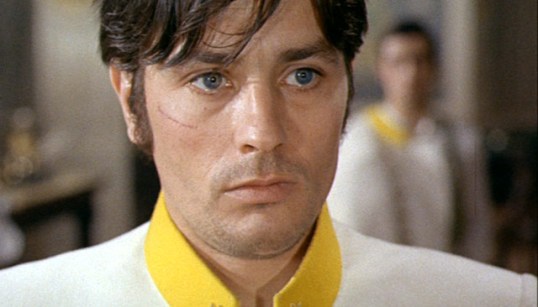
Malle’s William Wilson opens with the title character (played by Alain Delon) running through the cobblestone streets of a gray city.  As we shall soon learn, the time is the early 19th century.  William Wilson is an officer in the Austrian army, assigned to an occupied Italian village.  Wilson, with blood on his head, rushes into a church, ducks into a confessional, and tells the priest that he has just murdered someone.

Wilson goes on to tell the story of not just his life but also the life of his Doppelganger, who is also named William Wilson and who is just as virtuous as the first Wilson is corrupt.  All of his life, the first William Wilson has just wanted to be evil in peace and every time, the Doppelganger has shown up and ruined things.  The Doppelganger first showed up when Wilson was a young boy and he’s proceeded to always pop up wherever Wilson may happen to go.  When the first Wilson was enrolled in medical school and wanted to dissect a village girl, his Doppelganger had to show up and stop things.  When the first Wilson beat the famous courtesan, Giuseppina (Brigitte Bardot), at cards and won the right to whip her, the Doppelganger had to show up and let everyone know that Wilson had cheated.  Is the Doppelganger real or is he just a figment of Wilson’s imagination?  Is Wilson just evil or is he crazy as well?  Wilson isn’t sure but he does know that a well-placed dagger is one way to determine the truth…

Reportedly, Malle agreed to direct William Wilson because he was trying to raise the money to direct a far more personal film, Murmer of the Heart.  As such, Malle didn’t have a personal stake in William Wilson and made several compromises to keep the film’s producer happy.  As a result, William Wilson often doesn’t make much sense.  For instance, how does Wilson go from being merely decadent to suddenly trying to dissect a living human being?  Though the idea of Wilson cheating at cards is taken straight from Poe’s original story, Brigitte Bardot’s lengthy cameo still feels out of place.

That said, Malle was a good enough director that, even if he was detached from the end result, his segment of Spirits of the Dead is always watchable.  The film’s best moments are the ones that simply study Alain Delon’s fascinating face.  Delon feels miscast as the virtuous Doppelganger (who, let’s just be honest, is kind of a prig) but he is dangerously compelling at William Wilson.  The coldness of his eyes tells us everything that we need to know about who William Wilson is.

William Wilson is technically better than the 1st part of Spirits of the Dead, Roger Vadim’s Metzengerstein, but it’s never as much fun.

Short Horror Film Review: Spirits of the Dead — Metzengerstein (dir by Roger Vadim)


First released in 1968, Spirits of the Dead is an anthology film, one in which three famous international directors (Roger Vadim, Louis Malle, and Federico Fellini) each took a shot at adapting a short story by Edgar Allan Poe.  By their very nature, anthology films tend to be uneven and that’s certainly the case with Spirits of the Dead.

Consider the first story in the film, Roger Vadim’s adaptation of Metzengerstein.  Vadim was best known for his visually lavish films, the majority of which starred whoever he happened to be romantically involved with at the time.  Vadim’s films were sexually charged and decadent but it was a very specific, late 60s type of decadence.  They may have seemed wild when they were first released but, seen today, his films seem rather quaint (not to mention dated).

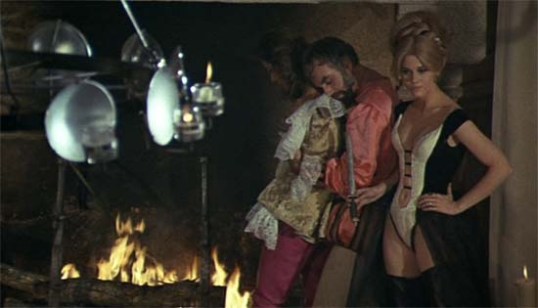
Anyway, when Vadim was hired to shoot his part of Spirits of the Dead, he was married to Jane Fonda so, of course, she stars as Countess Frederique Metzengerstein (Jane Fonda).  That Countess Frederique is evil is obvious from the start.  In between having tastefully shot orgies, she torments her servants.  She even has one servant boy hung so that she can see if she can shoot an arrow through the rope.  (Fortunately, for the servant boy, she can.)  It’s an evil, spiritually empty life but, as can be seen in the picture above, her clothes are to die for.

(Though Metzengerstein appears to be taking place in the 19th century, everyone looks like they’ve just flown over from swinging London.  There’s a lot of miniskirts, sideburns, and tinted glasses.)

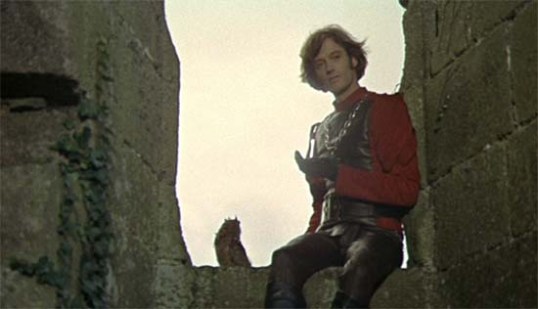
Anyway, things change for Frederique when she meets her virtuous cousin, Wilhelm.  She immediately falls into lust with him but he wants nothing to do with her and her evil ways.  (Her cousin, I might add, is played by Peter Fonda, brother of Jane.)  Upset over being rejected, Frederique sets his stables on fire.  Wilhelm dies in the inferno.

After Wilhelm’s death, a new horse suddenly appears outside of Frederique’s castle.  Convinced that Wilhelm’s spirit has inhabited it, Frederique grows obsessed with the horse.  Soon, Frederique is spending all of her time riding the horse.  With no more time to be evil, Frederique becomes less feared.

But, in the distance, there are always flames calling out to her…

So, let’s just start with the obvious.  There is a huge ick factor to be found in Metzengerstein.  Just as Frederique spends the first half of the movie in love with her cousin, Jane Fonda spends the first half of the movie pretending to be in love with Peter Fonda.  Wilhelm, of course, rejects Frederique but still, it just feels undeniably … creepy.  What’s odd is that it’s difficult to tell if Vadim was trying to make the audience uncomfortable or if this casting was just a case of Peter having some time to kill while visiting his sister and brother-in-law.  For all the attention that he pays to the film’s lush visuals, Vadim is such a detached storyteller that it’s hard to guess what his intention was.

Jane Fonda gives a good performance as the cruel Frederique but otherwise, everyone else in the film is just a part of the scenery.  That’s the thing with Metzengerstein.  It’s a gorgeous film but, ultimately, it’s all scenery that adds up to nothing.


Horror Scenes That I Love: Danny Meets The Girls In The Shining


Today’s horror scene that I love is from 1980’s The Shining.

(As much as I loved It and regardless of King’s own opinion, Stanley Kubrick’s The Shining remains the best Stephen King adaptation to date.)

I’ve seen this scene a hundred times.

It still freaks me out.

4 Shots From 4 Films: Special David Lynch Edition


4 Shots From 4 Films is just what it says it is, 4 shots from 4 of our favorite films. As opposed to the reviews and recaps that we usually post, 4 Shots From 4 Films is all about letting the visuals do the talking.

This October, I am going to be using our 4 Shots From 4 Films feature to pay tribute to some of my favorite horror directors, in alphabetical order!  That’s right, we’re going from Argento to Zombie in one month!

Today’s director: the one, the only David Lynch!

4 Shots From 4 Films

Eraserhead (1977, dir by David Lynch)

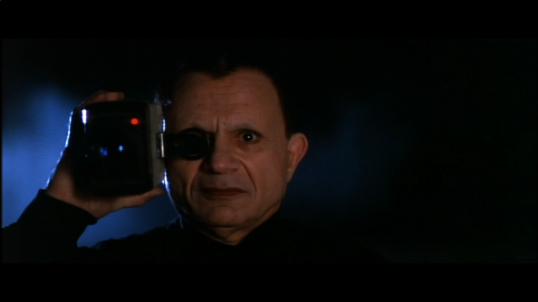
Twin Peaks: Fire Walk With Me (dir by David Lynch)

Lost Highway (1997, directed by David Lynch)

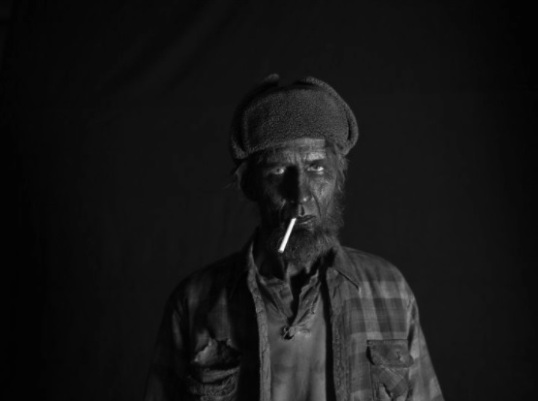
Twin Peaks: The Return (2017, dir by David Lynch)


Horror On The Lens: Gammera The Invincible (dir by Noriaki Yuasu and Sandy Howard)


Okay, I’ll be the first to admit that 1966’s Gammera The Invincible is not really a horror film.  Maybe there was a time when people found the idea of a giant, fire-breathing turtle to be scary but I kind of doubt it.

But let’s think about this!  What better time is there to watch a movie about giant, fire-breathing turtle than in October?

Seriously, this is a fun movie and if you’ve got some time to kill this morning, I guarantee this movie will make you smile.

As I wrote in my 2014 review of this film, Gammera is one hell of a turtle.

Enjoy!

The TSL’s Horror Grindhouse: Nightmare Beach, a.k.a. Welcome to Spring Break (dir by Harry Kirkpatrick and Umberto Lenzi)


Did Umberto Lenzi direct the 1989 film, Nightmare Beach?

That’s a question that Italian horror fans have been debating for a while now.  The film’s credited director is Harry Kirkpatrick.  Due to the fact that Kirkpatrick has no other known credits, it’s generally agreed that Kirkpatrick was a pseudonym.  But was it a pseudonym for Lenzi, screenwriter James Justice, or both of them?  In an interview for the book Spaghetti Nightmares, Lenzi said that he was originally hired to direct but, at the last minute, he changed his mind because he felt the film was too similar to his 1972 giallo, Seven Blood-Stained Orchids.  Lenzi says that he withdrew from directing but that he remained on set to provide technical assistance to the film’s actual director, “Harry Kirkpatrick,” who Lenzi also says co-wrote the script.  That may sound simple enough but skeptics point out that worrying about repeating himself didn’t dissuade Lenzi from following up Eaten Alive with Cannibal Ferox.  (Add to that, would Lenzi really have been concerned about duplicating a film that he made 17 years previously?)  As well, James Justice only has two credits listed on the imdb, one for writing this film and one for 2006’s Lesser Evil.

(For the record, I did a google search on James Justice and I didn’t find much.  However, I did comes across several Scientology sites that featured testimonials from “James Justice, screenwriter.”)

As for what the film’s about, it’s a strange combination of genres.  It starts out with a prisoner named Diablo (Tony Bolano) being sent to Florida’s electric chair.  Diablo was the leader of an infamous motorcycle gang.  He was convicted of murdering a teenage girl but, as he dies, Diablo yells that he’s been framed and that he was innocent.

However, no need to worry too much about Diablo!  No sooner has Diablo been sent to the chair then suddenly, Nightmare Beach turns into a spring break comedy!  Teenagers and college students are flooding the beaches of Florida and all they want to do is have a good time!  The local fire-and-brimstone preacher (Lance Le Gault) can’t stop the party, no matter how many times he says that everyone’s going to Hell.  The police chief (John Saxon) puts extra patrols on the beach.  The local doctor (Michael Parks) prepares to treat a hundred cases of alcohol poisoning.

The beach turns into a huge party!  Bands play.  T-shirts get wet.  For some reason, one dorky frat boy does the whole pretending to be dead while floating in the pool routine.  A young woman tries to stay in a hotel for free without getting caught.  Meanwhile, two college football players, Skip (Nicolas de Toth) and Ronny (Rawley Valverde) roll into town.  Skip is depressed because he lost the big game but Ronny is determined that his best friend is going to have a good time and get laid!  Whenever Skip gets depressed, Ronny pelts him with condoms.

It’s Spring Break!  Everyone’s going to have a good time…

Except, suddenly, a mysterious figure on a motorcycle rolls into town.  He never speaks.  He never takes off his helmet.  However, he does electrocute everyone that he meets.  Sometimes, he uses live wires and sometimes, he just has them sit on the back of his motorcycle, which has been designed to act as an electric chair.  Could it be the ghost of Diablo, seeking vengeance?  When Ronny disappears — NO!  NOT COMEDY RELIEF RONNY — Skip is determined to find out what’s going on.  Working with him is Gail (Sara Buxton), the sister of the girl that Diablo was convicted of murdering…

One reason why so many Italian horror aficionados are convinced that Umberto Lenzi must have directed Nightmare Beach is because, with its odd mix of genres and its weird combination of comedy and extreme gore, it just feels like an Umberto Lenzi film.  Add to that, around the same time that Nightmare Beach was filmed and released, Lenzi also filmed and released another film about teenagers being murdered during spring break, Hitcher In The Dark.

Because it’s such a strange mix of genres, Nightmare Beach is a much more interesting film than Hitcher In The Dark.  The motorcycle-driving killer is somehow both ludicrous and frightening at the same time. Plus, how can you resist a movie with both John Saxon and Michael Parks as ineffectual authority figures?  It just can’t be done.

The TSL’s Horror Grindhouse: Spasmo (dir by Umberto Lenzi)


Yesterday, Italian horror fans were saddened to hear of the passing of director Umberto Lenzi.

Over the course of his long career, Lenzi worked in almost every possible genre of Italian film.  He directed spy films.  He directed westerns.  He did a few comedies.  He directed two movies about Robin Hood.  In the wake of the international success of The French Connection, he was one of the leading directors of Italian crime films.  Among fans of Italian horror, he is best known for his cannibal films and his work in the giallo genre.  He even directed the first fast-zombie film, Nightmare City, a film that very well may have served as an inspiration for 28 Days Later.  According the imdb, Lenzi is credited with directing 65 films.  Some of them were good.  Many of them, if we’re to be honest, were rather forgettable.

But none were as strange as 1974’s Spasmo.

Attempting to detail the plot of Spasmo is a challenge.   Even by the twisty standards of the giallo genre, the mystery at the heart of Spasmo is a complicated one. According to Troy Howarth’s So Deadly, So Perverse Volume Two, even Lenzi admitted that Spasmo‘s storyline made no sense.  Add to that, Spasmo features so many twists and turns that it’s difficult to judge just how much of the movie’s plot you can safely describe before you start spoiling the film.

Spasmo tells the story of a man named Christian (Robert Hoffman).  While Christian is out walking on the beach with his girlfriend, they come across a woman lying face down in the surf.  The woman is named Barbara (Suzy Kendall) and, though she declines to explain why she was lying in the middle of the beach, Christian still becomes obsessed with her.  Barbara runs off but then he just happens to run into her at a party that’s being held on a boat.  Christian may be with his girlfriend and Barbara may be with her boyfriend but they end up leaving together.  Barbara says she will make love to Christian but only if he shaves his beard.

Meanwhile, lingerie-clad mannequins are being found on the beach.

Christian ends up getting attacked by a man named Tatum.  Christian shoots Tatum but then the body disappears.  Christian and Barbara hide out at a lighthouse.  There’s another couple at the lighthouse and where they came from is never quite clear.  They say that a dead body has recently been discovered but, when Christian demands to know what they mean, they say that they’re just joking.  Later, Christian thinks that he sees Tatum walking around but, just as suddenly, Tatum’s gone.

Christian is convinced that his brother, Fritz (Ivan Rassimov) can help him.  Barbara says that there is no hope.  We know better than to trust Fritz because he’s played by Ivan Rassimov.  Possessing the best hair in Italian horror, Ivan Rassimov almost always played the heel…

Meanwhile, mannequins continue to be found on the beach.

That may sound like I’ve described a lot of plot but I’ve actually only begun to scratch the surface.  Even by the standards of Italian thrillers, Spasmo is chaotic.  The film may not make any sense but it’s never boring.  Between the mannequins and the murders, it’s pretty much impossible to follow the plot but who cares?  As directed by Lenzi, Spasmo plays out like a dream, full of surreal images and memorably weird performances.  Robert Hoffman and Suzy Kendall are ideally cast while Ivan Rassimov is wonderfully slick and enigmatic as Fritz.  Spasmo is a film that keeps you guessing.  Whether it keeps you guessing because the plot is clever or because the plot itself is deliberately designed (and filmed) to make no sense is something that viewers will have to determine for themselves.  Personally, I think it’s a little of both.

Lenzi may not have cared much for Spasmo but it’s one of his most memorable films.

Horror Scenes that I Love: The Opening 6 Minutes of Jean Rollin’s Fascination


Today’s horror scene that I love comes from Jean Rollin’s surrealistic 1979 masterpiece, Fascination.

Below, you’ll fin the opening 6 minutes of Fascination, which contains some of the best examples of Rollin’s dream-like imagery.  The dance on the bridge remains one of his most haunting images.