A New Orleans Film Review: J.D.’s Revenge (dir by Arthur Marks)


Ike (Glynn Turman) is a nice guy.  He’s a law student living in New Orleans.  When not studying, he makes money driving a taxi cab.  He has a beautiful and loving wife named Christella (Joan Pringle).  He has a nice but modest apartment.  When we first see Ike, he is calmly and rationally breaking up a fight.  Perhaps the only real complain that can be made about Ike is that he’s actually too nice.  There’s nothing dangerous about Ike.  He works hard.  He studies.  That’s about it.

When Christella and their friends tell him that he needs to take a night off from studying, Ike is reluctant.  However, he finally agrees to go out with them.  They start out at a strip club in the French Quarter and eventually, they end up watching a hypnotist.  Ike is one of the men randomly selected to go up on stage.  Amazingly, rational and mild Ike is easily hypnotized.  The audience loves watching as Ike and the other men all reacts to hypnotic suggestion.  What they don’t know is that, while in his trance, Ike has been … possessed!

That’s right!  The ghost of J.D. Walker has entered Ike.  Who is J.D. Walker?  As we learn from a series of gauzy flashbacks, J.D. Walker was a gangster in the 1940s.  He wore a fedora.  He wore nice suits.  He was every bit as flamboyant as Ike is mild.  But then, one day, J.D. was killed, gunned down by his former business partner, Theotis Bliss (Fred Pinkard).

Soon, Ike starts to act … well, not like himself.  Suddenly, Ike is using 1940s slang.  He’s wearing 1940s clothes.  He’s gambling.  He mugs an old lady who gets in his cab and then abandons her on the wharf.  When his wife asks him why he’s acting like a 1940s gangster, he gets violent.  Soon, Ike is speaking in a different voice and dancing.

What does J.D. want?  He wants revenge against not only the man who shot him but also Theotis’s younger brother, a popular preacher named Elijah (Lou Gossett, Jr.).  As wild as the possessed Ike may be, he’s got nothing on Elijah.  Elijah was a boxer before he became a man of God and he’s still liable to throw a punch or two during his sermons.  Elijah, however, is also rather naive and has no hesitation about inviting J.D. to become a member of his congregation.  Theotis, who is now Elijah’s manager, is a bit more suspicious…

An oddly paced film that never quite escapes the lengthy shadows of all of the horror films that inspired it, J.D.’s Revenge is worth seeing for the performances Glynn Thurman and Lou Gossett, Jr.  Gossett is all energetic charisma in the role of the reverend, giving a performance that features just enough ambiguity that you’re never sure whether you should trust Elijah or not.  Meanwhile, Thurman is very good as the mild-mannered Ike but he seems to be having an absolute blast whenever he gets to play the psychotic J.D.  During the final confrontation between Ike/J.D. and the Bliss Brothers, Thurman’s performance is so bizarre and over the top that you simply cannot stop watching him.

J.D.’s Revenge was filmed in New Orleans, which add a little bit of gothic atmosphere to the film.  As I write this, a lot of our readers may currently be in New Orleans for Mardi Gras.  I wish them all well but I hope they’ll remember the lesson of J.D.’s Revenge.  Just say no to hypnosis!

Scenes that I Love: The Iguanas On The Coffee Tables From Bad Lieutenant: Port of Call New Orleans


If you’re in New Orleans for Mardi Gras, please be sure to keep an eye out for the iguanas.

Ever since Werner Herzog’s Bad Lieutenant: Port of Call New Orleans was first released, people have debated the symbolism of the iguanas on the coffee table.  Are they just a sign that Nicolas Cage’s bad lieutenant is totally high or do they have a deeper meaning?  Myself, I’m not even going to try to guess.  All I know is that the lieutenant eventually came to appreciate their presence.

Lisa Reviews An Oscar Nominee: Shanghai Express (dir by Josef von Sternberg)


(With the Oscars scheduled to be awarded on March 4th, I have decided to review at least one Oscar-nominated film a day.  These films could be nominees or they could be winners.  They could be from this year’s Oscars or they could be a previous year’s nominee!  We’ll see how things play out.  Today, I take a look at the 1932 best picture nominee, Shanghai Express!)

Welcome to China, circa 1931.  The country is beautiful, mysterious, and dangerous.  Civil War has broken out and living in China means being caught between two equally brutal forces, the government and the Communists.  Captain Doc Harvey (Clive Brook) is scheduled to ride the so-called Shangai Express, the train that will take him from Beiping to Shanghai.  The Governor-General is ill and Doc Harvey is the only man in China who operate on him.

For Doc, it’s a matter of duty.  However, soon after boarding, he discovers that he is traveling with the infamous Shanghai Lily (Marlene Dietrich).  Though Doc has never heard of her, everyone assures him that Shanghai Lily is one of the greatest courtesans in China.   When Doc does finally meet her, he’s shocked to discover that Shanghai Lily is his former lover, Magdalen.  Did his decision to break up with her lead to Magdalen becoming a courtesan?

“It took more than one man to change my name to Shanghai Lily,” she replies.

However, Doc and Lily aren’t the only two people with their own personal drama taking place on the train.  The train is full of passengers, all of whom have their secrets.  Some of the secrets are minor.  One woman spends most of the trip trying to keep anyone from discovering that she’s smuggled her dog onto the train.  Other secrets are major.  It is suspected that one of the passengers might be working for the rebels.  And then there’s people like Sam Salt (Eugene Pallette), who is addicted to gambling and Eric (Gustav von Syffertitz), the opium dealer.  Looking over it all is a Christian missionary (Lawrence Grant) who considers both Lily and her companion, Hui Fey (Anna May Wong), to be fallen women.

It’s not an easy journey, no matter how nice and romantic the train may be.  If the express isn’t being stopped by government soldiers, it’s being hijacked by a warlord who not only wants to stop Doc from performing the operation but who also wants to take Lily back to his palace…

Shanghai Express is pre-code drama at its best.  Director Josef von Sternberg delivers an ornate mix of opulence and melodrama, never shying away from the story’s more flamboyant possibilities.  Marlene Dietrich, appearing in her fourth film for von Sternberg, gives a strong and unapologetic performance as Shanghai Lily.  Just as Lily never apologizes for who she is, the film both refuses to judge her and condemns anyone who would try.  The film’s sympathy is purely with Dietrich and Wong as they do what they must to survive in a world dominated by men who are either judgmental, brutish, or weak.  (Within just a few years, the Hays Code would make it impossible for a film like Shanghai Express to be made by an American studio.)  With one very important exception, the entire cast is strong, with Warner Oland and Eugene Pallette especially turning in strong support.  The only exception is Clive Brook, who comes across as being a bit too dull to have ever won the the heart of Shanghai Lily.

Shanghai Express is not the best von Sternberg/Dietrich collaboration.  That would be the brilliantly insane Scarlet Empress.  However, it’s still a wonderfully entertaining melodrama.  It was nominated for best picture but lost to another entertaining melodrama, Grand Hotel.

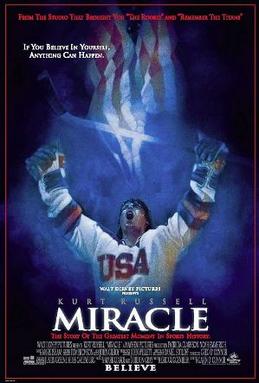
An Olympic Film Review: Miracle (dir by Gavin O’Connor)


(Back in 2011, Chris Mead — who wrote under the name Semtex Skittle — reviewed Miracle for this site.  At the that time, I had not seen the film.  Below are my thoughts but please, also be sure to read Chris’s review as well.)


Like all good people, I’m currently obsessed with the Winter Olympics.  Earlier this week I asked a couple of friends if they could recommend some good Winter Olympics movies.  A lot of movies were suggested but, without fail, everyone thought I should see Miracle.  (A lot of people also suggested Cool Runnings, which I’ll be watching next week.)  Having watched Miracle earlier today, I can see why everyone recommended it.

The year is 1980 and two hockey teams are about to face off at the Winter Olympics in upstate New York.  (The location, to be exact, is Lake Placid.  Fortunately, the giant alligators are nowhere to be seen.)

On one side you have the Russian team (or the Soviets as they were known back then).  They are widely considered to be one of the greatest hockey teams in history.  They are big, fierce, and determined.  Coming from a system that has declared individuality to be a crime against the state, the Soviet team plays like a machine.  The Soviets have won the gold in the last four Olympics.  As one American coach puts it, their greatest strength is that every other hockey team in the world is terrified of them.

On the other side, you have the American team.  However, this isn’t the type of American dream team that one would expect to see today.  In 1980, professional athletes were not allowed to compete on the U.S. Olympic team.  Instead, the 1980 hockey team is made up of amateurs and college players.  Unlike the Soviet teams, the American don’t have a government that grooms and supports them.  Instead, win or lose, they have to do it on their own.

Of course, it’s not just two hockey teams that are about to face off.  It’s also two super powers and two very different ways of life.  In 1980, the U.S. and the Soviet Union were the two most powerful rivals in the world.  The Soviets were trapped in an endless and unpopular war in Afghanistan.  Meanwhile, in the U.S., the economy was shaky, American citizens were being held hostage in Iran, and an ineffective President gave long-winded speeches about how unhappy everyone in the country appeared to be.  Both countries needed a victory but only one could win.

And it would take a miracle for that winning team to be American…

I don’t think it requires a spoiler alert to tell you that’s exactly what happens.  I mean, after all, I’m reviewing a film  called Miracle!  On top of that, it’s based on true events.  The U.S. hockey team — made up of college students and led by Coach Herb Brooks (played, in one of his best performance, by Kurt Russell) — not only managed to defeat the highly favored Soviet team but they went on to win the gold medal.

Even if you didn’t know that the Americans beat the Russians, you would never have any doubt about how Miracle is going to end.  Miracle is a film that utilizes almost every sports film cliché but it manages to do so with such sincerity and such style that you don’t mind the fact that the movie doesn’t exactly take you by surprise.  Is there any actor who is as good at project sincerity and human decency as Kurt Russell?  Whenever he says that he’s going to make his team into champions, you believe him.  When he says that he’s being hard on them because he wants them to be the best, you never doubt him or his techniques.  When he says that he’s proud of his team and his country, it brings tears to your eyes.  If there’s ever a movie that deserves a chant of “USA!  USA!  USA!,” it’s Miracle.

Mardi Gras Film Review: Mardi Gras Massacre (dir by Jack Weis)


(Note: The Trashfilm Guru reviewed this film on his own site in 2012.  Check out his review by clicking here!)

With this being Mari Gras weekend, I imagine that thousands of people are currently flooding into New Orleans and hoping to have a good time.  In honor of their commitment, I have been reviewing Mardi Gras-themed films.  Today’s film is low-budget 1978 “shocker” called Mardi Gras Massacre.

A serial killer is stalking New Orleans and…

Wait a minute.  Does this sound familiar?  Hmmm … okay, sorry, let’s continue.

…the police are powerless to stop him…

Okay, I swear, I think I’ve described this situation before.  But, anyway, to continue with Mardi Gras Massacre:

…despite being the most obvious serial killer in history, the murderer is able to move undetected through the Big Easy.  His motive?  Human sacrifices to an evil power…

OKAY, STOP! I just realized that I’m basically rewriting my earlier review of Mardi Gras For The Devil.  Despite the fact that there’s a 15-year age difference between the two films, both Mardi Gras Massacre and Mardi Gras For The Devil have the same basic plot.  A psycho wanders around New Orleans and commits occult-themed murders while an intense cop tries to stop him.  Eventually, the cop’s lover is targeted by the killer…

I mean, it’s the exact same plot!  The only real difference is that Mardi Gras For The Devil starred recognizable actors like Michael Ironside and Robert Davi while Mardi Gras Massacre was a low-budget obscurity starring no one that you have ever heard of.

In Mardi Gras Massacre, the killer’s name is John and he’s played by an actor named William Metzo.  John spends all of his time looking for prostitutes and strippers who he can sacrifice to an Aztec God.  John has an altar in his apartment.  The altar, of course, is surrounded by red curtains.  As I watched the film, I wondered where he got the altar.  Even more importantly, I wondered how he could fit that huge altar into what appeared to be a pretty small apartment.

John manages to sacrifice quite a few women without anyone becoming overly suspicious of him.  This is despite the fact that John spends almost the entire movie wearing a three-piece suit and glaring at everyone he meets.  When John steps into a bar, the first thing that he asks the bartender is where he can find the “evilest” prostitute.  No one seems to find that strange.  Then again, New Orleans is a very forgiving town.

Anyway, Sergeant Frank Herbert (Curt Dawson) is in charge of the investigation and, as soon as he shows up with his porn stache and his hairy chest, we know that we’re watching a movie from the 70s.  Sgt. Herbert falls in love with a prostitute named Sherry (Gwen Arment).  Halfway through the film, we get an extended falling in love montage.  New Orleans looks really pretty in the montage but, at the same time, the film has just spent 45 minutes establishing it as a city where a serial killer can ask for the “evilest” prostitute without raising any suspicion.  So, romantic montage outside, I have hard time believing that Mardi Gras Massacre did much for New Orleans tourism.

I should point out that, much as with the case of Mardi Gras For The Devil, there’s not really a whole lot of Mardi Gras to be found in Mardi Gras Massacre.  Towards the end of the movie, we get a chase through a Mardi Gras parade.  It’s obvious that the filmmakers filmed the chase during the actual parade so, from a historical point of view, it’s interesting to see how Mardi Gras was celebrated in the 70s.  At the same time, throughout the entire scene, drunk people are waving at the camera.  (One person even tries to grab the lens as they walk by.)

On a positive note, Mardi Gras Massacre features one of the best trashy disco scenes ever .  As well, the version that I watched had Spanish subtitles and I’m happy to say that my Spanish is apparently getting pretty good!  As for the rest of the film, it’s a movie that will be best appreciated by grindhouse aficionados.  It’s a low-budget, poorly acted, thoroughly silly film and its obviously fake gore managed to get the film banned in the UK.  It’s a historical oddity and, like many grindhouse films, its appeal mostly comes from watching it and saying, “Someone actually made this and managed to get it into theaters.”  At the very least, it will hopefully remind you to not admit to being the “evilest” anything during Mardi Gras.

Scenes That I Love: The New Orleans Funeral from Live and Let Die


If any of our readers are in New Orleans for Madi Gras weekend, a word of caution.

If you see a funeral procession, don’t ask who the funeral is for.

Seriously.

This scene is from 1973’s Live and Let Die.  It’s a scene of many emotions.  It may start out with the sond of a sad tune but everyone’s pretty happy by the end of it.

Lisa Reviews An Oscar Nominee: Kitty Foyle (dir by Sam Wood)


(With the Oscars scheduled to be awarded on March 4th, I have decided to review at least one Oscar-nominated film a day.  These films could be nominees or they could be winners.  They could be from this year’s Oscars or they could be a previous year’s nominee!  We’ll see how things play out.  Today, I take a look at the 1940 best picture nominee, Kitty Foyle!)

Kitty Foyle opens with a title card informing us that, before the film can tell us the story of Kitty Foyle, it is necessary to remind audiences of how Kitty Foyle — and so many other “white-collar” girls — arrived in their present (which is to say, 1940) situation.

We then get a strange little montage of life at the turn of the century.  A woman meets a man.  The man marries the woman.  They’re a happily married couple.  The man goes to work.  The woman takes care of the house.  The man comes home.  Everything’s perfect.  Then suddenly — oh my God, it’s the suffragettes!  They’re holding rallies!  They’re parading around with signs!  They’re demanding the right to vote!  They’re demanding prohibition!  Suddenly, women are expected to be independent and to have careers…

Which leads us to New York in the 1940s, where a bunch of women in an elevator discuss how difficult it is to find a good husband, especially now that they’re all busy working as salespeople and administrative assistants.  Apparently, this is the price that we all had to pay for the right to vote.  On the one hand, the women who cast their first votes in 1920 elected Warren G. Harding and spared the nation from another four years of Wilsonianism.  On the other hand, it’s now difficult to find a husband.

Fortunately, Kitty Foyle (Ginger Rogers) doesn’t have that problem.  She has a wonderful suitor, a man who has just asked her to marry him.  His name is Dr. Mark Eisen (James Craig).  He may not have a lot of money but he’s handsome, he’s considerate, and he spends all of his time providing medical care to the poor and indigent.  When Mark asks her to marry him, he asks her if she’s sure that she’s over that man from Philadelphia.  Kitty says that she is.

Of course, as soon as Kitty returns home, that man from Philadelphia is waiting for her.  Wyn Stafford VI (Dennis Morgan) is handsome, rich, and totally in love with Kitty.  Of course, he’s also married to his second wife.  (The identity of his first wife isn’t revealed until late in the film but you’ll be able to guess who she is.)  Wyn is in love with Kitty and he wants her to run away to South America with him.  Kitty says yes.

However, as Kitty is packing to leave, her reflection in the mirror starts talking to her.  It turns out to be a pretty judgmental mirror.  The rest of the film is an extended flashback, showing us how Kitty was raised by her single father (Ernest Cossart), how she first moved to New York, and how she met and fell in love with both Wyn and Mark.  Will she run off and live in wealthy sin with Wyn?  Or will she stay in New York and marry honest, hard-working Mark?

The main problem with Kitty Foyle is that there really isn’t much suspense as far as the film’s central dilemma is concerned.   Mark is a living saint who heals children.  Wyn is a heel who wants to abandon his wife and son so that he and Kitty can live in South America.  About the only thing that Wyn has going for him is that he’s got a better sense of humor than Mark but, in 1940, that wasn’t necessarily considered to be a good thing.  There’s really no question about who Kitty is going to pick and, in fact, the answer is so obvious that you kind of lose respect for Kitty when it takes her so long to make up her mind.  It’s like being told you could either marry a Nobel Peace Prize winner or someone who embezzles from a charity and replying, “Let me think about it…”

Of course, the main focus of Kitty Foyle is less on the love triangle and more on Ginger Rogers’s performance as Kitty.  This was one of Ginger’s first films after she stopped making films with Fred Astaire and it’s obvious that the film’s main theme was that Ginger Rogers could do more than just dance with Fred.  In Kitty Foyle, she gets to make jokes.  She gets to cry.  She gets to fall in love.  She gets a huge dramatic scene in which she mourns the loss of a child.  She does it all and yes, she does it very well.  Still, Kitty Foyle is never as much fun as the movies that she made with Fred.

Ginger Rogers won the Oscar for Best Actress for her performance in Kitty Foyle, beating out Katharine Hepburn, Joan Fontaine, Bette Davis, and Martha Scott.  Kitty Foyle was nominated for Best Picture but lost to Hitchcock’s Rebecca.

Film Review: The Cutting Edge: Fire and Ice (dir by Stephen Herek)


Right now, like all good people, I am totally obsessed with the Winter Olympics.  The skiing, the figure skating, the bobsleds, the luge .. even that silly speed skating thing that they do.  For the next two weeks, I’ll be loving all of it.  Last night, I not only watched the Opening Ceremonies but I also watched two movies about figure skating: Ice Princess and The Cutting Edge: Fire and Ice!

The Cutting Edge: Fire and Ice tells the story of Alex Delgado (Francia Raisa) and James McKinsey (Brendan Fehr).  Alex used to be a champion figure skater until her partner (both on the ice and in romance) retired.  This led to Alex not only retiring but also breaking up with the man who she thought was the love of her life.  Now, she spends her time teaching children how to skate and not going out on dates.  Her mother worried about Alex.  Not only is she throwing away her dreams but she also appears to be destined to be alone forever.

James was a champion speed skater, until his cocky attitude and his anger management programs got the better of him.  After punching out one of his teammates, James is suspended from speed skating.  However, James and his agent have a plan!  What if James becomes a … figure skater!?  He just needs a good coach and a great partner.  The coach is easy to find.  Zhen Zheng (Zhenhu Han) may not speak English but he loves a challenge and he travels with a translator (Russell Yuen).

But what about finding the right partner?  No one wants to skate with James, especially since everyone assumes that this is all just a publicity stunt until he’s able to get his suspension overturned.  When Alex is first approached about coming out of retirement and partnering up with James, she refuses.  But then, she realizes that, even if she doesn’t like James, she loves to skate and she loves to compete…

It’s not a match made in heaven, for all of the usual PG-13 reasons.  James is cocky and, instead of getting rest before practice, he goes to a party and then he has to skate with a hangover.  Alex is determined and disciplined but she’s afraid to take chances.  When James comes up with a spectacular move, Alex isn’t sure if they should do it or not.  At first, it doesn’t seem like they’ll ever be able to work together but then, things change.  Alex discovers that James loves children.  James discovers that Alex can shoot pool.  Add to that,  they’re the best-looking people in the movie and that means that they’re destined to get together.

The Cutting Edge: Fire and Ice is a film that is all about montages.  The film proves that you can learn anything in a montage.  As long as the right music is playing in the background, you can go from being awkward on the ice to a championship skater in one montage.  You can go from hating each other to being madly in love in montage.  Any questions you may have about the film’s plot can be answered by a montage.

This movie was made for Freeform, back when it was still ABC Family.  So, don’t expect anything too edgy.  At one point, James and Alex play strip poker and are both in their underwear when Alex’s mom drops by.  That’s about as wild as things get.  That said, this was a sweet if predictable movie.  Brendan Fehr and Francia Raisa had a lot of chemistry and the skating scenes were fun to watch.  I liked the fact that Alex refused to put up with anyone’s crap and the film celebrated her for that.  (Just compare this film to the original The Cutting Edge.)  I also liked the fact that James and Alex initially bonded during a bar fight.  Seriously, some of the greatest relationships in the world began with a brawl in a bar.

The Cutting Edge: Fire and Ice was a sweet, little movie.  It won’t change the world but I enjoyed it.

A Mardi Gras Film Review: Mardi Gras For The Devil (dir by David A. Prior)


A maniac is holding New Orleans hostage!  He’s committed a series of savage, Satanically-influenced homicides and the police cannot seem to even slow him down!  The entire city is terrified!

Well, actually … New Orleans doesn’t seem to be scared at all.  In fact, no one in this movie seems to be all that disturbed by all of the brutal murders that are happening around them.  Some people would probably say that’s because this film takes place during Mardi Gras and everyone’s too drunk to notice.  Why worry about being murdered when all you have to do to get a bunch of cheap beads is flash a boob?  Add to that, this is New Orleans.  New Orleans is a very forgiving city.

Anyway, regardless of whether people care or not, there’s a Satanic murderer prowling through the city.  Who is the killer?  Could he possibly be that guy who always dresses in black, who has a perfectly trimmed beard, and who is always throwing back his head and laughing before doing something evil?  The guy’s name is Bishop and he’s played by everyone’s favorite Canadian character actor, Michael Ironside.  As far as Michael Ironside villains are concerned, Bishop is pretty frightening though he’s nowhere near as a frightening as Darryl Revok.  I mean, he does a lot of evil stuff but he doesn’t actually make anyone’s head explode.

Detective Mike Turner (Robert Davi) is obsessed with stopping Bishop.  Unfortunately, Detective Turner doesn’t appear to be very good at his job.  I mean, everyone he knows he keeps getting seriously injured.  His first partner dies.  His second partner gets run over by a bus.  His ex-wife (Lesley-Anne Down) ends up trapped in a pool.  His girlfriend (Lydie Denier) ends up getting tied up in a barn while a time bomb ticks down across from her.  Fortunately, a few of these people do manage to survive.  Turner may not be a very good cop but, fortunately, Bishop isn’t that good of a serial killer.

It soon becomes apparent that Bishop has a motive for all of his murders, one that goes beyond the usual serial killer weirdness.  It turns out that Bishop’s murders are actually sacrifices and he has given his soul to Satan.  Giving your soul to the devil apparently gives you the power to do whatever the script needs you to do at any particular moment in the movie.  Fortunately, it also leaves you with a weakness that can be exploited whenever the movie decides to come to an end.

Am I saying that Mardi Gras For the Devil makes no sense?  I most definitely am!  However, that’s actually the film’s charm.  The film was made with so little concern for continuity and narrative logic that it plays out like a fever dream.  The cast is surprisingly good for a film like this, which means that everyone delivers the strangest of lines with the utmost sincerity.  Michael Ironside plays his role without a hint of subtlety, which is exactly the type of bad guy that a film like this requires.  Meanwhile, Robert Davi brings a weary cynicism to his role.  You can just hear him thinking, “Satanic serial killers?  I’m too old for this shit.”  Combine that with a fiery ending that doesn’t even try to make sense and you have a movie that, perhaps through no intention of the film’s director, manages to create and sustain a very surreal atmosphere.  The film may not be any good but it’s hard to look away from.

Though the film takes place at Mardi Gras and was released, in some countries, as both Mardi Gras For The Devil and Mardi Gras Nightmare, it actually has very little do with Mardi Gras.  The opening scenes were shot during a Mardi Gras parade but that’s about it.  The film was also released under the title Night Trap, which is a woefully generic title.  You can find the movie on YouTube.

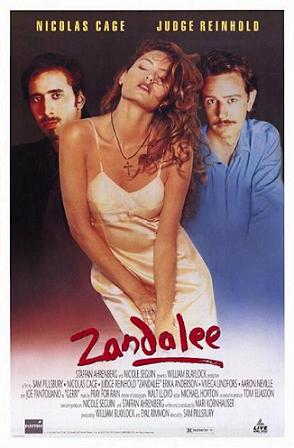
Scenes That I Love: Celebrate Mardi Gras Weekend With Nicolas Cage and Judge Reinhold in Zandalee!


I’m pretty sure that I’ve shared this scene before but, since it’s Mardi Gras weekend, it feels like a good time to share it again!

In this scene from the 1991 New Orleans-set melodrama, Zandalee, Judge Reinhold and Nicolas Cage share a dance on a bayou dock.  Reinhold knows that Cage has been sleeping with his wife.  Cage knows that Reinhold knows.  So, they decided to have an impromptu dance-off.

It sounds like a good to idea to me and, with everyone flooding into Louisiana this weekend, it seems like a good pick for today’s scene that I love!

#Dance!