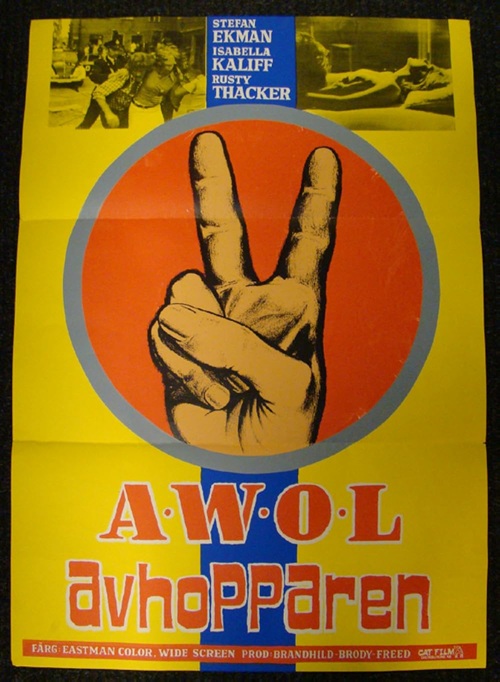
1972’s AWOL tells the story of an American soldier named Willy (Russ Thacker) who decides that he’s no longer going to fight in Vietnam. He goes to Sweden and informs the police that he has decided to desert. The bored policeman tells him to stay out of trouble. “No narcotics,” he says. “Of course,” Willy says, shocked to discover just how easy it is to desert.
Willy struggles to adapt to life in Sweden. At first, he has fun seeing the sights and wearing a silly little hat and visiting the carnival. Unfortunately, he has little money and no friends, and he soon finds himself feeling lonely. A job working on an adult film leads to him meeting another American expatriate, Mohammed G (Glynn Thurman). Mohammed introduces Willy to his friends, a group of rather shallow Leftists. Willy starts a relationship with Inga (Isabella Kaliff). They don’t agree on the merits of Che Guevara, but they fall in love anyway.
(Just a quick sidenote: Che was a racist butcher who executed thousands of innocent Cubans and who is only remembered today because of one good picture and the fact that he was executed by the Bolivians. The fact that he’s held up as some sort of icon is proof of just how shallow most political activists actually are.)
Meanwhile, the CIA wants Willy to come back home. A corpulent agent with the name of Cupp (Dutch Miller) continually appears and tries to bribe Willy into returning. He promises that nothing bad will happen to Willy if he returns to America. At worst, he’ll be required to do a few months of therapy. When that doesn’t work, Cupp drags Willy to his station house and has Willy’s parents appear on television. There’s a big moose head on the wall of the station house and its eyes glow red.
AWOL‘s a bit of an odd film, which should not be taken to mean that it’s necessarily an interesting film. The tone is all over the place. Willy and Mohammed discuss America and whether or not they can love the country from which they’ve fled. Cupp appears and uses a mini-camera hidden in his class ring to take pictures of Willy and Inga. Willy and Inga get a falling in love montage, complete with a syrupy ballad. Cupp offers Willy a briefcase full of American candy bars and soft drinks. There is footage of a demonstration. There are moments of goofy humor, and Russ Thacker wanders through the film with a somewhat dazed look on his face, a Vietnam-era Candide, a stranger in a Swedish land. The film ends on a dark note, leaving one to wonder if the film is trying to punish us for smirking at the shallowness of its politics. It’s not necessarily a good film, but it is definitely a film of its time.
AWOL was directed by Herb Freed, who got his start in commercials and later went on to direct the classic slasher, Graduation Day. The film was obviously meant to appeal to a combination of hippies and fans of Swedish sex films. That said, the sex is fairly tame and the film itself doesn’t seem to really have much affinity for the counterculture. If anything, the film’s Leftists come across as being so self-righteous that they make the openly amoral CIA agent seem likable by comparison. It’s tempting to compare this film to An American Hippie In Israel. An American Hippie was also a counter-culture film about a soldier who was traumatized by Vietnam and, like AWOL, it was tonally all over the place. But An American Hippie In Israel worked because, whatever else you might want to say about it (and I love the film), it’s actually sympathetic to the main character and his plea for people to “stop pushing buttons.” AWOL, on the other hand, doesn’t seem to even like Willy, much less understand him.
AWOL is very much a film of its time and, when it is interesting, it’s interesting as a portrayal of the early 70s. It’s a time capsule, one that is fit to be dug up and investigated at least once before being forgotten about again.


