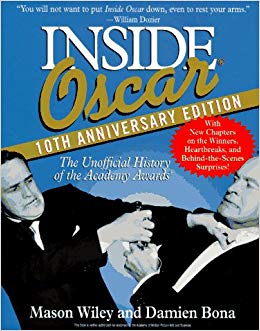
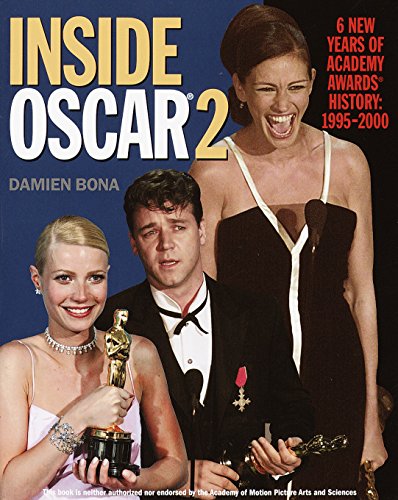
If you’re an Oscar fanatic or if you’re just a film lover who thinks that the Oscars are a joke, these are two books that you simply have to have.
As you can probably tell from the titles, Inside Oscar and Inside Oscar 2 are all about the Academy Awards. Inside Oscar starts with the founding of the Academy and ends with the 1994 Oscar ceremony. Inside Oscar 2 picks up with the 1995 ceremony and takes us through the year 2000. The books were written by two Oscar fanatics and, as a result, it contains just about every bit of trivia that you could hope to find about the Academy, the Oscars, and Hollywood during the previous century. (Unfortunately, both Mason Wiley and Damien Bona have passed away so we probably won’t be getting an Inside Oscar 3.) The books contain not only every detail that you could possibly want about the ceremonies themselves, they also touch on what was going on in America and the rest of the world during each year. For example, it’s quite interesting to read about how different the 1958 Academy Awards ceremony was to the 1968 ceremony. (Essentially, in 1968, longtime Oscar host Bob Hope made a joke about the ceremony being moved back a few days out of respect for the recently assassinated Martin Luther King, Jr. For the first time in Oscar history, the audience booed one of the host’s jokes.) As a result, Inside Oscar and its sequel aren’t just books about Hollywood. In their way, they also serve as an examination of the ever changing cultural and political landscape of the United States.
It’s not just the books are full of snarky details, though they are. It’s also that the books serve as a great reference to the history of the Oscars. In the appendixes, you’ll find every year’s list of nominees, some genuinely interesting trivia, and — perhaps most importantly — a list of notable films (and, in some years, songs) that were not nominated. As you might guess, it’s those lists of unnominated films that I find especially interesting. Every year, some very good films are ignored by the Academy. That was true in the past and it’s true in the present and it will probably continue to be true in the future.
Taken together, Inside Oscar and Inside Oscar 2 are the two best reference books out there for film lovers like you and me.
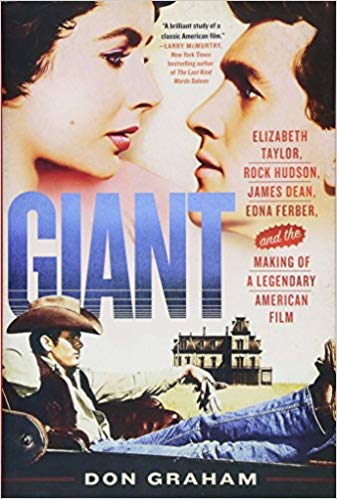
That was my first thought as I read Giant, Don Graham’s history about the making of the film of the same name. In the early 50s, Edna Ferber, a writer who was born in Michigan, raised in Wisconsin, and lived in New York, wrote a novel about Texas. The novel was called Giant and it told a story of ranchers, oilmen, and casual racists. It was meant to be an attack on Texas, a warning to the rest of the country to not allow itself to turn into Texas. Ferber presented Texas as being a land where everything was big and everyone owned a jet and an oil well and all the rest of the usual stereotypes. When Ferber’s novel was turned into a movie, she was apparently not happy to discover that the film was not the vehement denunciation of the state and its citizens that she wished it to be. In Don Graham’s book, Edna Feber often seems to be hovering in the background of every scene, throwing a fit about every detail of the movie. She comes across as a certain type of character that every Texan has had to deal with: the angry Northerner who can’t understand why we’re not as impressed with them as they are.
That’s not to say that Giant, as a film, was blindly pro-Texas. The film featured a subplot that deal with the prejudice that Mexicans faced in Texas. But the film also indicated that things could change and that people could grow and that was something that Ferber apparently did not agree with, at least as far as Texans are concerned.
If Graham’s entire book was just about Ferber’s displeasure with Giant, it would make for a fairly tedious read but, fortunately, Edna Ferber is just a minor part of the sprawling story that Graham tells. Instead of worrying too much about Ferber, Graham focuses on the filming of Giant and how it not only brought Hollywood to the citizens of Marfa, Texas but also what it meant to George Stevens, the film’s director and it’s three stars, Rock Hudson, Elizabeth Taylor, and James Dean. Giant was the film that proved that Elizabeth Taylor could act. It was also the film that brought Rock Hudson some rare critical acclaim. And, perhaps most importantly, it was the last film that James Dean made before his death.
Perhaps not surprisingly, the book is at its most interesting when it deals with James Dean. Graham does not make the mistake of blindly idolizing Dean. Indeed, Dean often comes across as a brat. Graham writes about Marlon Brando’s well-known dislike of Dean but he also shares anecdotes from the set that reveal that Dean was incredibly talented but also very self-destructive. Reading about Dean’s behavior and his frayed relationship with George Stevens, one gets the feeling that, even if he had survived the car accident, Dean’s acting career probably would never have survived his own self-destructive impulses. Graham celebrates Dean’s talent without idealizing his character.
Much as in the movie, Rock Hudson is frequently overshadowed by Dean. In the book, Hudson comes across as being …. well, he’s come across as being a bit of a jerk. Elizabeth Taylor, on the other hand, comes across as being driven, fragile, and committed to her stardom. She also comes across as possessing an unexpectedly sharp wit. If both Dean and Hudson were both a bit too self-impressed, Taylor possessed the knowledge of someone who had spent her entire life in the film industry.
Don Graham’s Giant is an entertaining book. Full of anecdotes and more than a little bit juicy speculation about what went on behind the scenes, Giant is a great read for Texans and film fans alike!
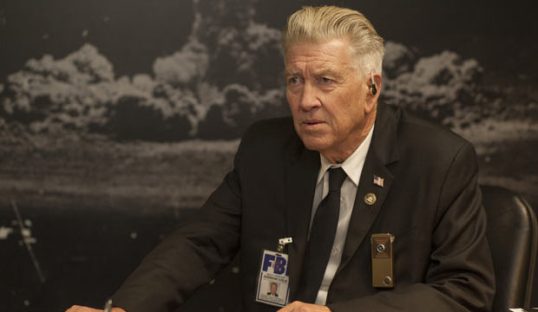
But first, a word about David Lynch. The Academy gave David Lynch a special award for his cinematic contributions back in October. It’s not the same as a competitive Oscar but it’s probably the best that a boldly idiosyncratic filmmaker like David Lynch could ever hope to get from the Academy. Normally, I would list Lynch below. I’m not doing so this year because, realistically, Lynch has said that it’s doubtful he’ll ever make another theatrical film. That said, I hope to God that someone gives David Lynch a blank check and allows him to make at least one more movie.
With that in mind, here are 6 other directors who I hope will have finally won an Oscar by 2030!
The Safdie Brothers
The Safdie Brothers deserved a nomination this year for their work on Uncut Gems. Unfortunately, that film was a bit too anxiety-inducing for the Academy. The Safdies are exciting filmmakers and I hope that someday, the Academy will realize what everyone who has seen Good Time and Uncut Gems already knows.
2. Sofia Coppola
She was nominated for Lost In Translation. She deserved to be nominates for several other films. Sofia Coppola is consistently one of the most challenging and interesting (if often criminally underrated) filmmakers working today. No other American director captures existential angst with quite the style of Sofia Coppola.
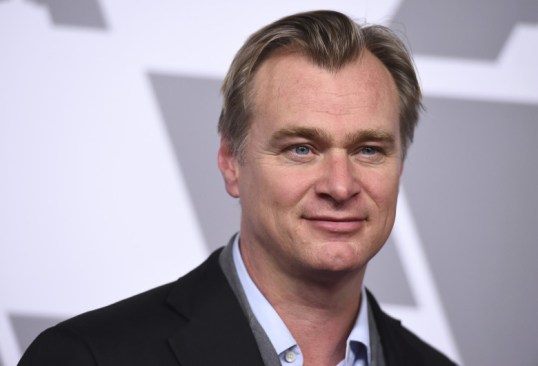
3. Christopher Nolan
Christopher Nolan has emerged as one of the most influential directors of the 21st century. With The Dark Knight, he revolutionized comic book films. With Inception, he created one of the greatest fantasy/action/sci-fi hybrids of all time. With Dunkirk, he paid tribute to one of the most heroic moments of World War II. Every recent film with a jumbled timeline owes a debt of gratitude to Christopher Nolan. Nolan seems destined to win someday.
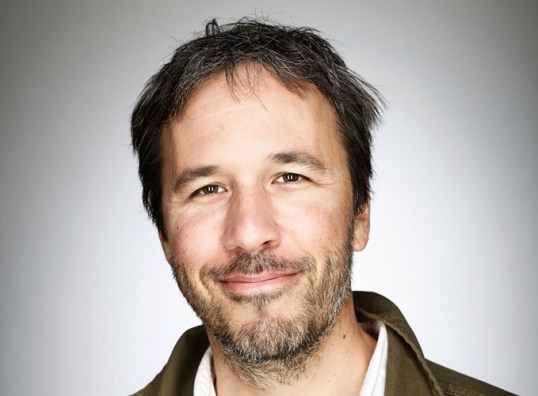
4. Denis Villeneuve
Speaking of being destined to win, that seems to also be an apt description of this visionary Canadian director. Some people think that Villeneuve will be an Oscar contender this year with Dune. Maybe. Maybe not. That said, Villeneuve seems destined to win at some point in the future.
5. Andrea Arnold
You might not recognize the name but Andrea Arnold is responsible for two of my favorite films of the last ten years: Fish Tank and American Honey. She deserved to be nominated for both of those films. My hope is that, between now and 2030, she’ll finally get the recognition that she deserves.
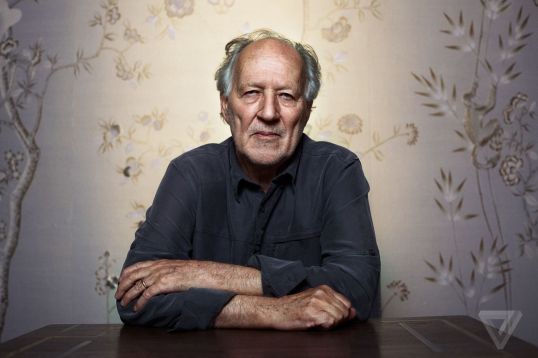
6. Werner Herzog
You know it would be the greatest acceptance speech ever.
Agree? Disagree? Let us know in the comments below!
Continuing the theme from my previous post, here are 6 actresses who I sincerely hope will have won their first competitive Oscar by the time that the 2030 ceremony rolls around.
(By the way, there’s a chance that Scarlett Johansson, Saorise Ronan and Florence Pugh could finally win Oscars tonight. That’s the only reason why they’re not on the list below.)
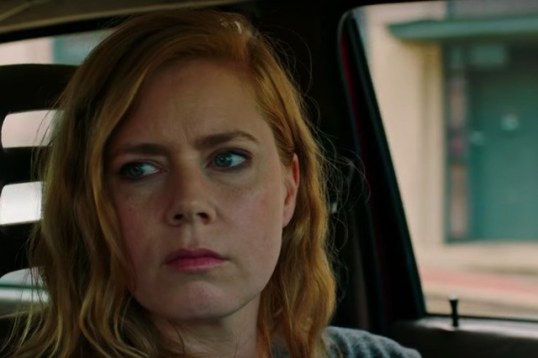
Amy Adams
Much like Bradley Cooper on my previous list, Amy Adams is probably the most obvious pick here. I’m actually amazed that, after been nominated a total of 6 times, the terrifically talented Amy Adams has yet to win her first Oscar. The fact that she could even receive a nomination for a film like Vice reveals that she’s got fans in the Academy and she’s definitely reached the point where she can say that she’s overdue for the award. The Woman In The Window was originally promoted as being an Oscar contender but, considering all the trouble that film’s gone through to just get a release date, Adams may have to wait another year or two. Still, she seems destined to win eventually and it’ll be a great day for all the members of the 2% of us who have naturally red hair.
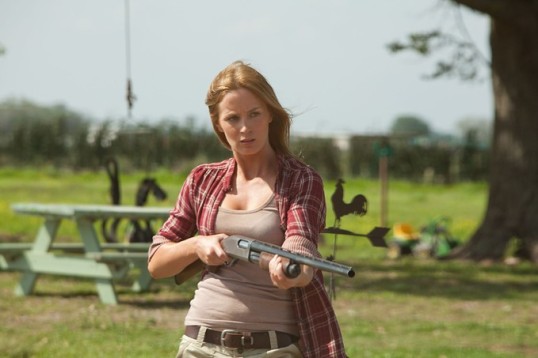
2. Emily Blunt
How has Emily Blunt never received a single Oscar nomination? I mean, Amy Adams should be angry that she doesn’t have an Oscar yet but at least she has six nominations. Emily Blunt doesn’t even have one yet, despite being one of the best actresses working today. Again, Blunt seems destined to win. It’s just a question of when.
3. Carey Mulligan
Carey Mulligan should have won for her performance in An Education. She also deserved to be nominated for Shame. She doesn’t have an Oscar but she certainly has the talent to win one. She’s one of the best actresses around, though she often seems to appear in the type of good but challenging films that fall off of the Academy’s radar. Promising Young Woman was a hit at Sundance so we’ll see if that leads to another nomination.
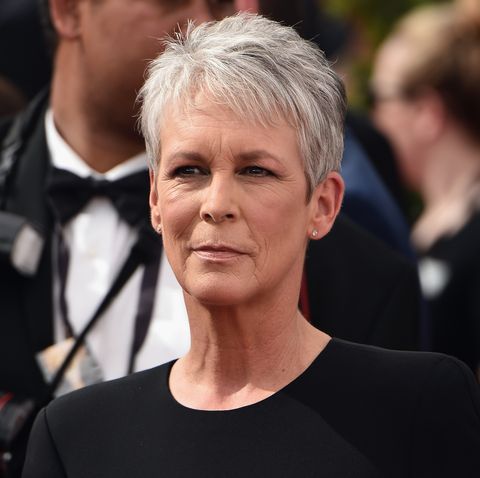
4. Jamie Lee Curtis
Jamie Lee Curtis has been giving good performances since before I was born but since so many of them were in horror films, the Academy failed to notice. She’s now one of those actresses who people seem to take for granted. Hopefully, someone writes a great role for her in the future as Curtis is overdue for not just a nomination but for an award as well.
5. Jessica Chastain
Jessica Chastain is one of those actresses who I think everyone assumes has won an Oscar but actually, she hasn’t. She’s been twice nominated and even that seems like it has to be a mistake. I mean, really? Only two nominations for Jessica Chastain? (Personally, I chalk it up to the Academy having an issue with those of us who have naturally red hair.) Much like Amy Adams, Chastain is another actress who seems destined to win over the next decade.
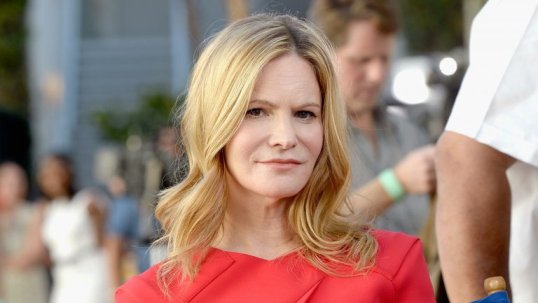
6. Jennifer Jason Leigh
Seriously, how does Jennifer Jason Leigh — one of the greatest actress of all freaking time — only have one nomination? Not only is she overdue for the award but, based on Marriage Story, she deserves one just for putting up with Noah Baumbach for eight years.
Agree? Disagree? Have another name to offer up? Let us know in the comments below!
The Razzie Awards are meant to honor the worst films of the year. It sounds like a noble goal, though the Razzies usually just go after easy targets and cheap jokes. In short, they haven’t really been interesting in a while. That said, they’ve been around forever and they usually get some attention from people who need some filler to report while waiting for the Oscar ceremony.
With that in mind, the 2019 Razzie Awards were announced yesterday and here they are:
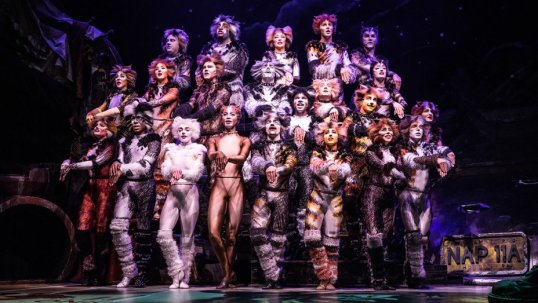
WORST PICTURE Cats
The Fanatic
The Haunting of Sharon Tate
A Madea Family Funeral
Rambo: Last Blood
WORST ACTOR
James Franco, Zeroville
David Harbour, Hellboy
Matthew McConaughey, Serenity
Sylvester Stallone, Rambo: Last Blood
John Travolta, The Fanatic and Trading Paint
WORST ACTRESS
Hilary Duff, The Haunting of Sharon Tate
Anne Hathaway, The Hustle and Serenity
Francesca Hayward, Cats
Tyler Perry (as Medea), A Madea Family Funeral
Rebel Wilson, The Hustle
WORST SUPPORTING ACTRESS
Jessica Chastain, Dark Phoenix
Cassi Davis, A Madea Family Funeral
Judi Dench, Cats
Fenessa Pineda, Rambo: First Blood
Rebel Wilson, Cats
WORST SUPPORTING ACTOR
James Corden, Cats
Tyler Perry (as Joe), A Madea Family Funeral
Tyler Perry (as Uncle Heathrow), A Madea Family Funeral
Seth Rogen, Zeroville
Bruce Willis, Glass
WORST SCREEN COMBO
Any two half-feline/half-human hairballs, Cats
Jason Derulo and his CGI-neutered bulge, Cats
Tyler Perry and Tyler Perry (or Tyler Perry), A Madea Family Funeral
Sylvester Stallone and his impotent rage, Rambo: First Blood
John Travolta and any screenplay he accepts
WORST DIRECTOR
Fred Durst, The Fanatic
James Franco, Zeroville
Adrian Grunberg, Rambo: Last Blood
Tom Hooper, Cats
Neil Marshall, Hellboy
WORST SCREENPLAY Cats, Screenplay by Lee Hall and Tom Hooper The Haunting of Sharon Tate, Written by Danial Farrands Hellboy, Screenplay by Andrew Cosby A Madea Family Funeral, Written by Tyler Perry Rambo: Last Blood, Screenplay by Matthew Cirulnick and Sylvester Stallone
WORST REMAKE, RIP-OFF or SEQUEL Dark Phoenix Godzilla, King of the Monsters Hellboy A Madea Family Funeral Rambo: Last Blood
WORST RECKLESS DISREGARD for HUMAN LIFE and PUBLIC PROPERTY
(New Category for 2019) Dragged Across Concrete The Haunting of Sharon Tate Hellboy Joker Rambo: Last Blood
RAZZIE REDEEMER AWARD
Eddie Murphy, Dolemite Is My Name
Keanu Reeves, John Wick 3 & Toy Story 4
Adam Sandler, Uncut Gems
Jennifer Lopez, Hustlers
Will Smith, Aladdin
Adam Sandler may not even be an Oscar winner but he is now officially an Independent Spirit Award winner. Last night, at the Spirits annual ceremony, he won Best Actor for Uncut Gems. Willem DaFoe picked up the Best Supporting Male award for The Lighthouse, another film that was largely overlooked by the Academy. Best Feature went to The Farewell, another movie that was totally snubbed by the Academy.
In other words, the Spirits were incredibly awesome and probably had better taste this year than the Oscars. Here’s a full list of what won:
BEST SUPPORTING MALE
Noah Jupe, “Honey Boy”
Shia LaBeouf, “Honey Boy”
Jonathan Majors, “The Last Black Man in San Francisco”
Willem Dafoe, “The Lighthouse” (WINNER)
Wendell Pierce, “Burning Cane”
BEST EDITING
Ronald Bronstein, Bennie Safdie, “Uncut Gems” (WINNERS)
Julie Beziau, “The Third Wife”
Tyler L. Cook, “Sword of Trust”
Louise Ford, “The Lighthouse”
Kirill Mikhanovsky, “Give Me Liberty”
BEST DOCUMENTARY
“American Factory” (WINNER)
“Apollo 11”
“For Sama”
“Honeyland”
“Island of the Hungry Ghosts”
BONNIE AWARD
Kelly Reichardt (WINNER)
BEST CINEMATOGRAPHY
Todd Banhazl, “Hustlers”
Jarin Blaschke, “The Lighthouse” (WINNER)
Natasha Braier, “Honey Boy”
Chananun Chotrungroj, “The Third Wife”
Pawel Pogorzelski, “Midsommar”
JOHN CASSAVETES AWARD
“Burning Cane”
“Colewell”
“Give Me Liberty” (WINNER)
“Premature”
“Wild Nights With Emily”
BEST FIRST SCREENPLAY
Andrew Patterson, Craig W. Sanger, “The Vast of Night”
Bridget Savage Cole, Danielle Krudy, “Blow the Man Down”
Jocelyn DeBoer, Dawn Luebbe, “Greener Grass”
Hannah Bos, Paul Thureen, “Driveways”
Fredrica Bailey, Stefon Bristol, “See You Yesterday” (WINNERS)
BEST FIRST FEATURE
“Booksmart” (WINNER)
“The Climb”
“Diane”
“The Last Black Man in San Francisco”
“The Mustang”
“See You Yesterday”
BEST INTERNATIONAL FILM
“Invisible Life” (Brazil)
“Les Miserables” (France)
“Parasite” (Korea) (WINNER)
“Portrait of a Lady on Fire” (France)
“Retablo” (Peru)
“The Souvenir” (United Kingdom)
BEST SCREENPLAY
Noah Baumbach, “Marriage Story” (WINNER)
Ronald Bronstein, Benny Safdie, Josh Safdie, “Uncut Gems”
4 Shots From 4 Films is just what it says it is, 4 shots from 4 of our favorite films. As opposed to the reviews and recaps that we usually post, 4 Shots From 4 Films lets the visuals do the talking!
Today’s edition of 4 Shots from 4 Films is dedicated to four of the best films that I’ve ever seen about Hollywood! I mean, it is Oscar Sunday after all!
4 Shots From 4 Films About Hollywood
The Bad and the Beautiful (1952, dir by Vincente Minnelli)
The Stunt Man (1980, dir by Richard Rush)
Mulholland Drive (2000, dir by David Lynch)
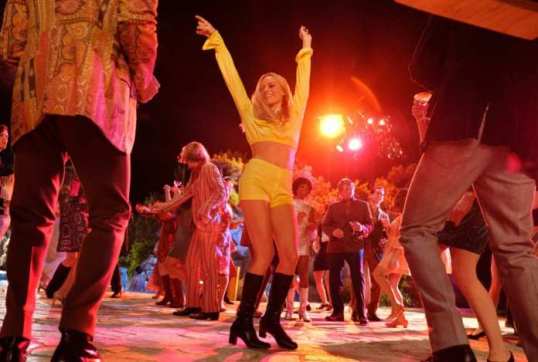
Once Upon A Time In Hollywood (2019, dir by Quentin Tarantino)
There’s a lot of film bloggers out there who have a natural aversion to anything that Jason Reitman is associated with.
And listen, I understand. The fact of the matter is that Jason Reitman probably does owe a lot of his success to the fact that people in the industry know and like his father. And it’s also true that Jason Reitman does tend to specializes in making films that you’re either going to love or you’re going to hate. His films mix drama and comedy and sentiment and snark and sometimes, his refusal to come down firmly on the side of either one can feel like a bit of a cop out. There’s a quirkiness to many of his films and sometimes, it can come across as being a bit cutesy. And I’ll even go as far as to agree with those who say that it’s been a while since Reitman’s made a really good film. The most common complaint I hear about Reitman is that his first four films (Thank You For Smoking, Juno, Up In The Air, and Young Adult) were okay and then he let his good reviews go to his head. Of course, some people — okay, a lot of people — will tell you that, of those four films, Juno’s overrated.
I get all of that and I actually agree with some of those points. Reitman is a director who sometimes seems to have lost his way after his early successes. I think the closest that Reitman’s come to giving us a good film post-Young Adult was with Tully and even then, that felt more like a Diablo Cody film than a Jason Reitman film.
But, with all of that in mind, I still really like Jason Reitman’s early films and I think that he still has the potential to once again be an important and interesting filmmaker. Thank You For Smoking and Juno are better than many give them credit for being. Charlize Theron has never been better than she was in Young Adult. Finally, this morning, I rewatched 2009’s Up In The Air for the first time in a long time and I was pleasantly surprised to see how well it holds up.
Up In The Air features George Clooney and Anna Kendrick. Clooney plays Ryan Bingham, an obsessive traveler who boats about living a life without commitment. Ryan works for a company that hires him out to fire people. If your boss is too much of a pussy to tell you that you’ve been terminated to your face, he hires Ryan to do it for him. Ryan specializes in trying to convince people that being fired is not a tragedy but an opportunity for a new beginning. Ryan also has a side gig as a motivational speaker. His speeches are largely about avoiding commitment and personal baggage.
Anna Kendrick plays Natalie Keener. Natalie works for the same company as Ryan but, at the age of 23 and just out of college, she’s a lot less confident when it comes to destroying people’s livelihoods. (“I’ve worked here for 17 years and I’m being fired by a 7th grader,” is one person’s response to being terminated by Natalie.) Natalie has come up with a new plan where all firings will be done via Skype. That way, the person doing the firing will never have to leave their office and won’t have to deal with the people they’ve fired one-on-one. Ryan says he considers this proposal to be inhumane but mostly, he’s just worried that he’ll lose his traveling privileges if Natalie’s plan is instituted.
Ryan and Natalie travel the country. Ryan teaches Natalie how to fire people and Natalie discovers that it’s not as easy to destroy someone’s life as she thought. Everywhere they go, they deal with people who are facing economic uncertainty. Ryan meets another frequent flyer, Alex (Vera Farmiga) and, after Alex reveals that she’s even less interested in commitment than Ryan, they begin an affair. Ryan starts to fall in love with Alex and even invited her to attend his sister’s wedding with him. However, Alex has a secret of her own.
One thing that I really like about Up in the Air is that Ryan and Natalie never end up sleeping together. I remember, when I first saw the movie, I was convinced that it was going to happen. After all, Ryan is handsome and charming and Natalie is attractive and, after her boyfriend dumps her, vulnerable. I was cringing at the knowledge that there would eventually be some contrived scene where Natalie and Ryan end up getting drunk and then end up waking up in bed together and the end result would be Natalie going from being a well-rounded, multi-dimensional character to just being a plot device in Ryan’s journey to becoming a better man. Well, there is a scene where Natalie and Ryan get drunk at the same time but it doesn’t lead to Natalie and Ryan becoming lovers and I respected Up in the Air for having enough respect for its characters to not do the convenient thing.
The other thing I liked about Up In The Air is that it’s one of the few films to make proper use of George Clooney’s deceptively smooth screen presence. We all know that Clooney is handsome and charming but what makes him an appealing actor is that there’s always been hints that there’s a lot dorkiness and insecurity hiding underneath the suave facade. Ryan may seem like he’s got it all together but, as the film progresses, you come to realize that he’s a lot more insecure and neurotic than he lets on. All of his snarky comments have more to do with his own fear of failure than anything else. Much as how the real life Clooney still sometimes seems as if he hasn’t fully gotten over being dismissed as just being another pretty face in the early days of his career, Ryan has never gotten over his dysfunctional childhood. Instead of taking a risk on love, he instead obsesses on getting frequent flyer miles. (At one point, Sam Elliott pops up out of nowhere and, in a scene that you could really only expect to find in a Jason Reitman film, gives Ryan a pep talk.) There’s a sadness to Ryan, one that seems to come from deep inside of his soul. Clooney does an excellent job of bringing that sadness to the surface while still giving a likable and compelling performance.
Up In The Air was released at a time when America was stuck in what seemed like a never-ending recession. Despite the fact that the news media and the politicians were insisting that things were on the verge of getting better (or, at the very least, boasting that unemployed actors were no longer “job-locked,” whatever the Hell that meant), many people believed that their best days were officially behind them. A lot of the contemporary reviews of the film focused on what it had to say about living in a time of economic uncertainty. That was ten years ago and we’re now living in a strong economy but, even so, Up In The Air still resonates. Reitman includes scenes in which people talk about what it was like to be fired. The majority of these people were not actors but were instead people recruited from the local unemployment office and they were speaking about their own experiences. The pain and resentment on their faces and in their voices is so palpable that it’s actually a bit jarring when J.K. Simmons and Zach Galifianakis show up, playing employees who are “terminated” by Ryan. I guess I should admit that I’ve never actually been fired from a job but, after watching Up In The Air, it’s not something that I would ever want to experience.
Up In The Air holds up well. Reitman’s direction is quirky but effective and he does a good job of mixing comedy in with the drama. (Wisely, whenever he has to make a choice, he emphasizes the drama over the comedy, instead of trying to maintain some sort of mythical 50/50 balance between them.) This film features one of George Clooney’s best performances and he has a really likable chemistry with Vera Farmiga. Anna Kendrick also does a great job with a character who could have become a stereotype in less skilled hands. Finally, along with Juno and The Gift, this film is one of the reasons why I always have a hard time watching Jason Bateman in any film or show where he’s cast as hero. Bateman plays Ryan’s boss and the character is so smarmy (and Bateman does such a good job of playing him) that he’ll make your skin crawl.
It’s been a while since Up In The Air was first released and Jason Reitman’s career has had its ups and downs. Still, regardless of whatever film Reitman makes next, Up In The Air remains a classic of the aughts.
The 1935 adventure film, The Lives of a Bengal Lancer, is a film that probably could not be made today.
Of course, that’s true of a lot of films from the 30s. In some cases, that’s a good thing and, in some cases, that’s a bad thing. The Lives of Bengal Lancer is an entertainingly old-fashioned adventure story but it’s also a shameless celebration of the British Empire. The fact that it was made in Los Angeles and featured all-American Gary Cooper in the lead role doesn’t diminish the fact that it’s pretty much a celebration of British colonialism.
Gary Cooper plays Lt. Alan MacGregor, a Scottish-Canadian who serves in British Calvary. He’s a member of the Lancers and is currently serving in India, which, at the time that this movie was set (and made), was still under British control. When the film begins, MacGregor is greeting the new arrivals. Among those arrivals are Lt. John Fosythe (Franchot Tone) and Lt. Donald Stone (Richard Cromwell). Lt. Forsythe is an experienced officer who has been sent to India as a replacement for another officer who managed to get himself killed while out on a patrol. Meanwhile, Lt. Donald Stone is a newly commissioned officer who is desperate to win the approval of his father (and McGregor’s superior), Col. Tom Stone (Guy Standing). Unfortunately, Donald quickly discovers that winning the approval of his father isn’t going to be easy. Col. Stone, after all, has a lot to deal with.
For instance, there’s Mohammed Khan (Douglas Dumbrille). Kahn is a local prince and he boasts that he has got an Oxford education. He pretends to be an ally of the British but instead, he is plotting a revolution. The first step in that revolution is to intercept a convoy of British weapons but how can Kahn discover the convoy’s route? Maybe he could kidnap a lancer who is close to the unit’s commanding officer? With the help of a Russian femme fatale named Tania (Kathleen Burke), Khan is able to capture Donald. When MacGregor and Forsythe defy the colonel’s orders and attempt to rescue Donald on their own, they end up getting captured as well!
“We have ways to make men talk!” Khan declares and soon, the three men are having their fingernails ripped out and the skin underneath burned with fiery bamboo. It’s a shocking act of sadism, one that caught me by surprise in 2020. I can only imagine how audiences in 1935 reacted to Gary Cooper and Franchot Tone being so graphically tortured on the big screen. Though the men swear that they will not reveal the location of the convoy, how much torture can they take before they break?
As I said at the start of this review, The Lives of a Bengal Lancer is an old-fashioned film and, with its depiction of savage rebels and heroic colonizers, it would probably cause a riot if it were released today. However, if you can set aside the whole pro-imperialist theme of the film, this is a fairly entertaining film. It gets off to a slow start and, to modern eyes, some of the acting is bit creaky but Gary Cooper is, not surprisingly, well-cast as the film’s hero and he’s ably supported by Tone and Cromwell. Douglas Dumbrille and Kathleen Burke are entertainingly campy villains and the film’s final battle is well-done.
A box office success, The Lives of a Bengal Lancer was nominated for Best Picture but it lost to an even bigger hit (and a film that was a bit more critical of the British Empire), Mutiny on the Bounty.
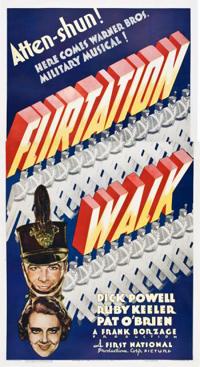
In the 1934 Best Picture nominee, Flirtation Walk, Dick Powell plays a soldier who is constantly trying to go AWOL.
It’s not that Richard “Dick” Palmer Grant Dorcy Jr. dislikes the army. In fact, he’s actually getting a pretty good deal out of his enlistment. He’s been stationed in Hawaii, where he gets to go to luaus and hang out on the beach. He has a wonderful friend and mentor in the person of Sgt. Scrapper Thornhill (Pat O’Brien). Since this film was made in 1934, he’s not going to have to worry about going to war for another 7 years. He’s known as The Canary because he loves to whistle and sing. Everyone like Pvt. Dick Dorcy and that includes Kit Fitts (Ruby Keeler).
Unfortunately, Kit’s father is General Fitts (Henry O’Neill) and he’s none too amused about his daughter having a romance with an irresponsible enlisted man. He would much rather that Kit marry his aide, Lt. Biddle (John Eldredge). After he’s told to stay away from Kitt, Dick makes plans to desert so he can run off with her. Fortunately, Scrapper finds out what Dick is planning and he goes to Kit and warns her that Dick’s about to throw away his life for her. Not wanting him to get into trouble, Kit pretends that she never felt anything for Dick. When a broken-hearted Dick wonders why Kit rejected him, Biddle smugly informs him that he’s neither “an officer nor a gentleman.”
Stung, Dick decides to fix that problem. In order to become an officer, he applies for admission to West Point and gets in. Dick leaves Hawaii for the mainland and he does very well at West Point. He’s even put in charge of producing, writing, and directing West Point’s annual theatrical production. However, things get complicated with Gen. Fitts arrives to serve as superintendent. Coming with Gen. Fitts are both Kit and Lt. Biddle.
Deciding to express his angst through art, Dick writes a show about a female general. Since Kit is the only female at West Point, guess who gets the lead role? Though Kit is still in love with Dick, she can’t get him to listen to her explanation for why she rejected him. Will a stroll along West Point’s famed Flirtation Walk help fix things?
Well, it is a Dick Powell musical….
Flirtation Walk is a pleasant but forgettable movie. Dick Powell and Ruby Keeler make for a cute couple but neither one of them gives a particularly interesting performance and the bland songs don’t make much of an impression either. Those who are into military history might enjoy the fact that the film was actually filmed on location at West Point but, for the rest of us, this is a nice but not particularly memorable musical romance. For me, the most interesting part of the film was that it didn’t even attempt to be realistic when it came to Dick’s theatrical production. It’s a huge production, if never coming close to being as much fun as the one from 42nd Street.
Why was Flirtation Walk nominated for Best Picture? I imagine it was because it was a hit at the box office. It only received one other nomination, for Best Sound Recording. Regardless of why it was nominated, it lost to the far more memorable It Happened One Night.










 Through the Shattered Lens