Welcome to Retro Television Reviews, a feature where we review some of our favorite and least favorite shows of the past! On Mondays, I will be reviewing Miami Vice, which ran on NBC from 1984 to 1989. The entire show can be purchased on Prime!
This week, Crockett and Tubbs — or is it Burnett and Cooper? — enter the art world.
Episode 5.14 “The Lost Madonna”
(Dir by Chip Chalmers, originally aired on March 17th, 1989)
When Crockett and Tubbs take down what they think is a drug deal, they’re shocked to discover that Stanley Costa (Stephen G. Anthony) was actually smuggling two paintings! They could always ask Stanley what’s going on but — whoops! They killed him during the show’s precredit sequence.
Detective Whitehead (Michael Chiklis) comes down from New York City and explains that the two paintings are the side pieces for a triptych called The Last Madonna. It was recently stolen from a Paris museum and Whitehead is convinced that theft was masterminded by Joey Scianti (Peter Dobson).
It’s time for Tubbs and Crockett to — *sigh* — go undercover. Why they’re still always going undercover, I have never really understood. Every time they go undercover, their cover gets blown. Do the members of the Miami underworld just not communicate with each other? Shouldn’t everyone know, by this point, that Tubbs and Crockett are cops? In this case, Tubbs goes undercover as someone who appreciates art. Crockett goes undercover as the crude Sonny Burnett….
Yes, Crockett is still using the Burnett cover. He’s doing this despite the fact that he just recently had a mental breakdown that led to him not only thinking that he actually was Burnett but also becoming Miami’s biggest drug lord. Even if the Scianti family was dumb enough to not know that Crockett was a cop, surely they would have heard enough about drug lord Sonny Burnett to wonder why he would be hanging out with a connoisseur of fine art.
(Indeed, it’s hard not to notice that everyone has apparently moved on rather quickly from Sonny’s mental breakdown and his time as a drug lord. For that matter, Sonny certainly doesn’t seem to ever give much thought to his dead second wife. Remember her? The world-famous singer who was literally gunned down in front of him? She appears to have been forgotten.)
This episode was dull, largely because the Scianti family was never really a credible threat. They came across as being a bunch of buffoons and, as such, it was hard to really get that concerned about whether or not they would figure out that Crockett and Tubbs were actually cops. This is another episode that features a twist that you’ll see coming from miles away. From the minute Michael Chiklis first showed up, I knew that he was eventually going to try to steal the The Lost Madonna for himself.
Considering that there was a lot of humor in this episode (Crockett, not surprisingly, struggled with understanding modern art), there’s also some surprisingly graphic violence. Crockett and Tubbs gun down Stanley Costa and blood splatters all over the wall. Whitehead shoots Joey Scianti and the shocked Joey looks down at his wound and says that it’s “real blood.” Tonally, this episode is all over the place.
Everyone seemed kind of bored with this episode. This was definitely a final season entry.
The 1984 film Amadeus is about a man who learns, after it’s a bit too late to really do anything about it, that he is thoroughly mediocre.
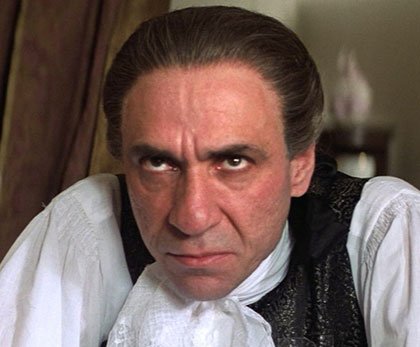
When we first meet Antonio Salieri (played by F. Murray Abraham), he’s an old man who has been confined to a mental asylum because he attempted to slit his own throat. What should drive Salieri — a respected, if not particularly beloved, composer in 18th Century Vienna — to attempt to take his own life? As he explains it to Father Vogler (Richard Frank), it’s the guilt of knowing that he’s responsible for death of the greatest composer of all time, Wolfgang Amadeus Mozart.
When Mozart (Tom Hulce) first showed up in Vienna, Salieri was already the court composer to the thoroughly vacuous Emperor Joseph II (Jeffrey Jones). At the time, Salieri believed himself to be a genius touched by God. As he recounts to Father Vogler, he prayed to God when he was a boy and he struck what he believed was an ironclad deal. God would make Salieri a great composer and Salieri would remain a faithful believer.
But then Mozart shows up and, from the minute that he first hears one of Mozart’s compositions, Salieri realizes that Mozart is the one who has been blessed with genius. Mozart is the one who is writing the music that will be remembered for the rest of time, long after Salieri and all of his other rival composers have been forgotten. Upon first hearing Mozart, Salieri suddenly realizes that he has been betrayed by God. He is a mediocre talent and he’s always been a mediocre talent.
The worst part of it is not just that Mozart’s a genius. It’s also that Mozart knows he’s a genius. He’s a bit of a brat as well, with a remarkably annoying laugh and vulgar manners that scandalize proper society. Despite the efforts of his rivals to dismiss his talent, Mozart is beloved by the common people. He’s an 18th century rock star and it seems as if no amount of scandal and petty jealousy can slow him down. Even worse, the emperor takes a interest in Mozart and commissions him — and not Salieri — to write an opera.
Rejecting a God that he feels has betrayed him, Salieri plots Mozart’s downfall….
Goddamn, this is a great movie. Seriously, everything about Amadeus works.
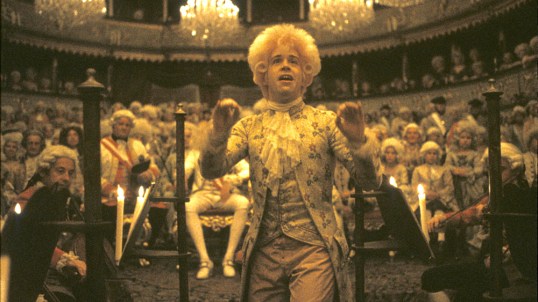
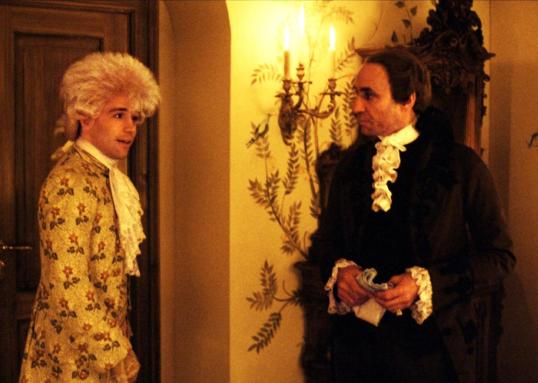
The ornate sets and the costumes not only wonderful to look at but they also actually tell us something about the characters who inhabit them. One look at the beautiful but cluttered home that Mozart shares with his wife, Constanze (Elisabeth Berridge), tells you almost everything you need to know about not only Mozart’s tastes (which are expensive) but also his talent (which is undisciplined but also limitless). The empty-headedness of Emperor Joseph is perfectly mirrored by the pretty but uninspired decor of his court while the grubby chaos of the mental asylum seems to have sprung straight from Salieri’s tortured soul. As visualized in Amadeus, there’s a cold beauty to Vienna, one that is fascinating but, at the same time, menacing. As for the costumes, Mozart’s powdered wig somehow seems to be brighter than everyone else’s and his colorful wardrobe demands your attention. Meanwhile, when a costumed and masked Salieri shows up at Mozart’s door, he’s like the Grim Reaper coming to collect a soul.
The witty script is full of sharp lines and director Milos Forman does a wonderful job of balancing comedy and drama. The scenes involving Joseph II are frequently hilarious and Jeffrey Jones does a great job of portraying Joseph as essentially being a very influential dunce. The scene where Joseph tells Mozart that he liked his latest composition but that “there are simply too many notes” is a classic and one to which any artist, whether they’re Mozart or not, will be able to relate. (“Just cut a few and it will be perfect.”)
The film is dominated by the performances of F. Murray Abraham and Tom Hulce. Hulce is wonderfully flamboyant in the early part of the film and, bravely, he doesn’t shy away from portraying Mozart as occasionally being a bit of a spoiled brat. It’s not just that Mozart can be annoying. It’s also that he’s often deliberately annoying. When we first see Mozart, it’s easy to understand why his very existence so grated on Salieri’s nerves and why Salieri considers him to be an “obscene child.” But as the film progresses, Hulce lets us in and we come to see that Mozart is actually a very vulnerable young man. When his disapproving father (Roy Dotrice) comes to visit, we suddenly understand both why Mozart is so driven to succeed but also why he is so instinctively self-destructive.
Meanwhile, F. Murray Abraham — well, what can I say about this performance? In the role of Salieri, Abraham gives one of the greatest film performances of all time. In many ways, Abraham has a tougher job than Hulce. If Hulce has to convince us that Mozart has been touched by genius despite the dumb things that he often does, Abraham has to make petty jealousy compelling. And somehow, Abraham manages to do just that. Whereas the role of Mozart allows Hucle to wear his emotions on the surface, Abraham has to play a character who keeps most of his thoughts and impulses hidden and the fact that we end up understanding Salieri (if never actually sympathizing with him) is a testament to F. Murray Abraham’s skill as an actor. Abraham won the Oscar for Best Actor for his work in Amadeus and it was more than deserved.
At the end of the film, Salieri declares himself to be the patron saint of mediocrities and, to a large extent, that’s what sets Amadeus apart from other biopics. Most people are mediocre. Most people are not going to end their life as a Mozart. They’re going to end their life as a Salieri or worse. This is one of the few films to be made about a runner-up. It’s interesting to note that, even though the film is more about Salieri than Mozart, it’s still called Amadeus. It’s not named Antonio or Salieri. Even in a film made about Salieri, Mozart is advertised as the main attraction.
(It should also be noted that many historians believe that Salieri and Mozart were actually fairly friendly acquaintances and that, beyond the normal rivalry that any two artists would feel, neither held any significant ill will towards the other. In other words, enjoy Amadeus as an outstanding piece of cinema but don’t necessarily mistake it for historical fact.)
Along with Abraham’s victory, Amadeus also won Best Picture of the year. Of the nominees, it certainly deserved it. (My pick for the best film of 1984 is Once Upon A Time In America with Amadeus as a close second.) It’s a great film and one that definitely deserves to be watched and rewatched.
What’s an Insomnia File? You know how some times you just can’t get any sleep and, at about three in the morning, you’ll find yourself watching whatever you can find on cable? This feature is all about those insomnia-inspired discoveries!
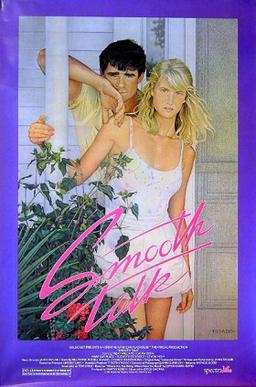
If you were having trouble getting to sleep around one in the morning last night, you could have turned over to This TV and watched Smooth Talk, a disturbingly creepy coming-of-age film from 1985.
Connie Wyatt (played by Laura Dern in one of her first film roles) is fifteen years old and ready to discover the word. It’s the summer and, for Connie and her friends, that means going to the mall, trying to capture the attention of the cute boys who go to their school, and lying to her parents about where she goes at night. (She tells them that she and her friends have been going to the same movie, night-after-night.) She likes it when the boys in the mall smile at her but not when the stranger honk their car horn at her whenever she walking at night. Connie thinks of herself as being an independent adult, even though she’s not sure what that means.
Connie does know that she doesn’t want to be like her mother (Mary Kay Place). Her mother, who claims that she was once a great beauty herself, complains that all Connie does is indulge in “trashy daydreams.” Her mother tells Connie to be careful about who she flirts with and constantly demands that Connie stay home and help to paint the house.
Connie also doesn’t want to be like her older sister, June (Elizabeth Berridge). June is obviously her mother’s favorite. June never sneaks out. June never rebels. Whenever Connie and her mother argue, June always take their mother’s side.
In fact, the only member of her family that Connie’s close with is her father (Levon Helm). Her father is always cheerful and always in a good mood. Somehow, the constant tension in the house never seems to get to him and he never seems to be worried about anything. He’s nice but he’s hardly an authority figure.
And then there’s an older man (Treat Wiliams). When we first see him, he’s sitting outside of a diner and casually watching all of the teenage girls as they walk by. (We all know the type.) When he sees Connie and her friends, he looks over at Connie and tells her, “I’m watching you.” Later, when Connie is alone at her house, the man pulls up in front of her house and starts to talk to her.
His name, he explains, is Arnold Friend. “A. Friend,” he puts it. That’s what he wants to be to her. When she asks how old he is, he says that he’s 18, though he’s clearly closer to 30. He’s handsome and he’s charming but there’s something off about him. He shows Connie his car. “Arnold Friend” is written on the side. “33, 19, 17,” is written on the back. Written next to a dent: “A woman driver did this.” Sitting in the car is a friend of Arnold’s, a man who hides his face behind a portable radio.
“He’s strange,” Arnold explains with a sly smile, before suggesting that Connie get in the car with them…
Smooth Talk is based on a short story by Joyce Carol Oates and, oh my God, is it ever creepy! The first half of the movie plays out like a typical coming-of-age teen film but then Arnold shows up in that car and the film turns into a nightmare. I spent almost the entire movie cringing, mostly because I once was Connie Wyatt, the only real difference being that I was even younger when I decided that I understood how the world worked better than my parents and I started rebelling. As I watched the movie, I found myself wondering what I would have done if Arnold Friend had pulled up in front of my house. Would I have gotten in the car or what I would have run back into the house, locked the door, and called the police? I’d like to think I would have done the smart thing but … no. Doing the smart thing would have meant admitting that the adults were right and there were situations that I couldn’t control or even really understand.
Laura Dern was 18 years old when she played 15 year-old Connie and she gave an amazing and naturalistic performance. When Treat Williams first appeared as Arnold, I thought that he was overacting but, as the film progressed, I came to see that he was actually perfectly cast and giving exactly the type of performance that the movie’s story needed. Arnold Friend, who speaks in outdated slang and always seems to be trying just a little bit too hard, has to be a slightly ridiculous figure because otherwise, no one would drop their guard enough to get into his car. As I watched the movie, I realized that it was a mistake to think of Arnold as being a human being. Instead, he’s a nightmare come to life.
Smooth Talk was a deeply unsettling film about growing up in an increasingly dangerous world. It’s right up there with Out of The Blue, Christiane F, and Blue Velvet among nightmarish coming-of-age stories.
1980’s The Funhouse opens with an almost shot-for-shot recreation of the famous shower scene from Psycho, with Amy (Elizabeth Berridge) getting attacked in the shower by a masked, knife-wielding maniac.
The only difference is that there’s no shrieking violins, there’s no blood, and the knife is quickly revealed to be a fake. It turns out that the “killer” is actually Amy’s younger brother, Joey (Shawn Carson). Joey loves horror movies. In fact, he’s pretty much the perfect stand-in for The Funhouse‘s intended audience. Joey was just playing a rather mean-spirited prank but now, as a result, Amy snaps that she’s not going to take him to the carnival.
Of course, Amy isn’t supposed to be going to the carnival either. Her parents have strictly forbidden it. Everyone knows that traveling carnivals are dangerous and, at the last town the carnival visited, two teenagers disappeared! There’s no proof that the carnival has anything to do with those disappearances, of course. But still…
Amy does exactly what I would have done in her situation. She tells her parents that she’s going over to a friend’s house and then she goes to the carnival anyway! Accompanying her is her boyfriend Buzz (Cooper Huckabee), who is so cool that he has a name like Buzz. Also along for the ride: Amy’s best friend, Liz (Largo Woodruff), and her boyfriend, Richie (Miles Chapin). Richie’s kind of a loser but that’s to be expected. Every group needs at least one idiot who can do something stupid that gets everyone else killed. We all know how that works.
The carnival turns out to be just as sleazy as Amy’s parents thought it would be. There’s a fake psychic (Sylvia Miles). There’s a magician who dresses like Dracula. There’s a barker (Kevin Conway), whose deep voice is constantly heard in the background. And, of course, there’s a funhouse! Still, everyone’s having a good time. Either that or they’re all just stoned.
For his part, Joey sneaks out of the house and goes to the carnival himself. He doesn’t have quite as much fun as Amy. In fact, his experience is pretty scary. Weird carnival people keep yelling at him. He keeps getting lost. Still, things could be worse. By the time his parents arrive to pick Joey up, Amy and her friends are all trapped in the funhouse. They’re being pursued by the barker and his deformed son (Wayne Doba). Needless to say, it’s all pretty much Richie’s fault.
Richie. What a dumbass.
With its teenage victims and its lengthy chase scenes, The Funhouse is often dismissed as just being another early 80s slasher film. However, The Funhouse is actually a fairly clever, entertaining, and occasionally even witty horror film. Much like director Tobe Hooper’s best-known film, The Texas Chainsaw Massacre, The Funhouse gets its scares by convincing audiences that they’re actually seeing more than they are. Hooper emphasizes atmosphere and performances over gore. While The Funhouse has its share of jump scares, it mostly succeeds by convincing us that anyone could die at any moment. It’s an intense film, with excellent performances from both Elizabeth Berridge and Kevin Conway.
After kickstaring the slasher genre with The Texas Chainsaw Massacre, Hooper used The Funhouse to poke a little fun at it. From the opening shower scene to the electrifying finale, Hooper plays with the genre-savvy expectations of the audiences. Our four victims even do the smart thing for once — they try to all stay together. Needless to say, that doesn’t work out too well.
The Funhouse is an entertaining thrill ride and, seen today, it’s more evidence that Tobe Hooper deserved better than he got from the film industry.


 Through the Shattered Lens