A Movie A Day #155: Out of the Fog (1941, directed by Anatole Litvak)


When two aging fishermen (Thomas Mitchell and John Qualen) attempt to buy a new boat, they run into a problem with local mobster, Harold Goff (John Garfield).  As Goff explains, if they do not pay him $5.00 a week, something bad could happen to their boat.  When one of the fisherman’s daughter (Ida Lupino) falls in love with Goff, she makes the mistake of letting him know that her father is planning on giving her $190 so that she can take a trip to Cuba.  When Goff demands the money for himself, the fishermen attempt to go to the police, just to be told that there is nothing that the authorities can do.  Goff tricked them into signing an “insurance” contract that allows him to demand whatever he wants.  The two fishermen are forced to consider taking drastic measures on their own.  Out of the Fog is an effective, early film noir, distinguished mostly be John Garfield’s sinister performance as Harold Goff.

Out of the Fog is also memorable as an example of how Hollywood dealt with adapting work with political content during the production code era.  Out of the Fog was based on The Gentle People, a play by Irwin Shaw.  In the play, which was staged by The Group Theater in 1939, Harold Goff was obviously meant to be a symbol of both European fascism and American capitalism.  In the play, the two fisherman had Jewish names and were meant to symbolize those being persecuted by the Third Reich and its allies.  In the transition for stage to film, Jonah Goodman became Jonah Goodwin and he was played by the very talented but definitely not Jewish Thomas Mitchell.   The play ended with Harold triumphant and apparently unstoppable.  Under the production code, all criminals had to be punished, which meant the ending had to be changed.  Out of the Fog is an effective 1940s crime thriller but, without any political subtext, it lacks the play’s bight.

One final note: while Out of the Fog had a good cast, with up and comer John Garfield squaring against old vets Thomas Mitchell and John Qualen, the original Broadway play’s cast was also distinguished.  Along with contemporary film stars Sylvia Sidney and Franchot Tone, the play’s cast was a who’s who of actors and directors who would go on to be prominent in the 1950 and 60s: Lee J. Cobb, Sam Jaffe, Karl Malden, Martin Ritt, and Elia Kazan all had roles.


Lisa Reviews An Oscar Nominee: The Longest Day (dir by Ken Annakin, Andrew Marton, Bernhard Wicki, Gerd Oswald, and Darryl F. Zanuck)


As my sister has already pointed out, today is the 73rd anniversary of D-Day.  With that in mind, and as a part of my ongoing mission to see and review every single film ever nominated for best picture, I decided to watch the 1962 film, The Longest Day!

The Longest Day is a pain-staking and meticulous recreation of invasion of Normandy, much of it filmed on location.  It was reportedly something of a dream project for the head of the 20th Century Fox, Darryl F. Zanuck.  Zanuck set out to make both the ultimate tribute to the Allied forces and the greatest war movie ever.  Based on a best seller, The Longest Day has five credited screenwriters and three credited directors.  (Ken Annakin was credited with “British and French exteriors,” Andrew Marton did “American exteriors,” and the German scenes were credited to Bernhard Wicki.  Oddly, Gerd Oswald was not credited for his work on the parachuting scenes, even though those were some of the strongest scenes in the film.)  Even though he was not credited as either a screenwriter or a director, it is generally agreed that the film ultimately reflected the vision of Darryl F. Zanuck.  Zanuck not only rewrote the script but he also directed a few scenes as well.  The film had a budget of 7.75 million dollars, which was a huge amount in 1962.  (Until Steven Spielberg’s Schindler’s List, The Longest Day was the most expensive black-and-white film ever made.)  Not only did the film tell an epic story, but it also had an epic length.  Clocking in at 3 hours, The Longest Day was also one of the longest movies to ever be nominated for best picture.

The Longest Day also had an epic cast.  Zanuck assembled an all-star cast for his recreation of D-Day.  If you’re like me and you love watching old movies on TCM, you’ll see a lot of familiar faces go rushing by during the course of The Longest Day.  American generals were played by actors like Robert Mitchum, Robert Ryan, Henry Fonda, and John Wayne.  Peter Lawford, then the brother-in-law of the President of the United States, had a memorable role as the Scottish Lord Lovat, who marched through D-Day to the sounds of bagpipes.  When the Allied troops storm the beach, everyone from Roddy McDowall to Sal Mineo to Robert Wagner to singer Paul Anka can be seen dodging bullets.  Sean Connery pops up, speaking in his Scottish accent and providing comic relief.  When a group of paratroopers parachute into an occupied village, comedian Red Buttons ends up hanging from the steeple of a church.  When Richard Beymer (who is currently playing Ben Horne on Twin Peaks) gets separated from his squad, he stumbles across Richard Burton.  Among those representing the French are Arletty and Christian Marquand.  (Ironically, after World War II, Arletty was convicted of collaborating with the Germans and spent 18 months under house arrest.  Her crime was having a romantic relationship with a German soldier.  It is said that, in response to the charges, Arletty said, “My heart is French but my ass is international.”)  Meanwhile, among the Germans, one can find three future Bond villains: Gert Frobe, Curt Jurgens, and Walter Gotell.

It’s a big film and, to be honest, it’s too big.  It’s hard to keep track of everyone and, even though the battle scenes are probably about an intense as one could get away with in 1962 (though it’s nowhere near as effective as the famous opening of Saving Private Ryan, I still felt bad when Jeffrey Hunter and Eddie Albert were gunned down), their effectiveness is compromised by the film’s all-star approach.  Often times, the action threatens to come to a halt so that everyone can get their close-up.  Unfortunately, most of those famous faces don’t really get much of a chance to make an impression.  Even as the battle rages, you keep getting distracted by questions like, “Was that guy famous or was he just an extra?”

Among the big stars, most of them play to their personas.  John Wayne, for instance, may have been cast as General Benjamin Vandervoort but there’s never any doubt that he’s playing John Wayne.  When he tells his troops to “send them to Hell,” it’s not Vandervoort giving orders.  It’s John Wayne representing America.  Henry Fonda may be identified as being General Theodore Roosevelt II but, ultimately, you react to him because he’s Henry Fonda, a symbol of middle-American decency.  Neither Wayne nor Fonda gives a bad performance but you never forget that you’re watching Fonda and Wayne.

Throughout this huge film, there are bits and pieces that work so well that you wish the film had just concentrated on them as opposed to trying to tell every single story that occurred during D-Day.  I liked Robert Mitchum as a tough but caring general who, in the midst of battle, gives a speech that inspires his troops to keep fighting.  The scenes of Peter Lawford marching with a bagpiper at his side were nicely surreal.  Finally, there’s Richard Beymer, wandering around the French countryside and going through the entire day without firing his gun once.  Beymer gets the best line of the film when he says, “I wonder if we won.”  It’s such a modest line but it’s probably the most powerful line in the film.  I wish The Longest Day had more scenes like that.

The Longest Day was nominated for best picture of 1962 but it lost to an even longer film, Lawrence of Arabia.

Lisa Reviews an Oscar Nominee: Roman Holiday (dir by William Wyler)


roman_holiday

The 1953 film Roman Holiday is one that I’ve watched quite a few times.  If you know anything about the film and/or me, you won’t be surprised by that.  I love Audrey Hepburn.  I love Rome.  I love romance.  And I love bittersweet endings.  And Roman Holiday has all four of those!

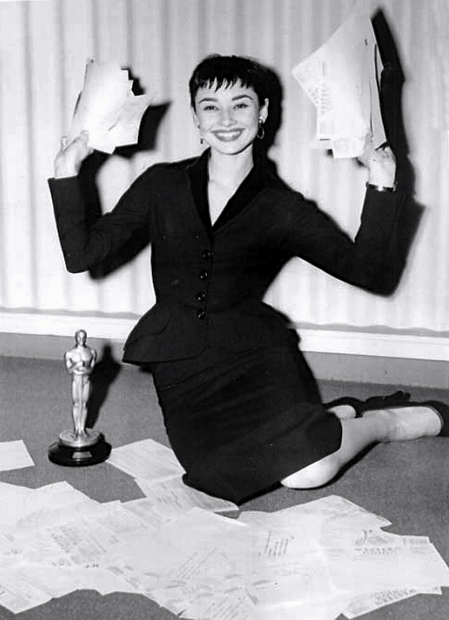
Speaking of Audrey Hepburn, I’ve shared this picture before but I’m going to share it again:

Audrey Hepburn 1954 Roman HolidayThat is Audrey Hepburn, the morning after she won the Best Actress Oscar for Roman Holiday.  Roman Holiday was Audrey Hepburn’s motion picture debut and it continues to hold up as one of the greatest film debuts of all time.  Watching how easily she controls and dominates the screen in Roman Holiday, you would think that she had made over a 100 films previously.

The film tells a simple story, really.  Audrey plays Ann, the crown princess of an unnamed country.  Princess Ann is touring the world.  The press is following her every move.  Her royal handlers are carefully choreographing every event.  Her ever-present bodyguards are always present to make sure that no one gets too close to her.  In public, Ann is the epitome of royal discretion, smiling politely and always being careful to say exactly the right thing.  But, in private, Ann is restless.  Ann knows that she has never been allowed to see the real world and yearns to escape, if just for one night, and live a normal life.  So far, her handlers have managed to keep her under control but then she arrives in Rome and…

…well, who can resist Rome?

Despite having been given a sedative earlier, Ann stays awake long enough to sneak out of her hotel room and see the enchanting Rome night life.  Of course, the sedative does eventually kick in and she ends up falling asleep on a bench.  It’s there that she’s discovered by an American, a cynical reporter named Joe Bradley (Gregory Peck).  Not realizing who she is and, instead, assuming she’s just a tourist who has been overwhelmed by Rome, Joe allows her to spend the night at his apartment.

The next morning, Joe finds out who Ann actually is.  Realizing that getting an exclusive interview with Ann could be his ticket to the big time, Joe and his photographer, Irving (Eddie Albert), rush back to Joe’s apartment.  Joe doesn’t tell her that he’s a reporter.  He just offers to take her on a tour of Rome.  Ann, however, wants to experience Rome on her own.

What follows is a wonderful and romantic travelogue of the glory of Rome.  Though Ann does explore on her own for a while, she eventually does meet back up with Joe and Irving.  Whenever I watch Roman Holiday, I always try to put myself in the shoes of someone in 1953, sitting in the audience during the film’s first week of release.  For many of them, this film may have been their first chance to ever see Rome.  (The opening credits of Roman Holiday proudly announce that the entire film was shot on location, properly acknowledging the Rome is as much a star of this film as Hepburn, Peck, and Albert.)  If you’re not already in love with Rome (and I fell in love with the city — and really, the entire country of Italy — the summer after I graduated high school), you will be after watching Roman Holiday.

(If you truly want to have a wonderful double feature, follow-up Roman Holiday with La Dolce Vita.)

The film’s most famous scene occurs at the Mouth of Truth and… well, just watch…

This scene was improvised, on the spot, by Gregory Peck.  Audrey Hepburn’s scream was very much real as Peck didn’t tell her what he was planning on doing.  As great as this scene is, it’s even better after you’ve actually been to Rome and put your own hand in the Mouth of Truth.

It’s a very sweet movie, one that stands as both a tribute to romance but also proof of what pure movie star charisma can accomplish.  It’s not just that Audrey Hepburn gives a great performance as Princess Ann.  It’s that Gregory Peck gives one of his most natural and surprisingly playful performance as well.  It’s that Peck and Hepburn have an amazing chemistry.  By the end of the film, you know that they deserve Rome and Rome deserves them.

And then there’s that ending, that bittersweet ending that always brings tears my mismatched eyes.  It’s a sad (though not depressing) little ending but somehow, it’s also the only ending that would work.

Roman Holiday was nominated for best picture but it lost to From Here To Eternity.

That’s right — Roman Holiday and From Here To Eternity were released one after another.

1953 was a very good year.

roman_holiday-1

gac_romanholiday

A Movie A Day #10: The Longest Yard (1974, directed by Robert Aldrich)


longest-yard-burt-reynolds

Once, Paul “Wrecking” Crewe (Burt Reynolds) was a superstar NFL quarterback.  That was until he was caught up in a point-shaving scandal and kicked out of the league.  When a drunk Crewe steals his girlfriend’s car, gets into a high-speed police chase, and throws a punch at a cop, he ends up sentenced to 18 months at Citrus State Prison.

The warden of the prison, Rudolph Hazen (Eddie Albert), is a football fanatic who, at first, is excited to have Crewe as an inmate.  The prison guards have a semi-pro football game and Hazen wants Crewe to coach the team and help them win a national championship.  Though initially reluctant and just wanting to do his time, Crewe relents after witnessing and experiencing the cruelty of the prison system.  Crewe forms The Mean Machine, a team made up of prisoners, and agrees to play an exhibition game against the guards.

At first, the members of the Mean Machine are just looking for an excuse to hit the guards without being punished but soon, they realize that they have a chance to win both the game and their dignity.  But Hazen is not above blackmailing Crewe to throw the game.

When it comes to understanding the Tao of Burt, The Longest Yard is the place to start.  Starting with a car chase and ending with near martyrdom, The Longest Yard is the ultimate Burt Reynolds film.  Paul Crewe ranks alongside Deliverance’s Lewis Medlock and Boogie Night‘s Jack Horner as Reynolds’s best performance.  Before injuries ended his athletic career, Reynolds was a college football star and, on the prison’s playing field, he holds his own with the large group of former professional football players who were cast to play the guards and the prisoners.  The Longest Yard’s climatic football game takes up over an hour of screen time and reportedly, the action was largely improvised during shooting.  Unlike most movie football games, the one in The Longest Yard looks and feels like a real game.

The Longest Yard was directed by Robert Aldrich, who specialized in making movies about anti-authoritarians fighting the system.  The scenes of Crewe recruiting and training The Mean Machine are very reminiscent of Aldrich’s best-known movie, The Dirty Dozen.  With its combination of dark humor, graphic violence, rebellious spirit, and Southern-friend melodrama, The Longest Yard is a movie that could only have worked in the 1970s.  The Adam Sandler remake may have made a lot of money at the box office but it still comes nowhere close to matching the original.

For tomorrow’s movie a day, it’s the best film of 2016, which also happens to be about a football player in prison.

thelongestyard

The Fabulous Forties #40: Smash-Up, The Story of a Woman (dir by Stuart Heisler)


Smash-Up_(1947)

The 39th film in the Fabulous Forties box set was 1947’s Smash-Up, the Story of a Woman.  I have to say it was a little bit strange going from watching the hilarious and life-affirming My Man Godfrey to watching the very serious and rather depressing Smash-Up.

Smash-Up is pure, tear-jerking Hollywood melodrama.  When the film starts, Angie Evans (Susan Hayward) is in a hospital, with her face totally covered in bandages.  Just by looking at her, we already know that her story is not going to be a happy one.

Flash back time!  Angie was a nightclub singer and a pretty good one at that.  The audiences loved her and she loved performing but she loved one thing more.  (See how overwrought my prose was there?  That’s a reflection of Smash-Up’s style.)  She loved Ken Conway (Lee Bowman, who may be related to me but probably isn’t).  Ken was a singer himself, though he was nowhere near as successful as Angie.  However, after Ken and Angie married, Angie put her career on hold while Ken went on to become a huge success.

Angie was already a drinker before she met Ken.  Having a few drinks before going out on stage helped to calm her nerves.  It helped her to relax and become the performer that the audiences loved.  However, once Ken became a star and Angie found herself continually alone in their home, she started to drink because it was the only thing that made her happy.  Whenever she started to regret giving up her career, she drank.  When she was worried that Ken was having an affair with his secretary (Marsha Hunt), Angie drank.  Ken’s best friend and songwriter, Steve (Eddie Albert), could see that Angie was losing control.  However, Ken refused to accept that his wife had a drinking problem.  Accepting that Angie was drinking to be happy would mean accepting that she wasn’t happy in the first place.

Trapped in the middle of all this was their daughter, Angel (Sharyn Payne).  When Ken, finally admitting that his wife could not control her drinking, demanded custody of Angel, Angie was determined to get back her daughter.

But, even though she wanted to, Angie could not stop drinking.  Or smoking.  And the smoking, the drinking, and the kidnapping did not make for a particularly good combination.

According to Wikipedia, Smash-Up was a failure at the box office and I can actually see why.  1940s American cinema can basically be divided between the earnest, patriotic, and optimistic films that were released during World War II and the dark and pessimistic films that came out after the war ended and the world realized just how evil and dangerous human beings could be.  Smash-Up is one of those dark films.  It’s not a happy film, nor is it at all subtle.  In fact, as much as I love a good melodrama, Smash-Up occasionally seems like a bit much.  Absolutely every bad thing that could happen does happen and it’s typical of the approach of Hollywood in the 40s that, for all the trouble Angie suffers as a result of her drinking, the film still has to find an excuse to send her to hospital with her face in bandages.  The film is often very empathetic in its treatment of Angie but, in the 1940s, mistakes still had to be punished.

Fortunately, Susan Hayward gives a great performance in the role of Angie, capturing the aching sadness that leads her to drink in the first place.  She saves the entire film and, quite justifiably, she received a nomination for best actress for her performance here.  She didn’t win but she still made Smash-Up worth seeing.

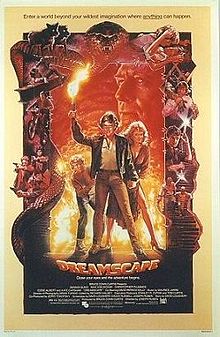
Halloween Film Review: Dreamscape (1984, directed by Joseph Ruben)


220px-Dreamscapeposter

Before there was Inception, there was Dreamscape!

DSDreamscape opens with the image of a woman running down a street while a red mushroom sprouts above the city behind her.  Just as a radioactive cloud envelopes the woman, the scene cuts to a man named John (Eddie Albert) waking up with a scream.  John is the President of the United States and he has been having reoccurring nightmares about nuclear war.  The dreams have shaken him to the extent that he plans of signing a disarmament treaty with the Soviet Union.

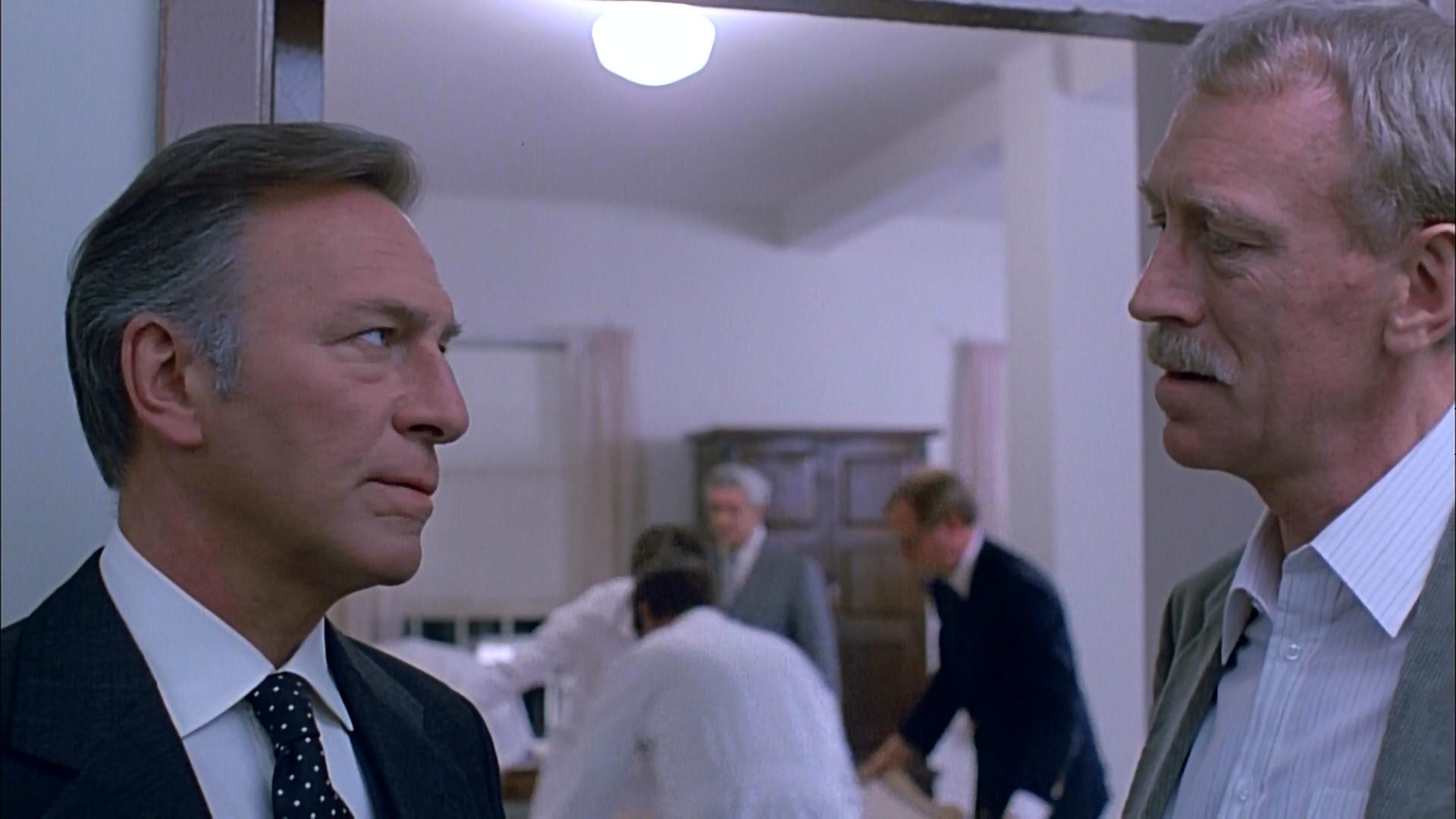
dreamscape-maxchrisBob Blair (Christopher Plummer, playing one of the slick villain roles that dominated his career until he finally won an Oscar for Beginners) is a political reactionary who works for a shadowy agency that is even feared by the CIA.  Determined to stop the President from signing that treaty, Blair recruits psychotic martial arts enthusiast Tommy Ray Glatman (David Patrick Kelly, of “Warriors, come out to play…” fame) to assassinate the President.  Tommy is a psychic who can enter people’s dreams and when you die in a dream, you die in real life.

Dreamscape_David_Patrick_KellyTommy is a part of a government-funded research project that is headed by Dr. Peter Novotny (Max Von Sydow) and Beth DeVries (Kate Capshaw).  Tommy was the program’s superstar until the arrival of Alex Gardner (Dennis Quaid).  Until he was recruited by Dr. Novotny, Alex was using his psychic abilities for gambling and womanizing.  Now, Alex has to use his abilities to save the President’s life.

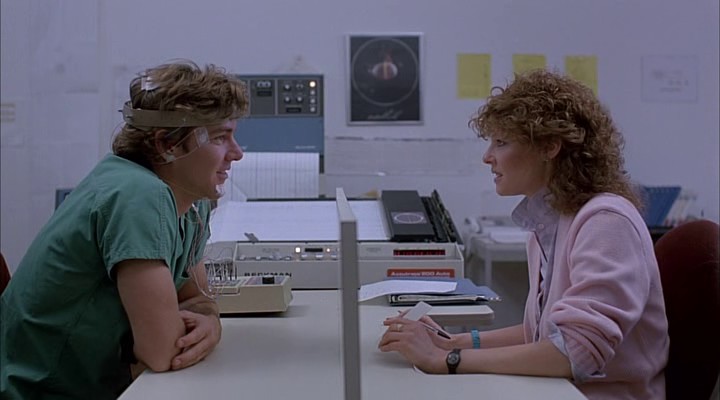
Dreamscape_Capshaw1Dreamscape came out the same year as Wes Craven’s Nightmare on Elm Street and they do share a few things in common.  During one scene set in the President’s nightmare, Tommy even has razor-sharp claws.  But ultimately, Nightmare and Dreamscape are two very different films.  Whereas Nightmare was a horror film, Dreamscape is an adventure film with horror elements.  In fact, Dreamscape feels like four different films all mashed together.  It’s a political conspiracy story, with Christopher Plummer plotting to kill the President.  It’s an adventure story, with Dennis Quaid as an appealing rogue.  It’s a love story, as Alex and Beth fall in love while researching dreams.  At times, it is also a very dark comedy, like when Alex enters the dream of a man who is terrified that his wife is cheating on him with everyone that they know.

Fans of cult cinema will appreciate that Dreamscape features one of David Patrick Kelly’s best villainous performances.  In the role of Tommy, he not only gets to do his usual bravura work as a weasley psychopath but he also gets to bust out an impressive impersonation of Bruce Lee as well.

dreamscape-4Along with David Patrick Kelly at his demented best, Dreamscape also features the Snakeman, a claymation monster who may look cheesy today but probably gave many youngsters nightmares back in 1984.  Like the Snakeman, all of the film’s special effects have aged but it does not detract from the film.  Since the special effects were used to create the film’s dreams, it doesn’t matter that they no longer look 100% realistic.  Dreams are supposed to be strange so the cheesiness of some of the special effects actually works to Dreamscape‘s advantage.

Dreamscape may not be as well-known as Inception or Nightmare on Elm Street but it is still a fun and entertaining excursion into the dream world.

Dreamscape

Out of the Saddle: John Wayne in MCQ (Warner Bros, 1974)


mcq1

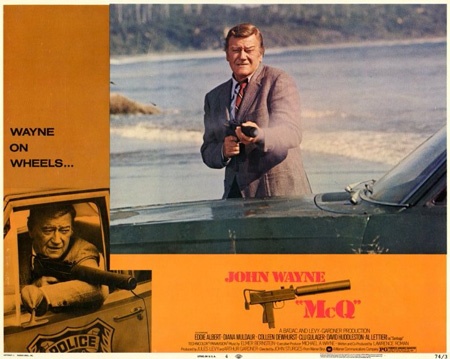
John Wayne didn’t get off his horse very often in the latter part of his career. The Duke hadn’t done a non-Western since 1969’s HELLFIGHTERS, but cop pictures were in style in the early 70s due to the success of movies like THE FRENCH CONNECTION and DIRTY HARRY. Wayne was actually offered the part of Dirty Harry Callahan and turned it down. But in 1974, Big John traded in his horse for a Pontiac Firebird in the action packed MCQ, directed by veteran John Sturges (GUNFIGHT AT THE OK CORRAL, THE MAGNIFICENT SEVEN, THE GREAT ESCAPE).

mcq2

Wayne plays tough cop Lon McQ, who quits the force to investigate the murder of his former partner. He gets tangled up with drug dealers and corrupt officials, car chases and shootouts. Sound formulaic? It is, but the action scenes make up for a lame script. Duke basically plays the same character he did in most all his films, tough but tender, fair but firm. It’s kind of jarring to see Wayne in his (pretty bad) hairpiece instead of the usual cowboy hat, and tooling around the streets of Seattle in a muscle car rather than the dusty trail on his horse. He’s surrounded by a supporting cast full of familiar faces (Eddie Albert, Diana Muldaur, Colleen Dewhurst, Al Lettieri, David Huttleston, Clu Gulager), all of whom do their best with the clichéd script. MCQ plays like a TV movie of the week, which isn’t necessarily a bad thing, and fans of 70s action flicks will dig it.

John Wayne only made three more films after MCQ, including another cop movie, BRANNIGAN, and his swan song, 1976’s THE SHOOTIST, before succumbing to cancer in 1979. The Duke made much better movies then MCQ, but for a look at the star without his spurs and six-gun,  it’s definitely worth watching.

(This post originally appeared, in slightly altered form, on the 2015 TCM Summer of the Stars Blogathon, hosted by Journeys in Classic Film)

Embracing the Melodrama Part II #49: Hustle (dir by Robert Aldrich)


HustleContinuing our journey into the dark Hell of the 1970s, we now take a quick look at the 1975 cop film, Hustle.

Taking place in Los Angeles, Hustle tells the story of several different people who find their lives intertwined in the desperate dance of existence.  (Does that sound overdramatic?  Well, that’s the type of film that this is.)

There’s Leo Sellers (Eddie Albert), a lawyer with bright rosy cheeks and a friendly manner.  You look at Leo and you automatically assume that he must be a nice guy, the type of guy who puts on a fake beard and plays Santa Claus down at the local orphanage.  But actually, Leo is a lawyer for the mob.  He’s gotten rich through crime and his mansion hides all sorts of secrets.  He also has a weakness for violently abusing prostitutes.

Speaking of prostitutes, one of Leo’s favorite is Nicole (Catherine Deneuve), an icy French beauty who survives by holding the world at a distance.  Though Nicole doesn’t like Leo, she has to keep him happy because Leo could easily arrange for her to be deported back to France.

Nicole is also the girlfriend of Phil Gaines (Burt Reynolds), a cynical homicide detective who, like her, tries to keep the world at a distance.  Phil is obsessed with old films and frequently speaks of how much he wishes the real world could be like a movie.  Throughout the film, he talks about eventually moving to Rome.

Phil’s partner is Louis Belgrave (Paul Winfield), who is not quite as cynical as Phil but who is definitely getting there.  Whereas Phil is always talking about how much the world has disappointed him, Louis mostly accepts things without complaint.  He just wants to do his job and go home at the end of the day.

Phil and Louis’s boss is Santoro (Ernest Borgnine, giving a typical Ernest Borgnine performance).  Santoro is not a bad guy but, in order to hold onto his job, he has to keep powerful men like Leo Sellers happy.

Santoro also has to deal with the complaints of people like the Hollingers.  Marty Hollinger (Ben Johnson) is a veteran of the Korean War and handles the world in a gruff and suspicious manner.  Paula (Eileen Brennan) is Marty’s wife and, as a result of his emotional distance, has recently started having an affair.

And then there’s Gloria (Colleen Brennan), Marty and Paula’s daughter.  Gloria ran away from home a while ago and soon found herself working as a stripper, a porn actress, and eventually as a prostitute.  When Gloria is found dead, Phil and Louis get the case.  It’s obvious to them that Gloria committed suicide.  It’s not so obvious to Marty, who is convinced that his daughter was murdered and, disgusted by Phil’s cynical attitude, sets out to investigate the case on his own.

One of the more interesting things about Hustle is that really is no murder mystery.  Despite what Marty believes, Gloria really did commit suicide.  Marty’s insistence that she was murdered has more to do with his guilt over being a bad father than it does with any real evidence.  As Marty investigates his daughter’s life, he is exposed to a sordid world of strip clubs and prostitution.  He discovers that Gloria’s clients included many powerful men and he decides that the last client she saw must have murdered Gloria.

That client is Leo Sellers.  And while Leo may not have murdered Gloria, he is willing to kill Marty to keep his secret life from being exposed.  Phil and Louis are forced to choose between remaining detached or protecting Marty from himself.

And, since this film was made in the 70s, it all ends on a really dark note!

Hustle shows up on Encore occasionally.  It’s a strange film to watch, as it alternates between being a fairly predictable cop film and being a portrait of existential dread.  The movie doesn’t really work; it’s too long, it features some amazingly pretentious dialogue, and Reynolds, Winfield, and Deneuve all seem to be bored with their characters.  Probably the film’s best performance comes from Ben Johnson.  I imagine that has to do with the fact that Johnson is playing the only character who behaves in a fairly consistent way.

And yet, if you’re like me and you’re fascinated with the nonstop fatalism of 70s cinema, Hustle does have some historical value.  It’s one of those films that you watch and you wonder how anyone survived the 1970s!

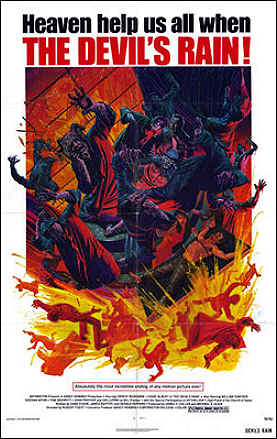
Horror On The Lens: The Devil’s Rain (dir by Robert Fuest)


TheDevilsRain

Satanic priest Jonathan Corbis (Ernest Borgnine) has spent decades pursuing the Preston family.  The Prestons, it turns out, have a book of powerful Satanic magic in their possession.  After Corbis causes the Preston patriarch to melt in the rain, Mark Preston (William Shatner) decides to confront Corbis and his followers…

Released in 1975, the Devil’s Rain was presumably made to capitalize on the success of films like Rosemary’s Baby and The Exorcist.  The film itself is a bit incoherent but it’s worth watching just to see shameless overactors William Shatner and Ernest Borgnine acting opposite each other.  The cast also includes Ida Lupino, Keenan Wynn, Tom Skerritt, and Eddie Albert, which means that there’s not a single bit of scenery that doesn’t get chewed at some point.

If watch carefully, you can spot John Travolta making his screen debut towards the end of the film.

6 Trailers That Are Partying…Partying…Partying…Yeah!


As Rebecca Black recently reminded us all, Saturday comes after Friday.  However, she neglected to say anything about the fact that Saturday also means another edition of Lisa Marie’s Favorite Grindhouse and Exploitation trailers.

Stuck-up bitch.

Anyway, it is indeed Saturday and here’s this weekend’s humble offerings…

1) Sweet Jesus Preacherman (1973)

To me, this first offering actually feels more like a parody trailer (like Machete or Hobo With A Shotgun) than an actual trailer.  But no, Sweet Jesus Preacherman appears to be an actual film. 

2) The Soldier (1982)

This was directed by James Glickenhaus, who directed The Exterminator.  According to the commentary track on one of the 42nd Street Forever DVDs, Glickenhaus felt that The Soldier would help him break into mainstream films and, though I’m not a huge fan of action movies, the trailer does look fairly exciting.  Plus, if you watch the whole without blinking, you might catch a split-second appearance from Klaus Kinski.  Supposedly, Kinski was offered a role in both this film and Raiders of the Lost Ark.  Kinski chose to appear in The Soldier.

3) The Great Silence (1968)

Speaking of Klaus Kinski, he’s also featured in our next trailer, The Great Silence.  Directed by Sergio Corbucci, The Great Silence has been acclaimed as one of the greatest spaghetti westerns of all time.  This film’s title refers to the fact that the nominal hero (played by Jean-Louis Trintignant) is a mute.  The trailer also features Ennio Morricone’s excellent score.

4) Flesh Gordon (1974)

There were actually two versions of this film — an explicit one and a slightly less explicit one.  I’m guessing this trailer was used to advertise the slightly less explicit version.

5) The Devil’s Rain (1975)

In this film, William Shatner, Eddie Albert, Tom Skerritt, and Ida Lupino battle Satanists (and Ernest Borgnine) in New Mexico.  Though he’s not mentioned in the trailer, John Travolta made his film debut here.  He plays a member of Borgnine’s cult.  This trailer — with its promise of the greatest ending of all time — is a drive-in classic.

6) Dolemite (1975)

Let’s end how we began, with a blaxploitation trailer.  I do have to say that, as a character, Dolemite looks a bit more interesting that Sweet Jesus Preacherman.  Plus, the Dolemite trailer rhymes.

Remember that Monday is Memorial Day so, if nothing else, take a few minutes to remember the men and women who have fought to allow us to live in a country where we can watch movies like Dolemite, Flesh Gordon, and Sweet Jesus Preacherman.