I swear, nothing annoys me more than when wannabe hipsters go out of their way to trash old movies.
You see that a lot on twitter. People who, for the most part, haven’t even studied film or cultural history will try to post something snarky about a film that was made decades before they were born. They either make fun of the acting or the dialogue or they attempt to call out the film for not being properly woke. It’s an easy way to get likes and retweets but it’s also about as intellectually lazy as you can get.
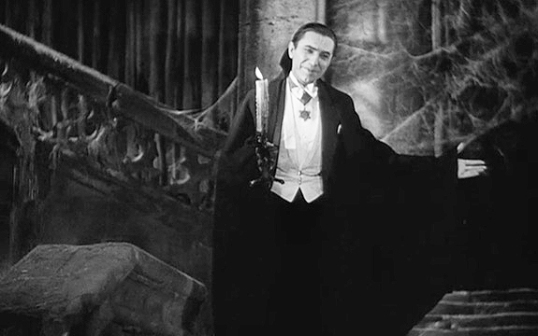
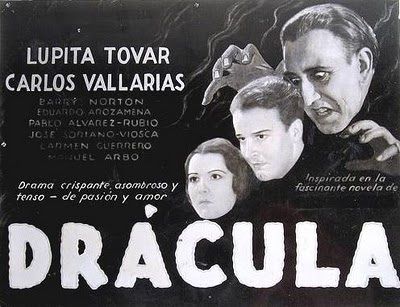
For instance, there’s a tendency to dismiss the 1931 version of Dracula and Bela Lugosi’s performance in the lead role. Personally, I do think that Dracula is a bit too stagey (it was, after all, based on a stage play that was based on Bram Stoker’s novel) and I wouldn’t put it up there with director Tod Browning’s best work. The Spanish-language version ofDracula, which was filmed at the same time, is technically a better film. But, that being said, I will accept no criticism of Lugosi’s performance. Lugosi is the perfect Dracula. If he seems overly theatrical …. well, Dracula’s a pretty theatrical character. It has to be remembered that Lugosi is playing a character who is supposed to be several hundred years old. If he acts like a man out-of-time, that’s because that is exactly what he is.
Ultimately, it comes down to this — a lot of actors have played Dracula. Some of them have been very good in the role. Some of them have been very bad. But, if not for Lugosi, none of them would have had the opportunity.
So, in honor of that legacy, today’s horror scene that I love comes from the original Dracula and features Bela Lugosi at his creepiest:
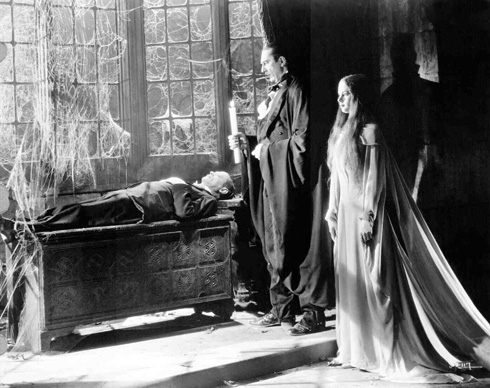
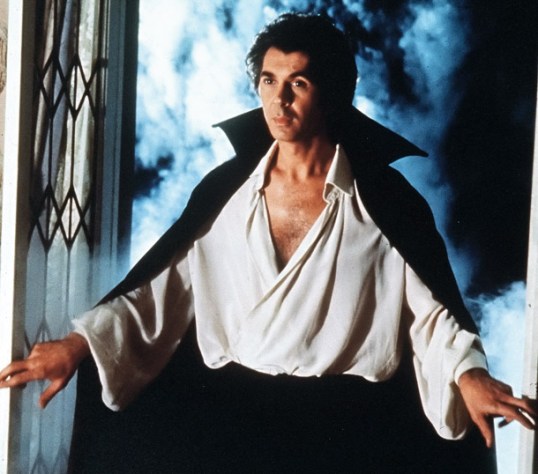
Count Dracula has been scaring people for centuries. Many different artists who have taken their turn portraying the world’s most famous vampire. Below is a small selection of portraits of Dracula through the ages:
For today’s music video of the day, we have yet another song called Dracula. However, as you can tell by looking at the lyrics, this song actually has some connection to everyone’s favorite vampire (or, at the very least, the legend of everyone’s favorite vampire):
Her She was a dancer Feel As the girl she twirls off the edge of her paper-thin world
The “I” Give to the Master Mirror, mirror Can you tell one from the other? Strange I offer my veins Feel As the girl she twirls off the edge of her paper-thin world
Oh in the night When Dracula comes to fill your soul To atone, confess My one true weakness My Dracula, Count Dracula
Her She was a dancer (First I must appease my thirst) Feels Good you know as the girl she twirls off the edge of her world
Oh in the night When Dracula comes to fill your soul To atone, confess My one true weakness My Dracula, Count Dracula
Oh in the night When Dracula comes to fill your soul To atone, confess My one true weakness My Dracula, Count Dracula
According to singer Moana Mayatrix, “I’d say it’s not directly about vampires but more so an exploration of vampire mythology and the allure of the dark side, much like being seduced by a Bram Stoker character.”
It’s debatable whether or not this song from Vondelpark is actually about the Lord of the Vampires but I imagine he’d appreciate it. Myself, I love the atmospheric, dream-like feel of both the song and the video. Just listening to this puts me into another world.
Sadly, Vondelpark is no more. They broke up in 2016. But Dracula lives forever.
4 Shots From 4 Films is just what it says it is, 4 shots from 4 of our favorite films. As opposed to the reviews and recaps that we usually post, 4 Shots From 4 Films is all about letting the visuals do the talking.
This October, I am going to be using our 4 Shots From 4 Films feature to pay tribute to some of my favorite horror directors, in alphabetical order! That’s right, we’re going from Argento to Zombie in one month!
Today’s director is Tod Browning, who started his career during the silent era, ended it in the sound era, and was responsible for some of the most important horror and suspense films of both!
I have to admit that, when I first sat down to watch the 1979 version of Dracula, I wasn’t expecting much. I hadn’t even heard of the film until I came across it on Encore and, when I considered that it was made in 1979, I immediately assumed it would be a disco Dracula film.
And, let’s be honest — a disco Dracula film sounds kinda fun. But still, it’s Halloween. Dracula is an icon of horror. And somehow, the idea of watching disco Dracula just was not appealing. It would be appealing in November or September. BUT THIS IS OCTOBER!
Well, despite my misgivings, I watched the film and I quickly discovered that it wasn’t a disco Dracula at all. This Dracula takes place in 1913 and there’s actually very little about it that would lead you to suspect that it had been made in the 1970s. Instead, it feels more like a tribute to the colorful and lushly erotic Dracula films that Hammer produced in the 60s. Except, oddly, the Hammer films were far more bloody than the 1979 version. Oh, don’t get me wrong. There’s a few gory scenes in 1979’s Dracula. Towards the end of the film, there’s a rather bloody impaling. Dracula graphically breaks another character’s neck as we watch. But, even with those scenes in mind, the 1979 Dracula feels oddly restrained at times.
In this version of Dracula, the title character is played by a youngish Frank Langella. I have to admit that it was a bit odd to see Langella playing someone other than a corrupt authority figure. Dare I say it, Langella is almost sexy in this film and his somewhat feral features are perfect for a character who considers wolves to be “the children of the night.” Langella’s performance falls between the haughty charm of Bela Lugosi and the animalistic fury of Christopher Lee. And while Langella’s performance never quite reaches the heights of those two actors, he’s still effectively cast.
As for the film itself, it starts with a shipwreck near a local asylum. One of the passengers on that ship is the charming but mysterious Count Dracula. Dracula introduces himself to the head of the asylum, Dr. Jack Seward (Donald Pleasence, stealing almost every scene in which he appears). There’s an immediate attraction between Dracula and Seward’s daughter, Lucy (Kate Nelligan). That does not amuse Lucy’s fiancee, Jonathan Harker (Trevor Eve, who is perhaps the whiniest Harker in film history).
Meanwhile, Lucy’s best friend, Mina (Jan Francis), has been taken ill and it might have something to do with the two puncture marks on her neck. After Mina dies, her father (played by Laurence Olivier) comes to investigate. Her father’s name? Abraham Van Helsing.
As I said, I was not expecting much from this version of Dracula so I was actually pleasantly surprised during the first hour of the film. This version gets off to a nice start, with director John Badham giving us a mix of lush romanticism and gothic moodiness. I’ve already talked about Langella’s performance but Donald Pleasence and Laurence Olivier also distinguish themselves. It’s obvious that these veteran performers enjoyed playing opposite each other and there’s a lot of pleasure to be found from watching Pleasence and Olivier compete to see who can steal the most scenes.
Unfortunately, after that strong first hour, Dracula slows down. Once Seward and Van Helsing know that Dracula is a vampire, the whole movie becomes about finding excuses for them to not do anything about it. The final 40 minutes feel almost like filler and, at one point, you’re required to believe that an elderly man, who has been seriously wounded, could still find the strength to swing a hook into a much stronger person’s back.
In the end, the 1979 Dracula is more of an intriguing oddity than a definitive version.
Well, Bram Stoker might disagree but, according to Universal Studios, he did. Her name was Countess Marya Zaleska and, as played by Gloria Holden, she is the title character in 1936’s Dracula’s Daughter! Like her father, the Countess was also a vampire. The film never gets into just how she became a vampire. Was she born a vampire or, far more disturbingly, was she once a mortal who turned into a vampire by her own father? The film doesn’t tell us but it does establish early on that she hates being one of the undead. Unlike her father, she struggles with her urge to drink blood. When she discovers that Dracula has been staked, she and her servant, Sandor (Irving Pichel), steal the body from the morgue and burn it. The Countess thinks that this will cure her of her urges.
Sadly, it does no such thing.
So, what’s a reluctant, 20th century vampire to do? Well, she can always go to a psychiatrist and hope that science can somehow break the curse. She ends up as a patient of Dr. Jeffrey Garth (Otto Kruger). By coincidence, Dr. Garth has another famous patient — Dr. Edward Von Helsing. (That’s right, they changed the “van” to a “von” in Dracula’s Daughter. Despite the name change, Edward van Sloan returns to play the veteran vampire hunter.)
Von Helsing in on trial, accused of murdering Dracula in the previous film. Oddly enough, nobody mentions Renfield who, seeing as how we’re told Dracula’s Daughter starts exactly where Dracula left off, would have been found dead in the crypt as well. Even stranger, no one steps forward to defend Von Helsing. Dr. Seward, Mina, Johnathan Harker? Forget about them. Not a single one is to be found while Von Helsing is accused of murder.
Bastards.
Fortunately, Von Helsing has a defense! Since Dracula was already dead and had been for 500 years, Von Helsing could not have killed him. Helping him out with this defense is Dr. Garth…
Meanwhile, the Countess tries to resist the urge to attack every woman that she sees. She pours her frustrations out into painting. One night, Sandor brings the Countess a new model, a beautiful young woman named Lil (Nan Grey). The Countess orders Lil to undress and then, after staring at her, gives into her urges and attacks…
If you’re thinking that there’s a subtext here, that’s because there is. (In fact, Universal’s tagline for the film was, “Save the women of London from Dracula’s Daughter!”) Perhaps even more so than in Dracula,Dracula’s Daughter uses vampirism as a metaphor for forbidden sex. When the Countess stares at Lil and, later, when she prepares to bite the neck of Dr. Garth’s fiancée, she is embodying the hysterical fears of a puritanical society. When she unsuccessfully seeks a cure for her vampirism, we’re reminded that, in the 1930s, psychiatry classified homosexuality as being a mental illness. When the Countess struggles with her urge to drink blood, she is a stand-in for everyone who has struggled with their sexuality.
Gloria Holden plays the Countess as being as much a victim as a victimizer. Whereas Bela Lugosi turned Dracula into the epitome of evil, Gloria Holden gives a performance that is full of ambiguity. In fact, she at times seems to be so tortured by her vampiric state that, when she finally fully embraces the fact that she’s a vampire, you have to cheer a little. At least she’s finally being honest with herself! At least she’s no longer making apologies or allowing society to punish her for being who she is. Was Countess Zaleska the first reluctant vampire in film history? I’m not sure but Holden’s performance undoubtedly set the bar by which all other self-loathing vampires should be judged.
Dracula’s Daughter holds up surprisingly well. It’s definitely one to look for during this Halloween season.
One of the wonderful oddities of film history is that, in 1931, Universal produced not one but two versions of Dracula. There’s the version that we all know, the one with Bela Lugosi. And then there was the Spanish language version.
It was a common practice during the early days of the sound era for the studios to concurrently shoot Spanish-language versions of their films. In the case of Dracula, the cast and the crew for the Spanish version would shoot at night, after Lugosi, Edward van Sloan, Dwight Frye, and everyone else had gone home. The crew and the actor cast as Dracula, Carlos Villarias, were allowed to watch the dailies, with Villarias being specifically told to model his performance as much on Lugosi’s as possible.
Most of the early Hollywood’s Spanish films have been lost but Drácula has survived. In fact, among some horror critics, it’s become a bit trendy to declare that the Spanish language version is superior to the English version. While I was preparing for our annual October horrorthon, I decided to watch Drácula and see for myself.
In some ways, Drácula is indeed superior. The film uses the same script as the English version and was filmed on the same sets. But visually, it’s a far more interesting film. Because director George Melford (who was quite an acclaimed silent film director) had a chance to watch Dracula‘s dailies, he also had the benefit of hindsight when it came to making decisions regarding lighting and camera angles. If the English language Dracula suffers because its stationary camera work makes it feel like a filmed stage play, the Spanish-language Drácula feels like a real movie.
As well, there’s a passion to the Spanish language Drácula, a passion that often seems to be missing from the English language version. The English language version often seems to be going out of its way not to offend — the screen fades to black whenever Dracula starts to bite anyone, Jonathan Harker and Mina Seward are both portrayed rather dully, and, with the exception of Lugosi, Dwight Frye, and Edward van Sloan, everyone seems to be a bit too restrained in their performances.
Perhaps because it was specifically being filmed for foreign distribution, the Spanish language Drácula is far less restrained. We see what Dracula actually does to his victims. We see Eva and Lucia’s ecstatic reactions to being bitten by the vampire. As oppose to Dracula, where everyone was very proper and very covered, Drácula embraces cleavage and moaning in the same way that, 20 years later, would make Hammer Studios famous. The actors in Drácula are far more passionate, emotional, and sensual than their English-language counterparts. They’re far more … well, Spanish. Spanish is an exciting language and it’s pretty much impossible for someone speaking it to be boring.
But, unfortunately, Drácula fails where it matters most. In the role of the count, Carlos Villarias never exhibits the charisma that we associate with the best Draculas. I get the feeling that he was mostly cast because he bore a passing resemblance to Bela Lugosi. Since he was instructed to imitate Lugosi, that’s what his performance comes across as being. While Villarias does a better Lugosi imitation than that guy that Ed Wood used in Plan Nine From Outer Space, it’s still just an imitation.
And unfortunately, you really can’t have a good Dracula film unless you have a good Dracula. In a perfect world, we would have a combination of the two versions, with Bela Lugosi starring in the Spanish version. However, we live in an imperfect world but at least it’s a world where we can watch both Dracula and Drácula.
It pains me to say it but, of all the classic Universal monster films, Dracula is probably my least favorite.
I hate to say that because I love vampires and I love the story of Dracula. I have read the book several times, I’ve seen several productions of the stage play, and I’ve seen a countless number of Dracula films. (Christopher Lee’s version is my favorite.) The 1931 version of Dracula — while hardly being the first vampire movie — was still a very important moment in the history of horror cinema. Every vampire film that has come out since owes a debt of gratitude to Dracula. Bela Lugosi’s performance set the standard against which almost all vampires are judged.
I always want to love Dracula but … no, the film just doesn’t work for me.
Of course, we all know the film’s story. Dracula (Bela Lugosi) comes to England from Transylvania. He turns Lucy (Frances Dade) into a vampire and attempts to do the same thing to Mina Seward (Helen Chandler). Mina’s fiancée, John Harker (David Manners) and father, Dr. Seward (Herbert Bunston), attempt to stop him with the help of Prof. Van Helsing (Edward van Sloan). Renfield (Dwight Frye) serves as Dracula’s servant and eats bugs. Dracula tells us that he does not drink … wine. He talks about the music of the night. His eyes get wide at the sight of blood and he hides his face when confronted with a cross.
Of course, though Dracula may have first appeared in Bram Stoker’s novel, the film is actually an adaptation of a stage play that was based on the novel. That’s the main problem with Dracula as a movie. It’s a very stagey film, one that never seems to quite break free of its theatrical origins. It’s a rather slow-moving film, one that is full of awkward scene transitions and moments of dead air. One need only compare it to F.W. Murnau’s Nosferatu or Carl Theodor Dreyer’s Vampyr to see just how visually bland Dracula really is.
Dracula‘s blandness is especially surprising when you consider that the direction is credited to Tod Browning. Browning directed some of the best horror films of the silent era and, after the release of Dracula, he went on to direct the brilliant Freaks. Dracula doesn’t feel like a Browning film but perhaps that’s because it actually wasn’t. Reportedly, Tod Browning was struggling with depression during the filming of Dracula and was rarely on set. Instead, most of the film’s direction was handled by cinematographer Karl Freund. Freund had never directed a film before (though he would later acquit himself quite well with The Mummy) and Dracula‘s flaws were largely a result of that inexperience.
Well, that may be true or it may not. Here’s what we can say for sure: Bela Lugosi’s work as Dracula holds up surprisingly well. When seen today, it can be difficult to fairly judge Lugosi’s performance. We’ve seen so many parodies and bad imitations that it’s difficult to imagine the impact that it may have had on audiences in 1931. Lugosi was recreating his stage performance and it’s a very theatrical performance but, at the same time, Dracula is a character that doesn’t demand or require subtlety. There’s a power to Lugosi’s performance. Maybe it’s the piercing stare or the unbridled blood lust that seems to be reflected in his eyes. Maybe it’s the accent. Maybe it’s the haughty and arrogant way that he carries himself. Whatever it is, it works.
No, Dracula does not hold up as well as you might hope. But Bela Lugosi’s performance remains a classic.