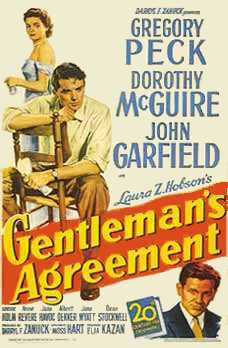
Earlier today, as I was watching the 1947 film, Gentleman’s Agreement, I found myself thinking about a conversation that I had in 2006.
This was when I was in college. I was having lunch with some friends from one of my classes. As we were eating, the conversation turned to the war in Iraq. That, in itself, was not surprising because, in 2006, it seemed like every conversation somehow turned to what was happening in the Middle East.
One of the people with whom I was having lunch was Olivia, self-styled intellectual who fancied herself as the most knowledgeable person on campus. To be honest, I can’t think of anyone who liked her that much but she had a skill for subtly weaseling her way into almost every conversation. She was one of those incredibly pretentious types who started every sentence with “Actually….” and who had embraced Marxism with the shallow vapidness of someone who had grown up in Highland Park and who would never have to struggle to pay a bill.
On that day, Olivia announced to us all that the only reason we were in Iraq was because we were doing the bidding of Israeli lobbyists and then she went on to talk about how 9-11 was an inside job. She repeated the old lie about Jews calling in sick on 9-11 and claimed that five MOSSAD agents were arrested in New York for celebrating after the collapse of the Twin Towers.
After Olivia said this, there was the briefest silence as everyone else tried to figure out how to react. Finally, someone tried to change the subject by making a joke about our professor. Realizing the no one was going to openly disagree with Olivia and risk an argument, I said, “That’s not true.”
“What’s not true?” Olivia asked.
“About Jewish people calling in sick on 9-11 and celebrating after the Towers fell. That’s not true.”
Olivia looked a little bit surprised that she was being openly challenged. Finally, she said, in a surprisingly sincere tone of voice, “I’m sorry. I didn’t realize you were Jewish.”
I’m not Jewish. I’m Irish-Italian-Spanish and pretty much all of my immediate ancestors were Catholic. But, as far as Olivia was concerned, I had to be Jewish because why else would I object to her repeating an anti-Semitic conspiracy theory? When she apologized (and, make no mistake, there was not a hint of sarcasm in her tone when she said she was sorry), it wasn’t for being a bigot. Instead, it was for being a bigot in front of the “wrong” person. It didn’t occur to her that I was upset because what she said was bullshit.
Anyway, I wish I could say that I threw a drink in Olivia’s face or that I stood up on the table and delivered an impassioned speech but, once again, the other people at the table hastily changed the subject. Anything to avoid a conflict, I suppose. That was the last time I ever had a conversation with Olivia. For the rest of the semester, I ignored her and I felt pretty proud of myself for shunning her. It’s only been recently that I realized that Olivia also didn’t really make any effort to really talk to me after that conversation. I shunned her because of her bigotry and I can only assume that she shunned me because of her misconception about my ancestry.
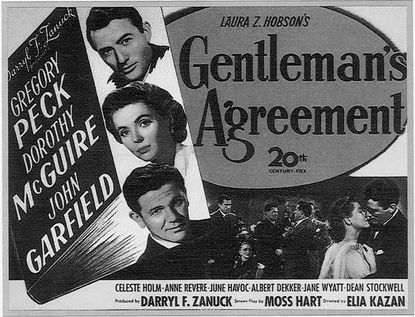
Gentleman’s Agreement is about a Gentile reporter named Phillip Green (Gregory Peck) who, while researching a story about anti-Semitism, poses as a Jew and discovers that the world is full of people like Olivia. His own fiancee, a self-declared liberal named Kathy (Dorothy McGuire), reacts to Phil’s plan by asking him, “But you’re not really Jewish …. are you?” By the simple act of telling everyone that his last name is actually “Greenberg,” Phil discovers that he suddenly can’t get a hotel reservation. People stop returning his calls. When he and Kathy have an engagement party in a wealthy community in Connecticut, many of Kathy’s friends stay away. (Kathy, meanwhile, begs Phil to let her tell her family that she’s not actually engaged to a Jew.) When Phil’s son, Tommy (Dean Stockwell), is harassed at school, Phil is shocked to hear Kathy tell Tommy that he shouldn’t listen to the bullies not because they’re a bunch of bigots but because “you’re not actually Jewish.”
Meanwhile, Phil’s friend, Dave Goldman (John Garfield), has returned from serving in World War II, just to discover that he can’t even rent a home for his family because many landlords refuse to rent to Jews. When Phil learns that Katy owns a vacant cottage, he suggests that she rent it out to Dave. Despite her sympathy for Dave, Kathy is shocked at the suggestion. What will the neighbors think?
Gentleman’s Agreement was produced by Darryl F. Zanuck, who took on the project after he was refused membership in the Los Angeles Country Club because the membership committee assumed that Zanuck was Jewish. It was considered to be quite a controversial film in 1947, as it not only dealt with American prejudice but it also called out two prominent elected anti-Semites — Sen. Theodore Bilbo and Rep. John E. Rankin — by name. Zanuck often claimed that the other studio moguls asked him to abandon the project, saying that a film would only inspire more of what it was trying to condemn. Still, Zanuck stuck with the project and it was not only a box office hit but it also won the Oscar for Best Picture.
Seen today, Gentleman’s Agreement has its flaws. In the lead role, Gregory Peck is a bit of a stiff and Elia Kazan’s directs in an efficient but bland manner. Because this film was made in 1947 and a happy ending was a must, Kathy is given a rather convenient opportunity at redemption. The film’s most compelling performers — John Garfield, Celeste Holm, and June Havoc (playing Phil’s Jewish secretary, who had to change her last name before anyone would even consider hiring her) — are often underused.
And yet, with all that in mind, Gentleman’s Agreement is still a very effective film. Gentleman’s Agreement understand that there’s more to prejudice than just the morons who go to rallies or the degenerates who shout slurs across the street. Gentleman’s Agreement understands that, for prejudice to thrive, it also needs people like Kathy or Olivia, people who have that prejudice so ingrained in their system that they don’t even think twice about it and Dorothy McGuire does a very good job of playing a self-satisfied liberal who is blind to her own prejudice. Gentleman’s Agreement understands that bigotry isn’t just about the openly hateful. It’s also about the people who silently tolerate it and who refuse to stand up against it. It’s about the people who respond to prejudice not with outrage but who instead attempt to change the subject.
In the UK, one of the two major political parties has basically surrendered itself to anti-Semitism. Here in the US, Congress can’t even bring itself to condemn the frequently anti-Semitic comments of two of its members. Elected leaders and pundits only offer up the weakest of condemnation when Jewish people are viciously attacked in the streets. When a man attacked a group of Jews on Hanukkah, many excused the man’s attack by trying to say that he was just upset about gentrification. For many reasons, Gentleman’s Agreement is still relevant and important today.