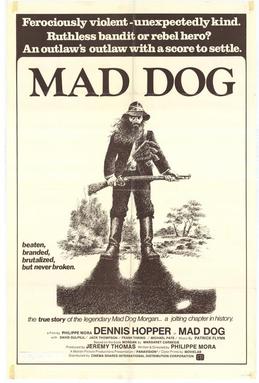
Though he may not be as internationally well-known as Ned Kelly, Dan “Mad Dog” Morgan was one of the most infamous bushrangers in 19th century Australia. Much as with the outlaws of American west, it is sometimes difficult to separate the fact from the legend when it comes to Mad Dog Morgan but it is agreed with Morgan has one of the most violent and bloodiest careers of the bushrangers. Whether Morgan was a folk hero or just a ruthless criminal depends on which source you choose to believe.
In Mad Dog Morgan, Dennis Hopper plays Morgan as being the ultimate outsider. Though the real Morgan was believed to have been born to Irish immigrants in New South Wales, the film presents Morgan as being the immigrant, an Irishman who ends up in Australia searching for gold and who is disgusted when he sees the way that the colonial authorities run the country. Addicted to opium and angered by the casual brutality and corruption that he sees all around him, Morgan fights back and soon ends up in prison where he spends years being abused and raped. It is all intended to break his spirit but, instead, Morgan comes out of prison even more determined to seek revenge on any and all figures of authority. Working with a fellow outsider, an Aborigine named Billy (David Gulpilil, from Nicolas Roeg’s Walkabout), Morgan blazes a bloody and self-destructive trail across Australia.
Mad Dog Morgan was made long before Hopper cleaned up his act and became on of America’s favorite character actors. This is Hopper back when he was still one of the most unpredictable and dangerous actors around. By many accounts, Hopper was in the throes of drug-induced psychosis during the filming of Mad Dog Morgan, which makes it all the more remarkable that Hopper still gave one of his best performances as the legendary bushranger. (For proof of how authentic Hopper feels in the role, compare his performance to Mick Jagger’s in Ned Kelly.) Hopper was an outlaw playing an outlaw and his full commitment to the role is obvious from the start. Featuring brutal action and a cast of talented Australian character actors, (Jack Thompson, Bruce Spence, Bill Hunter, and Hugh Keays-Byrne all have roles) Mad Dog Morgan is an essential film for fans of both Australian cinema and Dennis Hopper.
Los Angeles in the 80s. Beneath the California glamour that the rest of America thinks about when they think about L.A., a war is brewing. Bloods vs Crips vs the 21st Street Gang. For those living in the poorest sections of the city, gangs provide everything that mainstream society refuses to provide: money, a chance to belong, a chance to advance. The only drawback is that you’ll probably die before you turn thirty. Two cops — veteran Hodges (Robert Duvall) and rookie McGavin (Sean Penn) — spend their days patrolling a potential war zone. Hodges tries to maintain the peace, encouraging the gangs to stay in their own territory and treat each other with respect. McGavin is aggressive and cocky, the type of cop who seems to be destined to end up on the evening news. With only a year to go before his retirement, Hodges tries to teach McGavin how to be a better cop while the gangs continue to target and kill each other. The cycle continues.
Colors was one of the first and best-known of the “modern gang” films. It was also Dennis Hopper’s return to directing, 17 years after the notorious, drug-fueled disaster of The Last Movie. Hopper took an almost documentary approach to Colors, eschewing, for the most part, melodrama and instead focusing on the day-to-day monotony of life in a war zone. There are parts of Colors that are almost deliberately boring, with Hodges and McGavin driving through L.A. and trying to stop trouble before it happens. Hopper portrays Hodges and McGavin as being soldiers in a war that can’t be won, combatants in a concrete Vietnam. Colors is nearly 20 years old but it holds up. It’s a tough and gritty film that works because of the strong performances of Duvall and Penn. The legendary cinematographer Haskell Wexler vividly captures the harshness of life in the inner city. Actual gang members served as extras, adding to the film’s authentic, documentary feel. Among the actors playing gang members, Don Cheadle, Trinidad Silva, Glenn Plummer, and Courtney Gains all make a definite impression. In a small but important role, Maria Conchita Alonso stands in for everyone who is not a cop and who is not a gang member but who is still trapped by their endless conflict.
One person who was not impressed by Colors was future director John Singleton. Boyz ‘n The Hood was largely written as a response to Colors‘s portrait of life in South Central Los Angeles.
I Shot Andy Warhol was not the only 1996 film to feature Andy Warhol as a character. He was also a prominent supporting character in Basquiat. In this film, he’s played by David Bowie and Bowie gives a far different performance than Jared Harris did in I Shot Andy Warhol. Whereas Harris played Andy as a detached voyeur, Bowie’s performance is far more sympathetic. (Of course, it should be noted that Harris and Bowie were playing Andy Warhol at very different points in the artist’s life. Harris played the younger, pre-shooting Warhol. Bowie played the older, post-shooting Warhol.)
Then again, it’s not just Andy Warhol who is portrayed more positively in Basquiat than in I Shot Andy Warhol. The entire New York art scene is portrayed far more positively in Basquiat. Whereas I Shot Andy Warhol was a film about an outsider who was destined to forever remain an outsider, Basquiat is a film about an outsider who becomes an insider. On top of that, Basquiat was directed by a fellow insider, painter Julian Schnabel.
The film itself is a biopic of Jean-Michel Basquiat (very well played by Jeffrey Wright), the graffiti artist who, in the 1980s, briefly became one of the superstars of the New York art scene. However, it’s less of a conventional biopic and more of a meditation on what it means to be an artist. Throughout the film, Basquiat looks up to the New York skyline and sees a surfer riding a wave across the sky. The image itself is never explicitly explained. We never learn why, specifically, Basquiat visualizes a surfer. But then again, that’s what makes the surfer a perfect symbol of Basquiat’s artistic sensibility and talent. It’s a reminder that, while we can appreciate an artist’s work, only the artist can truly understand what that work is saying. All attempts to try to explain or categorize art are as pointless as trying to understand why that surfer is in the sky. Ultimately, the why is not as important as the simple fact that the surfer is there.
The film follows Basquiat as he goes from living on the streets to being a protegé of Andy Warhol’s and, until he overdosed on heroin, one of the shining lights of the New York art scene. Along the way, Basquiat struggles to maintain a balance between art and the business. In one of the key scenes of the film, an empty-headed suburbanite (Tatum O’Neal) looks at Basquiat’s work and whines that there’s too much green. She just can’t handle all of that green.
Basquiat’s friendship with Andy Warhol provides this film with a heart. When Bowie first appears — having lunch with a German art dealer played by Dennis Hopper — one’s natural instinct is to assume that Bowie as Warhol is stunt casting. However, Bowie quickly proves that instinct to be wrong. As opposed to many of the actors who have played Andy Warhol over the years, Bowie gives an actual performance. Instead of resorting to caricature, Bowie plays Warhol as being mildly bemused by both his fame and the world in general.
Basquiat also develops a close friendship with another artist. Gary Oldman may be playing a character named Albert Milo but it’s obvious from the moment that he first appears that he’s playing the film’s director, Julian Schnabel. If there was any doubt, Schnabel’s studio stands in for Milo’s studio. When Milo shows off his work, he’s showing off Schnabel’s work. When Albert Milo introduced Basquiat to his parents, the nice old couple is played by Julian Schnabel’s actual parents. It’s perhaps not surprising that Albert Milo is presented as being one of the most important and popular artists in New York City. In a film full of bitchy characters, Albert Milo is unique in that literally everyone likes and respects him. And yet Gary Oldman gives such a good and heartfelt performance that you can’t hold it against the character that he happens to be perfect. There’s a small but touching scene in which Albert Milo and his daughter share a dance in front of one of Schnabel’s gigantic canvases. Of course, Milo’s daughter is played by Julian Schnabel’s daughter.
The entire cast is full of familiar actors. Willem DaFoe appears as a sculptor. Christopher Walken plays a hilariously vapid interviewer. Courtney Love plays a groupie. Benicio Del Toro plays Basquiat’s best friend. Parker Posey shows up as gallery owner Mary Boone. Michael Wincott plays Rene Ricard, the somewhat infamous art critic who was among the first to celebrate the work of both Basquiat and Schnabel. For once, the use of familiar actors does not sabotage the effectiveness of the film. If anything, it helps to explain why Basquiat was so determined to make it. There’s a magical scene where a then-unknown Basquiat peeks through a gallery window and sees Andy Warhol, Albert Milo, and Bruno Bischofberger. However, the film’s audience sees David Bowie, Gary Oldman, and Dennis Hopper. What both Basquiat and the audience have in common is that they’re both seeing bigger-than-life stars.
Basquiat is an often magical and poignant film and I absolutely love it.
A motel sits off of a highway in the Nevada desert. One night, two criminals (Ally Walker and German boxer Wilhelm von Homburg) brutally murder the husband and wife who own the motel. Their youngest son, Steven, flees the criminals by jumping through a window and is left for dead.
Ten years later, the motel is still sitting off the highway, operated by the blind Steven (Bradley Gregg) and his older brother, Ray (Craig Sheffer). Ray is very protective of his brother and, when a car pulls up to the motel, he does not even want to turn on the vacancy sign.
The motel’s newest guests are a very unlikely couple. Marvin Gladstone (Dennis Hopper) is an alcoholic gambler who regularly berates at his much younger trophy wife, Sandra (Lara Flynn Boyle). Marvin and Sandra were heading to Las Vegas to renew their vows but the drunk Marvin accidentally drove their car off the road. Now, Marvin and Sandra are stranded at the motel while a dust storm approaches and one of the brothers turns out to be psychotic.
Eye of the Storm is another low-budget and predictable thriller from the 1990s but, taken on its own terms, it’s not bad. Along with some striking shots of the desert, Eye of the Storm features a quartet of strong performances. For fans of David Lynch, the main interest here will be seeing Blue Velvet‘s Dennis Hopper and Twin Peaks‘s Lara Flynn Boyle as a couple in trouble. Hopper especially seems to be enjoying himself and when his character leaves the movie, Eye of the Storm becomes much less interesting. Lara Flynn Boyle is sexy throughout, enough to make you reconsider everything you thought you knew about Donna Hayward.
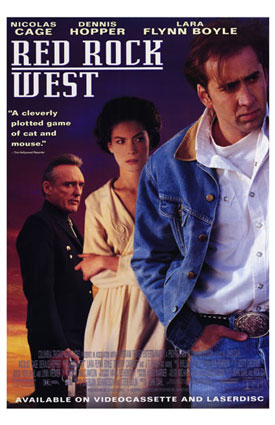
The place is Red Rock, a little town located in the middle of nowhere Wyoming. When a man from Texas (played by Nicolas Cage) wanders into his bar, the owner, Wayne (J.T. Walsh), assumes that the man is Lyle From Dallas, the semi-legendary hit man who Wayne has hired to kill his wife, Suzanne (Lara Flynn Boyle). Wayne gives the man half of his payment in advance and promises the other half after Suzanne is dead. What Wayne doesn’t realize is that Lyle From Dallas is not actually Lyle From Dallas. Instead, he is a drifter named Michael who has just recently lost his job. Michael takes Wayne’s money but, when he sees Suzanne, he tells her that Wayne wants her dead. Suzanne responds by offering to pay Michael to kill Wayne. Michael mostly just wants to leave town but his every effort is thwarted, with him continually only managing to get a mile or two out of town just to then find circumstances forcing him to once again pass the Red Rock welcome sign. Meanwhile, the real Lyle From Dallas (Dennis Hopper) has shown up and he is pissed.
Red Rock West is a clever and energetic neo noir that plays out like the child of a marriage between the Coen Brothers and David Lynch. Like the Coens’ Blood Simple, Red Rock West is a violent movie that is full of twist and turns and features characters who are often confused and rarely understand what is actually going on. From David Lynch, it borrows both Twin Peaks‘s Lara Flynn Boyle and Blue Velvet‘s Dennis Hopper. Red Rock West was made when Nicolas Cage still gave a damn and it also shows why, during his short career, J.T. Walsh was everyone’s favorite duplicitous character actor. Hopper is his usual crazy self and Boyle is a sultry and sexy fatale. Red Rock West is one of the best neo noirs of the 1990s.
Even though it has only been a week since I last did a movie a day, I feel like I’ve been gone forever. Thank you to everyone who commented or messaged me while I was gone. It turned out that I just had a bad sinus infection. It was painful as Hell but, with the help of antibiotics and the greatest care in the world, I’m recovering.
Last week, I asked if anyone had any suggestions for what the 68th movie a day should be. Case suggested Hoosiers and so it shall be.
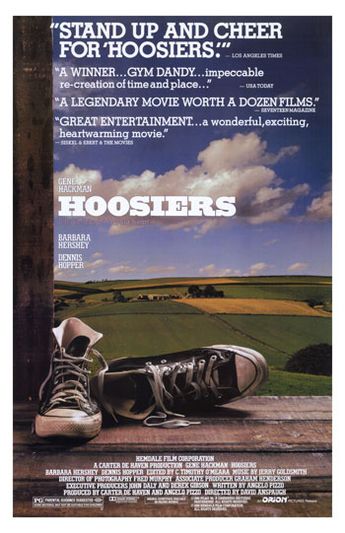
In 1951, Norman Dale (Gene Hackman) arrives in the small Indiana town of Hickory. He is a former college basketball coach who has been hired to coach the high school’s perennially struggling basketball team. Emphasizing the fundamentals and demanding discipline from his players, Dale struggles at first with both the team and the townspeople. When he makes an alcoholic former basketball star named Shooter (Dennis Hopper) an assistant coach, he nearly loses his job. Eventually, though, the Hickory team starts winning and soon, this small town high school is playing for the state championship against highly favored South Bend High School.
For many people, Hoosiers is not just “a basketball movie.” Instead, it is the basketball movie, the movie by which all other sport films are judged. Hoosiers is inspired by a true story. In 1954, small town Milan High School did defeat Muncie for the Indiana State Championship and they did it by two points. Otherwise, Hoosiers is heavily fictionalized and manages to include almost every sports film cliché that has ever existed. How good a coach is Norman Dale, really? Almost every game that Hickory wins is won by only one basket.
Why, then, is Hoosiers a classic? Much of it is due to director David Anspaugh’s attention to period and detail. Some of it is due to Gene Hackman, who gives a tough and unsentimental performance. Whenever Hoosiers starts to cross the line from sentimental to maudlin, Hackman is there to pull it back to reality with a gruff line delivery. Even his romance with the one-note anti-basketball teacher (Barbara Hershey) works. Hickory feels like a real place, with a real history and inhabited by real people.
And then there’s Dennis Hopper. Along with Blue Velvet, Hoosiers was Hopper’s comeback film. After spending twenty years lost in the Hollywood wilderness, better known for abusing drugs and shooting guns than acting, Hopper had just come out of rehab when he was offered the role of Shooter. Amazingly, he turned the role down and told the producers to offer it to his friend, Harry Dean Stanton.
According to Peter L. Winkler’s Dennis Hopper: Portrait of an American Rebel, this is what happened next:
Stanton (who, ironically, was also considered for Hopper’s role in Blue Velvet) called Hopper up and asked, “Aren’t you from Kansas?”
“Yeah.”
“Didn’t you have a hoop on your barn?”
“Yeah.”
“I think you may be the guy that David Anspaugh’s looking for.”
Harry Dean Stanton was right. Dennis Hopper, still very much in recovery, totally inhabited the role of the alcoholic Shooter and gave one of the best performances of his often underrated career. Both Shooter and the actor playing him surprised everyone by doing a good job and Hopper received his only Oscar nomination for acting for his performance in Hoosiers. (He had previously been nominated for co-writing Easy Rider.)
You don’t have to like basketball to enjoy the Hell out of Hoosiers.
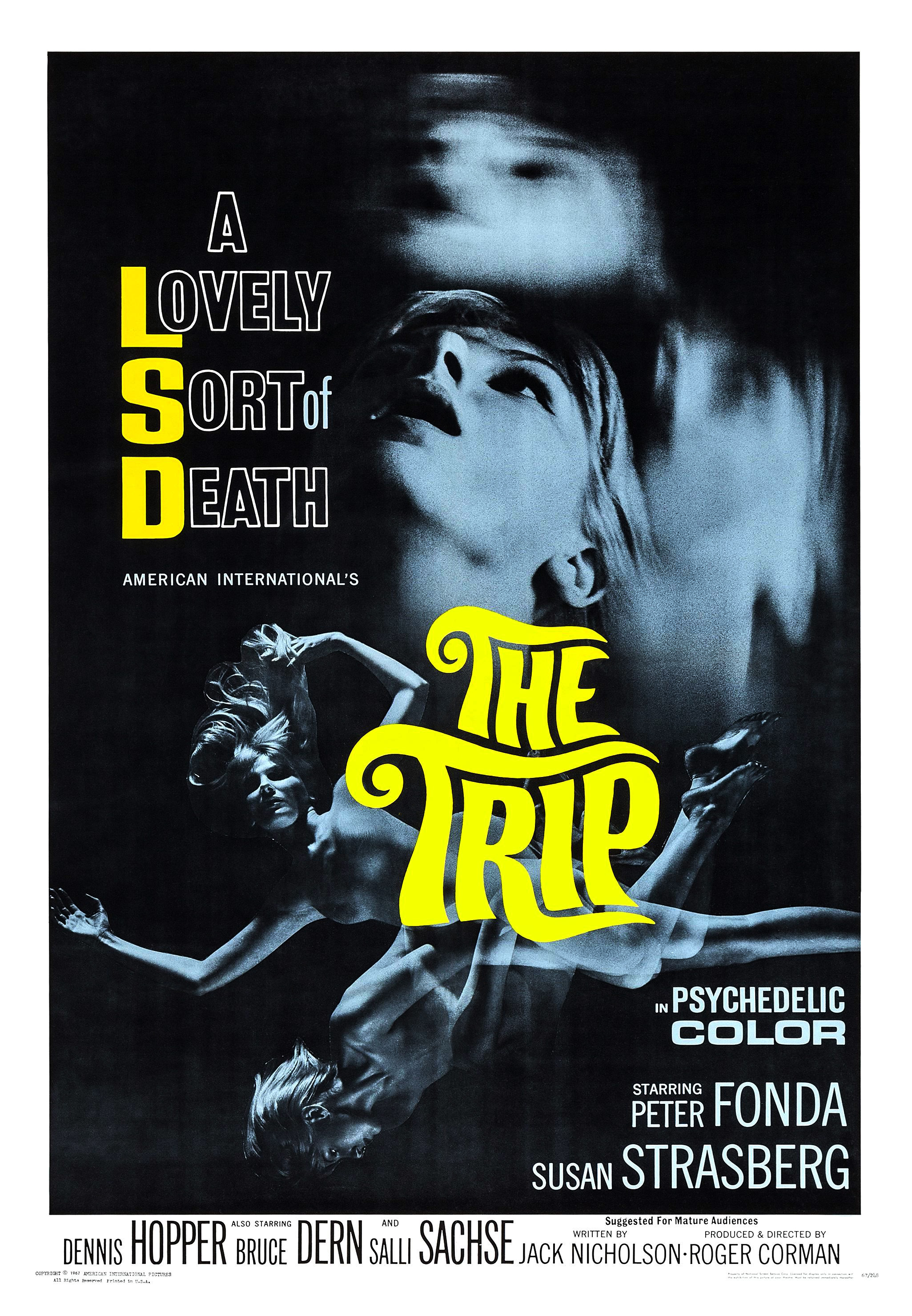
“You are about to be involved in a most unusual motion picture experience. It deals fictionally with the hallucinogenic drug LSD. Today, the extensive use in black market production of this and other so-called ‘mind bending’ chemicals are of great concern to medical and civil authorities…. This picture represents a shocking commentary on a prevalent trend of our time and one that must be of great concern to us all.” – Disclaimer at the beginning of 1967’s THE TRIP
“Tune in, turn on, drop out”, exhorted 60’s acid guru Timothy Leary. The hippie generation’s fascination with having a psychedelic experience was a craze ripe for exploitation picking, and leave it to Roger Corman to create the first drug movie, THE TRIP. Released during the peak of the Summer of Love, THE TRIP was a box office success. Most critics of the era had no clue what to make of it, but the youth…
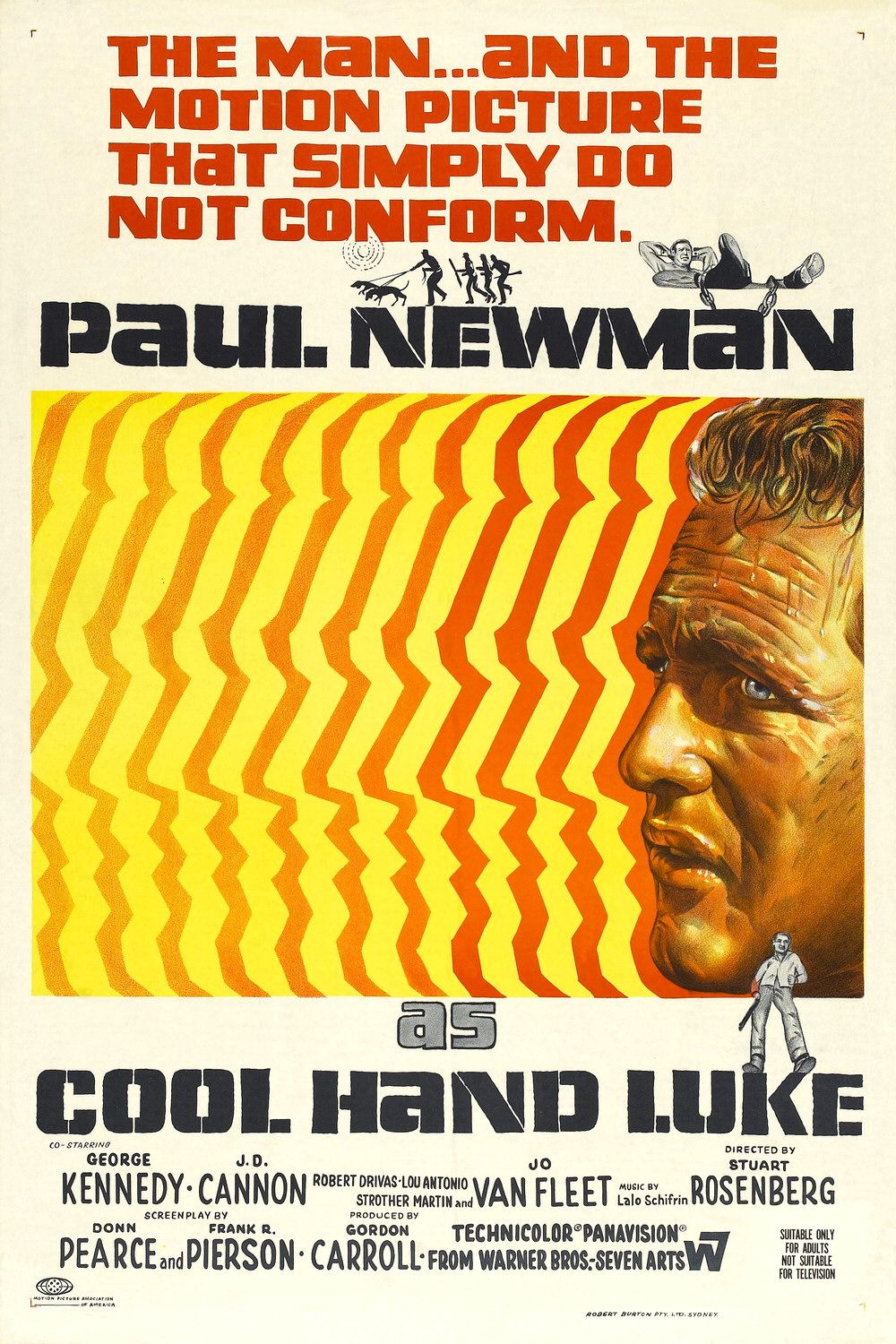
The Sixties was the decade of the rebellious anti-hero. The times they were a-changin’ and movies reflected the anti-establishment mood with BONNIE & CLYDE, EASY RIDER, and COOL HAND LUKE. Paul Newman starred as white-trash outsider Luke Jackson, but it was his co-star George Kennedy who took home the Oscar for his role as Dragline, the king of the cons who first despises then idolizes Luke.
War vet Luke gets busted for “malicious destruction of municipal property while drunk”, and sent to a prison farm in Florida. The non-conformist Luke butts heads with both the “bosses” (prison guards aka authority) and Dragline, a near illiterate convict who runs the yard. Dragline and Luke decide to settle their differences in a Saturday boxing match. The hulking Dragline beats the shit out of Luke, but the smaller man keeps getting up for more. Dragline finally walks away, and Luke earns both his and…
For the past week and a half, I have been on a major Warren Oates kick. The latest Oates film that I watched was Kid Blue, a quirky western comedy that features Warren in a small but key supporting role.
Bickford Warner (Dennis Hopper) is a long-haired and spaced-out train robber who, after one failed robbery too many, decides to go straight and live a conventional life. He settles in the town of Dime Box, Texas. He starts out sweeping the floor of a barber shop before getting a better job wringing the necks of chickens. Eventually, he ends up working at the Great American Ceramic Novelty Company, where he helps to make ashtrays for tourists.
He also meets Molly and Reese Ford (Lee Purcell and Warren Oates), a married couple who both end up taking an interest in Bickford. Reese, who ignores his beautiful wife, constantly praised Greek culture and insists that Bickford take a bath with him. Meanwhile, Molly and Bickford end up having an affair.
Bickford also meets the local preacher, Bob (Peter Boyle). Bob is enthusiastic about peyote and has built a primitive flying machine that he keeps in a field. The town’s fascist sheriff, Mean John (Ben Johnson), comes across Bob performing a river baptism and angrily admonishes him for using “white man’s water” to baptize an Indian.
Bickford attempts to live a straight life but is constantly hassled by Mean John, who suspects that Bickford might actually be Kid Blue. When Bickford’s former criminal partner (Janice Rule) shows up in town and Molly announces that she’s pregnant, Bickford has to decide whether or not to return to his old ways.
Kid Blue is one of a handful of counterculture westerns that were released in the early 70s. The film’s biggest problem is that, at the time he was playing “Kid” Blue, Dennis Hopper was 37 and looked several years older. It’s hard to buy him as a naïve naif when he looks older than everyone else in the cast. As for Warren Oates, his role was small but he did great work as usual. Gay characters were rarely presented sympathetically in the early 70s and counter-culture films were often the worst offenders. As written, Reese is a one-note (and one-joke) character but Warren played him with a lot of empathy and gave him a wounded dignity that was probably not present in the film’s script.
Kid Blue plays out at its own stoned pace, an uneven mix of quirky comedy and dippy philosophy. Still, the film is worth seeing for the only-in-the-70s cast and the curiosity factor of seeing Dennis Hopper in full counterculture mode, before he detoxed and became Hollywood’s favorite super villain.
What’s an Insomnia File? You know how some times you just can’t get any sleep and, at about three in the morning, you’ll find yourself watching whatever you can find on cable? This feature is all about those insomnia-inspired discoveries!
If, last night, you were suffering from insomnia at 3 in the morning, you could have turned on TCM and watched the 1957 faux epic, The Story of Mankind.
I call The Story of Mankind a faux epic because it’s an outwardly big film that turns out to be remarkably small on closer inspection. First off, it claims to the tell the story of Mankind but it only has a running time of 100 minutes so, as you can imagine, a lot of the story gets left out. (I was annoyed that neither my favorite social reformer, Victoria C. Woodhull, nor my favorite president, Rutherford B. Hayes, made an appearance.) It’s a film that follow Vincent Price and Ronald Colman as they stroll through history but it turns out that “history” is largely made up of stock footage taken from other movies. The film’s cast is full of actors who will be familiar to lovers of classic cinema and yet, few of them really have more than a few minutes of screen time. In fact, it only takes a little bit of research on the imdb to discover that most of the film’s cast was made up of performers who were on the verge of ending their careers.
The Story of Mankind opens with two angels noticing that mankind has apparently invented the “Super H-Bomb,” ten years ahead of schedule. It appears that mankind is on the verge of destroying itself and soon, both Heaven and Hell will be full of new arrivals. One of the angels exclaims that there’s already a housing shortage!
A celestial court, overseen by a stern judge (Cedric Hardwicke) is convened in outer space. The court must decide whether to intervene and prevent mankind from destroying itself. Speaking on behalf on humanity is the Spirit of Man. The Spirit of Man is played by Ronald Colman. This was Colman’s final film. In his heyday, he was such a popular star that he was Margaret Mitchell’s first choice to play Rhett Butler in Gone With The Wind. However, in The Story of Mankind, Colman comes across as being a bit bored with it all and you start to get worried that he might not be the best attorney that mankind could have hired.
Even more worrisome, as far as the future of mankind is concerned, is that the prosecutor, Mr. Scratch, is being played by Vincent Price. Making his case with his trademark theatrics and delivering every snaky line with a self-satisfied yet likable smirk on his face, Vincent Price is so much fun to watch that it was impossible not to agree with him. Destroy mankind, Mr. Scratch? Sure, why not? Mankind had a good run, after all…
In order to make their cases, Mr. Scratch and the Spirit of Man take a tour through history. Mr. Scratch reminds us of villains like the Egyptian pharaoh Khufu (John Carradine) and the Roman Emperor Nero (Peter Lorre, of course). He shows how Joan of Arc (Hedy Lamarr) was burned at the stake. The Spirit of Man argues that, despite all of that, man is still capable of doing good things, like inventing the printing press.
And really, the whole point of the film is to see who is playing which historical figure. The film features a huge cast of classic film actors. If you watch TCM on a semi-regular basis, you’ll recognize a good deal of the cast. The fun comes from seeing who tried to give a memorable performance and who just showed up to collect a paycheck. For instance, a very young Dennis Hopper gives a bizarre method interpretation of Napoleon and it’s one of those things that simply has to be seen.
And then the Marx Brothers show up!
They don’t share any scenes together, unfortunately. But three of them are present! (No, Zeppo does not make an appearance but I imagine that’s just because Jim Ameche was already cast in the role of Alexander Graham Bell.) Chico is a monk who tells Christopher Columbus not to waste his time looking for a quicker way to reach India. Harpo Marx is Sir Isaac Newton, who plays a harp and discovers gravity when a hundred apples smash down on his head. And Groucho Marx plays Peter Miniut, tricking a Native American chief into selling Manhattan Island while leering at the chief’s daughter.
And the good thing about the Marx Brothers is that their presence makes a strong argument that humanity deserves another chance. A world that produced the Marx Brothers can’t be all bad, right?
Anyway, Story of Mankind is one of those films that seems like it would be a good cure for insomnia but then you start watching it and it’s just such a weird movie that you simply have to watch it all the way to the end. It’s not a good movie but it is flamboyantly bad and, as a result, everyone should see it at least once.