Mardi Gras Film Review: Easy Rider (dir by Dennis Hopper)


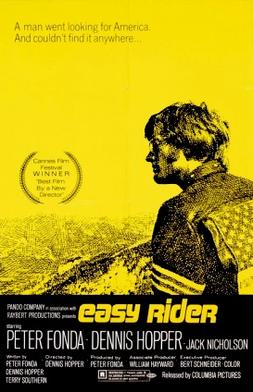
If you are among those who wanted to celebrate Mardi Gras today but couldn’t make it down to New Orleans, fear not!  There is a solution to your problem.  You can always just watch 1969 counterculture classic, Easy Rider.

Easy Rider features one of the most famous Mardi Gras scenes of all time and adding to the scene’s authenticity is the fact that it was actually shot in New Orleans during the celebration.  If you watch the Mardi Gras sequence carefully, you’ll notice that several people on the streets of the French Quarter actually stop and stare directly at the camera.  It reminds you that you’re watching a movie but, at the same time, it also reminds you that you’re seeing something authentic.  Those weren’t just professional extras pretending to get drunk and glaring at Dennis Hopper and Peter Fonda.  Those were people who were actually in the French Quarter for Mardi Gras and who just happened to end up getting included in one of the biggest cult films of all time.  If you want to know what Mardi Gras was like in the late 60s, this is the film to watch.

At the same time, after watching Easy Rider, you may be find yourself happy to not be in New Orleans today.  As with almost everything else in Easy Rider, Mardi Gras starts out as something exciting and full of promise but it ends as something dark and full of death.  One minute, Peter Fonda, Dennis Hopper, Karen Black, and Toni Basil are walking down the streets of New Orleans and having what appears to be a good time.  The next thing you know, they’re in a cemetery and Peter Fonda’s sobbing and talking about his mother’s suicide while Toni Basil and Karen Black are freaking out.  Of the four of them, only Dennis Hopper appears to not be having a bad trip but then again, Hopper is so naturally spacey in Easy Rider that it’s kind of hard to tell.

The next morning, Fonda and Hopper leave New Orleans on their motorcycles and promptly get blown away by two shotgun-toting rednecks in a pickup truck.  It seems a fitting conclusion to a film that celebrates the beauty of the American landscape while, at the same time, suggesting that almost everyone who lives there is a complete and total prick.

Of course, the whole Mardi Gras sequence doesn’t occur until the very end of the film.  The majority of the film deals with the journey to New Orleans.  Billy (Dennis Hopper) and Wyatt (Peter Fonda) are two motorcycle-riding drug dealers who have just made a small fortune off of selling cocaine to Phil Spector.  Billy and Wyatt are heading to New Orleans to celebrate and visit a famous brothel.  Wyatt is cool and stoic and always seems to be thinking about something.  Billy is Dennis Hopper.  Easy Rider is often referred to as being a hippie film but neither Billy nor Wyatt is really a hippie.  They’re outsiders and they like to smoke weed but they’re also largely apolitical.  They just want to enjoy the open road.  If anything, they’re beatniks who were born a year or two too late.

As they ride from California to New Mexico, Billy and Wyatt meet plenty of people along the way.  They stop off at a hippie commune and then later, they get harassed by a bunch of rednecks in a diner.  The rednecks are menacing while the hippies are annoying.  The rednecks throw Wyatt and Billy in jail for “parading without a permit.”  The hippies have a mime troupe.  The rednecks drive around with shotguns.  The hippies try to grow crops in the desert.  (I’m enough of a country girl to know that Billy’s right when he scornfully says that nothing that they’re planting is going to actually grow.)  The rednecks are ignorant.  The hippies are smug.  None of them really seem like people that you would want to spend too much time around.

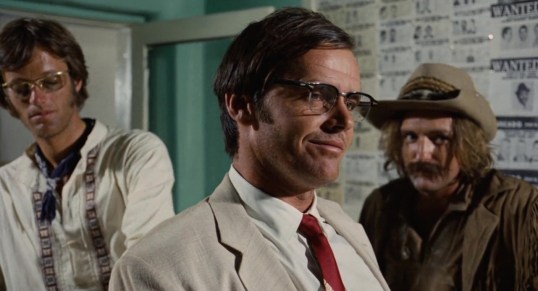
Along the way, Wyatt and Billy temporarily travel with two others.  The hitchhiker is played by Luke Askew.  We never learn his name but he does play a key role in the film when he gives Wyatt the tab of acid that will eventually ruin Mardi Gras.  Meanwhile, George Hanson is an alcoholic lawyer and he’s played by Jack Nicholson.  At the time that the film was shot, Nicholson was on the verge of retiring from acting so he could concentrate on directing and writing.  He took the role and expected, as almost everyone did, that Easy Rider would just be another biker film.  Instead, Easy Rider became a hit and a cultural milestone that not only won Nicholson his first Academy Award nomination but also made him a star.

Interestingly enough, Jack Nicholson is not really that good in Easy Rider.  His attempt at a Texas accent is terrible and you never believe him as someone who has never smoked weed before.  If anything, Luke Askew gives a far better performance than Nicholson and he actually has more screen time as well.  However, I think Nicholson benefited from the fact that George is probably the most likable character in the film.  (Depending on how you feel about Billy and Wyatt, you could argue that he’s the only likable character in the film.)  He’s not a smug hippie nor is he a murderous redneck.  Unlike Wyatt and Billy, he has a job that doesn’t involve selling cocaine to Phil Spector.  Whereas Luke Askew’s Hitchhiker seems like the type of guy who would just love to lecture you about why Vietnam is all your fault, George comes across as being a gentle soul. George is a character that viewers can feel safe identifying with, even if Nicholson is never quite convincing as someone so naive that he fears he’ll freak out after taking one hit off of a joint.

Easy Rider‘s critical reputation tends to go up and down, depending on who you’re reading or talking to.  There’s a tendency, among many critics, to complain that Fonda acted too little while Hopper acted too much.  Personally, I think there’s a lot of hidden wit to be found in Hopper’s performance and I love how annoyed he gets when they’re at the hippie compound.  As for Peter Fonda, he may not have been the most expressive actor but he did capture a certain feeling of ennui.  For most of the film, it’s hard to tell whether there’s anything actually going on in Wyatt’s head.  Then, we follow Wyatt and Billy to that cemetery in New Orleans and we discover that there’s actually quite a bit going on behind Wyatt’s wall of stoicism.  After watching Wyatt curse at a statue while sobbing, we understand why he keeps so much hidden.

When it was released in 1969, Easy Rider was a huge box office success and it inspired every major studio to try to duplicate it’s success with a counter culture film of its own.  (Hopper was given several million dollars and sent down to Peru to make a follow-up to Easy Rider.  The result was The Last Movie, a legendary disaster that temporarily ended Hopper’s career as a director.)  Seen today, Easy Rider is undeniably pretentious but always watchable.  The scenery is beautiful and the Mardi Gras sequence sets the standard by which all other bad trips should be judged.  Most importantly, the film works as a historical document.  Everything about it — from the music to the cultural attitudes to even Hopper’s attempts to imitate Jean-Luc Godard in his direction — makes this film into a time capsule.  Until they invent a time machine that works, Easy Rider is as close as some of us will ever get to experiencing the end of the 60s.

And finally, it’s the ultimate Mardi Gras film, even if it’s main message seems to be that everyone needs to stay the Hell away from Mardi Gras.  Or, at the very least, don’t accept LSD from a scruffy hitchhiker before rolling into New Orleans.  Seriously, the more you know….

The TSL’s Horror Grindhouse: Unspeakable (dir by Thomas J. Wright)


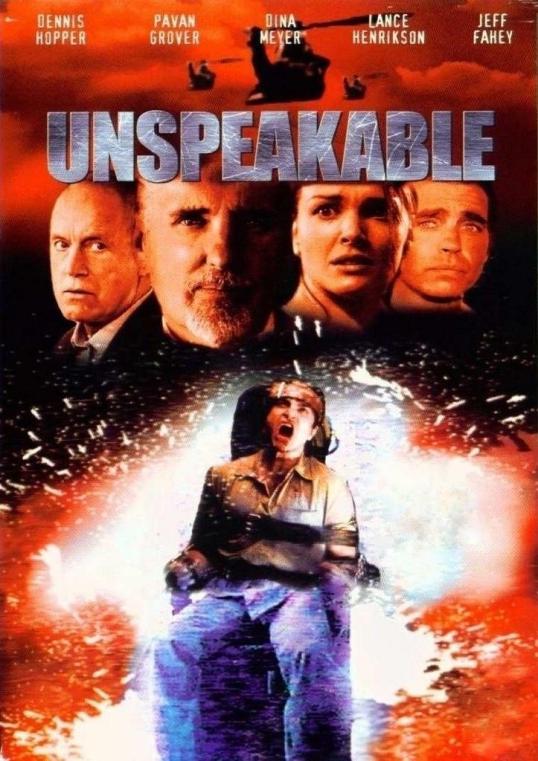
So, here’s a few good things about the 2002 film, Unspeakable.

First off, Jeff Fahey plays the governor of New Mexico.  Any film that presents us with a world where Jeff Fahey can be elected governor of an actual state has to be worth something.  Seriously, I’ve long thought that the country would be more interesting if actors were elected to run each state.  Here in Texas, for instance, there was a movement to draft Tommy Lee Jones a few years ago.  (Personally, I’d rather live under Governor McConaughey.)  Steven Seagal (agck!) apparently wanted to run for governor of Arizona and, of course, Cynthia Nixon actually ran up in New York.  There’s always a chance of Alec Baldwin running for something and, of course, Arnold Schwarzenegger actually did govern California for two terms.  Val Kilmer, I should add, came close to running for governor of New Mexico, where this film is set!  Personally, I’d vote for Jeff Fahey over Val Kilmer,  It’s the eyes.

Another good thing about Unspeakable is that it features Dennis Hopper playing a crazed prison warden who rambles about how much he enjoys sending people to the electric chair.  “I am God!” Hopper says at one point and you have to enjoy any scene that features Dennis Hopper saying, “I am God!” in a southwestern accent.

Another fun thing about Unspeakable is that it features Dina Meyer and Lance Henriksen as scientists!  Meyer invents this weird little headband thing that allows her to look into your mind and see your thoughts.  Let me repeat this for those of you who might have missed the significance: DINA MEYER HAS INVENTED A MACHINE THAT ALLOW HER TO SEE EXACTLY WHAT IS HAPPENING IN SOMEONE’S MIND!  If that wasn’t amazing enough, there’s also the fact that no one seems to be that impressed.  In fact, no one really cares.  Everyone just kind of shrugs it off.

Meyer and Henriksen ask for permission to test their invention out on death row inmates.  Sure, why not?  It’s not like Warden Hopper cares what happens to the inmates, right?  Meyer discovers that one of the inmates is innocent!  Unfortunately, no one cares.  Gov. Fahey, who is also Meyer’s former lover, refuses to commute the sentence because he’s got an election coming up and voters love the death penalty.  And so, that innocent man goes off to the electric chair.

But wait!  There’s a new prisoner on death row.  His name is Jesse Mowatt and he’s played by Pavan Grover, the doctor who wrote this film.  It turns out that he is America’s most prolific serial killer!  He’s murdered hundreds of people, all because of some weird issue he has with religion.  Anyway, it’s pretty obvious that this killer has a date with the electric chair but first, Meyer gets to use her amazing-invention-that-nobody-cares-about on him.  What she discovers is that this serial killer might be a demon-possessed monster who can use his mind to drive other people to do things like rip their faces off.  Or maybe he’s just really clever.  He does definitely have super strength and beats up any guard that comes near him.  It never occurs to the guards to use handcuffs on him or anything.  That’s just the type of prison that it is.

Anyway, I appreciated the film’s anti-death penalty theme but the film still got a bit too heavy-handed for my tastes.  Pavan Grover wrote himself a pretty good part but he doesn’t really have the screen presence necessary to do the whole irresistible sociopath thing.  Still, I appreciate any movie that features Jeff Fahey as a governor.

FAHEY 2024!


Horror On The Lens: Night Tide (dir by Curtis Harrington)


Night Tide

First released in 1961 and directed by Curtis Harrington, Night Tide stars a young Dennis Hopper as Johnny, an awkward sailor.  Johnny meets Mora (Linda Lawson), who works as a “mermaid” on the pier.  For Johnny, it’s love at first sight.  However, the more that Johnny pursues her, the more he learns about both her mysterious past and the dark fate of her previous boyfriends.

Night Tide is low-key and atmospheric gem of a movie, one that serve as an inspiration for low-budget filmmakers every where.  Lawson is perfectly cast as the enigmatic Mora but the film really belongs to Dennis Hopper.  Hopper’s naturally off-key presence made him perfect for the role of Johnny.

Night Tide is one of those low-budget movies that, because it’s in the public domain,  has been released on DVD (often in inferior form) by dozens of different companies.  Often times, films like this turn out to be fairly forgettable.  Night Tide, however, is an exception.

When It Comes To Halloween, Should You Trust The IMDb?


Dr. Sam Loomis

Like a lot of people, I enjoy browsing the trivia sections of the IMDb.  While it’s true that a lot of the items are stuff like, “This movie features two people who appeared on a television series set in the Star Trek Universe!,” you still occasionally came across an interesting fact or two.

Of course, sometimes, you just come across something that makes so little sense that you can only assume that it was posted as a joke.  For instance, I was reading the IMDb’s trivia for the original 1978 Halloween and I came across this:

Peter O’Toole, Mel Brooks, Steven Hill, Walter Matthau, Jerry Van Dyke, Lawrence Tierney, Kirk Douglas, John Belushi, Lloyd Bridges, Abe Vigoda, Kris Kristofferson, Sterling Hayden, David Carradine, Dennis Hopper, Charles Napier, Yul Brynner and Edward Bunker were considered for the role of Dr. Sam Loomis.

Now, some of these names make sense.  Despite the fact that Sam Loomis became Donald Pleasence’s signature role, it is still possible to imagine other actors taking the role and perhaps bringing a less neurotic interpretation to the character.

Peter O’Toole as Dr. Loomis?  Okay, I can see that.

Kirk Douglas, Sterling Hayden, Charles Napier, Steve Hill, or Lloyd Bridges as Dr. Loomis?  Actually, I can imagine all of them grimacing through the role.

Walter Matthau?  Well, I guess if you wanted Dr. Loomis to be kind of schlubby….

Abe Vigoda?  Uhmmm, okay.

Dennis Hopper?  That would be interesting.

Mel Brooks?  What?  Wait….

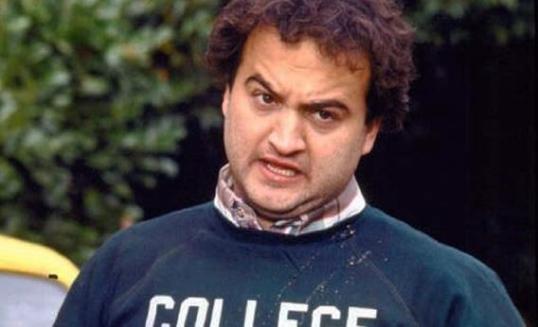
John Belushi?  Okay, stop it!

Dr. Sam Loomis

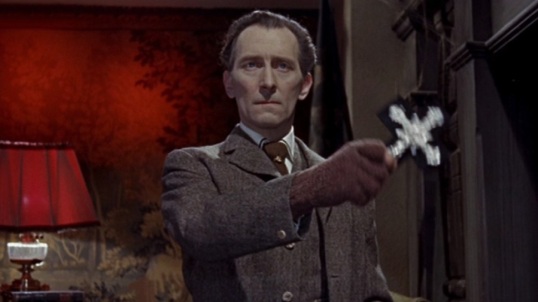
My point is that I doubt any of these people were considered for the role of Dr. Loomis.  Both director John Carpenter and producer Debra Hill have said that they wanted to cast an English horror actor in the role, as a bit of an homage to the Hammer films of the 60s.  Christopher Lee was offered the role but turned it down, saying that he didn’t care for the script or the low salary.  (Lee later said this was one of the biggest mistakes of his career.)  Peter Cushing’s agent turned down the role, again because of the money.  It’s not clear whether Cushing himself ever saw the script.

To be honest, I could easily Peter Cushing in the role and I could see him making a brilliant Dr. Loomis.  But, ultimately, Donald Pleasence was the perfect (if not the first) choice for the role.  Of course, Pleasence nearly turned down the role as well.  Apparently, it was his daughter, Angela, who changed his mind.  She was an admirer of John Carpenter’s previous film, Assault on Precint 13.  Carpenter has said that he was originally intimidated by Donald Pleasence (the man had played Blofeld, after all) but that Pleasence turned out to be a professional and a gentleman.

Laurie Strode

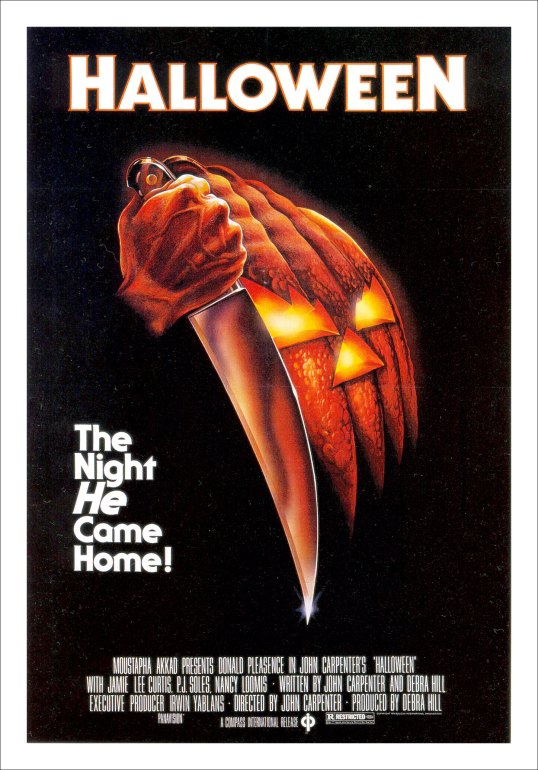
Of course, Halloween is best known for being the first starring role of Jamie Lee Curtis.  Curtis was actually not Carpenter’s first choice for the role of Laurie Strode.  His first choice was an actress named Annie Lockhart, who was the daughter of June Lockhart.  Carpenter changed his mind when he learned that Jamie was the daughter of Janet Leigh.  Like any great showman, Carpenter understood the importance of publicity and he knew nothing would bring his horror movie more publicity then casting the daughter of the woman whose onscreen death in Psycho left moviegoers nervous about taking a shower.

There was also another future big name who came close to appearing in Halloween.  At the time that she was cast as Lynda, P.J. Soles was dating an up-and-coming actor from Texas named Dennis Quaid.  Quaid was offered the role of Lynda’s doomed boyfriend, Bob but he was already committed to another film.

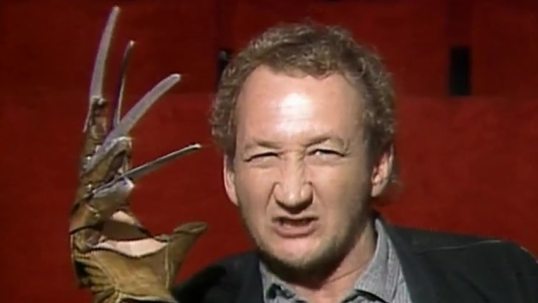
Not considered for a role was Robert Englund, though the future Freddy Krueger still spent some time on set.  He was hired by Carpenter to help spread around the leaves that would make it appear as if his film was taking place in the October, even though it was filmed in May.

Robert Englund, making May look like October

Interestingly enough, Englund nearly wasn’t need for that job because Halloween was not originally envisioned as taking place on Halloween or any other specific holiday.  When producer Irwin Yablans and financier Moustapha Akkad originally approached Carpenter and Hill to make a movie for them about a psycho stalking three babysitters, they didn’t care when the film was set.  It was only after Carpenter and Hill wrote a script called The Babysitter Muders that it occurred to Yablans that setting the film during Halloween would be good from a marketing standpoint.  Plus Halloween made for a better title than The Babysitter Murders.

And, of course, the rest is history.  Carpenter’s film came to define Halloween and it still remains the standard by which every subsequent slasher movie has been judged.  Would that have happened if the film had been known as The Babysitter Murders and had starred John Belushi?

Sadly, we may never know.

Film Review: The Hot Spot (dir by Dennis Hopper)


As befits the title, the 1990 film, The Hot Spot, is all about heat.

There’s the figurative heat that comes from a cast of characters who are obsessed with sex, lies, and murder.  There’s the literal heat that comes from a fire that the film’s “hero” sets in order to distract everyone long enough so that he can get away with robbing a bank.  And, of course, there’s the fact that the film is set in a small Texas town that appears to be the hottest place on Earth.  Every scene in the film appears to be drenched by the sun and, if the characters often seem to take their time from getting from one point to another, that’s because everyone knows better than to rush around when it’s over a hundred degrees in the shade.  As someone who has spent most of her life in Texas, I can tell you that, if nothing else, The Hot Spot captures the feel of what summer is usually like down here.   I’ve often felt that stepping outside during a Texas summer is like stepping into a wall of pure heat.  The Hot Spot takes place on the other side of that wall.

The Hot Spot is a heavily stylized film noir, one in which the the traditional fog and shadows have been replaced by clouds of dust and blinding sunlight.  Harry (Don Johnson) is a drifter who has just rolled into a small Texas town.  Harry’s not too bright but he’s handsome and cocky and who needs to be smart when you’ve got charm?  Harry gets a job selling used cars, though he actually aspires to be a bank robber.  Harry finds himself falling in love with Gloria (Jennifer Connelly), a seemingly innocent accountant who is being blackmailed by the brutish Frank Sutton (William Sadler).  Meanwhile, Harry is also being pursued by his boss’s wife, Dolly (Virginia Madsen), an over-the-top femme fatale who is just as amoral as Harry but who might be a little bit smarter.  Complicating matters is that, while Harry’s trying to rob a bank, he also ends up saving a man’s life.  Only Dolly knows that Harry isn’t the hero that the rest of the town thinks he is.  She tells him that she’ll keep his secret if he does her just one little favor….

The Hot Spot was directed by Dennis Hopper (yes, that Dennis Hopper) and, from the start, it quickly becomes apparent that he’s not really that interested in the film’s story.  Instead, he’s more interested in exploring the increasingly surreal world in which Harry has found himself.  The Hot Spot plays out at a languid pace, which allows Hopper to focus on his cast of small-town eccentrics.  (My particular favorite was Jack Nance as the alcoholic bank president who also doubles as the town’s volunteer fire marshal.)  The film is so hyper stylized that it’s hard not to suspect that every character — with the possible exception of Harry — understands that they’re only characters in a film noir.  For instance, is Dolly really the over-the-top femme fatale that she presents herself as being or is she just a frustrated housewife playing a role?  Is Gloria really an innocent caught up in a blackmail scheme or is she just smart enough to realize that the rules of noir requires her to appear to be Dolly’s opposite?  And is Harry being manipulated or is he allowing himself to be manipulated because, deep down, he understands that’s his destiny as a handsome but dumb drifter in a small town?  Do any of the characters really have any control over their choices and their actions or has everyone’s fate been predetermined by virtue of them being characters in a film noir?  In the end, The Hot Spot is more than just a traditional noir.  It’s also a study of why the genre has endured.

It’s a long and, at times, slow movie, one that plays out at its own peculiar pace.  As a result, some people will be bored out of their mind.  But if you can tap into the film surreal worldview and adjust to the languid style, The Hot Spot is a frequently entertaining and, at times, rather sardonic slice of Texas noir.

Film Review: Blood Red (1989, directed by Peter Masterson)


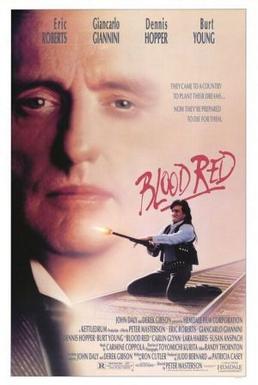
The time is the 1890s.  The place is California.  Sicilian immigrant Sebastian Collogero (Giancarlo Giannini) has just been sworn in as an American citizen and owns his own vineyard.  When Irish immigrant William Bradford Berrigan (Dennis Hopper) demands that Sebastian give up his land so Berrigan run a railroad through it, Sebastian refuses.  Berrigan hires a group of thugs led by Andrews (Burt Young) to make Sebastian see the error of his ways.  When Sebastian ends up dead, his wayward son, Marco (Eric Roberts), takes up arms and seeks revenge.

Have you ever wondered what would have happened if the famously self-indulgent directors Michael Cimino and Francis Ford Coppola teamed up to make a movie about the American Dream?  The end result would probably be something like Blood Red.  Like Cimino’s The Deer Hunter and Heaven’s Gate, Blood Red begins with a lengthy celebration (in this case, in honor of Sebastian’s naturalization ceremony) that doesn’t have much to do with the rest of the film but which is included just to make sure we know that what we’re about to see is more than just a mere genre piece.  Like many of Coppola’s films, Blood Red features a tight-knit family, flowing wine, and a score composed by Carmine Coppola.  The only difference between our hypothetical Cimino/Coppola collaboration and Blood Red is that the Cimino/Coppola film would probably be longer and more interesting than Blood Red.  Blood Red is only 80 minutes long and directed by Peter Masterson, who seems lost.  There’s a potentially interesting story here about two different immigrants fighting to determine the future of America but it gets lost in all of the shots of Eric Roberts flexing his muscles.

For an actor known for his demented energy, Eric Roberts is surprisingly dull as the lead but Blood Red is a film that even manages to make veteran scenery chewers like Dennis Hopper and Burt Young seem boring.  (Hopper’s bizarre attempt at an Irish brogue does occasionally liven things up.)  The cast is full of familiar faces like Michael Madsen, Aldo Ray, Marc Lawrence, and Elias Koteas but none of them get to do much.  Of course, the most familiar face of all belongs to Eric’s sister, Julia.  Julia Roberts made her film debut playing Marco’s sister, Maria.  (Because the film sat on the shelf for three years after production was completed, Blood Red wasn’t released until after Julia has subsequently appeared in Mystic Pizza and Satisfaction.)  She gets three lines and less than five minutes of screen time but she does get to briefly show off the smile that would later make her famous.  Today, of course, that smile is the only reason anyone remembers Blood Red.

Music Video Of The Day: God’s Gonna Cut You Down (2006, dir by Tony Kaye)


This is a case where I like the song more than the music video.  This video was actually filmed three years after Johnny Cash’s death.  As far as “official” music videos are concerned, I always feel like a musician should have some sort of say into how their music is visually interpreted.  Obviously, Johnny Cash wasn’t around to have anything to say about the video for God’s Gonna Cut You Down.

Since Cash wasn’t available, director Tony Kaye filled the video with cameos from other actors and musicians, a few of whom (though not many) were previous Cash collaborators.  Among the celebs who make an appearance in this video: David Allan Coe, Patricia Arquette, Travis Barker, Peter Blake, Bono, Sheryl Crow, Johnny Depp, the Dixie Chicks, Flea, Billy Gibbons, Whoopi Goldberg, Woody Harrelson, Dennis Hopper, Terrence Howard, Jay-Z, Mick Jones, Kid Rock, Anthony Kiedis, Kris Kristofferson, Amy Lee, Adam Levine, Shelby Lynne, Chris Martin, Kate Moss, Graham Nash, Busy Philipps, Iggy Pop, Lisa Marie Presley, Q-Tip, Corinne Bailey Rae, Keith Richards, Chris Rock, Rick Rubin, Patti Smith, Sharon Stone, Justin Timberlake, Kanye West, Brian Wilson, and Owen Wilson.  Some of the celebs — like Dennis Hopper and Kris Kristofferson — seem like they naturally belong there.  Others seem so out-of-place that you’ll want to throw something.  You know how that works,

God’s Gonna Cut You Down is a traditional folk song.  I’ve heard countless versions of it.  I prefer Cash’s version to the more traditional gospel arrangement but, then again, I tend to find gospel music to be dull in general.  Cash’s arrangement brought new life to an old song.

Enjoy!

6 Good Films That Were Not Nominated For Best Picture: The 1980s


Rob Lowe and Snow White perform at the 1989 Oscars

Continuing our look at good films that were not nominated for best picture, here are 6 films from the 1980s.

Out of the Blue (1980, dir by Dennis Hopper)

After spending several years in the cultural wilderness, Dennis Hopper directed his best film, this downbeat study of a young girl, her junkie mother, and her irresponsible father.  From the film’s first scene, in which Hopper crashes his truck into a school bus to the film’s explosive ending, Out of the Blue is a fascinating trip into the heart of American darkness.  It was definitely too dark for the Academy.

Fast Times At Ridgemont High (1982, dir by Amy Heckerling)

Fast Times would appear to take place in a totally different universe from Out of the Blue.  Still, it’s an unexpectedly intelligent look at growing up in the suburbs and it’s influenced practically every high school film that’s come after.  Plus, this may be the only movie in which Sean Penn was intentionally funny.  Despite good reviews and a cast full of future stars, Fast Times At Ridgemont High received not a single nomination.

Once Upon A Time In America (1984, dir by Sergio Leone)

Sergio Leone’s final film, this epic gangster film might be a look at how America grew and changed over the first half of the 20th Century.  It might be a trenchant critique of capitalism.  It might be an homage to the classic gangster films of the 30s.  Or it might just be a hallucination that Robert De Niro is having while visiting an opium den.  That critics are are still debating just watch exactly this film actually means says a lot about the power of Once Upon A Time In America.  However, because the film was originally released in a severely edited form, Once Upon A Time In America received not one nomination.

Brazil (1985, dir by Terry Gilliam)

Much like Once Upon A Time In America, Brazil is a brilliant film that was betrayed by the studio that distributed it.  Convinced that Terry Gilliam’s satire was too strange for American audiences, Universal Pictures initially released the film in a severely edited version.  Fortunately, Gilliam’s version was eventually released but the controversy undoubtedly hurt Brazil when it came time for the members of the Academy to select their nominees for Best Picture.

The Breakfast Club (1985, dir by John Hughes)

Perhaps the Academy understood just how unfair it was that Anthony Michael Hall had to write the essay while everyone else got either a makeover or a new romance.  For whatever reason, this classic high school film — perhaps the classic high school film — received not a single nomination.

Blue Velvet (1986, dir by David Lynch)

David Lynch was nominated for Best Director but the film itself proved to be just a bit too controversial for the Academy to give it a Best Picture nomination.  David Lynch described this film as being “the Hardy Boys In Hell” and it would have been an uncoventional, though very worthy, nominee for Best Picture.

Up next, in an hour or so, the 90s!


Film Review: Tracks (1977, dir by Henry Jaglom)


The 1977 film, Tracks, opens somewhere in America.

Jack Falen (Dennis Hopper) sits on a bench, waiting for a train.  He’s wearing a military uniform.  He claims that he’s a 1st sergeant.  He claims that he’s just returned from Vietnam.  He’s traveling with a flag-draped coffin.  He says that the coffin contains the remains of his best friend from Nam.  Jack is accompanying the coffin back to his friend’s hometown.  Jack says that he’s going to make sure that his friend gets a proper burial.

From the minute we meet Jack, we get the feeling that there’s something off about him.  He’s a little bit too quick to smile and, when he laughs, it’s the guttural sound of someone who has learned how to show joy by watching other people but who has perhaps never felt it himself.  Sometimes, he’s quiet.  Sometimes, he is loquacious and verbose.  When he does speak, he rarely looks anyone in the eyes.  Jack is jumpy, as if he’s constantly afraid that he’s about to be exposed as a liar.

Soon, Jack is riding a train across the country.  While the rest of the passengers look out the windows and takes in the American landscape, Jack nervously wanders around the train.  He gets involved in a regular chess game.  He befriends a mysterious man named Mark (Dean Stockwell).  He starts a tentative relationship with a student named Stephanie (Taryn Power).  He tells anyone who will listen that he’s traveling with the body of his best friend.  When a black Korean war vet complains that Jack is acting like he’s the only person who lost a friend in a war, an offended Jack replies that his friend was black.

Jack sees things.  When he sees that the other passengers are assaulting Stepanie, he pulls out a small gun and aims it at the back of the train, just to suddenly realize that Stephanie is sitting unbothered at the back of the train.  While we know that Jack was hallucinating the attack on Stephanie, we still wonder if he really pulled out that gun.  If he did, no one else seems to have noticed.

Sometimes, the passengers say things to Jack that don’t seem to make any sense, leaving Jack staring at them in confusion.  Other times, Jack sees dark figures walking through the train.  At night, he wanders around naked.  Jack spends the trip watching the other passengers with a slightly dazed look on his face.  He plays chess with a man who later insists that he’s never played chess with Jack.  Sometimes, he thinks that he and Stephanie are outside of the train.  When Mark approaches Jack and asks for help, Jack explains that he can’t help anyone.  While a soundtrack of old World War II propaganda songs thunders in the background, Jack struggles to keep track of what’s real and what isn’t.

And so does the audience.  As we watch, it occurs to us that Jack’s stories about Vietnam don’t really seem to add up.  Add to that, we never actually saw Jack board the train.  Instead, we saw him sitting on a bench and waiting for the train.  We’re left to wonder if the train’s real or if the whole movie is just a figment of Jack’s damaged imagination.  And what about the coffin?  Tracks is full of unanswered questions but, in the film’s incendiary final moments, we do learn the truth about that coffin … maybe.

Henry Jaglom has been making independent films for several decades now.  Tracks is one of his better films, if just because Jaglom’s loose, seemingly improvised style actually works well at communicating Jack’s own struggle to keep up with what’s really happening and what he’s imagining.  As deceptively random as the film’s collections of scenes may appear, it’s all anchored by Dennis Hopper’s wonderfully unhinged performance.  Hopper brings a method actor’s intensity to Jack’s struggle to not only keep straight what’s real and what isn’t but also to keep his fellow passengers from understanding that he’s deeply unbalanced.  This film was made during Hopper’s drug-fueled lost years and he plays Jack like a man who is desperately trying to keep the world from seeing that he’s in the throes of withdrawal.  Unlike Hopper, Jack’s addiction isn’t to drugs.  Instead, Jack’s addicted to war, or at the very least his obsession with war.  (By the end of the movie, you have your doubts about whether Jack’s ever been to Vietnam or not.)  The use of World War II propaganda songs on the soundtrack may occasionally get annoying but they actually play up the contrast between our often simplistic view of war and the far more complex reality.

If nothing else, I would recommend Tracks for Hopper’s performance.  As well, since he co-stars with Dean Stockwell, it’s easy to imagine Tracks as being a bit of a prequel to Blue Velvet.  Who’s to say that Jack Falen didn’t change his name to Frank Booth?

Scenes that I Love: Peter Fonda and Dennis Hopper Do Mardi Gras and Drop Acid in Easy Rider!


Today, a lot of people have traveled to New Orleans to celebrate Mardi Gras.  Here’s hoping that they have a better time in the city than Billy (Dennis Hopper) and Wyatt (Peter Fonda) had in the 1969 film, Easy Rider.

The scenes below, featuring Hopper, Fonda, Karen Black, and the legendary Toni Basil were actually filmed at Mardi Gras in 1968.  These were among the first scenes that Hopper (making his directorial debut) shot for the film and reportedly, filming was so chaotic that they were also nearly the last scenes to be filmed.  As those who have seen Easy Rider know, Billy and Wyatt spend the entire movie trying to get to New Orleans so that they can visit a famous brothel.  Once they get there, they discover that absolutely nothing lives up to the legend.  The brothel is a sleazy mess.  Mardi Gras is full of bad vibes.  Wyatt has an amazingly bad LSD trip.  (Hopper convinced Fonda to really drop acid before filming the scene, which led some harrowing footage.)  After they leave New Orleans, Fonda and Hopper cross the border into Texas and promptly end up getting blown away by two rednecks in a pickup truck.

Welcome to the sixties!

In the scene below, we get actual footage of 1968’s Mardi Gras.  Just watch all the celebrants who stop to stare at the  camera.

And here is the infamous cemetery scene.  Fonda resisted doing it and the end result is not easy to watch but it’s also one of the most powerful moments in the entire film: