April Noir: To Live And Die In L.A. (dir by William Friedkin)


Some people love money so much that they make their own.

In 1985’s To Live And Die In L.A., Williem DaFoe is magnetically evil as Rick Masters, a genius at counterfeiting who has gotten rich by selling other people fake money.  The film features a lengthy sequence showing how Masters makes his money and the viewer really is left feeling as if they’ve just watched an artist at work.  Masters has a talent and he’s a professional.  He’s good at what he does.  Unfortunately, he’s also a sociopath who is willing to kill just about anyone who he comes across.  There have been a lot of movies made about sympathetic counterfeiters.  They’re often portrayed as being quirky and rather likable individuals.  This is not one of those films.  DaFoe’s charisma makes it impossible to look away from Rick but he’s still not someone you would ever want to have to deal with for a prolonged period of time.  One gets the feeling that Rick eventually kills everyone that he does business with.

Secret Service agents Richard Chance (William Petersen) and John Vukovich (John Pankow) are investigating Masters.  They’re a classic crime movie partnership.  Vukovich is youngish and, when we first meet him, goes by-the-book.  Chance is a veteran member of the Secret Service, an impulsive loose cannon whose last partner was killed by Masters.  Chance is now obsessed with taking Masters down and he’s willing to do whatever it takes.  If that means threatening his lover and informant, the recently paroled Ruth (Darlanne Fluegel), so be it.  If that means defying the lawyers (represented by Dean Stockwell), so be it.  If that means committing crimes himself and nearly getting Vukovich killed in the process, so be it.  At first, Vukovich is horrified by Chance’s techniques but, as the film progresses, Vukovich comes to embrace Chance’s philosophy of doing whatever it takes.

What sets To Live and Die in L.A. apart from some other films is that, even as it concludes, it leaves us uncertain as to whether or not Chance and Vukovich’s actions were really worth it.  This is not a standard cops-vs-robbers film.  This is a William Friedkin film and he brings the same moral ambiguity that distinguished The French Connection to this film’s portrait of the Secret Service.  (When Chance isn’t chasing after a counterfeiter, he’s foiling an assassination attempt against the president.)

Like The French Connection, To Live and Die In L.A. features an pulse-pounding car chase, one that occurs as Chance and Vukovich make an escape from robbing a man who they believe to be a criminal.  (The man turns out to have been an FBI agent.)  This chase involves Chance and Vukovich driving the wrong way down a crowded freeway, desperately tying not to crash into any of the cars that are swerving out of the way.  It’s such an exciting scene that it’s easy to forget that Chance and Vukovich are actually escaping from committing a crime.  In The French Connection, Gene Hackman was chasing the man who tried to assassinate him.  In To Love and Die In L.A., Chance is fleeing the consequences of his own actions.

To Live and Die In L.A. holds up well.  DaFoe and Petersen both give charismatic performance but, for me, it really is John Pankow who carries the film.  Vukovich’s transformation from being a straight-laced member of law enforcement to being a doppelganger of his partner is both exciting and a little disturbing,  To Live and Die In L.A. is a crime film that leaves you wondering how far one can go battling the bad guys before becoming one of them.

14 Days of Paranoia #3: The Lincoln Conspiracy (dir by James L. Conway)


When it comes to conspiracy theories involving presidential assassinations, the theories surrounding JFK may get all the attention but it’s the theories surrounding the death of Abraham Lincoln are usually far more plausible.

Unless, of course, it’s the theories that are pushed in the 1977 docudrama, The Lincoln Conspiracy.

A mix of documentary-style narration and really cheap-looking historical reenactments, The Lincoln Conspiracy essentially indicts almost everyone who was alive in 1865 as being a part of either the conspiracy or the subsequent cover-up.  Really, it’s remarkable how many historical figures are implicated in this film.

With the Civil War coming to a close, President Lincoln (John Anderson) hopes to pursue a generous reconstruction policy for the former Confederate States.  Secretary of War Edwin Stanton (Robert Middleton), Senator Ben Wade (Dick Callinan), and a host of other are all opposed to this plan, both because they want vengeance and they also want to make as much money as possible off of the Southern cotton fields.  They come up with a plan to impeach Lincoln but, in order to draw up the articles, they have to make sure that Lincoln is not seen for a few days.  When Col. Lafayette Baker (John Dehner) discovers that an actor named John Wilkes Booth (Bradford Dillman) is planning on kidnapping Lincoln, Stanton and his conspirators decide to give Booth their unofficial support.  However, when the plan changes at the last minute and Stanton decides that it would actually be a bad idea to kidnap Lincoln, an angry Booth decides to just kill Lincoln, Andrew Johnson, and William Seward.

Booth succeeds in shooting Lincoln and making his escape.  The other members of Booth’s group all fail in their assignments.  Andrew Johnson becomes president.  Though grievously wounded, William Seward survives.  Booth flees to Canada and …. oh, you thought Booth died?  No, that was just a look alike who was shot by a bizarre soldier named Boston Corbett.  By allowing everyone to believe that Booth was killed, Stanton is able to cover up any role he and his allies played in inspiring the assassination.  Unfortunately, Col. Baker keeps a diary and it seems like he might be planning on revealing the truth but he dies mysteriously before he can.

(And, to give the film some credit, Col. Baker’s sudden death at 41 was an odd one.  And, though it’s not really explored in the film, Boston Corbett, the man who shoot Booth, really was a weirdo who was described by contemporaries as being a religious fanatic who castrated himself and claimed to hear the voice of God.)

It’s a big conspiracy theory that is presented in The Lincoln Conspiracy.  In fact, it’s a bit too big to really be taken seriously.  The film pretty much accuses everyone in Washington of having a part in the assassination.  The film itself has the cheap look of a community theater production and the use of Dr. Samuel Mudd as a narrator only adds to the film’s silliness.  If you’re a fan of gigantic and thoroughly implausible conspiracy theories, as I am, the film is entertaining in its way.  If nothing else, Bradford Dillman certainly looks like how most people probably imagine John Wilkes Booth to have looked.  Otherwise, The Lincoln Conspiracy is far-fetched and not at all realistic, which is why I assume that a lot of people in 1977 probably believed every word of it.

Previous entries in 2025’s 14 Days Of Paranoia:

  1. The Fourth Wall (1969)
  2. Extreme Justice (1993)

Guilty Pleasure No. 65: Invaders From Mars (dir by Tobe Hooper)


The 1986 film, Invaders from Mars, opens with a dark and stormy night.

12 year-old David Gardner (Hunter Carson, son of actress Karen Black and filmmaker L.T. Kit Carson), who dreams of growing up to become an astronaut, witnesses something strange happening outside of his bedroom window.  He watches as a spaceship lands on a nearby hill and apparently drills itself into the ground.  The next morning, David convinces his father (Timothy Bottoms) to go out to the hill and see what he can find.  When his father returns, he says that he didn’t see anything strange at the hill.  However, he is now acting strangely, no longer showing emotion.

Soon, everyone in the small town is also acting strangely, from David’s mother (Laraine Newman) to his teacher (Louise Fletcher).  David notices that everyone has a mysterious mark on the back of their neck.  Even more alarmingly, he walks in on his teacher eating a mouse.  Investigating the hill himself, David discovers that his father was lying about nothing being there.  Instead, there’s a cavernous spaceship that is patrolled by aliens!  A creature with a giant brain has taken control of almost everyone in David’s life.  David discovers that the hill right outside of his house is now the headquarters of an intergalactic invasion.  It’s a war of the worlds and David is stuck right in the middle.

Fortunately, David does have a few allies.  The aliens have not managed to take control of everyone.  The school nurse (Karen Black) believes David and helps him explore the spaceship.  The surprisingly nice General Wilson (James Karen) is not only willing to launch a military operation on the advice of a 12 year-old but he also doesn’t have any problem allowing that 12 year-old to take de facto command of his soldiers.  Can David save his community from the Martians?

A remake of the 1953 sci-fi classic, Invaders from Mars was directed by Tobe Hooper, the Texas-born director who was best known for The Texas Chainsaw Massacre and Poltergeist.  At first, the deliberately campy Invaders from Mars might seem like an unexpected film from Hooper but actually, it has quite a bit in common with Hooper’s other credits.  Like The Texas Chainsaw Massacre, it plays out like an increasingly surreal dream, one with an emphasis on isolation.  Like Poltergeist, it’s ultimately a satire of suburban and small town conformity.  (Indeed, one could argue that Invaders From Mars is Poltergeist without the interference of Steven Spielberg.)  If the original Invaders From Mars was about the dangers of communism, the remake is about the danger of losing your childhood imagination and just becoming a mindless drone.

Invaders From Mars is often a deliberately silly film.  Sometimes, it’s definitely a bit too silly for its own good, hence the guilty in guilty pleasure.  That said, whenever I see it, I can’t help but smile at how quickly General Wilson starts taking orders from David.  (James Karen plays the role with such earnestness that General Wilson seems to be less concerned with David’s age but instead just happy that he has someone around who can tell him what he needs to do.)  But it makes sense when you consider that the film is meant to be a child’s fantasy of what would happen if there was an alien invasion.  Who wouldn’t want to be the one telling the adults how to save the planet?  For all the aliens and the mind control, this is a rather innocent film.  Featuring entertaining performances from Hunter Carson, Timothy Bottoms, Karen Black, and the great James Karen, Invaders From Mars is an entertaining daydream of interstellar conquest.

Previous Guilty Pleasures

  1. Half-Baked
  2. Save The Last Dance
  3. Every Rose Has Its Thorns
  4. The Jeremy Kyle Show
  5. Invasion USA
  6. The Golden Child
  7. Final Destination 2
  8. Paparazzi
  9. The Principal
  10. The Substitute
  11. Terror In The Family
  12. Pandorum
  13. Lambada
  14. Fear
  15. Cocktail
  16. Keep Off The Grass
  17. Girls, Girls, Girls
  18. Class
  19. Tart
  20. King Kong vs. Godzilla
  21. Hawk the Slayer
  22. Battle Beyond the Stars
  23. Meridian
  24. Walk of Shame
  25. From Justin To Kelly
  26. Project Greenlight
  27. Sex Decoy: Love Stings
  28. Swimfan
  29. On the Line
  30. Wolfen
  31. Hail Caesar!
  32. It’s So Cold In The D
  33. In the Mix
  34. Healed By Grace
  35. Valley of the Dolls
  36. The Legend of Billie Jean
  37. Death Wish
  38. Shipping Wars
  39. Ghost Whisperer
  40. Parking Wars
  41. The Dead Are After Me
  42. Harper’s Island
  43. The Resurrection of Gavin Stone
  44. Paranormal State
  45. Utopia
  46. Bar Rescue
  47. The Powers of Matthew Star
  48. Spiker
  49. Heavenly Bodies
  50. Maid in Manhattan
  51. Rage and Honor
  52. Saved By The Bell 3. 21 “No Hope With Dope”
  53. Happy Gilmore
  54. Solarbabies
  55. The Dawn of Correction
  56. Once You Understand
  57. The Voyeurs 
  58. Robot Jox
  59. Teen Wolf
  60. The Running Man
  61. Double Dragon
  62. Backtrack
  63. Julie and Jack
  64. Karate Warrior

Holiday Film Review: Jack Frost (dir by Michael Cooney)


Tis the season for killing!

One snowy December night, a prison transport drives through the town of Snowmonton.  The prisoner (Scott McDonald) being transported is a serial killer who murdered 38 people over the course of his crime spree.  In fact, he was arrested right in the town of Snowmonton and, since he’s now due to be executed, you can bet that he holds a grudge.  And get this …. the killer’s name is Jack Frost!  I mean, what a weird series of coincidences, no?

What do you think the chances are that the prison transport is going to crash into a genetic research truck?  And what do you think the chances are that Jack Frost is going to get splashed by a lot of chemicals that lead to him merging with the snow?  I mean, I guess it only makes sense that he would turn into a murderous snowman who goes on a rampage in Snowmonton and who stalks everyone that he holds responsible for his capture.

Actually, it doesn’t make any sense at all but so what?  The fact that this 1997 film still has a small cult following is a testament to the fact that sometimes, people don’t want movies that make sense.  Sometimes, they just want a movie about a trash-talking snowman who can shoot icicles.  Jack Frost is also known for being the film debut of actress Shannon Elizabeth who falls victim to the snowman in a scene that is both horrifying and incredibly silly-looking.  Though Jack may have taken on the form of a snowman, he’s actually a liquid.  (Don’t ask.)  So, as Shannon Elizabeth’s character learns, it’s smart to be careful about taking a bath when Jack Frost is dripping around.

(In Thirteen Ghosts, Shannon Elizabeth was attacked by a ghost while looking at a bathroom sink. In Jack Frost, she’s attacked by a snowman while taking a bath. There definitely seems to be a pattern here.)

It’s up to Sheriff Tiller (Christopher Allport) and FBI Agent Manners (Stephen Mendel) to figure out how to defeat the killer snowman.  It won’t be easy.  Manners thinks that the solution to everything is just to fire a gun or set off an explosive.  Sheriff Tiller and his staff likes aerosol cans.  But Jack Frost turns out to be a lot smarter than the average snowman.  He’s also a lot meaner than Frosty.

Jack Frost was apparently shot over the course of the week and screenwriter Michael Cooney only agreed to direct because no one else was willing to do it.  The budget was low and it shows in every scene of the film.  Fortunately, this is one of those cases where the budget was so low that the cheapness of it all eventually becomes rather charming.  You can’t help but respect the fact that, despite having no money, the filmmakers still managed to make a movie.  Jack Frost is smart enough not to take itself seriously.  Instead of wasting the viewer’s time with pointless drama, the film focuses on the snowman making angry expressions and shouting out morbid one-liners.  That’s really the only way to go when you’re making a movie about a killer snowman and the filmmakers deserve some credit for knowing exactly what type of movie they were making.  Jack Frost may not be a good film but it’s definitely an amusing one.

Horror Film Review: Dead & Buried (by Gary Sherman)


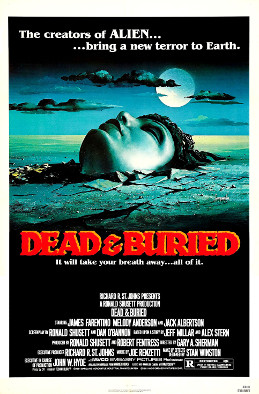
The 1981 horror film, Dead & Buried, takes place in the small town of Potters Bluff.  It seems like it should be a nice place to live.  The people are friendly.  The scenery is lovely.  The town is right on the coast of the ocean so the view is great.  It’s a bit of an artist’s colony, the type of place where you would expect to find Elizabeth Taylor painting the sunset while Richard Burton battles a hangover in the beach house.  It’s the type of small town that used to by very popular on television.  It’s just one Gilmore girl away from being an old CW show.

It’s such a nice town.  So, why are so many people dying?

That’s the mystery that Sheriff Dan Gillis (James Farentino) has to solve.  Actually, it’s one of the many mysteries that Dan has to solve.  There’s also the mystery of why his wife, Janet (Melody Anderson), has been acting so strangely.  And then there’s the mystery of what happened to the person who, one night, Dan ran into with his car.  The person ran away but he left behind his arm.  When Dan gets some skin from the arm analyzed, he’s told that the arm belongs to someone who has been dead for at least four months!

Who can explain all of this?  How about William G. Dobbs (Jack Albertson), the folksy coroner who seems to enjoy his work just a little bit too much.  In fact, Dr. Dobbs seems to be a bit more than just a tad eccentric.  One would necessarily expect a coroner to have a somewhat macabre view of life but Dr. Dobbs seems to take things to extreme.  Is it possible that Dr. Dobbs knows more than he’s letting on?

Dead & Buried has a reputation for being something of a sleeper, a deliberately-paced and often darky humorous horror film that had the misfortune to be released at a time when most horror audiences were more interested in watching a masked man with a machete kill half-naked teenagers.  Because the studio wasn’t sure how exactly to market Dead & Buried, it failed at the box office and it was only years later, after it was released on home video, that people watched the film and realized that it was actually pretty good.  And make no mistake about it, Dead & Buried is a fairly clever horror film, one that is full of effective moments and which does a good job of creating a creepy atmosphere.  If I’m not quite as enthused about this film as others, that’s because I do think that it’s occasionally a bit too slow and the film’s twist ending, while well-executed, didn’t particularly take me by surprise.  This is one of those films that you enjoy despite the fact that you can see the surprise conclusion coming from a mile away.

In the end, Dead & Buried fills like a particularly twisted, extra-long episode of one of those old horror anthology shows, like Night Gallery, Twilight Zone, or maybe even Ghost Story.  It’s a nicely done slice of small town horror, featuring a study lead performance from James Farentino and an enjoyably weird one from Jack Albertson.  Though the film is not heavy on gore, Stan Winston’s special effects are appropriate macabre.  Even if it’s not quite up there with Gary Sherman’s other films (like Vice Squad and Death Line, to name two), Dead & Buried is an entertainingly eccentric offering for Halloween.

Sundance Film Review: Circle of Power (dir by Bobby Roth)


With the Sundance Film festival currently taking place in Utah, I am currently reviewing films that originally made a splash at the Sundance Film Festival!

(a.k.a. Circle of Power, Mystique, Naked Weekend, and probably a handful of other titles)

The Sundance Film Festival wasn’t always the Sundance Film Festival.

Up until 1984, it was known as the US Film Festival.  Because of the involvement of Robert Redford, it was something of a big deal but still nowhere as big a deal as it is today.  In fact, many of the films that were showcased and celebrated at the US Film Festival have slipped into obscurity.  While winning an award at the US Film Festival may have been nice a ego boost for an independent filmmaker, it certainly didn’t bring a film anywhere near the amount of attention that winning at Sundance does now.

Take the long and strange saga of Circle of Power, for instance.

From my own research, it appears that Circle of Power was originally filmed in 1980.  At that time, it was called Mystique.  It premiered at the Chicago International Film Festival in 1981.  A year later, under the title Circle of Power, it played at the US Film Festival.  It was awarded the Dramatic prize (which was the forerunner for Sundance’s Grand Jury Prize).

After that, it still took Circle of Power two years to achieve national distribution.  In 1984, when it was reviewed by Roger Ebert, the film had been released as Naked Weekend, a title that was as commercial as it was misleading.  (There is nudity in the film but probably not the type of nudity that Naked Weekend‘s audience was expecting.)  By the time the film was finally released on VHS, it had picked up yet another title: Brainwash.

That’s the poster for Brainwash at the top of this video.  There are two images on that poster.  One is of a woman holding a riding crop and showing off her bra.  The other is of a naked man in a cage.  Only the latter image actually appears in the movie.

The film’s distributors were obviously trying to sell Circle of Power as an exploitation film.  Actually, it’s not.  It’s … well, it’s hard to describe what exactly it is.  It starts out with a title card, informing us that what we’re about to see is based on a true story.  The rest of the film deals with a group of executives and their wives who are required to spend the weekend attending a “training course” at a beautiful hotel.  The weekend gets off to a good start, with lots of dancing and laughing.  Of course, none of the executives seem to notice that the hotel staff is watching them with a mix of scorn and pity.

(The film continually contrasts the privileged white executives with the largely black and Hispanic hotel staff.)

Before the training sessions begin, all of the executives and their wives are forced to sign a paper that states they understand that they will be psychologically and physically abused over the weekend.  Only one executive objects and he is quickly bullied into signing by his co-workers.  Apparently, they can’t do the training unless everyone agrees to sign.

The men and the women are separated.  (Interestingly, all of the executives are men.)  The men are “trained” by Bianca Ray (Yvete Mimieux, who is chilling in her final performance to date) while the women are left with Jordan Carelli (John Considine).  The training turns out to be a combination of ego stripping and physical abuse.  One overweight executive (Walter Olkewicz) is ordered to strip naked and is then locked in a cage, where food is dumped on him.  An alcoholic is forced to lay down in a coffin.  Soon, everyone is covered in bruises.  What’s remarkable is that only one executive and his wife actually seems to find any of this to be objectionable.  In fact, everyone else reacts to the abuse by hugging their abusers and crying for joy.

It’s a strange little film, one that often seems to be unsure of what it’s saying but which, at the same time, still possesses an undeniable power.  The film may be 38 years old but brainwashing is a timeless subject.  One need only spend an hour or two on twitter to see how easily people can be brainwashed.  While the film probably disappointed those seeking a naked weekend, it’s still an undeniably watchable oddity.

Previous Sundance Film Reviews:

  1. Blood Simple
  2. I Don’t Feel At Home In This World Anymore

A Movie A Day #15: Special Bulletin (1983, directed by Ed Zwick)


specialbulletin2

“We interrupt our regularly scheduled programming for a special report…”

Led by veteran anchor John Woodley, the RBS news team is providing continuing coverage of a developing crisis in Charleston, South Carolina, where terrorists are holding several members of the coast guard, a local new reporter, and his cameraman hostage on a small tugboat.  These are not typical terrorists, though.  Two of them are nuclear scientists.  One of them is a social worker.  Another one is a nationally-renowned poet.  The final terrorist is a former banker robber who was just recently released from prison.  This unlikely group has only two demands: that the U.S. government hand over every single nuclear trigger device at the U.S. Naval Base and that RBS give them a live television feed so that they can explain their actions to the nation.  If either of those demands are not met, a nuclear bomb will be detonated and will destroy Charleston.

This made-for-TV movie was shot on video tape, to specifically make it look like an actual news broadcast.  Though much of the movie seems dated when compared to today’s slick, 24-hour media circus, Special Bulletin was convincing enough that, when it was originally broadcast in 1983, it caused a mini-panic among viewers who missed the opening disclaimer:

specbull_disclaimer

Because the movie deals with the threat of nuclear terrorism instead of a U.S.-Soviet nuclear war, it still feels relevant in a way that many of the atomic disaster films of the 1980s do not.  Beyond making an anti-nuclear statement, Special Bulletin is also a critical look at how the news media sensationalizes every crisis, with the RBS news team going from smug complacency to outright horror as the situation continues to deteriorate.  David Clennon and David Rasche are memorable as the two most outspoken of the terrorists and Ed Flanders is perfectly cast as a veteran news anchor struggling to maintain control in the middle of an uncontrollable situation.  Special Bulletin won an Emmy for Outstanding Drama Special and can be currently be found on YouTube.

Keep an eye out for Michael Madsen, who shows up 57 minutes in and gets the movie’s best line: “That guy’s a total psycho ward.”

madsen-special-bulletin

The Daily Horror Grindhouse: Savage Weekend (dir by David Paulsen)


Savage_Weekend_poster

Filmed in 1976 but not released until 1979, Savage Weekend is the story of a brave boom mic that takes a trip to upstate New York for the weekend and ends up witnessing a lot of decadent behavior and, eventually, a few gruesome murders.  Sadly, the brave little boom mic apparently has no social skills because everyone pretends like they don’t see it, even though it shows up a few dozen times, always floating at the top of the screen.

It’s also the story of Otis (William Sanderson), a local redneck (I’ve never been to upstate New York but I still find it amusing how movies always portray it as being a step away from Deliverance country) who spends his time talking to his father’s gravestone.  Apparently, when Otis was younger, he found out his girlfriend was cheating on him so he branded her with an H.  Why an H?  Because, we’re told, Otis doesn’t know how to spell whore.

Well, okay then…

Actually, if you’ve watched any number of these type of films, you’ll immediately recognize William Sanderson.  Sanderson played a countless number of backwoods weirdos and he always did a pretty good job.  (He also played the poignantly sympathetic J.F. Sebastian in Blade Runner.)  Interestingly enough, in real life, Sanderson has a law degree.

Savage Weekend, incidentally, has a brilliant opening.  After running through the woods, a woman finds herself cornered by Otis.  As Otis approaches her, he gives her a strange little half-smile.  It’s super creepy and scary and the rest of the film never lives up to it.

That said, Savage Weekend is an interesting film, even if it’s not a particularly good one.  I’m not sure if it’s intentional or if it’s a happy byproduct of the filmmaker’s general incompetence but Savage Weekend has a truly surreal feel to it.  It moves at a deliberate, almost dream-like pace.  Characters appear and then vanish for lengthy periods of time.  Plot points are raised and then abandoned.  As a result of an inconsistent script, much is hinted at without ever being truly revealed.  It makes for a very odd viewing experience.

Plotwise, it’s your standard slasher film.  A group of people find themselves in an isolated location and are picked off, one-by-one, by a masked killer.  Whereas most slasher films feature teenage victims, Savage Weekend is distinguished by the fact that all of the victims are adults and they’re all way too old and successful to justify continually making the type of stupid decisions necessary for a slasher movie to work.  Two of them, Robert (Jim Doerr) and Jay (Devin Goldenberg), are stockbrokers.  Marie (Marilyn Hamlin) is the ex-wife of the Governor of New York’s press secretary.  (At one point, someone mentions that the governor was corrupt and apparently committed suicide.  It’s one of those plot points that comes out of nowhere.)  Meanwhile, Marie’s sister, Shirley (Caitlin O’Heany), is accompanied by her best friend, Nicky (Christopher Allport).  Nicky is flamboyantly gay and, shortly after being introduced, he single-handedly beats up three rednecks and then dramatically announced, “I was raised in the Bronx!”

Since the first murder doesn’t take place until an hour into the film, we spend more time than usual getting to know our victims but none of them behave in any sort of consistent manner, which adds to the film’s dreamlike feel.  Nicky clutches a barbed wire fence while watching Shirley fool around with Jay.  Marie appears to be on the verge of touching herself while listening to the story about Otis branding his girlfriend.  Later, a good deal of screen time is devoted to Marie and another redneck milking a cow, with the camera zooming in on the milk shooting out of the udders.  While being stalked by the killer, Nicky puts on makeup while a lingerie-clad Shirley dances through the house while tango music plays on the soundtrack.

It all just feels very odd and strangely paced, as if huge chunks of the script were either not filmed or left on the editing room floor.  But that oddness (along with the boom mic) is exactly what makes Savage Weekend an interesting movie.