Every Monday night at 9:00 Central Time, my wife Sierra and I host a “Live Movie Tweet” event on X using the hashtag #MondayMuggers. We rotate movie picks each week, and our tastes are quite different. Tonight, Monday April 28th, Sierra has chosen THE RIVER MURDERS (2011) starring Ray Liotta, Ving Rhames, Christian Slater, and Raymond J. Barry.
The plot revolves around a homicide detective (Liotta) who becomes the prime suspect in a series of murders when the FBI uncovers his close personal ties to all of the victims.
This sounds pretty good to me, so join us tonight for #MondayMuggers and watch THE RIVER MURDERS! It’s on Amazon Prime. The trailer is included below:
First released in 1988, Tucker: The Man and His Dream is a biopic about Preston Tucker.
Tucker was an engineer in Detroit who went from designing vehicles for the Army during World War II to trying to launch his own car company. His ideas for an automobile don’t sound particularly radical today. He wanted every car to have seat belts. He wanted a windshield that popped out as a safety precaution. He want brake pads and he also wanted a car that looked sleek and aerodynamic, as opposed to the old boxy cars that were being pushed out be Detroit. He wanted a car that got good mileage and he wanted one that could be taken just about anywhere. Unfortunately, Tucker’s dreams were cut short when he was indicted for stock fraud, a prosecution that most people agree was a frame-up on behalf of the Big Three auto makers. Tucker was eventually acquitted but his car company went out of business. Of the 50 cars that Tucker did produce, 48 of them were still on the road and being driven forty years later.
The film stars Jeff Bridges as Preston Tucker, Joan Allen as his wife, Christian Slater and Corin Nemec as two of his sons, Lloyd Bridges as the senator who tried to take Tucker down, Martin Landau as Tucker’s business partner, and Dean Stockwell as Howard Hughes, who shows up for a few minutes to encourage Tucker to follow his dreams regardless of how much the government tries to stop him. One gets the feeling that the film was a personal one for director Francis Ford Coppola, a filmmaker who has pretty much spent his entire career fighting with studios while trying to bring his vision to the screen. Tucker fought for seat belts. Coppola fought for a mix of color and black-and-white in Rumble Fish. Tucker stood up for his business partner. Francis Ford Coppola stood up for Al Pacino when no one else could envision him as Michael Corleone. As is the case with many of Coppola’s films, Tucker: The Man And His Dream is a film that Coppola spent years trying to get made. It was the film that Coppola originally intended to be the follow-up to The Godfather, with Marlon Brando projected for the lead role of Tucker. After watching the Tucker, it’s hard not to feel that it worked out for the best that Coppola was not able to make the film in 1973. It’s impossible to imagine anyone other than Jeff Bridges in the role of Preston Tucker.
“Chase that tiger….chase that tiger….chase that tiger….” It’s a song that Tucker sings constantly throughout the film as the camera spins around him and how you react to Tucker: The Man And His Dream will largely depend on how tolerant you are of Coppola’s stylistic flourishes. Coppola directs the film as a combination of Disney fairy tale and film noir. The opening of the film, with Tucker running around in almost a manic state and excitedly telling everyone about his plans, is presented with vibrant colors and frequent smiles and an almost overwhelming air of cheerful optimism. As the film progresses and Tucker finds himself being targeted by both the government and the other auto companies, the film gets darker and the viewer starts to notice more and more shadows in the background. The moments of humor become less and less and there’s a heart-breaking moment where Martin Landau, in one of his best performances, reveals just how far the government will go to take down Tucker’s company. But, in the end, Tucker refuses to surrender and Jeff Bridges’s charming smile continues to fill the viewer with hope. The film becomes about more than just cars. It’s a film that celebrates all of the innovators who are willing to defy the establishment.
There’s a tendency to dismiss the majority of Coppola’s post-Apocalypse Now films. However, Tucker: The Man And His Dream is a later Coppola film that deserves to be remembered.
Unfrosted is a thoroughly amiable and goofy comedy about the invention of the Pop Tart.
Taking place in an imaginary 1963, Unfrosted tells the story of the Cereal Wars. Kellog’s and Post are competing for dominance in the kids breakfast food market, dominating the scene while the dour folks at Quaker can only shake their heads in holier-than-thou shame. Bob Cabana (played by the film’s director, Jerry Seinfeld) is a Kellog’s exec who spends his day dealing with pompous cereal mascots (led by a hilarious Hugh Grant) and the somewhat random whims of his boss, Edsel Kellog III (Jim Gaffigan). He dreams of someday having a lawn made out of sod and also having enough money to send his kids to a good college. “Those colleges can cost $200 a year!” he says, at one point.
Life is good until he discovers that Post — headed up by Marjorie Post (Amy Schumer) — is developing a type of new breakfast food that could revolutionize the industry and dethrone Kellog’s as America’s top cereal company. Bob gets Edsel’s permission to try to create something that will beat Post’s new product to the shelves. But first, Bob has to go to NASA and convince brilliant engineer Donna “Stan” Stankowski (Melissa McCarthy) to abandon the moon project and return to Kellog’s. “You know we’re never going to land on the moon,” Bob tells her.
Soon, the entire nation is riveted by the competition between Post and Kellog’s. Walter Cronkite (Kyle Dunnigan) reports on every development, in between complaining about his wife and playing with silly putty. The Russians decide to help Post, leading the world to the brink of nuclear war while President Kennedy (Bill Burr) spends his time with the Doublemint Twins. Harry Friendly (Peter Dinklage), head of the milk syndicate, warns that kids better not stop eating cereal while Bob finds himself being menaced by a sinister milkman (Christian Slater). A German scientist (Thomas Lennon) and Chef Boyardee (Bobby Moynihan) combine a sea monkey with a square of ravioli, leading to a new life form that lives in the Kellog’s ventilation system. Steve Schwinn (Jack McBrayer), the bicycle guy, risks his life to test a prototype while a super computer is shipped to Vietnam and turns into Colonel Kurtz and….
Okay, you’re getting the idea. This is a silly, joke-a-minute film that is in no way meant to be taken seriously. It’s obvious that Seinfeld and his co-writers greatly amused themselves while writing the script and your amusement will depend on whether or not you’re on the same wavelength. I enjoyed the film, because I love history and I love pop culture and I like random homages to other films. Not all of the jokes landed. There’s a lengthy Mad Men parody that, while funny, still feels several years too late. But, for the most part, I enjoyed the amiable goofiness of it all.
Unfrosted is currently getting some savagely negative reviews but that has more to do with Seinfeld’s recent comment that the “extreme left” was ruining comedy. Though most people would probably consider Seinfeld’s comment to be common sense (and would also realize that Seinfeld was condemning the “extreme” as opposed to liberalism in general), the online folks, many of whom were already angry over Seinfeld’s outspoken support of Israel, were scandalized and most mainstream film reviewers today never want to get on the bad side of an online mob, regardless of how annoying that mob may be. (Even a positive review in TheHollywood Reporter contained an odd passage in which the reviewer seemed to beg forgiveness for giving a non-condemnatory review to a film made by someone on the other side.) Of course, there are also some reviewers who are currently overpraising this film as a way to “own the libs.” The fact that a film as silly and inoffensive as this one could suddenly find itself at the center of the culture war tends to prove Seinfeld’s point.
The important thing is that Unfrosted is amusing and, in the end, rather likable. I enjoyed it.
First released in 1990 and based on a horror-themed television series that was created by the one-and-only George Romero, Tales From The Darkside: The Movie is an anthology film. Usually, I can’t stand anthology films because it seems like the viewer only gets one good story and has to sit through two or three mediocre stories to get to the worthwhile stuff. However, I have to say that I really enjoyed all of the stories featured in Tales From The Darkside: The Movie.
The film opens with a wrap-around story, featuring Timmy (Matthew Lawrence), a young boy who is chained up in a pantry and who a local witch named Betty (Debbie Harry) is planning on cooking for a dinner party. Timmy tries to distract Betty from her kitchen duties by telling her three stories.
The first story features Steve Buscemi as a nerdy college student named Edward Bellingham. On the verge of getting a much-needed scholarship, Edward is framed for theft by two of his classmates (one of whom is played by Julianne Moore) and loses the scholarship. Edward responds by doing what anyone would do. He unrolls an ancient parchment and brings to life a mummy who kills his rivals. A very preppy Christian Slater plays Andy, the smug brother of one of the victims who seeks revenge against Bellingham. In a surprise twist, Bellingham is able to get some vengeance of his own.
The second story features William Hickey as Drogan, an annoying old man who is convinced that he is being stalked by an evil black cat. Drogan hires a hitman (David Johansen) to kill the cat but, as we all know, black cats are far more clever than anyone realizes. The story ends on a notably grisly note because cats rule!
Finally, the third story features James Remar as a struggling artist who, one night, discovers that the stone gargoyle that sits atop of his apartment building is actually alive. After witnessing the gargoyle kill someone, the artist promises never to reveal that the gargoyle exists. “Cross your heart?” the gargoyle asks before flying away. Later, the artist meets a mysterious woman (Rae Dawn Chong) who helps him to become a success on the art scene. However, even after he marries the woman and they start a family, Remar is still haunted by his memories of the gargoyle.
As I said at the start of this review, I’m not a huge fan of anthology films but I really liked Tales From The Darkside: The Movie. All three of the stories are equally good and there’s really not a slow spot to be found. This is a horror anthology that manages to balance scares and laughs without becoming too silly or forgetting that the movie is meant to be a horror story. Steve Buscemi, Christian Slater, and James Remar are stand-outs amongst the cast. Even the wrap-around story had a good ending!
If you’re going to watch an anthology film for Halloween, allow me to recommend Tales From The Darkside: The Movie!
Five thieves show up in Vegas to rob a casino. The casino is also hosting an Elvis convention so the criminals all dress up like Elvis before trying to pull off their heist. Since one of the criminals is played by Kurt Russell and Russell famously played Elvis in a made-for-TV movie, it’s a meta joke. The worst of the criminals is played by Kevin Costner because, in 2001, Costner’s career was dead in the water and he was trying to reinvent himself as some sort of badass character actor.
As a result of a shootout and series of personal betrayals, Russell and Costner are the only two thieves who survive the heist. Kurt Russell ends up taking all of the money for himself and running off with single mother Courteney Cox. (Yes, Cox’s then-husband, David Arquette, does have a small role in the movie.) Costner pursues them, killing anyone who he comes in contact with until it all leads to one final shoot out.
3000 Miles to Graceland is a stupid, stupid movie that was made at the time when every director was still trying to remake Reservoir Dogs and The Usual Suspects. If you need any proof of how bad this movie is, just consider that it is one of the few Kurt Russell films to never develop a cult following. There are people who would jump into the mouth of a volcano if Kurt Russell told them to and even they won’t watch 3000 Miles to Graceland. Even the worst 90s crime films have at least a few people willing to defend them but 3000 Miles to Graceland has been abandoned on the ash heap of crime film history. Despite having a once-in-a-lifetime supporting cast — Christian Slater, Bookeem Woodbine, Kevin Pollack, Jon Lovitz, Howie Long, Ice-T, and even Paul Anka — 3000 Miles to Graceland has never even received a direct-to-video sequel.
Why is 3000 Miles to Graceland so forgettable? The heist storyline has been done to death and this film doesn’t bring anything new to the genre. The only new wrinkle that 3000 Miles to Graceland brings to its familiar story is that the thieves are all dressed like Elvis and that gets old pretty quick. The other problem is that Kevin Costner is miscast as the psycho villain. Michael Madsen could have handled the role. So could Tom Sizemore or Woody Harrelson or just about other actor out there. But Kevin Costner, who first found fame as a sort of modern-day Gary Cooper, never seems comfortable playing a cold-hearted sociopath. He makes up for this discomfort by trying too hard. Comparing his performance here to his more nuanced turn as another criminal in A Perfect World shows just how miscast he was in 3000 Miles To Graceland.
Fortunately, better things were ahead for almost everyone involved in this movie. Kevin Costner has recently returned to playing the type of roles that made him a star to begin with and Kurt Russell has become an American idol. Fortunately, 3000 Miles to Graceland is remembered, if at all, as just an unfortunate detour in their otherwise distinguished careers.
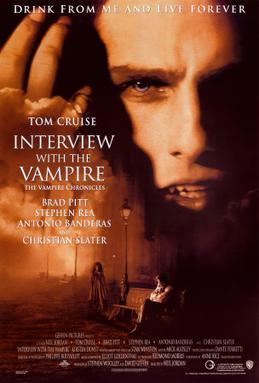
There are a lot of vampires and other cursed beings wandering through the 1994 film adaptation of Interview With A Vampire but Claudia (Kisten Dunst) is the only one for whom I have any sympathy.
Louis (Brad Pitt) may be the main character and the vampire giving the interview but it’s hard to have much sympathy for him. He’s just such a whiny little bitch. The Louisiana aristocrat is transformed into a vampire in 1791 and basically spends the next 200 years complaining about it. You want to have sympathy for him but sometimes, you just have to accept stuff and move on. It doesn’t help that Brad Pitt, who has always given his best performances when cast as men of action, is somewhat miscast as the effete and self-loathing Louis.
Lestat (Tom Cruise) may be the most charismatic of the vampires but he’s never exactly sympathetic. He turns Louis into a vampire and then spends years following him across Louisiana and Europe. Lestat is decadence personified and he never whines and, as a result, he’s far more enjoyable to spend time with than Louis. Cruise is as perfectly cast as Lestat as Pitt was miscat as Louis. Lestat is a star and Tom Cruise has always been one of the few true movie stars around. That said, Lestat is still far too self-indulgent and thoughtlessly self-destructive to really be a sympathetic character. Instead, he’s like Lord Byron, destroying happy families but at least writing a poem about it afterwards.
Armand (Antonio Banderas) runs the Théâtre des Vampires in Paris and he becomes Louis’s companion for a time. Louis is charismatic because he’s played by Antonio Banderas but, ultimately, he proves to be a rather ineffectual leader. Armand puts on a good show but, in the end, that’s all he has to offer. He’s a bit shallow, despite all of the theatrics.
Santiago (Stephen Rea) isn’t sympathetic at all but at least he really seems to get into being evil. Good for him!
And then there’s Daniel Malloy (Christian Slater), the journalist who conducts the interview with Louis. In the film, Malloy starts out as a cynic, the type of writer who theatrically pours himself a glass of whiskey before dramatically turning to his typewriter. All he needs is a fedora with a press pass tucked into the headband. It’s difficult to take him seriously.
But then there’s Claudia. Poor Claudia. In the book, Claudia was only five years old when she was turned into a vampire. In the movie, she’s played by 12 year-old Kirsten Dunst and it’s left ambiguous as to how young Claudia actually was when Lestat turned her into a vampire, though it’s still made clear that was too young to be cursed without her consent. Claudia becomes Lestat and Louis’s companion. Louis treats her like the daughter that he will never have. Lestart treats her like an apprentice, teaching her how to kill. Claudia grows up but is forever trapped in the body of a child. It’s impossible not to feel sorry for Claudia, who never asked to become a vampire, who indeed was just turned so that Lestat could use her as a pawn to keep control of Louis. Claudia spends a good deal of the movie in a rage and who can blame her?
Interview With A Vampire is a messy and uneven film. Brad Pitt is miscast and the whole film is oddly paced, with the New Orleans scenes taking too long and the Paris scenes going by almost too quickly. At the same time, Tom Cruise brings the proper joie de mort to the role of Lestat and Claudia and her fate will simply break your heart. Interview With The Vampire is not the best vampire movie that I’ve ever seen but it definitely has its pleasures.
Two weeks ago, while I was sick in bed, I watched The Legend of Billie Jean, a deeply silly movie from 1985.
Okay, get this. Billie Jean (Helen Slater) and her younger brother, Binx (an incredibly young Christian Slater), live in Corpus Christi, Texas. Binx has always wanted to go to Vermont. That right there should tell you just how silly this movie is. Not only does it feature a character named Binx but it also features Texans wanting to go to Vermont. I’m a native Texan who loves to travel but I can tell you right now that the last place I would ever want to go would be Vermont. In fact, down here, we tend to assume that Vermont’s just a place that was made up by the media. Bernie Sanders? He’s just an actor. Seriously, there’s no way that Vermont actually exists.
Anyway, after Binx throws a milkshake in the face of local bully, Hubie Pyatt (Barry Tubb), Hubie steals Binx’s scooter. (If you’re stuck with a name like Hubie Pyatt, it seems kinda predestined that you’re going to grow up to be a bully.) After getting nowhere with the police, Billie Jean returns home to discover that Binx has been beaten up and his scooter has been dismantled. Billie Jean goes to Hubie’s father (Richard Bradford) to demand some money to get the scooter fixed. Mr. Pyatt responds by attempting to assault Billie Jean, which leads to Binx shooting Mr. Pyatt in the shoulder.
So now, Billie Jean and Binx are on the run.
Joining them in their flight are two idiot friends (Martha Gehman and Yeardley Smith) and Lloyd (Keith Gordon), the son of the local district attorney. Because this is a movie, Billie Jean quickly becomes a media superstar. Everyone wants to meet Billie Jean. Everyone wants to help Billie Jean. A sympathetic police detective (Peter Coyote) is determined to capture Billie Jean without violence but that might be difficult with the media constantly getting in the way.
While hiding out in a motel, Billie Jean turns on the TV and watches the classic 1928 silent film, The Passion of Joan of Arc. (I have to say that I’ve stayed in a few motels around Corpus Christi and never once did I turn on the TV and just happen to come across a classic silent movie.) Moved by Renee Falconetti’s performance in the lead role, Billie Jean decides to cut her hair really, really short (though not as short as Falconetti’s). I guess Billie Jean is supposed to be a 1980s version of Joan of Arc, which really doesn’t make any sense. I mean, Joan of Arc heard the voice of God and led the French to victory over the British. Billie Jean is just trying to get some money to get her brother’s scooter fixed and pay for a trip to the imaginary state of Vermont.
Meanwhile, Mr. Pyatt has recovered from his wounds and is now selling Billie Jean merchandise in his store. The detective mentions how weird that is but Mr. Pyatt is just out to make some money. Can you blame him? The entire country is obsessed with Billie Jean!
As you might have guessed, The Legend of Billie Jean is incredibly silly but likable. Despite having an inconsistent Texas accent, Helen Slater does a good job in the lead role of Billie Jean and it’s interesting to actually see Christian Slater before he developed the sarcastic style that, for better or worse, has come to define pretty much all of his performances. Never for a second do you believe that Billie Jean would actually become a media superstar. (Nor do you ever believe that she’s the type who would have the patience to watch a silent movie.) I mean, when you get right down to it, it’s a pretty dumb movie. But, when you’re sick in bed, The Legend of Billie Jean is a perfectly acceptable way to pass the time.
Brian Kelly (Christian Slater) is a California skater with a rebellious attitude and an adopted Vietnamese brother named Vinh (Art Chudabala). When the movie starts, all Brian cares about is not selling out and finding empty pools to skate. He even hires an airplane to fly him and his friends over Orange County so they can get a bird’s-eye view of the layout. Vinh is more worried about his job with the Vietnamese Anti-Community Relief Fund. The fund has been set up to send medical supplies to Vietnam but, when Vinh comes across a discrepancy in the shipping records, he realizes that something else is going on. When Vinh turns up dead in a hotel room, everyone else may believe that it is suicide but Brian knows that his brother was murdered. With the help of his fellow skaters and a sympathetic cop (Steven Bauer), Brian sets out to bring his brother’s killers to justice.
I was surprised when I watched Gleaming the Cube because it turned out to be much better than I was expecting. The movie is justifiably best known for its skating sequences, which were shot by Stacy Peralta and which featured pro-skaters Mike McGill, Rodney Mullen, and Gator Rogowski doubling for Slater in some of the film’s more spectacular stunts. (Tony Hawk plays one of Slater’s friends.) Slater, himself, learned how to skate for the movie and looks far more comfortable and natural on his board than Josh Brolin did in Thrashin’. Beyond the spectacular skating, Gleaming the Cube is energetically directed and surprisingly well-acted. A pre-stardom Christian Slater gives one of his best and most natural performances as Brian, playing the role without any of the tics or affectations that later came to define his career. Of its type, Gleaming the Cube is a classic.
The place is New York City. The time is the prohibition era. The rackets are controlled by powerful but out of touch gangsters like Arnold Rothstein (F. Murray Abraham), Joe Masseria (Anthony Quinn), and Salvatore Faranzano (Michael Gambon). However, four young gangsters — Lucky Luciano (Christian Slater), Meyer Lansky (Patrick Dempsey), Frank Costello (Costas Mandylor), and Bugsy Siegel (Richard Greico) — have an ambitious plan. They want to form a commission that will bring together all of the Mafia families as a national force. To do it, they will have to push aside and eliminate the old-fashioned mob bosses and take over the rackets themselves. When Masseria and Faranzano go to war over who will be the new Boss of all Bosses, Luciano and Lansky seen their opportunity to strike.
I love a good gangster movie, which is one reason that I have never cared much for Mobsters. Mobsters was made in the wake of the success of Young Guns and, like that film, it attempted to breathe new life into an old genre by casting teen heartthrobs in the lead roles. There was nothing inherently wrong with that because Luciano, Lansky, and Seigel were all still young men, in their 20s and early 30s, when they took over the Mafia. (Costello was 39 but Mobsters presents him as being the same age as they other three.) The problem was that none of the four main actors were in the least bit convincing as 1920s mobsters. Christian Slater was the least convincing Sicilian since Alex Cord in The Brotherhood. As for the supporting cast, actors like Chris Penn and F. Murray Abraham did the best that they could with the material but Anthony Quinn’s performance in Mobsters was the worst of his long and distinguished career.
Fans of Twin Peaks will note that Lara Flynn Boyle had a small role in Mobsters. She played Luciano’s girlfriend. Unfortunately, other than looking pretty and dying tragically, she was not given much to do in this disappointing gangster film.
This month, since the site is currently reviewing every episode of Twin Peaks, each entry in Move A Day is going to have a Twin Peaks connection. Where The Day Takes You is a movie that has not just one but two connections to Twin Peaks.
Where The Day Takes You is an episodic film about young runaways living on the streets of Los Angeles. Led by 22 year-old King (Dermot Mulroney), who ran away from home when he was 16, the runaways form a surrogate family. While being constantly harassed by both the police and well-meaning social workers, some of the runaways get addicted to drugs while others turn to prostitution in order to survive. Some find love. Some find death. They all go where the day takes you. (Not sure if that was the movie’s tag line but it should have been.)
Where The Day Takes You is a gritty and often tough film, though it’s effectiveness is undercut by a predictable ending and the presence of too many familiar faces in the cast. The runaways are made up of a who’s who of prominent young actors from the 1990s. Balthazar Getty plays King’s second-in-command. Sean Astin plays an obviously doomed drug addict. Alyssa Milano and David Arquette play prostitutes. Ricki Lake and James Le Gros play comedic relief. Will Smith, in his film debut, plays a wheelchair-bound runaway. Christian Slater and Laura San Giacomo show up as social workers while the police are represented by Rachel Ticotin and Adam Baldwin. Everyone gives a good performance but the film would have worked better with unknown actors or even real runaways. No matter how good a performance Sean Astin gives as a heroin addict, he is always going to be Sean Astin and it is always going to be difficult to look at him without saying, “I might not be able to carry the ring but I can carry you!”
The movie’s first Twin Peaks connection is that Lara Flynn Boyle, who played innocent Donna Hayward on Twin Peaks, plays innocent runaway Heather in Where The Day Takes You. The role is cliché but Boyle shows the same charm that she showed while playing Donna.
The movie’s second Twin Peaks connection is more unexpected. Kyle MacLachlan is effectively cast against type as Ted, the drug dealer who keeps most of the runaways hooked on heroin and who is perfectly willing to leave an overdosed junkie in a garbage bin. Ted is about as far from Dale Cooper as you can get.




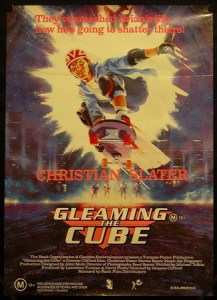 Brian Kelly (Christian Slater) is a California skater with a rebellious attitude and an adopted Vietnamese brother named Vinh (Art Chudabala). When the movie starts, all Brian cares about is not selling out and finding empty pools to skate. He even hires an airplane to fly him and his friends over Orange County so they can get a bird’s-eye view of the layout. Vinh is more worried about his job with the Vietnamese Anti-Community Relief Fund. The fund has been set up to send medical supplies to Vietnam but, when Vinh comes across a discrepancy in the shipping records, he realizes that something else is going on. When Vinh turns up dead in a hotel room, everyone else may believe that it is suicide but Brian knows that his brother was murdered. With the help of his fellow skaters and a sympathetic cop (Steven Bauer), Brian sets out to bring his brother’s killers to justice.
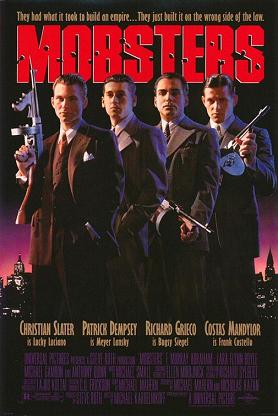 The place is New York City. The time is the prohibition era. The rackets are controlled by powerful but out of touch gangsters like Arnold Rothstein (F. Murray Abraham), Joe Masseria (Anthony Quinn), and Salvatore Faranzano (Michael Gambon). However, four young gangsters — Lucky Luciano (Christian Slater), Meyer Lansky (Patrick Dempsey), Frank Costello (Costas Mandylor), and Bugsy Siegel (Richard Greico) — have an ambitious plan. They want to form a commission that will bring together all of the Mafia families as a national force. To do it, they will have to push aside and eliminate the old-fashioned mob bosses and take over the rackets themselves. When Masseria and Faranzano go to war over who will be the new Boss of all Bosses, Luciano and Lansky seen their opportunity to strike.
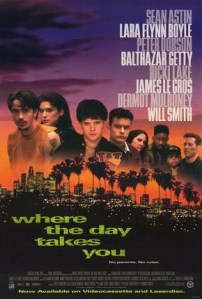 This month, since the site is currently reviewing every episode of Twin Peaks, each entry in Move A Day is going to have a Twin Peaks connection. Where The Day Takes You is a movie that has not just one but two connections to Twin Peaks.
 Through the Shattered Lens