Some films are so ludicrous and self-aware of their absurdity that you can’t help but love them and that’s certainly the case with 1991’s Point Break.
Consider what Point Break offers us:
First, you’ve got Keanu Reeves playing a former college football star who, after blowing out his knee, ended up joining the FBI. Keanu, who looks like he’s barely out of high school in this film, plays a character with the wonderful name of Johnny Utah. Keanu gives a relaxed performance. You can tell that he’s having fun in this movie and Johnny Utah’s enthusiasm is infectious. Personally, I prefer Johnny Utah to John Wick.
Secondly, you’ve got Patrick Swayze as Bodhi, the ruthless bank robber who is also a surfer. Much like Reeves, Swayze could occasionally be a stiff actor but in this film, you can tell he’s having fun and again, it’s hard not have fun watching him as he spouts his surfer philosophy, jumps out of planes, and dreams of dying while mastering a 50-foot wave. Swayze is so charismatic as Bodhi that you totally buy that Johnny Utah would like him despite all the times that Bodhi tries to kill him.
You’ve got Bodhi’s bank-robbing gang, who call themselves the Ex-Presidents. Bodhi wears a Ronald Reagan mask. Other members of the gang wear LBJ, Nixon, and Carter masks. “I am not a crook!” Nixon says. The wonderful thing about the Ex-Presidents is that they seem to truly enjoy robbing banks. Of course, they also enjoy surfing.
Gary Busey plays a character who is not Gary Busy. Instead, he’s Johnny’s partner. Everyone in the FBI laughs at him when he says the bank robbers are surfers but guess who knows what he’s talking about! Seriously, though, it’s always interesting to see Gary Busey in the years when he was still a somewhat serious actor.
John C. McGinley does the uptight boss thing. Lori Petty is the waitress who teaches Johnny Utah how to surf. The surf footage is beautifully shot. A soaked Johnny give the camera a thumbs-up. Director Kathryn Bigelow keeps the action moving quickly and, just as she did with Near Dark, uses the film’s genre trappings to explore the bond that holds together a group of outsiders.
It’s an over-the-top and cheerfully absurd film and it’s impossible not to love it. I haven’t felt the need to watch the remake. Why would I? The original has everything I need.
One of my favorite scenes from TV’s King of the Hill occurs in an episode in which Hank and Peggy are celebrating their wedding anniversary. They’ve sent Bobby and Luanne away for the weekend. They have the house to themselves but, after their anniversary party, Peggy is feeling depressed. She tells Hank that, for the first time ever, she feels old and she regrets all the dreams that she had that have yet to come true, like inventing and selling her own barbecue sauce.
Trying to cheer her up, Hank says, “C’mon, Peg. We got the house to ourselves for weekend …. and I rented an R-rated movie!”
Peggy looks up, briefly hopeful that Hank did something romantic. “What movie?” she asks.
Hank hesitates, glances down at the floor, and says, “Uhmm …. Platoon.”
It’s funny because it’s true. Just about every man that I know loves Platoon. First released in 1986 and reportedly based on Oliver Stone’s own experiences as an infantryman in Vietnam, Platoon is often cited as being one of the greatest war films ever made. Oddly enough, the film has an anti-war and anti-military message but, in my experience, those who love it talk more about the battle scenes than any message that Stone may have been trying to impart about the futility of war. Pauline Kael once wrote that Oliver Stone had left-wing politics but a right-wing sensibility and I think you can definitely see that in Platoon. Despite all of the characters talking about how pointless the war is and how much they resent being forced to risk their lives for no apparent purpose, the film’s energy comes from the scenes of Chris Taylor (Charlie Sheen) stalking through the jungle and, towards the end, losing his mind and giving himself completely over to the adrenaline that comes from being trapped in the middle of a battle. Throughout the film, we hear Taylor’s rather pedantic thoughts on the military and his fellow soldiers but it’s hard not to notice that his actions and his dialogue are usually far less eloquent. Taylor may be a rich intellectual (and wow, is Charlie Sheen ever unconvincing when it comes to portraying that part of Taylor’s personality) but when he’s in the jungle, he’s just fighting for survival.
The film’s plot centers around the conflict between two sergeants, the peace-loving Elias (Willem DaFoe) and the war-loving Barnes (Tom Berenger). Taylor has to decide which one of the two to follow. The pot-smoking Elias loves his men and goes out of his way to protect them. The beer-drinking Barnes has a much harsher view of the world but, at the same time, he’s the type of scarred warrior who seems immortal. One gets the feeling that he’ll never be defeated. The rest of the platoon is full of familiar faces, with everyone from John C. McGinley to Francesco Quinn to Tony Todd to Forest Whitaker to Johnny Depp to a baby-faced Kevin Dillon showing up. (Dillon is especially frightening as a psycho who has, for some reason, been nicknamed Bunny.) The majority of the platoon is dead by the end of the film. Even with the leadership of Elias and Barnes, the soldiers are stuck in a winless situation. As Taylor points out, the Americans aren’t just fighting the enemy. They’re also fighting each other.
Platoon is certainly not my favorite of the film nominated in 1986. I would have gone with A Room With A View. (Blue Velvet, which is as influential a film as Platoon, was not even nominated.) That said, I can’t deny the power of Platoon‘s combat scenes. Though Stone’s script is didactic and Taylor’s narration is awkwardly deployed throughout the film, Stone’s direction definitely captures the fear and dread of being in a strange place with no idea of whether or not you’re going to survive. Stone is critical of the military (at one point, an officer calls an air strike on his own men) but seems to love the soldiers, even the ones who have pushed over to the dark side.
Platoon was not the first Best Picture nominee to be made about the Vietnam War. The Deer Hunter, Coming Home, and Apocalypse Now were all released first. But both The Deer Hunter and Apocalypse Now are surreal epics that seem to take place in a dream world. Coming Home, which has a script that somehow manages to be even more didactic than Platoon‘s, focuses on the war back home. Platoon is far more gritty and personal film. Watching Platoon, you can smell the gunpowder and the napalm and feel the humidity of the jungle. I can understand why it won, even if I prefer to watch Helena Bonham Carter and Julian Sands fall in love.
— Phillip Jeffries (David Bowie) in Twin Peaks: Fire Walk With Me (1992)
Even among fans of the show, Twin Peaks: Fire Walk With Me is controversial.
If you read Reflections: An Oral History of Twin Peaks, you’ll discover that many members of the television show’s cast either didn’t want to be involved in the film or didn’t care much for it when it came out. Fearful of being typecast, Kyle MacLachlan only agreed to play Dale Cooper on the condition that his role be greatly reduced. (Was it that fear of being typecast as clean-cut Dale Cooper that led to MacLachlan later appearing in films like Showgirls?) Neither Lara Flynn Boyle nor Sherilyn Fenn could work the film into their schedules.
When Twin Peaks: Fire Walk With Me premiered at Cannes, it was reportedly booed by the same critics who previously applauded Lynch’s Wild at Heart and who, years later, would again applaud Mulholland Drive. When it was released in the United States, the film was savaged by critics and a notorious box office flop. Quentin Tarantino, previously a fan of Lynch’s, has been very outspoken about his hatred of Twin Peaks: Fire Walk With Me. When I first told people that we would be looking back at Twin Peaks for this site, quite a few replied with, “Even the movie?”
And yet, there are many people, like me, who consider Twin Peaks: Fire Walk With Me to be one of David Lynch’s most haunting films.
It’s also one of his most straight forward. Twin Peaks: Fire Walk With Me is a prequel, dealing with the events leading up to the death of Laura Palmer. Going into the film, the viewer already knows that Laura Palmer (Sheryl Lee) is full of secrets. They know that she is using drugs. They know that she is dating Bobby (Dana Ashbrook), while secretly seeing James (James Marshall). They know about her diary and her relationship with the reclusive Harold (Lenny Von Dohlen). They know that she is a friend to innocent Donna Hayward (Moria Kelly, somewhat awkwardly taking the place of Lara Flynn Boyle). Even more importantly, they know that she has spent the last six years of her life being abused by BOB (Frank Silva) and that BOB is her father, Leland Palmer (Ray Wise). The viewer starts the story knowing how it is going to end.
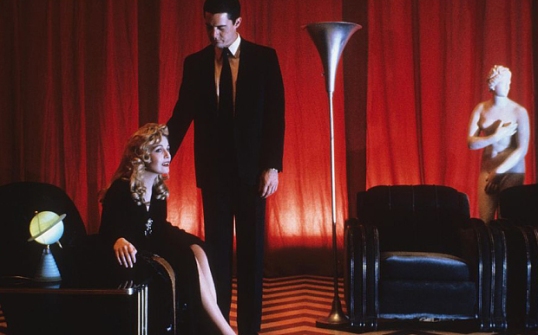
Things do get off to a somewhat shaky start with a nearly 20-minute prologue that basically plays like a prequel to the prequel. Theresa Banks, who was mentioned in the show’s pilot, has been murdered and FBI director Gordon Cole (David Lynch) assigns agents Chester Desmond (Chris Isaak) and Sam Stanley (Kiefer Sutherland) to investigate. Chester and Sam’s investigation basically amounts to a quick reenactment of the first season of Twin Peaks, with the agents discovering that Theresa was involved in drugs and prostitution. When Chester vanishes, Dale Cooper is sent to investigate. Harry Dean Stanton shows up as the manager of a trailer park and David Bowie has an odd cameo as a Southern-accented FBI agent who has just returned from the Black Lodge but otherwise, the start of the film almost feels like a satire of Lynch’s style.
But then, finally, we hear the familiar theme music and the “Welcome to Twin Peaks” sign appears.
“And the angel’s wouldn’t help you. Because they’ve all gone away.”
— Laura Palmer (Sheryl Lee), Twin Peaks: Fire Walk With Me (1992)
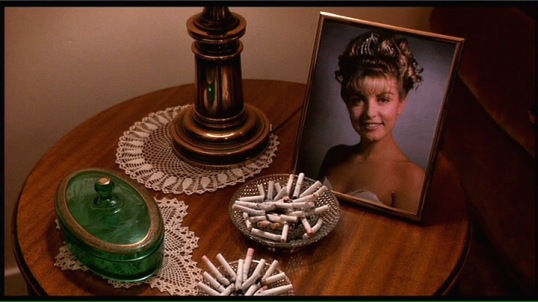
A year has passed since Theresa Banks was murdered. The rest of the film deals with the final few days of the life of doomed homecoming queen Laura Palmer. Laura smiles in public but cries in private. She is full of secrets that she feels that she has to hide from a town that has literally idolized her. She has visions of terrifying men creeping through her life and each day, she doesn’t know whether it will be BOB or her father waiting for her at home. She knows that the world considers her to be beautiful but she also know that, within human nature, there is a desire to both conquer and destroy beauty. When she sleeps, she has disturbing dreams that she cannot understand but that she knows are important. At a time when everyone says she should be happy to alive, all she can think about is death. Everywhere she goes, the male gaze follows and everything that should be liberating just feels her leaving more trapped. For all the complaints that Twin Peaks: Fire Walk With Me is somehow too strange to be understood, it’s not a strange film at all. This is David Lynch at his most straight forward. Anyone who thinks that Laura’s story is incomprehensible has never been a 17 year-old girl.
This is the bleakest of all of David Lynch’s films. There is none of broad humor or intentional camp that distinguished the TV show. After the show’s occasionally cartoonish second season, the film served as a trip into the heart of the darkness that was always beating right underneath the surface of Twin Peaks. It’s interesting how few of the show’s regulars actually show up in Twin Peaks: Fire Walk With Me. None of the characters who represented goodness are present. There’s no Doc Hayward. No Sheriff Truman. No Deputies Andy or Hawk. No Pete Martell. No Bookhouse Boys. Scenes were filmed for some of them but they didn’t make it into the final cut because their tone did not fit with the story that Lynch was seeking to tell. The Hornes, Dr. Jacoby, Josie, none of them are present either.
Instead, there’s just Larua and her father. As much as they try to deny it, Laura knows that she is going to die and Leland knows that he is going to kill her. Killer BOB and the denziens of the Black Lodge may be scary but what’s truly terrifying is the sight of a girl living in fear of her own father. Is Leland possessed by BOB or is BOB simply his way of excusing his own actions? If not for Leland’s sickness, would BOB even exist? When Laura shouts, “Who are you!?” at the spirit of BOB, she speaks for every victim of abuse who is still struggling to understand why it happened. For all the talk of the Black Lodge and all the surreal moments, the horror of this film is very much the horror of reality. Leland’s abuse of Laura is not terrifying because Leland is possessed by BOB. It’s terrifying because Leland is her father
David Lynch directs the film as if it where a living nightmare. This is especially evident in scenes like the one where, at the dinner table, Leland switches from being kindly to abusive while Laura recoils in fear and her mother (Grace Zabriskie) begs Leland to stop. It’s a hard scene to watch and yet, it’s a scene that is so brilliantly acted and directed that you can’t look away. As brilliant as Ray Wise and Grace Zabriskie are, it’s Sheryl Lee who (rightly) dominates the scene and the rest of the film, giving a bravely vulnerable and emotionally raw performance. In Reflections, Sheryl Lee speaks candidly about the difficulty of letting go of Laura after filming had been completed. She became Laura and gave a performance that anchors this absolutely terrifying film.
“Mr. Lynch’s taste for brain-dead grotesque has lost its novelty.”
— Janet Maslin
“It’s not the worst movie ever made; it just seems to be”
— Vincent Canby
If you need proof that critics routinely don’t know what they’re talking about, just go read some of the original reviews of Twin Peaks: Fire Walk With Me.
And yet, having just rewatched the show and now the movie, I can understand why critics and audiences were baffled by this film. This is not Twin Peaks the TV show. There is no light to be found here. There is no comic relief. (Even Bobby Briggs, who had become something of a goofy anti-hero by the time the series ended, is seen here shooting a man in the head.) There is no exit and there is no hope. In the end, the film’s only comfort comes from knowing that Laura was able to save one person before dying. It’s not easy to watch but, at the same time, it’s almost impossible to look away. The film ends on Laura’s spirit smiling and, for the first time, the smile feels real. Even if she’s now trapped in the Black Lodge, she’s still free from her father.
Since this was a prequel, it didn’t offer up any answers to the questions that were left up in the air by the show’s 2nd season finale. Fortunately, those questions will be answered (or, then again, they may not be) when the third season premieres on Showtime on May 21st.
I’ve been reviewing film on this site for over four years now and one theme that I find myself returning to, time-after-time, is that I love movies that serve as time capsules. I love movies that were made specifically to capitalize on specific trends, culture, and fashion. Many people dismiss these films as being dated but that’s precisely why I enjoy them. I just love seeing how the world once looked and how life was once lived.
The 1984 film Suburbia definitely falls into that category. Produced by the legendary Roger Corman and directed by documentary filmmaker Penelope Spheeris, Suburbia tells the tale of The Rejected, a group of teenage runaways and other outcasts who, having both rejected and been rejected from conventional society, now illegally live in an abandoned house in the middle of the suburbs. The film focuses on two runaways — Sheila (Jennifer Clay), who was abused by her father, and Evan (Bill Coyne), who is fleeing an alcoholic mother. Both of them — along with yet another runaway named Joe Schmoe (Wade Waltson) — are invited to live in the “T.R. House” by the group’s leader, Jack Diddley (Chris Pedersen), on the condition that all three of them allow themselves to be branded with the letters “T.R.” In short, when you’re rejected, you’re rejected for life.
Eventually, all three of them settle into life at the house. Joe and Sheila start a tentative relationship. Evan brings his younger brother Ethan (Andrew Pece) to the house. They spend their days frightening their conventional, middle class neighbors and being harassed by a group who, rather ominously, refer to themselves as “Citizens Against Crime.” When they need food, they either steal it or they rummage through other people’s garbage. Jack’s stepfather, a cop named Bill (Donald Allen), drops by the house and tells them that they need to leave before someone tries to make them leave. The Rejected, however, refuse to forced out. It all leads to both violence and tragedy…
What makes Suburbia an interesting film (even for someone like me, who would probably be spit at by the residents of the T.R. House) is that Spheeris is both clearly on the side of the Rejected but, at the same time, she also makes no attempt to idealize them. The film does not shy away from showing that the residents of the T.R. House are, for the most part, angry, violent, and self-destructive. However, Spheeris suggests that, in a society that continually tries to co-opt and neuter all forms of rebellion, the Rejected don’t have much of a choice but to continually go to the next extreme. She finds a humanity and a beauty in their often hopeless existence because, even if they are doomed, at least they’re going to be doomed on their own terms.
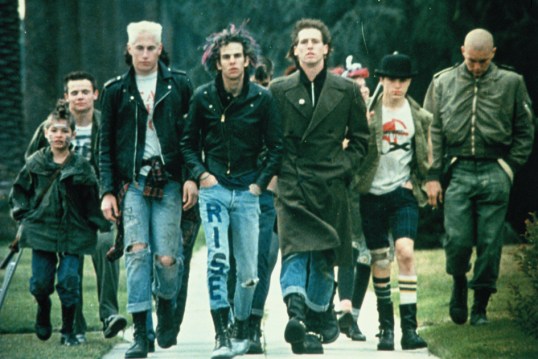
Spheeris filled the film with non-actors and local Los Angeles musicians (A very young Flea plays one of the residents of the house) and, as a result, Suburbia features some of the most wooden performances and awkward line readings that I have ever seen or heard. But, what the cast lacks in acting ability, they make up for with the right attitude and the right look. And you can see that in perhaps the film’s best and most iconic scene, the infamous punk parade.


 Through the Shattered Lens