Musical Film Review: National Lampoon’s Lemmings (directed by Michael Keady)


“Welcome to the Woodchuck Music Festival, three days of peace, love, and death.”

Your emcee is a bearded John Belushi and, in between warning the audience about spiked drugs and encouraging the people climbing the sound tower to jump off from the high spot possible, he introduces several musical acts.  Christopher Guest appears as Bob Dylan, repeatedly walking to and then retreating from the stage until Belushi produces enough money to convince him to perform a song called Positively Wall Street.  Introduced as the ultimate “bummer” by Belushi, Joan Baez (Rhonda Coullet) comes out on stage with a baby and rambles about her imprisoned husband David (whose hunger strike was so successful that he and the inmates of Cell Block 11 have all starved to death) before singing a protest song with a title that I can’t repeat.  Joe Cocker (Belushi) sings while shaking on stage.  James Taylor (Christopher Guest) attempts to perform but his band (including Belushi and Chevy Chase) are too zoned out on heroin to play their instruments.  The owner of Yasser’s Farm (played by Christopher Guest) comes out to praise everyone in the audience who has already died.  Finally, a heavy metal group called Megadeath (no, not that Megadeth!) come out on stage and turn up their amplifiers so loud that the entire audience dies at the end of their song.

An Off-Broadway production that premiered in 1973 and ran for over 300 performance, National Lampoon’s Lemmings has achieved legendary status amongst comedy nerds.  It’s rare that you read any history of Saturday Night Live, Second City, or This Is Spinal Tap without coming across a reference to Lemmings.  Along with satirizing Woodstock and the 60s counterculture in a way that probably few would have the guts to do today, the production features Belushi, Chase, and Guest before any of them became (however briefly) stars.  Fortunately, HBO — which started broadcasting a year before the premiere of Lemmings — filmed one of the stage shows.

Viewed today, Lemmings still carries a strong satiric bite.  Though Lemmings was clearly a 70s production, much of its humor still feels relevant today.  The vapid political posturing, the greed disguised as altruism, the audience blindly following their idols, there was little in Lemmings that one can’t see today just by spending a few minutes on social media.  Beyond the humor, though, Lemmings is a chance to see Belushi, Chase, and Guest as youngish men who had their entire lives ahead of them.  Chase is surprisingly likable, playing up his goofy physical comedy.  Guest disappears into each role that he plays, with his impersonation of Dylan being the clear highlight.  That said, Belushi is the clear star of the show, delivering the most absurd of lines with an engaging sincerity.  As I watched Lemmings, it was hard not to wonder what type of roles John Belushi would be playing today.  Would he still be doing comedy?  Would he have faded away?  Or, like Bill Murray (or, for that matter, Jim Belushi), would he now be appearing in a mix of comedic and serious roles?

We’ll never know.  But we’ll always have his performance as Joe Cocker.

Great Moments In Television History #39: The Wolverines


50 years ago tonight, the first episode of Saturday Night Live opened with Michael O’Donoghue giving a language lesson to John Belushi.

Previous Moments In Television History:

  1. Planet of the Apes The TV Series
  2. Lonely Water
  3. Ghostwatch Traumatizes The UK
  4. Frasier Meets The Candidate
  5. The Autons Terrify The UK
  6. Freedom’s Last Stand
  7. Bing Crosby and David Bowie Share A Duet
  8. Apaches Traumatizes the UK
  9. Doctor Who Begins Its 100th Serial
  10. First Night 2013 With Jamie Kennedy
  11. Elvis Sings With Sinatra
  12. NBC Airs Their First Football Game
  13. The A-Team Premieres
  14. The Birth of Dr. Johnny Fever
  15. The Second NFL Pro Bowl Is Broadcast
  16. Maude Flanders Gets Hit By A T-Shirt Cannon
  17. Charles Rocket Nearly Ends SNL
  18. Frank Sinatra Wins An Oscar
  19. CHiPs Skates With The Stars
  20. Eisenhower In Color
  21. The Origin of Spider-Man
  22. Steve Martin’s Saturday Night Live Holiday Wish List
  23. Barnabas Collins Is Freed From His Coffin
  24. Siskel and Ebert Recommend Horror Films
  25. Vincent Price Meets The Muppets
  26. Siskel and Ebert Discuss Horror
  27. The Final Scene of Dark Shadows
  28. The WKRP Turkey Drop
  29. Barney Pops On National TV
  30. The Greatest American Hero Premieres
  31. Rodney Dangerfield On The Tonight Show
  32. The Doors Are Open
  33. The Thighmaster Commercial Premieres
  34. The Hosts of Real People Say “Get High On Yourself”
  35. The 33rd NFL Championship Game Is Broadcast In Color
  36. The Sopranos Premieres on HBO
  37. Eisenhower Hosts The First Televised Press Conference
  38. The Twilight Zone Premieres On CBS

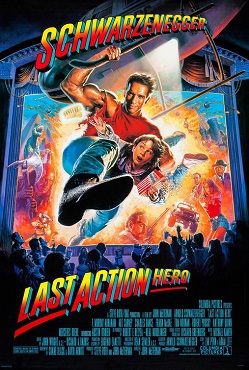
Guilty Pleasure No. 84: Last Action Hero (dir by John McTiernan)


Oh, Last Action Hero.

Ever since this film was first released in 1993, it’s usually held up as an example of a Hollywood fiasco.  The script was originally written to be a modest satire of action films.  The screenwriters wrote the character of Jack Slater, an movie action hero who comes into the real world, for Dolph Lundgren.  Instead, the film became an Arnold Schwarzenegger extravaganza and the studio ended up tossing a ton of money at it.  When the film was originally released, the reviews were mixed and the box office was considered to be disappointing.  (That it went up against the first Jurassic Park was definitely an underrated issue when it came to the box office.)  Ever since then, The Last Action Hero has had a reputation for being a bad film.

Well, I don’t care.  I like The Last Action Hero.  Yes, it’s a bit overproduced for a comedy.  (It breaks my own rule about how no comedy should run longer than two hours.)  Yes, it gets a bit sentimental with ten year-old Danny Madigan (Austin O’Brien) using a magic, golden ticket to enter the film world of his hero, Jack Slater.  If you want to argue that the film should have devoted more time to and gone a bit deeper into contrasting the film world with the real world, I won’t disagree with you.  But I will also say that Sylvester Stallone starring as The Terminator in Jack’s world was actually a pretty funny sight gag.  Danny knowing better than to trust a character played by F. Murray Abraham made me laugh.  Danny’s fantasy in which Arnold Schwarzenegger played Hamlet was made all the better by the fact that his teacher was played by Laurence Olivier’s wife, Joan Plowright.   Danny DeVito as Whiskers the Cartoon Cat makes me laugh as well, even if it is perhaps a bit too bizarre of a joke for this particular film.  (There’s nothing else about the Jack Slater films that would explain the presence of a cartoon cat.)

When you set aside the idea of the Last Action Hero being a symbol of Hollywood bloat and just watch it as a film, it emerges as an enjoyably goofy action movie, one that captures the joy of watching movies (because who hasn’t wanted to enter a movie’s world at some point in their life), and also one that features a rather charming performance from Arnold Schwarzenegger.  (Schwarzenegger, I should add, plays both himself and Jack Slater.  One of my favorite jokes is when the real Schwarzenegger is at a premiere and he mistakes the evil Ripper for Tom Noonan, the actor who played him in the previous Jack Slater film.)  Yeah, the golden ticket is a little bit hokey but who cares?  Underneath all of the special effects and action and money spent on star salaries, Last Action Hero is an action movie and comedy with a heart.  Danny meets his hero but also gets to become a hero himself.  And Jack Slater turns out to be everything you would hope your movie hero would be.  In the end, it’s obvious that a lot of the criticism of this film has more to do with the appeal of riding the bandwagon as opposed to what actually happens on screen.

Last Action Hero is a movie that I’ll happily defend.

Previous Guilty Pleasures

  1. Half-Baked
  2. Save The Last Dance
  3. Every Rose Has Its Thorns
  4. The Jeremy Kyle Show
  5. Invasion USA
  6. The Golden Child
  7. Final Destination 2
  8. Paparazzi
  9. The Principal
  10. The Substitute
  11. Terror In The Family
  12. Pandorum
  13. Lambada
  14. Fear
  15. Cocktail
  16. Keep Off The Grass
  17. Girls, Girls, Girls
  18. Class
  19. Tart
  20. King Kong vs. Godzilla
  21. Hawk the Slayer
  22. Battle Beyond the Stars
  23. Meridian
  24. Walk of Shame
  25. From Justin To Kelly
  26. Project Greenlight
  27. Sex Decoy: Love Stings
  28. Swimfan
  29. On the Line
  30. Wolfen
  31. Hail Caesar!
  32. It’s So Cold In The D
  33. In the Mix
  34. Healed By Grace
  35. Valley of the Dolls
  36. The Legend of Billie Jean
  37. Death Wish
  38. Shipping Wars
  39. Ghost Whisperer
  40. Parking Wars
  41. The Dead Are After Me
  42. Harper’s Island
  43. The Resurrection of Gavin Stone
  44. Paranormal State
  45. Utopia
  46. Bar Rescue
  47. The Powers of Matthew Star
  48. Spiker
  49. Heavenly Bodies
  50. Maid in Manhattan
  51. Rage and Honor
  52. Saved By The Bell 3. 21 “No Hope With Dope”
  53. Happy Gilmore
  54. Solarbabies
  55. The Dawn of Correction
  56. Once You Understand
  57. The Voyeurs 
  58. Robot Jox
  59. Teen Wolf
  60. The Running Man
  61. Double Dragon
  62. Backtrack
  63. Julie and Jack
  64. Karate Warrior
  65. Invaders From Mars
  66. Cloverfield
  67. Aerobicide 
  68. Blood Harvest
  69. Shocking Dark
  70. Face The Truth
  71. Submerged
  72. The Canyons
  73. Days of Thunder
  74. Van Helsing
  75. The Night Comes for Us
  76. Code of Silence
  77. Captain Ron
  78. Armageddon
  79. Kate’s Secret
  80. Point Break
  81. The Replacements
  82. The Shadow
  83. Meteor

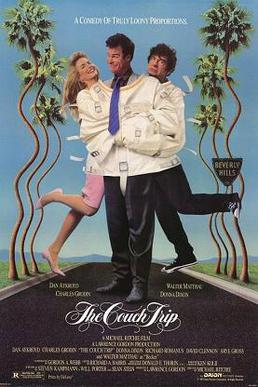
The Couch Trip (1988, directed by Michael Ritchie)


When renowned radio psychiatrist George Matlin (Charles Grodin) has a nervous breakdown, he takes a trip to Europe with his wife (Mary Gross) to both recover and also work on his marriage.  (Matlin’s breakdown was the result of an extramarital affair.)  Needing someone to host Dr. Matlin’s radio show, his producers call Dr. Lawrence Baird (David Clennon), who oversees a mental facility in Chicago.  They assume that Dr. Baird is just dumb enough that they won’t have to worry about him overshadowing Dr. Matlin while he’s guest-hosting.  However, when they call, Dr. Baird is out of his office and the phone is answered by John Burns (Dan Aykroyd), a con artist who has been pretending to be insane so that he can avoid serving time in prison.  Pretending to be Baird, Burns accepts their offer and then escapes from the asylum and heads to Beverly Hills.  The real Dr. Baird, not knowing about the offer, goes on vacation in Europe.  Though Burns had originally only been planning on doing the radio job long enough to get paid enough money to head to Mexico, he soon becomes a celebrity with his non-nonsense, blunt advice.

There’s a lot of talented people in The Couch Trip, including Walter Matthau as a former priest-turned-kleptomaniac and Aykryod’s wife, Donna Dixon, as Matlin’s colleague and Burns’s eventual love interest.  Director Michael Ritchie was responsible for some of the best films of the 70s and radio psychiatry is certainly a ripe subject for satire.  Why, then does, The Couch Trip fall flat?  Some of it is because the movie never seems to know if it wants to be wacky farce or a dramedy about a criminal who finds a new life helping people.  The other big problem is that the talented Dan Aykroyd is miscast as the type of unapologetic smartass that Bill Murray could play in his sleep.  (In a version where Murray played John Burns, Aykroyd would have been perfect casting as George Matlin.)

Aykroyd was one of the most talented members of the original Not Ready For Prime Time Players.  (His impersonations of Nixon and Jimmy Carter were second-to-none.)  Sadly, Hollywood has never figured out what to do with his off-center talent.  The Couch Trip is a prime example of that.


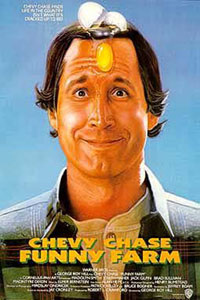
Funny Farm (1988, directed by George Roy Hill)


Andy Farmer (Chevy Chase) is a New York sports writer who leaves the city and moves to the small town of Rosebud, Vermont so that he can work on his novel.  He and his wife, Elizabeth (Madolyn Smith), struggle to adjust to living in a small town.  The delivery of their furniture is delayed by the collapse of a covered bridge.  When they try to make a phone call from inside their own house, the local operator tells them to deposit ten cents.  They were expecting a Norman Rockwell-type town and instead, they find themselves having to pay for the funeral of a man who was buried on their property long before they moved in.  When Elizabeth makes more progress writing a children’s book than Andy does with his heist novel, their marriage starts to feel the strain.

Chevy Chase is now so much better known for the stories of his unprofessional and diva-like behavior on film and television sets that it’s easy to forget that he was, at his peak, a very funny actor.  Chase may be playing a variation of his put-upon everyman but, compared to the first two Vacation movies, most of the humor in Funny Farm is very mild.  George Roy Hill was a classy director who had been making movies since the 50s and Funny Farm feels like a throwback to the type of family-friendly comedies that Disney would make in the 60s.  That I laughed as much as I did was largely due to Chase’s performance.  Whether he was tripping over a Dutch door, reacting to his wife’s dislike of the first few chapters of his new novel, or offering to pay the townspeople $50 to pretend to be nice for a weekend, Chase was consistently funny and even likable.  I don’t know if this is the type of performance that Chevy Chase could give today.  There’s a bitterness that’s now integral to screen persona and it’s made him into someone who audience want to laugh at instead of with.  It’s too bad because Funny Farm is a reminder of the type of comedic actor that Chevy Chase used to be and who he probably still could be if not for the failed talk show and the infamous Friar’s Club roast.

As for Funny Farm, it’s an amusing and likable comedy and it still holds up well today.  Chase is the key to the film’s success but he’s not the only reason that the film works.  I liked the scene where Mike Starr and Glenn Plummer, as the two movers, watch as the bridge they tried to drive over collapses.  I even liked the running joke about the two ducks who refused to leave the Farmers’s property.  Funny Farm may not have been a hit when it was first released but it’s since built up a cult following.  There will always be a place for a funny comedy that leaves you in a good mood.

Funny Money (2006, directed by Leslie Greif)


Henry Perkins (Chevy Chase), the most boring man alive, has a job making wax fruit while his wife (Penelope Ann Miller) wants to make a living through drawing naked men.  (I guess that’s fair considering how many men make their living by drawing naked women.)  On Henry’s birthday, Henry spots a briefcase just like his and decides to swap them.  At home, Henry discovers that his new briefcase contains five million dollars!

Henry wants to move to Europe immediately.  But every time he and his wife try to leave their home, something occurs.  A menacing cop (Armanda Assante) shows up.  Henry’s friends drop by to celebrate his birthday.  The Romanian mob makes an appearance, looking for their money.  All Henry and his wife want to do is steal the money but instead, they spend a night dealing with false identities, physical comedy, and slapstick humor.

Funny Money was based on a stage play and it seems like the sort of thing that would have been hilarious if viewed live, with everyone running on and off the stage and some genuine suspense about who was going to show up next.  It does not translate well to film.  This would have been a good vehicle for Chase in the 80s or even the 90s but, by the time the movie was made, Chase seemed old and tired.  Penelope Ann Miller is never convincing as Chase’s wife.  (Someone should have tried to reunite Chase with Beverly D’Angelo or even Goldie Hawn for this movie.)  The main problem is that the supporting characters are never as funny or as quick-on-their-feet as the film needs them to be.  Armand Assante doesn’t seem to know he’s in a comedy.  Even a reliable actor like Christopher McDonald is let down by the film’s script and direction.  That’s too bad because the material had potential.  While it’s not a disaster like Cops and Robbersons, Funny Money is still never funny enough.

Caddyshack II (1988, directed by Allan Arkush)


Welcome back to Bushwood Country Club!  The Gopher is still stealing balls and burrowing through the course.  Ty Webb (Chevy Chase) is still the majority shareholder of the club, even though he now only plays golf inside of his mansion.  And that’s it!

Only the Gopher and Chevy Chase returned for Caddyshack II.  Ted Knight died before the movie went into production.  Bill Murray didn’t want to recreate his role from the first movie.  Rodney Dangerfield was involved in developing the movie but then dropped out after two million had already been spent in pre-production.  Chevy Chase was paid seven figures to return and he later called it one of the biggest mistakes of his career.  Only the Gopher didn’t complain.

With hardly anyone from the first film willing to come back for a second round, Caddyshack II features comedian Jackie Mason as Jack Hartounian, a real estate developer whose daughter, Kate (Jessica Lundy), wants to be a part of the WASPy Bushwood social set.  When Chandler Young (Robert Stack) keeps the plain-spoken Jack from being given a membership, Jack teams up with his old friend Ty and buys Bushwood.  He turns Bushwood into an amusement park called Jackie’s Wacky Golf.  Kate tells Jack that he’s ruined everything and turned Bushwood into Coney Island.  Chandler hires survivalist Tom Everett (Dan Aykroyd) to kill Jack and then agrees to play Jack in a round of golf.  The winner wins Bushwood.

A bust with both audiences and critics, Caddyshack II is one of the worst sequels ever made.  Why would you do a sequel to Caddyshack that features almost nothing that made the first film so entertaining?  Jackie Mason was a great comedian and writer but he wasn’t much of an actor and he makes a poor replacement for Rodney Dangerfield.  The film really loses me when Chandler Young literally pays money to have Jackie murdered.  It’s just a step too far.  Not even Ted Knight tried to kill Rodney Dangerfield and Dangerfield was a lot more obnoxious than Jackie Mason ever was.  Not even the dancing Gopher can generate much laughs and Kate’s right.  Jackie’s Wacky Golf really is a terrible place.

There are some interesting actors and actresses in the supporting cast.  The lovely Dyan Cannon plays Jack’s love interest and is one of the few good things about the movie, despite having no chemistry with Mason.  Randy Quaid gives a manic performance as Jack’s lawyer, a role that was originally meant for Sam Kinison.  Jonathan Silverman is the good caddy who falls for Jack’s daughter while Chynna Phillips is Chandler’s snobby daughter who befriends Kate and tells her she should change her last name to Hart.  Dan Aykroyd delivers all of his lines in a high-pitched voice that isn’t funny but which becomes very annoying.

The slobs win again.  The snobs are defeated and the Gopher dances with noticeably less enthusiasm.  There has never been a Caddyshack 3.

Caddyshack (1980, directed by Harold Ramis)


Whenever I think about Caddyshack, which is one of the funniest moves ever made, I think first of the Gopher, burrowing across the course and dancing to the music.

I then think about Bill Murray, playing the demented groundskeeper and growing his own special grass that you can both play golf on and smoke afterwards.

I remember Rodney Dangerfield dancing on the green while Ted Knight throws a fit.  This was the first film that I ever saw Rodney Dangerfield in.  “It looks good on you, though,” was one of those simple lines that Rodney could turn into a classic.

I remember Ted Knight, appearing in one of his few film roles, and saying, “Well, we’re waiting!” and drawing out every single word.

I remember the scene in the pool.  You know which one I’m talking about.

I remember Chevy Chase, back when he was still funny.

Then I remember how Rodney Dangerfield’s classic last line, “We’re all going to get laid,” was changed to “We’re all going to take a shower!” for television.  Why the censors thought that sounded less dirty than the original, I’ll never know.

I remember the Bishop getting struck by lightning while playing the best game of his life.

And, of course, I remember Cindy Morgan as Lacy Underall.

I remember so many classic moments and funny lines that I’m always surprised when I rewatch the movie and discover that it’s not really about the Gopher, Bill Murray, Rodney Dangerfield, Chevy Chase, or even Lacy Underall.  Instead, the main character in the movie is Danny Noonan (Michael O’Keefe), a teenage caddy at Bushwood Country Club who wants to win a scholarship so he can go to college and avoid having to work in the lumber yard with his father (Albert Salmi).  Danny has a friendly rivalry with caddy Tony D’Annuzio (Scott Colomby) and is dating Maggie (Sarah Holcomb).  Danny has to decide whether to ally himself with the snobs (led by Ted Knight) or the slobs (led by Rodney Dangerfield).

Caddyshack was originally envisioned as being Danny’s story but, once filming started, Harold Ramis (making his directorial debut) realized that the comedic characters were actually more interesting.  The movie went from being a straight-forward coming-of-age story to an almost plotless collection of gags and jokes, with both Bill Murray and Rodney Dangerfield improvising the majority of their dialogue and the Gopher emerging as the film’s true star.  That was bad news for the younger actors playing the caddies, who all found their roles greatly reduced in the film’s final cut but that was good news for audiences.  Caddyshack may not have much of a narrative structure but it does have some of the funniest people who ever lived at the peak of their powers.

Despite a legendarily troubled production, Caddyshack was a huge success with audiences and eventually, the critics came around as well.  Harold Ramis always said that he had a hard time watching it because all he could see were the mistakes that he made.  All audiences could see, though, was a hilariously funny movie that continues to bring people joy to this day.

Cops and Robbersons (1994, directed by Michael Ritchie)


Chevy Chase is Norman Robberson, a hen-pecked suburban dad who likes to watch cop shows.  When he is informed that his next door neighbor, Horace Obsborn (Robert Davi), is suspected of being a Mafia hitman, he agrees to allow Detectives Jake Stone (Jack Palance) and Tony Moore (David Barry Gray) to use his house as their stakeout location.

Cops and Robbersons is just as terrible as its title.  Norman is basically Clark Griswold without the excuse of a vacation or the holidays to explain away his stupidity.  Jack Palance growls and looks annoyed but without the same comedic flair that he brought to City Slickers.  Dianne Wiest is wasted as Norman’s wife.  Of course, Norman’s daughter develops a crush on Tony while Norman’s son dressed up like Dracula and tries to put the bite on Stone.  Norman keeps getting in the way of the two cops and trying to conduct an investigation on his own.  There has to be an easier way to capture a hitman.  The only thing that really works is Robert Davi’s performance as the hitman.  Davi doesn’t try to be funny, which actually brings out the best in Chase whenever they share a scene.  Chase’s goofy dad shtick works best when he’s dealing with someone who isn’t trying to score laughs of his own.

How did the great Michael Ritchie end up directing movies like this?  Whoever let that happen should be ashamed.


Memoirs of an Invisible Man (1992, directed by John Carpenter)


An accident at a laboratory renders stock analyst Nick Holloway (Chevy Chase) invisible.  CIA agent David Jenkins (Sam Neill) wants to recruit Nick to be an assassin but Nick doesn’t want to kill people.  He just wants to make his date with Alice (Daryl Hannah).  With Jenkins and his agents in pursuit, Nick flees to a beach house belonging to his friend George (Michael McKean) and tries to figure out what to do with his life now that no one can see him.  Fortunately, Alice is staying at the beach house too.  Nick and Alice fall in love but Jenkins is close behind.

Based on a science fiction novel by H.F. Saint, Memoirs of an Invisible Man started out as a vanity project for Chevy Chase, who felt that the film’s mix of comedy and drama would establish him as a serious actor.  The project went through a series of directors, including Ivan Reitman and Richard Donner, but in the end no one wanted to work with the special effects necessary to create the impression of invisibility and, even more importantly, no one wanted to work with Chase.  When the film was finally offered to John Carpenter, he was reluctant to do another studio film because of his bad experience with They Live.  He finally agreed because it had been four years since his last film.

The special effects in Memoirs of an Invisible Man are still impressive and the chase scenes show off Carpenter’s abilities as an action director.  The movie flopped with critics and audiences but that was not Carpenter’s fault.  Carpenter keeps the story moving and gets good performances out of Sam Neill and even Daryl Hannah.  The problem with the movie is that Chevy Chase is miscast as an action hero and he tries too hard to give a serious performance.  Carpenter later said he wanted to add more comedy to the film and to emphasize Chase’s talent for physical comedy but Chase refused to do so.  Chase also resented wearing the blue bodysuit that would be used to render him invisible onscreen and often removed the suit early, ruining whatever else Carpenter had planned to shoot during the day.  You can add John Carpenter to the long list of directors who have said they will never work with Chevy Chase again.

One good thing did come out of Memoirs of an Invisible Man.  Carpenter met and enjoyed working with Sam Neill.  (Memoirs of an Invisible Man probably would have worked better in Neill and Chase had switched roles.)  Neill would go on to star in Carpenter’s next film, In The Mouth of Madness.