Masters of the Universe (1987, directed by Gary Goddard)


On the distant planet Eternia, the evil Skeletor (Frank Langella) has finally taken over Castle Grayskull and imprisoned the Sorceress (Christina Pickles).  When He-Man (Dolph Lundgren) and his allies Teela (Chelsea Field), Man-At-Arms (Jon Cypher), and Gwildor (Billy Barty) launch a rescue mission, they find themselves overwhelmed by Skeletor’s forces and are forced to use an interdimensional key to escape.

He-Man and his friends end up in 1980s California.  The key is lost in the process and discovered by two teenagers, one of whom is played by a pre-Friends Courteney Cox.  Skeletor sends Evil-Lyn (Meg Foster), Beast Man (Tony Carroll), and a host of other henchmen after the key.

The first (and, as of this writing, only) live action film to be based on the famous Mattel action figures, Masters of the Universe was produced by Cannon and it should have been a lot better than it actually was.  The idea of He-Man and Skeletor in modern-day California was a good one and it’s easy to imagine scenes of He-Man and Skeletor wandering around downtown Los Angeles and being as shocked by the locals as the locals are by them.  Big, blonde Dolph Lundgren seemed like the ideal pick for the role of He-Man.  Best of all, from the perspective of many, is that there was no Orko.  The most annoying member of the He-Man ensemble was left out of the film.  (Billy Barty’s Gwildor may have sometimes been annoying but he was still better than Orko.)

Unfortunately, the movie did not live up to anyone’s expectations.  Taking more inspiration for Star Wars and Conan than from any of the He-Man mythology, Cannon’s version of Masters of the Universe is a generic action movie in which He-Man is reduced to being just another forthright hero with a sword.  (He’s not Prince Adam in this movie.  He’s just He-Man.)   Teela doesn’t even wear her famous costume.  The main problem with Masters of the Universe is that so few of the Masters actually appear in the movie.  This was a Cannon/Mattel co-production but apparently, Mattel was stingy when it came to delivering their half of the budget.  There wasn’t enough money to bring He-Man’s rogue’s gallery (not to mention the majority of his allies) to life.  The means no Trap-Jaw and no Mer-Man.  Not even Ram Man makes the cut and this movie could have really used Ram Man.

Fortunately, Skeletor and Evil-Lyn are present to pick up the slack.  (When it came to the Masters of the Universe franchise as a whole, the villains were always more entertaining than the heroes.)  With the help of a surprisingly convincing makeup job that give him a skull face, Frank Langella appears to be having the time of his life as the evil Skeletor and I wasn’t surprised to recently read that this was one of Langella’s favorite roles.  Langella seems to having a blast playing such a thoroughly evil and cartoonish character and his scenes have a playful energy that the rest of the film is lacking.  Meg Foster, she of the piercing eyes, is the perfect choice for Evil-Lyn and is magnetically evil.  They provide some of the most entertaining villainy since Max von Sydow announced, “Klytus, I’m bored,” at the start of Flash Gordon.

Masters of the Universe was a critical failure when it was released in 1987, which isn’t a surprise.  A film based on a toy line and a children’s cartoon?  Maybe that would be an Oscar nominee today but, in 1987, there was no way the critics were going to go for it.  But Masters of the Universe was also a box office failure, one of many high-profile Cannon films that failed to score when it was first released.  (It did find a cult following when it was released on video.)  A proposed sequel — in which Lundgren would be replaced as He-Man by surfer Laird Hamilton — was abandoned.  The sets that had been built for Masters of the Universe 2 were instead used for Cyborg, starring Jean-Claude Van Damme.

A new live action Masters of the Universe film is scheduled to be released in 2026.  Jared Leto will be playing Skeletor.  That is probably all that needs to be said.


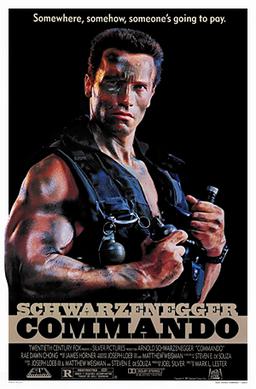
Commando (1985, directed by Mark L. Lester)


John Matrix (Arnold Schwarzenegger) is a former colonel in the U.S. Amy Special Forces.  He was one of the best at what he did but he’s now retired from all that and lives in the mountains of California with his young daughter, Jenny (Alyssa Milano).  When Capt Bennett (Vernon Wells), Martix’s former comrade-in-arms, kidnaps Jenny, Matrix is told that he has 11 hours to assassinate the leader of the country of Val Verde so that General Arius (Dan Hedaya) can launch a coup.  Knowing that the bad guys are planning on killing both him and Jenny no matter what he does, Matrix instead takes out Arius’s men as he makes his way to where Jenny is being held captive.

Commando is one of my favorite Schwarzenegger films.  It has some of the best one-liners (“I like you, Sully, I kill you last,”), some of the best character actors (Sully is played by David Patrick Kelly), and also one of Schwarzenegger’s best performances.  In Commando, Schwarzenegger shows that he’s willing to poke fun at himself, which was something that set him apart from many of the action heroes of the 80s.  (Stallone eventually learned how to poke fun at himself but it took a very long time.)  At his California home, Matrix chops down and carries a tree without breaking a sweat.  During a chase through a mall, Matrix easily lifts up a phone booth.  Matrix may be trying to save the life of his daughter but he still takes the time to come up with one-liners and fall in love with flight attendant Cindy (Rae Dawn Chong).  Commando is essentially just a big comic book brought to life and Schwarzenegger understands that and gives a very knowing, self-aware performance.  Director Mark Lester wastes no time getting to the action and the result is one of the most entertaining action films of the 80s.

Believe it or not, Commando was originally envisioned as being a Gene Simmons picture.  When the KISS frontman turned down the film, the script was rewritten for Arnold Schwarzenegger.  Schwarzenegger made this film after The Terminator and it was another box office success.  As for Gene Simmons, he would have to wait for Runaway to make his action debut.

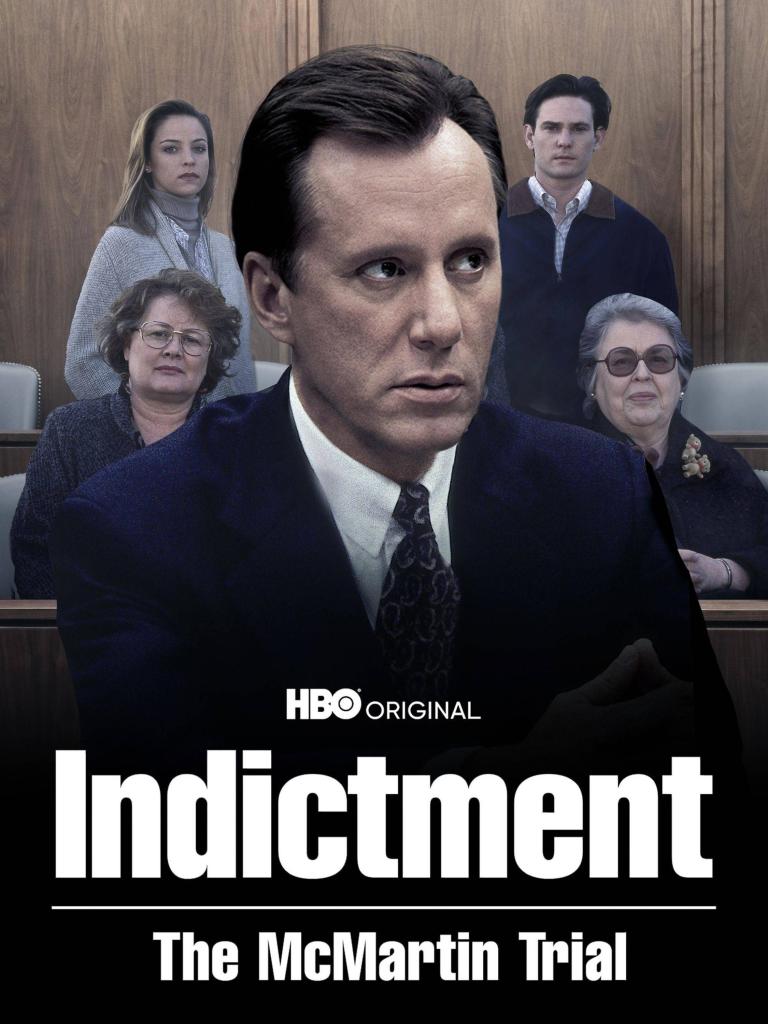
INDICTMENT: THE MCMARTIN TRIAL (1995)


Actor James Woods is great at portraying attorneys. Whether it be as the real life Assistant D.A. Bob Tanenbaum in the excellent T.V. Movie BADGE OF THE ASSASSIN (1985), the crusading hippie Eddie Dodd in TRUE BELIEVER (1989) or the namesake of the excellent TV series SHARK (2006-2008), Woods knows how to play that unique combination of intelligence, shrewdness, and sneakiness to perfection. In 1995, he further applied those skills when he portrayed real life attorney Danny Davis in the HBO movie INDICTMENT: THE MCMARTIN TRIAL. This movie is based on the McMartin day care sexual abuse case that began with horrific allegations in 1983 and ended in 1990 with zero convictions and all charges dropped. During that time, the McMartin Trial became the longest and most expensive series of criminal trials in American history. 

I’ll just go ahead and challenge any person to watch INDICTMENT: THE MCMARTIN TRIAL and not get filled with righteous anger about the complete failure of our judicial system. Add to that failure the complete breakdown of our media to cover events in a fair and impartial fashion with even the smallest shred of objectivity. Does any of this sound familiar? As good as James Woods is in the central role, the star of this film is the true story itself. We watch as various people in positions of authority and power act completely out of self interest, including Davis himself at first, with the pursuit of the truth or justice not even the slightest consideration no matter what the evidence suggests. In actuality, the truth was hidden by the prosecution in pursuit of convictions that never came. The shit that this family was put through with coerced evidence that had no chance of standing up to the slightest bit of scrutiny is disgraceful. It’s one of the most infuriating films I’ve ever seen and it’s just as relevant in 2025 as it was in 1995. The performances are spot on, beginning with Woods’ central performance as Danny Davis and moving on to Shirley Knight in a Golden Globe winning portrayal of Peggy McMartin Buckey, Mercedes Ruehl as prosecutor Lael Rubin, Lolita Davidovich as child therapist Kee MacFarlane, Sada Thompson as matriarch Virginia McMartin, and Henry Thomas as the odd but innocent Ray Buckey. Produced by Oliver Stone and directed by Mick Jackson (THE BODYGUARD, VOLCANO), this button pushing, thought provoking film would win both the Primetime Emmy and Golden Globe awards for best Made for Television Movie in 1995. It’s truly an excellent film and should be seen by any person interested in a fair judicial system or unbiased media.

14 Days of Paranoia #2: Extreme Justice (dir by Mark L. Lester)


What type of justice?

Extreme justice, y’all!

In this 1993 film, Lou Diamond Phillips stars as Jeff Powers.  Who is Jeff Powers?  He’s a cop!  He wants to keep the street safe!  Sometimes, he knows that you have to be willing to break the rules!  He’s a cop who does things his way!

Okay, is that enough exclamation points?  I’m not just using them to be obnoxious.  The film is pretty much just one big exclamation point.  The action is hyperintense and the film is full of characters who always seem like they’re just one step away from exploding.  No one in this film is particularly calm or laid back.  From the start, everything is dialed to eleven and it just keeps going higher and higher.

After Jeff is put on probation for roughing up a suspect, he receives an invitation to join an elite squad of detective.  Led by the charismatic Detective Dan Vaughn (Scott Glenn, giving a performance that is so over-the-top that he yells straight at the camera at one point), the Special Investigative Section is the best of the bed.  Upon joining, Jeff finds himself a member of a sacred fraternity of law enforcers.  Working with men like the always amused Detective Larson (Yaphet Kotto) and the somewhat paranoid Angel (Andrew Divoff), Jeff finds himself tracking some of the biggest criminals in the city.

What Jeff also discovers is that SIS does more than just arrest criminals.  The SIS has been given an unofficial license to kill and they end up executing as many people as they take to jail.  Often times, Vaughn will tells the men to allow a crime to be committed so that they can then dispense their own brand of justice.  In the film’s most disturbing scene, the members of SIS wait until after a woman has been raped in an alley before they move to neutralize her attackers.  When Jeff finally decides that he can’t be a part of all this and tries to reveal what’s going on, he discovers that the SIS has some support in some very high places.  Who cares if the SIS is allowing crimes to be committed or if an innocent person occasionally gets caught in the crossfire?  At least they’re taking care of the criminals!

Extreme Justice is a crude and energetic film and one that is based on some of the stories that spread about the LAPD’s RAMPART division in the 90s.  That the film works is a testament to the performances of Phillips, Kotto, and Glenn and also the direction of Mark L. Lester.  An exploitation vet who occassionally made big studio action films as well, Lester keeps the pace moving at breakneck speed and, even more importantly, he allows both sides to have their say.  While Jeff is upset about SIS’s methods, Detective Vaughn is correct when he says that his unit is targeting the worst of the worst.  It makes for an unusually intelligent exploitation film, one that leaves the audience with a lot to consider.  How far would you go to keep your neighborhood safe?

Previous entries in 2025’s 14 Days Of Paranoia:

  1. The Fourth Wall (1969)

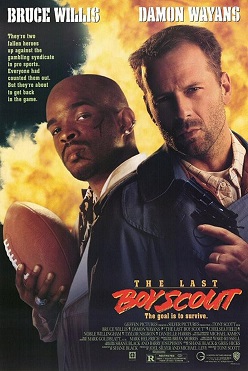
Holiday Film Review: The Last Boy Scout (dir by Tony Scott)


My God, what a violent holiday season!

Like the majority of the films that have been written and/or directed by Shane Black, The Last Boy Scout takes place in December.  It’s not quite as Christmas-y as some of Black’s other films.  I think that I may have spotted a few decorations in the background of some of the scenes.  And there’s a scene where private investigator Joe Hallenbeck (Bruce Willis) discovers that his daughter (played by a very young Danielle Harris) has been drawing pictures of “Satan Claus.”  Otherwise, there’s not a lot of Christmas to be found in this December-set film and perhaps that’s for the best.  Seriously, this movie is violent!  Not even the comedic relief characters are safe from getting a bullet to the head.  This is a film that actually begins with a football player shooting three other players during a game and then saying, “Ain’t life a bitch,” before shooting himself in the head.

The film’s plot isn’t always easy to follow.  Joe is a private investigator who drinks too much and whose partner has just been blown up in front of his house.  (His partner was also sleeping with Joe’s wife so guess who is now a suspect!)  Joe is also hired to act as a bodyguard for a stripper named Cory (Halle Berry).  Cory is dating Jimmy Dix (Damon Wayans), a former quarterback who used to be Joe’s hero.  Then Jimmy got kicked out of the league for gambling and Joe stopped watching football.  Cory says that she has a tape recording that will get Joe back into the NFL.  But then, Cory is brutally gunned down in the middle of the street and the tape is accidentally destroyed by Joe’s crappy tape player.  It’s time for Jimmy and Joe to team up, trade one liners, and uncover the conspiracy.

It all links back to the efforts of football team owner Shelley Marcuse (Noble Willingham) to legalize gambling.  Senator Calvin Baynard (Chelcie Ross) is standing in Marcuse’s way because Marcuse didn’t offer him a big enough bribe.  Marcuse is planning to assassinate the senator and he’s going to frame Joe for the crime because, in an amazing coincidence, Joe used to be a secret service agent until he caught Senator Baynard torturing a sex worker.  Of course, the actual assassination will be carried out by Marcuse’s chief henchman, Milo (Taylor Negron, who is absolutely chilling in the role).  Milo rarely shows emotion and always refers to everyone by their formal name.  (Joe is called Joseph.  Jimmy is called James.)  Milo is also a total sociopath, one who will shoot anyone in the head without a second thought.

Shane Black, who is a genius regardless of what I may think of this particular film, has said that he wrote The Last Boy Scout after he broke up with a longtime girlfriend and he was suffering from depression.  Disillusionment hangs over almost every frame of the movie.  Joe did the right thing and lost his career.  Jimmy lost his family on the same night that he played the best game of his career.  The Senator is opposed to Marcuse’s scheme solely because he’s not getting enough of a cut.  Marcuse is a respected businessman who thinks little of killing strangers.  Jimmy and Joe are heroes not because they’re particularly good but because everyone else around them is just so bad.  This is also very much a movie about guys doing guy things.  I watched it with my brother-in-law and I have to say that I think he got a bit more out of the film than I did.  Then again, I also think my sister Megan also got more out of it than I did so maybe I just wasn’t in the mood to watch so many people get shot in the head.  It happens.

The Last Boy Scout was directed by Tony Scott so, no matter what else you might want to say about it, the movie looks great.  Willis seems a bit bored with the film and Wayans sometimes struggles with the more dramatic moments.  In many ways, the film feels like a precursor to Shane Black’s The New Guys, though Willis and Wayans never have the same chemistry as Russell Crowe and Ryan Gosling did in that underrated film.  However, The Last Boy Scout’s action moves quickly and the screen is always full of neon lights.  It’s a well-made action movie though, unlike Lethal Weapon, Die Hard, and The Nice Guys, it’s not one that really sticks around in your head after the end credits roll.  Personally, I think it needed a little more holiday spirit.

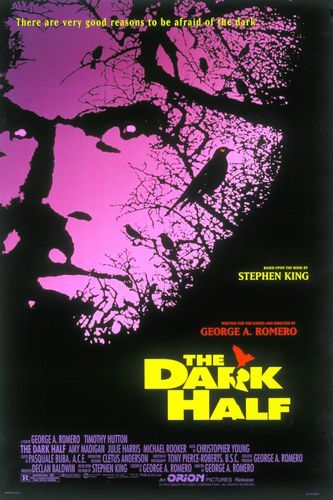
Horror Film Review: The Dark Half (dir by George Romero)


It will always fascinate me that Stephen King, one of the most popular writers in the world and one of the legitimate masters of horror, also has one of the least inspiring accounts on twitter.

Seriously, he may be the most popular author in the world but he tweets like a retiree who has just discovered the internet.  Go over to his twitter account and you won’t find memorable descriptions of small town hypocrisy.  You won’t find scenes of shocking psychological insight.  You won’t find moments of unexpected but laugh-out-loud dark humor.  Instead, you’ll find a combination of dad jokes, boomer nostalgia, and an unseemly obsession with wishing death on any public figure who is to the right of Bernie Sanders.  It’s odd because no one can deny that King’s a good storyteller.  At his best, Stephen King is responsible for some of the best horror novels ever written.  Everyone who is a horror fan owes him a debt of gratitude for the work that he’s done promoting the genre.  At his worst, he’s your uncle who retweets the article without reading it first.

Of course, someone can be great at one thing an terrible at something else.  I can dance but I certainly can’t sing.  Stephen King can write a best seller but a good tweet is beyond him.  That’s the dual nature of existence, I suppose.  That’s certainly one of the themes at the heart of both Stephen King’s The Dark Half and the subsequent film adaptation from George Romero.

Filmed in 1990 but not released for three years due to the bankruptcy of the studio that produced it, The Dark Half tells the story of Thad Beaumont and George Stark (both played by Timothy Hutton).  Thad is a professor who writes “serious” literature under his real name and violent, pulpy fiction under the name of George Stark.  No one reads Thad’s books but they love George Stark and his stories about the master criminal and assassin, Alexis Machine.  (Alexis Machine?  George Stark may be a good writer but he sucks at coming up with names.)  After a demented fan (played, with creepy intensity, by Robert Joy) attempts to blackmail him by threatening to reveal that he’s George Stark, Thad decides to go public on his own.  His agent even arranges for a fake funeral so that Thad can bury George once and for all.

Soon, however, Thad’s associates are turning up dead.  It seems as if everyone associated with the funeral is now being targeted.  Sheriff Alan Pangborn (Michael Rooker) suspects that Thad is the murderer.  However, the murderer is actually George Stark, who has come to life and is seeking revenge.  Of course, George has more problems than just being buried.  His body is decaying and he’s got a bunch of angry sparrows after him.  The Sparrows Are Flying Again, we’re told over and over.  Seeking to cure his affliction and to get those birds to leave him alone, Stark targets Thad’s wife (Amy Madigan) and their children.

The Dark Half has its moments, as I think we would expect of any film based on a Stephen King novel and directed by George Stark.  Some of the deaths are memorably nasty.  Hutton is believably neurotic as Thad and cartoonishly evil as Stark and, in both cases, it works well.  Rooker may be an unconventional pick for the role but he does a good job as Pangborn and Amy Madigan brings some unexpected energy to the thankless role of being the threatened wife.

But, in the end, The Dark Half never really seems to live up to its potential.  In the book, Thad was a recovering alcoholic and it was obvious that George Stark was a metaphor for Thad’s addiction.  That element is largely abandoned in the movie and, as a result, George goes from being the literal representation of Thad’s demons to just being another overly loquacious movie serial killer.  Despite having a few creepy scenes, the film itself is never as disturbing as it should be.  For all the blood, the horror still feels a bit watered down.  Take away the sparrows and this could just as easily be a straight-forward action film where the hero has to rescue his family from a smug kidnapper.  Comparing this film to Romero’s Martin is all the proof you need that Romero was best-served by working outside the mainstream than by trying to be a part of it.

Add to that, I got sick of the sparrows.  Yes, both the film and the book explain why the sparrows are important but “The Sparrows Are Flying Again” almost sounds like something you’d find in something written in a deliberate attempt to parody King’s style.  It’s a phrase that’s intriguingly enigmatic the first time that you hear it, annoying the third time, and boring the fifth time.

The Dark Half was a bit of a disappointment but that’s okay.  For King fans, there will always be Carrie.  (I would probably watch The Shining but apparently, King still hasn’t forgiven Stanley Kubrick for improving on the novel.)  And, for us Romero fans, we’ll always have Night of the Living Dead, Martin, Dawn of the Dead, and the original Crazies.  And, for fans of George Stark, I’m sure someone else will pick up the story of Alexis Machine.  It’s hard to keep a good character down.

A Movie A Day #270: Prison (1987, directed by Renny Harlin)


In 1964, the state of Wyoming executed Charles Forsythe (Viggo Mortensen) for killing another inmate at Creedmore State Prison.  Forsythe was innocent of the crime but the only other two people who knew, a prisoner named Cresus (Lincoln Kilpatrick) and a guard named Eaton Sharpe (Lane Smith), kept silent.  Twenty-three years later, Cresus is still an inmate and Sharpe has been named the new warden of Creedmore.  When a group of prisoner open up the old execution chamber, Forsythe’s electrified spirit escapes into the prison and starts to kill the prisoners and the guards, one-by-one.  A convict named Burke (also played by Mortensen) understands what is going on but can he get anyone to believe him?
If the idea of an executed murderer turning into an electrified spirit sounds familiar, that’s because the exact same idea was used in Destroyer, The Horror Show, and Wes Craven’s Shocker, all of which went into production and were released at roughly the same time.  Why did the late 80s see so many director making movies about convicts coming back to life after being sent to the electric chair?  We may never know.

Of the four electric ghosts movies, Prison is the best.  Lane Smith is a great villain and Prison makes good use of its claustrophobic setting.  Since Charlie is stalking inmates instead of horny teenagers, there literally is no way for anyone to escape him.  (It never makes sense, though, why Charlie is killing “innocent” prisoners when Sharpe, who hates all of this prisoners, is the one that Charlie is targeting for revenge.)  The best scenes are the ones where the warden desperately tries to force the inmates to confess to the murders so he won’t have to confront the truth about Charlie’s revenge.  Lane Smith, who would later be best known for playing Richard Nixon in The Final Days, acts the hell out of those scenes.

Prison was the first American film to be directed by Finnish director Renny Harlin and it is a hundred times better than many of the overproduced action films that Harlin would later be best known for.  Of course, it’s no Die Hard 2 but I would gladly watch Prison over Cutthroat Island.

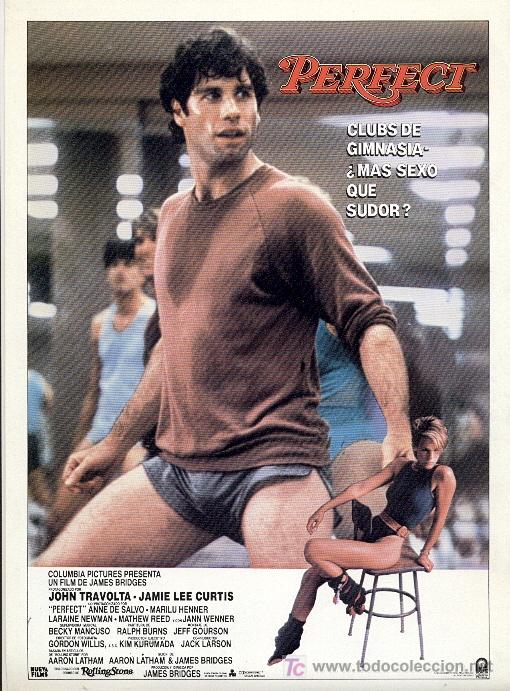
Embracing the Melodrama Part II #74: Perfect (dir by James Bridges)


PerfectOkay,before reviewing the 1985 film Perfect, I have three things to say.

Number one, I nearly captioned the picture above “John Travolta, Jamie Lee Curtis, and Little Xenu.”  And then I laughed and laughed.  But, in the end, I resisted temptation because I’m an adult now.

Number two, Perfect came out in June in 1985, a few months before I was born.  As a result, I have no idea what the 1985 reviews looked like.  However, it still seems to me that you’re taking a big risk when you give a movie a title like Perfect, especially when the movie itself is far from perfect.  How many reviews opened with, “Perfect fails to live up to its name…”

And finally, as a result of seeing both this film and Staying Alive, I have to say, “What the Hell, John Travolta?”  Seriously, what the Hell was going on?  John Travolta gave a great performance in the 1970s, with Saturday Night Fever.  And then in the 1990s, he was good in Pulp Fiction, Get Shorty, Face/Off, Primary Colors, and a few others.  (For our purposes here, we shall pretend that Battlefield Earth never happened.)  Even though most of Travolta’s recent films have been forgettable, his performances have generally been adequate.

So, seriously, John — what was going on in the 80s?  Because judging from both Perfect and Staying Alive, John Travolta apparently totally forgot how to act during that decade.  When I reviewed Staying Alive, I said that Travolta’s performance managed to create a whole new definition of bad.  But he’s actually even worse in Perfect.  It helped, of course, that in Staying Alive, Travolta’s character was supposed to be stupid.  In Perfect, on the other hand, he’s actually supposed to be a brilliant reporter.

Or, at the very least, he’s supposed to be brilliant by the standards of Rolling Stone.  Travolta plays Adam Lawrence, an award-winning reporter for Rolling Stone.  The magazine, by the way, plays itself and so does its publisher, Jann Wenner (though his character is technically named Mark Roth).  What’s interesting is that the film itself doesn’t necessarily paint a flattering picture of Rolling Stone or Jann Wenner, though admittedly a lot of that is due to the fact that Wenner himself gives a performance that is even worse than Travolta’s.  It’s impossible to watch Perfect without thinking about the fact that Adam is writing for the same magazine that would eventually put Dzokhar Tsarnaev on the cover and publish the UVA rape story.

Anyway, if I seem to avoiding talking about the exact plot of Perfect, that’s because there’s not really much of a plot to describe.  Adam, a hard-hitting investigative journalist, is doing research on a story about how people are hooking up at gyms.  Wenner agrees.  “We haven’t done L.A. in a while!” he says.  Adams joins the a gym called the Sports Connection, which he is soon calling “The Sports Erection” because he’s a super clever reporter.  He falls in love with an aerobics instructor, who is played by Jamie Lee Curtis.  She doesn’t trust reporters but is eventually won over by Travolta’s … well, who knows?  Mostly she’s won over because the plot needs some conflict.  She gets on Adam’s computer and she types, “Want to fuck?”  Adam says sure but then tries too hard to dig into the dark secret from her past.  “You’re a sphincter muscle!” she shouts as him.  Adam writes a compassionate and balanced article about the Sports Connection.  Wenner edits the article and turn it into a sordid hit piece.  (And again, you wonder why Wenner agreed to play himself.)  Feelings are hurt, issues are resolved, and eventually everyone takes an aerobics class.

Honestly, the entire movie is mostly just a collection of scenes of Jamie Lee Curtis and John Travolta working out.  And, in all fairness, Curtis does about as well as anyone could in this terrible film.  Travolta, on the other had … well, just check out the scene below and maybe you’ll understand why I had a hard time concentrating on Travolta’s acting.

Perfect fails to live up to its name.