Pale Rider (dir. by Clint Eastwood)


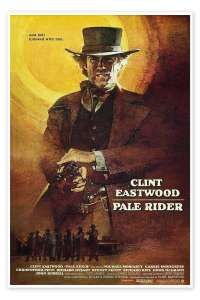
We continue the Shattered Lens’ celebration of Clint Eastwood with 1985’s Pale Rider, one of my favorites. This was a film my long time friend Jay shared with me many years ago, as he owns most of Eastwood’s library of films. I like to think of it as a softer version of Eastwood’s own High Plains Drifter, which my father loved, but I couldn’t really get. It’s a tale of vengeance, but wrapped more in miracles. 

You should first know that Westerns aren’t really my genre when it comes to film types I often watch. I don’t have a lot of historical background when it comes to Westerns overall. If you asked for a short list of my favorites, I’d give up Rustler’s Rhapsody (it’s a fun comedy), The Good, The Bad & The Ugly (my Dad watched it often), Blazing Saddles, and in terms of books, the first few books of Stephen King’s The Dark Tower. I only recently watched Shaneafter Logan was first released, and I love the Red Dead Redemption games.

Pale Rider takes place in California around the time of the gold rush. Outside the town of LaHood, named after the wicked Coy LaHood (Richard Dysart, The Thing), we have a group of miners settled in that are hoping to strike it rich. It’s somewhat difficult with LaHood’s henchmen trying to drive them out at every turn, to steal the land. Hull Barrett (Michael Moriarty, Q The Winged Serpent) hopes to be successful, living with his fiancé Sarah (Carrie Snodgress, The Fury) and her daughter, Meghan (Sydney Penny, The Wife He Met Online). The most recent attack from LaHood’s men has shattered the miners’ morale and few are spared. Even Meghan’s dog is killed, causing her to wish for a miracle.

When LaHood’s son, Josh (Chris Penn, True Romance) and some other baddies (including The Thing‘s Charles Callahan, reuniting with Dysart) confront Hull, a stranger steps in. He handles them all easily with an axe handle, and as thanks, Hull welcomes him to the Miners area for room and board. Of course, having a stranger brings up all sorts of questions from the townsfolk, who don’t appear to be too trusting. Is he an outlaw, possibly? Even Meghan’s a little apprehensive at first, with her quote from Revelations 6:8 forshadowing the Pale Rider’s presence. Everyone is put at ease when they find our stranger is actually a Preacher, though Hull is still a bit curious about the six bullet sized scars on the man’s back. Can the Preacher help the Miners keep their land and stop LaHood? 

From a casting standpoint, Pale Rider is damn near perfect. Although Eastwood is the main star in his own film, he comes across more as an accessory for everyone else in scenes. Moriarty does most of the heavy lifting, as does Snodgress and Penny. Their characters are all easily likable and the supporting cast (particularly Doug McGrath’s Spider) shine in their parts. Dysart’s LaHood is a dark character and there’s a wonderful verbal conflict between him and Eastwood in one scene that’s just sweet to watch to see who loses their cool first. 

Pale Rider is both pretty simple and well executed from a story standpoint. It bears some similarities to Eastwood’s other film, High Plains Drifter. Though the town isn’t painted in red, there are allusions to the idea that the Preacher may be something of.a specter or ghost of vengeance. We’re not given any kind of full story as to why the Preacher’s here. We are shown that both The Preacher and LaHood’s Marshall, Stockburn (John Russell, The Outlaw Josey Wales) share a history, but that’s it. The story, like the Preacher and the events around him, moves in mysterious ways. 

What I love the most about Pale Rider is the way the Preacher changes the minds (and hearts) of those around him. The miners learn to fend for themselves. His enemies are often in shock over what he does (and at least one flips from bad to good). It kind of reminds me of Wild West version of John Wick or Nobody, with a character whose reputation precedes him. 

Bruce Surtees was the Cinematographer for Pale Rider, who also worked on a number of Eastwood’s earlier films, including The Outlaw Josey Wales and Play Misty for Me. Pale Rider has some beautiful landscape shots of the West (as the film was filmed in Idaho). Despite all the well lit shots, there are still moments where faces are obscured by the brim of a hat or the contrasts in a candlelit room. 

The story isn’t without some dark areas or some odd moments. A dog is killed, and there’s a scene where Meghan is nearly raped, but there’s some intervention before things can get out of hand. Both instances help to show how dark the villains are in the overall tale. Both Sarah and Meghan seem to take their own shine to The Preacher, one already in a relationship and the other too young for what she’s asking for, but I took it to just be that their both a bit mesmerized by the Preacher’s presence in different ways. 

Overall, Pale Rider is a wonderful offering by Eastwood, with fine performances by everyone involved. The Preacher does what he can to make things better around him with a peaceful approach. When push comes to shove, however, the guns come out blazing. 
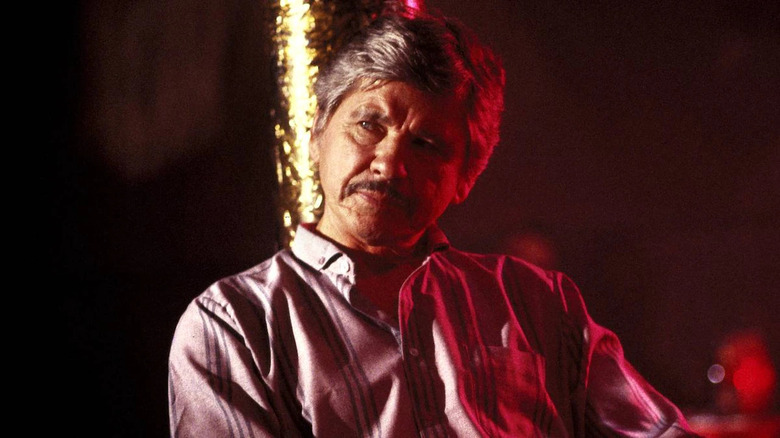
MURPHY’S LAW – Don’t F#&k with Jack Murphy!


I became obsessed with actor Charles Bronson in 1986 after receiving a VHS copy of DEATH WISH 3 as a Christmas present. Going along with that obsession was my desire to see every Charles Bronson movie that had ever been made. As much as I enjoyed re-watching DEATH WISH 3, it was always a treat when I could rent a different Bronson film at the video store. The current Bronson movie at the video store in 1987 that appealed to me as a 13 year old boy was MURPHY’S LAW, so I wanted to rent it as often as possible. There were even a couple of times when different friends asked me to spend the night, and I had one requirement for saying yes… that we rent MURPHY’S LAW! Y’all, don’t think too bad of me for this admission. Remember, I was only 13 years old, I couldn’t drive, and I didn’t have a job so if I had to use a friend’s mom to get my Bronson fix, that’s just what I had to do! Based on the timing of my initial Bronson obsession, DEATH WISH 3 and MURPHY’S LAW are 1-2 in the films that I’ve watched the most times during my life.

In MURPHY’S LAW, Charles Bronson plays Jack Murphy, a tough cop who seems to be experiencing a series of unfortunate events:

  1. A thief named Arabella McGee (Kathleen Wilhoite) tries to steal Murphy’s car and drives it through the window of a pizzaria. We know that’s his car because he loudly proclaims, “That’s MY car!!” He even wastes money on a sack of groceries by throwing it at his car while she’s driving away. He’s able to chase her down on foot, but she kicks him in the testicles and runs off leaving him doubled over in pain, grocery-less, and clutching the family jewels!
  2. A mafia kingpin named Frank Vincenzo (Richard Romanus) wants to kill him because Murphy was forced to shoot and kill the kingpin’s brother. We know the cop and the kingpin don’t like each other, because a little before the shooting they have a slight disagreement in front of the mafioso’s mother over whether the brother is a scum-sucking pimp or a talent agent. Unable to resolve the debate amicably, the mafioso inquires as to whether or not Jack has ever heard of “Murphy’s Law, if anything can possibly go wrong it will?” Murphy responds with an alternative version of Murphy’s Law, the only law that he knows, and one that I greatly prefer. You get the feeling that this argument may be revisited later in the film.     
  3. Murphy’s now ex-wife Jan (Angel Tompkins) is performing extremely artistic striptease routines at a local club called Madam Tong’s. She’s also making love to the manager of the club. Rather than drinking at home alone until he passes out like most depressed men, Murphy hangs out at Madam Tong’s watching her shake her goodies for a bunch of horny lowlifes, before following them home and watching from outside until they turn off the bedroom lights. Very sad indeed.
  4. And here’s the worst part, on one of those typical nights where he’s obsessively stalking his wife, another mystery woman (Carrie Snodgress) knocks him in the head, shoots the slimy manager and Mrs. Murphy with his gun, and then frames him for their murders. Arrested for the murders and subsequently handcuffed to the thief who tried to steal his car, Murphy must stage a daring helicopter jailbreak in order to find out who framed him and clear his name before everything and everyone he holds dear is taken from him!

There are several reasons that I loved MURPHY’S LAW back in the eighties, and that I still enjoy it now. First, of course, is Charles Bronson. He was around 64 years old when he filmed MURPHY’S LAW, but he’s still in great physical condition in 1986. One of Bronson’s greatest strengths is his screen presence, and he still dominates each frame he’s in. Second, the film has an excellent supporting cast. Carrie Snodgress is having a ball playing the main villain in the film. I’ve seen her in quite a few movies, like PALE RIDER with Clint Eastwood, and 8 SECONDS with Luke Perry, but I’ve never seen her in a role like this. Snodgress was nominated for an Oscar for her role in a 1970 film called DIARY OF A MAD HOUSEWIFE. I’ve never seen that one before, but I should probably check it out! I love Kathleen Wilhoite as Arabella McGee, the thief who ends up handcuffed to Bronson. Her vocabulary, while probably not very realistic for the streets of LA at the time, was hilarious to me as a teenager. I enjoy calling the people I love “snot licking donkey farts” on occasion to this very day. It’s Kathleen Wilhoite singing the title song over the closing credits! And Robert F. Lyons is very special to me in his role as Art Penney, Jack Murphy’s partner. We got to interview him on the THIS WEEK IN CHARLES BRONSON podcast about his roles on DEATH WISH 2, 10 TO MIDNIGHT, and MURPHY’S LAW. He was so generous with his time, and just a hell of a nice guy! I’ve attached a link to the YouTube video of the interview with Mr. Lyons if you’re interested in the great stories he tells us about his time in Hollywood! Finally, MURPHY’S LAW was directed by J. Lee Thompson, my personal favorite director who worked with Bronson. Thompson directed Bronson in 9 different films, beginning with ST. IVES in 1976 and ending with KINJITE: FORBIDDEN SUBJECTS in 1989. No matter the material, you always knew that Thompson would deliver a film with a certain quality that made Bronson look good!

I’ll always be a fan of MURPHY’S LAW, partly for nostalgic reasons, but mainly because I think it’s an entertaining mid-80’s action film for Bronson at a time when he was one of the kings of the video store!

8 SECONDS – Luke Perry channels bull riding phenom Lane Frost


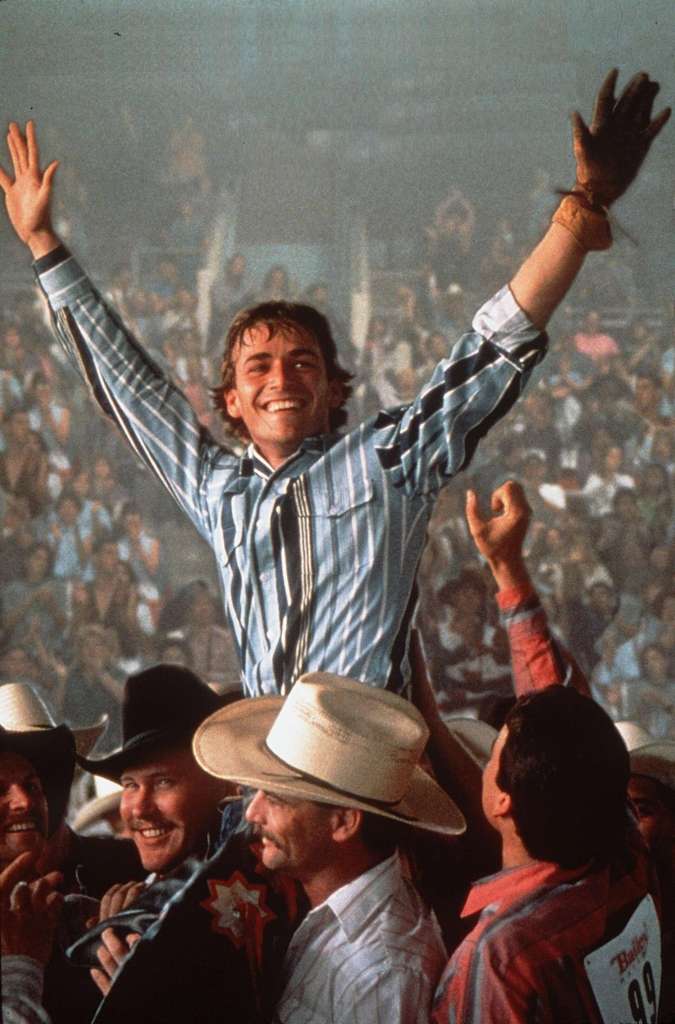
I watched the 1994 film 8 SECONDS today for the first time in close to 30 years. The movie is based on the life of Lane Frost, the world champion bull rider, who tragically died when a bull gored him at the Frontier Days in Cheyenne, Wyoming in 1989 at just 25 years of age. I’ll go ahead and say that I’m about as opposite from a rodeo cowboy as a person can possibly get. I won’t go into all the hows and whys, but I’m actually a little scared of cows and horses. I have my reasons, and I’ll leave it at that. We did attend a rodeo in Cody, Wyoming featuring professional bull riders in the summer of 2023 when we were vacationing in Yellowstone. We enjoyed the evening at the rodeo, but it’s also a brutal sport where professional cowboys were getting thrown off more often than not, and sometimes with some rather serious looking injuries. Even though I’m not a rodeo guy, I do enjoy movies based on real stories and people. The short, but spectacular life of Lane Frost makes for a compelling story.

Our story opens in Oklahoma with a little boy and his dad watching a cattle drive. The boy tells his dad that he isn’t scared of the bulls they are watching. We then see that boy, a young Lane Frost, growing up at the rodeo, first riding sheep and then bulls until he’s being played by Luke Perry. At this point in his life, Lane and his two best friends, Tuff and Cody, are riding the weekend Texas rodeo circuit in towns like Amarillo and Nacogdoches. Lane is a better rider than his buddies, and he’s also great with his young fans. One day Lane notices a beautiful barrel racer named Kellie and asks her to go eat with him. Since they’re in Texas, I enjoyed that he took her to Whataburger. I’ll pause for a quick tangent about why I enjoyed the choice of restaurant for their dinner. Our son grew up in Arkansas on McDonalds as the fast food of choice, but he went to college in Texas. When he first got to East Texas Baptist University, he’d suggest to his buddies on the golf team that they go to Mickey D’s. His buddies, the ones from Texas, would give him hell and say that Whataburger is the ONLY place to go for burgers and fries. His buddies were down right snobbish about it and put down McDonald’s like it was completely second class to the gold standard that is Whataburger. When he told me about it, I just thought it was funny. Tangent over and back to the movie. After this amazing Whataburger experience, we see Lane rising in the rodeo world, while simultaneously romancing and marrying Kellie. From this point forward, the movie settles in with the ups and downs of Frost’s professional life and personal life. We see really high moments like his ascension to world bull riding champion at just 24 years of age, and we see really low moments like their temporary marital separation due to the temptations of being on the road too much. Lane and Kellie eventually reconcile and are in a great place in their relationship when we arrive at that tragic day in Cheyenne. 

There are quite a few things that I like about 8 SECONDS, but the main reason is that I like Luke Perry. When I was in college in the early 90’s, I had a standing date with my girlfriend and her older sister to watch every new episode of BEVERLY HILLS 90210. Like most people, that’s where I first got to know Luke. Couple that with his co-starring role on the 1992 film version of BUFFY THE VAMPIRE SLAYER, with the great Rutger Hauer as the head vampire, and I was a fan for life. Our kids got to know him on the Netflix show RIVERDALE, so it was nice to see them discover him as well. It was a real shame that we lost Luke Perry in March of 2019 at 52 years old. I also like that Lane Frost’s mom in the movie is played by actress Carrie Snodgress. Carrie played the evil villainess Joan Freeman who sliced Charles Bronson’s stomach with an axe in MURPHY’S LAW. It made me happy to see her again as I had forgotten she was even in the movie. It’s also interesting to see a young Renee Zellweger pop up as a tempting “Buckle Bunny” a couple of years before she hit the real big time with JERRY MAGUIRE. I like that John G. Avildsen directed 8 SECONDS. Avildsen has directed classics like ROCKY and THE KARATE KID. This may not rise to those heights, but it has its share of touching and stirring moments, which is a specialty of the veteran director. I’ll admit to a couple of tears when Lane’s often critical dad (veteran actor James Rebhorn) finally tells him that he’s proud of him, something that Lane has been needing to hear for years. Additional misty moments occurred when Lane’s longtime buddy Tuff (Stephen Baldwin) dedicates his own national championship ride to Frost, riding his bull for 16 seconds instead of eight. Finally, I like country music and Vince Gill, McBride & the Ride, and Brooks & Dunn all perform in the movie at different times. The early 90’s were an extremely popular time in country music and it’s fun seeing these stars pop up. 

As I close this review, I wanted to point out one last thing about 8 SECONDS that I really enjoy. The film’s credits last for over 10 minutes and they’re played over pictures and videos of the real life Lane, Kellie, Tuff, Lane’s parents, and others. It’s quite touching as we see the real people and many of the real events that inspired what we had just watched in the movie. It’s quite poignant and brings the movie home in a way that feels genuinely special.

Late Night Retro Television Review: Friday the 13th 1.18 “Brain Drain”


Welcome to Late Night Retro Television Reviews, a new feature where we review some of our favorite and least favorite shows of the past! On Fridays, I will be reviewing Friday the 13th: The Series, a show which ran in syndication from 1987 to 1990. The show can be found on YouTube!

This week, Jack falls in love but, unfortunately, someone is stealing brains.

Episode 1.18 “Brain Drain”

(Dir by Lyndon Chubbuck, originally aired on April 25th, 1988)

Jack, Ryan, and Micki go to the Natural History Museum of Ontario to try to retrieve a trephinator, which is a device that the ancient Greeks apparently used to measure the size of people’s heads.  The belief was that the bigger head someone had, the more intelligent they were.  While at the museum, Jack runs into a former girlfriend, Dr. Viola Rhodes (Carrie Snodgress).  Jack is so happy to run into Viola that he soon seems to forget about the trephinator but instead finds himself planning their upcoming wedding.

(Just to make clear, Micki canceled her engagement so she could spend the next few years of her life tracking down cursed antiques but Jack can apparently just decide to get married out-of-the-blue without it being an issue.)

Well, Jack may have other things on his mind but that trephinator is still out there and it’s dangerous!  It has been incorporated into a chair that allows a formerly developmentally challenged man to steal the brain fluid of others and use it to increase his own intelligence.  Stewart Pangborn (Denis Forest) used to be a test subject but now he’s a scientist.  When he decides that Viola will be his next victim, Jack’s wedding plans are put in danger.

Even after watching this episode, I have no idea what a trephinator is, what it looks like, or how it was incorporated into the big bulky chair that Pangborn used to steal other people’s brain fluids.  Was the trephinator the big needle that would be forcibly inserted into the base of the skulls of Pangborn’s victims?  I don’t know but I do know that the whole point of Friday the 13th was that Chris, Jack, and Micki were searching for cursed antiques.  Overall, it’s helpful to actually be able to look at the screen and say, “Oh, there’s the antique.”

The episode had quite a few flaws, from the bulkiness of the chair to the apparent ease by which Pangborn was able to set himself up as a scientist at the museum.  (Do they not do background checks in Canada?)  The episode’s dialogue had a “It’s only first draft, we’ll think of something better later” quality to it and the performances, even from the usually reliable Denis Forest, felt subpar.  The idea of Jack meeting an ex-girlfriend and falling in love had potential but there was very little chemistry between Chris Wiggins and Carrie Snodgress.  If anything, Jack’s romance reminded the viewers of how strange it was that neither the handsome Ryan nor the beautiful Micki ever seemed to have any amorous admirers.

It was a disappointing episode this week but apparently, next week will feature Ryan joining some sort of Amish death cult.  That sounds promising!

Late Night Retro Television Reviews: Highway To Heaven 1.3 “To Touch The Moon”


Welcome to Late Night Retro Television Reviews, a feature where we review some of our favorite and least favorite shows of the past!  On Thursdays, I will be reviewing Highway to Heaven, which aired on NBC from 1984 to 1989.  The entire show is currently streaming on Tubi and several other services!

This week, Highway to Heaven is determined to make you cry.

Episode 1.3 “To Touch The Moon”

(Dir by Michael Landon, originally aired on September 26th, 1984)

Oh my God, this episode.  Seriously, this episode was a real tear-jerker and a good example of how this show’s earnest and extremely sincere approach could make even the most predictable of stories emotionally effective.

This episode deals with two young boys living in Houston.

Arthur Nealy (Barret Oliver) is the son of a man who flew to the Moon as a part of NASA and then died when the plane that he was flying crashed.  (Before the crash, Arthur’s father got the plane out over the ocean and saved the lives of everyone who was underneath him.)  For most of his short life, Arthur has struggled with Leukemia.  After a year of being in remission, the cancer has returned and, as his doctor (Don Starr) tells his mother (Carrie Snodgress), there is no hope this time.  Arthur’s only wish is to “touch the moon” before he dies.

Tony Rizzo (Tony La Torre) is a tough kid who has been in trouble with the police numerous times and who is on the verge of being kicked out his apartment by his own grandmother (Penny Santon).

Mark and Jonathan meet Tony while the latter is standing on the side of the road and hitchhiking.  Former cop Mark doesn’t want to stop to pick up any hitchhikers.  Jonathan, being an angel who can basically do anything, forces the car to stop anyways.  Jonathan and Mark agree to give Tony a ride but, when they stop off to get breakfast at a diner, Tony promptly steals Mark’s car.  While Jonathan goes off to do angel stuff, Mark pursues Tony.

Eventually, Mark tracks Tony down to his grandmother’s apartment but, when Mark discovers that Tony’s parents abandoned him and that his grandmother doesn’t even want him, Mark doesn’t have the heart to take Tony to the police.  (Awwwww!)  Instead, he takes Tony with him to an address that Jonathan give him earlier.

The address is the Nealy House, where Jonathan shows up to give Arthur a birthday gift and introduces himself as being a friend of Arthur’s father.  (The implication is that Jonathan and Arthur’s father have been conversing in Heaven.)  Arthur asks his mother if Tony can stay with him for a few days.  Arthur’s mother agrees.  When Tony tries to later sneak out of the house, he’s stopped by Jonathan, who reveals that Arthur has cancer and who gets Tony to agree to be Arthur’s friend for a few days.

You can probably guess where this is heading.  Tony and Arthur end up bonding.  Tony lets down his tough exterior.  Arthur says that he wants his mother to adopt Tony after he dies.  One happy family montage later, Arthur collapses in his bedroom and is taken to the hospital where Jonathan visits him in his hospital room and shows him that death is nothing to fear.  Arthur stares out the hospital window and the camera zooms in on the moon, the implication being the Arthur’s spirit is now free to touch the moon.

“Your home, son,” Jonathan says, his voice cracking, “you’re  home.”

I mean, Good Lord!  I’m crying just typing this up!  And really, that’s the best review that I can give you of this episode.  It was heavy-handed and sometimes the performances felt a little awkward but it totally made me cry.  There’s not a hint of cynicism to be found here, nor are there any hints of snarkiness.  There’s just a lot of very honest emotion.

Next week, I assume the show will make me cry again.

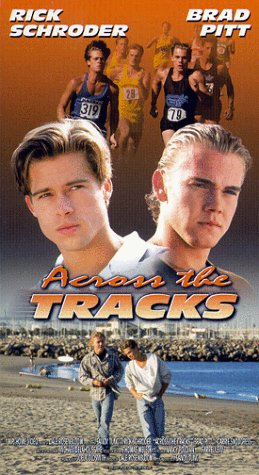
Across the Tracks (1990, directed by Sandy Tung)


Joe Maloney (Brad Pitt) is a senior at a high school in Los Angeles.  He lives with his mother (Carrie Snodgress) in a trailer park, located in a high-crime neighborhood.  Joe has managed to resist giving into all of the temptations around him.  He’s a good students with a clean record and a bright future.  He’s a track star and all he had to do is when the big race at the end of the year and he’ll get a scholarship to Sanford.

Joe’s slightly younger brother, Billy (Rick Schroder) is a different story.  Billy is always getting into trouble and, because he got caught driving a stolen car, he’s spent the last few months in reform school.  Once Billy is released, he returns to the trailer park.  His mother welcomes him with open arms but Joe wants nothing to do with his good-for-nothing brother.  Because Billy has caused too much trouble at his old high school, he’s transferred to a school in a rich district.

Things get even worse when Billy joins Joe for one of his morning runs and he discovers that he’s also a good runner.  Joe suggests that Billy try out for his new school’s track team.  Billy does so and soon, he and Joe are in direct competition.  With the the scholarship to Stanford on the line, who will win the big race?

With the exception of some language that was probably only tossed in to get an R-rating, Across The Tracks feels like an old after school special.  The brothers may not always get along but they learn a lesson.  It’s not really a bad movie but it is a very predictable one and, if you’re watching this to see an early performance from future Oscar-winner Brat Pitt, keep in mind that his role is largely a supporting one.  Rick Schroder is the star of this one and he gives a performance that, like the rest of the film, isn’t really bad but isn’t exactly memorable either.  Across The Tracks was designed to make audiences look at Rick Schroder and say, “He really can act!” but Schroder is miscast as both a juvenile delinquent and a track star.  Ironically, Brad Pitt is more believable as a high school student even though he was 26 when this film was made while Schroder was only 20.

Personally, if I had an older brother and his entire future depended on him beating me in a race, I’d probably let him win.

A Movie A Day #177: Murphy’s Law (1986, directed by J. Lee Thompson)


What is Murphy’s Law?

Let’s ask LAPD Detective Jack Murphy.

“Don’t fuck with Jack Murphy.”

Normally, having a law named after you would be pretty cool but it appears that this is just a law that Jack came up with himself.  Having to come up with your own law is kind of like having to come up with your own nickname.  Dude, it’s just lame.  Since Jack Murphy is played Charles Bronson, we can cut him some slack.

Murphy’s Law was one of the many film that, towards the end of his career, Bronson made for Cannon Films.  He played a detective in almost all of them.  Jack Murphy is Dirty Harry without the fashion sense.  He is also an alcoholic who cannot get over his ex-wife (Angel Tompkins) and her decision to become a stripper.  Not only has Murphy managed to piss off his superiors with his bad attitude but the mob is out to get him.  Everyone has forgotten Murphy’s Law.  Everyone is fucking with Jack Murphy.

Jack’s main problem, though, is Joan Freeman (Carrie Snodgress).  Years ago, Murphy sent Joan to prison for murder but, because it’s California and Jerry Brown appointed all of the judges, Joan gets out after just a few years.  Joan starts to systematically murder everyone that Murphy knows, framing Murphy for the murders.  Murphy’s arrested by his fellow cops, all of whom need a refresher on Murphy’s Law.  Though handcuffed to a young thief (Kathleen Wilhoite), Murphy escapes from jail and set off to remind everyone why you don’t fuck with Jack Murphy.

Murphy’s Law is a typical Cannon Bronson film: low-budget, ludicrously violent, borderline incoherent, so reactionary than it makes the Dirty Harry films look liberal, and, if you’re a fan of Charles Bronson, wildly entertaining.  Bronson was 65 years old when he played Jack Murphy so he cannot be blamed for letting his stunt double do most of the work in this movie.  What’s interesting is that, for once, Bronson is not the one doing most of the killing.  Instead, it is Carrie Snodgress, in the role of Joan Freeman, who gets to murder nearly the entire cast.  There is nothing subtle about Snodgress’s demonic performance, which makes it perfect for a Cannon-era Bronson film.  In fact, Carrie Snodgress gives one of the best villainous performances in the entire Bronson filmography.  There is never any doubt that Snodgress is capable of killing even the mighty Charles Bronson, which makes Murphy’s Law a little more suspenseful than most of the movies that Bronson made in the 80s.

Whatever else can be said about Murphy’s Law, it does feature one of Bronson’s best one liners.  When Joan threatens to send him to Hell, Murphy replies, without missing a beat, “Ladies first.”  Only Bronson could make a line like that sound cool.  That’s Bronson’s Law.

Insomnia File #26: Rabbit Run (dir by Jack Smight)


What’s an Insomnia File? You know how some times you just can’t get any sleep and, at about three in the morning, you’ll find yourself watching whatever you can find on cable? This feature is all about those insomnia-inspired discoveries!

If, at one in the morning on Wednesday, you were suffering from insomnia, you could have turned over to TCM and watched the 1970 film, Rabbit Run.  That’s what I did.

Rabbit Run is the epitome of a dumb lug film.  In a dumb lug film, a male character finds himself living an unfulfilling life but he can’t figure out the reason.  Why can’t he figure it out?  Because he’s a dumb lug, with the emphasis on dumb.  Usually, the viewer is supposed to sympathize with the dumb lug because he doesn’t mean to hurt anyone and everyone else in his world is somehow even more annoying than he is.  Typically, the dumb lug will have an emotionally distant wife who refuses to have sex with him and who is usually portrayed as being somehow at fault for everything bad that has happened in the dumb lug’s face.  (Want to see a more recent dumb lug film than Rabbit Run?  American Beauty.)  Ever since the silent era, there have been dumb lug films.  In particular, male filmmakers and critics seem to love dumb lug films because they allow them to pat themselves on the back for admitting to being dumb while, at the same time, assuring them that everything is the fault of the wife or the girlfriend or the mother or the mother-in-law.

In Rabbit Run, the dumb lug is named Harry Angstrom (James Caan), though most people still remember him as Rabbit, the high school basketball star.  Harry’s life peaked in high school.  Now, he’s 28 and he can’t hold down a job.  He’s married to Janice (Carrie Snodgress), who spends all of her time drinking and watching TV.  He has a son and another baby is on the way.  One day, when the pregnant Janice asks him to go out and get her a pack of cigarettes, Harry responds by getting in his car and driving all the way from Pennsylvania to Virginia.

When he returns to Pennsylvania, Rabbit doesn’t go back to his wife.  Instead, he drops in on his former basketball coach (Jack Albertson) and begs for advice on what he should do.  The coach, it turns out, is more than little creepy.  He also has absolutely no practical advise to give.  He does introduce Rabbit to a part-time prostitute named Ruth (Anjanette Comer).  Rabbit quickly decides that he’s in love with Ruth and soon, he’s moved in with her.

Meanwhile, there’s all sorts of little things going on.  Rabbit gets a job working as a gardener.  Rabbit befriends the local Episcopal minister (Arthur Hill), even while the minister’s cynical wife (Melodie Johnson) tries to tempt Rabbit away from both his wife and his mistress.  Rabbit both resents and envies the sexual freedom of the counter culture, as represented by his younger sister.  And, of course, Janice is pregnant…

Rabbit Run is based on a highly acclaimed novel by John Updike.  I haven’t read the novel so I can’t compare it to the film, beyond pointing out that many great works of literature have been turned into mediocre movies, largely because the director never found a way to visually translate whatever it was that made the book so memorable in the first place.  Rabbit Run was directed by Jack Smight, who takes a rather frantic approach to the material.  Since Rabbit Run is primarily a character study, it needed a director who would be willing to get out of the way and let the actors dominate the film.  Instead, Smight overdirects, as if he was desperately trying to prove that he could keep up with all the other trendy filmmakers.  The whole movie is full of extreme close-ups, abrupt jump cuts, intrusive music, and delusions of ennui.  You find yourself wishing that someone had been willing to grab Smight and shout, “Calm down!”

(On the plus side, as far as the films of 1970 are concerned, Smight’s direction of Rabbit Run still isn’t as bad as Richard Rush’s direction of Gettting Straight.)

James Caan actually gives a likable performance as Rabbit, which is good because Rabbit would be totally unbearable if not played by an actor with at least a little genuine charisma.  There’s nothing subtle about Caan’s performance but he makes it work.  You never like Rabbit but, at the same time, you don’t hate him.

Unfortunately, there’s nothing subtle about the rest of the cast either.  Something rather tragic happens about 80 minutes into the film and, as much as I knew I shouldn’t, I still found myself giggling because Carrie Snodgress’s performance was so bad that it was impossible for me to take any of it seriously.  Even worse is Arthur Hill, as the minister who won’t stop trying to help Rabbit out.  I eventually reached the point where, every time that sanctimonious character started to open his mouth, I found myself hoping someone would hit him over the head and knock him out.  Among the major supporting players, only Anjanette Comer is allowed a chance to be something more than just a sterotype.  Like Caan, she does the best that she can but ultimately. this is James Caan’s movie.

It’s a disappointing movie but it did not put me to sleep.  Give credit for that to James Caan, who is the only reason to see Rabbit Run.

Previous Insomnia Files:

  1. Story of Mankind
  2. Stag
  3. Love Is A Gun
  4. Nina Takes A Lover
  5. Black Ice
  6. Frogs For Snakes
  7. Fair Game
  8. From The Hip
  9. Born Killers
  10. Eye For An Eye
  11. Summer Catch
  12. Beyond the Law
  13. Spring Broke
  14. Promise
  15. George Wallace
  16. Kill The Messenger
  17. The Suburbans
  18. Only The Strong
  19. Great Expectations
  20. Casual Sex?
  21. Truth
  22. Insomina
  23. Death Do Us Part
  24. A Star is Born
  25. The Winning Season


Embracing the Melodrama #46: Wild Things (dir by John McNaughton)


The 1998 film Wild Things starts out like a standard B-movie.  It take place in Florida so, of course, we get a lot of shots of the sun setting on the bayous and crocodiles staring at the camera as if to ask, “What are you looking for?”  Boats skim the water.  High school guidance counselor Sam Lombardo (Matt Dillon) walks across campus while all of the toned and tanned students stop to admire him.  Local rich girl Kelly Von Ryan (Denise Richards) smirks and says something snarky.  Detective Ray Duquette (Kevin Bacon) shows up in the background and stares at the world from behind dark glasses and a serious expression.  Meanwhile, local poor girl Suzie (Neve Campbell) goes back to her home, which happens to be located right behind an alligator farm.

Judging from the first few minutes, Wild Things could just as easily be an episode of CSI Miami.

But then Bill Murray shows up as Kenneth Bowden, a hilariously sleazy attorney who spends most of the movie wearing a neck brace, just in case the insurance company is watching him.

And then Theresa Russell shows up Kelly’s mother, standing on a balcony in a gold bikini and hitting on every passing man like the world’s most hyperactive cougar.

And then Carrie Snodgress shows up as Suzie’s mother, complete with an over-the-top white trash accent.

By the time that Robert Wagner shows up and literally growls at Matt Dillon: “You’re finished, Lombardo!  Finished!,” you realize that Wild Things is probably the most self-aware B-movie ever made and it’s all the better for it.

As for the plot — well, let’s see if I can keep track.  Suzie and Kelly both accuse Sam of rape.  Sam claims to be innocent but nobody in town believes him.  Sam is forced to hire the disreputable Kenneth Bowden to defend him.  During the trial, Kenneth is able to prove that Kelly blamed Sam for the suicide of her father while Suzie is angry that Sam once refused to bail her out of jail on a drug charge.  To get revenge, Kelly and Suzie decided to frame Sam.  Sam is acquitted and, again with Bowden’s help, is able to negotiate an 8 million dollar settlement for defamation.  True, Sam does lose his job but at least he’s a rich man now…

But wait a minute.

The movie still has a little over an hour to go.

Could it be that there’s more to this story?

Well, of course, there is.  It turns out that Sam, Kelly, and Suzie have been working together all the time.  The accusations, the trial, the defamation suit — it was all a part of a grand scheme to get the money.  Sam, Kelly, and Suzie celebrate their success with champagne and a threesome.

While everyone else in town seems to be ready to move on from the entire scandal, Detective Ray Duquette is telling anyone who will listen that he thinks that Sam, Kelly, and Suzie were all in on it together.  Even when Ray is ordered by his superiors to back off, Ray continues to investigate the case.

And why?

Because Ray Duquette is a cop who gets results!

Well, maybe.

Actually, it doesn’t take long to realize that there’s something off about Ray.  For one thing, his obsession with Sam really does seem to be a personal thing.  On top of that, Ray has a past connection with Suzie…

Wild Things has everything that you could hope for from a good exploitation film: a script that is full of double and triple crosses, unapologetically pulpy dialogue, over-the-top performances, and lots of sex.  Yesterday, I reviewed Normal Life and praised John McNaughton’s decision to play up the banality of the film’s characters and locations.  With Wild Things, McNaughton takes the exact opposite approach, playing up every sordid and tawdry detail to such an extent that the film itself eventually transcends such mundane concepts as good and bad.

Wild Things is a lot of fun and it’s also one of the best films of the 1990s.

Wild Things

44 Days of Paranoia #39: The Fury (dir by Brian DePalma)


For our latest entry in the 44 Days of Paranoia, let’s take a look at one of the silliest films ever made, Brian DePalma’s 1978 horror/thriller hybrid The Fury.

The Fury opens on a beach in Israel.  CIA veteran Peter (Kirk Douglas, who grimaces up a storm) is hanging out with his teenage son Robin (Andrew Stevens) and his friend and colleague Ben Childress (John Cassavetes).  Two things quickly become apparent.

First off, Robin has psychic powers.  We know this because Peter is obsessed with protecting him from being captured by a shadowy government agency that wants to use his power as a weapon.

And secondly, Ben is evil.  We know that Ben’s evil because he’s played by John Cassavetes.  As one of the first truly independent filmmakers, Cassavetes would often raise the money to make his fiercely individualistic films by playing villains in bad B-movies, like this one.

Ben, in fact, is so evil that he’s arranged for terrorists to attack the beach.  After Peter is apparently killed in a ludicrously violent gunfight, Ben takes off with Robin.

However, Peter is not dead!  Somehow, despite the fact that both the beach and the ocean were pretty much blown up with him on it, Peter survived and now, he’s looking for his son.  Peter makes his way to Chicago where he calls up his girlfriend, Hester (Carrie Snodgress), and says things like, “I want your body, baby.”

Hester, meanwhile, works at the Paragon Clinic, which is run by Dr. James McKeever (Charles Durning) who, himself, is secretly working for Ben.  The Paragon Clinic is a front to try to discover other teenage psychics and to turn them into weapons as well.  The newest patient is Gillian (Amy Irving), a teenage girl who might be able to help Peter track down his son.

Of course, what Peter doesn’t take into account is that, in his absence, Robin has turned into a power-mad sociopath who spends his time doing things like killing tourists at amusing parks…

Wow, that’s a lot of plot, isn’t it?  And, with all of that, I haven’t even gotten into what happens during the second half of the film!

The Fury is an enjoyably silly film, an awkward attempt to combine DePalma’s previous film, Carrie, with a paranoia-fueled political thriller.  There’s a certain charm to a film that takes itself so seriously and yet, at the same time, manages to be totally over-the-top and ludicrous.

For example, just consider the performances of the high-powered cast and the fact that none of the actors appear to be acting in the same film.  Playing a character who is a bit of a hero by default (because, seriously, how stupid did he have to be to not realize that Ben was evil to begin with), Kirk Douglas grimaces so manfully that Peter’s stupidity almost starts to feel like a satiric comment on hyper-masculinity.  John Cassavetes, on the other hand, is so disdainful of the film that he actually rolls his eyes while delivering some of his more melodramatic lines.  Meanwhile, Carrie Snodgress is forced to say things like, “Here comes the Pony Express!” and Charles Durning brings the full weight of his talent to deliver lines like, “If you’re having your monthlies, I don’t want you near the patient.”

And finally, there’s Amy Irving.  In DePalma’s Carrie, Irving played Sue Snell, the sole survivor of a psychic rampage.  In The Fury, Irving gets to play the psychic and she gives such a dramatic and emotional performance that you almost get the idea that she was trying to challenge Sissy Spacek.  “This is how you play a psychic, Sissy!” she seems to be shouting.  Of course, the big difference is that Carrie was actually a good film whereas The Fury is a bad film that happens to be watchable.

Finally, no review of The Fury is complete without talking about Brian DePalma’s direction.  To put it lightly, Brian DePalma directs the Hell out of The Fury and the effect is something like what an episode of Agents of SHIELD would look like if directed by Martin Scorsese.  The entire film is a collection of tracking shots, zoom lenses, and sweeping overhead shots with the camera only stopping long enough to linger over scenes of violence and spilled blood.  In perhaps the film’s most ludicrous scene, Amy Irving runs away from the clinic in slow motion while the orchestral score plays out on the soundtrack.  We get close-ups of Irving’s face and close-ups of the faces of her pursuers.  One character gets shot multiple times but we don’t hear the gunshots.  Instead, we only hear the music and watch as the character overacts and dies in slow motion.  It’s almost as if DePalma was trying to win a bet by achieving the most counter-productive use of slow motion in film history.

Ultimately, The Fury is so thoroughly silly and over-the-top that it simply has to be seen.

Other Entries In The 44 Days of Paranoia 

  1. Clonus
  2. Executive Action
  3. Winter Kills
  4. Interview With The Assassin
  5. The Trial of Lee Harvey Oswald
  6. JFK
  7. Beyond The Doors
  8. Three Days of the Condor
  9. They Saved Hitler’s Brain
  10. The Intruder
  11. Police, Adjective
  12. Burn After Reading
  13. Quiz Show
  14. Flying Blind
  15. God Told Me To
  16. Wag the Dog
  17. Cheaters
  18. Scream and Scream Again
  19. Capricorn One
  20. Seven Days In May
  21. Broken City
  22. Suddenly
  23. Pickup on South Street
  24. The Informer
  25. Chinatown
  26. Compliance
  27. The Lives of Others
  28. The Departed
  29. A Face In The Crowd
  30. Nixon
  31. The Hunger Games: Catching Fire
  32. The Purge
  33. The Stepford Wives
  34. Saboteur
  35. A Dark Truth
  36. The Fugitive
  37. The Day of Jackal
  38. Z