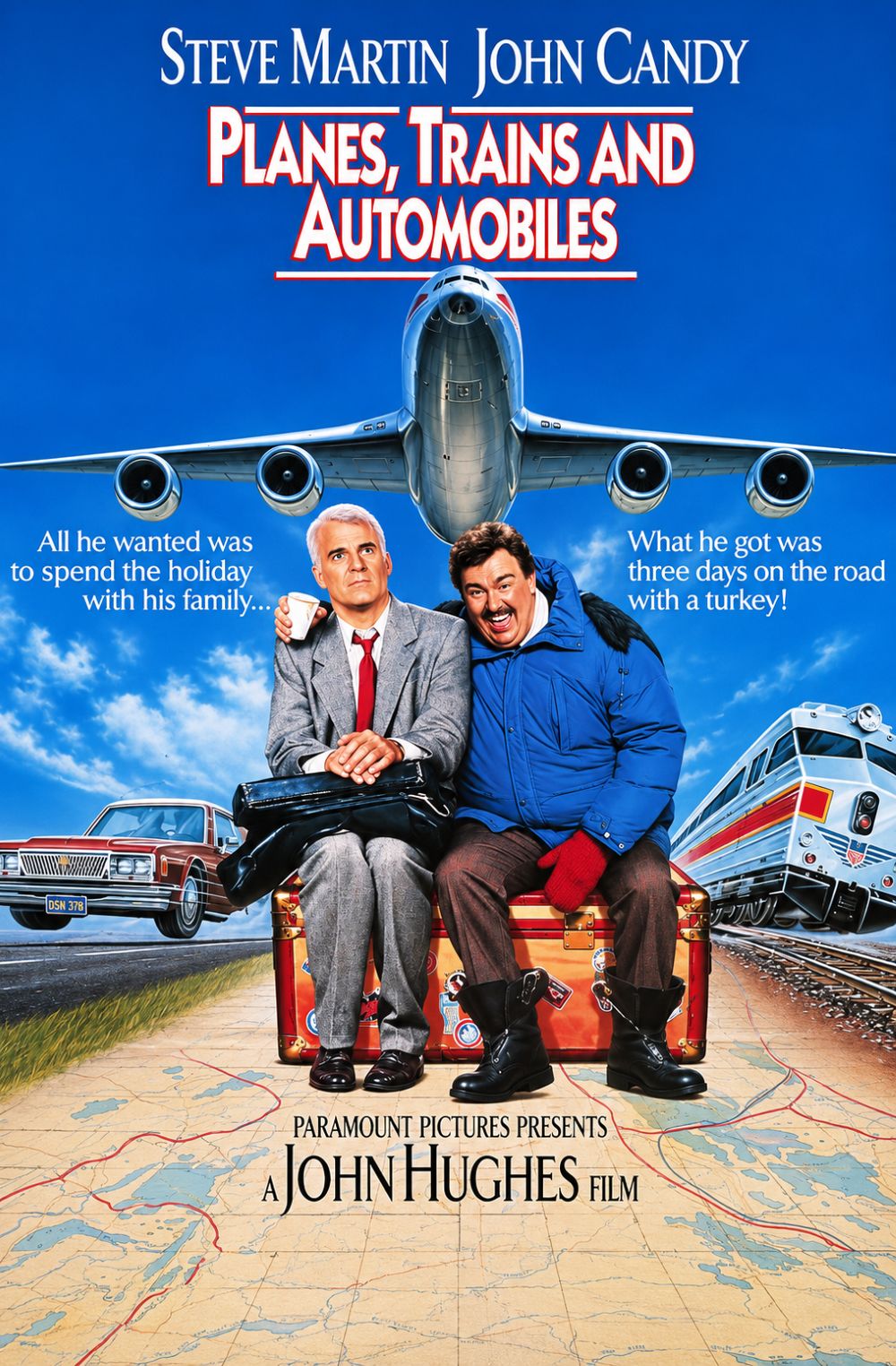
“Love… is not a big enough word. It’s not a big enough word for how I feel about my wife.” — Del Griffith
Every year, somewhere between the last of the grocery runs and the first slice of pie, there’s a moment when someone says, “Are we watching it this year?” Nobody has to ask what “it” is. Planes, Trains & Automobiles has become the unofficial opening act of Thanksgiving for a lot of households, and it’s easy to see why. It’s a movie about the desperate, ridiculous, occasionally miserable journey home, and it reminds us that getting there is only half the story.
John Hughes wrote, produced, and directed the film in 1987, and it follows Neal Page, a buttoned-up Chicago advertising executive played by Steve Martin. All Neal wants is to get home from New York in time for the holiday. A snowstorm has other plans, and he ends up shackled to Del Griffith, a chatty, endlessly cheerful shower curtain ring salesman played by John Candy. What follows is a chain of disasters involving cancelled flights, a breakdown on the rails, a rental car that has seen better days, and a motel room that’s much too cozy for two strangers. Every fix creates a fresh problem, and Hughes paces the escalation so well that the gags never feel like filler.
Part of what makes the movie so rewatchable is that it’s actually about something. Hughes was best known for teen comedies like Sixteen Candles and The Breakfast Club, but here he swaps prom-night angst for grown-up loneliness and pride. The jokes are big and physical, yet the real question driving the story is whether Neal will ever look past Del’s noise and see a decent, lonely man underneath. That’s a sweet idea to hang a comedy on, especially one that also contains a famously profane showdown at a rental car counter. It’s a perfectly built comic explosion, and it works because the film has spent an hour making you feel every ounce of Neal’s frustration.
Let’s talk about Steve Martin, because playing the straight man is a thankless job, especially opposite a scene-stealer. Martin is wonderfully controlled here. He lets Neal’s irritation simmer across his face, then boil over in precise, beautifully timed blowups. You can practically watch a pressure gauge climbing behind his eyes. What makes it work is that Neal never turns into a villain. Even when he’s being unkind to Del, you understand the impulse, because anyone who’s been stuck beside a talkative stranger while exhausted will feel seen. When Neal’s armor finally cracks late in the movie, Martin plays it with a restraint that makes the moment land even harder.
John Candy, meanwhile, is simply extraordinary. Del could have been a cartoon, a lovable oaf whose only job is to annoy the hero. Candy makes him a real person instead, big and loud and funny, with a vulnerability that the film reveals slowly. He covers loneliness with chatter and insecurity with bravado, and you can feel it under every joke. You laugh at Del constantly, and then a quiet scene hits, like when Neal tears into him and Del answers with hurt dignity, and suddenly you feel awful for laughing. It’s arguably the best work of Candy’s career, and it gives the whole film its soul.
The chemistry between the two is the real magic. Martin has said they ad-libbed a lot on set, and he later remembered Candy as having the biggest heart of anyone he’d ever known. That affection bleeds into every scene, from the awkward waking-up-in-bed moment to the car ride where Del cheerfully sings along to the radio. Martin sets the rhythm, Candy riffs on it, and everything feels loose and alive instead of scripted. The supporting cast, including a quick Kevin Bacon cameo, Edie McClurg, Michael McKean, and Laila Robins, adds flavor without ever stealing focus. The film also looks like winter in the Midwest, all slush and gray skies and fluorescent-lit waiting rooms, which keeps even the wildest situations feeling grounded.
This is also what makes it such a perfect Thanksgiving ritual. Holiday movies tend to fall into two camps, the sugary ones and the sarcastic ones, and this film manages to be both without feeling forced. It’s about the stress of getting home, the strangers who help along the way, and the people we end up making room for at the table. Watching it has become a tradition the same way the turkey and the stuffing have, something you’d feel a little off about skipping. It also runs a tidy 93 minutes, so it slides neatly into the lull between dinner and dessert.
The ending is where it truly separates itself from other buddy comedies. I won’t spoil it, but the final stretch recontextualizes Del in a way that’s genuinely moving, and Neal does something quietly kind that lands harder than any gag in the movie. It’s earned, too, because the film spent its whole runtime building the relationship honestly. Is it flawless? Not quite, since a few middle gags stretch a little and the plot is basically a loop of “something breaks, they find another way.” But the confidence of the tone and the generosity toward its characters make those quibbles evaporate.
And here’s the thing about this movie: it never gets old. Nearly forty years on, the delayed flights, missed connections, and forced closeness with strangers feel just as relatable as ever, maybe more so. You can know every beat and every line and still laugh at the same spots, still tear up at the same quiet moment. Some comedies lose a little air each time you revisit them, but this one seems to gain something, whether it’s a new favorite joke or a fresh appreciation for how good Martin and Candy are together.
So when the holiday rolls around again, you’ll probably find yourself reaching for it the way you reach for your favorite family recipe. Planes, Trains & Automobiles is always welcome, never overstays, and somehow feels like coming home even though it’s about everything that stands in the way. Clear a spot on the couch, pass the leftovers, and let Neal and Del take you the long way around one more time.

