The TSL Grindhouse: The Wild Angels (dir by Roger Corman)


“What is it exactly that you want?” a preacher (Frank Maxwell) asks a congregation of leather-clad bikers.

“We want to get loaded!” Heavenly Blues (Peter Fonda) replies, “And we want to have a good time!”

And have a good time, they proceed to have.  Of course, it’s a good time for them.  Everyone else who meets the bikers at the center of 1966’s The Wild Angels are horrified by this collection of rebellious and violent outsiders.  Sure, Heavenly Blues might actually be a soulful guy who mistakenly believes that he can control the gang’s more excessive tendencies.  His girlfriend, Mike (Nancy Sinatra), actually seems rather reserved and conservative when compared to the rest of the gang.  But make no mistake about it, the majority of the members of the gang are into violence for its own sake.  They are bullies who couldn’t make the football team so, instead, they hopped on a motorcycle and formed their own society.  They’re self-styled rebels  but what are they rebelling against?  What have you got?

I know, I know.  That famous line comes from Marlon Brando and it was uttered in The Wild One.  Peter Fonda, to put it lightly, was no Marlon Brando and, as directed by Roger Corman, The Wild Angels doesn’t have the societal concerns that lay at the hear of The Wild One.  As Corman was often the first to admit, his main concern when it came to making movies was to make money.  Corman wasn’t necessarily against message films.  He often stated that, as a director, 1962’s The Intruder was the film in which he took the most pride.  The Intruder took a firm stand against racism and it let everyone know where Corman stood on when it came to the Civil Rights Movement.  It was also one of his few films to lose money.  The Wild Angels celebrates rebellion but one gets the feeling that celebration is motivated by the fact that younger filmgoers would be happy to pay to see a movie about a bunch of “youngish” people telling the old folks to shut up and get out of the way.  The Wild Angels themselves don’t seem to be motivated by any sort of grand ideology.  Heavenly Blues preaches about getting loaded and having a good time and celebrating freedom but he also allows the members of the gang to drape a Nazi flag over a casket.  What does Heavenly Blues actually believe in?

Heavenly Blues believes in loyalty to his friends.  For all the fights and the orgies and the scenes of motorcycles roaring down country roads, this is ultimately just a film about a guy who wants to give his best friend a decent burial.  The Loser (Bruce Dern) dies about halfway through the film and one gets the feeling that he probably would have lived if the gang hadn’t kidnapped him from the hospital.  Heavenly Blues wants to give The Loser the type of wild funeral that Blues thinks he would have wanted though I think The Loser probably would have been happier not have been killed by the actions of his idiot friends.  Diane Ladd, who was married to Bruce Dern at the time and who has said Laura Dern was conceived during the filming of The Wild Angels, is heart-breaking as The Loser’s girlfriend, Gaysh.  Gaysh wants to mourn her boyfriend while the rest of the gang is more concerned with figuring out who her next boyfriend is going to be.

Does Heavenly Blues ever realize that he’s traveling with a bunch of animals?  He does but one gets the feeling that he’s accepted his fate.  There’s no going back.  The past can’t change and the future cannot be controlled so Heavenly Blues is content to live in the present.  All he can do is try to give his friend a decent burial while the sirens of cops shriek in the distance.

The Wild Angels was a controversial film when it was first released.  It also made a lot of money and led to a whole cycle of outlaw biker films, culminating with Easy Rider.  Seen today, it’s a portrait of a society coming apart, with the establishment and the bikers not even willing to stop fighting long enough to allow for a simple burial.  It’s definitely a time capsule film, one of those productions that epitomizes an era.  There’s not much going on underneath the surface and most of the film’s bikers really are awful people but there is something touching about Blues giving it all up just to try to give his friend a decent burial.
The Unnominated #12: Tombstone (dir by George Pan Cosmatos)


Though the Academy of Motion Picture Arts and Sciences claim that the Oscars honor the best of the year, we all know that there are always worthy films and performances that end up getting overlooked.  Sometimes, it’s because the competition too fierce.  Sometimes, it’s because the film itself was too controversial.  Often, it’s just a case of a film’s quality not being fully recognized until years after its initial released.  This series of reviews takes a look at the films and performances that should have been nominated but were, for whatever reason, overlooked.  These are the Unnominated.

I have come around on Tombstone.

The first time I watched this 1993 film, I was a bit confused as to why so many of my friends (especially my male friends) worshipped the film.  To me, it was a bit too messy for its own good, an overlong film that told a familiar story and which featured so many characters that it was difficult for me to keep track of them all.  Perhaps because everyone I knew loved the film so much, I felt the need to play contrarian and pick out every flaw I could find.

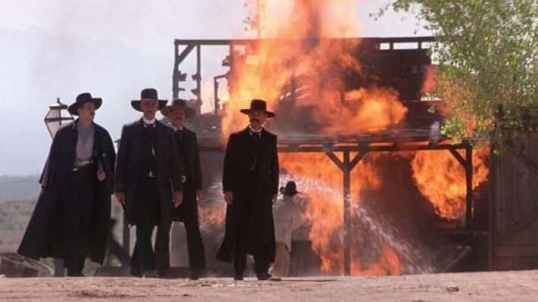
And I still think those flaws are there.  The film had a troubled production, with original director Kevin Jarre falling behind in shooting and getting replaced by George Pan Cosmatos, a director who didn’t have any real interest in the material and whose all-business approach rubbed many members of the cast the wrong way.  Kurt Russell took over production of the film, directing the actors and reportedly paring down the sprawling script to emphasize the relationship between Russell’s Wyatt Earp and Val Kilmer’s Doc Holliday.  On the one hand, this led to a lot of characters who really didn’t seem to have much to do in the finished film.  Jason Priestley’s bookish deputy comes to mind.  On the other hand, Russell was right.

The film’s heart really is found in the friendship between Wyatt and Doc.  It doesn’t matter that, in real life, Wyatt Earp was hardly as upstanding as portrayed by Kurt Russell.  It also doesn’t matter that the real-life Doc Holliday was perhaps not as poetic as portrayed by Val Kilmer.  Today, if you ask someone to picture Wyatt Earp, they’re probably going to picture Kurt Russell with a mustache, a cowboy hat, and a rifle.  And if you ask them to picture Doc Holliday, they’re going to picture Val Kilmer, sweating due to tuberculosis but still managing to enjoy life.  Did Doc Holliday every say, “I’ll be your huckleberry,” before gunning someone down?  He might as well have.  That’s how he’s remembered in the popular imagination.  And it’s due to the performances of Russell and Kilmer that I’ve come around to eventually liking this big and flawed western. With each subsequent viewing, I’ve come to appreciate how Russell and Kilmer managed to create fully realized characters while still remaining true to the Western genre.  If Wyatt Earp initially fought for the law, Doc Holliday fought for friendship.  Kilmer is not only believable as a confident gunslinger who has no fear of walking into a dangerous situation.  He’s also believable as someone who puts his personal loyalty above all else.  He’s the type of friend that everyone would want to have.

That said, I do have to mention that there are a lot of talented people in the cast, many of whom are no longer with us but who will live forever as a result their appearance here.  When Powers Boothe delivered the line, “Well …. bye,” he had no way of knowing that he would eventually become a meme.  Boothe is no longer with us, I’m sad to say.  But he’ll live forever as long as people need a pithy way to respond to someone announcing that they’re leaving social media forever.  Charlton Heston appears briefly as a rancher and he links this 90s western with the westerns of the past.  Robert Mitchum provides the narration and it just feels right.  The large ensemble cast can be difficult to keep track of and even a little distracting but there’s no way I can’t appreciate a film that manages to bring together not just Russell, Kilmer, Boothe, Heston, and Mitchum but also Sam Elliott, Bill Paxton, Michael Biehn, Michael Rooker, Billy Bob Thornton, Frank Stallone, Terry O’Quinn, and even Billy Zane!  The female roles are a bit underwritten.  Dana Delaney is miscast but Joanna Pacula feels exactly right as Doc Holliday’s lover.

But ultimately, this film really does belong to Val Kilmer.  When I heard the sad news that he had passed away last night, I thought of two films.  I thought of Top Gun and then I thought of Tombstone.  Iceman probably wouldn’t have had much use for Doc Holliday.  And Doc Holliday would have resented Iceman’s attitude.  But Val Kilmer — that brilliant actor who was so underappreciated until he fell ill — brought both of them to brilliant life.  In the documentary Val, Kilmer attends a showing of Tombstone and you can say he much he loves the sound of audience cheering whenever Doc Holliday showed up onscreen.

Tombstone was a flawed film and 1993 was a strong year.  But it’s a shame that Val Kilmer was never once nominated for an Oscar.  Tombstone may not have been a Best Picture contender but, in a year when Tommy Lee Jones won the Oscar for Best Supporting Actor for his role in the similarly flawed The Fugitive, it seems a shame that Kilmer’s Doc Holliday was overlooked.

Tombstone (1993, dir by George Pan Cosmatos (and Kurt Russell), DP: William Fraker)

Previous entries in The Unnominated:

  1. Auto Focus 
  2. Star 80
  3. Monty Python and The Holy Grail
  4. Johnny Got His Gun
  5. Saint Jack
  6. Office Space
  7. Play Misty For Me
  8. The Long Riders
  9. Mean Streets
  10. The Long Goodbye
  11. The General

An Offer You Can’t Refuse #18: The St. Valentine’s Day Massacre (dir by Roger Corman)


On February 14th, 1929, seven men were murdered in a garage in Chicago, Illinois.  Five of the seven men were known to be associates of gangster George “Bugs” Moran.  The other two men were considered to be innocent bystanders, a mechanic and a dry cleaner who just happened to enjoy hanging out with gangsters.  Though no one was ever convicted of the crime, it was well-known that the murders were carried out on the orders of Al Capone.

In many ways, the St. Valentine’s Day Massacre was a turning point in America’s relationship with organized crime.  Before the massacre, Capone had become a bit of a folk hero.  He knew how to talk to the press and he was viewed as merely breaking a law (in this case, prohibition) that most people opposed in the first place.  However, after the murders, public opinion soured on Capone.

Some of it was the brutality of the crime.  It’s been said that over five hundred bullets were fired in that garage, all to kill seven defenseless men who were lined up against a wall.  Grisly pictures of the victims were released to the press.  Perhaps if the seven men had been carrying weapons and had been involved in a shootout with their murderers, the public’s reaction would have been different.  But this was a cold-blooded execution.

Personally, I think the fact that the killers disguised themselves as cops also played a role in the public’s outrage.  It was a very calculated move on the part of the killers and it highlighted just how much planning went into the St. Valentine’s Day Massacre.  As well, it undoubtedly made people paranoid.  If a bunch of killer could dress up like cops, who knew who else they could dress up as?

Finally, I think that Capone’s biggest mistake was carrying out the crime on Valentine’s Day.  You don’t murder people on a holiday.  Anyone should know that.  If Capone had waited until February 20th, he probably could have gotten away with it.

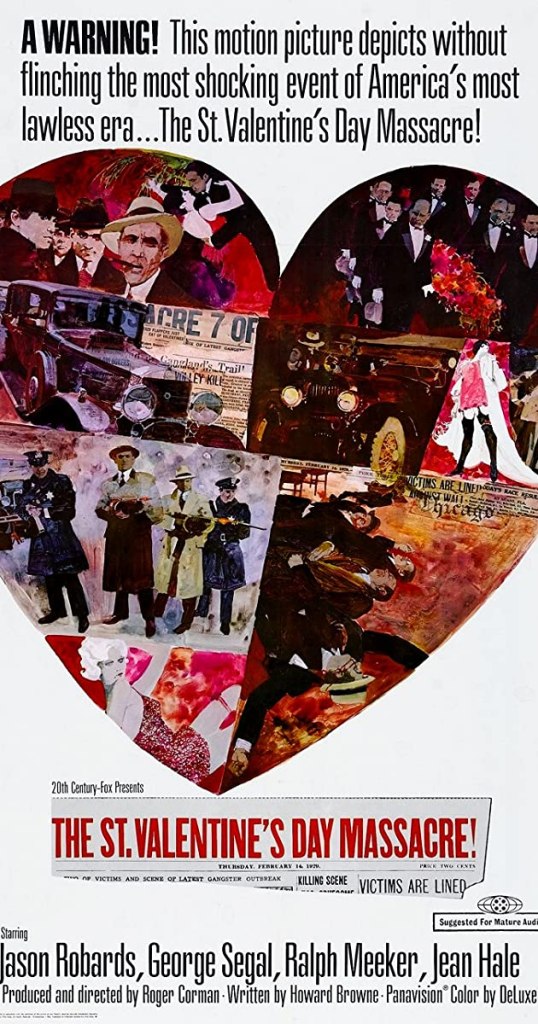
The 1967 film, The St. Valentine’s Day Massacre, details the rivalry between Capone and Moran, starting with them fighting for control over the Chicago rackets and ending with the title event.  Moran is played by Ralph Meeker while Jason Robards plays Capone.

Now I know what you’re probably thinking.  Perennial WASP Jason Robards as Al Capone?  That may sound like odd casting and, let’s just be honest here, it is.  However, it actually kind of works.  Robards may not be convincingly Italian but he is convincingly ruthless.  Add to that, one of the major subplots of the St. Valentine’s Day Massacre is that, even as the head of the Chicago Outfit, Capone still feels like an outsider in the world of organized crime because, while he is Italian, he isn’t Sicilian.  Capone feels as if Lucky Luciano and all of the major New York crime bosses look down on him and one reason why he’s so ruthless about taking over Chicago is that wants to show Luciano that he can be just as effective a crime lord as any Sicilian.  Capone feeling out of place in the Mafia is reflected by Robards initially seeming to be out of place in a gangster film.  By the end of the movie, of course, Capone has proven himself and so has Jason Robards.

Robards isn’t the only familiar face to be found in The St. Valentine’s Day Massacre.  Though this film was released by 20th Century Fox, it was directed by Roger Corman and Corman fills the production with members of his stock company.  Dick Miller, Jonathan Haze, and Jack Nicholson all have small roles as gunmen.  Bruce Dern plays the unlucky mechanic who enjoys hanging out with gangsters.  Buck Taylor, Leo Gordon, and Joe Turkel all have small roles.  John Agar plays Dion O’Bannon and is gunned down in his flower store.  Though not members of the Corman stock company, George Segal and David Canary plays brothers who work for Moran.  There’s a lot of characters wandering through this film but Corman makes sure that everyone gets a chance to make an impression.

It’s a good gangster film.  Though he was working with a larger budget than usual, Corman still brought his exploitation film aesthetic to the material and the end result is a violent, melodramatic gangster film that looks really impressive.  The film’s recreation of 1920s Chicago is a visual delight and looking at the well-dressed and stylish gangsters walking and driving down the vibrant city streets, you can understand why organized crime would have such a draw for some people.

The St. Valentine’s Day Massacre is a classic gangster film and a classic Corman film.  It’s an offer you can’t refuse.

Previous Offers You Can’t (or Can) Refuse:

  1. The Public Enemy
  2. Scarface
  3. The Purple Gang
  4. The Gang That Could’t Shoot Straight
  5. The Happening
  6. King of the Roaring Twenties: The Story of Arnold Rothstein 
  7. The Roaring Twenties
  8. Force of Evil
  9. Rob the Mob
  10. Gambling House
  11. Race Street
  12. Racket Girls
  13. Hoffa
  14. Contraband
  15. Bugsy Malone
  16. Love Me or Leave Me
  17. Murder, Inc.


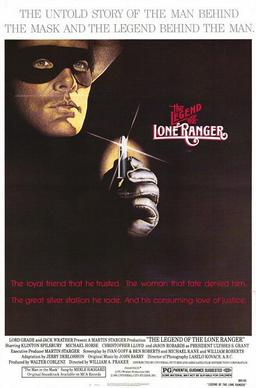
A Movie A Day #107: The Legend of the Lone Ranger (1981, directed by William A. Fraker)


Long before he found fame playing Deputy Hawk on Twin Peaks, Michael Horse made his film debut in one of the most notorious box office flops of all time, The Legend of the Lone Ranger.  

Michael Horse played Tonto, the young Comanche who rescues his childhood friend, John Reid (Klinton Spilsbury), and nurses him back to health after Reid has been attacked and left for dead by the notorious outlaw, Butch Cavendish (Christopher Lloyd).  Reid was a civilian, accompanying a group of Texas Rangers led by his older brother, Dan (John Bennett Perry).  When Cavendish attacked, John was the only survivor.  John wants to avenge his brother’s death but first, Tonto is going to have to teach him how to shoot a six-shooter and how to ride his new horse, Silver.  Finally, John is ready to don the mask and becomes the Lone Ranger.  It’s just in time, because Cavendish has kidnapped President Grant (Jason Robards).

An even bigger flop than the more recent Lone Ranger film starring Armie Hammer and Johnny Depp, The Legend of the Lone Ranger failed for several reasons.  For one thing, the film has a major identity crisis.  The violence is not for kids but most of the dialogue and the performances are.  For another thing, it takes forever for John Reid to actually put on the mask and become the Lone Ranger.  By the time the William Tell Overture is heard, the movie is nearly over.

It was made to capitalize on the same type of nostalgia that previously made Superman a hit and, just as Superman introduced the world to Christopher Reeve, The Legend of the Lone Ranger introduced the world to a football player turned actor, named Klinton Spilsbury.  Unfortunately, the world did not want to meet Klinton Spilsbury, whose blank-faced performance was so bad that James Keach was brought in to dub over all of his dialogue.   Spilsbury did not help himself by reportedly acting like a diva during the shooting, demanding constant rewrites, and getting into bar brawls offset.  Of the two actors who made their screen debuts in The Legend of the Lone Ranger, Michael Horse has worked again.  Klinton Spilsbury has not.

When The Legend of the Lone Ranger went into production, the film’s producers made the incredibly boneheaded move of getting a court injunction barring Clayton Moore (who had played the role on TV) from wearing his Lone Ranger uniform is public.  Since the semi-retired Moore was living off of the money that he made appearing as the Lone Ranger at country fairs and children’s hospitals, this move was a public relations disaster.  (For his part, Moore filed a counter suit and continued to make appearances, now wearing wrap-around sunglasses instead of his mask.)  Moore refused to appear in a cameo and spent much of 1981 speaking out against the film.

Finally, the main reason that Legend of The Lone Ranger flopped was because it opened on the same Friday as a little film called Raiders of the Lost Ark.

The rest is history.

Film Review: Indiscretion (dir by John Stewart Muller)


ilm

Indiscretion is a strange one.

(And by strange, I mean dull and kind of pointless.)

This film premiered on Lifetime last Saturday but, as I watched it, it quickly became obvious that it wasn’t originally produced for Lifetime.

For one thing, the film was shot on location in Louisiana.  Instead of letting Montreal or Toronto stand in for a generic American city, this film was actually shot on the streets of New Orleans.  (Unfortunately, the film also made New Orleans seem kind of boring.)

Secondly, Indiscretion turned out to be one of those films where the soundtrack would suddenly go silent whenever a character said anything stronger than “damn.”  It was odd because you would see a character very obviously saying something like, “Fuck you,” but you wouldn’t be able to hear the voice.  I guess that was to protect the gentle sensibilities of the viewer but what about people who read lips?

And finally, Indiscretion didn’t feature any of the usual Lifetime actors.  Instead, it starred Mira Sorvino as a frustrated wife and Cary Elwes as her politician husband.  Sorvino’s real-life husband, Christoper Backus, played the troubled sculptor who has an affair with Sorvino and then ends up stalking her family.

So, no, Indiscretion was clearly made to, at the very least, be released straight to video.  It was not meant for commercial television.  And yet, somehow, it ended up making a somewhat awkward premiere on Lifetime.

Anyway, Indiscretion starts out well enough.  It doesn’t waste any time arranging for Sorvino and Backus to meet at a fund raiser and for them to end up having a passionate affair.  Sorvino, of course, claims that it was just a weekend fling and that she loves her husband.  Backus refuses to believe her and soon, he’s worming his way into her family.  He befriends her husband and even gets to go on a hunting trip with the governor of Louisiana.  He also ends up having an affair with Sorvino’s teenage daughter.

(Or, at the very least, he takes some pictures of her, which Sorvino later discovers.  It’s a sign of how haphazardly constructed this film is that you’re never quite sure what’s going on with Backus and Sorvino’s daughter.  Backus also uses one of those old Polaroid cameras to take pictures.  Apparently, troubled artists don’t use digital cameras.)

The problem is that, after the first, artfully-shot sex scene, the film itself slows down to an interminable crawl.  It’s as if the film’s director, editor, screenwriter, and producers all forgot that the audience has already seen a hundred movies just like this one.  Nothing surprising happens and, unlike the best Lifetime films, Indiscretion never winks at the audience or indirectly acknowledges the clichéd nature of its narrative.  The whole thing is just painfully dull and no amount of mood lighting is going to change that.  There is a little twist at the end but most viewers will probably be so bored with it all that they probably won’t even notice.  That’s just the type of film this is.

If you want to see an entertainingly over-the-top and pulpy film about people having sex in New Orleans, I would suggest checking to see if Zandalee is still available on YouTube.

Scenes I Love: Tombstone


Tombstone

Weekend was busy, but still found time to catch a few favorite flicks on TV. One of these happened to be the classic early 90’s western Tombstone starring Kurt Russell and Val Kilmer. I already profiled my favorite scene from this film awhile back, but as I watched the film again I realized there was another sequence that totally made the film for me.

So, the latest “Scenes I Love’ once again comes from Tombstone and it does a great job in showing the darker and vengeful side of Wyatt Earp as played by Kurt Russell. The first scene I loved about this film was more about the cool, calm and badass Wyatt Earp who can spot a bullshitter, blowhard, coward from a miles away. This scene shows Earp in his scary, God’s Wrath mode as he begins his vendetta ride against the Clantons and the Cowboys.

Just love the look of fire and brimstone from Russell’s eyes as he confronts a cowed Ike Clanton and lets him know what he has planned for his clan and group. Better yet, in addition to Kilmer’s Doc Holliday, we also see a younger Michael Rooker aka Merle Dixon. He plays one of the members in Earp’s posse.