October True Crime: Summer of Sam (dir by Spike Lee)


First released in 1999, Summer of Sam is Spike Lee’s sprawling, frustrating, flawed, occasionally compelling, and ultimately rather intriguing film about the summer of 1977 in New York City.

As one can guess from the title, it was a summer that was dominated by the reign of terror of the serial killer known as the Son of Sam.  While New York suffered one of the hottest summers on record, the Son of Sam shot couples while they sat in their cars.  Because all of his victims had been women with long, dark hair, women across the city wore blonde wigs.  While the police searched for the killer, the city was also caught up in the World Series.  Club 57 was the hottest club in New York but a growing number of rebels, inspired by the news that was coming out of the UK, eschewed the glitz of disco for the gritty and deliberately ugly aesthetic of punk and the Mud Club.

Though the film is centered around the murders of the Son of Sam, he remains a largely shadowy figure in the film.  Played by Michael Badalucco, David Berkowitz spends most of his time in his filthy home, yelling at the dog across the street and writing cryptic messages on the walls.  He only gets a few minutes of screen time because the film is ultimately less about the Son of Sam’s crimes and more about how one Italian-American neighborhood in New York deals with the atmosphere of fear and paranoia created by those crimes.  It’s a neighborhood that’s ruled over by the ruthless but benevolent Luigi (Ben Gazzara).  When the two detectives (Anthony LaPaglia and Roger Guevener Smith) come to the neighborhood in search of information, they know that Luigi is the man to see.

Vinny (John Leguizamo) is one of the neighborhood’s citizens, a hairdresser who hasn’t let his marriage to Dionna (Mira Sorvino) stand in the way of his compulsive womanizing.  Vinny is the type who cheats on his wife and then goes to Confession to get forgiveness.  He’s the type who gets angry whenever Dionna wants to have sex with the lights on or do anything other than a quick three minutes in the missionary position.  When he realizes that the Son of Sam was watching him while he was having sex in a car with Dionna’s cousin and that he could have been one of his victims, Vinny starts to spin out of control.  Vinny’s childhood friend is Ritchie (Adrien Brody), who shocks everyone when he spikes his hair, puts on a Union Jack t-shirt, and starts speaking with a fake British accent.  Ritchie and his girlfriend, Ruby (Jennifer Esposito), embrace the punk lifestyle and even put one the Son of Sam’s letters to music when they perform at the Mud Club.

It’s an ambitious film but it’s also an overlong film, one where the slow spots can truly test the viewer’s patience.  With a 142-minute running time, Summer of Sam finds the time to touch on almost every trope of the late 70s.  Vinny and Dionna hit the clubs, where the usually quiet Dionna truly comes to life as she dances.  (Vinny’s moves are far less impressive.  Tony Manero would have laughed at him.)  Ritchie not only embraces punk rock but he also makes his money by performing in live sex shows.  When a mysterious man offers to give Vinny and Dionna a ride in his limo, it’s hard not to smile when it’s revealed that he’s taking them to the infamous sex club, Plato’s Retreat.  One can respect Lee’s ambition while still finding the film itself to be a bit too self-indulgent for it’s own good.

Spike Lee, for all of his other talents, has never been a particularly subtle director.  Vinny and his friends spend a lot of time hanging out at the end of street, strategically placed in front of a sign that loudly proclaims, “DEAD END.”  At one point, Vinny is inspired to run to his window and start screaming insults at the Son of Sam and Leguizamo’s histrionic delivery of the lines make it impossible to take his anguish seriously.  At the same time, there are moments that work brilliantly.  I particularly liked the scenes that took place during the blackout of 1977.  Luigi automatically knows how to keep control in his neighborhood and he sends his men out with baseball bats, channeling their aggression into a search for the phantom serial killer.  For every scene that doesn’t work, there’s a scene like the Baba O’Riley montage or Vinny, Dionna, Ritchie, and Ruby having a candlelit dinner.

“We really dig your vibe.”

John Leguizamo is shrill and miscast as Vinny, though I’m not sure if anyone could have made much of such a one-dimensional characters.  I preferred the performances of Mira Sorvino, Adrien Brody, and Jennifer Esposito, who all brought their characters to authentic life.  (I especially liked how Brody switched from being tough to being a wounded child at the drop of a hat.)  As is so often the case with Lee’s films, it’s the supporting actors who make the strongest impression.  I loved Mike Starr’s earthy performance as Ritchie’s father and Ben Gazzara’s sly turn as the neighborhood mobster.  Bebe Neuwirth is underused but memorable as Vinny’s boss.

The film is overstuffed and overlong but it effectively portrays a community in the grips of paranoia and anger.  In the end, the film is epitomized by a scene in which the neighbor’s dog enter David Berkowtiz’s living room and starts yelling at him in the voice of John Turturro.  It’s a scene that’s so ludicrous that it somehow becomes effective.  It’s a scene that most directors would have left on the editing room floor but Spike Lee included it.  It takes courage to write, film, and keep a scene like that.  Summer of Sam is a wreck of a film but it’s also ultimately a compelling portrait of a community coming apart.  In the end, just as in real life, Berkowitz is brought to justice and a community is left wondering what to do now.

Summer of Sam features some of Spike Lee’s best work and also some of his worst.  The film opens with columnist Jimmy Breslin describing New York as being the city that he both loves and hates and that’s the way that I feel about this film.  For all of its flaws, there’s enough strengths to make up for them.  It’s a New York story and, appropriately, it’s just as messy as the city that it is about.

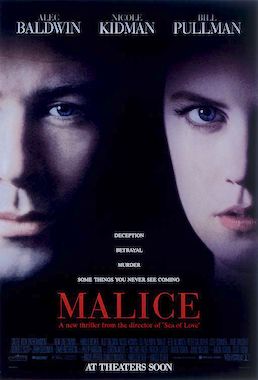
Insomnia File #48: Malice (dir by Harold Becker)


What’s an Insomnia File? You know how some times you just can’t get any sleep and, at about three in the morning, you’ll find yourself watching whatever you can find on cable or Netflix? This feature is all about those insomnia-inspired discoveries!

If you were having trouble getting to sleep last night around 12 midnight, you could have turned over to the Cinemax and watched the 1993 thriller, Malice.  And then you could have spent the next few hours trying to figure out what you just watched.

Seriously, there’s a lot going on in Malice.  The screenplay is credited to Aaron Sorkin and Scott Frank and while it has enough overly arch dialogue and untrustworthy women to plainly identify it as being a product of Sorkin’s imagination, it’s also filled with a mini-series worth of incidents and subplots and random characters.  This is also one of those films where no one can simply answer a question with a “yes” or a “no.”  Instead, it’s one of those movies where everyone gets a monologue, giving the proceedings a rather theatrical feel.  It’s the type of thing that David Mamet could have pulled off.  (Check out The Spanish Prisoner for proof.)  Harold Becker, however, was a far more conventionally-minded director and he often seems to be at a loss with what to do with all of the film’s Sorkinisms (and, to be fair, Frankisms as well).

The film starts out as a thriller, with a serial rapist stalking a college campus and Prof. Andy Safian (Bill Pullman) becoming an unlikely suspect.  Then it turns into a domestic drama as Andy and his wife, Tracy (Nicole Kidman), talk about starting a family.  Then Andy meets a brilliant surgeon named Jed Hill (Alec Baldwin) and the film turns into a roommate from Hell story after Jed moves in with them.  Then it becomes a medical drama after a mistake by Dr. Hill leaves Tracy unable to have children.  Then it returns briefly to the campus rapist story before then turning into a modern-day noir as Andy discovers that Tracy has secrets of her own.  (Whenever one watches a film written by Aaron Sorkin, you can practically hear him whispering, “Women are not to be trusted….” in the background.)  Even as you try to keep up with the plot, you find yourself distracted by all of the cameos.   George C. Scott glowers as Jed’s mentor.  Anne Bancroft acts the Hell out of her role as a drunken con artist.  Peter Gallagher is the lawyer you distrust because he’s Peter Gallagher.  Tobin Bell shows up as a handyman.  Gwynneth Paltrow, in one of her first roles, plays dead convincingly

It’s a big and busy and messy film and it too often mistakes being complicated for being clever.  Bill Pullman is a likable hero but you have to be willing to overlook that the script requires him to do some truly stupid things.  Nicole Kidman is always well-cast as a femme fatale but again, the script often lets her down.

Surprisingly enough, it’s Alec Baldwin who comes out of the film unscathed.  Watching Baldwin in this film, it’s hard to believe that he’s the same actor who has since become something of a bloated self-parody.  Yes, he’s playing an arrogant character (which is pretty much his trademark) but, in Malice, he actually brings a hint of subtlety and wit to his performance.  Baldwin does very little bellowing in the film, despite playing a role that one would think would naturally appeal to all of his bellowing instincts.  Malice is a mess but it’s nice to see the type of actor that Alec Baldwin once was.

Previous Insomnia Files:

  1. Story of Mankind
  2. Stag
  3. Love Is A Gun
  4. Nina Takes A Lover
  5. Black Ice
  6. Frogs For Snakes
  7. Fair Game
  8. From The Hip
  9. Born Killers
  10. Eye For An Eye
  11. Summer Catch
  12. Beyond the Law
  13. Spring Broke
  14. Promise
  15. George Wallace
  16. Kill The Messenger
  17. The Suburbans
  18. Only The Strong
  19. Great Expectations
  20. Casual Sex?
  21. Truth
  22. Insomina
  23. Death Do Us Part
  24. A Star is Born
  25. The Winning Season
  26. Rabbit Run
  27. Remember My Name
  28. The Arrangement
  29. Day of the Animals
  30. Still of The Night
  31. Arsenal
  32. Smooth Talk
  33. The Comedian
  34. The Minus Man
  35. Donnie Brasco
  36. Punchline
  37. Evita
  38. Six: The Mark Unleashed
  39. Disclosure
  40. The Spanish Prisoner
  41. Elektra
  42. Revenge
  43. Legend
  44. Cat Run
  45. The Pyramid
  46. Enter the Ninja
  47. Downhill

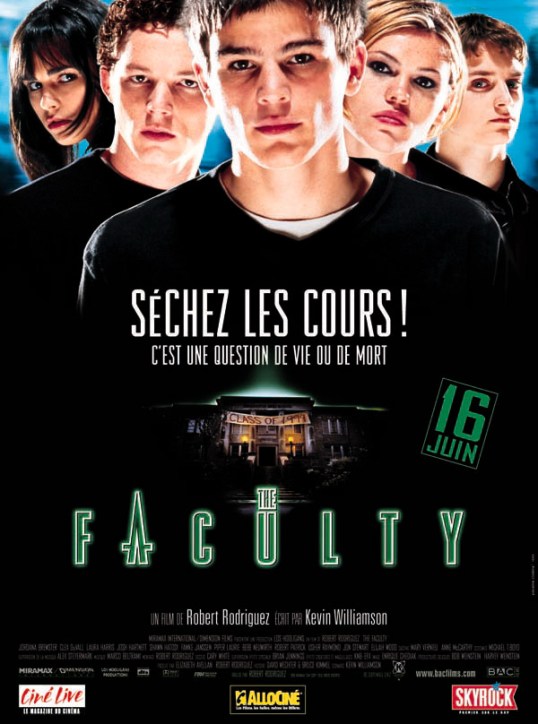
Back to School #52: The Faculty (dir by Robert Rodriguez)


3494-b-the-faculty

Have you ever wanted to see Jon Stewart get stabbed in the eye with a hypodermic needle?

If you answered yes, then 1998’s The Faculty might be the film for you!

The Faculty takes a look at what happens when a new alien species happens to turn up outside of a painfully normal high school in Ohio.  By painfully normal, I mean that Herrington High School is just as messed up as you would expect a suburban high school to be.  The teachers are all underpaid and resentful of their principal (Bebe Neuwrith).  Prof. Furlong (Jon Stewart) is the overqualified science teacher who will perhaps be a little too excited about the chance to examine a new alien species.  Coach Willis (Robert Patrick) is the emotionally shut off coach of the school’s losing football team.  Mrs. Olson (Piper Laurie) is the drama teacher who struggles to promote creativity in a school that’s more interested in blind conformity.  Miss Burke (Famke Janssen) is the teacher who cares too much.  And, finally, there’s Nurse Harper (Salma Hayek), who looks a lot like Salma Hayek.

And, as typical as the teachers may be, the students are even more so.  We get to know a few and they all neatly fit into the expected stereotypes.  Casey (Elijah Wood) is the nerdy outcast who is regularly picked on by … well, by everyone.  Deliliah (Jordana Brewster) is the status-obsessed head cheerleader who has just broken up with her boyfriend, Stan (Shawn Hatosy), because he quit the football team.  Zeke (Josh Hartnett) is the school rebel, the kid who is repeating his senior year and who sells synthetic drugs out of the trunk of his car.  Stokes (Clea DuVall) is an intentional outcast who pretends to be a lesbian and has a crush on Stan.  And finally, there’s Marybeth (Laura Harris), a new transfer student who speaks with a Southern accent.

These students would seem to have nothing in common but they’re going to have to work together because the entire faculty of Herrington High has been taken over by aliens!  Fortunately, the aliens are vulnerable to Zeke’s drugs, which is something that is learned after Jon Stewart takes a hypodermic to the eye…

When one looks over the top Texas filmmakers (director like Terrence Malick, Richard Linklater, Mike Judge, and David Gorden Green), Robert Rodriguez often comes across as being both the most likable and the least interesting.  Like his frequent collaborator Quentin Tarantino, Rodriguez fills his movies with references and homages to other films but, unlike Tarantino, there rarely seems to be much going on behind all of those references.  However, Rodriguez’s referential style works well in The Faculty because, along with acting as an homage to both Invasion of the Body Snatchers and John Carpenter’s The Thing, The Faculty also manages to tap into a universal truth.

Teachers are weird!

Or, at least, they seem weird when you’re a student.  Now that I’m out of high school, I can look back and see that my teachers were actually pretty normal.  They were people who did their jobs and, as much as I like to think that I was everyone’s all-time favorite, I’m sure that there have been other brilliant, asthmatic, redheaded, aspiring ballerinas who have sat in their class.  My teachers spent a lot of time talking about things that I may not have been interested in but that wasn’t because they were obsessed with talking to me about algebra or chemistry or anything like that.  They were just doing their job, just like everyone else does.

But, seriously, when you’re a student, it’s easy to believe that your teachers have been possessed by an alien life form.

Probably the best thing about The Faculty is the fact that the aliens cause the teachers to act in ways that are the exact opposite of their usual personalities.  For most of the teachers, this means that they turn into homicidal lunatics.  But, in the case of Coach Willis, this actually leads to him not only becoming a happy, well-adjusted human being but it also turns him into a good coach.  Suddenly, Willis is getting emotional about the games, his team loves him, and he even gets a win!

Go Coach Willis!

As for the film itself, it’s not bad at all.

Lisa’s rating: 7 out of 10.

Embracing the Melodrama #40: Bugsy (dir by Barry Levinson)


Bugsy5lrg

Let’s continue to embrace the melodrama with the 1991 best picture nominee Bugsy.

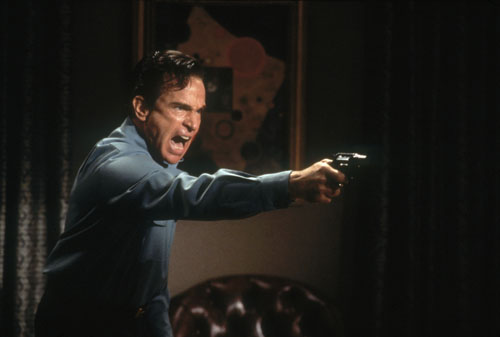
Gangster Benjamin Siegel (Warren Beatty) may be known as Bugsy but nobody dares call him that to his face.  Siegel may be best known for his quick temper and his willingness to murder anyone who gets in his way, but Ben insists that he’s not as crazy as everyone considers him to be.  Instead, Ben knows that he’s a very special person, a visionary businessman whose business just happens to be organized crime.  Along with his childhood friends Lucky Luciano (Bill Graham) and Meyer Lansky (Ben Kingsley), Siegel is one of the founders of the modern American crime syndicate.  Unlike his more practical-minded partners, Siegel revels in being a public figure.  Bugsy examines how Siegel became a celebrity gangster and how that celebrity eventually led to his downfall.

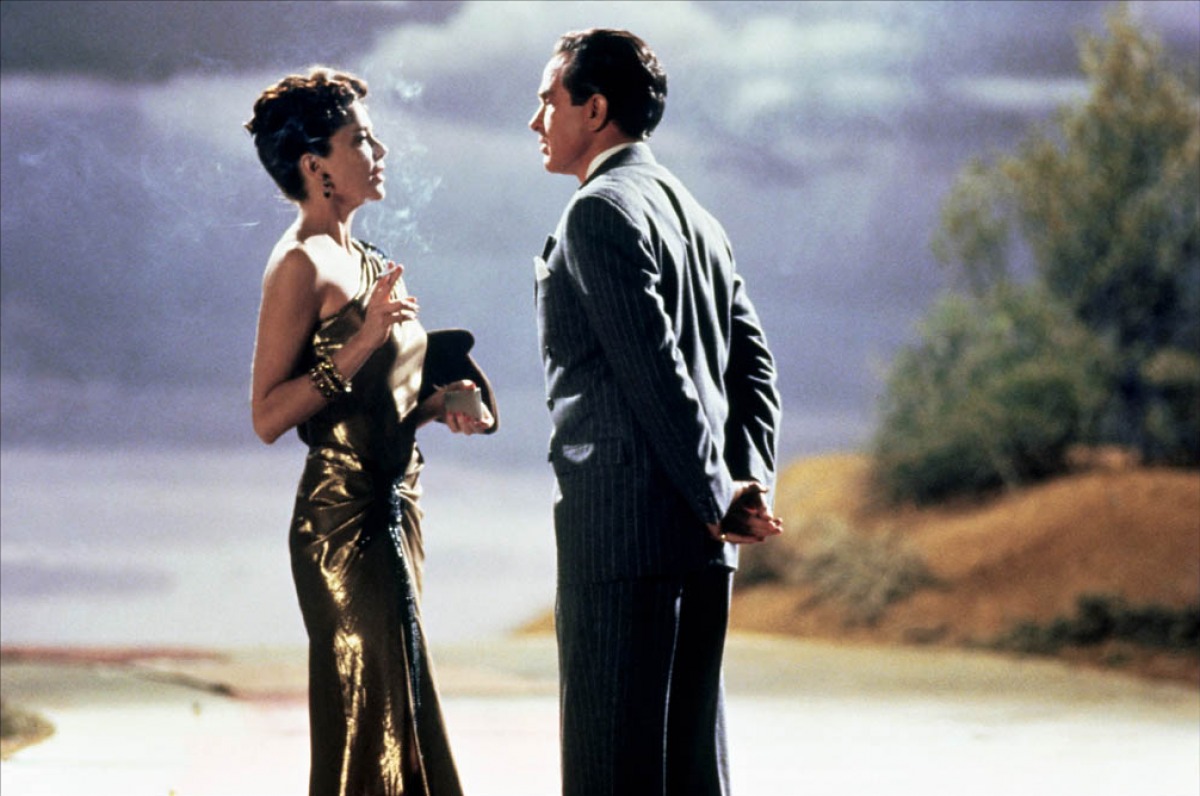
As the film opens, Luciano and Lansky send Siegel out to Los Angeles, specifically to look after their west coast business operations.  Before Siegel leaves, he is specifically told to keep a low profile.  So, of course, as soon as Siegel arrives in Los Angeles, he starts hanging out with actor George Raft (Joe Mantegna) and having a very public affair with actress Virginia Hill (Annette Bening).  Siegel quickly falls in love with the glamour and glitz of Hollywood and starts to think of himself as being a movie star.  When he’s not working with violent gangster Mickey Cohen (Harvey Keitel) to control the Los Angeles underworld, Siegel is attending film premieres and even shooting a Hollywood screen test.  Back in New York, Luciano and Lansky can only watch as their childhood friend goes out of his way to defy their instructions and become the most famous gangster in America.

Eventually, Siegel goes on a gambling trip to Nevada and comes up with an idea that is destined to change America forever.  With funding from Lansky and Luciano, Siegel begins construction on the Flamingo Hotel and Casino in Las Vegas, Nevada.  However, Siegel’s plans are so extravagant and, in many ways, impractical that the budget soon soars out of control.  Not helping matters is the fact that Virginia is embezzling money from the casino’s budget.  Even after Siegel finds out, he can’t bring himself to be angry at her.  He understand that he and Virginia are essentially cut from the same cloth.

However, back in New York, Luciano grows more and more frustrated with Siegel’s wasteful ways and Lansky comes to realize that he can only protect his friend for so long…

Bugsy is a big, extravagant movie that tries to be a few too many things at once.  Over the course of two and a half hours, it attempts to be a love story, a biopic, a classic gangster film, an allegory for the American dream, a history lesson, a period piece, and finally, a metaphor for the act of filmmaking itself.  (When Siegel complains that Luciano and Lansky don’t understand why the Flamingo has to be huge, it’s hard not to feel that he’s meant to be a stand in for every director who has ever had his budget cut by a meddling studio executive.)  When a film tries to be so many different things all at once, you can’t be surprised when the end result is a little uneven.  Bugsy starts out slowly but gradually picks up speed and the final part of the movie is everything that one could hope for from an epic gangster film.

The film works best as a character study of a man who, in the best American tradition, attempts to reinvent himself by moving out west.  Back in New York, Ben is known as a cold-blooded and dangerous killer.  However, once he arrives in Los Angeles, Ben attempts to recreate himself as a celebrity and then as a visionary.  For him, the Flamingo is about more than money.  The Flamingo is about being remembered for something other than his nickname.  The Flamingo is his way to escape from his past.  However, as Bugsy makes clear, the past can be ignored but it never goes away.

bugsy-1991-09-g