Embracing the Melodrama Part III #1: No Down Payment (dir by Martin Ritt)


Back in 2014 and 2015, I did a series of reviews that I called Embracing the Melodrama, in which I reviewed some of the best (and worst) melodramas ever made.  All together, I reviewed 186 films as a part of Embracing the Melodrama, everything from Sunrise to Reefer Madness to The Towering Inferno to Cocaine: One Man’s Seduction.  I had so much fun doing it that I’ve decided to do it again.

No, don’t worry.  I’m not going to attempt to review 186 films this time.  Instead, for Embracing The Melodrama Part III, I am going to limit myself to reviewing 8 films.  I’ll be posting one Embracing the Melodrama review a day, from now until next Sunday.

Let’s kick things off with 1957’s No Down Payment, a film about life in … THE SUBURBS!

(cue dramatic music)

The suburbs!

Is there any place in America that’s more dramatic?  Is it any wonder that, since the early 50s, films have regularly been using the suburbs as an example of everything that’s apparently wrong with America?  Every year sees at least one major film about how terrible life is in the suburbs.  Last year, for instance, George Clooney directed a film called Suburbicon, which was regularly cited as a possible Oscar contender before it was released and everyone was reminded of the fact that George Clooney is a terrible director.  That said, I can understand why filmmakers continue to be drawn to the suburbs.  Secret affairs.  Dangerous drugs.  Duplicitous children.  Fractured families.  Barbecuing alcoholics.  Undercover occultists.  You can find them all in the suburbs!

No Down Payment opens with David (Jeffrey Hunter) and Jean Martin (Patricia Owens) driving down a California highway and looking at the billboards that dot the landscape.  Every billboard advertises a new community, inviting people to make a new and better life away from the crowded city.  David and Jean smile, amused by how blatant all of the ads are.  That’s when they see the billboard that’s advertising their new home:

Sunrise Hill Estates

A Better Place For Better Living

Soon, David and Jean are moving into their new home and meeting their new neighbors.  It turns out that most of the houses in Sunrise Hill Estates are available for “no down payment” and the majority of the residents are struggling financially.  Though David may look at all of his neighbors and say, “Looks like everybody here is living a wonderful life,” the truth is something far different.

(If David’s line sound a bit too on the nose and obvious, that’s because almost all of the dialogue in No Down Payment was too on the nose and obvious.  As a side note, “on the nose” is an extremely strange expression.)

David’s neighbors include:

Herm Kreitzer (Pat Hingle) and his wife, Betty (Barbara Rush).  Herm owns an appliance store and sits on the town council.  Herm is gruff but likable.  He’s the leader of his neighborhood and he welcomes the Martins with a backyard party.  Herm’s employee, Iko (Aki Aleong), wants to move to Sunrise Hill but no one is willing to give him a reference because he’s not white.

Troy Boone (Cameron Mitchell) and his wife, Leola (Joanne Woodward).  We know that Troy is going to be trouble because he’s played by Cameron Mitchell.  We know that we’re going to like Leola because she’s played by Joanne Woodward.  Troy’s an auto mechanic and a veteran.  He wants to be appointed the chief of police but the town is reluctant to hire him because he doesn’t have a college education.  Leola wants to have a child but Troy says that they can’t even think about that until he has a good job.

And then there’s Jerry Flagg (Tony Randall) and his wife, Isabelle (Sheree North).  Jerry is a used car salesman and he’s also a drunk.  Jerry spends most of the movie hitting on other women and embarrassing Isabelle.  Jerry has no impulse control and, as a result, he’s heavily in debt.  His only hope is that he can convince a family to buy an expensive car that they really don’t need.  When last I checked, that’s what a used car salesman is supposed to do.

The film deals with a lot of issues — prejudice, sexism, economic insecurity — that are still relevant today.  Unfortunately, the film itself is a bit slow and what was shocking in the 50s seems rather jejune today.  Watching the film, you get the feeling that, as with many films of the 50s, all of the interesting stuff is happening off-screen.  That said, the film has an interesting cast.  Jeffrey Hunter and Patricia Owens are a bit dull as the Martins but then you’ve got their neighbors!  Any film that features Cameron Mitchell glowering can’t be all bad but the best performance comes from Tony Randall, who is memorably sleazy and desperate as Jerry Flagg.  For a fun experiment, watch this film right before watching Will Success Spoil Rock Hunter?

Tomorrow, we’ll continue to embrace the melodrama with 1961’s Common Law Wife!
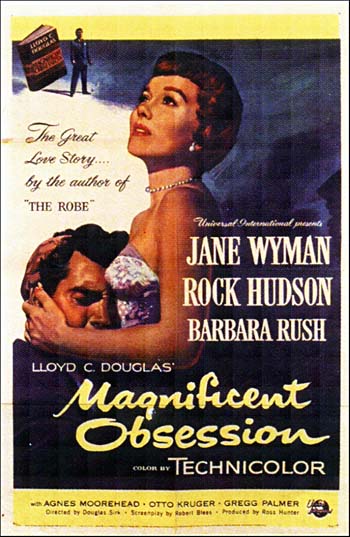
Embracing the Melodrama Part II #20: Magnificent Obsession (dir by Douglas Sirk)


Magnificent_obsessionThere’s a scene early on in the 1954 melodrama Magnificent Obsession in which formerly carefree millionaire Bob Merrick (Rock Hudson) meets with an artist named Edward Randolph (Otto Kruger).  We know that Randolph’s brilliant because he speaks in a deep voice, tends to be unnecessarily verbose, and often stares off in the distance after speaking.  Bob wants to know about a dead doctor who was a friend of Randolph’s.  Randolph explains the late doctor’s philosophy of doing anonymous good works.  Bob’s mind is blown.  (Hudson, who was never the most expressive of actors, conveys having his mind blown by grinning.)

“This is dangerous stuff,” Randolph warns him, “One of the first men who used it went to the cross at the age of 33…”

And a heavenly chorus is heard in the background…

And that one line pretty much tells you exactly what type of film Magnificent Obsession is.  It’s a film that not only embraces the melodrama but which also holds on tight to make sure that the melodrama can never escape.  There’s not a single minute in this film that is not hilarious overwritten.  It’s not just Randolph who tends to be portentous in his pronouncements.  No — everyone in the film speaks that way!

The dead doctor is dead specifically because of Bob.  Apparently, the doctor had a heart attack but the local hospital’s only resuscitator was being used to save the life of Bob who, while the doctor was dying, was busy recklessly driving a boat.

Helen (Jane Wyman), the doctor’s widow is, at first, bitter towards Bob and when Bob offers to donate $250,000 to the hospital, Helen refuses to accept his check.  This leads to Bob doing a lot of soul-searching and eventually having his life-changing conversation with Randolph.  Excited at the prospect of doing anonymous good works for the rest of his life, Bob tracks down Helen and tries to tell her that he’s a changed man.  Helen, however, wants nothing to do with Bob and ends up getting hit by a car while running away from him.  Helen survives but now, she’s blind!

Now, at this point, you might think that Bob has done enough to ruin Helen’s life.  At least, that’s the way that Helen’s family views it and when Bob attempts to visit her in the hospital, they order him to go away.

Eventually, Helen comes home from the hospital and starts to adjust to a life without eyesight.  One day, she meets a man on the beach and they start up a tentative romance.  What she doesn’t realize, at first, is that the man is Bob!  By the time she does realize who the man is, Helen has fallen in love with him.  However, she feels that it wouldn’t be fair to Bob to pursue a relationship with him and she leaves him.

So, of course, Bob’s response is to go to medical school and become a neurosurgeon.  Many years later, Helen has a brain tumor and needs an operation to survive.

Can you guess who her surgeon turns out to be?

Magnificent Obsession is almost a prototypical 1950s melodrama.  It’s big, it’s glossy, it’s self-important, and undeniably (and occasionally unintentionally) funny.  Even the total lack of chemistry between Hudson and Wyman somehow adds to the film’s strange charm.  It’s hard not to admire a film that starts out over-the-top and just grows more excessive from there.

Watching Magnificent Obsession is a bit like taking a trip into a parallel, technicolor dimension.  It’s strange, fascinating, and far more watchable than it should be.


Embracing the Melodrama #14: Bigger Than Life (dir by Nicholas Ray)


Bigger Than Life 2

Today, we continue to embrace the melodrama by taking a look at Nicholas Ray’s 1956 Hell-In-The-Suburbs masterpiece, Bigger Than Life.  Unfortunately for some of you, this review is going to contain minor spoilers because there’s no way you can talk about Bigger Than Life without talking about that ending.

Bigger Than Life is a film about deception.

English teacher Ed Avery (James Mason, who not only gives a brilliant lead performance but produced the film as well) pretends to be happy with his safe and dull life but it only takes a few minutes of looking at his strained smile and listening to him wearily  make perfunctory conversation to realize that Ed is a deeply disappointed man.  He decorates his house with travel posters for locations that he’s never visited and spends too much time thinking about when he played football in high school, the one time in life when he truly stood out from the crowd.

Ed doesn’t want his wife Louise (Barbara Rush) to know that they’re in financial trouble so he gets a job working as a taxi dispatcher without telling her.  While Louise fears that he’s actually having an affair, Ed spends his time coming up with excuses for why he can never come straight home from school.

Ed doesn’t want either Lou or his son Richie (Christopher Olsen) to know that he’s been feeling pain and dizziness.  It’s only after he faints at home that he finally agrees to go to the hospital.

The doctors who inform Ed that he has a life threatening condition don’t want Ed to know how dangerous the medicine that they’ve prescribed for him can truly be.  They tell him that cortisone can save his life but they don’t tell him about the side effects.  It’s up to his friend Wally (Walter Matthau) to research the drug and, by the time he does, it’s already too late.

Ed doesn’t want anyone to know that he’s becoming a drug addict.  However, as he takes more and more of the pills, his personality starts to change.  The once meek Ed is now demanding perfect service at stores and restaurants.  At a PTA meeting, Ed has no problem announcing that most of his students are stupid.  (“You should make that young man principal!” one parent shouts, apparently relieved to hear that a teacher thinks of little of his children as he does.)  At home, Ed pushes his son to become a football great and announces that he no longer loves his wife.

Richie doesn’t want his father to know that he now hates him.  Lou doesn’t want her husband to know how much she is growing to fear him.

Ed doesn’t want Richie to know that, after reading the biblical story of Abraham and Isaac, Ed has decided that he has to murder his son.  When Lou points out that God kept Abraham from killing Isaac, Ed replies, “God was wrong.”

And finally, the film itself deceives you into thinking that it has a happy ending with Lou and Richie hugging a now recovered Ed.  Everyone laughs and the happy music swells but there’s prominent shadow cast on the wall close to the family, a reminder that the darkness that Ed has unleashed on his family will not be so easily contained or forgotten.

bigger than life

Bigger Than Life is famous for being one of those films that flopped when it was originally released, just to eventually be rediscovered and acclaimed decades later when it was released as part of the Criterion Collection.  It’s easy to understand why the film flopped because the power of Bigger Than Life is almost entirely to be found in the film’s subtext.  On the surface, Bigger Than Life is a typical social problem film.  In this case, that problem would appear to be drug abuse.

However, as you watch the film, it becomes obvious that, for director Nicholas Ray, the real problem is the conformist and repressed society that the Avery family finds themselves living in.  When Ed’s personality changes, all he is really doing is achieving an extreme version of the ideal suburban existence.  The suburban ideal is that the man should be the king of his castle.  Ed becomes a king but he’s one of those kings who would behead his subjects on a whim.  In telling this tale of American exceptionalism gone mad, Nicholas Ray uses the techniques of European expressionism, using skewed camera angles and creating a world that is full of shadows.  Even before Ed takes his first pill, his world is a dark and threatening one.

By the end of the film, Ed may be off the drugs and he may be recovering but, as Nicholas Ray makes clear, the real problem remains.

Bigger Than Life