Kill la Kill is one of the more recent anime to come out of Japan to become a major sensation both in and out of the Land of the Rising Sun. It’s a series that some have called as too much of a slave to it’s fanservice scenes while some have called the series as much deeper than it’s visual surface has shown. Whatever the case, the series sports one of the best anime soundtracks of the past year due to the work by composer Hiroyuki Sawano.
It’s from this series’ soundtrack that the latest “Song of the Day” arrives from. “Blumenkranz” is the theme song for one of the series’ integral characters. It plays as a sort of walk-up theme music and it has become a favorite of pretty much every fan of the anime.
While the original song as sung by Japanese artist Rie was still in German it was heavily accented and has even confused some German speakers. An anime fan and native German speaker, singer Paperblossom has done the best cover of the song which has all the German lyrics spoken properly. It’s this version of the song that has become my favorite version of the song. I actually think it’s the superior version with all due respect to Rie’s original performance of the song.
One thing I’m sure of that this song would make for a killer entrance music for anyone looking to enter a room with much haughty and superior attitude.
Blumenkranz
Ich möchte stärker werden, weil unsere Welt sehr grausam ist Es ist ratsam, welke Blumen zu entfernen
Du fragst mich, ob ich mit dir komm Du flüsterst mir in mein Ohr Du fragst mich, ob ich deine Hand nehm Ich hab keinen Grund, dich abzulehnen
Du fragst mich, ob ich mit dir komm Du flüsterst mir in mein Ohr Du fragst mich, ob ich deine Hand nehm
(Du flüsterst mir)
Ja, ich bin viel stärker, als ich je gedacht hab Fliege höher! Laufe viel schneller! Vergiss die Wahrheit nicht! Ja, ich bin viel stärker, als ich je gedacht hab Ich entferne welke Blumen Wieso siehst du so traurig aus?
Diese Welt ist grausam Es ist traurig aber wahr Diese Welt ist seltsam Es ist fraglich aber wahr Ist der Blumengarten echt oder falsch?
Ich möchte stärker werden, weil unsere Welt sehr grausam ist Es ist ratsam, welke Blumen zu entfernen
Ja, ich bin viel stärker, als ich je gedacht hab Fliege höher! Laufe viel schneller! Vergiss die Wahrheit nicht! Ja, ich bin viel stärker, als ich je gedacht hab Ich entferne welke Blumen Wieso siehst du so traurig aus?
Was willst du von mir? Ich mag wollen oder nicht, ich muss den Feind verfolgen Ich bin nicht frei von dieser Welt
Egal wie hart du auch bist Fliege höher! Laufe viel schneller! Du bist sehr stark Du bindest einen Blumenkranz Wieso siehst du so traurig aus?
I was told today that one of my favorite anime series of all-time was going to get a new manga adaptation. I am talking about Manabi Straight. It’s from this series that today’s latest song of the day comes from: “Seioh Gakuen Kouka”.
The song was first introduced in the series by it’s main character Manami Amamiya who also goes by the name Manabi. The character’s voice actress is the very talented and popular seiyuu and singer Yui Horie. The song is pretty much the school anthem of the fictitious Seioh High School where Manabi and her high school friends attend. The series goes through the girls’ ups and downs of being high school kids who bond through their love of each other and of their school.
“Seioh Gakuen Kouka” is the school’s anthem and Manabi sings it in front of the entire school during her first day as a transfer student. It’s definitely one of my favorite songs of any genre and type. It brings back my own memories of being a high school student and all the friendships made during those four years.
Seioh Gakuen Kouka
Ima wo ikiru deai no kisetsu yo Mabushii hikari yume wo atsumete Onaji seishun ayumu kiseki Sakura iro no mirai tachi sora wo mau
Aah Seioh yorokobi doko he yo Aah Seioh manabi no sono ni hibike Kagayaku toki nakama to tomo ni aru
Ima wo ikiru yorokobi no naka de Mabushii hikari kaze wo atsumete Koi to kanashi jounetsu ni Kibou iro no musume tachi chuu wo mau
Aah Seioh ai no hibi yo Aah Seioh manabi no sono ni sodate Kagayaku toki nakama to tomo ni aru
Aah miageta ao wa haruka Aah tsukau toki kitto kitto Kagayaku toki nakama to tomo ni aru
Seioh Gakuen Kouka (ver. English)
Live the present moment, the season of encounters. The bright sunlight, the gathering of dreams. The miracle where people walk through the same youth. Cherry-blossom colored futures fly into the sky.
Ah, the cheerful sounds of Seioh! Ah, let it resonate through Seioh’s garden! When we shine, we shine with our friends.
Live the present moment, inside this happiness. The bright sunlight, the gathering of the wind. The burning love passion with the hope-colored girls fly into the sky.
Ah, the days of love at Seioh! Ah, grow up inside Seioh’s garden! When we shine, we shine with our friends.
Ah, the blue sky we look up to is far away. Ah, when we get a hold of it, for sure, for sure, when we shine, we shine with our friends.
“Hell, I’m just trying to keep this thing interesting. You can’t write me off like that. You’re just a voice, pal! You don’t know a damn thing about racing!” — Sweet JP
Anime has long distinguished itself from Western animation through its embrace of hyperkinetic imagery—an intensity of motion and visual energy that often prioritizes sensation over realism. While Western animation traditionally leans toward fluidity and physical believability, anime frequently pushes beyond those constraints, opting instead for exaggerated speed, explosive movement, and stylized impact. This difference isn’t just aesthetic; it reflects a broader philosophical divide in how motion itself is perceived. In anime, movement isn’t always about replicating reality—it’s about amplifying it.
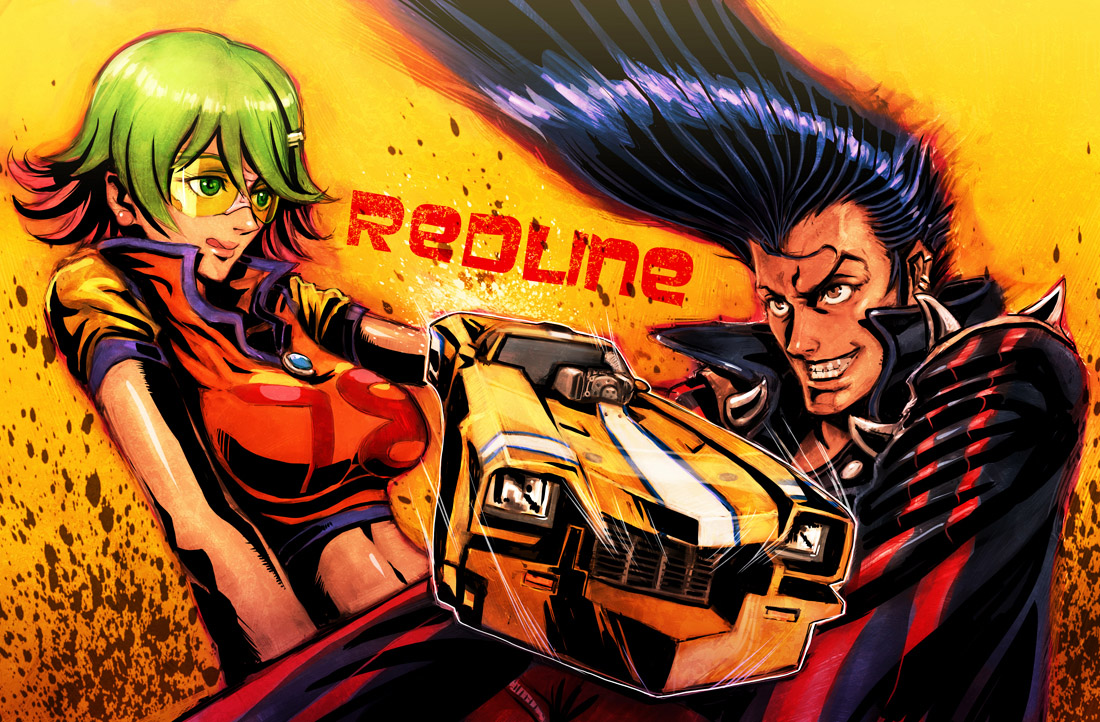
Few films embody this ethos as completely as Madhouse’s 2009 OVA Redline, a project that takes anime’s penchant for excess and turns it into a full-blown artistic manifesto. Directed by Takeshi Koike, Redline is less a conventional narrative film and more a sustained audiovisual adrenaline rush—a sci-fi racing spectacle that fuses breakneck pacing with meticulous hand-drawn craftsmanship. The production history of Redline is almost as legendary as the film itself: Koike and his team spent seven years bringing the project to life, pouring millions of dollars and an extraordinary amount of labor into its creation, with over 100,000 hand-drawn frames used in the final product. The result is a visual texture that feels both raw and impossibly refined—so detailed and fluid at times that it borders on looking computer-generated, despite being entirely handcrafted.
Koike’s influences are unmistakable throughout. There’s a clear lineage connecting Redline to the work of his mentor, Yoshiaki Kawajiri, particularly in the sharp character designs and kinetic action choreography reminiscent of Ninja Scroll and Vampire Hunter D. At the same time, the film borrows heavily from Western graphic aesthetics, most notably the thick linework and heavy shadowing associated with Frank Miller. This fusion creates a visual identity that feels globally informed yet uniquely its own—an anime that doesn’t just borrow from other traditions but aggressively remixes them.
Narratively, Redline is deceptively simple, and for some viewers, that simplicity borders on a flaw. The film centers on a futuristic intergalactic race—one that deliberately rejects advanced hover technology in favor of visceral, ground-based machines, giving the world a gritty, almost rebellious edge. At its core, the story follows Sweet JP, a daredevil racer with a towering pompadour and retro greaser aesthetic, as he competes in the titular race—the most dangerous and prestigious competition in the galaxy. His journey is framed through familiar tropes: the underdog striving for victory, the thrill of competition, and a romantic subplot involving his rival Sonoshee, who is both a love interest and a formidable racer in her own right. JP and Sonoshee are given just enough backstory and personality to be engaging, but they never evolve beyond archetypes, and the film never pretends otherwise.
And yet, this simplicity isn’t necessarily a weakness—it’s a deliberate trade-off. Redline understands exactly where its strengths lie, investing nearly all its creative energy into delivering a sensory experience rather than a deeply layered narrative. The characters function less as psychological studies and more as conduits for momentum, existing primarily to carry the viewer from one explosive set piece to the next. What truly sets Redline apart is the sheer density of its animation: every frame feels alive with motion, detail, and intent. Backgrounds pulse with activity, vehicles tear through space with exaggerated force, and the action sequences are so relentless and visually packed that they almost demand multiple viewings, as it’s nearly impossible to absorb everything in a single pass.
This overwhelming kinetic energy is where Redline transcends its narrative limitations. It creates a kind of visual immersion that few animated films—Western or otherwise—have managed to achieve. Watching it feels less like observing a story and more like being strapped into the driver’s seat of a machine hurtling toward collapse. Some critics have compared Redline to the Fast & Furious franchise, particularly its later, more exaggerated entries. On the surface, the comparison makes sense: both celebrate speed, spectacle, and a kind of reckless bravado encapsulated by the mantra “ride or die.” But the relationship feels less like equivalence and more like inversion—if anything, Fast & Furious comes across as a live-action attempt to capture the kind of unrestrained energy that Redline achieves effortlessly through animation. Where Fast & Furious is still tethered, however loosely, to physics, Redline operates in a space where those limits don’t exist and doesn’t need to justify its excess—it revels in it.
Despite its relatively modest reputation compared to more narratively complex anime films, Redline has earned a cult status among fans who appreciate animation as an art form. It prioritizes craft, motion, and sensory impact above all else, achieving something rare: a pure expression of animation’s potential. That’s why Redline remains such an essential watch. It may not offer the emotional depth of a Studio Ghibli film or the intricate plotting of a Satoshi Kon work, but it delivers something equally valuable—a reminder of what animation can do when pushed to its absolute limits.
For the best experience, Redline deserves to be seen on the largest, highest-quality screen possible. Its dense visuals and explosive color palette benefit immensely from high-resolution displays, particularly modern 4K screens that can fully capture the detail of its hand-drawn artistry. While it’s accessible through streaming platforms like YouTube, watching it on a premium setup transforms it from a great film into a full sensory event. In the end, Redline isn’t just a movie—it’s a showcase, a flex, and a love letter to animation itself, proving that sometimes style isn’t just substance—it is the substance.
It’s been a month since Anime Boston 2014 and I’ve decided to put up the third AMV to win one of the categories from the con.
This particular AMV won the Romance category and for once it uses an anime that I’m not familiar with, but after watching the video I’m definitely looking forward to checking it out once the blu-ray comes out sometime this year.
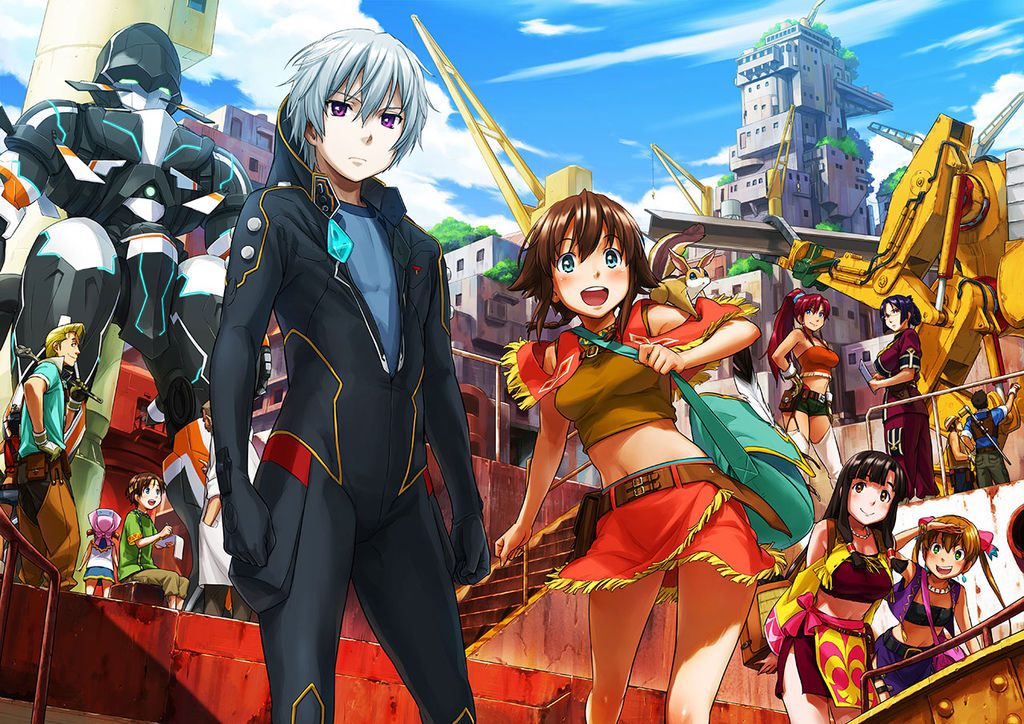
The AMV in question is “Strangers Like Us” by davenfonet who uses the Phil Collins song of the same title and the mecha series Gargantia on the Verdorous Planet. The video itself doesn’t go for the usual ballad-like tone, but instead goes for a much more fun romance vibe that doesn’t seem to win many Romance category contests. This time this type of romance AMV wins and the fact that it makes me want to watch the series after never having heard of it til Anime Boston means the creator succeeded.
So, I’ve fallen way behind on my posting. But let’s face it, I never really intended to make this a truly regular column. If I had to blame something, and let’s face it, blaming something besides myself is much more fun, I’d blame going to Anime Boston with site founder Arleigh. I mean, it makes sense, doesn’t it? It kept me preoccupied for a time, and it’s a very convenient excuse. Hey Arleigh, where’s the rest of the Anime Boston AMVs?
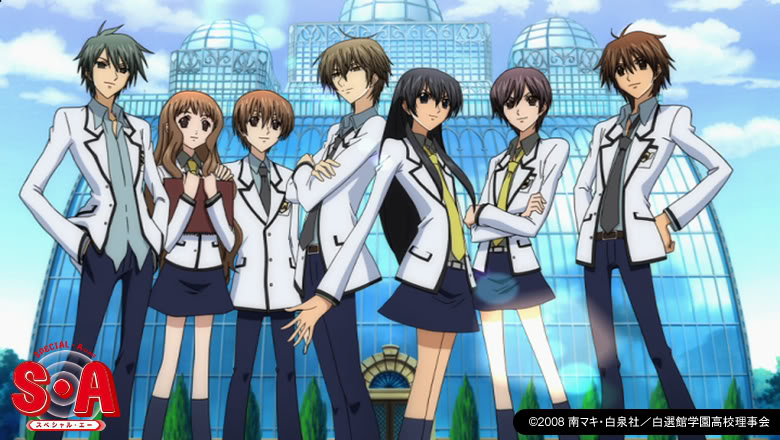
Alright, now that the focus is taken off of me, I’ll come back to the last set I watched before I stopped actually posting, and that’s the final set of the anime Special A, or more informally known as S.A. This is based off a shojo manga, or manga made with girls in mind, by Maki Minami. It basically follows the exploits of Hikari Hanazono in her super rich and super privileged high school class consisting of the best of the best. Of course, Hikari comes from a very modest family, so naturally she is the hardest worker in the group because she knows what it’s like to not be born from a family that’s going to automatically give her an eight or nine figure inheritance.
And that in a large part is the problem I have with the show. It’s all about Rich People’s Problems. Yet another show showing us how rich people are just the same as us, they have all the problems us commoners have, just magnified because they’re rich! Yeah, sorry, not buying it. Frankly if I’m in line to inherit a couple hundred million dollars, then I don’t really care what sort of responsibilities I might have to deal with. Oh no, my parents want me to marry someone worth millions of dollars to make our family worth billions? Cry me a river.
That episode is just a taste of what they go through. Frankly, I don’t care about Rich People’s Problems. I don’t relate to it at all. Look, I don’t want my anime to be realistic. I want my heroes to kick ass an take names. I want them to struggle a bit, but come out winning in the end. I WANT SHINJI TO GET IN THE GODDAMN ROBOT!! Ahem. Sorry about that. Anyways, this show just did not resonate with me. Some of the side characters were quite interesting, such as the pairing of Megumi and Yahiro. Now that was interesting. Hikari and Kei? Couldn’t care less. It probably doesn’t help that Maki Minami doesn’t do a great job of drawing distinctive characters, and the anime reflects this. Yes, you can tell them apart, but they’re so similar that it can be hard at times. All in all, this comes across as a series drawn by someone who’s basically saying “wouldn’t it be awesome if you were a clueless normal girl who got to go to a super elite rich person school just because you were fairly smart, and the richest smartest boy in school fell in love with you?” Yes, yes it would, but that doesn’t make for a particularly compelling story, especially for people that just don’t get or care about rich people’s problems. I don’t care how much you want it to be true, rich people do not have the same troubles us thousandaires do, and nothing you do can convince me otherwise.
All in all, I say skip this series. The anime can be had for cheap, provided you don’t care about English dubs, and even if you want your dubs you can have it for half the price of the manga. The manga does expound a bit further upon the story than the anime (obviously) but the ending is completely obvious from the beginning, so there’s not much need to put yourself through it all. If you want to see a better story of Normal Girl in Rich Person School, then I totally recommend Ouran High School Host Club instead.
The latest “AMV of the Day” doesn’t come courtesy of this past spring’s Anime Boston, but it caught my eye since it was the latest creation from one of my favorite AMV creators: IleiaAMVs.
“RadioAkshun” was her very popular and excellent AMV from last year’s anime con season and her latest offering for this weekend’s Sakura-Con 2014 may just be another hit.
This latest anime music video from IleiaAMVs combines one of the more mature-oriented anime one can get into without venturing into the truly extreme anime with one of the most popular songs of the past year with “Let It Go” from Frozen. One wouldn’t think that Elfen Lied and Frozen would go together like peanut butter and jelly but in this one instance they’re perfect together.
The second AMV winner to come out of last weekend’s Anime Boston 2014 was for Best Action.
“Valor” by MycathatesyouAMV pretty much a montage of the hyper-fast battle scenes from the current anime of the moment, Kill la Kill. The editor uses Celldweller’s “Tough Guy” track and just goes with the tempo and speed of the song to focus on the insane action this anime series has become quite well-known for.
Definitely a better Best Action winner than last year’s Anime Boston action winner.
This year’s Anime Boston actually had quite the line-up of AMV winners. Most of the time a con may have a couple of great winners, some good ones and the rest the usual meh. This wasn’t the case with Anime Boston 2014.
The latest AMV of the Day comes courtesy of AMV editor AdventLostKaichou who entered the anime music video “Time Falls Away” which promptly won in two categories: Judges’ Choice and Best Drama. Winning in one category is celebration enough, but winning in another means this particular video struck a chord with the judges and audience alike.
I haven’t seen the anime used for the video. It’s an 11-episode series from 2009 titled Tokyo Magnitude 8.0 and after watching this video I’m more than likely going to hunt this series down and watch it in one marathon sitting.
It’s now February and that means there just might an influx of Valentines-related postings popping up until the 14th. The first one comes courtesy of our latest “AMV of the Day”. This new AMV is both romantic and more than a bit melancholy.
“Left Us Falling” is an AMV based on scenes from the anime series Clannad and, it’s follow-up, Clannad: After Story. The video focuses on the character of Tomoya Okazaki and the changes to his life from the inclusion of two pivotal ladies into his wayward life. The first part of the video shows how much he realizes that Nagisa is the one for him. This is quite a life-changing event for Tomoya since the game and anime the series is based on is of the harem variety. The second person to enter his life that truly upends his life in a good way would be his young daughter Ushio.
To say anymore would be a total spoiler for those who haven’t seen the series and will leave it at that. I will say that the two series plays off quite differently with the first season coming off as being more of the romantic-comedy while the second season turns on a more serious note.
I know I’ve recommended that people watch this series in the past and I will repeat myself and point out that people should watch this series at least once in their life.
I meant to write this up some days ago when I actually finished this set, however I couldn’t figure out how to insert a link in here (and still can’t) so as is typical for me, I got pissed off and just gave up. However, with a show this good, it would be very remiss of me to not share it. I have already written up on the series in general with an Anime You Should Be Watching post (which is what I meant to link in here, but alas, the Add Link button remains greyed out) so this is just about the third and final season of Aria.
As I mentioned in that previous review, this show is the very definition of Slice of Life shows. In the previous seasons of Aria, it’s largely about the wonders that Akari sees on her new homeworld of Aqua (Mars), and the people she meets and befriends. Throughout those times, she and her friends are striving towards becoming Prima Undines, basically gondoliers like we have in Venice. This season the focus is much more on Akari and her friends realizing their dreams and the passing of the torch from the Three Great Water Fairies. But, like with all slice of life series, the destination isn’t what’s important. No one who watches this would think that Akari is going to fail her exam. We know she’ll become a Prima. The important thing is the journey, and seeing Akari and her friends come to terms with the fact that when they do reach their goals, that things aren’t going to be able to stay the same as they were before. Needless to say, there’s going to be a need for a lot of tissues. It’s not tragic sad like a Clannad is, but rather just so packed full of emotion that even thinking about certain scenes, such as Alice’s promotion, is enough to choke a person up. This is that episode, for anyone curious.
This set, released by Nozomi Entertainment which is the licensing arm of anime retailer The Right Stuf, is very beautiful. The artbox that was used is a nice, sturdy chipboard box with lovely artwork on it. The set contains all 13 episodes of Aria the Origination, the 7 episode picture drama (just think of a regular anime with little to no actual animation), and the OAV Aria the Arietta. It also comes with an episode guide booklet, and a disc with 2 hours of extras containing cast and staff interviews. There is no dub on it, so everything is in Japanese with English subtitles.
A few random thoughts I had about this set. First off, I really like how the opening theme song is played as part of the show. The vast majority of anime just have a set opener with the same animation every time. Aria has always made it so the opening just starts playing as we’re eased into the show, so in effect the OP animation is different every time. Secondly, just how freaking old is President Aria? On Aqua, apparently they have cats that are much more intelligent than Earth cats in that they seem to understand human speech. Of course, maybe our cats understand us perfectly and just don’t deem us worthy of responding, I don’t know. Anyways, President Aria is one such cat, but it’s shown that the founder of Aria Company, whom everyone calls Grandma, first came across and befriended President Aria back when she was an undine with another company. At that time she was probably at most 25, and now appears to be in her 70’s. So President Aria is at least 50, and still as active and pudgy as he was back then. I guess Martian cats live a very long time.
All in all, this was a treat to see. It’s definitely not a show that you’ll want to marathon, since it’s so slow paced. It’s best to be enjoyed an episode or two at a time, so you have time to properly digest each episode. Whether you need a pick me up, or just want to relax after a long day, there’s an episode of Aria that can fit the bill at any time. The great thing about Aria is that other than the last 3 episodes or so, you can really watch it in any order that you wish, and the story being told will make perfect sense.