If you’re in Texas or Arkansas today, I hope you’re keeping as bundled up as Charles Bronson in DEATH HUNT. It’s cold out there people! Keep safe and stay home if at all possible! We don’t know how to drive in this weather!
Enjoy DEATH HUNT’s trailer below! Charles Bronson and Lee Marvin are as tough as it gets!
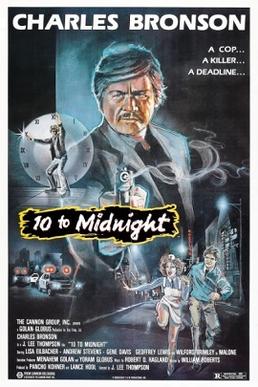
The 1983 film, 10 to Midnight, opens with LAPD detective Leo Kessler (played by legendary tough guy Charles Bronson) sitting at his desk in a police station. He’s typing up a report and taking his time about it. A reporter who is in search of a story starts to bother Leo.
“Jerry,” Leo tells him, “I’m not a nice person. I’m a mean, selfish son-of-a-bitch. I know you want a story but I want a killer and what I want comes first.”
It’s a classic opening, even if Leo isn’t being totally honest. Yes, he can be a little bit selfish but he’s really not as mean as he pretends to be. He may not know how to talk to his daughter Laurie (Lisa Eilbacher) but he is also very protective of her and he wants to be a better father than he’s been in the past. He may roll his eyes when he discovers that Detective Paul McAnn (Andrew Stevens) is the son of a sociology professor but he still tries to act as a mentor to his younger partner. Leo may complain that the criminal justice system “protects those maggots like they’re an endangered species” but that’s just because he’s seen some truly disturbing things during his time on the force and, let’s face it, Leo has a point. When one of Laurie’s friends is murdered, Leo is convinced that Warren Stacy (Gene Davis) is the murderer and he’s determined to do whatever he has to do to get Warren off the streets. “All those girls,” Leo snarls when he sees Warren, his tone letting us know that his mission to stop Warren is about more than just doing his job.
Warren Stacy is handsome, athletic, and he has good taste in movies. (He’s especially a fan of Butch Cassidy and the Sundance Kid. Just don’t try to trick him by saying Steve McQueen played the Sundance Kid.) Warren is also a total creep, the type of guy who complains that a murder victim “wasn’t a good person,” because she trashed him in her diary. When Leo takes a look around Warren’s apartment, he finds not only porn but also a penis pump. (“It’s for jacking off!” Leo yells at Warren, enunciating the line as only Charles Bronson could.) Warren is also a murderer but he’s a clever murderer, the type who sets himself up with an alibi by acting obnoxiously in a movie theater. Warren strips nude before killing his victims, in order to make sure that he doesn’t leave behind any evidence. (This film was made in the days before DNA testing.)
Leo knows that Warren is guilty but, as both his gruff-but-fair captain (Wilford Brimley, naturally) and the D.A. (Robert F. Lyons) point out, he has no way to prove it. When Warren starts to stalk Laurie and her friends (including Kelly Preston), Leo decides that he has no choice but to frame Warren. But when Warren’s amoral attorney, Dave Dante (Geoffrey Lewis, giving a wonderfully sleazy performance), threatens to call McAnn to the stand, McAnn has to decide whether to tell the truth or to join Leo in framing a guilty man.
10 to Midnight is a violent, vulgar, and undoubtedly exploitive film, one that features a ham-fisted message about how the justice system is more concerned with protecting the rights of the accused as opposed to lives of the innocent. And yet, in its gloriously pulpy way, this is also one of Bronson’s best films. It’s certainly my personal favorite of the films that he made for Cannon.
Director J. Lee Thompson and Charles Bronson were frequent collaborators and Thompson obviously knew how to get the best out of the notoriously reserved actor. Bronson was not known for his tremendous range but he still gives one of his strongest performances in 10 to Midnight, playing Leo as being not just a determined cop but also as an aging man who is confused by the way the world is changing around him. Stopping Warren isn’t just about justice. It’s also about fighting back against the the type of world that would create a Warren Stacy and then allow him to remain on the streets in the first place. Interestingly, though Leo doesn’t hesitate when it comes to framing Warren, he is also sympathetic to McAnn’s objections. Unlike other Bronson characters, Leo doesn’t hold a grudge when his partner questions his methods. Instead, he simply know that McAnn hasn’t spent enough time in the real world to understand what’s at stake. McAnn hasn’t given into cynicism. He hasn’t decided that the best way to deal with his job is to be a “mean son of a bitch.” Bronson and Andrew Stevens, who had worked together in the past, have a believable dynamic. McAnn looks up to Leo but is also conflicted by his actions. Leo may be annoyed by McAnn’s reluctance but he also respects him for trying to be an honest cop. Their partnership feels real in a way that sets 10 to Midnight apart from so many other films about an older cop having to deal with an idealistic partner.
One of the most interesting things about the film is Leo’s relationship with his daughter, Laurie. Over the course of the film, Leo and Laurie go from barely speaking to bonding over liquor and their shared regrets about the state of the justice system. When McAnn first meets Laurie, she’s offended when McAnn suggests that she takes after her father. But, as the film progresses, she comes to realize that she and Leo have much in common. (To be honest, I related quite a bit to Laurie, especially as I’ve recently come to better appreciate how much of my own independent nature was inherited from my father.) Lisa Eilbacher and Charles Bronson are believable as father-and-daughter and they play off of each other well. The scenes between Laurie and Leo give 10 to Midnight a bit more depth than one might otherwise expect from a Bronson Cannon film. Leo isn’t just trying to protect his daughter and her roommates from a serial killer. He’s also trying to be the father who he wishes he had been when she was younger. He’s trying to make up for lost time, even as he also tries to keep Warren Stacy away from his family.
As played by Gene Davis, Warren Stacy is one of the most loathsome cinematic villains of all time. Warren’s crimes are disturbing enough. (Indeed, the surreal sight of a naked and blood-covered Warren Stacy stalking through a dark apartment is pure nightmare fuel.) What makes Warren particularly frightening is that we’ve all had to deal with a Warren Stacy at some point in our life. He’s the sarcastic and easily offended incel who thought he was entitled to a phone number or a date or perhaps even more. As I rewatched this movie last night, I wondered how many Warrens I had met in my life. How many potential serial killers have any of us unknowingly had to deal with? Warren tries to strut through life, smirking and going out of his way to let everyone know that he knows more than they do but the minute that Leo turns the table on him, Warren starts whining about he’s being treated unfairly. During his final, disturbing rampage, Warren yells that his victims aren’t being honest with him, blaming them for his actions. The film deserves a lot of credit for not turning Warren into some sort of diabolical and erudite supervillain. He’s not Hannibal Lecter. Instead, like all real-life serial killers, he’s a loser who is looking for power over those to whom he feels inferior and for revenge on a world that he feels owes him something. He’s a realistic monster and that makes him all the more frightening and the film all the more powerful. Warren is the type of killer who, even as I sit here typing this, could be walking down anyone’s street. He’s such a complete monster that it’s undeniably cathartic whenever Leo goes after him.
How delusional is Warren Stacy? He’s delusional enough to actually taunt Charles Bronson! At one point, Warren informs Leo that he can’t be punished for being sick. Warren announces that, when he’s arrested, he might go away for a while but he’ll be back and there’s nothing Leo can do about it. (The suggestion, of course, is that Warren will be back because he committed his crimes in California and all the judges were appointed by a bunch of bleeding heart governors. Warren may not say that out loud but we all know that is the film’s subtext. Some people may agree with the film, some people may disagree. Myself, I’m against the death penalty because I think it’s a prime example of government overreach but I still cheered the first time that I heard Clint Eastwood say, “Well, I’m all torn up about his rights,” in Dirty Harry.) How does Leo react to Warren’s taunts? I can’t spoil the film’s best moment but I can tell you that 10 to Midnight features one of Bronson’s greatest (and, after what we’ve just seen Warren do, most emotionally satisfying) one-lines.
The title has nothing to do with anything that happens in the film. In typical Cannon fashion, the film’s producers came up with a snappy title (and 10 to Midnight is a good one) and then slapped it onto a script that was previously called Bloody Sunday. Fortunately, as long as Bronson is doing what he does best, it doesn’t matter if the title makes sense. And make no mistake. 10 to Midnight is Bronson at his best.
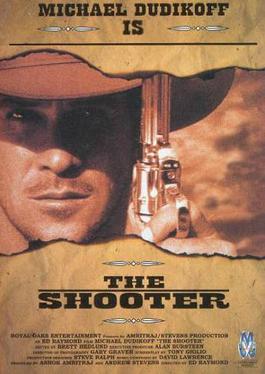
While riding his horse through the old, Michael Atherton (Michael Dudikoff) discovers a group of thuggish ranch hands attacking a prostitute named Wendy (Valerie Wildman). Because Michael is known as being the Shooter, he has no problem coolly gunning the men down and saving Wendy’s life. Unfortunately, for Michael, one of the dead men is the son of a fearsome rancher named Jerry Krants (William Smith) and Jerry has his own reasons for wanting Wendy dead. Michael may be the Shooter but Jerry Krants is William Smith so you automatically know that it is not a good idea to mess with him.
In the grand spaghetti western tradition, Krants has his men kidnap Michael, beat him up, and crucify him outside of town. The men leave Michael for dead but, after they’ve left, Wendy repays Michael’s kindness by untying him from the cross, nursing him back to health, and saving his life. (The same thing used to happen to Clint Eastwood, except he usually had to nurse himself back to health without anyone else’s help.) With everyone else believing him to be dead, Michael rides into town to get his violent revenge against Krants and his men. With all of the townspeople convinced that Michael has returned as a ghost, only the town’s power-hungry sheriff, Kyle Tapert (Randy Travis), understands what has actually happened. Tapert makes plans to use Michael’s return for his own advantage. While it wouldn’t look good for Tapert to openly murder all of his opponents, what if he killed them and then framed Michael? And then what if he made himself a hero by being the one to end Michael’s reign of terror?
Directed by Fred Olen Ray, The Shooter is a low-budget western that turned out to be far better than I was expecting. Ray is obviously a fan of the western genre and, with The Shooter, he’s made a respectful and, by his standards, restrained homage to the classic spaghetti westerns of old. He even shows some undeniable skill when it comes to building up the suspense before the climatic showdown. Ray indulges in every western cliché imaginable but he does so with the respect of a true fan.
With his less than grizzled screen presence, Michael Dudikoff is slightly miscast as a Clint Eastwood-style gunslinger but the rest of the cast is made up of genre veterans who give it their best. In particular, William Smith shows why he was one of the busiest “bad guys” working in the movies. To me, the most surprising part of the film was that the casting of Randy Travis as a villain actually worked. Fred Olen Ray made good use of Travis’s natural amiability, making Kyle into a villain who will give you friendly smile right before he opens fire. Also be sure to keep an eye out for Andrew Stevens, playing the man who records Michael’s story. It wouldn’t be a Fed Olen Ray movie without Andrew Stevens playing at least a small role.
Low-budget, undemanding, and made with obvious care, The Shooter is film that will be appreciated by western fans everywhere.
Two years after ripping off Alien with The Terror Within, producer Roger Corman decided to rip it off a second time with The Terror Within II. This time, star Andrew Stevens hopped into the director’s chair and, along with the sex-crazed monsters, a religious cult was also added. A year after The Terror Within II was released, Alien 3 was released and it also featured a religious cult. Was it a coincidence or was Roger Corman predicting the future?
Speaking of the future, The Terror Within II returns us to the crappy future that was predicted by the first film. As the previous film’s only survivor, scientist Andrew Stevens is walking across Colorado to take a position at yet another lab. Along the way, he meets a young woman named Ariel (Clare Hoak). No sooner have they met than they’re doing their bit to repopulate the human race. Meanwhile, a cult wants to kidnap Ariel and offer her up to the mutants. (The mutants were called Gargoyles in the first film. Now, they’re called Lusus.)
Meanwhile, at the other lab, the scientists, including Stella Stevens and R. Lee Ermey, are studying a mutated finger, which appears to be spontaneously regenerating into a Gargoyle or a Lusus or whatever its called now. Does it occur to anyone at the lab that growing their own monster is a stupid idea? No. Humanity is doomed.
The Terror Within II was shot for even less money than the first film but it’s also a marked improvement. That’s mostly due to Andrew Stevens being a far more competent filmmaker than the director who did the first film. Stevens know how to shoot an action scene and, when the monsters inevitable do end up storming the lab, it’s more exciting in the second film than it was in the first. Plus, whereas The Terror Within only had George Kennedy to lend it some class, The Terror Within II has both R. Lee Ermey and Stella Stevens! It’s an improvement, all around.
Unfortunately, there was never a third film. The Lusus probably would have won anyways. There’s only so many underground labs that humanity can hide out in.
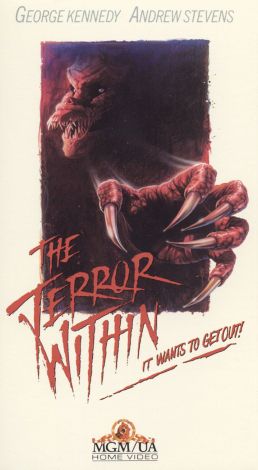
Years after “The Accident,” the Earth is a post-apocalyptic wasteland. The surface is controlled by Gargoyles, scaly monsters with big claws and a rampaging libido. The few human survivors hide out in underground bunkers, trying to find a cure for “the Plague,” which I guess came about as a result of the Accident. That still doesn’t explain the Gargoyles, though. It doesn’t matter, though. This is a Roger Corman-produced cheapie, one that what so obviously made to exploit the success of Alien, Aliens, Insemenoid, and Day of the Dead that I hope Corman at least had the decency to buy Christmas presents for Ridley Scott, James Cameron, Norman Warren, and George Romero.
The plot kicks into high gear when a group of human scientists discover a pregnant woman on the surface. They take her into their bunker, where she gives birth to a garoyle/human hybrid. The hybrid baby quickly grows into an adult gargoyle and is soon running through the air ducts, killing all the men, and attempting to mate with all the women. It’s actually pretty offensive, not that anyone complained when the movie used to show up on late night Cinemax in the 90s.
It’s up to the humans to stop the terror within. Unfortunately, the humans are interchangeable and easily killed. The only two that you’ll remember are Andrew Stevens and George Kennedy. Stevens, you’ll remember because he’s the star and has the ability to somehow survive while everyone around him is dying. You’ll remember George Kennedy because he’s George Kennedy, an Oscar-winning actor picking up some extra money by barking orders in a few scenes. I doubt Kennedy listed this film high on his list of accomplishment but, because he manages to deliver his lines with a straight face, he’s one of the best thing about the movie. The other thing that partially redeems this film is that the monster, once it reaches adulthood, looks far more convincing than I think anyone would expect it to. Corman may not have spent a lot of money on this film but he was smart enough to invest in a convincing monster.
The Terror Within has a cult following, mostly made up by people like me who saw it when we were kids and were too dumb to realize that it’s really not a very good movie. The main problem is that, though the film may be based on Alien, the director is no Ridley Scott or James Cameron. He’s not even a Fred Olen Ray or Jim Wynorski. There’s no suspense or humor or anything that would really distinguish the film. The Terror Within was still successful enough to lead to a sequel. Fortunately, Andrew Stevens took over as director for The Terror Within II.
This is the Biblical parable about how the rich man who has two sons, both of whom are due to receive a large inheritance from their father. The younger son asks for his inheritance early and then leaves home, determined to make a life on his own. The older son stays at home and continues to loyally work for his father. Things don’t go well for the younger son. Before long, he’s broke, destitute, and desperate. For the longest time, the youngest son tries to avoid returning home. He doesn’t want to admit that he’s failed and he’s also scared of how his father will react.
Finally, though, the son does return home. He admits that he wasted his inheritance. He admits that he hasn’t been as responsible or faithful as his older brother. His father, though, forgives him and orders a large party to be thrown in his honor. The older son is not happy about this.
“Why,” the older son demands, “are you celebrating the return of Fredo when you’ve got Michael right here!?”
His father replies that he loves both of his sons equally and nothing will ever change that. But he is celebrating the return of his youngest son because “he was lost and now he’s found.”
It’s a parable that teaches a good lesson about forgiveness and the selflessness of parental love, regardless of whether you’re religious or not. Perhaps not surprisingly, it’s also a parable that has inspired any number of films. I mean, it’s inherent cinematic. Not only do you have a dramatic conflict between members of the same family but, before the forgiveness, comes the decadence. The parable of the prodigal son allows audiences to celebrate the younger son’s mistakes before also celebrating the eventual lesson that’s inspired by those mistakes.
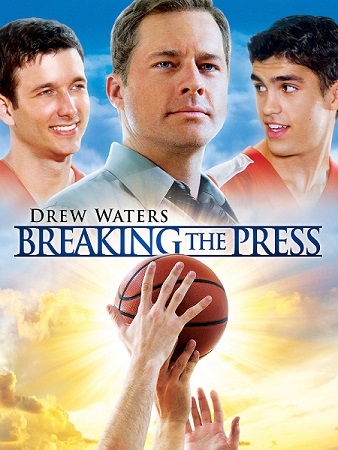
2010’s Breaking The Press is based on the parable of the prodigal son, this time imagining the father as a high school basketball coach in rural Texas and his two sons as his star players. When one of his sons gets an offer to play basketball for a ritzy school in Dallas, he jumps at the opportunity. Unfortunately, things don’t go well in the big city. The prodigal son may be a good basketball player but he’s not mature enough to handle living away from his parents. Before long, he gets expelled from school and ends up living on the streets. Meanwhile, his father is coaching his team and his other son towards the state championship but will he be able to concentrate on the game when he learns what has happened? You can probably guess what this all leads to. I mean, I started off the review by sharing the parable and you did read all of that, right? You didn’t just skim it, did you?
In the end, Breaking the Press is a pleasant film. Even when the prodigal son ends up living on the streets, they’re not particularly frightening streets. By the standards of most prodigal son films, there’s not really much decadence to be found in Breaking the Press but that’s probably because the film was made for a family audience. That said, I kind of liked the film. Andrew Stevens is a Hollywood veteran and, even when working with an obviously low-budget, he still knows how to frame a shot and keep the action moving. Drew Waters is believable as the conflicted coach while his two sons are well-played by Tom Maden and Chad Holbrook. The film was shot in Waxahachie and there’s an authenticity to the film’s small town setting, one that helps the film survive a few heavy-handed moments. As a general rule, I’m going to enjoy any film that looks like it could have been filmed down the street from me.
I watched Breaking The Press last month, while I was recovering from a sinus infection. I was feeling like crap at the time but the film still held my interest and, most importantly, it didn’t make me feel any worse. That’s the key thing when it comes to a film like this. It was pleasant and it helped to pass the time until I felt up to watching something a bit more challenging.
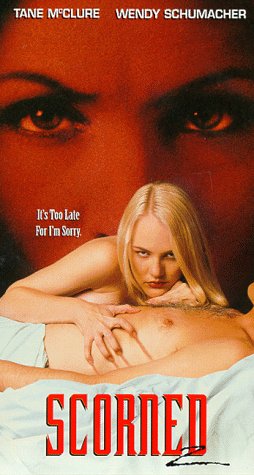
Released in 1993 as a part of the 90s Skinemax explosion, Scorned was one of the best of the many films to co-star Andrew and Shannon Tweed. The story of a vengeful widow (Tweed) hellbent on destroying Stevens’s family proved to be so popular that it was inevitable that there would be a sequel. Four years later, the mayhem continued in Scorned 2.
Tane McClure takes over Shannon Tweed’s role as Amanda, who has amnesia and can’t remember anything about her previous life as a sex-addicted sociopath. Amanda is now married to psychology professor Mark Foley (Myles O’Brien) but she’s haunted by nightmares (which are made up of scenes lifted from the first Scorned) that provide clues to her former life. While Amanda seeks help from a hypnotherapist, her frustrated husband ends up falling for one of his students, Cynthia (Wendy Schumacher). Cynthia already has a boyfriend but she’s willing to screw a professor if it will help her grades. When Amanda discovers that Mark is cheating on her, she snaps and reverts back to her old ways as she seeks revenge on everyone who she feels has betrayed her. Further complicating things is that Alex Weston (Andrew Stevens, reprising his role from the first Scorned) has recently arrived on campus and is seeking revenge for the death of his son.
Scorned 2 was made during the dwindling days of Skinemax, long after the heyday of late night cable’s popularity. It even featured a scene in which Cynthia’s boyfriend explains how computer passwords work, which is not something that anyone had to worry about when the first Scorned or its many imitators were initially released. Unfortunately, Shannon Tweed did not reprise her role as Amanda. Tane McClure was not a bad actress and bore a superficial similarity to Tweed but she just didn’t have Tweed’s ability to make even the stupidest dialogue sound natural. Andrew Stevens did return but his character is largely wasted. The real star of the film is Wendy Schumacher, for giving a credible performance while showing how far one student will go to keep up her grades. Considering the cost of college, can you blame her? Today, as with many of the films of that era, the main appeal of Scorned 2 is one of nostalgia.
What’s an Insomnia File? You know how some times you just can’t get any sleep and, at about three in the morning, you’ll find yourself watching whatever you can find on cable? This feature is all about those insomnia-inspired discoveries!
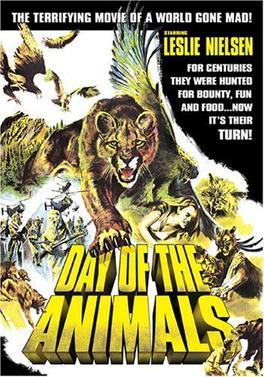
Last night, if you were having trouble sleeping around 2:30 in the morning, you could have turned on your television, changed the station to Movies TV, and watched the 1977 nature-goes-crazy horror film, Day of the Animals!
Now, I should admit that I was not suffering from insomnia last night. Jeff and I are currently up at beautiful Lake Texoma and we just happened to be up late last night and flipping through the stations. I should also admit that, unlike most of the other movies reviewed for this feature, Day of the Animals was not one of “those insomnia-inspired discoveries.”
No, we had both seen Day of the Animals before. The thing with Day of the Animals is that it’s one of those films that, if you see that it’s on TV, you simply have to stop what you’re doing and watch it. Considering that the man had a long career in the movies and I haven’t seen every film that he made, I could be wrong on this but I am fairly certain that Day of the Animals is your only opportunity to see Leslie Nielsen wrestle a grizzly bear.
Leslie Nielsen plays Paul, a businessman who is part of a group of hikers. Shortly before he wrestles with the bear, Paul stands, bare-chested, in the middle of a rainstorm and attempts to taunt God. “Melville’s God, that’s the God I believe in!” Paul shouts, “You want something!? YOU TAKE IT!” Then he turns to one of the hikers and says, “I know what I want and I’m taking it! I killed a man for you!”
Now, at this point, I should probably make it clear that Day of the Animals is not a comedy, though it’s always inspired a lot of laughter whenever I’ve watched it. Day of the Animals attempts to be a very serious horror movie. It even has an environmental message. Because of the hole in the ozone layer, solar radiation is driving all of the mountain animals crazy. Mountain lions attack campers. A grizzly bear wrestles Leslie Nielsen. A group of rats attempt to kill a policeman. German shepherds tear a man apart. And it’s not just the wild animals that are being affected. Leslie Nielsen goes crazy too.
Of course, Leslie Nielsen isn’t the only hiker. Genre vet Christopher George plays the leader of the tour and Lynda Day George is along for the ride as well. If you’ve seen the movie Pieces, you’ll remember Christopher George as the tough cop and Lynda Day George as the tennis pro who, at one point, dramatically screams “BASTARD!” into the wind. Susan Backlinie, who was the first victim in Jaws, also has a role in this film and that seems appropriate. Director William Girdler found quite a bit of success in ripping off Jaws. Before Day of the Animals, he directed Grizzly.
But good ole Leslie Nielsen is pretty much the entire show here. He tries really, really hard to give an intense and frightening performance. In fact, he tries so hard that you almost feel guilty for laughing at times. But then you see that head of perfect silver hair and you hear that deadpan voice saying, “Come here, you little punk!” and you just can’t help yourself.
Anyway, Day of the Animals may be bad but I defy anyone not to watch it.
“In an hour, I promise, you’ll be able to beg in two languages.” — Patricia (Shannon Tweed) in Scorned
If anyone could pull that line off, it would be Shannon Tweed at the height of her Skinemax stardom!
In Scorned, Shannon plays Patricia, the beautiful wife of executive Truman Langley (Daniel McVicar). Truman is desperate to land the Wainwright account, thinking it could be the key to getting a huge promotion. To help him out, Patricia sleeps with Mason Wainwright (Stephen Young). Truman gets the account but Alex Weston (Andrew Stevens, who also directed) gets the promotion. After Truman kills himself, Patricia shows up at the Weston house, disguised as a tutor for their son, Robey (Michael D. Arenz). Like clockwork, Patricia seduces not just Alex and Robey but Marina Weston (Kim Morgan Greene) as well.
Of the many direct-to-video films that Andrew Stevens and Shannon Tweed made together in the 90s, Scorned is one of the best. Of course, Shannon Tweed looks good. Of all the regular 90s direct-to-video vixens, Shannon was the sexiest. What is often forgotten is that Shannon could also actually act and she shows that here with her ferocious performance. Andrew Stevens does a good job too, giving an above average performance and, as a director, staying out of Shannon’s way. He knows that everyone watching the movie is watching to see Shannon and this film does not disappoint.
It does stretch credibility that no one in the household realizes that Shannon is trying to destroy them but, then again, what parents would actually hire their hormonal, teenage son a live-in tutor who looks like this?
It is all about maintaining a healthy suspension of disbelief.
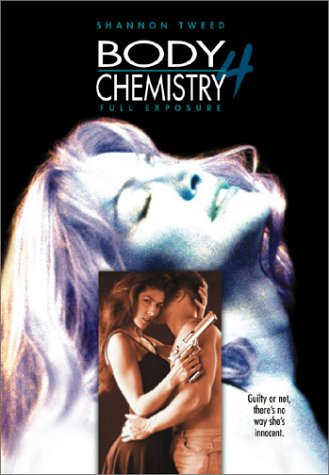
After five years of kinky sex and murder, the Body Chemistry franchise ended with Body Chemistry 4: Full Exposure.
Like the third film, Full Exposure was directed by Jim Wynorski and produced by Andrew Stevens. Shannon Tweed stepped into the role of murderous Dr. Claire Archer, replacing Shari Shattuck. Shannon Tweed was always one of the most talented of the actresses who regularly appeared on what was then nicknamed Skinemax. It wasn’t just that Tweed always seemed to being give it her all in her films’ frequent sex scenes. Tweed also had the look and style of an old-fashioned femme fatale. It was easy to imagine her trading sultry quips with Alan Ladd or Tom Neal. This made Tweed perfect for the role of Claire Archer and her performance was a noticeable improvement on Shari Shattuck’s. It’s just too bad the rest of the film was such a snoozefest.
In Full Exposure, after getting away with three murders in the first two BodyChemistry films, Claire has finally been arrested. She is on trial for killing Alan Clay (Andrew Stevens) at the end of the third film. However, she has a hotshot lawyer named Simon Mitchell (Larry Poindexter) and she is soon up to her old tricks, having sex with Simon in his office, a parking garage, and an elevator. Simon’s aide, Lane (Marta Martin), has come across proof of Claire’s crimes but Claire has a plan to take care of that. She always does.
Full Exposure starts out as a typical Body Chemistry film, with neon-lit sex scenes, but it quickly get bogged down in lengthy courtroom sequences. In the previous three films, Claire at least had some sort of motivation but here, it’s never clear why she would try to destroy her lawyer’s life during the trial instead of waiting until he had, at least, gotten her off the hook. Tweed is a perfect Claire but the rest of the cast is just going through the motions. Though Claire once again got away with murder, there were no more chapters to her story after this one. The Body Chemistry franchise managed to do a lot with a very thin premise but Full Exposure shows, that by the fourth film, there was no where left to go.


 “In an hour, I promise, you’ll be able to beg in two languages.” — Patricia (Shannon Tweed) in Scorned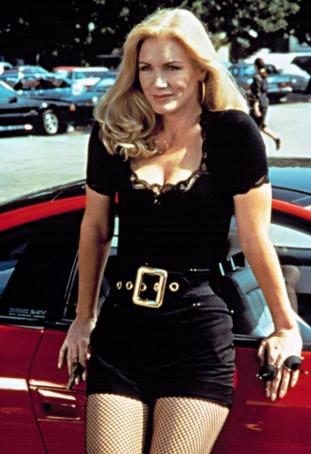
 Through the Shattered Lens