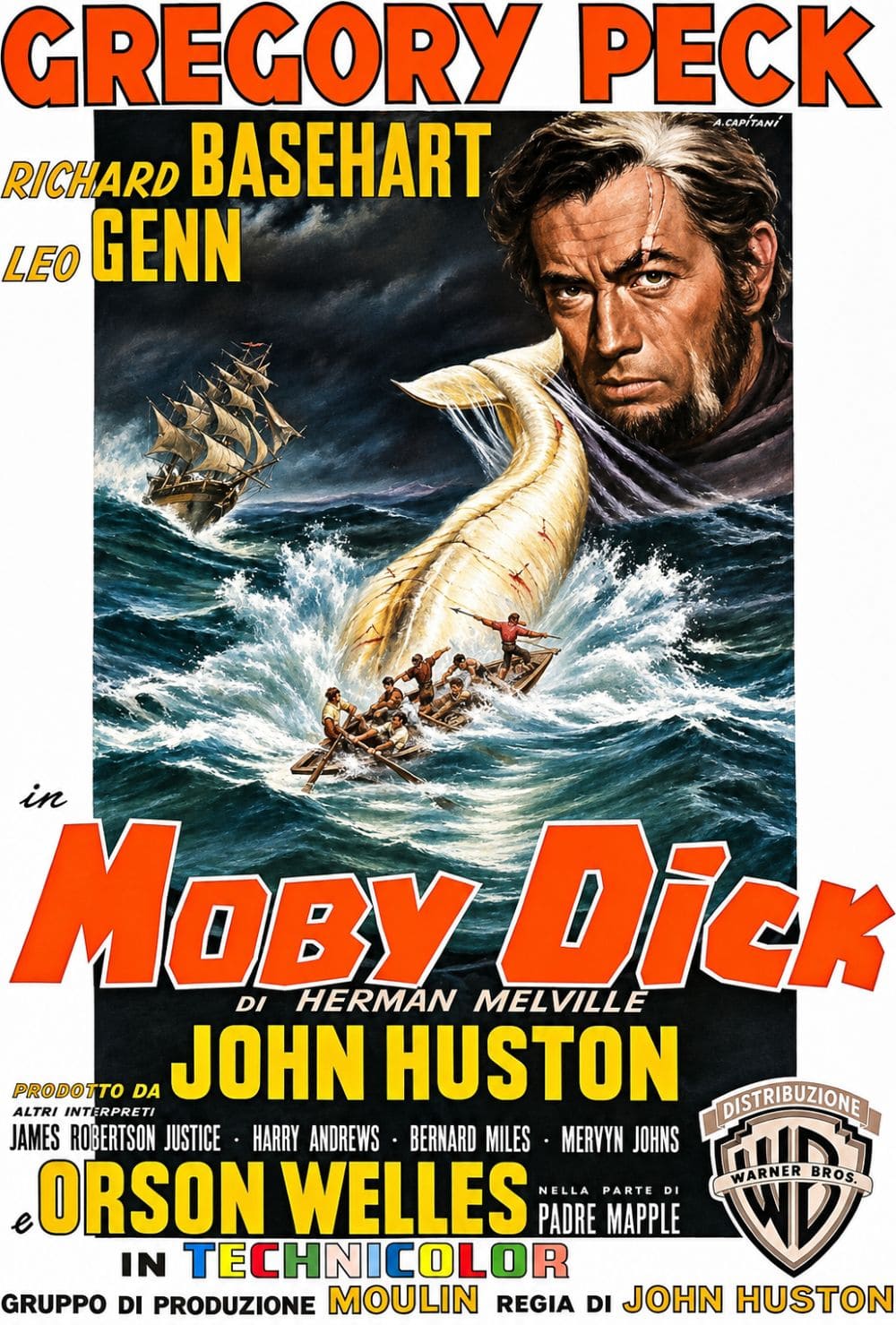
“I’ll follow him around the Horn, and around the Norway maelstrom, and around perdition’s flames before I give him up.” — Captain Ahab
The most frightening thing in John Huston’s Moby Dick (1956) is not the enormous white whale. It is the certainty of a man who has decided that his suffering gives him the right to endanger everyone around him. That is what gives this seafaring adventure its bite. Beneath the harpoons, salt spray, and booming speeches is a story about a captain who turns personal pain into a collective mission. Huston gives Herman Melville’s Moby-Dick the scale of an old-fashioned Hollywood epic, but the film’s real strength is its uncomfortable understanding of how easily commanding leadership can slide into destructive obsession.
The story begins with Ishmael, played by Richard Basehart, looking for work and a little adventure at sea. He joins the crew of the Pequod expecting a whaling voyage, not a front-row seat to his captain’s unraveling. Captain Ahab has other plans. Having lost his leg to Moby Dick, he intends to hunt down the whale regardless of the danger or the ship’s actual business. The setup is straightforward, and that simplicity helps the movie. Even when the dialogue becomes grand and biblical, the central problem stays clear: everyone’s future rests in the hands of someone who no longer recognizes reasonable limits.
Gregory Peck makes that problem fascinating to watch. Ahab was a real change from the quiet, heroic roles Peck usually played, but he uses that familiar reserve rather than abandoning it. His captain has the upright bearing and controlled delivery of a man accustomed to being respected. What has changed is the purpose behind that authority. Despite working outside his usual screen personality, Peck plays an excellent Ahab, bringing quiet dignity to the simmering obsession eating away at him. There is something especially unsettling about watching an actor so associated with steadiness turn that quality into an expression of dangerous, immovable conviction.
Peck’s performance works best when he lets the anger sit beneath the surface. His stillness can suggest that Ahab has spent so long nursing his hatred that it no longer needs constant outward expression. When the speeches arrive, they feel like pressure finally escaping. The performance does have a theatrical edge, and some viewers may find his delivery too formal. For me, that formality mostly fits. Ahab is not simply having a bad voyage; he has built an entire identity around his grievance. Peck makes him seem like a man determined to maintain his grandeur even as his judgment falls apart.
Huston strengthens that impression by delaying Ahab’s full introduction. Before we properly meet the captain, we feel the uncertainty surrounding him, which gives his eventual appearance more weight. Meanwhile, Ishmael offers a welcoming way into the story. Basehart is not as commanding as Peck, but his openness serves a useful purpose: he lets us experience the voyage before Ahab’s will completely takes it over. The early scenes establish a working community with its own friendships, routines, and expectations. That matters because the crew must feel like people with lives of their own, not merely an audience for their captain’s speeches.
Leo Genn’s Starbuck provides the clearest challenge to Ahab’s thinking. He understands that a captain has responsibilities beyond satisfying his own anger, and his resistance gives the film an essential moral tension. This is not a simple contest between a brave man and a timid one. Starbuck’s caution requires its own courage, especially when Ahab can make his private revenge sound like a glorious shared purpose. Orson Welles also makes a memorable impression as Father Mapple. His sermon gives the opening a sense of spiritual danger, preparing us for a voyage in which pride and disobedience matter as much as wind and weather.
The film’s visual style reinforces that feeling without making every scene look like an obvious symbol. Cinematographer Oswald Morris gives the images a muted, weathered appearance that suits the roughness of the setting. This is not a sparkling ocean playground. The ship looks vulnerable against the water and sky, and even the beautiful views carry a hint of menace. Huston also understands the appeal of the practical details: ropes, boats, crowded decks, and men working together. Those textures keep the film grounded. The more convincing the ordinary labor becomes, the more disturbing it is when Ahab redirects that labor toward his own destructive goal.
As an adaptation, Moby Dick inevitably trades some of Melville’s range for dramatic focus. The screenplay, credited to Huston and Ray Bradbury, cannot accommodate all the novel’s digressions, shifting tones, and philosophical curiosity. Instead, it builds a clear line toward the confrontation between Ahab and the whale. That approach makes the film accessible, though it also narrows the experience. Ishmael becomes less of an expansive storytelling presence, while Ahab increasingly dominates everything. Still, the choice suits the movie’s central effect. We feel the voyage tightening around one man’s purpose until there seems to be very little room left for anyone else’s judgment.
The final hunt has moments when the effects show their age, particularly when the whale must function as a convincing physical creature. Yet the climax remains gripping because Huston has already established what is emotionally at stake. The important question is no longer whether the monster will look completely real. It is whether anyone can escape the consequences of Ahab’s certainty. That is why Moby Dick stays with me more as a tragedy than as a spectacle. Peck’s wounded dignity makes the captain worth watching, but never makes him right. By the end, the film has turned a thrilling pursuit into a bleak reminder that a leader’s strength means very little when he has lost the ability to turn back.

