Film Review: Notorious (dir by Alfred Hitchcock)


Today is the 121st birthday of one of the great actors of Hollywood’s Golden Age, the one and only Cary Grant.  For those of us who love to watch older films, Grant is usually the epitome of old-fashioned movie star charisma.  He was an actor who could do it all, from screwball comedy to tear-jerking melodrama to exciting thrillers.  What one usually hears about Cary Grant is that he was an actor who was taken for granted because he made everything seem so effortless.

And yet, there was a darkness to Grant’s best performances.  Like Jimmy Stewart, he was an actor whose affable screen presence often hinted at inner turmoil.  And, much as in the case of Stewart, Alfred Hitchcock was a director who immediately understood that.  He cast Grant in some of his best films, usually playing a character with a secret or two to hide.  One of my favorite “darker” Grant performances and films is 1946’s Notorious.

Directed by Alfred Hitchcock, Notorious opens with T.R. Devlin (Cary Grant) meeting and, it is implied, seducing Alicia Huberman (Ingrid Bergman).  Alicia, at the time, was attempting to drink away her sorrow over her father being convicted of treason for his pro-Nazi activities during World War II.  As the daughter of an American Nazi with a reputation for drinking too much and being promiscuous, Alicia is indeed notorious.  That’s something that Devlin uses to his advantage the next morning when he informs that hangover Alicia that he is an American intelligence agent and that he is investigating the activities of a group of Nazi sympathizers who fled to South America at the end of the war.  He wants Alicia, as the daughter of a known sympathizer, to infiltrate their operations.

Reluctantly, Alicia agrees and, while they wait for to learn the exact details of her assignment, they fall in love.  Devlin is not happy when his superiors inform him that they want Alicia to approach and seduce Alex Sebastian (Claude Rains), a friend of her father’s who now lives in Brazil with his domineering mother (Leopoldine Konstantin).  Alicia is even less happy when Devlin tells her of the assignment, especially as she knows that the weak-willed Sebastian has always been in love with her.  She assumes that Devlin only pretended to love her.

After Devlin arranges for Alicia to be at the local riding club at the same time as Alex, Alex meets her and immediately brings her to the mansion that he shares with his mother.  Alex is an interesting character.  When we first meet him, he hardly seems like a Nazi sympathizer.  His happiness when he sees Alicia and the apparent sincerity of his love for her stands in contrast to the often cold, manipulative, and harsh Devlin.  Sebastian invites Alicia to move into his mansion and soon, Alicia tells Devlin that he can add Sebastian to “my list of playmates.”  When Sebastian asks Alicia to marry him, Devlin tells Alicia to do what she wants.  Alicia married Sebastian though she loves Devlin but she soon discovers just how for Sebastian and his mother will go to protect themselves and their Nazi conspirators.

Notorious is famous for its 2 and a half kissing scene between Devlin and Alicia, filmed at a time when the production code specifically stated that kisses could only last for three seconds.  Hitchcock handled this by interrupting the kiss every three seconds and then having his two stars get back to it.  Both Cary Grant and Ingrid Bergman said the scene was awkward to shoot, specifically because they had to keep finding reasons to split apart without splitting too far apart but the effect onscreen is amazingly romantic and probably about as erotic as 1940s studio production could be.  In that scene, you have no doubt that Devlin and Alicia share a passion that Alex, even though he is in love with Alicia, could never understand.  Grant and Bergman have an amazing chemistry in this scene and really the entire film.

As played by Cary Grant, Devlin is not always likable in Notorious.  He can be cold and manipulative and judgmental but, in the end, we never doubt his love for Alicia.  Alex also loves Alicia but he ultimately puts himself (and his mother) first.  As for Alicia, she is someone who has been unfairly branded by both the activities of her father and her past reputation and anyone who has ever come to work or gone to school on a Monday morning and heard the snickering that goes along with the rumors about what she did during the weekend will immediately relate to Alicia.  Alicia is told that the mission is a way to redeem herself but the film suggests that no redemption is necessary.  If anything, it’s Devlin who needs to redeem himself for the way he previously manipulated and judged her.  Devlin and his superiors are trying to stop a group of Nazi sympathizers from graining power in South America and their mission is an important one.  (That sentiment would be even more true from audience watching in 1946, just a year after the end of World War II).  But the important of their mission doesn’t change the fact that the people involved are human beings with very real and very fragile emotions.

Notorious features some of Hitchcock’s best set pieces, from the famous kissing scene to another scene involving the key to a wine cellar.  Grant, Bergman, and Rains give three of their best performances in this intelligent thriller.  (Watching, one can see why Ian Fleming suggested Cary Grant as a possible James Bond.)  I first saw Notorious in a film class in college.  At first, the class was a bit hesitant about a black-and-white movie from 1946 but, by the end, there were cheers as Devlin rushed to save Alicia.  Notorious is a timeless classic.

Notorious (1946, dir by Alfred Hitchcock, DP: Ted Tetzlaff)
THE UNTOUCHABLES (1987) – Happy 70th Birthday, Kevin Costner!


There was a time in my life, before I could drive, when I would beg my parents to stop at the video store every time we went to the neighboring town of Conway, Arkansas. The town I grew up in was too small to have more than just a gas station, so this movie buff had to take advantage of every trip to town. One night when we were headed home, my parents relented to my repeated requests, so we stopped off at Budget Video. I wanted to choose all the movies, but unfortunately mom and dad would also let my brother and sister choose movies from time to time as well. On this particular night, my brother wanted to rent THE UNTOUCHABLES (1987). I don’t remember what I was wanting, but I do remember that it was not THE UNTOUCHABLES. I probably pouted a little bit, but we ended up taking THE UNTOUCHABLES home with us. We turned it on that night, and I’ll gladly admit that I was 100% wrong. THE UNTOUCHABLES immediately became one of my favorite films. Great job, bro!

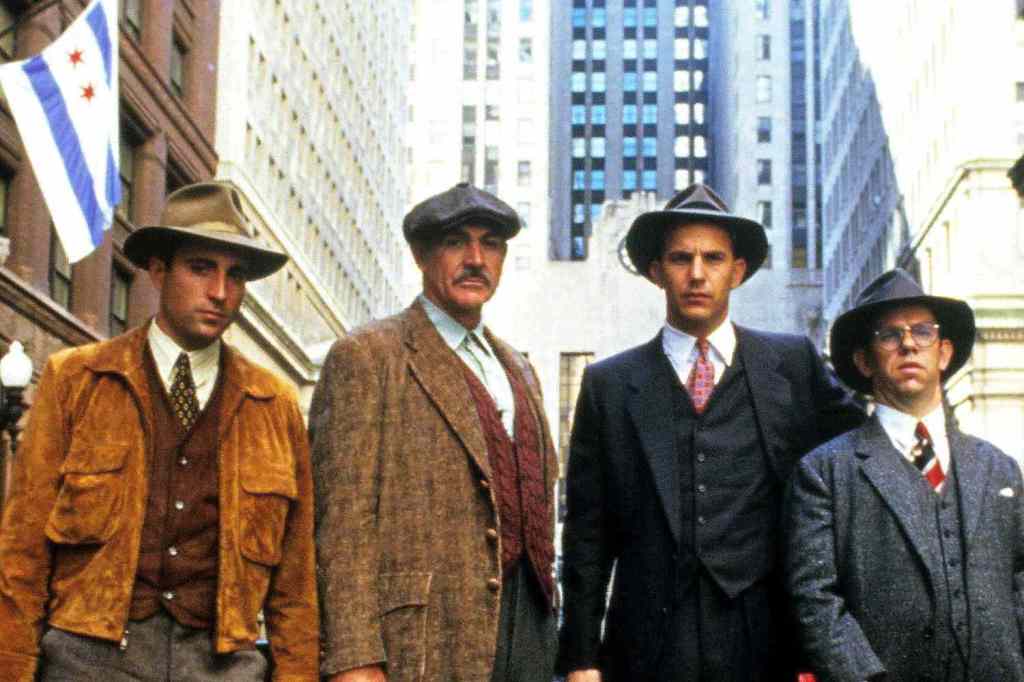
It’s 1930 and Prohibition is the law of the land in the United States of America. Treasury agent Eliot Ness (Kevin Costner) has been given the seemingly impossible task of bringing down notorious gangster Al Capone (Robert De Niro), who supplies booze to nearly all of Chicago. Capone doesn’t just supply the booze, he rules Chicago with an iron fist; and if you’re a local business who doesn’t want to buy his product, he just may blow your ass up! Ness’ job is made especially difficult due to the rampant corruption in Chicago, where everyone from the Mayor, to the judges, lawyers, and law enforcement officers are all on Capone’s payroll, making it pretty much impossible to trust anyone. In a complete stroke of luck, Ness encounters the honest Irish American policeman James Malone (Sean Connery) and asks him to join him in bringing down Capone. With Malone, Ness has found that honest and badass cop who’s not afraid to go up against Capone and his goons. Knowing that most of the police force is already compromised, the two men head to the police academy to try to find another honest cop. This turns out to be another great move as they come upon an Italian American trainee named George Stone (Andy Garcia), who’s a prodigy with a gun. Their last, and greatest move in this humble CPA’s opinion, comes when they accept accountant Oscar Wallace (Charles Martin Smith) to their team. Wallace is convinced that the key to bringing down Capone is trying to build a tax evasion case against him. He’s initially laughed at, but it’s soon apparent that this accountant knows his debits and credits, and his expertise may be just what’s needed to end Capone’s reign of terror once and for all.

I’ve always considered THE UNTOUCHABLES to be a near perfect film. One of the main reasons I find the film so perfect is the direction of Brian De Palma. I’ve been a fan of his “style” for so long, with films like DRESSED TO KILL (1980) and BLOW OUT (1981), but I think he just nails the material here. There are so many great scenes, but the “Union Station” sequence has to be one of the most perfectly choreographed sequences of all time. The building of the tension, the slow-motion shootout when the bad guys arrive, and finally the badass resolution all prove what an absolute master De Palma could be with the right material. De Palma claims that he made up the series of shots as he was filming the scenes at the train station, making the final product that much more impressive. And this all plays out against the background of a “lullaby theme” composed by the legendary Ennio Morricone (THE GOOD, THE BAD, AND THE UGLY). This is what “cinema” is all about.

THE UNTOUCHABLES has an amazing cast of actors to bring its “based on real events” story to life. Kevin Costner was just beginning to emerge as a movie star when this movie was made back in 1987. Especially as a younger actor, Costner was good at projecting both a certain innocence, tempered with the willingness to do what it takes to get the job done once his family and friends are put in danger. And what can you say about actors like Sean Connery and Robert De Niro?!! Connery is so charismatic, wise, and tough as the beat cop who shows Eliot Ness how to beat Capone… ”he sends one of yours to the hospital, you send one of his to the morgue!” He’s a beat cop because he’s incorruptible, and Connery projects that stubborn honesty perfectly. I’m so glad that Connery won an Oscar for this performance, as it would be the only time he would ever be nominated for an Academy Award. He’s amazing in this role, even if his accent is Scottish rather than Irish (a notable controversy at the time). Connery may have won the Oscar, but Robert De Niro matches him scene for scene. His ability to make Capone both charismatic and evil in equal measure is an example of what makes De Niro special as an actor. So many actors phone in these types of broad performances, but not De Niro. I also just think it’s cool that De Niro admitted that his performance was heavily influenced by Rod Steiger’s in 1959’s AL CAPONE. I love Steiger and consider this a wonderful tribute. Throw in a young Andy Garcia, the always underrated Charles Martin Smith, and a creepy Billy Drago as Frank Nitti, and you have one of the better casts ever assembled. I especially became a fan of Garcia based on his performance in THE UNTOUCHABLES.

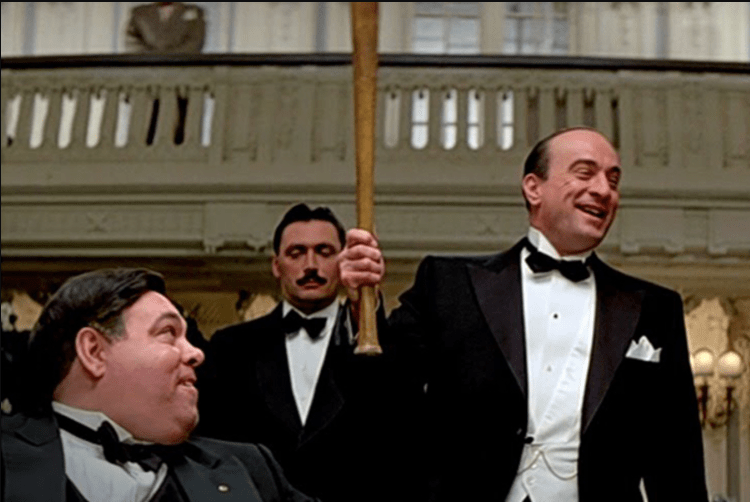
The last person I want to mention is the screenwriter, David Mamet. His screenplay is another perfect element of THE UNTOUCHABLES. The same man who has directed his own films like HOUSE OF GAMES (1987), HOMICIDE (1991), THE SPANISH PRISONER (1997), and SPARTAN (2004) knows how to write a great screenplay. There are so many amazing moments, from the “baseball bat” sequence to the “Stone recruitment” scene, and even Ness’ “he’s in the car” line about Frank Nitti, it’s a muscular screenplay full of big-time moments of audience satisfaction.

At the end of the day, THE UNTOUCHABLES is just a great movie. I still periodically thank my brother for picking it out that fateful day in the late 80’s, and it will always be one of my very favorites. It’s one of those movies that I recommend with zero reservations!

Check out the trailer below, and if you’re smart, you’ll watch one of the great movies of the 1980’s, Brian De Palma’s THE UNTOUCHABLES.

Music Video of the Day: Delta 88 Nightmare by X (2019, dir by Henry Mortensen)


How about starting the long weekend with X?

This video stars and was directed by Exene’s son, Henry Mortensen and co-stars her niece, Carolyn Allen.  The video was shot in Cannery Row in Monterey, California.

Enjoy!

Late Night Retro Television Review: Friday the 13th 2.24 “The Shaman’s Apprentice”


Welcome to Late Night Retro Television Reviews, a feature where we review some of our favorite and least favorite shows of the past! On Fridays, I will be reviewing Friday the 13th: The Series, a show which ran in syndication from 1987 to 1990. The entire series can be found on YouTube!

This week, Micki is faced with a moral dilemma.

Episode 2.24 “The Shaman’s Apprentice”

(Dir by William Fruet, originally aired on May 29th, 1989)

Micki’s friend, Blair (Isabelle Mejias) is in the hospital.  She’s been having serious chest pains and, as Micki puts it, she’s too young to be suffering from them.  Blair finds out that she has a sarcoma and the doctors are not giving her much chance to live.  Dr. Lamar (James B. Douglas), the arrogant head of surgery at the local hospital, doesn’t seem to really care whether Blair lives or dies.  All he cares about is taking care of the wealthy patients who might be moved to donate some of their money to the hospital.

However, Blair has found a reason for hope.  There is a Native American doctor named John Whitecloud (Paul Sanchez).  He has his own clinic, one that is funded by a rich man who Dr. Lamar said couldn’t be saved.  Dr. Lamar hates Whitecloud, largely because Lamar is a racist who views Whitecloud’s “shamanistic” techniques with scorn.  However, Whitecloud appears to be capable of saving anyone.  Of course, the doctors and the nurses who have failed to treat Whitecloud with respect have a habit of mysteriously dying, usually right before Whitecloud manages to save a terminal patient.

Whitecloud does indeed have an objects that Jack and Ryan are interested in retrieving.  It’s not a cursed antique.  Instead, it’s a rattle that Whitecloud stole from his grandfather, Spotted Owl (Gordon Tootoosis).  Whitecloud is using the rattle to cure his patients but, for every cure, he also has to use it to kill someone else.  Whitecloud even uses it to kill Spotted Owl, though Whitecloud seems to feel bad about doing it.  When Jack realizes that Whitecloud’s next target is going to be Dr. Lamar, he and Ryan are determined to stop him….

….except, as Micki points out, stopping Whitecloud will mean that her friend Blair will die.  Why, Micki wonders, should Lamar get to live while Blair dies?  Micki argues that they should at least let Whitecloud cure Blair but Jack gently explains that it doesn’t work that way.  Jack says that their job is not to play God.

Long story short: The spirit of Spotted Owl shows up to drag Whitecloud into the afterlife.  Jack gives the rattle back to the tribe, despite Ryan feeling that it should be in the vault.  (“It’s not ours to take,” Jack explains in that reasonable and reassuring way of his.)  Micki is angry and depressed that Blair is probably going to die.  Blair stands on a street corner and stares at Whitecloud’s now empty clinic.  Roll the end credits!

Wow, that was depressing!  But it was really the only way the episode could end and I respect the fact that the show had the courage and the integrity to stay true to itself and end on such a down note.  Not many shows would have had the courage to resist coming up with some sudden, miracle solution.  This episode had some really cheap looking special effects and some not-so-great acting from some of the guest stars but Chris Wiggins, Robey, and John D. LeMay were as strong as always.  This episode was especially an effective showcase for Chris Wiggins, who played Jack with just the right amount of weary gravitas.  This was a depressing episode but it was a good one.

Lisa Marie Review An Oscar Nominee: Here Comes Mr. Jordan (dir by Alexander Hall)


1941’s Here Comes Mr. Jordan tells the story of Joe Pendelton (Robert Montgomery).

Joe’s a boxer, an honest and kind-hearted guy who is in training for the big title fight.  Despite the concerns of his trainer, Max (James Gleason), Joe decides to take his own private airplane out for a flight.  A freak accident causes the plane to go into a nosedive and Joe suddenly finds himself standing amongst the clouds with a bunch of other people who are waiting for their chance to enter Heaven.

7013 (Edward Everett Horton), an angel, explains that he took Joe’s soul up to heaven when he saw that the plane was about to crash.  Joe is not happy about this.  He wants his title fight!  7013’s superior, Mr. Jordan (Claude Rains), checks his records and discovers that a mistake has been made.  Joe was supposed to live until 1991 and he was also supposed to win the boxing championship.  Unfortunately, Max has had Joe’s body cremated.  Mr. Jordan decides to put Joe’s soul into the body of someone else who is scheduled to die.  Joe asks to be put in the body of an athlete so that he can pursue his boxing career.

Instead, Joe ends up in the body of a middle-aged banker named Bruce Farnsworth.  Farnsworth has been poisoned by his wife (Rita Johnson) and her lover (John Emery).  At first, Joe refuses to become Farnsworth but when he sees his murderers taunting Bette (Evelyn Keyes), whose father was defrauded by Farnsworth, Joe changes his mind.  His murderers are shocked when Farnsworth turns out to be alive.  Bette is shocked when the previously cold Farnsworth helps her get back the money that her father lost.  And Max is shocked when Farnsworth calls him to the mansion and explains that he’s really Joe Pendleton.  Only with Joe/Farnsworth plays the saxophone badly does Max believe what Joe says.  Joe asks Max to train him for the boxing match that he was scheduled to fight while alive.  Max agrees but Mr. Jordan warns Joe that, if he’s going to fulfill his destiny and become champ, it’s not going to be as Bruce Farnsworth, regardless of the fact that Joe/Farnsworth and Bette have now fallen in love.

A romantic comedy that is blessed with two likable performances from Robert Montgomery and Evelyn Keyes and a great one from Claude Rains, Here Comes Mr. Jordan was nominated for Best Picture of 1941.  It lost to How Green Was My Valley.  While Here Comes Mr. Jordan really can’t compare to some of the other films that lost (amongst the other nominees were Citizen Kane and The Maltese Falcon), it’s still a wonderfully charming film that holds up well today.  Everyone should be as lucky as to have a guardian who is as charming and urbane as Claude Rains is as Mr. Jordan.

In 1978, Here Comes Mr. Jordan was remade by Warren Beatty, who named his version of the story Heaven Can Wait.  That version of the story was also nominated for Best Picture, though it lost to The Deer Hunter.

Cops and Robbersons (1994, directed by Michael Ritchie)


Chevy Chase is Norman Robberson, a hen-pecked suburban dad who likes to watch cop shows.  When he is informed that his next door neighbor, Horace Obsborn (Robert Davi), is suspected of being a Mafia hitman, he agrees to allow Detectives Jake Stone (Jack Palance) and Tony Moore (David Barry Gray) to use his house as their stakeout location.

Cops and Robbersons is just as terrible as its title.  Norman is basically Clark Griswold without the excuse of a vacation or the holidays to explain away his stupidity.  Jack Palance growls and looks annoyed but without the same comedic flair that he brought to City Slickers.  Dianne Wiest is wasted as Norman’s wife.  Of course, Norman’s daughter develops a crush on Tony while Norman’s son dressed up like Dracula and tries to put the bite on Stone.  Norman keeps getting in the way of the two cops and trying to conduct an investigation on his own.  There has to be an easier way to capture a hitman.  The only thing that really works is Robert Davi’s performance as the hitman.  Davi doesn’t try to be funny, which actually brings out the best in Chase whenever they share a scene.  Chase’s goofy dad shtick works best when he’s dealing with someone who isn’t trying to score laughs of his own.

How did the great Michael Ritchie end up directing movies like this?  Whoever let that happen should be ashamed.


Retro Television Review: St. Elsewhere 1.8 “Tweety and Ralph”


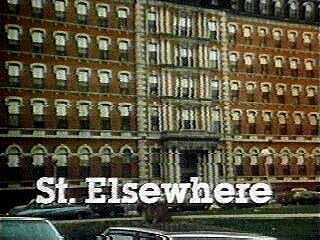
Welcome to Retro Television Reviews, a feature where we review some of our favorite and least favorite shows of the past! On Fridays, I will be reviewing St. Elsewhere, a medical show which ran on NBC from 1982 to 1988.  The show can be found on Hulu and, for purchase, on Prime!

Oddly enough, this week’s episode is not available on Hulu.  I had to purchase it on Prime.  I’m not really sure why this episode — and apparently this episode alone — wouldn’t be on Hulu.  The world of Streaming is a strange and arbitrary place.

Episode 1.8 “Tweety and Ralph”

(Dir by Mark Tinker, originally aired on December 20th, 1982)

Dr. Craig is still trying to track down the mysterious Dr. Barnum, the man who says that he’s interested in Craig’s convertible.  Dr. Craig is constantly getting messages from Barnum.  He’s constantly hearing Barnum being paged on the PA.  Craig has become obsessed with tracking down the elusive Dr. Barnum.

Of course, Dr. Barnum does not exist.  What started as a practical joke on the part of Dr. Samuels has grown into a hospital-wide conspiracy of people playing with the emotions of the pompous and prickly Dr. Craig.  Craig is so obsessed with selling his car that he even cuts his hand while working on the engine.  Finally, Dr. Craig’s wife, Ellen (played by William Daniels’s real-life wife, Bonnie Bartlett), confronts Samuels and tells him that she knows what he’s doing.  When Samuels hears that Craig cut his hand, he feels guilty.  He knows how important a surgeon’s hands are.  Samuels finally works up the courage to tell Craig the truth.  Craig laughs.  And then he punches out Dr. Samuels.

And you know what?  Dr. Samuels totally deserved it.  Good for you, Dr. Craig!

(Everyone seems to have forgiven Dr. Samuels for causing a VD break-out during the pilot.  They’re very forgiving at St. Eligius.)

Meanwhile, the Legionnaire’s outbreak is finally contained, with the culprit being one dirty shower head.  Ward 5 is re-opened!  Yay!  Dr. Westphall celebrates his victory but still comes across as being the most depressed man on the planet.  While that goes on, Dr. Fiscus reveals that he now carries a gun so he won’t get mugged in the ER again and Dr. Cavanero considers her decision to devote her life to her career when a friend check into the hospital for hysterectomy.

That said, the majority of the episode centered around Ralph (Richard Marcus) and Jane (Laraine Newman), two psychiatric patients.  Jane is pregnant and Ralph is the father.  Ralph is a genius who graduated at the top of his class from MIT and who invented his own personal computer.  Unfortunately, he also thinks that he’s a bird and has been stealing medical supplies to build a giant nest in one of the supply closets.  Jane wants to marry Ralph but, when she and Ralph go out to dinner with Dr. Beale, Jane can only watch in horror as Ralph panics at the sight of a cat.  “Caw!  Caw!” Ralph shouts as he jumps up on  a chair.  The cat, for its part, just looks confused.

In other words, the marriage is off.  Jane tells Ralph that she’ll always love him but that she can’t be with him anymore.  The episode ends with a close-up of Ralph intensely staring at the camera.  Uh-oh, that doesn’t look good….

This was a weird but ultimately effective episode.  I really shouldn’t have been as emotionally moved as I was by Ralph and Jane’s story.  Ralph’s behavior was more than a little cartoonish.  But, I have to admit that I felt really sad as Jane said goodbye to Ralph.  Richard Marcus and Laraine Newman did such a good job playing the characters that I couldn’t help but be sad that things weren’t working out for them.

Oh well.  I guess that’s just another day at St. Eligius….

Anime You Should Be Watching: MONSTER


“For you, all lives are created equal. That’s why I came back to life. But you’ve finally come to realize it now, haven’t you? Only one thing is equal for all, and that is death.” — Johan Liebert

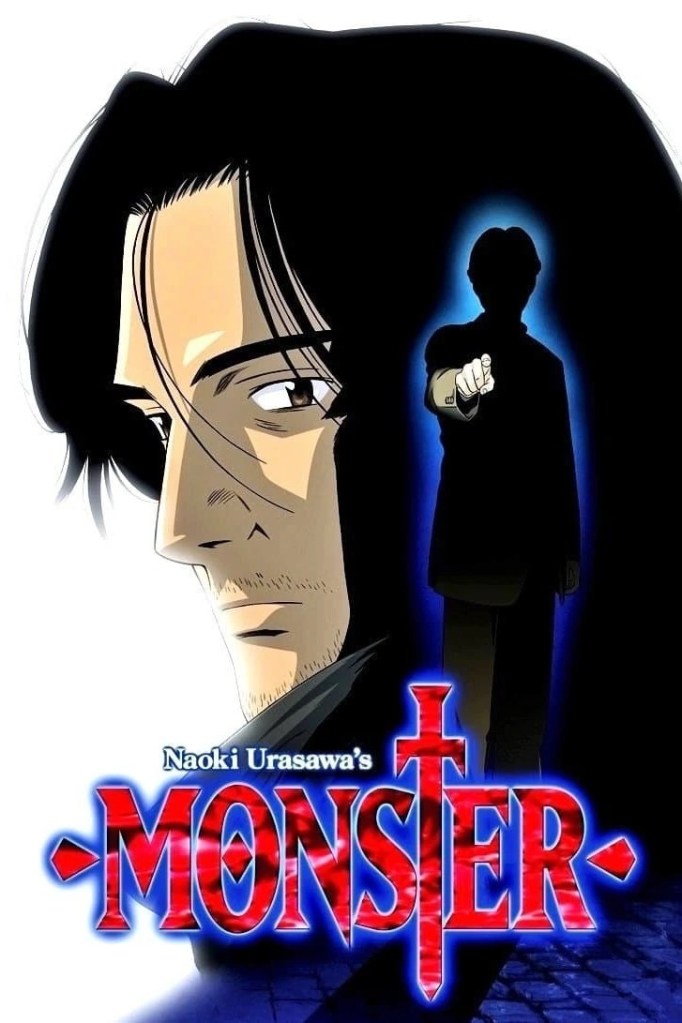
Naoki Urasawa’s MONSTER stands as one of the most accomplished psychological thrillers not just in manga, but in modern storytelling as a whole. Widely regarded as one of the greatest mangaka, Urasawa has built a reputation for crafting deeply human narratives that transcend genre boundaries. While his works span science fiction (20th Century Boys), sports (Happy!), and beyond, MONSTER represents perhaps his most fully realized exploration of morality, identity, and the fragile line between good and evil. Both the original manga (1998–2001) and its anime adaptation (2004–2005) serve as masterclasses in long-form storytelling, though each medium offers a slightly different experience in how these themes are conveyed.

At its core, MONSTER is a story about moral responsibility and the consequences of choice. Dr. Kenzo Tenma’s fateful decision to save the life of a young boy—who would grow up to become the enigmatic and terrifying Johan Liebert—forms the backbone of the narrative. What begins as an ethical stand against institutional corruption evolves into a haunting question: can a single act of good inadvertently unleash unimaginable evil? Urasawa refuses to offer easy answers. Instead, he constructs a world where morality is rarely absolute, and where even the most well-intentioned actions can ripple outward in unforeseen ways.

Johan himself is less a conventional antagonist and more an embodiment of philosophical dread. He represents the void—the idea that human identity can be hollowed out, shaped, or even erased entirely. Throughout the series, Urasawa interrogates whether evil is innate or constructed. Is Johan born a “monster,” or is he the product of trauma, manipulation, and systemic failure? This ambiguity is central to the story’s power. Unlike many thrillers that seek to explain or rationalize their villains, MONSTER leans into discomfort, suggesting that some truths may be fundamentally unknowable.

Another key theme is the search for identity, particularly in the aftermath of trauma. Characters across the narrative grapple with fractured pasts, false names, and reconstructed selves. Nina Fortner (Anna Liebert) serves as a compelling counterpoint to Johan—someone who has endured similar horrors but struggles toward healing rather than destruction. Through her and others, Urasawa presents identity not as something fixed, but as something constantly negotiated. Memory, in this context, becomes both a burden and a battleground. To remember is to risk pain; to forget is to risk losing oneself entirely.

The manga’s strength lies in how patiently and meticulously it develops these ideas. Urasawa’s paneling, pacing, and use of silence create a reading experience that feels almost surgical in its precision. He allows tension to build gradually, often dedicating entire chapters to side characters whose lives intersect with the central narrative in unexpected ways. These detours are not distractions but essential threads that reinforce the story’s thematic tapestry. They emphasize that MONSTER is not just about Tenma and Johan, but about a broader human landscape shaped by fear, ideology, and history—particularly the lingering shadows of post-Cold War Europe.

When Madhouse adapted MONSTER into an anime, the primary challenge was translating this deliberate pacing and narrative density into a different medium without losing its essence. Many adaptations of complex manga falter by condensing material or prioritizing spectacle over substance. MONSTER, however, takes the opposite approach. Spanning 74 episodes, the anime commits itself to a remarkably faithful retelling, often recreating scenes from the manga with near shot-for-shot accuracy.

This fidelity is both the anime’s greatest strength and, depending on the viewer, a potential limitation. On one hand, it preserves the integrity of Urasawa’s storytelling. The slow-burn pacing remains intact, allowing tension and atmosphere to develop organically. The anime resists the temptation to sensationalize its material, maintaining the grounded, almost clinical tone that defines the manga. On the other hand, this adherence means that the anime inherits the same demands it places on its audience. It requires patience, attention, and a willingness to sit with ambiguity—qualities that are increasingly rare in more fast-paced, contemporary anime.

Where the anime distinguishes itself is in its use of audiovisual elements to enhance the story’s emotional and psychological impact. The soundtrack, composed by Kuniaki Haishima, is particularly effective in reinforcing the series’ eerie, unsettling tone. Subtle musical cues and ambient sound design heighten tension in ways that static panels cannot. Silence, too, is used masterfully—moments of quiet often feel heavier and more oppressive when experienced in real time.

Voice acting further deepens character portrayal, especially in Johan’s case. His calm, almost hypnotic delivery adds an additional layer of menace that complements the manga’s more interpretive presentation. Similarly, Tenma’s internal conflict becomes more immediate and visceral when expressed through performance rather than internal monologue. These elements collectively make the anime a more immersive sensory experience, even as it mirrors the manga’s narrative structure.

Visually, the adaptation remains grounded and realistic, avoiding the exaggerated stylistic flourishes common in other anime. This restraint works in its favor, reinforcing the story’s mature tone. The European settings are depicted with care and authenticity, contributing to a sense of place that is crucial to the narrative. While the animation itself may not be as dynamic or visually striking as other series, it is consistently purposeful, prioritizing mood and clarity over spectacle.

In comparing the two, it becomes clear that the manga and anime function less as competing versions and more as complementary experiences. The manga offers a slightly more intimate engagement, allowing readers to control pacing and linger on specific panels or moments. Its visual storytelling invites interpretation, particularly in how it frames Johan’s presence—or absence—within a scene. The anime, by contrast, provides a more guided experience, using sound, timing, and performance to shape the viewer’s emotional response.

Ultimately, the success of the MONSTER anime lies in its restraint. Rather than attempting to reinterpret or modernize the source material, it recognizes the strength of Urasawa’s original vision and commits to preserving it. This makes it one of the rare adaptations that can stand alongside its source as an equal, rather than merely a derivative work.

MONSTER endures because it refuses to offer comfort. It challenges its audience to confront unsettling questions about human nature, morality, and the structures that shape our lives. Whether experienced through the manga or the anime, it remains a deeply affecting work—one that lingers long after its final moments. The anime may not surpass the manga in every respect, but it honors it with a level of care and seriousness that is all too rare, solidifying MONSTER as a benchmark for what adaptations can and should strive to be.

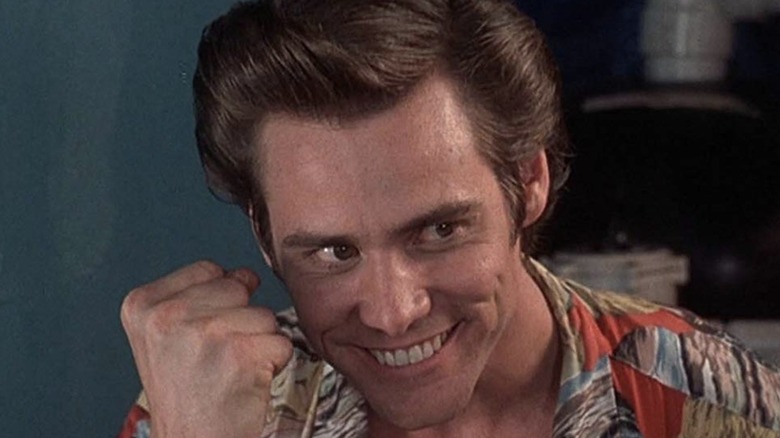
Happy 63rd Birthday, Jim Carrey! The ACE VENTURA (1994) montage sequence that made me a fan!


How many of you remember something specific that you did on February 9th, 1994? I do! I was sitting in a movie theater in Conway, Arkansas watching the goofy Jim Carrey comedy ACE VENTURA: PET DETECTIVE. I already knew he was a funny guy based on his various appearances on the sketch comedy show IN LIVING COLOR. I also remember seeing him in that vampire comedy ONCE BITTEN (1985) with Lauren Hutton when I was in junior high. To be honest though, when I was watching ONCE BITTEN in the mid-80’s, I was much more interested in Lauren’s character than I was in Jim’s. On this particular day in February of 1994, I was more interested in being at the theater because I had a major crush on the girl that was there with me. I figured the movie would be pretty silly, but that’s okay because I don’t mind silly comedies when they’re done right. Admittedly, I was also curious to see if Jim Carrey could actually carry a film by himself, and if the film would be as funny as the trailers I had seen.

I had settled in and was enjoying this film, when the montage shared below appeared on-screen, accompanied by Aerosmith’s “Line Up.” At the very end of the montage, when Ace Ventura resorts to chloroform to slow down the Dolphin player on the track, I probably laughed harder in the theater than I ever had up to that point in my life. I don’t think I’ve ever laughed as hard since either. The stars had all aligned and for that moment, I thought Jim Carrey was the funniest person on earth. Enjoy!