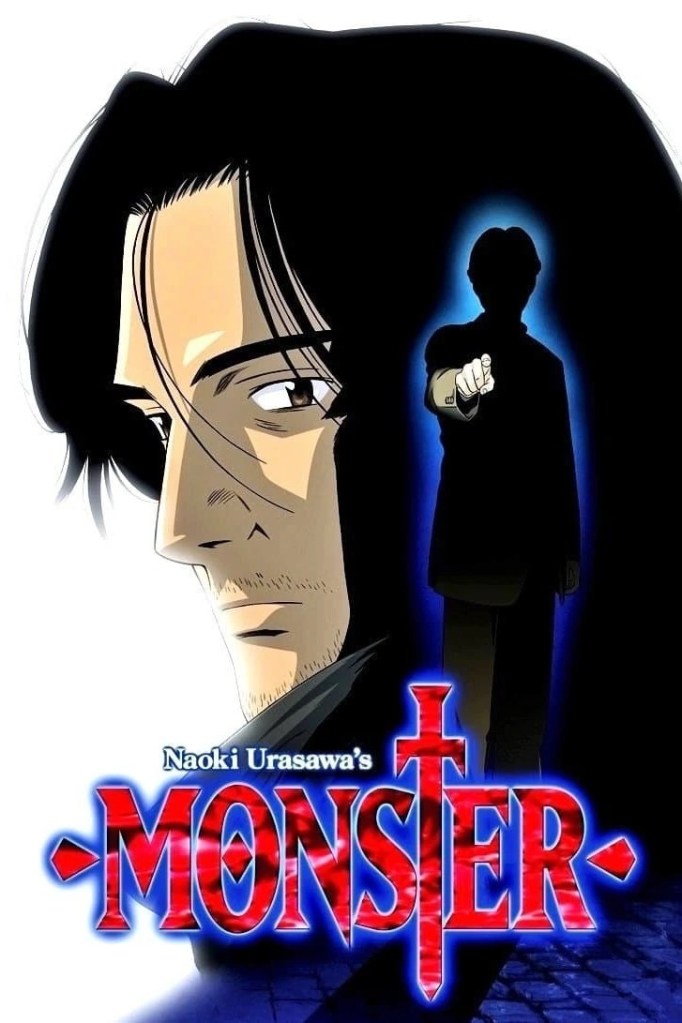
“For you, all lives are created equal. That’s why I came back to life. But you’ve finally come to realize it now, haven’t you? Only one thing is equal for all, and that is death.” — Johan Liebert
Naoki Urasawa’s MONSTER stands as one of the most accomplished psychological thrillers not just in manga, but in modern storytelling as a whole. Widely regarded as one of the greatest mangaka, Urasawa has built a reputation for crafting deeply human narratives that transcend genre boundaries. While his works span science fiction (20th Century Boys), sports (Happy!), and beyond, MONSTER represents perhaps his most fully realized exploration of morality, identity, and the fragile line between good and evil. Both the original manga (1998–2001) and its anime adaptation (2004–2005) serve as masterclasses in long-form storytelling, though each medium offers a slightly different experience in how these themes are conveyed.
At its core, MONSTER is a story about moral responsibility and the consequences of choice. Dr. Kenzo Tenma’s fateful decision to save the life of a young boy—who would grow up to become the enigmatic and terrifying Johan Liebert—forms the backbone of the narrative. What begins as an ethical stand against institutional corruption evolves into a haunting question: can a single act of good inadvertently unleash unimaginable evil? Urasawa refuses to offer easy answers. Instead, he constructs a world where morality is rarely absolute, and where even the most well-intentioned actions can ripple outward in unforeseen ways.
Johan himself is less a conventional antagonist and more an embodiment of philosophical dread. He represents the void—the idea that human identity can be hollowed out, shaped, or even erased entirely. Throughout the series, Urasawa interrogates whether evil is innate or constructed. Is Johan born a “monster,” or is he the product of trauma, manipulation, and systemic failure? This ambiguity is central to the story’s power. Unlike many thrillers that seek to explain or rationalize their villains, MONSTER leans into discomfort, suggesting that some truths may be fundamentally unknowable.
Another key theme is the search for identity, particularly in the aftermath of trauma. Characters across the narrative grapple with fractured pasts, false names, and reconstructed selves. Nina Fortner (Anna Liebert) serves as a compelling counterpoint to Johan—someone who has endured similar horrors but struggles toward healing rather than destruction. Through her and others, Urasawa presents identity not as something fixed, but as something constantly negotiated. Memory, in this context, becomes both a burden and a battleground. To remember is to risk pain; to forget is to risk losing oneself entirely.
The manga’s strength lies in how patiently and meticulously it develops these ideas. Urasawa’s paneling, pacing, and use of silence create a reading experience that feels almost surgical in its precision. He allows tension to build gradually, often dedicating entire chapters to side characters whose lives intersect with the central narrative in unexpected ways. These detours are not distractions but essential threads that reinforce the story’s thematic tapestry. They emphasize that MONSTER is not just about Tenma and Johan, but about a broader human landscape shaped by fear, ideology, and history—particularly the lingering shadows of post-Cold War Europe.
When Madhouse adapted MONSTER into an anime, the primary challenge was translating this deliberate pacing and narrative density into a different medium without losing its essence. Many adaptations of complex manga falter by condensing material or prioritizing spectacle over substance. MONSTER, however, takes the opposite approach. Spanning 74 episodes, the anime commits itself to a remarkably faithful retelling, often recreating scenes from the manga with near shot-for-shot accuracy.
This fidelity is both the anime’s greatest strength and, depending on the viewer, a potential limitation. On one hand, it preserves the integrity of Urasawa’s storytelling. The slow-burn pacing remains intact, allowing tension and atmosphere to develop organically. The anime resists the temptation to sensationalize its material, maintaining the grounded, almost clinical tone that defines the manga. On the other hand, this adherence means that the anime inherits the same demands it places on its audience. It requires patience, attention, and a willingness to sit with ambiguity—qualities that are increasingly rare in more fast-paced, contemporary anime.
Where the anime distinguishes itself is in its use of audiovisual elements to enhance the story’s emotional and psychological impact. The soundtrack, composed by Kuniaki Haishima, is particularly effective in reinforcing the series’ eerie, unsettling tone. Subtle musical cues and ambient sound design heighten tension in ways that static panels cannot. Silence, too, is used masterfully—moments of quiet often feel heavier and more oppressive when experienced in real time.
Voice acting further deepens character portrayal, especially in Johan’s case. His calm, almost hypnotic delivery adds an additional layer of menace that complements the manga’s more interpretive presentation. Similarly, Tenma’s internal conflict becomes more immediate and visceral when expressed through performance rather than internal monologue. These elements collectively make the anime a more immersive sensory experience, even as it mirrors the manga’s narrative structure.
Visually, the adaptation remains grounded and realistic, avoiding the exaggerated stylistic flourishes common in other anime. This restraint works in its favor, reinforcing the story’s mature tone. The European settings are depicted with care and authenticity, contributing to a sense of place that is crucial to the narrative. While the animation itself may not be as dynamic or visually striking as other series, it is consistently purposeful, prioritizing mood and clarity over spectacle.
In comparing the two, it becomes clear that the manga and anime function less as competing versions and more as complementary experiences. The manga offers a slightly more intimate engagement, allowing readers to control pacing and linger on specific panels or moments. Its visual storytelling invites interpretation, particularly in how it frames Johan’s presence—or absence—within a scene. The anime, by contrast, provides a more guided experience, using sound, timing, and performance to shape the viewer’s emotional response.
Ultimately, the success of the MONSTER anime lies in its restraint. Rather than attempting to reinterpret or modernize the source material, it recognizes the strength of Urasawa’s original vision and commits to preserving it. This makes it one of the rare adaptations that can stand alongside its source as an equal, rather than merely a derivative work.
MONSTER endures because it refuses to offer comfort. It challenges its audience to confront unsettling questions about human nature, morality, and the structures that shape our lives. Whether experienced through the manga or the anime, it remains a deeply affecting work—one that lingers long after its final moments. The anime may not surpass the manga in every respect, but it honors it with a level of care and seriousness that is all too rare, solidifying MONSTER as a benchmark for what adaptations can and should strive to be.
Anime You Should Be Watching
- Gakuen Utopia Manabi Straight
- Chōjin Densetsu Urotsukidōji
- School Days
- Higurashi no Naku Koro ni
- Toradora!
- Aria
- Azumanga Daioh
- Bible Black
- Puella Magi Madoka Magica
- Black Lagoon
- Ika Musume
- High School DxD
- Bakemonogatari
- Sailor Moon
- Princess Tutu
- Another
- Hellsing Ultimate
- Sword Art Online
- Wolf Children Ame and Yuki
- Toaru Kagaku no Railgun
- Nichijō
- Redline
- Gakkou Gurashi (School Live)
- Gate: Thus the Japanese Self-Defense Force Fought in Their Land
- Hinamatsuri
- Asobi Asobase
- Zombie Land Saga

