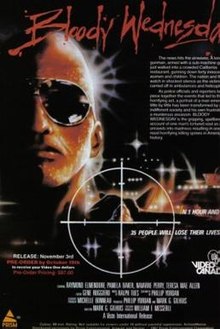
Harry (Raymond Elmendorf) is an auto mechanic with a problem. He has lost his mind. When he’s found staring at an engine that he’s taken apart and saying that he can’t put it all back together, he’s fired. When he shows up in church naked, he’s institutionalized. When his brother arranges for him to live in an abandoned and condemned Hollywood hotel (because that would be the perfect place for a man with deep mental issues to live), Harry loses it completely. After playing Russian roulette with a street gang and interacting with a hotel staff that only exists in his mind, Harry goes crazy on one bloody Wednesday.
Bloody Wednesday is a prototypical mediocre white man with a gun movie. Think of Taxi Driver, The Shining, The Joker, or even The King of Comedy, if all four of those films were terribly written, acted, and directed. It starts out strong, with Elmendorf doing a convincing job of portraying Harry’s growing psychosis, but goes downhill once Harry moves into the hotel and starts to interact with the people in his head. When he gets into argument and even fights with them, it doesn’t matter because we know that they don’t really exist outside of Harry’s imagination. Even worse is the street gang that actually does exist but which decides that they’re going to spare Harry’s life because he challenges them to a game of Russian Roulette. The gang leader, who looks like he’s trying to be Rambo for Halloween, is impressed by Harry’s self-destructive tendencies. The film’s final scenes, with Harry going on a shooting rampage, are disturbing not because of anything that’s happened in the film leading up to that moment but instead, because it feels like even more of a reflection of America today than it probably did in 1987.
Interestingly, this film was written by Philip Yordan, who began his career as a writer in 1942, won multiple Oscars, and who was later revealed to have worked as a front for blacklisted screenwriters at the height of the McCarthy era.
Long before people were worrying about the violence in Grand Theft Auto or the nudity in Heavy Rain, they were holding Congressional hearings about a game called Night Trap.
Night Trap was an interactive movie video game, one that was presented through full motion video at a time when that was still a big deal. The player was a member of S.C.A.T., the Special Control Attack Team. For 25 minutes, your job was to watch as blood-sucking creatures known as Augers attempted to launch a sneak attack on five girls at a slumber party. Whenever an Auger approached a trap, the player had to click a button to capture the Auger.
It sounds pretty simple and it was.
It also sounds pretty stupid and again, it was.
Night Trap initially received some attention because it featured former Diff’rent Strokes star Dana Plato as one of the girls. Plato played Kelly, who was actually an undercover member of S.C.A.T. and who searched for clues while you were busy trapping Augers. Plato gave such an annoying performance that many gamers probably purposefully let a few Augers escape just so they could get the “bad” ending, with Kelly plunging into Hell.
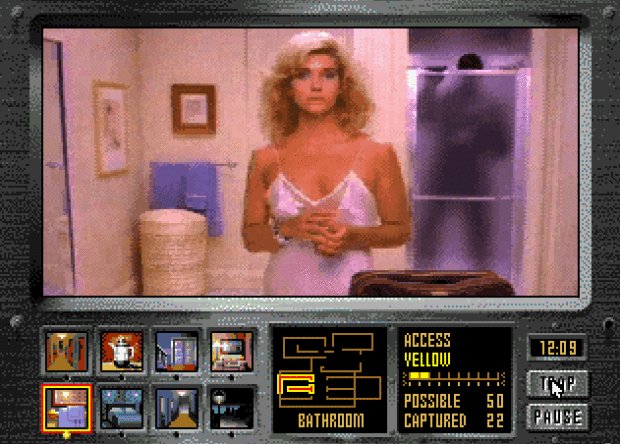
However, even more than Dana Plato running around in a sports bra, it was a scene of one of the girls being stalked while wearing a nightgown that truly worried the moral guardians of 1993. At the Congressional hearings, Senators Joseph Lieberman and Herb Kohl spent hours reviewing this scene and demanding to know whether it had any socially redeeming qualities. The hearings also focused on Mortal Kombat and the senators seemed to be far more offended by an actress in a nightgown than they were about Kano ripping his opponent’s still-beating heart out of his chest.
Night Trap seems tame today but, of course, it was also tame back in 1993. One reason why the “nightgown scene” got so much attention at the hearings is because it was the only scene in the entire game that could be considered the least bit racy. There’s no sex or nudity in Night Trap. For the most part, there’s also not any violence. Whatever actual blood sucking that happens in Night Trap happens off-camera. Probably the most intense scenes in the game involved Dana Plato scolding you if you let too many of the girls get captured. Since the only thing the player could do during the game was activate a trap by pushing a button at a certain moment, this game required not so much skill as just being able to keep track of time. Now, If you enjoyed just pushing a button over and over again, Night Trap might have some appeal but otherwise, this is a dull and poorly acted game. Not even as formidable a thespian as Dana Plato could liven things up.
Ironically, those Congressional hearings made Night Trap. If people still remember the game today, it’s because of those hearings. If you want to know how a boring game like Night Trap could get a special 25th anniversary edition, it was because of those hearings. There’s nothing like a moral panic to boot sales.
Actually, I don’t know if love is quite the right word. I’m actually kind of annoyed that The Wicker Man has gone from being one of the best horror films of the 70s to being known for the remake’s bees scene. That’s one reason why remakes, in general, are not a good thing. That said, for the record, I don’t like bees either.
First published in 1948 by the American Comics Group, Adventures Into The Unknown was the first regularly published horror comic book and it’s success led several other comic book companies, most notably EC Comics, to start publishing horror comics of their own. Because Adventures Into The Unknown‘s content was never as explicit as some of the comics that it inspired, Adventures became one of the few horror comics to survive the anti-comic book moral panic that erupted in 1954. Unlike Tales From The Crypt and The Vault of Horror, Adventures Into The Unknown continued to be published after the creation of the Comic Book Code. In total, it enjoyed a 20-year run of 174 issues.
Below are some of the many covers of Adventures Into The Unknown. As you can tell, the covers went from emphasizing horror to emphasizing science fiction and adventure after the creation of the Comic Book Code.
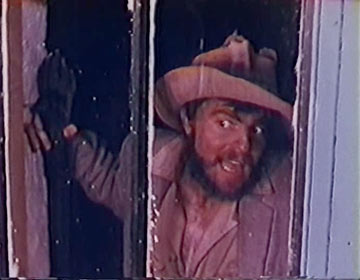
I should start things off with a confession. This is actually not the first time that I’ve shared Manos: The Hands of Fate here on the Shattered Lens. I previously shared it on both October 8th of 2013 and October 15th of 2015 and, both times, I even used the exact same picture of Torgo.
However, Manos proved to be such a popular choice that I simply had to post it again. As I pointed out two years ago, Manos has a reputation for being one of the worst films ever made. And, honestly, who am I to disagree? However, it’s also a film that is so bad that it simply has to be seen.
By the way, everyone who watches Manos ends up making fun of Torgo, who was played by John Reynolds. What they may not know is that Reynolds committed suicide shortly after filming on Manos wrapped. So, as tempting at it may be to ridicule poor Mr. Reynolds’s performance, save your barbs for Torgo and leave John Reynolds alone.
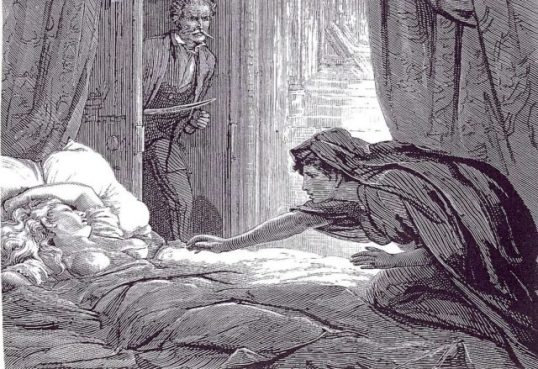
“You will think me cruel, very selfish, but love is always selfish; the more ardent the more selfish. How jealous I am you cannot know. You must come with me, loving me, to death; or else hate me, and still come with me, and hating me through death and after.”
It’s been an exhausting week so the list below may be a bit perfunctory. I apologize for that. Last week started with a tornado touching ground just two miles away from my house and it’s ending with me coming down with a cold as the temperatures plunge outside.
Glass, as you may remember, came out in January and was one of the first big cinematic disappointments of the 2019. People were certainly excited about it before the film was released. Glass was a sequel to not only Split but also Unbreakable. James McAvoy, Samuel L. Jackson, and Bruce Willis would all be returning to the roles that they played in those original films. Glass was viewed as being the film that would establish whether director M. Night Shyamalan was truly back after the critical and commercial success of Split or if he was going to return to being the kinda hacky director who we all remembered from the mid to late-aughts.
Actually, it can probably be argued that, as a director, M. Night Shyamalan managed to go from being slightly overrated to being wildly underrated. Even his worse films aren’t exactly terrible. Even the incredibly silly The Happening had a few effective scenes. Shyamalan wasn’t a bad director as much as he was a director who, at times, seemed to be way too convinced of his own cleverness. The Shyamalan twist became both his trademark and his curse. I can still remember an entire theater audibly groaning during The Village, not because the twist was necessarily bad as much as just because it was so expected. Was Shyamalan capable of making a film that didn’t end with a gimmicky twist? Interestingly, for most of its running time, Split seemed like a straight forward story about a psychotic man with multiple personalities. It was only at the last minute, when Bruce Willis showed up in that bar, the people realized that Split had a Shyamalan twist.
Glass has a few twists of its own, most of them dealing with how Kevin Wendell Crumb (James McAvoy) became the killer known as The Beast. It’s all connected to Elijah Price (Samuel L. Jackson), who is also the supervillain named Mr. Glass. Kevin, Elijah, and David Dunn (Bruce Willis) all end up in a mental asylum together. Dr. Ellie Staple (Sarah Paulson) insists that the three of them do not have any super powers and instead, they’re all suffering from a shared delusion. Of course, Dr. Staple has an agenda of her own. It’s not a particularly interesting agenda but then again, who cares, right? I mean, the main reason people are going to watch this movie is so they can watch James McAvoy and Bruce Willis square off against each other, right?
Well, those people are out of luck. The audience may not care about Dr. Staple’s agenda but Shyamalan certainly does and, as a result, McAvoy, Jackson, and Willis often seem to be bystanders in their own film. When the long-promised confrontations between our three main characters finally do occur, it all leads to a finale that leaves a rather sour aftertaste. You can’t help but feel that the characters (and their actors) deserved better. What ultimately happens to David Dunn in Glass feels almost like an extended middle finger to anyone who has ever defended Unbreakable. One gets the feeling that Shyamalan was so eager to work in one of his trademark surprises that he never stopped to consider whether the film’s storyline was strong enough to support his ambition.
The other problem is that Bruce Willis’s David Dunn and James McAvoy’s The Beast really don’t belong in the same movie together. Willis gives an understated and rather haunted performance as David but McAvoy is so flamboyantly evil as the Beast that it destroys whatever gritty reality Willis had managed to develop. Both McAvoy and Willis give good performances but they appear to be performing in different films. As for Jackson, nobody glowers with the power of Samuel L. Jackson. But, oddly, he never seems to have much to do. Glass may be named after his character but Mr. Glass often feels superfluous to the overall plot.
Glass is ultimately a rather forgettable movie. One gets the feeling that Shyamalan was truly trying to say something profound about heroism and pulp mythology in the final part of the trilogy that began with Unbreakable. But, ultimately, Glass‘s message is too muddled to have much of an effect. In the end, Glass leaves Shyamalan’s ambitions unfulfilled.
After Mr. Markheim (Franchot Tone) murders a pawnbroker, he assures himself that he’s not going to do anything more than take some of the man’s possessions and then lead a good life. After all, he’s not really an evil man. He simply did what he did because he was so jealous of the pawnbroker. Why should the pawnbroker have so much while Markheim has so little?
Unfortunately, an otherworldly visitor pops up and suggests that there’s no way that Markheim can lead a good life after doing something so evil. So, why not go out and be evil for a little while more?
This episode originally aired on October 28th, 1952. Truman was still president but not for much longer.
 Harry (Raymond Elmendorf) is an auto mechanic with a problem. He has lost his mind. When he’s found staring at an engine that he’s taken apart and saying that he can’t put it all back together, he’s fired. When he shows up in church naked, he’s institutionalized. When his brother arranges for him to live in an abandoned and condemned Hollywood hotel (because that would be the perfect place for a man with deep mental issues to live), Harry loses it completely. After playing Russian roulette with a street gang and interacting with a hotel staff that only exists in his mind, Harry goes crazy on one bloody Wednesday.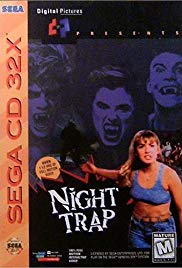






 Through the Shattered Lens