Trick or Treaters in the post-apocalypse or is it just San Francisco?
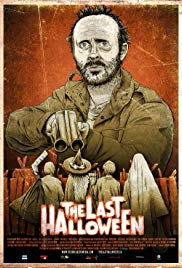
Four kids in traditional costumes go out for candy and find a survivalist house with loads of guns, but hey candy is on the line! The home is occupied buy a very tired husband and wife. The wife is getting sick, but it appears that the kids might be in the house!!!
The wife disappears and the husband is confronted by one of the kids in a ghost costume. These aren’t ordinary trick or treaters and those costumes aren’t store bought!!!! It’s kind of cool figuring out what’s going on in the end. It’s a very fun short!
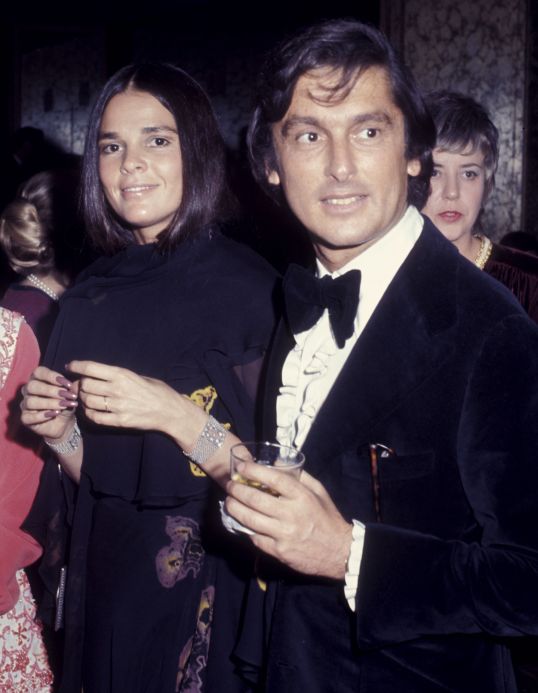
As Jeff reported earlier today, the famed Hollywood producer Robert Evans passed away this weekend. As a student of both Hollywood and history, I have to say that I always found Evans to be a rather fascinating figure. It seemed inevitable that his name would pop up whenever I read a book, an article, or even just an interview concerning the films of the 60s, 70s, and 80s. Robert Evans was nice enough to follow me on twitter and we even exchanged tweets on occasion.
As a producer, Robert Evans is probably more associated with gangster movies like The Godfather and The Cotton Club than horror films. But Evans was involved in a few “scary” and horror-adjacent films, both as an actor and a producer. So, tonight’s edition of Lisa Marie’s Favorite Grindhouse Trailers is dedicated to Robert Evans.
Man of a Thousand Face (1957)
As an actor, Evans began his career by playing Irving Thalberg in this biopic of Lon Chaney, Sr. Evans was specifically chosen for the role by Thalberg’s widow, Norma Shearer. Not surprisingly, the trailer below concentrates on James Cagney’s performance as legendary horror star, Lon Chaney, Sr.
2. The Fiend Who Walked The West (1958)
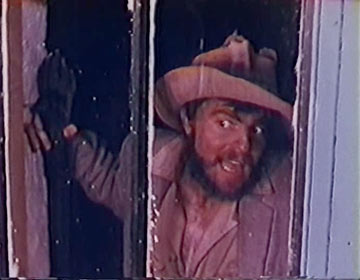
One of Evans’s rare starring roles was in this western-horror hybrid. Yes, that’s Robert Evans as the “kooky killer.”
3. Rosemary’s Baby (1968)
As head of production at Paramount, Evans was responsible for greenlighting this classic horror film, starring Mia Farrow. Reportedly, Evans arranged for his friend, Jack Nicholson, to screen test for the role of Rosemary’s husband.
4. Marathon Man (1976)
Evans produced this film. Technically, Marathon Man was a thriller/spy movie. But the scenes of Dustin Hoffman in the dentist chair definitely qualify as horror.
5. Sliver (1993)
After spending the 80s financially bereft and an almost forgotten figure, Evans made a comeback by producing this incredibly silly “erotic” thriller.
6. Jade (1995)
Sliver did well enough at the box office that Evans followed it up with another, similarly silly thriller.
Of course, while it’s tempting to laugh at films like Jade and Sliver, it should be remembered that Evans was also involved with some of the best and most important films of all time. Next time you watch The Godfather, be sure to say a little thank you to Robert Evans.
From the end of World War II to 2007, the UK’s Central Office of Information used to produced Public Information Films (known as PIFs), which would often air on television during children’s programming. These were the British equivalent of the “More You Know” PSAs that appear on American television. A typical PIF would deal with a safety issue, warning children to be careful crossing the street or while visiting a farm or when thinking of sticking a fork into an electrical socket.
One of the most notorious PIFs was first broadcast in 1973 and aired for several years after that. Lonely Water warned children about the danger of foolish behavior and risk-taking at lakes, ponds, and other pools of standing water. Aimed at the 7-to-12 year-old age bracket, Lonely Water was narrated by Donald Pleasence and featured a black-clad figure watching as children foolishly dived into danger. Even though the children ultimately do the right thing, it only leads to Pleasence declaring, “I’LL BE BACK!”
Lonely Water reportedly scarred a generation for life and led to several traumatized British children deciding to never learn how to swim at all. In 2006, it was voted as the UK’s 4th-favorite PIF of all time.
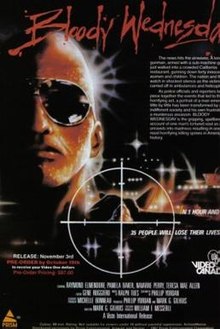
Harry (Raymond Elmendorf) is an auto mechanic with a problem. He has lost his mind. When he’s found staring at an engine that he’s taken apart and saying that he can’t put it all back together, he’s fired. When he shows up in church naked, he’s institutionalized. When his brother arranges for him to live in an abandoned and condemned Hollywood hotel (because that would be the perfect place for a man with deep mental issues to live), Harry loses it completely. After playing Russian roulette with a street gang and interacting with a hotel staff that only exists in his mind, Harry goes crazy on one bloody Wednesday.
Bloody Wednesday is a prototypical mediocre white man with a gun movie. Think of Taxi Driver, The Shining, The Joker, or even The King of Comedy, if all four of those films were terribly written, acted, and directed. It starts out strong, with Elmendorf doing a convincing job of portraying Harry’s growing psychosis, but goes downhill once Harry moves into the hotel and starts to interact with the people in his head. When he gets into argument and even fights with them, it doesn’t matter because we know that they don’t really exist outside of Harry’s imagination. Even worse is the street gang that actually does exist but which decides that they’re going to spare Harry’s life because he challenges them to a game of Russian Roulette. The gang leader, who looks like he’s trying to be Rambo for Halloween, is impressed by Harry’s self-destructive tendencies. The film’s final scenes, with Harry going on a shooting rampage, are disturbing not because of anything that’s happened in the film leading up to that moment but instead, because it feels like even more of a reflection of America today than it probably did in 1987.
Interestingly, this film was written by Philip Yordan, who began his career as a writer in 1942, won multiple Oscars, and who was later revealed to have worked as a front for blacklisted screenwriters at the height of the McCarthy era.
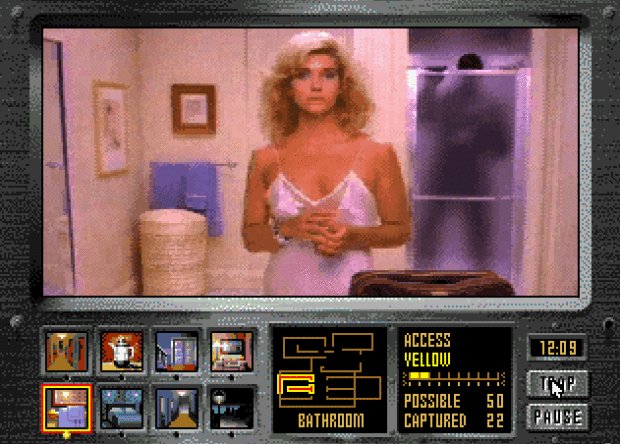
Long before people were worrying about the violence in Grand Theft Auto or the nudity in Heavy Rain, they were holding Congressional hearings about a game called Night Trap.
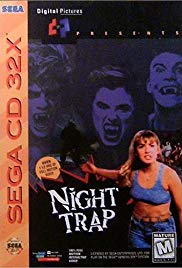
Night Trap was an interactive movie video game, one that was presented through full motion video at a time when that was still a big deal. The player was a member of S.C.A.T., the Special Control Attack Team. For 25 minutes, your job was to watch as blood-sucking creatures known as Augers attempted to launch a sneak attack on five girls at a slumber party. Whenever an Auger approached a trap, the player had to click a button to capture the Auger.
It sounds pretty simple and it was.
It also sounds pretty stupid and again, it was.
Night Trap initially received some attention because it featured former Diff’rent Strokes star Dana Plato as one of the girls. Plato played Kelly, who was actually an undercover member of S.C.A.T. and who searched for clues while you were busy trapping Augers. Plato gave such an annoying performance that many gamers probably purposefully let a few Augers escape just so they could get the “bad” ending, with Kelly plunging into Hell.
However, even more than Dana Plato running around in a sports bra, it was a scene of one of the girls being stalked while wearing a nightgown that truly worried the moral guardians of 1993. At the Congressional hearings, Senators Joseph Lieberman and Herb Kohl spent hours reviewing this scene and demanding to know whether it had any socially redeeming qualities. The hearings also focused on Mortal Kombat and the senators seemed to be far more offended by an actress in a nightgown than they were about Kano ripping his opponent’s still-beating heart out of his chest.
Night Trap seems tame today but, of course, it was also tame back in 1993. One reason why the “nightgown scene” got so much attention at the hearings is because it was the only scene in the entire game that could be considered the least bit racy. There’s no sex or nudity in Night Trap. For the most part, there’s also not any violence. Whatever actual blood sucking that happens in Night Trap happens off-camera. Probably the most intense scenes in the game involved Dana Plato scolding you if you let too many of the girls get captured. Since the only thing the player could do during the game was activate a trap by pushing a button at a certain moment, this game required not so much skill as just being able to keep track of time. Now, If you enjoyed just pushing a button over and over again, Night Trap might have some appeal but otherwise, this is a dull and poorly acted game. Not even as formidable a thespian as Dana Plato could liven things up.
Ironically, those Congressional hearings made Night Trap. If people still remember the game today, it’s because of those hearings. If you want to know how a boring game like Night Trap could get a special 25th anniversary edition, it was because of those hearings. There’s nothing like a moral panic to boot sales.
Actually, I don’t know if love is quite the right word. I’m actually kind of annoyed that The Wicker Man has gone from being one of the best horror films of the 70s to being known for the remake’s bees scene. That’s one reason why remakes, in general, are not a good thing. That said, for the record, I don’t like bees either.
First published in 1948 by the American Comics Group, Adventures Into The Unknown was the first regularly published horror comic book and it’s success led several other comic book companies, most notably EC Comics, to start publishing horror comics of their own. Because Adventures Into The Unknown‘s content was never as explicit as some of the comics that it inspired, Adventures became one of the few horror comics to survive the anti-comic book moral panic that erupted in 1954. Unlike Tales From The Crypt and The Vault of Horror, Adventures Into The Unknown continued to be published after the creation of the Comic Book Code. In total, it enjoyed a 20-year run of 174 issues.
Below are some of the many covers of Adventures Into The Unknown. As you can tell, the covers went from emphasizing horror to emphasizing science fiction and adventure after the creation of the Comic Book Code.
I should start things off with a confession. This is actually not the first time that I’ve shared Manos: The Hands of Fate here on the Shattered Lens. I previously shared it on both October 8th of 2013 and October 15th of 2015 and, both times, I even used the exact same picture of Torgo.
However, Manos proved to be such a popular choice that I simply had to post it again. As I pointed out two years ago, Manos has a reputation for being one of the worst films ever made. And, honestly, who am I to disagree? However, it’s also a film that is so bad that it simply has to be seen.
By the way, everyone who watches Manos ends up making fun of Torgo, who was played by John Reynolds. What they may not know is that Reynolds committed suicide shortly after filming on Manos wrapped. So, as tempting at it may be to ridicule poor Mr. Reynolds’s performance, save your barbs for Torgo and leave John Reynolds alone.
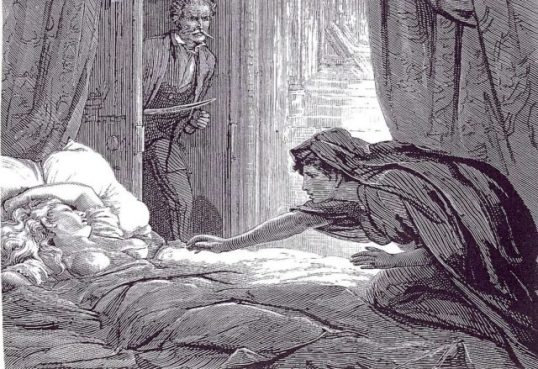
“You will think me cruel, very selfish, but love is always selfish; the more ardent the more selfish. How jealous I am you cannot know. You must come with me, loving me, to death; or else hate me, and still come with me, and hating me through death and after.”